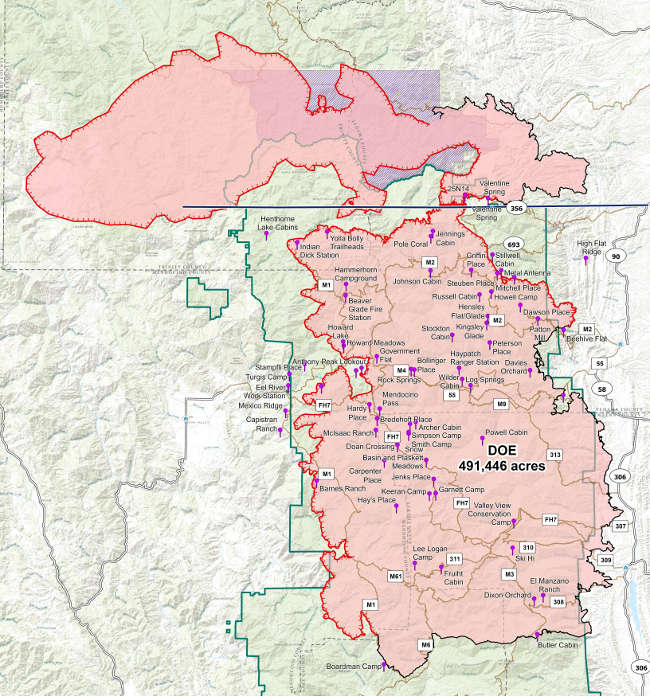
NORTHERN CALIFORNIA – California’s largest wildland fire incident is nearing the 500,000-acre mark as it continues to burn deep in the Mendocino National Forest.
The August Complex grew to 491,446 acres and 25-percent containment on Friday, the US Forest Service said.
It is now listed as the largest fire in California history.
The Great Basin Incident Management Team assumed command of the August Complex on Friday.
On the west side of the fire, firefighters continue to work with Cal Fire on containment lines. Structure protection continues in many areas across the complex, officials said.
The Forest Service said firefighters are working to create fireline in the Elk Creek drainage and Sanhedrin Wilderness west of Monkey Rock.
Crews also continue to assess areas following the strong wind and fire activity earlier this week.
Forest officials said in a Thursday night briefing that more than two dozen structures have been burned in the complex.
Two hundred thirty-three soldiers from the 14th Brigade Engineer Battalion based out of Joint Base Lewis-McChord, Washington are deployed in support of the August Complex. The firefighting soldiers are working in various areas of the complex, officials said.
Fire activity is expected to remain high with critically dry fuels and poor overnight moisture recovery. Shading from dense smoke may moderate fire behavior in some areas, the Forest Service reported.
Evacuation orders are in effect for multiple counties; in Lake County, evacuations remain in effect for Pillsbury Ranch and the entire Lake Pillsbury basin.
For specific cabin access related questions, call the forest at 530-934-3316 for the latest information.
The August Complex in Northern California as mapped on Friday, September 12, 2020.
LAKEPORT, Calif. – Lake County Library, along with every local library in California, is able to provide access to multiple K-12 educational resources for students, teachers and parents starting now – the beginning of the 2020–2021 school year.
ProQuest databases can be found on the library website from the main page by clicking Digital Content and then the ProQuest Research link.
The databases do require a temporary or physical Lake County library card. Online cards will need to upgrade to a physical card to be able to use ProQuest Research. To speak to a library employee about ProQuest or other library services, call 707-263-8817.
ProQuest Research includes six different databases. Through a single interface, the ProQuest Unified Search, students can search several databases.
CultureGrams presents concise and reliable cultural information on countries around the world.
SIRS Discoverer offers newspapers, magazines, and images for new researchers, especially elementary and middle school students and educators.
The SIRS Issues Researcher includes curriculum-aligned database of pro/con content organized by complex issues, ideally for middle and high school students and educators.
ELibrary is a general reference aggregation of periodical and digital media content with editorial guidance for new researchers.
Ebook Central provides authoritative, full-text e-books in a wide range of subject areas along with powerful tools to find, use, and manage the information.
The ProQuest Research Companion helps students learn how to research and evaluate information. The information literacy tools and tutorials help students develop critical thinking.
Online resources paid for by the State of California from Encyclopaedia Britannica, ProQuest and TeachingBooks are already available through multiple means – at school, at home, on laptops, on phones – to all K-12 educators, students, librarians, administrators and families in California.
Britannica and TeachingBooks have been available through local libraries since the 2018 school year. This is the first year for six ProQuest platforms to be available through library websites as well.
“It’s a simple idea: Help more California school kids succeed by being able to find more reliable information more easily where they’ll be going to school this fall – online,” said California State Librarian Greg Lucas.
Increasing opportunities for learning online prepares California students for a 21st Century information and innovation-driven economy.
These resources offered by the state include educational tutorials and guides to assist teachers and students, as well as millions of pieces of information from hundreds of newspapers, periodicals and scientific journals.
Many of the resources and search tools can address cultural sensitivity and diversity. Others support early childhood learning.
“Yet another reason every Californian should have a library card,” said Lucas.
The availability of these online resources for all public schools and libraries comes from an annual investment of $3 million through the California State Library that began in August 2018.
Since then, the websites have seen 123 million clicks, views and downloads.
There has been as much as a 590 percent increase in usage of some resources since March when schools closed.
Jan Cook is a library technician with the Lake County Library.
NORTHERN CALIFORNIA – At the site of the North Complex Fire in Oroville on Friday, Gov. Gavin Newsom signed AB 2147, a bill that eliminates barriers that prevent former inmate fire crew members from pursuing careers as firefighters once they have served their time.
Authored by Assemblymember Eloise Gomez Reyes, the bill allows nonviolent offenders who have fought fires as members of the California Department of Corrections and Rehabilitation’s fire camps to have their records expunged, paving the way for individuals leaving fire camps to seek meaningful employment and further training.
“This legislation rights a historic wrong and recognizes the sacrifice of thousands of incarcerated people who have helped battle wildfires in our state, and I would like to thank the Legislature for passing this bill,” said Gov. Newsom.
“Signing AB 2147 into law is about giving second chances. To correct is to right a wrong; to rehabilitate is to restore,” said Assemblymember Gomez Reyes. “Rehabilitation without strategies to ensure the formerly incarcerated have a career is a pathway to recidivism. We must get serious about providing pathways for those that show the determination to turn their lives around.”
Despite their experience and qualifications, many formerly incarcerated firefighters struggle to obtain licenses and employment due to their criminal records.
Under AB 2147, formerly incarcerated individuals can file a petition in county court to expunge their records and waive parole time, which will open career pathways in emergency response and a variety of other disciplines.
It's 5 o'clock somewhere – and while here on Earth, "happy hour" is commonly associated with winding down and the optional cold beverage, that's when things get going on Bennu, the destination asteroid of NASA’s OSIRIS-REx mission.
In a special collection of research papers published Sep. 9 in the Journal of Geophysical Research: Planets, the OSIRIS-REx science team reports detailed observations that reveal Bennu is shedding material on a regular basis.
The OSIRIS-REx spacecraft has provided planetary scientists with the opportunity to observe such activity at close range for the first time ever, and Bennu’s active surface underscores an emerging picture in which asteroids are quite dynamic worlds.
The publications provide the first in-depth look at the nature of Bennu's particle ejection events, detail the methods used to study these phenomena, and discuss the likely mechanisms at work that cause the asteroid to release pieces of itself into space.
The first observation of particles popping off the asteroid's surface was made in January 2019, mere days after the spacecraft arrived at Bennu. This event may have gone completely unnoticed were it not for the keen eye of the mission's lead astronomer and University of Arizona’s Lunar and Planetary Laboratory scientist, Carl Hergenrother, one of the lead authors of the collection.
Much like ocean-going explorers in centuries past, the space probe relies on stars to fix its position in space and remain on course during its years-long voyage across space. A specialized navigation camera onboard the spacecraft takes repeat images of background stars. By cross-referencing the constellations the spacecraft “sees” with programmed star charts, course corrections can be made as necessary.
Hergenrother was poring over these images that the spacecraft had beamed back to Earth when something caught his attention. The images showed the asteroid silhouetted against a black sky dotted with many stars – except there seemed to be too many.
"I was looking at the star patterns in these images and thought, 'huh, I don't remember that star cluster,'" Hergenrother said. "I only noticed it because there were 200 dots of light where there should be about 10 stars. Other than that, it looked to be just a dense part of the sky."
A closer inspection and an application of image-processing techniques unearthed the mystery: the "star cluster" was in fact a cloud of tiny particles that had been ejected from the asteroid's surface. Follow-up observations made by the spacecraft revealed the telltale streaks typical of objects moving across the frame, setting them apart from the background stars that appear stationary due to their enormous distances.
"We thought that Bennu’s boulder-covered surface was the wild card discovery at the asteroid, but these particle events definitely surprised us," said Dante Lauretta, OSIRIS-REx principal investigator and professor at LPL. "We’ve spent the last year investigating Bennu’s active surface, and it’s provided us with a remarkable opportunity to expand our knowledge of how active asteroids behave."
Since arriving at the asteroid, the team has observed and tracked more than 300 particle ejection events on Bennu. According to the authors, some particles escape into space, others briefly orbit the asteroid, and most fall back onto its surface after being launched. Ejections most often occur during Bennu’s local two-hour afternoon and evening timeframe.
The spacecraft is equipped with a sophisticated set of electronic eyes – the Touch-and-Go Camera Suite, or TAGCAMS. Although its primary purpose is to assist in spacecraft navigation, TAGCAMS has now been placed into active duty spotting any particles in the vicinity of the asteroid.
Using software algorithms developed at the Catalina Sky Survey, which specializes in discovering and tracking near-Earth asteroids by detecting their motion against background stars, the OSIRIS-REx team found the largest particles erupting from Bennu to be about 6 centimeters (2 inches) in diameter. Due to their small size and low velocities – this is like a shower of tiny pebbles in super-slo-mo – the mission team does not deem the particles a threat to the spacecraft.
"Space is so empty that even when the asteroid is throwing off hundreds of particles, as we have seen in some events, the chances of one of those hitting the spacecraft is extremely small," Hergenrother said, "and even if that were to happen, the vast majority of them are not fast or large enough to cause damage."
During a number of observation campaigns between January and September 2019 dedicated to detecting and tracking mass ejected from the asteroid, a total of 668 particles were studied, with the vast majority measuring between 0.5 and 1 centimeters (0.2-0.4 inches), and moving at about 20 centimeters (8 inches) per second, about as fast – or slow – as a beetle scurrying across the ground. In one instance, a speedy outlier was clocked at about 3 meters (9.8 feet) per second.
On average, the authors observed one to two particles kicked up per day, with much of the material falling back onto the asteroid. Add to that the small particle sizes, and the mass loss becomes minimal, Hergenrother explained.
"To give you an idea, all of those 200 particles we observed during the first event after arrival would fit on a 4-inch x 4-inch tile," he said. "The fact that we can even see them is a testament to the capabilities of our cameras."
The authors investigated various mechanisms that could cause these phenomena, including released water vapor, impacts by small space rocks known as meteoroids and rocks cracking from thermal stress. The two latter mechanisms were found to be the most likely driving forces, confirming predictions about Bennu's environment based on ground observations preceding the space mission.
As Bennu completes one rotation every 4.3 hours, boulders on its surface are exposed to a constant thermo-cycling as they heat during the day and cool during the night. Over time, the rocks crack and break down, and eventually particles may be thrown from the surface.
The fact that particle ejections were observed with greater frequency during late afternoon, when the rocks heat up, suggests thermal cracking is a major driver. The timing of the events is also consistent with the timing of meteoroid impacts, indicating that these small impacts could be throwing material from the surface.
Either, or both, of these processes could be driving the particle ejections, and because of the asteroid's microgravity environment, it doesn't take much energy to launch an object from Bennu's surface.
Of the particles the team observed, some had suborbital trajectories, keeping them aloft for a few hours before they settled back down, while others fly off the asteroid to go into their own orbits around the sun.
In one instance, the team tracked one particle as it circled the asteroid for almost a week. The spacecraft's cameras even witnessed a ricochet, according to Hergenrother.
"One particle came down, hit a boulder and went back into orbit," he said. "If Bennu has this kind of activity, then there is a good chance all asteroids do, and that is really exciting."
As Bennu continues to unveil itself, the OSIRIS-REx team continues to discover that this small world is glowingly complex. These findings could serve as a cornerstone for future planetary missions that seek to better characterize and understand how these small bodies behave and evolve.
NASA's Goddard Space Flight Center in Greenbelt, Maryland, provides overall mission management, systems engineering, and the safety and mission assurance for OSIRIS-REx. Dante Lauretta of the University of Arizona, Tucson, is the principal investigator, and the University of Arizona also leads the science team and the mission's science observation planning and data processing.
Lockheed Martin Space in Denver built the spacecraft and provides flight operations. Goddard and KinetX Aerospace are responsible for navigating the OSIRIS-REx spacecraft. OSIRIS-REx is the third mission in NASA's New Frontiers Program, which is managed by NASA's Marshall Space Flight Center in Huntsville, Alabama, for the agency's Science Mission Directorate in Washington.
LAKE COUNTY, Calif. – Lake County Public Health said Friday that a COVID-19 outbreak in a Lakeport skilled nursing facility has led to a fourth death in less than two weeks and the county’s seventh death overall related to the virus.
Public Health Officer Dr. Gary Pace said the individual who died was over the age of 65 and had underlying chronic medical issues, as was the case with three previous residents who died from COVID-19-related illnesses.
The previous deaths at the facility were reported on Aug. 29, Sept. 1 and Sept. 8.
Pace has declined to identify the location where the outbreak has occurred, but the California Department of Public Health’s online dashboard of skilled nursing facilities with COVID-19 cases confirmed that Lakeport Post Acute on Craig Avenue is the only such facility in Lake County with COVID-19 cases and deaths in residents.
That dashboard also reported that Meadowood Nursing Center has health care workers who have tested positive, but it did not give a specific number, saying only it was less than 11.
When contacted by Lake County News, the Lakeport Post Acute facility administrator declined to comment and referred this reporter to another individual who as of early Friday evening had not responded to inquiries about the outbreak.
Referring to Lakeport Post Acute but not by name, Pace said the facility took immediate steps to stop the spread by setting up a special “COVID wing” for the positive residents and dedicating specific staff for the COVID hallway.
He said Public Health staff and state infectious disease experts have been working closely with the facility in an attempt to contain the infection.
Pace told Lake County News earlier this week that the facility notified all residents and their families of the outbreak.
“At this point, the efforts are to contain the initial wave of infection which appears to have originated from a staff member getting exposed outside of work and bringing it into the facility. Further testing will determine if the spread has been stopped,” Pace said.
Pace said nine staffers and 22 residents – including the four who died – have tested positive for COVID-19. Those are numbers slightly higher than available from the state on Friday.
Of the 1,223 skilled nursing facilities across California, as of Friday afternoon, the California Department of Public Health said 24,867 residents had tested positive and 4,271 have died.
Local health departments have reported 34,834 confirmed positive cases in health care workers and 167 deaths statewide, the state reported.
“The importance of mask-wearing and preventative measures cannot be over-emphasized. This outbreak is a heartbreaking example of how devastating COVID can be, especially in our most vulnerable community members. We encourage everyone to continue taking proper precautions in order to slow the spread,” said Pace.
As of Friday, Lake County’s overall COVID-19 caseload totaled 390, up 12 from Thursday. Of those, 30 are active and continuing to be monitored by health officials, two are hospitalized, 353 have so far recovered and 10,510 tests have been conducted, Lake County Public Health reported.
Public Health reported Lake County’s first COVID-19 case on April 5 and its first COVID-19-related on July 3.
Statewide, more than 752,000 cases and 14,000 deaths have been reported by county Public Health departs to date.
Lake County residents seeking public health information on how to reduce the spread of the COVID-19 virus can access Lake County’s Public Health Division webpage or call the COVID-19 hotline at 707-263-8174 to speak to a Public Health adviser.
Email Elizabeth Larson at This email address is being protected from spambots. You need JavaScript enabled to view it.. Follow her on Twitter, @ERLarson, or Lake County News, @LakeCoNews.
LAKE COUNTY, Calif. – During a brief special meeting on Thursday afternoon, the Board of Supervisors ratified Lake County Public Health Officer Dr. Gary Pace’s local health emergency declaration for areas impacted by the LNU Lightning Complex.
The complex, which began early on the morning of Aug. 17, has burned 363,220 acres across Colusa, Lake, Napa, Solano, Sonoma and Yolo counties.
The fire has burned 85,000 acres in southern Lake County, officials reported.
Firefighters are in the final stretch of containing it. Cal Fire said Thursday night that the complex was up to 95-percent containment.
The complex has claimed five lives – three in Napa County, two in Solano County – injured four civilians and one first responder, destroyed 1,491 structures and damaged 232 others across six counties, Cal Fire reported.
The Hennessey fire, on the east side of the complex, burned into Lake County. It was 95 percent contained on Thursday, with the Walbridge fire in Sonoma County holding at 55,209 acres and 95-percent containment, Cal Fire said. The 2,360-acre Meyers fire, also in Sonoma County, was fully contained last week.
At one point, it was estimated that about 7,000 Lake County residents had been forced to evacuate due to the complex.
Cal Fire said all evacuation orders and warnings have been lifted, repairs are underway in the fire area and nearly 900 firefighters remain assigned to the incident, working on the final areas needing containment.
In this fire, Lake County lost nine structures, eight of them homes.
Pace issued his health emergency declaration on Wednesday. “Legislative actions taken by both the state of California and the United States Federal Government enabled Lake County to make this declaration and will additionally provide resources and financial assistance to our community members who were directly impacted by the LNU Lightning Complex fire,” he reported.
Pace told the board at its special meeting that the emergency proclamation is “mainly to help us move through the cleanup process” for those nine destroyed structures.
He said state officials are prepared to come on Friday and begin doing hazardous materials sweeps of the burned properties.
Due to issues in the past with the fire cleanups and the length of time it took to carry them out, Pace said he wanted to get the process started quickly.
Health Services Director Denise Pomeroy said CalRecycle called her agency on Tuesday and said they could come and get the local hazardous materials sweeps done on Friday. The declaration is meant to allow that cleanup to go forward.
Craig Wetherbee, a hazardous materials specialist for the Health Services Department, told the board that he has a list of eight properties with destroyed structures. He visited six of them off the Jerusalem Grade on Thursday.
“The good news is, there’s not a whole lot of extensive damage to homes, just those few,” he said.
However, Wetherbee said the nine impacted structures are all total losses, and they have hazardous materials on site that need to be removed.
As an example, he said one burned property had a large 55-gallon drum of oil and a large amount of gasoline.
There was no public comment on the matter before Supervisor Bruno Sabatier moved to approve ratification of the health emergency declaration, which Supervisor EJ Crandell seconded and the board approved 5-0.
Residents seeking more information related to community disaster resources should access the local recovery website.
Email Elizabeth Larson at This email address is being protected from spambots. You need JavaScript enabled to view it.. Follow her on Twitter, @ERLarson, or Lake County News, @LakeCoNews.
 How to resolve AdBlock issue?