LAKE COUNTY, Calif. – The US Census Bureau said Wednesday that 93 percent of housing units nationwide have been accounted for in the 2020 Census, but in areas like Lake County, the response rate remains low.
The Census Bureau said that of the housing units counted so far, 27.1 percent were counted by census takers and other field data collection operations, with another 65.9 percent of housing units responding online, by phone or by mail.
In California, the enumeration rate is 95.4 percent, the Census Bureau said.
California’s self-response rate is higher than the national average, at 68.4 percent.
Lake County’s self-response rate as of Wednesday was 47.7 percent, up nearly 3 percentage points since July. Its Internet response rate is 29.9 percent.
The city of Clearlake’s self-response rate is 40.9 percent while Lakeport’s is 66.1 percent, the Census Bureau reported.
Census Bureau data shows that Lake County has the sixth-lowest overall self-response rate amongst California’s 58 counties.
The county’s overall self-response rate in the 2010 Census was 44.9 percent.
Visit www.2020census.gov to respond now and for more details.
Email Elizabeth Larson at This email address is being protected from spambots. You need JavaScript enabled to view it.. Follow her on Twitter, @ERLarson, or Lake County News, @LakeCoNews.
LAKE COUNTY, Calif. – Three more residents at a Lakeport skilled nursing facility have died as the result of a COVID-19 outbreak there.
The three new deaths bring the total COVID-19-related deaths at Lakeport Post Acute to seven, and Lake County’s overall COVID-19-related deaths to 10, according to Public Health officials.
Lake County Public Health Officer Dr. Gary Pace said that all three of the individuals who just died were older than 65 years of age and had chronic health conditions.
To date, Lake County has 433 confirmed COVID-19 cases, of which 54 are active and three hospitalized, with 372 having recovered and 10 deaths overall, Public Health reported.
As of early Wednesday evening, health departments across California reported more than 770,000 COVID-19 cases and more than 14,700 deaths statewide.
The COVID-19 outbreak at Lakeport Post Acute began late in August, with the first death reported on Aug. 29.
Pace said that so far 30 residents of the facility – a number that includes the seven who have died – have tested positive for COVID-19.
While Pace has not named the facility, the California Department of Public Health has identified it as Lakeport Post Acute in its COVID-19 reporting dashboard, as Lake County News first reported last week.
CDPH also reported that 19 health care workers at the facility have tested positive for COVID-19 as of Wednesday. The agency had confirmed health care worker cases at that facility last week, as Lake County News has reported.
“This outbreak has been heartbreaking for residents, family and staff, and it is still being monitored,” said Pace. “These cases appear to have been picked up in the community and transmitted through the facility by people providing care and services. Many people have mild symptoms, and some unknowingly spread COVID-19. Risks for the vulnerable can be dire.”
He said the cases and deaths have occurred despite the efforts by staff and Public Health officials to contain it.
Across California, 25,184 residents of 1,223 skilled nursing facilities have tested positive for COVID-19, with 4,326 dying, CPDH said Wednesday.
The state said another 18,739 health care workers in those facilities have tested positive, with 146 COVID-19-related deaths reported among those workers.
In an update to the Lakeport City Council on Tuesday night, Pace described the efforts taken at the facility to contain the virus, including setting up a separate COVID-19 wing for those who tested positive and consulting with local and state health officials.
At that point, he had warned of the potential for more deaths “in the near future.”
“This is a very vulnerable population and once the infection gets in that population it can be very devastating,” he told the council.
Pace said Wednesday that when an outbreak occurs in a residential facility, there are established protocols to stop the spread, including weekly testing of residents and staff, use of personal protective equipment, proper disinfection and establishment of a separate COVID-19 ward for infected or exposed individuals.
“These guidelines are being followed now. The State’s Healthcare-Associated Infections team has visited and consulted, and they did not identify any significant problems,” he said.
In addition to the new deaths and cases at Lakeport Post Acute, Pace said another local skilled nursing facility has reported two staffers who tested positive for the virus.
While Pace also didn’t name the second facility, CDPH said Meadowood Nursing Center in Clearlake has staff with the virus, but so far no residents there have tested positive.
In reference to the health care worker cases at Meadowood, Pace said, “They are now isolated, and this facility has put all residents in quarantine, and begun testing all residents and staff; families are being notified, as well. We are in the early stages of determining if this is a separate significant outbreak or if the virus has been prevented from spreading.”
Email Elizabeth Larson at This email address is being protected from spambots. You need JavaScript enabled to view it.. Follow her on Twitter, @ERLarson, or Lake County News, @LakeCoNews.
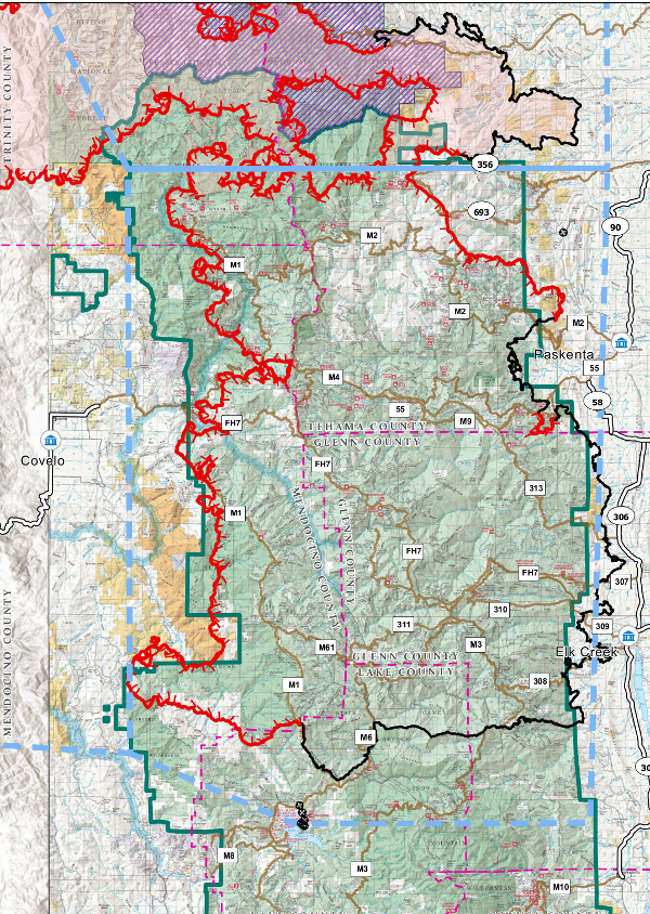
NORTHERN CALIFORNIA – The US Forest Service’s latest report on the growing August Complex confirmed dozens of structures have been destroyed as the lightning-caused fires continue to burn through several national forests.
As of Wednesday, the Forest Service said the August Complex has burned 796,651 acres and is 30-percent contained. It began following on Aug. 17 following thunderstorms that moved over the region.
The Forest Service said the complex has destroyed 35 structures and continues to threaten another 400.
The complex is burning on the Mendocino, Shasta-Trinity and Six Rivers National Forests.
The August Complex South Zone, which includes the Doe fire that had burned into northern Lake County, has burned 531,471 acres, the US Forest Service reported.
The August Complex-South Zone will hold a virtual public meeting at 7 p.m. Thursday, Sept. 17, to provide a fire overview and to allow the public to ask questions. The meeting will be live-streamed on the Mendocino National Forest Facebook page.
Officials said the complex’s South Zone continues to grow in size as fire crews make good progress in some locations, while conditions in other areas are proving difficult.
The sheer size of the fire creates varying fire activity across the vast terrain and fuel conditions, the Forest Service said.
Firefighters were successful in implementing additional control line and containment measures along the eastern portion of the fire on Tuesday. The Forest Service said crews completed burning operations near Salt Creek that will provide a secure containment line once mop-up of the area is complete.
The fire continues to progress south toward Lake Pillsbury where extreme dry conditions and heavy vegetation are allowing for substantial fire growth despite having favorable winds from the southwest, the Forest Service said.
In the Lake Pillsbury area, fire crews are constructing dozer and hand lines, and tying into previously constructed lines from the 2018 Ranch fire. Firefighters are also installing hose lays and implementing measures for structure protection, officials said.
Officials said evacuation orders remain in place for Pillsbury Ranch and the entire Lake Pillsbury basin.
In the southwest area of the fire within the Yuki and Sanhedrin Wilderness Areas, fire behavior remains active, and growth has progressed west of Impassible Rock. The Forest Service said air tankers are being utilized to provide protection of important communications facilities with retardant drops.
In addition to the evacuations in Lake County, evacuation orders also are in effect for portions of Mendocino, Humboldt and Trinity counties. Evacuation information can be found at Inciweb.
The August Complex as mapped on Wednesday, September 16, 2020. Map courtesy of the US Forest Service.
LAKE COUNTY, Calif. – In response to the COVID-19 pandemic, the Lake County Literacy Coalition has turned its annual fundraising event, “the Vineyard Run for Literacy,” into “the Virtual Walk/Run for Literacy.”
Registration is open through Oct. 1, and the event can be completed any time through and including Oct. 11.
All proceeds go to support the volunteer tutors of the Adult Literacy Program and to purchase books to distribute through the Families for Literacy program, to help break the cycle of illiteracy.
The coalition invites individuals, friends and families who enjoy walking and running to participate, and those who aren’t runners or walkers to donate to our effort to increase literacy skills in Lake County.
“Virtual events have some real advantages in this time of COVID-19,” said Coalition President Deb Ehrhardt. “Instead of a large group all running at the same time, the Virtual Walk/Run for Literacy can be completed any time between Sept. 11 and Oct. 11, 2020. And it can be completed anywhere you choose – in your neighborhood, on a trail, in a park, or even inside on a treadmill. All distances are self-timed, and submitting your result is optional.”
This year, in addition to the 5k run/walk and 10K run, participants can choose any distance they prefer. Children or seniors might prefer a shorter distance; competitive runners a longer distance.
The first 100 people to register receive a free Lake County Literacy Coalition headband.
Participants are encouraged to refer others to the event. “When you register online, you are sent your own identity link which you can send to friends. When four friends register using that specific identifying link, Run Sign Up tallies them and sends an automatic refund after four have registered and paid $25,” said Nancy Hudson, the 2020 race director. “The $20 refund is generated by Run Sign Up and goes directly to the original participant’s credit card.”
Registration fees are $25 per adult (age 19 and over) and $10 per child (ages 7 through 18). Children under age 7 pay no fee and do not need to register.
Online registration is encouraged here; a minimal processing fee applies.
Printed registration/T-shirt order forms can be requested from the Literacy Coalition at This email address is being protected from spambots. You need JavaScript enabled to view it. or 707-263-7633. T-shirts can be ordered through the online registration link, via the “Order T-shirts” tab, or a printed form. They are available for an additional $15 fee ($17 for XXL) if you are participating, or can be ordered alone.
“T-shirts and headbands will be mailed by Nov. 1 to the address you provide to Run Sign Up, or on the printed registration/order form,” said Ginny Cholez, coalition Vice President.
For additional information about the nonprofit Coalition and the Virtual Walk/Run for Literacy, visit the coalition’s website or call 707-263-7633.
CLEARLAKE, Calif. – The Clearlake City Council is due to consider an amendment to city code regarding commercial cannabis rules and the award of a project to repair roads damaged in the 2017 Sulphur fire.
The council will meet beginning at 6 p.m. Thursday, Sept. 17.
Because of the county’s shelter in place order, Clearlake City Hall remains closed to the public, however, the virtual meeting will be broadcast live on the city's YouTube channel or the Lake County PEG TV YouTube Channel. Community members also can participate via Zoom.
Comments and questions can be submitted in writing for City Council consideration by sending them to Administrative Services Director/City Clerk Melissa Swanson at This email address is being protected from spambots. You need JavaScript enabled to view it.. You can also visit the city’s town hall site and submit written comments at https://www.opentownhall.com/portals/327/forum_home. Identify the subject you wish to comment on in your email’s subject line or in your town hall submission.
To give the council adequate time to review your questions and comments, please submit your written comments prior to 4 p.m. on Thursday, Sept. 17.
Each public comment emailed to the city clerk will be read aloud by the mayor or a member of staff for up to three minutes or will be displayed on a screen. Public comment emails and town hall public comment submissions that are received after the beginning of the meeting will not be included in the record.
At the start of the meeting, the council will meet September’s adoptable dogs and get a presentation from Pacific Gas and Electric Co. on public safety power shutoffs.
The council will then hold the first reading of an ordinance adopting the city’s development impact fee program for transportation.
Also on Thursday, the council will hold the first reading of an ordinance to amend the section of Clearlake Municipal Code relating to commercial cannabis businesses.
City Manager Alan Flora’s report on the item explained that over the past two meetings the council has discussed changes to the city’s commercial cannabis ordinances.
At the Sept. 3 meeting, Flora said the council provided direction to staff to amend the limitations on the number of commercial cannabis businesses, including delivery-only dispensaries, while continuing to limit the location of the businesses based on the Commercial Cannabis Combining District map.
He said the Clearlake Municipal Code limits retail dispensaries in the city to three, delivery-only dispensaries to two and other cannabis businesses – such as those involved in indoor cultivation, distribution, manufacturing and labs – to 12.
Based on council direction at the previous meeting, retail dispensaries would continue to be limited to three while delivery-only dispensaries and other cannabis businesses wouldn’t be limited on the basis of numbers but on locations on the city’s Commercial Cannabis Combining District map, Flora said.
If the council holds and approves the first reading of the new ordinance, it would be brought back for a second and final reading at the Oct. 1 meeting.
The council also is set to consider awarding a contract to the California Engineering Co. for professional engineering services in the amount of $455,000 for the Sulphur Fire Road Rehabilitation Project.
Director of Public Works Dale Goodman’s report to the council said that the project area is San Joaquin from Arrowhead to Gooseneck, and on Lakeshore from Olympic to Oak. “Most of the smaller roads within the fire area will also be included in the project for a total of approximately 10 miles of work. Design will include guardrail and storm water improvements along both roads.”
The total Sulphur Fire Road Rehabilitation project is expected to be approximately $10 million, Goodman said.
Goodman said the funds for the engineering contract will come from the PG&E Sulphur Fire litigation.
In council business, the council will consider adding a radio voting receiver site for the police department, take up the adoption of a third amendment to the Fiscal Year 2020-21 budget to appropriate funding for professional services, equipment and supplies, and discuss the 2020 League of California Cities Annual Conference resolutions.
On the meeting's consent agenda – items that are not considered controversial and are usually adopted on a single vote – are warrant registers; minutes of the Aug. 12 Lake County Vector Control meeting; ratification of purchases of a Bobcat Toolcat 5600 with accessories and used K-Rail barrier; acceptance for filing the 2020 Local Agency biennial notice regarding amendments to the conflict of interest code; consideration of rejection of bids for the Austin Park Bus Stop Renovation/Relocation Project.
Email Elizabeth Larson at This email address is being protected from spambots. You need JavaScript enabled to view it.. Follow her on Twitter, @ERLarson, or Lake County News, @LakeCoNews.
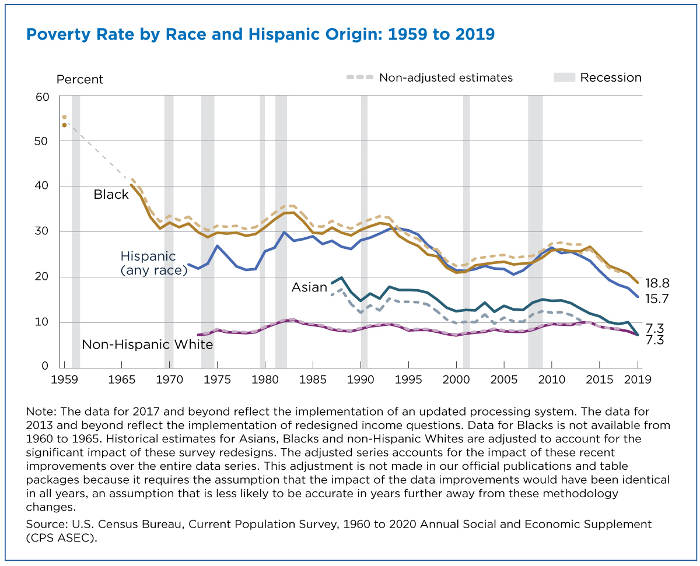
In 2019, the poverty rate for the United States was 10.5 percent, the lowest since estimates were first released for 1959.
Poverty rates declined between 2018 and 2019 for all major race and Hispanic origin groups.
Two of these groups, Blacks and Hispanics, reached historic lows in their poverty rates in 2019. The poverty rate for Blacks was 18.8 percent; for Hispanics, it was 15.7 percent.
The historically low poverty rates for Blacks and Hispanics in 2019 reflect gains for race and Hispanic origin groups that have traditionally been disadvantaged compared to other groups over time.
These estimates, released today, are from the Current Population Survey Annual Social and Economic Supplement, or CPS ASEC.
Changes in surveys over time can make historical comparisons difficult. Using a methodology proposed last year, we can adjust the historical series to account for statistically significant impacts of recent CPS ASEC survey redesigns.
The figure below charts historical poverty rates for each of the major race and Hispanic origin groups and Hispanics in the CPS ASEC.
Adjustments are made for Asians, Blacks and non-Hispanic Whites because the recent survey changes resulted in statistically significant changes in poverty rates. Poverty rates for Hispanics are not adjusted because the survey changes did not result in statistically different poverty rates.
The figure shows that for Blacks, the poverty rate of 18.8 percent in 2019 was the lowest rate observed since poverty estimates were first produced for this group for 1959. The previous low for this group was 20.8 percent in 2018.
Poverty rates in 2019 were also the lowest ever observed for Hispanics (15.7 percent), compared to the prior low of 17.6 percent in 2018. Poverty statistics for Hispanics date back to 1972.
The Asian poverty rate of 7.3 percent was also the lowest on record.
The 2019 poverty rate of 7.3 percent for non-Hispanic Whites was not statistically different than the previous low (historically adjusted) of 7.2 percent in 2000 and 7.3 percent in 1973.
Distribution of poverty by race and Hispanic origin
The historically low poverty rates for Blacks and Hispanics in 2019 reflect gains for race and Hispanic origin groups that have traditionally been disadvantaged compared to other groups over time.
However, even with these gains, Blacks and Hispanics continue to be over-represented in the population in poverty relative to their representation in the overall population.
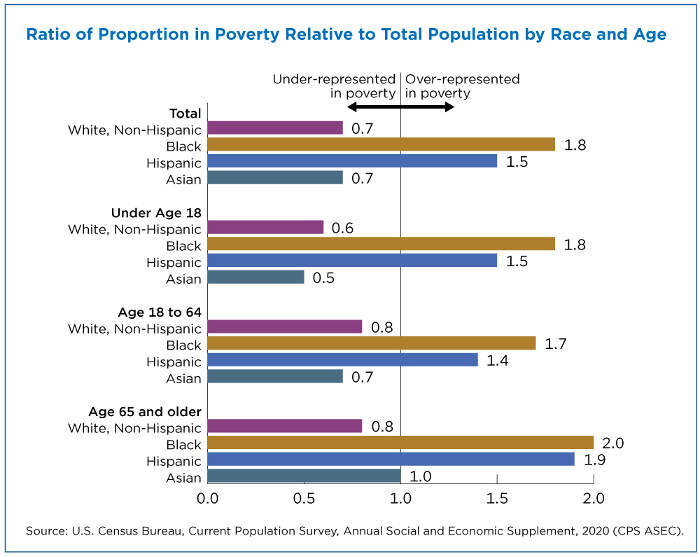
The figure below shows the ratio of people in poverty by race or Hispanic origin group to each group’s share of the total population.
If the poverty population is perfectly proportional to the total population, we would expect the ratio to be 1.0. If a group is over-represented in poverty, the ratio will be greater than 1.0. If the ratio is less than 1.0, the group is under-represented in poverty.
In 2019, the share of Blacks in poverty was 1.8 times greater than their share among the general population. Blacks represented 13.2 percent of the total population in the United States, but 23.8 percent of the poverty population.
The share of Hispanics in poverty was 1.5 times more than their share in the general population. Hispanics comprised 18.7 percent of the total population, but 28.1 percent of the population in poverty.
In contrast, non-Hispanic Whites and Asians were under-represented in the poverty population.
Non-Hispanic Whites made up 59.9 percent of the total population but only 41.6 percent of the population in poverty. Asians made up 6.1 percent of the population and 4.3 percent of the population in poverty.
These disparities are especially pronounced among children and people ages 65 and older.
The share of Non-Hispanic White and Asian children in poverty was about half of their share in the general population. Among people ages 65 and over, the shares of Blacks and Hispanics in poverty were approximately twice their share in the general population.
Time trends
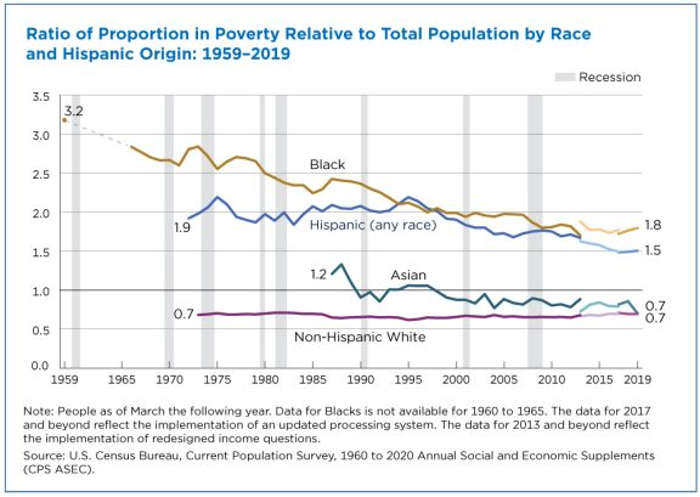
The figure below shows that over time, non-Hispanics Whites have consistently been under-represented among the population in poverty, while Blacks and Hispanics have consistently been over-represented. Asians have been under-represented in poverty for the last 20 years.
The adjustment for survey changes is not made here for simplicity.
The figure shows that there has been a gradual decrease in the degree of over-representation of Blacks and Hispanics in poverty.
After the Great Recession ended in June 2009, the degree of overrepresentation stayed level for Blacks, while the ratio moved closer to one for Hispanics, continuing a trend which started in the mid-1990s.
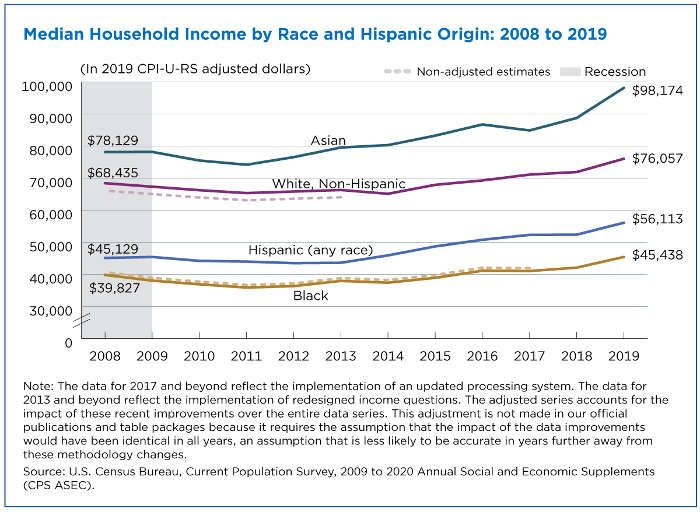
One potential reason for the recent trend is that since 2008, median household income for Blacks has grown at a slower rate than median household income for Hispanics.
The figure below tracks median household income using 2019 dollars from 2008, the last full year of the most recent recession, until 2019.
Like Figure 1, the series below implements adjustments to the estimates for groups whose median household incomes were statistically changed by the survey improvements.
In 2019, median household income for Black households was $45,438 compared to $56,113 for Hispanic households, $76,057 for non-Hispanic White households, and $98,174 for Asian households.
Since 2008, median household income increased 14.1 percent for Black households, compared to 24.3 percent for Hispanic households, 11.1 percent for non-Hispanic White households, and 25.7 percent for Asian households.
 How to resolve AdBlock issue?