 How to resolve AdBlock issue?
News
State’s COVID-19 blueprint places most counties in restrictive purple tier; Lake remains in red tier
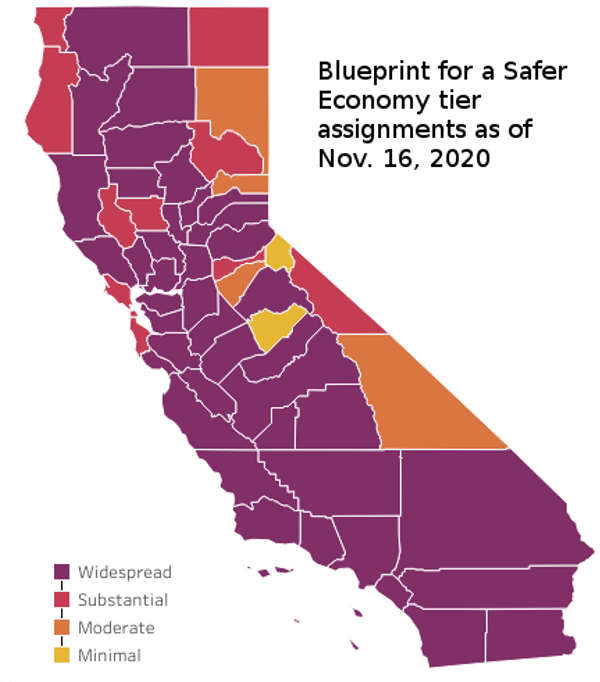
LAKE COUNTY, Calif. – Lake was among a handful of counties on Monday that avoided being placed by the state under tighter restrictions related to COVID-19.
The state on Monday reported its new rankings of the 58 counties in the Blueprint for a Safer Economy in response to spiking caseloads across the state.
The blueprint has four tiers:
– Yellow, or minimal; most indoor business operations are open with modifications.
– Orange, or moderate; some indoor business operations are open with modifications.
– Red, or substantial; some nonessential indoor business operations are closed.
– Purple, or widespread; many nonessential indoor business operations are closed.
Monday’s update of the rankings shows that 41 counties are now in the purple tier, the most restrictive.
Of those 41 counties, 29 were just moved into the purple tier from a lower tier. Twelves others – Imperial, Los Angeles, Madera, Monterey, Riverside, Sacramento, San Bernardino, San Diego, Shasta, Sonoma, Tehama and Tulare – had been in the purple tier last week and remain so this week.
Lake County has been in the red tier for some time and in the latest rankings on Monday remained there, allowing businesses and activities to continue without more restrictions.
Other counties whose rankings remained unchanged in the lower tiers as of Monday are Alpine, yellow; Inyo, orange; Lassen, orange; and Mariposa, yellow.
Lake’s neighboring counties of Glenn, Mendocino, Napa, Sonoma and Yolo are all in the purple tier now, while Colusa is in the red tier.
Lake County’s total cases reached 788 on Monday, with three currently hospitalized and 726 recovered. There are now 18 deaths reported, an increase of one since last week, Lake County Public Health reported.
The county’s adjusted case rate is 5.7, the fifth-lowest case rate statewide, based on California Department of Public Health numbers.
Statewide, 1,043,950 cases and 18,305 deaths had been reported by county Public Health departments as of Monday night.
The California Department of Public Health said Monday that the seven-day positivity rate is 5 percent and the 14-day positivity rate is 4.6 percent.
As of Monday, 21,068,894 tests had been conducted in California, which the California Department of Public Health said represented an increase of 202,109 over the prior 24-hour reporting period.
To date, 17,213 tests have been conducted in Lake County, according to the Public Health Department.
For more information about the tiers and restrictions, visit www.covid19.ca.gov.
Email Elizabeth Larson at
City Manager Alan Flora presented, and received approval for, his plan to facilitate development of the former Pearce Field Airport property on Highway 53 from the council at its Oct. 1 meeting.
The site has been slated for a shopping center in several different iterations, but so far no project has been completed.
Flora said it was “a little depressing” to research the property’s history, as he didn’t realize how far back efforts and discussions to develop it went.
Based on Flora’s report to the council, the Clearlake Redevelopment Agency purchased the 38.5-acre property for $840,000 from the county in 1994, after the county closed it. Four years later, the redevelopment agency sold 10 acres that were used to develop Outrageous Waters water park, now closed.
After the shutdown of redevelopment, the property was transferred in 2013 from the agency to the city for public use, he said.
Flora proposed to the council that the city offer a compensation agreement to the taxing entities that are entitled to proceeds – such as the Konocti Unified School District, Woodland Community College, the Lake County Office of Education and the county of Lake – should the city sell the property.
In order to actually make the project happen, Flora said the city needs to get creative. That includes installing infrastructure – water, sewer and roads – at the site.
If the city has full control of the property, Flora said it could move forward with a low- or no-cost ground lease to a development firm, that would then develop the property and rent it out.
Eliminating the cost of infrastructure and land would make the site more attractive to developers, Flora said.
Flora said there are a couple of successful local businesses that are potentially interested in this proposed development model.
He said the city would need to take the plan to the Lake County Redevelopment Oversight Board for final approval.
The proposal includes having the city maintain 1.72 acres for uses including animal control’s shelter, the city’s Public Works yard – until a new location is found – and the Lake County Fire Protection District.
Flora proposed paying $10,000 per acre to the taxing entities – or a total of $241,800. He said the taxing entities have been agreeable to a proposal to reduce the cost for private developers.
“This is a little different model than what we had proposed before,” he said.
The city could then take on the commitment of installing infrastructure. Flora said if the city can get those first two steps moving forward, it can start on design work and negotiations.
Councilman Phil Harris moved to approve the plan, which the council approved 5-0.
The council unanimously approved a second motion for the city to work with RAM Development Partners, a sister company to Retail Strategies, the company that has been working with the city to attract development interest and investment into Clearlake, on the project.
Flora took the proposal to the county’s redevelopment oversight board late last month.
At the meeting, which Flora took place on Oct. 28, the board unanimously approved the compensation agreement.
He said he has a good amount of interest in the project.
RAM Development’s current role is marketing and planning for the build-out, Flora said.
“We will be developing plans and designing the roadway and infrastructure. If all goes well we will actually use RAM as the developer for the property. We would do a ground lease to RAM, they would then build the space and then lease to tenants,” he said.
“Everything is looking great for this project to move forward,” Flora said.
Email Elizabeth Larson at

LAKE COUNTY, Calif. – November is National Hospice and Palliative Care Month, and it also marks the 41st year of serving Lake County residents.
Hospice Services of Lake County formed in 1979 by a group of concerned volunteers.
This year the group also is welcoming Cindy Sobel, RN, MS, as the new executive director. She succeeds Ruth Lincoln, who retired Oct. 30.
The Board of Directors of Hospice Services of Lake County selected Sobel from a highly competitive field on Oct. 29.
“The board was most impressed by her knowledge of Lake County with 30 years of clinical leadership experience in home care management and six years serving Hospice Services of Lake County,” said Board President Don Hubbard.
Held in high regard by her peers and staff, Sobel has an outstanding record of accomplishment in performance improvement, strategic planning, business planning and operations management.
She is no stranger to hospice and palliative care in Lake County. During her leadership role as director of Patient Care Services, she grew the Palliative Care program, adding and training new staff to expand services for Lake County residents.
Sobel holds a Master of Science degree in healthcare management, a Bachelor of Science in management and a registered nursing degree.
Having a lifelong passion for education, she is also a “Train the Trainer” for the End-of-Life Nursing Education Consortium for more than four years.
“Hospice Services of Lake County encourages you to explore your options for comfort care and to share your wishes with family, loved ones and your professional healthcare providers. We have many services to assist you,” said Sobel.
There are many myths about eligibility and the best time to start hospice care. Often, starting sooner provides the most benefits.
Hospice Services of Lake County will mark the month with community outreach to help bring about awareness of options to enhance quality of life for individuals experiencing a life-threatening disease.
In addition, the organization will present the second annual Festival of Trees Nov. 20 to 30. The annual “Light Up a Life” ceremonies are scheduled for Dec. 3 in Lakeport and Dec. 12 in Middletown.
Hospice Services of Lake County started as a small organization assisting only a few patients in 1980.
In the last 12 months, the team of trained staff provided hospice care to 262 individuals including 58 military veterans.
In the same period of time, 86 individuals including adults and children have received grief counseling in response to the loss of family members or loved ones through support groups, the Wings of Hope family camps and school-based counseling programs.
All services are provided following protocols established by the CDC and Lake County Department of Health Services.
Trained volunteers providing patient/family support, bereavement services, assistance with the thrift store, fund development and administrative duties are an integral part of the organization. Eighty-six volunteers provided 2, 912 hours of service in the past 12 months.
The core of hospice service is to provide patient- and family-centered care, ensuring the highest quality of life at the end-of-life wherever the individual calls home. Specially trained staff ensure that families receive the necessary support to allow that to happen. Services include nursing care, symptom management, and emotional and spiritual support tailored to a patient’s needs and wishes.
Services are paid for 100 percent by Medicare, Medi-Cal and the Veteran’s Administration. Many private health insurances also cover hospice care.
Financial support from the community through individual and corporate donations allows Hospice Services to cover special needs of patients and provide community bereavement services. No patients are turned away if they do not have the means to pay for hospice care.
“We encourage you to see how our compassionate team can assist you and your loved ones. We are happy to talk with you about the services that we provide and how we can help,” said Sobel.
Call us at 707-263-6222 or visit Hospice Services at 1862 Parallel Drive, Lakeport.
Additional information is also available on Hospice Services of Lake County’s website, www.lakecountyhospice.org.
Janine Smith Citron is director of development for Hospice Services of Lake County.
As of late fall, wildfires are still smoldering under snowfall in Colorado. I am hoping that the cold and snowy weather over the last few days will finally put to bed the 2020 fire season in my state. Through much of October, great pillars of smoke rose in the sky and ash rained down from at least four major fall wildfires, affecting millions in the urban corridors east of the Rocky Mountains.
October wildfires are rare in Colorado, especially large ones that burn more than 1,000 acres. Only about a dozen that size have burned since 1984, out of 335 in the state over that period.
This fall’s major blazes are a signal of climate change in the here and now. And they’re not the only such evidence in a record hot and dry 2020 fire season, where states across the West are still putting out hot spots and mopping up the blazes.
Wildfires have shaped the Earth for hundreds of millions of years and play key roles in many of its ecosystems. And humans have used fire for landscape management for millennia. But we are just starting to understand our modern relationship with fire. As a fire scientist based in the West, I see reason for hope. By making changes now, I believe that we can help shape the types of fire we live with in the future.

Pathways to living with more fire
More than 8.7 million acres – an area larger than the state of Maryland – have burned across the U.S. just in 2020. Tens of millions of people have suffered from the resulting toxic smoke. Hundreds of thousands have been forced to evacuate in the midst of the COVID-19 pandemic. Thousands of homes have burned to the ground, and dozens of people have lost their lives.
The science is clear: Earth’s warming climate has doubled the area in western U.S. forests that has burned since the 1980s. And this increase comes at a high price. The most devastating wildfires have caused US$76 billion in damage since 1980, with most of those losses occurring in the past 20 years. And the 2020 fire season isn’t over yet.
Fire is responding quickly to climate change, so humans need to respond faster. Based on my own research and work by others, here are six pathways that I believe will help the U.S. get ahead of its wildfire crisis.
- Build better. Across the U.S., tens of millions of homes have been built in the wildland-urban interface, where development runs up against forests, shrublands and grasslands. These communities need to retrofit flammable homes and build new ones that are fire-resistant.
Mapping zones where fire is likely in a changing climate is critical. Just as the Federal Emergency Management Agency produces maps of flood-prone areas, the U.S. needs national firescape maps, coupled with national policies to guide development and insurance decisions.
Congress passed an omnibus bill in 2018 that mandated wildfire hazard potential mapping, but this effort will require concerted scientific support and funding. The maps should incorporate how warming temperatures affect the likelihood of wildfires, and should tie into a national program that directs development out of harm’s way.
- Emphasize backyard management. Local communities and federal and state land management agencies should focus on reducing flammable trees and brush near where people live. Mechanical removal, raking and logging in the middle of the woods to reduce fire risk is way too expensive and ineffective. It would cost billions of dollars to clean up 150 million dead trees in California.
There’s also a need for more research on how homes ignite and how fire progresses through neighborhoods. The U.S. has had mandatory fire codes for over a century to limit fires indoors and protect occupants. Today we need similar measures for outdoor areas around homes.
- Bring Smokey Bear to the suburbs. Many human activities bring fire. Virtually all of the wildfires that threaten homes anywhere in the lower 48 states are started by human actions, either deliberate or accidental.
For decades the U.S. Forest Service’s Smokey Bear public education campaign taught Americans that “Only you can prevent forest fires.” Today there’s a need to raise awareness of how daily activities, from camping to setting off fireworks or operating yard equipment, can generate sparks. Power lines, which can blow over during extreme weather conditions and start deadly wildfires, should be a major focus.
- Use fire to fight fire. Studies show that the U.S. is not setting enough prescribed fires to reduce flammable materials on the ground, especially in western states.
The only federal agency that has been able to increase prescribed burning in the past two decades is the Bureau of Indian Affairs. This may reflect growing recognition that Native American burning practices offer a model for fire-prone communities. Science-informed policies to delineate when and where to implement prescribed burning could help agencies manage smoke more effectively and support ecosystem restoration.
- Understand whom wildfires harm most. A 2018 study estimated that 12 million socially vulnerable Americans who are poorly equipped to respond to fire due to low incomes, language barriers or other factors live in areas where there is substantial wildfire potential.
Further, people of color, based on majority Black, Hispanic or Native American census tracts, may be more vulnerable than others. This disparity makes it urgent to better pinpoint whose lungs and homes are in harm’s way, who receives and acts on evacuation notices, and how well fuel treatments and firefighting protect the most vulnerable communities. Answering these questions would help to reduce disproportionate wildfire risks borne by vulnerable communities.
- Stop fixating on “megafires” and “gigafires.” Big fires matter for smoke, small fires matter for homes and fast-moving fires matter for lives. There are better ways to delineate why wildfires matter to society.
New sources ranging from satellites to government records to social media are providing a wealth of opportunities to learn more about wildfire behavior and how it threatens people and affects ecosystems. These data could be linked with information on why fires are becoming so costly, damaging and deadly, leading to astronomical fire suppression budgets.
[Deep knowledge, daily. Sign up for The Conversation’s newsletter.]
The U.S. spends over $2 billion on average fighting wildfires every year. I believe it’s time to abandon our emergency response mindset and start investing in proactive measures to reduce risks. In my view, we will never get ahead of the threat without a better understanding of how to manage flammable landscapes and adapt to increasing wildfire threats.
Jennifer Balch, Associate Professor of Geography and Director, Earth Lab, University of Colorado Boulder
This article is republished from The Conversation under a Creative Commons license. Read the original article.
CLEARLAKE, Calif. – The Clearlake City Council is moving forward with a potential land sale and a land purchase, two actions that are intertwined as part of a larger plan to bring more amenities to the city.
At its Nov. 5 meeting, the council unanimously approved a letter of intent for a six-month exclusive negotiation period with King Management LLC, which wants to purchase a 2.5-acre portion of Redbud Park at 14800 Ballpark Ave.
It followed up by approving a purchase agreement with One Shot Mining Co. LLC for parcels located at 14885 Burns Valley Road, 14795 Burns Valley Road, 14760 Olympic Drive, 3334 Washington St., 3359 Washington St. and 3367 Washington St. The purchase price is $870,000.
The discussion of the Redbud Park negotiations begins at the 52-minute mark in the video above. It is immediately followed by the property purchase item.
City Manager Alan Flora explained that in July the city entered into a letter of intent with King Management for development of a hotel at the former Pearce Field airport property on Highway 53.
“They are still interested in moving forward with that project,” said Flora.
However, the company also has become interested in doing another hotel development at the Redbud Park location, he said.
Altogether, Flora said there is a 6.5-acre area at the Redbud Park site, which encompasses the city’s three Little League fields, for the potential hotel development by King Management, retail and a second hotel. Those plans wouldn’t impact the nearby Youth Center.
The park, overall, is reported to have 15 acres, so even with the sale the boat launch, pier, restrooms and parking would remain.
Having a new hotel and other amenities in place there, Flora said, would let the city take advantage of opportunities such as more fishing tournaments at the park’s Thompson Harbor.
However, Flora said the city doesn’t want to move forward with the hotel project until it has new ballfields in place for the Little League teams, which the city would like to relocate to the new property it is seeking to purchase on Burns Valley Road.
Flora said King Management is proposing a 60- to 80-room national brand hotel, with a small conference center, pool and other amenities, on the 2.5 acres on the far eastern portion of the property.
One of the benefits of moving the ballfields to another location, said Flora, is that it would allow for the city to improve the ballfields and have larger crowds without impacting the nearly residential areas as much. It also would allow for night games.
He recommended moving forward with the letter of intent, which is the prelude to a purchase agreement. The city would then begin seeking parties to purchase and develop the remaining four acres of the available park property.
Council members supported the idea but added that they also wanted new ballfields in place before the old ones are redeveloped for the hotel project.
In response to questions from a community member, Flora emphasized that any hotel development wouldn’t happen until new ballfields are built at a new location. “The city is not interested in disrupting any of the seasons.”
“I have a longtime emotional attachment to that ballfield,” said Mayor Russ Cremer.
The existing fields at Redbud Park have been in place for 60 years, and during the discussion Cremer said he was on the first Little League team for the Clearlake Highlands that played there beginning in 1959.
Helen Mitcham of the Southshore Little League said they are trying to get a season going for early 2021 and was concerned about the timing of the negotiations.
Flora repeated that the city isn’t interested in causing impacts on the Little League season and that removal of the old ballfields wouldn’t be allowed to move forward without new ballfields being constructed.
“I love the vision that you have,” said Supervisor Bruno Sabatier.
He wanted to know if the city could stipulate that proceeds from the park property sale go to developing the ballfields at the new location.
Flora said it’s their intent to use the funds from the sale of the ballfields for construction of the new fields, adding that the money they get won’t be enough to build new fields with adequate lighting, irrigation and parking, and that they’ll be looking for other funds as well.
Mitcham told the council that the Little League has grants they plan on applying for to pay for lights at the new location.
Councilman Phil Harris said he had discussed the concept with the Little League board.
If a sales agreement is negotiated, timelines would be pivotal, with Harris noting that the city’s ultimate goal is to provide adequate playing fields for children and have opportunities to host tournaments.
Councilman Russ Perdock said he liked the idea of creating a sports complex, not just ballfields, and having the opportunity to offer tournament play for both adults and children.
Councilwoman Joyce Overton moved to authorize Flora signing the letter of intent with King Management, which Perdock seconded and the council approved 4-0. Vice Mayor Dirk Slooten recused himself from the discussion.
Council approves purchase of 31-acre property
The council then turned to the proposed purchase of the land from One Shot Mining Co.
Flora said the city has been talking for years about developing a new Public Works yard and relocating from the existing location at the former airport property.
Now, with a new animal shelter at the airport property, it’s even more important to get a new location because there’s not enough room for Public Works and animal control at the site, he said.
Flora said staff had been looking at various opportunities and found some adequate sites. Due to the need to develop a new location for the ballfields, they started zeroing in on this site on Burns Valley Road.
“We think that this particular site also includes an opportunity to have a housing development on it,” along with a recreational center, additional retail and commercial development on the eastern portion, said Flora.
The property’s owners have so far removed one building on the land and a second will be removed prior to escrow closing, Flora said.
The purchase agreement calls for the city to make three annual payments, $300,000 per year for each of the first two years and then a final payment of $270,000, with no interest accruing, he said.
Slooten said he thought it was an excellent opportunity, and a good place to locate the corporation yard and ballfields. The location is flat and will be easier to develop, he added.
Harris agreed with Slooten. “I think this is a premier property for the city to own.”
Harris asked if the city had already started looking for grant opportunities for the ballfield and other aspects of the plan.
Flora said yes, reporting that they think it’s an excellent fit for a grant for infill development.
“There may be some other opportunities out there that we haven’t pursued as well,” said Flora, explaining that the city is working with a contractor on funding for the Highlands Park project, and that they can have the contractor look at other funding opportunities for this new development.
Harris asked if there are any potential issues with developing ballfields on the land due to the nearby Orchard Park Senior Living facility. Flora said they will need to design the project in such a way as to mitigate any issues.
“I just think this is a fantastic opportunity,” said Perdock.
Flora said that if the council approved the purchase, city staff would move forward as soon as possible with planning, explaining there are a lot of pieces between this and the Redbud Park property development that all work together.
During public comment, Sheryl Almon asked them to include a swimming pool in the recreation complex.
Miles Cooley pointed out that there are numerous large and beautiful oak trees on the property and he wanted to make sure they are taken into account in designing a project there.
Vicki Crystal thanked the staff and council for looking for alternative locations for the corporation yard – they previously had considered a location at a county-owned property on Pond Road – and lauded them for their work and efforts to approve the city.
Mitcham asked to establish a committee that includes the Little League to work on plans for the property. “We want to be in the discussion and are ready and willing to help.”
Staff and council members agreed that there should be such an ad hoc committee that includes the Little League to work on the project.
Cremer said he wanted to hold off on development of housing at the site until the sports complex is completed. Harris agreed, unless the housing portion is key to getting grants.
Slooten moved to approve the purchase agreement, which Harris seconded and the council approved 5-0.
Email Elizabeth Larson at
The meeting will begin at 9 a.m. Tuesday, Nov. 17.
The supervisors will meet in the board chambers on the first floor of the Lake County Courthouse, 255 N. Forbes St., Lakeport, for a hybrid meeting format which also will include the opportunity for community members to continue to participate virtually.
The meeting can be watched live on Channel 8, online at https://countyoflake.legistar.com/Calendar.aspx and on the county’s Facebook page. Accompanying board documents, the agenda and archived board meeting videos also are available at that link.
To participate in real-time, join the Zoom meeting by clicking this link at 9 a.m. The meeting ID is 939 8046 7939, password 667935.
To submit a written comment on any agenda item please visit https://countyoflake.legistar.com/Calendar.aspx and click on the eComment feature linked to the meeting date. If a comment is submitted after the meeting begins, it may not be read during the meeting but will become a part of the record.
In an untimed item, the board will continue a discussion regarding staff’s proposal to consider extending Friday office closures to the public through March 31, 2021, in light of COVID-19 and expected effects of the 2020-21 flu season.
The Friday closures began in August 2018 on a six-month basis in response to county job vacancy rates and have since been extended for other reasons, most recently COVID-19.
At the Nov. 3 meeting, Supervisor Rob Brown said there is nothing more permanent than a temporary program. “This is playing out that way.”
Supervisors expressed their desire to see the closures end and Friday office hours to resume by April. Supervisor Bruno Sabatier suggested that the closures should begin to be rolled back in January, when departments could assign one staffer each to basic customer service duties.
The board on Tuesday is expected to finalize its direction to staff on the matter.
In other business on Tuesday, at 9:05 a.m. the board will get an update from Public Health Officer Dr. Gary Pace.
At 10:45 a.m., the board will consider an ordinance allowing microenterprise home kitchen operations with a pilot program.
A memo to the board from Supervisor Sabatier and Supervisor EJ Crandell explained, “AB626 allows for a home kitchen to be utilized for a limited number of meals per week, and a limited amount of income to individuals wishing to start a home based food facility. In order to allow this to occur in Lake County, we must opt in and allow the permitting of such facilities.”
The memo noted that on July 21 the board approved moving forward with producing an ordinance opting in for AB626 and offering a Microenterprise Home Kitchen Operations permit to the public.
Since county staffers have raised issues about the impact on workload, Crandell and Sabatier are proposing a pilot program allowing for a maximum of two applications per month for a maximum of 10 total applications during the pilot program period.
“The applications will also be separated at 2 per district to ensure that the program will be accessible around the county and not concentrated in one area,” the memo said.
The permit process will require approval by the landlord if the home is not owned by the tenant and also will require a zoning permit or minor use permit depending on whether or not food is being delivered, according to the memo.
“A minor use permit would be necessary to ensure that parking and traffic issues would be mitigated prior to approving a permit,” Crandell and Sabatier wrote.
The full agenda follows.
CONSENT AGENDA
5.1: Approve the early release of one member of the Lucerne Area Town Hall.
5.2: Ratify second side letter agreement with county of Lake Deputy Sheriff’s Association regarding amendment to the 2019 MOU.
5.3: Approve amendment to the County of Lake COVID-19 Public Health Emergency Return to Work – Worksite Protection Protocol.
5.4: (a) Waive the formal bidding process, pursuant to Lake County Code Section 38.2, as it is not in the public interest due to the unique nature of goods or services; and (b) approve the agreement between the county of Lake and Redwood Community Services Inc. Tule House for substance abuse block grant eligible substance use disorder perinatal residential services for Fiscal Year 2020-21, for an amount not to exceed $50,000 and authorize the board chair to sign the agreement.
5.5: (a) Waive the formal bidding process, pursuant to Lake County Code Section 38.2, as it is not in the public interest due to the unique nature of goods or services; and (b) approve the agreement between the county of Lake and Redwood Community Services Inc. Tule House for drug Medi-Cal eligible substance use disorder perinatal residential services for Fiscal Year 2020-21, for an amount not to exceed $150,000.00 and authorize the board chair to sign the Agreement.
5.6: (a) Waive the formal bidding process, pursuant to Lake County Code Section 38.2, as it is not in the public interest due to the unique nature of goods or services; and (b) approve the agreement between the county of Lake and Willow Glen Care Center for adult residential support services and specialty mental health services for Fiscal Year 2020-21 for a contract maximum of $100,000 and authorize the board chair to sign the agreement.
5.7: (a) Waive the formal bidding process pursuant to Lake County Code Section 38.2, as it is not in the public interest due to the unique nature of goods or services; and (b) approve agreement between the county of Lake and Social Service Data Solutions Inc. DBA Decipher HMIS and Impact Homelessness Project for the coordination of activities involved in the compliance with the Lake County Continuum of Care Homeless Management Integration Software for Fiscal Year 2020-21 for a contract maximum of $54,300 and authorize the board chair to sign the agreement.
5.8: Adopt resolution approving the standard agreement between county of Lake and the Department of Housing and Community Development in the amount of $560,227 and authorize the board chair to sign the agreement.
5.9: Approve Addendum No. 3 to the commercial lease agreement between the county of Lake and Bruno’s Property Management to allow for the additional lease of attached property at the 6302 13th Ave., Lucerne, California and authorize the board chair to sign.
5.10: Adopt resolution to amend the budget for FY 2020-2021 by appropriating unanticipated revenue for Public Health services and authorize the Health Services director to sign necessary documents to secure these funds.
5.11: Adopt resolution amending Resolution 2020-134 establishing position allocations for Fiscal Year 2020-21, Budget Unit No.4011, Public Health.
5.12: Approve the continuation of a local health emergency and order prohibiting the endangerment of the community through the unsafe removal, transportation, and disposal of fire debris for the Mendocino Complex fire.
5.13: Approve the continuation of a local health emergency related to the 2019 Coronavirus (COVID-19) as proclaimed by the Lake County Public Health officer.
5.14: A) Authorize the Public Services director / assistant purchasing agent to issue a purchase order not to exceed $65,000 to Leete Generators for a portable diesel generator, including installation; and B) approve Budget Transfer in Budget Unit 4011, Health Services Department, Public Health Division to Object Code 62-74, to purchase and install a backup generator in the amount of $65,000.
5.15: Approve the continuation of resolution ratifying the declaration of local health emergency and order prohibiting the endangerment of the community through the unsafe removal, transport, and disposal of fire debris for the LNU Complex wildfire.
5.16: Approve the continuation of a local emergency due to the Mendocino Complex fire incident (River and Ranch fires).
5.17: Approve the continuation of a local emergency due to the Pawnee fire incident.
5.18: Approve the Continuation of a local emergency due to COVID-19.
5.19: Approve the continuation of a local emergency in Lake County in response to the LNU Lightning Complex wildfire event.
5.20: Sitting as the Board of Directors, Lake County Watershed Protection District, consideration and approval of joint funding agreement with the U.S. Geological Survey, U.S. Dept. of the Interior for annual maintenance of the Kelsey Creek flow gauge station in the amount of $14,430 and authorize the chair to sign.
5.21: Sitting as the Board of Directors for the Lake County Watershed Protection District, (a) waive the formal bidding process, pursuant to Lake County Code Section 38.2 (2) & (3), as it is not in the public interest due to the unique nature of the goods or services and its determined that competitive bidding would produce no economic benefit to the county; (B) approve the agreement between the county of Lake and EOA Inc. environmental consulting firm in the amount of $104,000 to provide assistance to meet NPDES storm water permit and TMDL compliance and to authorize the chair of the board of directors to sign the agreement.
5.22: Sitting as the Board of Directors for the Lake County Watershed Protection District, approve the reimbursement agreements between the district and (a) the city of Lakeport and the (b) city of Clearlake to provide reimbursement for TMDL and storm water program services and to authorize the chair of the board of directors to sign the agreements.
5.23: Approve amendment one to agreement between the county of Lake and Quincy Engineering Inc. for engineering services for Hill Road MP 7.75 Landslide Repair Project in Lake County.
5.24: Approve amendment two to the agreement between the county of Lake and Quincy Engineering Inc. for engineering services for replacement of Cooper Creek Bridge at Witter Springs Road (14C-0119) in Lake County.
5.25: Approve additional leave of absence that extends beyond Department Leave and County Administrative Officer approved leave for Shirah Ruiz from Nov. 12, 2020, through Jan. 4, 2021, and authorize the Board of Supervisors chair.
TIMED ITEMS
6.1, 9:01 a.m.: Public input.
6.2, 9:05 a.m.: Consideration of update on COVID-19.
6.3, 10 a.m.: Public hearing, discussion/consideration to name an existing unnamed road located off Jerusalem Grand in Middletown Area, Psi Keep Ranch Road.
6.4, 10:30 a.m.: Discussion of Proposition 64 Draft Cannabis Equity Assessment and Funding For Equity Program.
6.5, 10:45 a.m.: Consideration of ordinance allowing microenterprise home kitchen operations with a pilot program.
6.6, 11:15 a.m.: Continuance of hearing on account and proposed assessment for the property 12942 Second St., Clearlake Oaks.
UNTIMED ITEMS
7.2: (a) Discussion and possible direction to staff regarding Friday closures; (b) consideration of a resolution extending Friday closures through March 31, 2021, in light of COVID-19 and expected effects of the 2020-21 flu season.
7.3: Consideration of proposed 2021 Board of Supervisors regular meeting calendar.
7.4: Consideration of amendment two to the agreement between the county of Lake and the Kelseyville Motel for COVID-19 emergency isolation housing and authorize the chair to sign.
CLOSED SESSION
8.1: Public employee appointment pursuant to Gov. Code Section 54957(b) (1): Appointment of Special Districts administrator.
8.2: Public employee evaluations: County Administrative Officer Carol Huchingson, Public Health Officer Dr. Gary Pace.
8.3: Conference with legal counsel: Existing litigation pursuant to Government Code section 54956.9 (d)(1): City of Clearlake v. County of Lake, et al.
8.4: Conference with legal counsel: Significant exposure to litigation pursuant to Government Code section 54956.9(d)(2)(e)(3), claim of Lillie.
8.5: Conference with legal counsel: Existing litigation pursuant to Government Code section 54956.9 (d)(1): Sabalone v. County of Lake.
Email Elizabeth Larson at