 How to resolve AdBlock issue?
News
Dogs available for adoption this week include mixes of husky, Labrador Retriever, pit bull, Pomeranian, red heeler and Shar Pei.
Dogs that are adopted from Lake County Animal Care and Control are either neutered or spayed, microchipped and, if old enough, given a rabies shot and county license before being released to their new owner. License fees do not apply to residents of the cities of Lakeport or Clearlake.
The following dogs at the Lake County Animal Care and Control shelter have been cleared for adoption (additional dogs on the animal control Web site not listed are still “on hold”).
Call Lake County Animal Care and Control at 707-263-0278 or visit the shelter online at http://www.co.lake.ca.us/Government/Directory/Animal_Care_And_Control.htm for information on visiting or adopting.
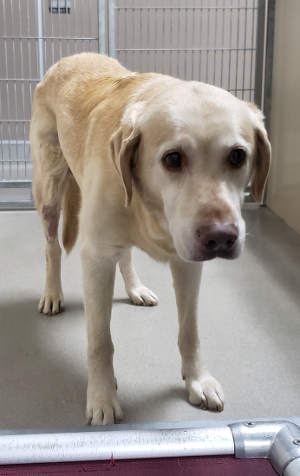
Male yellow Labrador Retriever
This male yellow Labrador Retriever has a medium-length coat.
He’s in kennel No. 20, ID No. 14183.
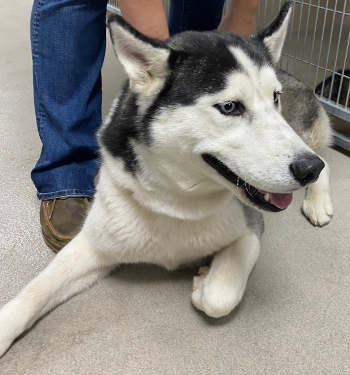
Male husky
This male husky has a medium-length black and white coat and blue eyes.
He’s in kennel No. 22, ID No. 14194.

Female pit bull terrier
This young female pit bull terrier has a short brown coat.
She is in kennel No. 25, ID No. 14181.

Male pit bull terrier
This male pit bull terrier has a short gray and brindle coat.
He is in kennel No. 26, ID No. 14138.

Female red heeler
This female red heeler has a short coat.
She is in kennel No. 27, ID No. 14195.

Male heeler-Labrador Retriever
This male heeler-Labrador Retriever mix has a short black and white coat.
He is in kennel No. 29, ID No. 14178.

Male pit bull-Shar Pei
This male pit bull-Shar Pei has a short brown coat.
He is in kennel No. 30, ID No. 14177.

Male Pomeranian
This male Pomeranian has a long tan coat.
He is in kennel No. 33, ID No. 14182.

‘Hugo’
“Hugo” is a male pit bull terrier with a medium-length black and white coat.
He has been neutered.
He’s in kennel No. 34, ID No. 14174.
Email Elizabeth Larson at

Historians know that turkey and corn were part of the first Thanksgiving, when Wampanoag peoples shared a harvest meal with the pilgrims of Plymouth plantation in Massachusetts. And traditional Native American farming practices tell us that squash and beans likely were part of that 1621 dinner too.
For centuries before Europeans reached North America, many Native Americans grew these foods together in one plot, along with the less familiar sunflower. They called the plants sisters to reflect how they thrived when they were cultivated together.
Today three-quarters of Native Americans live off of reservations, mainly in urban areas. And nationwide, many Native American communities lack access to healthy food. As a scholar of Indigenous studies focusing on Native relationships with the land, I began to wonder why Native farming practices had declined and what benefits could emerge from bringing them back.
To answer these questions, I am working with agronomist Marshall McDaniel, horticulturalist Ajay Nair, nutritionist Donna Winham and Native gardening projects in Iowa, Nebraska, Wisconsin and Minnesota. Our research project, “Reuniting the Three Sisters,” explores what it means to be a responsible caretaker of the land from the perspective of peoples who have been balancing agricultural production with sustainability for hundreds of years.
Abundant harvests
Historically, Native people throughout the Americas bred indigenous plant varieties specific to the growing conditions of their homelands. They selected seeds for many different traits, such as flavor, texture and color.
Native growers knew that planting corn, beans, squash and sunflowers together produced mutual benefits. Corn stalks created a trellis for beans to climb, and beans’ twining vines secured the corn in high winds. They also certainly observed that corn and bean plants growing together tended to be healthier than when raised separately. Today we know the reason: Bacteria living on bean plant roots pull nitrogen – an essential plant nutrient – from the air and convert it to a form that both beans and corn can use.
Squash plants contributed by shading the ground with their broad leaves, preventing weeds from growing and retaining water in the soil. Heritage squash varieties also had spines that discouraged deer and raccoons from visiting the garden for a snack. And sunflowers planted around the edges of the garden created a natural fence, protecting other plants from wind and animals and attracting pollinators.
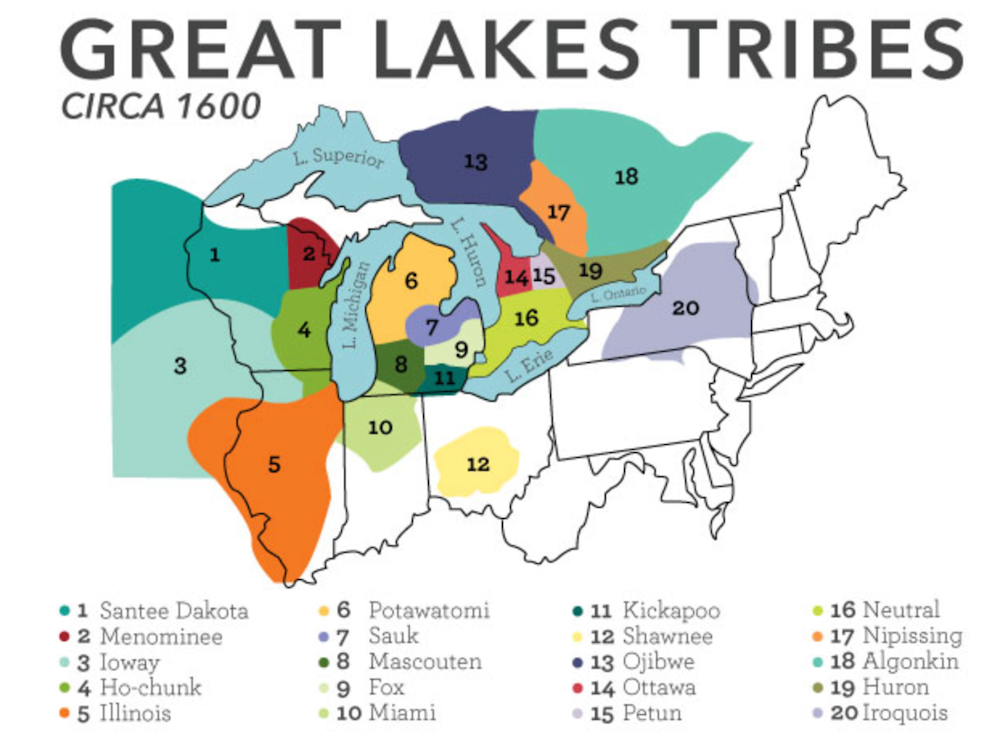
Interplanting these agricultural sisters produced bountiful harvests that sustained large Native communities and spurred fruitful trade economies. The first Europeans who reached the Americas were shocked at the abundant food crops they found. My research is exploring how, 200 years ago, Native American agriculturalists around the Great Lakes and along the Missouri and Red rivers fed fur traders with their diverse vegetable products.
Displaced from the land
As Euro-Americans settled permanently on the most fertile North American lands and acquired seeds that Native growers had carefully bred, they imposed policies that made Native farming practices impossible. In 1830 President Andrew Jackson signed the Indian Removal Act, which made it official U.S. policy to force Native peoples from their home locations, pushing them onto subpar lands.
On reservations, U.S. government officials discouraged Native women from cultivating anything larger than small garden plots and pressured Native men to practice Euro-American style monoculture. Allotment policies assigned small plots to nuclear families, further limiting Native Americans’ access to land and preventing them from using communal farming practices.
Native children were forced to attend boarding schools, where they had no opportunity to learn Native agriculture techniques or preservation and preparation of Indigenous foods. Instead they were forced to eat Western foods, turning their palates away from their traditional preferences. Taken together, these policies almost entirely eradicated three sisters agriculture from Native communities in the Midwest by the 1930s.
Reviving Native agriculture
Today Native people all over the U.S. are working diligently to reclaim Indigenous varieties of corn, beans, squash, sunflowers and other crops. This effort is important for many reasons.
Improving Native people’s access to healthy, culturally appropriate foods will help lower rates of diabetes and obesity, which affect Native Americans at disproportionately high rates. Sharing traditional knowledge about agriculture is a way for elders to pass cultural information along to younger generations. Indigenous growing techniques also protect the lands that Native nations now inhabit, and can potentially benefit the wider ecosystems around them.
But Native communities often lack access to resources such as farming equipment, soil testing, fertilizer and pest prevention techniques. This is what inspired Iowa State University’s Three Sisters Gardening Project. We work collaboratively with Native farmers at Tsyunhehkw, a community agriculture program, and the Ohelaku Corn Growers Co-Op on the Oneida reservation in Wisconsin; the Nebraska Indian College, which serves the Omaha and Santee Sioux in Nebraska; and Dream of Wild Health, a nonprofit organization that works to reconnect the Native American community in Minneapolis-St. Paul, Minnesota, with traditional Native plants and their culinary, medicinal and spiritual uses.
[The Conversation’s science, health and technology editors pick their favorite stories. Weekly on Wednesdays.]
We are growing three sisters research plots at ISU’s Horticulture Farm and in each of these communities. Our project also runs workshops on topics of interests to Native gardeners, encourages local soil health testing and grows rare seeds to rematriate them, or return them to their home communities.
The monocropping industrial agricultural systems that produce much of the U.S. food supply harms the environment, rural communities and human health and safety in many ways. By growing corn, beans and squash in research plots, we are helping to quantify how intercropping benefits both plants and soil.
By documenting limited nutritional offerings at reservation grocery stores, we are demonstrating the need for Indigenous gardens in Native communities. By interviewing Native growers and elders knowledgeable about foodways, we are illuminating how healing Indigenous gardening practices can be for Native communities and people – their bodies, minds and spirits.
Our Native collaborators are benefiting from the project through rematriation of rare seeds grown in ISU plots, workshops on topics they select and the new relationships they are building with Native gardeners across the Midwest. As researchers, we are learning about what it means to work collaboratively and to conduct research that respects protocols our Native collaborators value, such as treating seeds, plants and soil in a culturally appropriate manner. By listening with humility, we are working to build a network where we can all learn from one another.
Christina Gish Hill, Associate Professor of Anthropology, Iowa State University
This article is republished from The Conversation under a Creative Commons license. Read the original article.
A joint U.S.-European satellite built to monitor global sea levels lifted off on a SpaceX Falcon 9 rocket from Space Launch Complex 4E at Vandenberg Air Force Base in California Saturday at 9:17 a.m. Pacific Standard Time.
About the size of a small pickup truck, Sentinel-6 Michael Freilich will extend a nearly 30-year continuous dataset on sea level collected by an ongoing collaboration of U.S. and European satellites while enhancing weather forecasts and providing detailed information on large-scale ocean currents to support ship navigation near coastlines.
"The Earth is changing, and this satellite will help deepen our understanding of how," said Karen St. Germain, director of NASA's Earth Science Division. "The changing Earth processes are affecting sea level globally, but the impact on local communities varies widely. International collaboration is critical to both understanding these changes and informing coastal communities around the world."
After arriving in orbit, the spacecraft separated from the rocket's second stage and unfolded its twin sets of solar arrays. Ground controllers successfully acquired the satellite's signal, and initial telemetry reports showed the spacecraft in good health.
Sentinel-6 Michael Freilich will now undergo a series of exhaustive checks and calibrations before it starts collecting science data in a few months' time.
Continuing the legacy
The spacecraft is named in honor of Michael Freilich, the former director of NASA's Earth Science Division, who was a leading figure in advancing ocean observations from space. Freilich passed away Aug. 5, 2020. His close family and friends attended the launch of the satellite that now carries his name.
"Michael was a tireless force in Earth sciences. Climate change and sea level rise know no national borders, and he championed international collaboration to confront the challenge," said ESA (European Space Agency) Director of Earth Observation Programmes Josef Aschbacher. "It's fitting that a satellite in his name will continue the 'gold standard' of sea level measurements for the next half-decade. This European-U.S. cooperation is exemplary and will pave the way for more cooperation opportunities in Earth observation."
"Mike helped ensure NASA was a steadfast partner with scientists and space agencies worldwide, and his love of oceanography and Earth science helped us improve understanding of our beautiful planet," added Thomas Zurbuchen, NASA associate administrator for science at the agency's headquarters. "This satellite so graciously named for him by our European partners will carry out the critical work Mike so believed in – adding to a legacy of crucial data about our oceans and paying it forward for the benefit of future generations."
Sentinel-6 Michael Freilich will continue the sea level record that began in 1992 with the TOPEX/Poseidon satellite and continued with Jason-1 (2001), OSTM/Jason-2 (2008), and eventually Jason-3, which has been observing the oceans since 2016.
Together, these satellites have provided a nearly 30-year record of precise measurements of sea level height while tracking the rate at which our oceans are rising in response to our warming climate.
Sentinel-6 Michael Freilich will pass the baton to its twin, Sentinel-6B, in 2025, extending the current climate record at least another 10 years between the two satellites.
Global science impact
This latest mission marks the first international involvement in Copernicus, the European Union's Earth Observation Programme.
Along with measuring sea levels for almost the entire globe, Sentinel-6 Michael Freilich's suite of scientific instruments will also make atmospheric measurements that can be used to complement climate models and help meteorologists make better weather forecasts.
"NASA is but one of several partners involved in Sentinel-6 Michael Freilich, but this satellite speaks to the very core of our mission," said NASA Administrator Jim Bridenstine. "Whether 800 miles above Earth with this remarkable spacecraft or traveling to Mars to look for signs of life, whether providing farmers with agricultural data or aiding first responders with our Disasters program, we are tirelessly committed not just to learning and exploring, but to having an impact where it's needed."
The initial orbit of Sentinel-6 Michael Freilich is about 12.5 miles (20.1 kilometers) lower than its ultimate operational orbit of 830 miles (1,336 kilometers).
In less than a month, the satellite will receive commands to raise its orbit, trailing Jason-3 by about 30 seconds. Mission scientists and engineers will then spend about a year cross-calibrating data collected by the two satellites to ensure the continuity of sea level measurements from one satellite to the next.
Sentinel-6 Michael Freilich will then take over as the primary sea level satellite and Jason-3 will provide a supporting role until the end of its mission.
"This mission is the very essence of partnership, precision, and incredible long-term focus," said Michael Watkins, director of NASA's Jet Propulsion Laboratory in Southern California, which manages the mission. "Sentinel-6 Michael Freilich not only provides a critical measurement, it is essential for continuing this historic multi-decadal sea level record."
Sentinel-6 Michael Freilich and Sentinel-6B compose the Sentinel-6/Jason-CS (Continuity of Service) mission developed in partnership with ESA. ESA is developing the new Sentinel family of missions to support the operational needs of the Copernicus program, managed by the European Commission.
Other partners include the European Organisation for the Exploitation of Meteorological Satellites, or EUMETSAT, and National Oceanic and Atmospheric Administration, with funding support from the European Commission and technical support from France's National Centre for Space Studies.
"The data from this satellite, which is so critical for climate monitoring and weather forecasting, will be of unprecedented accuracy," said EUMETSAT Director-General Alain Ratier. "These data, which can only be obtained by measurements from space, will bring a wide range of benefits to people around the globe, from safer ocean travel to more precise prediction of hurricane paths, from greater understanding of sea level rise to more accurate seasonal weather forecasts, and so much more."
JPL, a division of Caltech in Pasadena, California, is contributing three science instruments to each Sentinel-6 satellite: the Advanced Microwave Radiometer for Climate, the Global Navigation Satellite System – Radio Occultation, and the Laser Retroreflector Array.
NASA is also contributing launch services, ground systems supporting operation of the NASA science instruments, the science data processors for two of these instruments, and support for the U.S. component of the international Ocean Surface Topography Science Team.
The launch is managed by NASA’s Launch Services Program, based at the agency’s Kennedy Space Center in Florida.
To learn more about Sentinel-6 Michael Freilich, visit https://www.nasa.gov/sentinel-6.
The Clearlake Police Department said Saturday that the name of the male pedestrian, who was in his 60s, is being withheld pending the notification of next of kin.
Just before 10 p.m. Thursday, Clearlake Police officers responded to a report of a vehicle crash involving a pedestrian that had occurred on Highway 53 near 18th Avenue, said Sgt. Ryan Peterson.
Peterson said the male pedestrian was located at the scene with major injuries.
Medical staff from the Lake County Fire Protection District arrived at the scene and evaluated the man, who Peterson said succumbed to his injuries and was pronounced deceased by medical staff at the scene.
The driver of the vehicle remained at the scene and was cooperative with the investigation, Peterson said.
Traffic Officer Michael Perreault responded to the scene and took over the investigation. Peterson said the southbound lanes of Highway 53 between 18th Avenue and Dam Road were closed while the scene was reviewed and evidence was collected.
Peterson said preliminary indications are that the pedestrian was crossing the roadway outside of a crosswalk and was struck by the vehicle.
This case is pending further investigation and review for final determination and cause, Peterson said.
Peterson asked drivers and pedestrians to be vigilant while on the roadways, especially with the hours of daylight being shorter and the weather changing.
Anyone with information in this case is encouraged to contact Officer Michael Perreault at 707-994-8251, Extension 519.
In a unanimous vote at the end of the nearly two-hour meeting, the board decided to declare the district in the hybrid learning phase, the second step in the Lake County Return to School Continuum, which includes in-person schooling. That transition will be complete by Jan. 4.
As part of that phase two, Lakeport Unified students will be able to return to athletic competitions as soon as the state gives the go-ahead. Under the continuum, athletics can only resume in stages two and above, not in the first phase, distance learning.
On Nov. 9, the board had voted 3-2 during a special meeting to move into the hybrid model on Jan. 4, at the start of the next semester.
However, during its regular Wednesday night meeting, the board was confronted during a discussion on sports events by parents, students and coaches who wanted them to move up the start date to Nov. 30, with the board ultimately agreeing to hold a special meeting Friday to hear information from Public Health Officer Dr. Gary Pace on reopening.
Last week, Superintendent Jill Falconer told the board that Nov. 30 was the earliest staff could be prepared to move to in-person instruction after giving parents at least 10 days' notice.
With the Thanksgiving break now underway, Falconer told the board on Friday night that Nov. 30 is actually the district’s next school day.
That date, Falconer said, is “not an option because we haven’t told parents anything.”
Instead, the board approved a motion offered by Board Chair Dan Buffalo that he said offered an “elegant solution.”
It recognized that the district already is practicing stage two because of having 200 special education and English as a second language students on campus daily; that the board’s Nov. 9 decision declared the district’s movement into the second phase; and gives Jan. 4 as the time by which the transition from distance learning to the phase two hybrid model will be completed.
The board’s nuanced action on Friday night is an attempt to get ahead of what Dr. Pace said during the meeting is a high likelihood of Lake County seeing increased restrictions from the state under its revamped Blueprint for a Safer Economy.
Pace said that within the next week or so Lake could move from the red, or second-most restrictive tier on the blueprint, to purple, the most restrictive.
If that were the case when the district was still in phase one of the back to school plan, it would be unable to open for in-person instruction until the county returned to a lower tier, which Pace said could be well after the Christmas holiday.
Lucerne Elementary and Upper Lake Unified, the county’s two smallest school districts, began the school year with in-person instruction and so far have had no issues with outbreaks, Pace reported.
Separately, some Lake County Office of Education schools have had in-person instruction. The county’s private and Christian schools also have teachers and students together in the classrooms and are capacity for enrollment, Lake County Superintendent of Schools Brock Falkenberg told Lake County News on Friday.
Kelseyville Unified has announced plans to transition to phase two on Nov. 30, and during a special Friday afternoon meeting of the Konocti Unified School Board, Superintendent Dr. Becky Salato said that district is on target to open in the hybrid model on Jan. 5 – so long as the situation doesn’t change.
Middletown Unified this week sent out a survey to parents in which the administration reported that it is projecting January as the time for potentially moving into a stage two or three model.
However, on Friday Middletown Unified followed up with a report that three of its staffers at Coyote Valley Elementary School and Middletown Middle School have tested positive for COVID-19 and are now in quarantine.
20JULY Return2School EngSpan FINALFinal by LakeCoNews on Scribd
Pace updates board on COVID-19 and schools
The Lakeport Unified board met in the Marge Alakszay Center, this time sitting farther apart than at the last meeting, a measure Buffalo said was taken at the direction of Public Health and the district attorney.
They were joined by an in-person audience as well as more than 100 people including parents, and teachers participating via Zoom.
Dr. Pace, who also attended via Zoom, went through a PowerPoint that he has recently presented to other school district boards. The 19-page presentation is published below.
“Things are changing really fast right now, in the state and in the county,” said Pace, but at the same time there is evidence to support the safe opening of schools.
Pace said the United States has tended to prioritize opening restaurants more than supporting on-site learning at schools, while Europe has taken the opposite approach.
He said there is starting to be a marked increase in new cases “and there's no end in sight,” making it a very concerning time.
While he said he believes the state’s tier system is probably one of the best in the country for allowing local control and differentiation between areas, it’s not perfect.
“We are on the verge of going into the purple tier,” said Pace. “Things have really changed in the last two weeks.”
That’s because the majority of the state’s 58 counties are moving into the most restricted tier. “Our numbers are quickly moving that way, he said, adding that there is a very good chance by this time next week the county will be in the purple tier.
As of Friday, Lake’s caseload was at 823, with total deaths remaining at 18.
“I don’t think there’s anything we can do to stop that at this point,” he said of the potential tier change.
Once Lake County is in the purple tier, schools that already are open can remain so, but those that haven’t yet opened won’t be able to, although Pace said elementary schools can pursue waivers to open.
He said the science indicates that children – particularly those age 10 and under – are less susceptible to contracting and spreading COVID-19. As children get older, the chances of contracting the virus increase.
Pace explained during the meeting that of Lake County’s total cases, 100 – or 13-percent – involve children age 18 and under. Of those 100 cases, 22 percent were in children from birth to age 4, 35 percent were in the 5 to 12 age group, and 44 percent were in those ages 13 to 18. One local child has been hospitalized.
However, he said there are risks for teachers. “To ignore that, I think is a mistake.”
Pace said the evidence from Australia and Europe shows that adults are much more likely to introduce the virus into schools than children. “This data has been very reassuring about the risk” from kids transmitting it to adults. There also haven’t been many cases traced to children passing it to each other.
In New York’s schools, they did random testing of 16,000 children three weeks into school reopening and only 28 tested positive. Among 37,000 staff, there were 180 positives. Pace said that in California, only two outbreaks have been registered in schools.
Pace said there is a greater downside to not having students back in class, pointing to declining grades, challenges from poor wifi and disparities for economically disadvantaged children. There also are the impacts on mental health, increases of trauma and domestic violence, substance abuse, lack of sports and loss of socialization.
Keeping schools safe will involve social distancing, limiting congregate activities, using masks, screening for temperatures, conducting testing and having an active response when cases are identified, Pace said.
He said he’s working with the local districts to work out arrangements for testing staff. Currently, the county’s testing site doesn’t test children, although beginning on Dec. 1 it will offer testing for children age 12 and older. Pace said it’s best to go through one’s pediatrician, adding that Tribal Health also has done a good job testing children.
Buffalo asking about long-term impacts of COVID-19. Pace said there’s a lot that’s not known.
He referred to Multisystem Inflammatory Syndrome in Children, or MIS-C, a rare inflammatory condition in children that’s associated with COVID-19. The California Department of Public Health said it can damage multiple organ systems, require hospitalization and be life-threatening.
Signs and symptoms of MIS-C include a fever that does not go away, abdominal pain, vomiting, diarrhea, neck pain, rash, bloodshot eyes or feeling tired. Early diagnosis and treatment of patients is critical to preventing long-term complications, the state reported.
On Friday, the California Department of Public Health said 129 cases of MIS-C have been reported statewide.
While those children get really sick, the vast majority don’t, Pace said.
Board member Carly Alvord asked Pace about the comparisons between COVID-19 and the flu.
He explained that the flu season has a beginning, middle and an end, and tends to be more seasonal. It hasn’t been the same with COVID-19.
The last really bad flu season had a death toll of 100,000, with COVID-19 now having registered 250,000 deaths in eight months, Pace said. “The worst is still ahead of us.”
He pointed out that the 1918 flu pandemic – which he said lasted about a year and a half – had 650,000 deaths.
Pace said COVID-19 is in a “whole other league” from the flu, which he added doesn’t keep students out of school.
Board member Jeannie Markham asked about sports, which Pace acknowledged are important. He said Public Health is following the state guidelines, which were due to be updated with a more elaborate version but stopped by this week’s developments, a reference to the governor’s actions to put more counties in the restricted tier.
“At this point it’s very vague what they're allowing,” he said, which is mainly conditioning.
While “fomite” transmission – through contaminated surfaces and objects – no longer seems to be as much of a concern for contracting COVID-19, Pace said being in indoor spaces, running, breathing deeply from exertion and bumping into each other is.
Alvord asked Pace if he agreed with the statement this week by Centers for Disease Control and Prevention Director Robert Redfield, who said the data suggests children are safest in school.
Pace indicated he agreed, noting that with more evidence the medical community is getting behind that conclusion.
Board agrees on next actions
Following Pace’s presentation, the board then turned to its only agendized action item, the consideration of its scheduled start date.
Falconer said the district had agreed to abide by the return to school continuum, and based on that document, with some students already on campus since the beginning of the school year, she believed the district already was partially in stage two. By declaring it’s in stage two, she said they could begin sports.
Buffalo then offered the motion to make that declaration and abide by its Nov. 9 decision, making Jan. 4 the date for the transition’s completion. He said that compromise also gives staff the necessary time to complete implementing protocols and notify parents.
Markham, herself a retired teacher, said she knows that the district’s teachers will rise to the occasion. “They will be ready for this and rise to that challenge when it’s time.”
She also encouraged students and parents to take advantage of the opportunity to meet with teachers on campus. “Your struggles don’t have to be academic,” she said.
Markham added, “We care about you. We want to see you.”
During public comment, Sheriff Brian Martin, who has a son attending the high school, said he liked what he was hearing from the board and it was a good compromise. Martin had been among those on Wednesday encouraging board members to move up the school start date.
Referring to a COVID-19 outbreak that’s continuing at the jail, “We’ve dealt with this,” Martin said, noting Dr. Pace’s help and guidance, and his willingness to leave decisionmaking up to the individual agencies.
District teacher and parent Tanya Wynacht thanked the board for finding a compromise. She said she wants her students to come to school and also wants her son to be able to enjoy a school year.
The board then took the 5-0 vote to approve the motion, gaining a round of applause before the meeting ended.
Email Elizabeth Larson at
Lake County Public Health officer COVID-19 presentation by LakeCoNews on Scribd

LAKE COUNTY, Calif. – Habitat for Humanity is continuing to offer a variety of services to make homes safer and more comfortable for Lake County residents who need the help.
Referred to Habitat for Humanity by a friend, Margaret and Margie Bartlemus were in desperate need of a ramp for their home.
It has been difficult for Margaret Bartlemus to get her daughter in and out of their home by herself and Margie Bartlemus was unable to easily use a manual wheelchair.
When they reached out to Habitat to request assistance with a ramp, they were fortunate to discover that Habitat also had a motorized scooter available for their use.
Habitat’s repair team discovered the family was also in need of a new stove, a working heating and cooling system, and repairs to a plumbing leak under their sink, all of which they addressed as part of the Brush of Kindness Critical Home Repair Program.
“Everything they have done has been wondrous,” Margie Bartlemus said. “This ramp was a miracle for me because I only had four steps to climb but they were so difficult. I want to thank them for all of the things that they did. If they can help someone else, I say trust them. They are good people.
To date, Habitat for Humanity Lake County has assisted approximately 300 homeowners with repairs to their homes. They expect to complete as many additional families as possible for 2021 and are accepting applications now.
Brush of Kindness recipients are typically seniors and military veterans who may be disabled and unable to effect repairs on their own.
In addition to Habitat’s homeownership program, critical health and safety-related repair work has become one of Habitat Lake County’s primary goals.
Donations to the Critical Home Repair Fund, especially for wheelchair ramps and lifts are critical to the program’s success.
To donate, or if you or someone you know are low-income homeowners who could benefit from critical health and safety-related repairs, please contact Habitat for Humanity Lake County at 707-994-1100 for an application or visit the office at 15312 Lakeshore Drive in Clearlake.