 How to resolve AdBlock issue?
News

As Americans prepare for the first Thanksgiving in the time of the coronavirus, the Centers for Disease Control and Prevention issued a stark warning a week before the big day: Don’t travel.
No over the river and through the woods to grandmother’s condo. No flying to a beach gathering with the family you choose.
And if it sounds like the CDC is trying to be like the Grinch who stole Thanksgiving, it is important to remember the grim statistic of more than a quarter of a million people dead from COVID-19. There is no mistaking: The coronavirus is out of control.
Ultimately, lowering the staggering numbers of COVID-19 cases and deaths lies squarely with us. Yes, governments can mandate actions; but we’re the ones responsible for adhering to them. Our failure is clear when you look at the latest numbers: Deaths from the virus are projected to soon approach 2,000 Americans a day, and cases continue to climb in the vast majority of states.
If national numbers don’t spur action, will it help to localize the problem? You can find out what’s happening closer to home here at the Johns Hopkins Coronavirus Resource Center. Drill down to see the data in your state and county, then take a moment to pause and consider the catastrophic consequences. It’s still within our power to reverse course and lower these numbers. But as a public health scholar and researcher, I can tell you that as infections increase, the more difficult that becomes.
Even the rural states of North Dakota, South Dakota, Iowa and Wyoming are experiencing tremendous surges. Exhausted hospitals and health care workers across the U.S. are becoming overwhelmed, if not already there. Overwhelmed systems place care at risk. Those with other health conditions need medical intervention and hospitalization. And those with a lax attitude about COVID-19 put themselves at increased risk for negative health outcomes.

Changing behavior is a must
Modifying our behavior minimizes the chances to spread infection. But this is a big task. Government actions are most effective when based on local data and the option to loosen or tighten restrictions based on solid information. We should not view these actions as an attempt to take away our civil liberties. Instead, we should think of them as liberating, a way to keep us away from the virus.
It is not too late to modify your behavior if you’ve been reluctant to accept the realities of the virus. With promising vaccines on the horizon, our challenge as individuals is to reduce current infection numbers. And to do that, everyone must commit to established public health strategies.
A dozen things you can do
-
Always mask up when indoors and around people who don’t live in your household.
-
Always mask up when outdoors and unable to maintain physical distancing.
-
Use either disposable masks or a multi-layer tightly woven cotton mask. Single-layer kerchiefs are insufficient.
-
When you mask up, make sure it fits your face and covers both nose and mouth. Wash or sanitize your hands after touching or removing the mask.
-
Remember that masks are not a substitute for physical distancing.
-
Maintain at least six feet of distance between you and others outside of your household.
-
Wash your hands frequently with soap and water for 20 seconds, or use a hand sanitizer with at least 60% alcohol.
-
Avoid motions that transfer organisms from your hands to your face. Your mouth, nose and eyes have mucous membranes that are potentially receptive to these organisms.
-
Clean frequently touched surfaces.
-
Do as much as possible outside and keep interactions with others short.
-
Fortify ventilation systems for more frequent air exchanges.
-
Curtail in-person holiday celebrations with those not in your household.
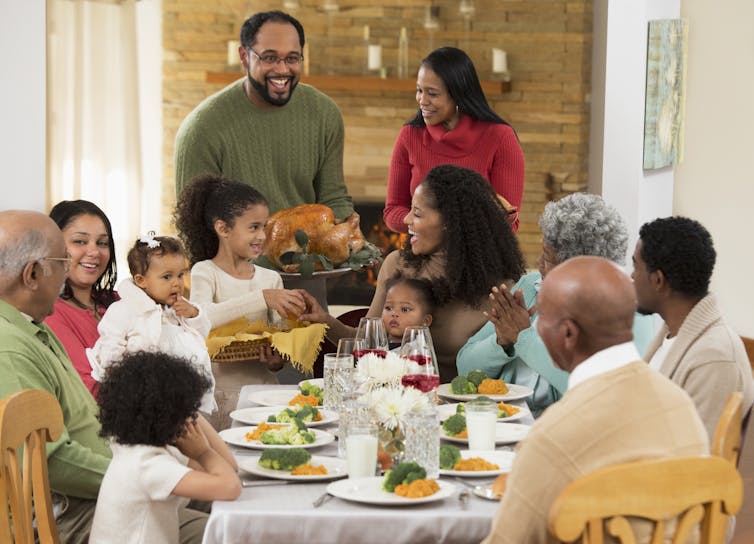
Celebrations are particularly challenging because it’s difficult for everyone to self-quarantine for the 14 days prior to the event. Also, events are typically inside rather than out; spacing of six feet may not be an option; ventilation systems in our energy-efficient homes are likely COVID-19-insufficient; and one cannot be masked while eating.
[Deep knowledge, daily. Sign up for The Conversation’s newsletter.]
So for Thanksgiving, do a virtual gathering instead. Cook the same menu in different houses to promote a sense of sharing. Send e-cards to each other with a personal note and wish for a good holiday. Or do a Zoom call where all can speak and express thankfulness for the ability to still be able to connect this year.
It is not unusual for COVID-19 patients to rage when they discover that those around them dismissed or downplayed the wisdom and experience of scientists and doctors about the realities of the pandemic. But there is no need to give up, even in the face of increasingly frightening statistics. Instead, now is the time we need to commit not just to ourselves, but to one another. What’s standing in the way of curtailing the numbers of COVID-19 cases, hospitalizations and deaths is us.
Pamela M. Aaltonen, Professor Emerita; Immediate Past President, APHA, Purdue University
This article is republished from The Conversation under a Creative Commons license. Read the original article.

California’s Proposition 19 (passed in 2020) amends existing local property tax reassessment rules (i.e., California’s Proposition 13 and 58) in its Constitution.
Proposition 19 affects two categories of residents: first, seniors, severely disabled and victims of wildfire or natural disaster who relocate within California; second, families who transfer real properties between generations.
Effective April 1, 2021, “an owner of a primary residence who is over 55 years of age, severely disabled, or a victim of a wildfire or natural disaster may transfer the taxable value of their primary residence to a replacement primary residence located anywhere in this state, regardless of the location or value of the replacement primary residence, that is purchased or newly constructed as that person’s principal residence within two years of the sale of the original primary residence.” (https://vig.cdn.sos.ca.gov/2020/general/pdf/topl-prop19.pdf )
This is welcome news for seniors, disabled persons, and wildfire/disaster victims who are no longer restricted to relocating within their existing county.
“For any transfer of taxable value to a replacement primary residence of equal or lesser value than the original primary residence, the taxable value of the replacement primary residence shall be deemed to be the taxable value of the original primary residence.”
“For any transfer of taxable value to a replacement primary residence of greater value than the original primary residence, the taxable value of the replacement primary residence shall be calculated by adding the difference between the full cash value of the original primary residence and the full cash value of the replacement primary residence to the taxable value of the original primary residence.” Thus, the new residence’s additional value is added to the prior residence’s old tax base.
A person seeking to transfer their residence’s tax assessed value must file an application with the assessor in the county of the new residence. Seniors and severely disable property owners may transfer their old residence’s property tax basis up to three times in their lifetime. No such restriction applies to fire and disaster victims.
Next, under existing law (Proposition 58) a parent can transfer their family residence, family farm and up to $1 million in assessed value of other real properties to their children (either during the parent’s life or at death) without changing the property’s assessed value. Similarly a grandparent to grandchild exclusion applies when the grandchild’s parent (who is the child of the grandparent) is deceased.
Effective February 16, 2021, the parent-child and grandparent-grandchild exclusions from property tax reassessment only apply to transfers of a family home and only if the child or grandchild, as relevant, moves into the family home within 1 year of the transfer. Furthermore, for family homes where the current value at time of transfer exceeds its existing tax assessment (in the hands of the transferor) by more than $1 million (to be adjusted annually), then the excess value is added to the existing assessed value to compute the current assessed value.
Some residents may make wish to transfer real properties to their children (or grandchildren) prior to Feb. 16, 2021, in order to take advantage of existing law.
However, the children and grandchildren will not get a step-up in basis at the death of the transferor parent or grandparent. Rather, they will get the transferor’s adjusted basis in the property at time of transfer. When the children sell the property, they will pay capital gains tax on the difference between their basis and the sales price.
It is expected that the tax revenue lost by giving seniors, disabled persons and fire/disaster victims tax relief is more than made up with tax revenue gains on transfers to children and certain transfers to grandchildren. The revenue funds California’s fire-fighting and local schools.
Dennis A. Fordham, attorney, is a State Bar-Certified Specialist in estate planning, probate and trust law. His office is at 870 S. Main St., Lakeport, Calif. He can be reached at
Think of the International Space Station, and most likely you imagine an orbiting laboratory, where scientists observe how plants, materials, and humans react to microgravity conditions.
But during the past decade, the station has also served a very different role - that of being a business incubator. And this is one of its star products – the CubeSat.
The CubeSat is one of many types of satellites now found in space. It is one of the smallest; one “unit” is a compact 10 by 10 by 10cm cube and is commonly referred to as 1U. And it can be deployed for a fraction of what its larger cousins cost.
Early small satellites launched from the station were literally thrown into space by Russian cosmonauts! In 2012, crewmembers began utilizing the airlock in the Japanese Kibo module to deploy up to 6U of CubeSats per airlock cycle.
And not long after, the American company Nanoracks built and began operating an even more robust deployer on the station, capable of launching up to 48U per cycle. That changed everything.
Mike Read is the manager of space station business and economic development at Johnson Space Center. He notes how one of Nanoracks’ first customers, Planet, leveraged the new launch capabilities aboard the space station:
“Planet wanted to take high resolution photos of Earth. While you can take pictures from the space station, your coverage is limited by the station’s orbit. With multiple CubeSats however, you can position them to cover almost any point on Earth.”
In a relatively short time, Planet deployed several generations of CubeSats from the space station, proving the viability of their technology approach and their business model.
With these successes, Planet quickly expanded to an operational fleet of over 150 satellites deployed using commercial launch providers. This fleet gives them the ability to image the entire Earth’s landmass every day.
Planet’s imagery is now in high demand by companies and governments who use this big data in the fields of agriculture, forestry and land use, mapping, and disaster response. Within a decade the company has grown from a true start-up to employing nearly 500 people.
Multiple companies are now building small launch vehicles specifically to deploy CubeSats and other small satellites into low-Earth orbit, for use in a variety of ways for companies as well as students and non-profit organizations.
CubeSats are being used to provide internet services to even the most remote regions of the planet. They’re helping build better weather and climate models to improve weather forecasting. They’re enabling text messaging for your phone, around the globe, even without a cell signal.
CubeSats also are leaving the planet. The first and second interplanetary CubeSats accompanied NASA’s Insight Lander on its recent mission to Mars, relaying data about the spacecraft as it entered the planet’s atmosphere.
Some CubeSat missions will serve as pathfinders to help map the way for the Artemis missions to the Moon, and 13 CubeSats will launch on the first mission, Artemis I.
Read concludes with this observation: “Today, more and more, a single large and expensive satellite is being replaced by one of the newest members of the satellite portfolio – a flock of small, less expensive, yet very powerful CubeSats. Affordable access to space has broadened the station’s capabilities in a way that, frankly, was never envisioned. However, that access has enabled CubeSats to become a sustained commercial success, contributing significantly to the growing space marketplace.”
For more science and research from the International Space Station, go to www.nasa.gov/iss-science.
To discover more about the space on, around, and beyond our planet visit http://science.nasa.gov.

LAKE COUNTY, Calif. – A Lucerne couple has been arrested for felony child abuse after their two small children were found wandering outdoors, naked and bloody, at a Lakeport motel on Thursday night.
Officers took Elizabeth Ann Frost, 40, and Eric Dwayne Kantner, 46, into custody in the case, according to the Lakeport Police Department.
The agency said that on Thursday evening Lakeport Police officers – assisted by the Lake County Sheriff’s Office and the Lakeport Fire Protection District – were dispatched to the Anchorage Inn Motel on Main Street to investigate the report of two small children found walking around the grounds naked with blood on their bodies.
The temperature at the time of the incident was approximately 40 degrees, police said.
The police department said officers arrived on the scene and determined that the motel manager located the children after motel guests reported them being outside.
The children, found to be 1 and 3 years of age, were provided immediate care and medical treatment by police and fire. Police said further investigation determined that the children had been outside for up to 10 minutes, both screaming and knocking on doors.
Police said Kantner and Frost, who police confirmed are the children’s parents, were located at the motel and found to have been inside of a room, heavily intoxicated and sleeping at the time the children were outside.
Based on evidence gathered at the scene, officers believe that Kantner assaulted one of the children, causing injury, police said.
Officers determined that the children needed to be taken into protective custody and contacted the Lake County Department of Child Welfare Services, which responded and took custody of them.
The police department said the officers also located two dogs belonging to Kantner and Frost and took custody of them and transported them to Lake County Animal Care and Control.
Both Kantner and Frost were arrested and transported to the Lake County Correctional Facility. Kantner was booked for felony charges of willful cruelty to a child and inflicting injury on a child and Frost was booked for felony charges of willful cruelty to a child and probation violation, police said.
Jail records showed bail for both was set at $75,000. They are set to be arraigned in Lake County Superior Court on Monday.
Local arrest records show that Frost has previous arrests for drug- and alcohol-related charges and probation violations. She also was arrested in 2019 for willful cruelty to a child and this past April for spousal battery.
Anyone with information on this incident is asked to contact Officer Kaylene Strugnell at
On Monday, Gov. Gavin Newsom said he was “pulling an emergency brake” in response to virus case spikes across the state in recent weeks.
The result of Newsom’s action was that 29 of California’s counties moved into the purple or most restrictive tier of the Blueprint for a Safer Economy.
Now, 42 of California’s 58 counties – accounting for 94.1 percent of the state’s residents – are in that most restrictive tier, and on Thursday Newsom went further by issuing a nighttime stay-at-home order for those purple tier counties.
Lake County is among 5.6 percent of the state’s population in the second most restrictive tier, red.
However, there’s no guarantee that Lake County will stay there, as the governor’s office said data is continuously being reassessed.
Over the summer, Lake came close to moving to the purple tier due to outbreaks in local skilled nursing facilities and more recently is being challenged by an outbreak at the Lake County Jail.
In response to Newsom’s action, at the Tuesday Board of Supervisors meeting, Supervisor Bruno Sabatier asked to add to the agenda an extra item in the form of a letter he wrote that morning to the governor.
That same day, Lake County surpassed the 800-case mark, with 18 COVID-19-related deaths during the pandemic so far. Statewide, by Tuesday there were more than 1,054,000 cases and 18,350 deaths.
“From my perspective, saying nothing is agreeing and I do not agree with the direction that we are going,” Sabatier said.
He said he wanted to act right away before the governor’s actions could impact the county.
The board agreed to add the letter’s consideration to the agenda.
During the discussion, Sabatier said not all places are being impacted in the same way.
Public Health Officer Dr. Gary Pace said there have been a small number of cases related to businesses. Some businesses have been hit harder than others, “and it would be good to try to figure out how to help them stay alive.”
Sabatier said he’s not trying to dismantle the tier system, but wanted to address the shortened timeline for data analysis and ranking. Previously, the county’s caseload was judged over a two-week period. Now, it can be moved within tiers after a week.
Special Districts Administrator Jan Coppinger – giving the perspective of the county’s utilities arm, which serves thousands of sewer and water customers – said that for the first six months of the pandemic, customers were doing pretty good at keeping their water and sewer bills paid.
“In the last two to three months, we’ve seen an explosion in delinquent accounts,” Coppinger said.
“I think people hung on as long as they could,” she said. “They put a lot of extra money into their business to try to operate at 25 to 50 percent of their normal, and it’s hurting them.”
Coppinger said they don’t want to overlook the fact that some of those customers are accruing a lot of back bills, which could cause them to crumble in a few months.
“It’s even worse than what we’re seeing at first glance,” Coppinger said.
Letter explains local impacts
The letter acknowledged that COVID-19 has been a struggle for all. “It has impacted every foundational fabric of our communities. Our schools, our elderly, our medically fragile, and our businesses have all been impacted. Here in Lake County we have worked hard to protect our vulnerable, provide assistance to our businesses, and continue to track the virus and manage the pandemic to the best of our abilities.”
It also recounted the adjustments Lake County has had to make to meet the state’s mandates while working to keep case numbers down.
The letter explained that local leaders have been discussing how to save businesses from the oncoming winter months. “The survival of these businesses, while ensuring the safety of staff and customers, is important for the short and long term of our county as the need for our services has not subsided.”
It then addressed the needs of community members at large. The letter cited a 500-percent increase in calls for substance use disorders and a 129-percent increase in mental health calls, numbers which Sabatier told Lake County News came from Lake County Behavioral Health Services.
Sabatier’s letter then focused on the struggles of restricted businesses, such as restaurants, which if forced to go outdoors-only in the coming winter months would be facing the same kinds of total losses as they would in a public safety power shutoff.
It explained that the state’s discussions with the California State Association of Counties that brought forth the new criteria for small counties was due to Lake County being impacted by a single outbreak such as the one that is now occurring in the Lake County Jail.
“We should be looking for stability with safety guidelines for our communities. This new approach creates a vastly unstable environment for our businesses to try and survive,” the letter said.
“Please reconsider this new change and review how it is that we can support our rural businesses, while utilizing every safety precaution to ensure the safety of our communities and to reduce the risk of an economic collapse,” the letter concluded.
Sabatier wanted to ensure that the last line emphasized the different impacts that are occurring for rural counties.
The board voted unanimously to approve and send the letter to Gov. Newsom and to send copies to state and federal elected representatives.
Sabatier confirmed to Lake County News that the letter – signed by all five supervisors – was sent on Tuesday and that, as in previous cases where the board has sent communications to the governor, it hasn’t received a direct reply.
However, he said the county has seen good outcomes from previous advocacy efforts and is hopeful that such will be the case this time.
Email Elizabeth Larson at
111720 Lake County Board of Supervisors letter to Gov. Newsom by LakeCoNews on Scribd
The meeting will take place at 6:30 p.m. Friday, Nov. 20, in the Marge Alakszay Center, 250 Lange St.
Members of the public also can participate in the public session of the meeting via Zoom: https://lakeportusd.zoom.us/j/85759629637.
The agenda can be found here.
On Nov. 9, the board held a special meeting in which it decided to move to the hybrid learning model, which is phase two of the Lake County Return to School Continuum Plan, in January. The hybrid stage will start in-person instruction at schools.
However, at its regular Wednesday night meeting, the board was confronted by students, parents and coaches who wanted the district to move to the hybrid stage on Nov. 30, the date Superintendent Jill Falconer told the board last week that staff would be ready to make the transition.
The board agreed to hold a special meeting on Friday, when Public Health Officer Dr. Gary Pace said he is available to give them a presentation on COVID-19 and schools.
The Friday meeting will host Pace’s presentation as well as the board’s review of the current start date for full implementation of Stage 2 hybrid learning on the Lake County Return to School Continuum Plan.
Email Elizabeth Larson at