How to resolve AdBlock issue?
Refresh this page
How to resolve AdBlock issue?
Refresh this page
Lake County News,California
  • Home
    • Registration Form
  • News
    • Education
    • Veterans
    • Community
      • Obituaries
      • Letters
      • Commentary
    • Police Logs
    • Business
    • Recreation
    • Health
    • Religion
    • Legals
    • Arts & Life
    • Regional
  • Calendar
  • Contact us
    • FAQs
    • Phones, E-Mail
    • Subscribe
  • Advertise Here
  • Login

News

Space News: NASA’s Artemis II crewed mission to the Moon shows how US space strategy has changed since Apollo – and contrasts with China’s closed program

As part of the Artemis II mission, humans will fly around the Moon for the first time in decades. Roberto Moiola/Sysaworld via Getty Images

When Apollo 13 looped around the Moon in April 1970, more than 40 million people around the world watched the United States recover from a potential catastrophe. An oxygen tank explosion turned a planned landing into an urgent exercise in problem-solving, and the three astronauts on board used the Moon’s gravity to sling themselves safely home. It was a moment of extraordinary human drama, and a revealing geopolitical one.

The Cold War space race was a two-player contest. The Soviet Union and the United States operated in parallel, rarely cooperating, but clearly measuring themselves against one another. By 1970, the United States had already landed on the Moon, and competition centered on demonstrating technological capability, political and economic superiority and national prestige. As Apollo 13 showed, even missions that did not go as planned could reinforce a country’s leadership if they were managed effectively.

More than half a century later, NASA’s Artemis II mission will send humans around the Moon again in early 2026, this time deliberately. But the strategy going into Artemis II looks very different from that of 1970. The United States is no longer competing against a single rival in a largely symbolic race.
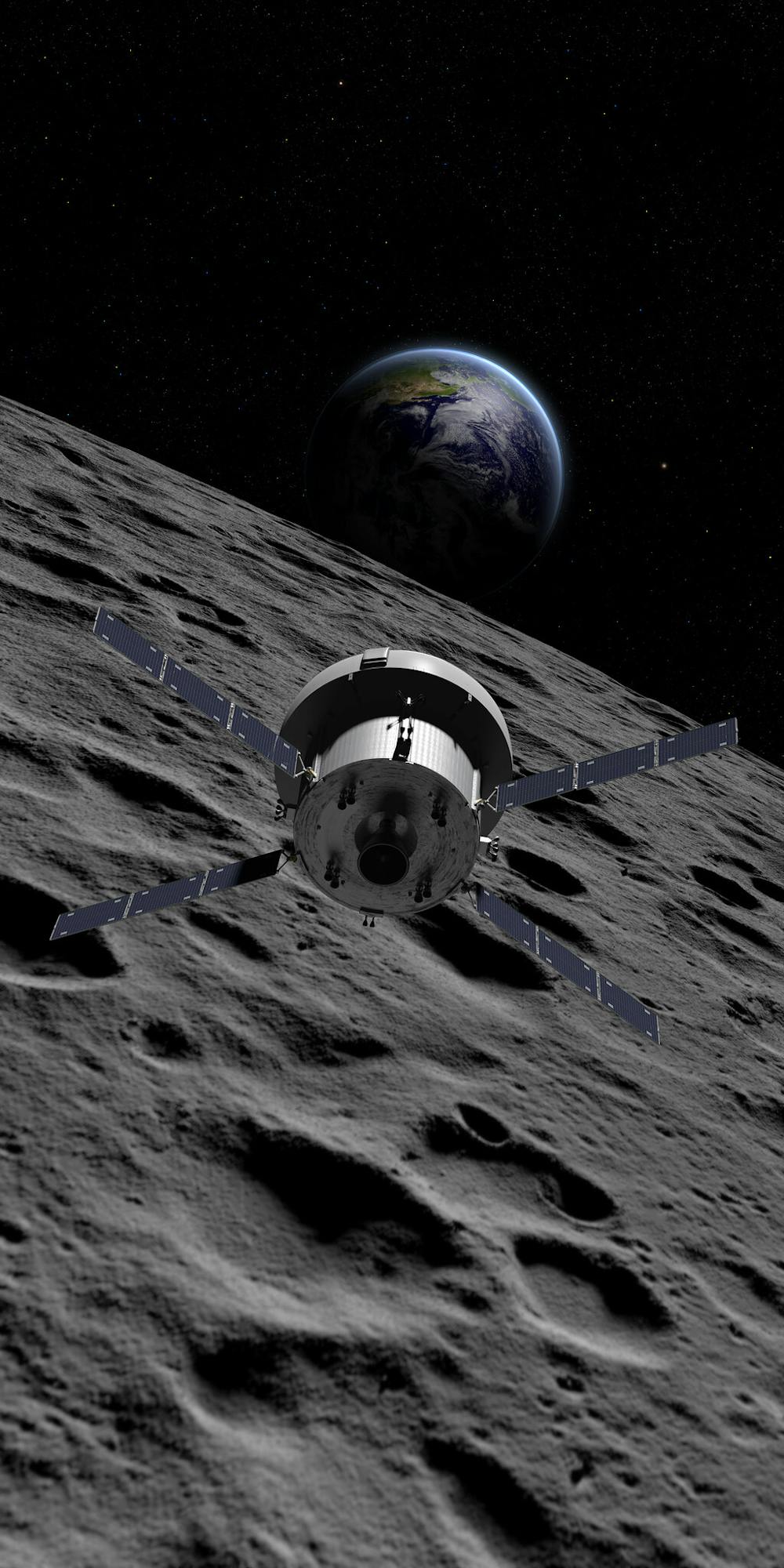
An artist's impression of a spacecraft flying over the surface of the Moon.
The crew will make a single flyby of the Moon in an Orion capsule, shown in this illustration. NASA, CC BY-NC

As a professor of air and space law, I research questions of governance and conflict avoidance beyond Earth. From a space law perspective, sustained human activity on the Moon and beyond depends on shared expectations about safety and responsible behavior. In practice, the countries that show up, operate repeatedly and demonstrate how activity on the lunar surface and in outer space can be carried out over time shape these expectations.

Artemis II matters not as nostalgia or merely a technical test flight. It is a strategic signal that the United States intends to compete in a different kind of Moon race, one defined less by singular achievements and more by sustained presence, partnerships and the ability to shape how activity on the Moon is conducted.

From a 2-player race to a crowded field

Today, more countries are competing to land on the Moon than ever before, with China emerging as a pacing competitor. While national prestige remains a factor, the stakes now extend well beyond flags and firsts.

Governments remain central actors in the race to the Moon, but they no longer operate alone. Commercial companies design and operate spacecraft, and international partnerships shape missions from the start.

China, in particular, has developed a lunar program that is deliberate, well-resourced and focused on establishing a long-term presence, including plans for a research station. Its robotic missions have landed on the Moon’s far side and returned samples to Earth, and Beijing has announced plans for a crewed landing by 2030. Together, these steps reflect a program built on incremental capability rather than symbolic milestones.

Why Artemis II matters without landing

Artemis II, scheduled to launch in February 2026, will not land on the Moon. Its four-person crew will loop around the Moon’s far side, test life-support and navigation systems, and return to Earth. This mission may appear modest. Strategically, however, crewed missions carry a different weight than robotic missions.
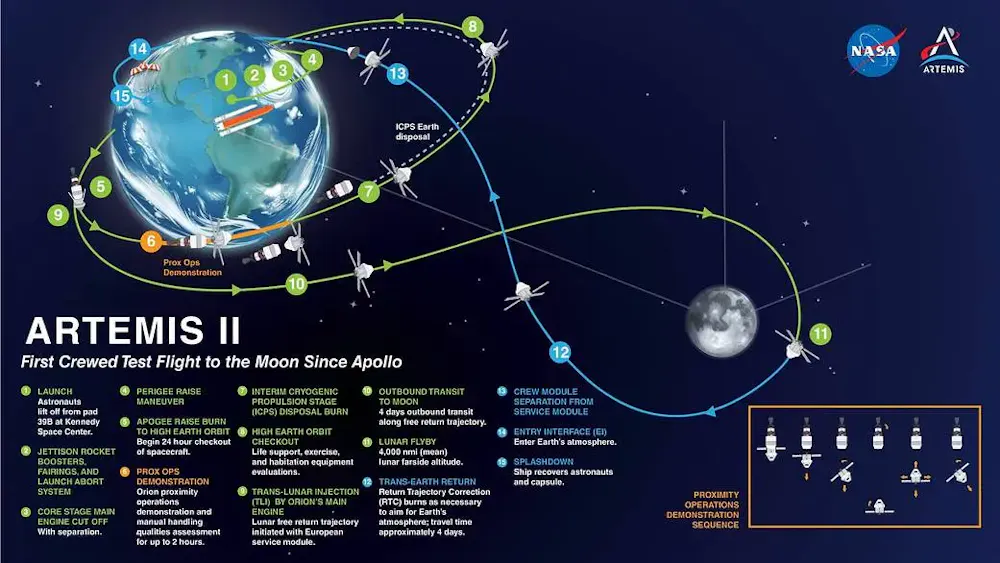
A diagram showing the trajectory of Artemis II and major milestones, from jettisoning its rocket boosters to the crew capsule's separation.
Artemis II’s four-person crew will circle around the Earth and the Moon. NASA

Sending people beyond low Earth orbit requires sustained political commitment to spaceflight, funding stability and systems reliable enough that sovereign and commercial partners can align their own plans around them.

Artemis II also serves as a bridge to Artemis III, the mission where NASA plans to land astronauts near the Moon’s south pole, currently targeted for 2028. A credible, near-term human return signals that the U.S. is moving beyond experimentation and toward a sustained presence.

The Artemis II mission, detailed from launch to splashdown.

2 different models for going back to the Moon

The contrast between U.S. and Chinese lunar strategies is increasingly clear.

China’s program is centrally directed and tightly controlled by the state. Its partnerships are selective, and it has released few details about how activities on the Moon would be coordinated with other countries or commercial actors.

The U.S. approach, by contrast, is intentionally open. The Artemis program is designed so partners, both other countries and companies, can operate within a shared framework for exploration, resource use and surface activity.

This openness reflects a strategic choice. Coalitions among countries and companies expand their capabilities and shape expectations about how activities such as landing, operating surface equipment and using local resources are conducted.

When vague rules start to matter

International space law already contains a framework relevant to this emerging competition. Article IX of the 1967 outer space treaty requires countries to conduct their activities with “due regard” for the interests of others and to avoid harmful interference. In simple terms, this means countries are expected to avoid actions that would disrupt or impede the activities of others.

For decades, this obligation remained largely theoretical. On Earth, however, similarly open-ended rules, particularly in maritime contexts, created international conflicts as traffic on shipping lanes, resource extraction and military activity increased. Disputes intensified as some states asserted claims that extended beyond what international law recognized.

The Moon is now approaching a comparable phase.

As more actors converge on resource-rich regions, particularly near the lunar south pole, due regard becomes an immediate operational question rather than a theoretical future issue. How it is interpreted – whether it means simply staying out of each other’s way or actively coordinating activities – will shape who can operate where, and under what conditions.

Washington is naming the race − without panic

During his second Senate Commerce Committee confirmation hearing, NASA Administrator Jared Isaacman was asked directly about competition with China in lunar exploration. He emphasized the importance of keeping U.S. space efforts on track over time, linking the success of the Artemis program to long-term American leadership in space.

A similar perspective appears in a recent U.S. government assessment, the U.S.-China Economic and Security Review Commission’s 2025 annual report to Congress. Chapter 7 addresses space as a domain of strategic competition, highlighting China’s growing capabilities. The report frames human spaceflight and deep-space infrastructure – including spacecraft, lunar bases and supporting technologies – as part of broader strategic efforts. It emphasizes growing a human space program over time, rather than changing course in response to individual setbacks or the accomplishments of other countries.
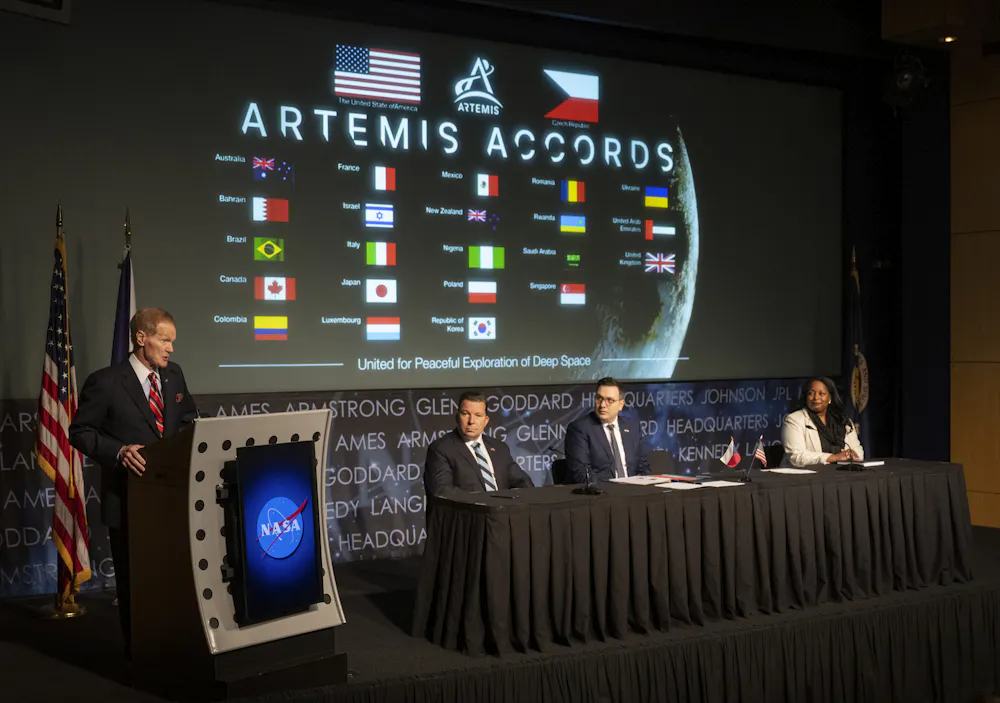
Three people sitting at a panel table and one speaking at a podium with the NASA logo. Projected behind them is a slide reading Artemis Accords, with the flags of several countries.
The U.S. approach to spaceflight is emphasizing international cooperation. Joel Kowsky/NASA via Getty Images

Recent U.S. policy reflects this emphasis on continuity. A new executive order affirms federal support for sustained lunar operations, as well as commercial participation and coordination across agencies. Rather than treating the Moon as a short-term challenge, the order anticipates long-term activity where clear rules, partnerships and predictability matter.

Artemis II aligns with this posture as one step in the U.S.’s plans for sustained activity on the Moon.

A different kind of test

As Artemis II heads toward the Moon, China will also continue to advance its lunar ambitions, and competition will shape the pace and manner of activity around the Moon. But competition alone does not determine leadership. In my view, leadership emerges when a country demonstrates that its approach reduces uncertainty, supports cooperation and translates ambition into a set of stable operating practices.

Artemis II will not settle the future of the Moon. It does, however, illustrate the American model of space activity built on coalitions, transparency and shared expectations. If sustained, that model could influence how the next era of lunar, and eventually Martian, exploration unfolds.The Conversation

Michelle L.D. Hanlon, Professor of Air and Space Law, University of Mississippi

This article is republished from The Conversation under a Creative Commons license. Read the original article.
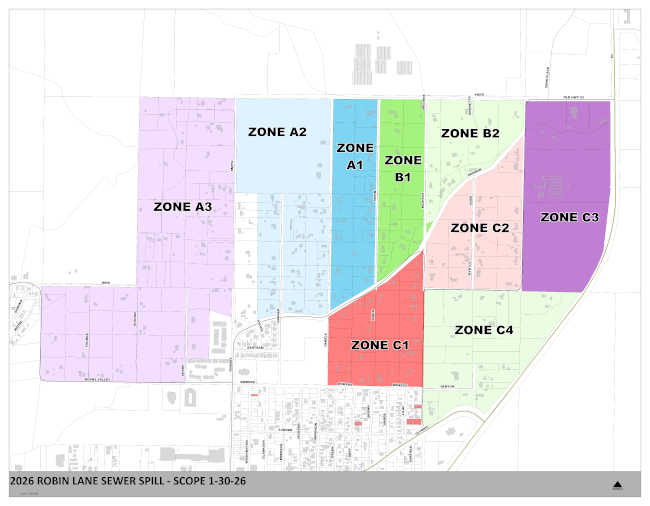
Clearlake sewer spill area expanded; more water tanks installed

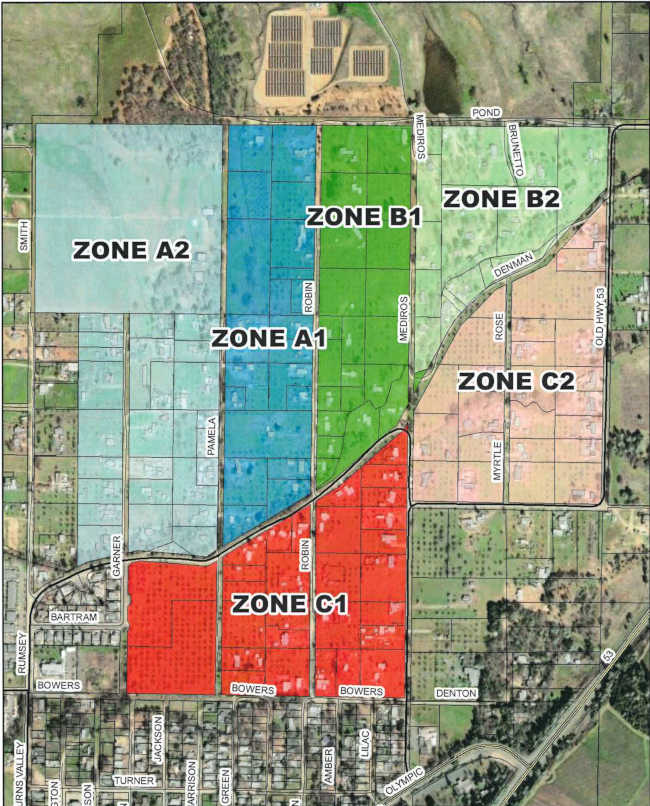
A new map of the expanded 2026 Robin Lake Sewer Spill impact area issued on Friday, Jan. 30, 2026. 


LAKE COUNTY, Calif. — Officials on Friday said they have expanded the incident area for a massive sewer spill in the northern part of Clearlake as a precautionary measure.

Sunday will mark three weeks since a Lake County Sanitation District-owned force main rupture triggered the Robin Lane sewer spill, which released nearly three million gallons of raw sewage into streets and across private properties.

On Monday, the city of Clearlake began managing the recovery phase of the incident in unified command with the Lake County Sheriff’s Office of Emergency Services.

During the week, officials expanded the number of impacted properties from 58 to 200.

By Friday, the unified command said that, based on continued evaluation of groundwater conditions related to the spill, the incident area was expanded as a precautionary measure to ensure the protection of public health.

When the sewer line break was first identified, officials said an initial impact area was established based on the information available at that time, including where groundwater from the shallow aquifer was believed to have the potential to be affected. 

“After further review and consultation with a hydrogeologist, it was determined that groundwater in the area may have moved more laterally than originally anticipated,” the Friday unified command report said.

As a result, unified command expanded the incident area to include additional residents who rely on private wells drawing from the shallow aquifer. 

Three new incident zones were created for properties north of Burns Valley Road that are east of Reid Lane and south of Pond Road, which comprise the new Zone A3, and properties north of Olympic Drive that are east of Old Highway 53, and west of Highway 53, which are included in zones C3 and C4.

Those zone changes — which bring the total number of zones to nine — resulted in the new incident area growing from about 297 acres to an estimated 550 acres, based on an analysis of the city map released by city and county officials.

“Inclusion in the expanded area does not mean contamination has been confirmed at a property. The expansion is intended to ensure that all areas that could potentially be affected receive appropriate guidance, testing and support,” officials said.

Following the recommendation of Public Health Officer Dr. Robert Bernstein, residents within the expanded area are advised not to use their well water until water sampling and laboratory testing have been completed and results confirm the water is safe for use, according to the Friday report.

Officials said Friday that additional groundwater testing and evaluation will continue as part of the ongoing response, and residents will be notified directly about testing and next steps as more information becomes available.

Friday’s recovery update also included new figures for testing, with 151 sites tested and 376 water samples completed.

Additionally, 25 water tanks have now been installed, 18 of them by the incident management team and seven through a program administered by Lake County Social Services.

For residents without water, the mobile laundry and hygiene service trailer is located at 2485 Old Highway 53 in Clearlake.

Residents with questions may contact Lake County Environmental Health at 707-263-1164 for well testing and the city of Clearlake at 707-994-8201 for general information. 

Updates, maps, testing information and available resources are available at the city of Clearlake's website or Response.LakeCountyCA.gov. 

Email Elizabeth Larson at This email address is being protected from spambots. You need JavaScript enabled to view it.. Follow her on Twitter, @ERLarson, and on Bluesky, @erlarson.bsky.social. Find Lake County News on the following platforms: Facebook, @LakeCoNews; X, @LakeCoNews; Threads, @lakeconews, and on Bluesky, @lakeconews.bsky.social. 

Authorities identify subjects killed in Jan. 23 crashes

LAKE COUNTY, Calif. — Authorities have released the names of two people who died in separate crashes last week.

The Lake County Sheriff’s Office said Richard Orvis Evens, 63, Kelseyville died in a vehicle crash on Big Valley Road in Kelseyville and Thalia Inez Ugaz, 23, Stockton was hit and killed by a vehicle while crossing Highway 29 in Nice on Friday, Jan. 23.

The two crashes occurred two hours apart.

At 5:25 p.m. Jan. 23, the California Highway Patrol’s Ukiah Dispatch Center broadcast a call of a solo vehicle crash on Big Valley Road east of Renfro Drive, the CHP reported.

Responding units determined Evens was driving a gray Honda CR-V west on Big Valley Road when, for unknown reasons, he failed to negotiate the curve of the roadway. 

The CHP said Evens drove the Honda off the road and the front of the Honda crashed into a ditch south of Big Valley Road. 

The Honda cartwheeled multiple times and came to rest on its wheels south of Big Valley Road and east of Renfro Drive facing an easterly direction, the CHP said.

The CHP said preliminary evidence suggests Evens was not wearing a seatbelt during the crash. 

He was pronounced dead at the scene, the CHP said.

The CHP said Friday that it remains unknown if drugs and/or alcohol were factors in the crash.

Just two hours after the Evens crash, the CHP responded to a call for a pedestrian hit by a vehicle on Highway 20, west of Howard Avenue in Nice.

Ugaz was found lying in the roadway, unresponsive. A CHP officer administered aid by Ugaz died of her injuries at the scene, the CHP said.

The CHP said the preliminary investigation showed that Ugaz was crossing Highway 20 from south to north, within a crosswalk at Howard Avenue, when she was hit by a gray 2012 Honda Ridgeline being driven westbound on Highway 20 by Brannon Keller, 64, of Clearlake.

Keller was not under the influence of drugs or alcohol and was released from the scene, while the CHP said it was not yet known if Ugaz was under the influence of any substance when the crash occurred.

Email Elizabeth Larson at This email address is being protected from spambots. You need JavaScript enabled to view it.. Follow her on Twitter, @ERLarson, and on Bluesky, @erlarson.bsky.social. Find Lake County News on the following platforms: Facebook, @LakeCoNews; X, @LakeCoNews; Threads, @lakeconews, and on Bluesky, @lakeconews.bsky.social. 

California Commission on the Status of Women and Girls launches 2026 Girls Agenda

The California Commission on the Status of Women and Girls, or CCSWG, announced the release of the 2026 Girls Agenda, a comprehensive statewide policy roadmap created by the commission’s Youth Advisory Council.

Developed by 17 youth commissioners representing communities across California, the Girls Agenda outlines urgent priorities in education and workforce development, health and access, and safety and prevention. Each section is grounded in current data, lived experience and the realities girls face every day.

“The Girls Agenda is more than a report; it is a call to action,” said Chair of the CCSWG Youth Advisory Council Nicole Kim. “Girls are navigating challenges from food insecurity and mental health struggles to inequitable access to STEM education and unsafe environments. This agenda reflects our vision for a California where every girl can grow up safe, healthy, and able to pursue the education and opportunities that shape her future.”

The Girls Agenda highlights the systemic barriers that continue to affect the lives of girls statewide, including the high cost of childcare, underrepresentation in STEM fields, rising rates of depression among teen girls, food insecurity, menstrual inequity, and persistent threats to safety. 

The Girls Agenda also identifies gaps in existing policy implementation, such as uneven enforcement of menstrual equity laws and limited access to mental health resources in rural and low-income communities.

“This work is essential because the challenges facing girls today are complex and interconnected,” said Chair of the CCSWG Dr. Rita Gallardo Good. “Girls are sharing their needs with us, and The Girls Agenda ensures that their voices will guide our policy priorities. By uplifting girls’ voices, we strengthen the future of every community in California.”

Key recommendations in The Girls Agenda include:

• Expanding access to computer science and STEM courses;
• Strengthening childcare support for teen parents;
• Improving nutrition and eating disorder education in schools;
• Enforcing menstrual equity laws;
• Increasing mental health resources; and
• Enhancing Title IX protections and violence prevention education.

The Girls Agenda also calls for youth-centered approaches to digital safety, reproductive health access, and teen dating violence prevention.

“Our Youth Advisory Council has done extraordinary work,” said Executive Director of the CCSWG Darcy Totten. “Their leadership, insight, and honesty have shaped a powerful blueprint for change. The Girls Agenda is a reminder that when we listen to girls, we can help them create policies that reflect their lived realities and support our collective future. This effort continues the Commission’s commitment to ensuring girls’ voices remain central to statewide decision-making and that those most impacted by policy have a seat at the table to help design it.”

The commission will use The Girls Agenda to guide its policy advocacy and programming throughout 2026 and will partner with state agencies, legislators and community organizations to advance the recommendations.

The California Commission on the Status of Women and Girls recognizes that youth aren’t just the leaders of tomorrow — they’re powerful changemakers today. 

The commission’s Youth Advisory Council provides young Californians (ages 14–20) with a meaningful platform to engage with the commission’s legislative work and help shape and elevate policies that impact their lives. 

Through this council, youth connect with other youth across the state, develop advocacy and leadership skills, obtain hands-on experience with California’s policy process, participate in mentorship, and have transformative conversations about the needs of our state’s young people.  

For more than 50 years, the California Commission on the Status of Women and Girls has identified and worked to eliminate inequities in state laws, practices, and conditions that affect California’s women and girls. Established as a state agency with 17 appointed commissioners in 1965, the Commission regularly assesses gender equity in health, safety, employment, education, and equal representation in the military, and the media. The Commission provides leadership through research, policy and program development, education, outreach and collaboration, advocacy, and strategic partnerships. Learn more at www.women.ca.gov. 

Space News: Rural areas have darker skies but fewer resources for students interested in astronomy – telescopes in schools can help

Observing the night sky can get kids interested in astronomy and STEM careers. Jeremy Thomas/Unsplash

The night sky has long sparked wonder and curiosity. Early civilizations studied the stars and tracked celestial events, predicted eclipses and used their observations to construct calendars, develop maps and formulate religious rituals.

Scholars widely agree that astronomy is a gateway science – that it inspires a core human interest in science among people of all ages, from senior citizens to schoolchildren. Helping young people tap into their excitement about the night sky helps them build confidence and opens career pathways they may not have considered before.

Yet today the night sky is often hidden from view. Almost all Americans live under light-polluted skies, and only 1 in 5 people in North America can see the Milky Way. When people live in areas where the night sky is clearer, they tend to express a greater wonder about the universe. Altogether, this means communities with less light pollution have great potential to educate the next generation of scientists.

Rural communities have some of the darkest skies in the country, making them perfect for stargazing. Yet while students in rural areas are in the optimal physical environment to be inspired by the night sky, they are the most in need of science, technology, engineering and mathematics, or STEM, education resources to support their interests and build the confidence they need to pursue careers in science.

Stargazing, finding constellations and watching meteor showers as a kid inspired my own sense of awe around the vastness of space and possibilities in our universe. Now, I’m the executive director of the Smithsonian’s Scientists Taking Astronomy to Rural Schools, or STARS, a new program led by the Smithsonian Astrophysical Observatory, part of the Center for Astrophysics | Harvard & Smithsonian, that delivers telescopes and associated lesson plans to rural schools across the United States, free of charge. I’m working to share my excitement and wonder with students in rural areas.

The Sun, partially blocked by the Moon.
A solar eclipse, as viewed through a telescope. STARS

Why hands-on STEM learning matters

Students need direct exposure to STEM careers and hands-on experiences that help them learn the skills they will need to pursue these careers on their own. Hands-on activities ground new knowledge in ways that lectures and reading often cannot. Experiential opportunities connect what may be distant or abstract concepts to clear, tangible, real-world skills. This experiential learning improves students’ understanding of astronomy content and increases their motivation to learn.

Telescopes are important tools for astronomy that scientists use all the time. When students use telescopes as part of their learning, they are experiencing real techniques that scientists use. Using a telescope brings the viewer closer to fantastic celestial objects – allowing them to see galaxies, nebulas, planets, the Moon and the Sun, with solar filter protection, more closely or in greater detail.

A full Moon, tinged orange from sunlight, during a lunar eclipse.
Telescopes help students view astronomical objects, like the Moon, up close. STARS

There is nothing quite like seeing the soaring peaks and shadowed valleys of the Moon, or the distinct ring structure of Saturn, or endless other astronomical objects, through a telescope lens. This inspiration can motivate students to use their curiosity to explore the universe and see STEM careers as potential pathways.

Rural STEM education

The National Rural Education Association’s Why Rural Matters 2023 report estimates that there are 9.5 million students attending school in rural areas in the U.S., across more than 32,000 schools. This is more students than the student population of the 100 largest U.S. school districts combined.

While rural communities around the country all look different, they can face similar challenges: limited access to broadband internet, reduced state funding support and restricted geographical access to field trip opportunities, such as museums. Why Rural Matters found, on average, that 13.4% of rural households have a limited internet connection, and for some states this increases to 20%.

Each state distributes their education funding differently. The percentage allocated to rural schools varies from state to state, ranging from 5% to 50% of the total funding, which results in a wide range of money spent per student. Nonrural districts spend an average of US$500 more per student than rural districts. Looking state by state, however, this disparity climbs into the thousands of dollars.

Given their remote locations, rural areas host only 1 in 4 museums in the United States. Only 12% of children’s museums are in rural areas.

Educators may also consider STEM topics daunting. Many teachers do not feel adequately prepared or confident to introduce these topics to students. In other situations, there simply aren’t enough teachers to cover these topics. Shortages of STEM-focused teachers occur at some of the highest rates in rural districts, reducing rural students’ access to these subjects.

These reasons are why, through the STARS program, we give teachers access to a national community of practice that supports peer sharing and participation, alongside the telescope and science-aligned lesson plans. The lesson plans will be available online for anyone to use later this spring, whether or not they are part of the program.

STARS isn’t the only program connecting students with the night sky. Teachers, parents and students can also participate in national activities such as Observe the Moon Night and Globe at Night, and local activities, like their local amateur astronomy clubs.

A starry sky, silhouetted by trees.
Rural areas farther from cities tend to have darker skies, better for stargazing. Ryan Hutton/Unsplash

Opportunities to observe the sky with telescopes lead to an improvement in learning outcomes and STEM identity, and rural schools are uniquely situated to introduce students to the night sky. With a little extra support, through community events and educational programs, these schools have the opportunity to inspire the next generation of scientists and engineers.The Conversation

Emma Marcucci, Executive Director of STARS, Smithsonian Astrophysical Observatory, Smithsonian Institution

This article is republished from The Conversation under a Creative Commons license. Read the original article.

Sewer spill response: More tanks installed, tests completed

A map of the 2026 Robin Lane Sewer Spill area divided into zones. Courtesy of the city of Clearlake.


LAKE COUNTY, Calif. — Officials reported progress on Thursday in the continued water testing and tank placement in the neighborhoods impacted by a massive sewage spill that occurred earlier this month.

The city of Clearlake and the Lake County Office of Emergency Services, or Lake County OES, entered into unified command on Monday in managing the response to the Robin Lane sewer spill, which began on Jan. 11.

That management includes coordinating testing, resources and public updates as the recovery efforts continue, officials reported.

The spill, the result of a 16-inch force main rupture, lasted more than 38 hours and resulted in an estimated 2.9 million gallons of sewage being released, with impacts extending over a roughly 300-acre area. 

Public Health Officer Dr. Bob Bernstein urged residents of the spill area who rely on well water to temporarily relocate until their wells have been deemed safe following testing.

The Lake County Sanitation District, overseen by Lake County Special Districts, operates the sewer system that failed.

Initially, Special Districts was leading the response, but this week the management transitioned to the city and OES.

Officials told community members at a Wednesday night town hall that their goal is to get people back to normal as soon as possible.

The city said response efforts have moved from emergency containment to coordinated recovery and monitoring, with assessment and testing teams working across the six zones into which the spill area has been split.

“Sewer infrastructure has been stabilized, environmental assessments have been completed, and private well testing is ongoing across all zones, with each zone tested at least once and continued follow-up sampling underway,” the city reported.

The response has included providing potable water tanks, water deliveries, mobile laundry and hygiene services, and temporary shelter support to residents and animals, according to the Thursday report.

With the change in leadership, more information has become available this week, including an updated number of impacted properties — from the initial estimate of 58 to 200.

On Thursday, the city of Clearlake reported that the unified command’s teams had tested another 151 sites, bringing the total of water samples completed to 310.

To date, the total number of water tanks installed has risen to 19. Of those, 12 were installed by the incident team and the seven others were installed by a program overseen by Lake County Social Services.

The city of Clearlake’s website has a webpage dedicated to the incident. 

Additional information requests about the incident can be directed to Administrative Services Director/City Clerk Melissa Swanson, who also is acting as the incident’s public information officer, at 707-994-8201, Extension 106, or This email address is being protected from spambots. You need JavaScript enabled to view it..

Lake County Special Districts can be reached at 707-263-0119.

Email Elizabeth Larson at This email address is being protected from spambots. You need JavaScript enabled to view it.. Follow her on Twitter, @ERLarson, and on Bluesky, @erlarson.bsky.social. Find Lake County News on the following platforms: Facebook, @LakeCoNews; X, @LakeCoNews; Threads, @lakeconews, and on Bluesky, @lakeconews.bsky.social. 

  • 9
  • 10
  • 11
  • 12
  • 13
  • 14
  • 15
  • 16
  • 17
  • 18

Community

  • Lake County Wine Alliance offers sponsor update; beneficiary applications open 

  • Mendocino National Forest announces seasonal hiring for upcoming field season

Public Safety

  • Lakeport Police logs: Thursday, Jan. 15

  • Lakeport Police logs: Wednesday, Jan. 14

Education

  • Woodland Community College receives maximum eight-year reaffirmation of accreditation from ACCJC

  • SNHU announces Fall 2025 President's List

Health

  • California ranks 24th in America’s Health Rankings Annual Report from United Health Foundation

  • Healthy blood donors especially vital during active flu season

Business

  • Two Lake County Mediacom employees earn company’s top service awards

  • Redwood Credit Union launches holiday gift and porch-to-pantry food drives

Obituaries

  • Rufino ‘Ray’ Pato

  • Patty Lee Smith

Opinion & Letters

  • The benefits of music for students

  • How to ease the burden of high electric bills

Veterans

  • CalVet and CSU Long Beach team up to improve data collection related to veteran suicides

  • A ‘Big Step Forward’ for Gulf War Veterans

Recreation

  • Wet weather trail closure in effect on Upper Lake Ranger District

  • Mendocino National Forest seeking public input on OHV grant applications

  • State Parks announces 2026 Anderson Marsh nature walk schedule 

  • BLM lifts seasonal fire restrictions in central California

Religion

  • Kelseyville Presbyterian to host Ash Wednesday service and Lenten dinner Feb. 18

  • Kelseyville Presbyterian Church to hold ‘Longest Night’ service Dec. 21

Arts & Life

  • Auditions announced for original musical ‘Even In Shadow’ set for March 21 and 28

  • ‘The Rip’ action heist; ‘Steal’ grounded in a crime thriller

Government & Politics

  • Lake County Democrats issue endorsements in local races for the June California Primary

  • County negotiates money-saving power purchase agreement

Legals

  • March 3 hearing on ordinance amending code for commercial cannabis uses

  • Feb. 12 public hearing on resolution to establish standards for agricultural roads

How to resolve AdBlock issue?
Refresh this page