How to resolve AdBlock issue?
Refresh this page
How to resolve AdBlock issue?
Refresh this page
Lake County News,California
  • Home
    • Registration Form
  • News
    • Education
    • Veterans
    • Community
      • Obituaries
      • Letters
      • Commentary
    • Police Logs
    • Business
    • Recreation
    • Health
    • Religion
    • Legals
    • Arts & Life
    • Regional
  • Calendar
  • Contact us
    • FAQs
    • Phones, E-Mail
    • Subscribe
  • Advertise Here
  • Login

News

CHP’s Clear Lake Area office welcomes new officer

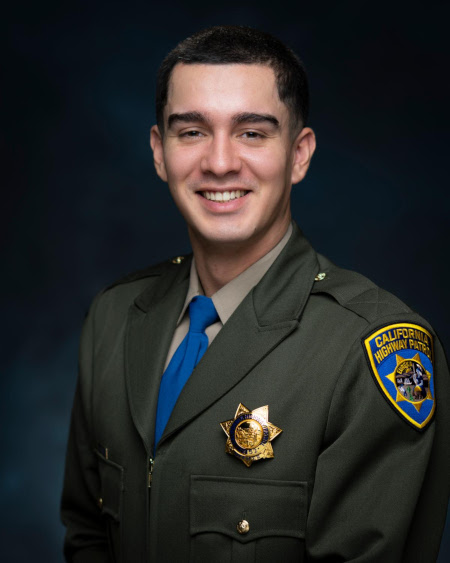
California Highway Patrol Officer Dante Ramirez has joined the agency’s Clear Lake Area office in Kelseyville, California. Photo courtesy of the CHP.


LAKE COUNTY, Calif. – The California Highway Patrol’s Clear Lake Area office is welcoming its newest officer.

Dante Ramirez of Crescent City has successfully completed cadet training at the California Highway Patrol Academy.

He is assigned to duty at the CHP's Clear Lake Area office, located in Kelseyville.

Officer Ramirez graduated from Del Norte High School in 2020. 

Before attending the CHP Academy, he worked as an apprentice carpenter at Fern Hook Cabins. 

He is proud of himself and his roommates for overcoming the academy's challenges.

At the CHP Academy, cadet training starts with nobility in policing, leadership, professionalism, ethics, and cultural diversity. Training also includes mental illness response and crisis intervention techniques. 

Cadet instruction covers patrol operations, crash investigation, first aid, and the arrest of suspected violators, including those who drive under the influence of alcohol or drugs. 

During their six months of training, the cadets also receive training in traffic control, report writing, recovery of stolen vehicles, assisting the motoring public, issuing citations, emergency scene management, and knowledge of various codes, including the Vehicle Code, Penal Code and Health and Safety Code.

Ramirez was one of 129 new officers who graduated from the Academy on Friday.

“These new officers represent the future of public safety in California. The badge they were given is on loan from the people of this state, and every day they must earn the right to wear it through professionalism, ethical conduct and accountability to the public they serve,” said CHP Commissioner Sean Duryee.

CHP Commissioner Sean Duryee, at left, speaks to a newly graduated officer on Friday, Feb. 6, 2026. Photo courtesy of the CHP.

Tribes cite ongoing federal review and judicial warnings in opposing Scotts Valley ‘preview casino’ in Vallejo


NORTHERN CALIFORNIA — The Yocha Dehe Wintun Nation, the Kletsel Dehe Wintun Nation, the Lytton Rancheria of California, and the United Auburn Indian Community this week expressed serious concern as the Scotts Valley Band of Pomo Indians moves toward opening a temporary “preview casino” in Vallejo, while the U.S. Department of the Interior continues an active reconsideration of the project’s gaming eligibility.

The group said that any move to proceed at this time would come despite a clear warning from the federal court overseeing the matter that Scotts Valley would be “ill-served” by relying on the temporary restoration of gaming eligibility while the Department completes its reconsideration, which the court has directed be conducted expeditiously and thoroughly.

“The court was explicit that its ruling should not be viewed as a green light to proceed with gaming activity while the federal review is ongoing,” said Anthony Roberts, chairman of the Yocha Dehe Wintun Nation. “Moving forward with this short-term cash grab ignores the Court’s warning, disrespects the reconsideration process, and jeopardizes the City of Vallejo’s limited public safety and other resources for its citizens.”

Lake County News reached out to a representative for Scotts Valley but so far has not received a response.

The tribes emphasized that the issue is not competition, but respect for the rule of law, tribal sovereignty, and the integrity of the federal review process, particularly where significant questions remain about gaming eligibility, historical connection to the land, and potential environmental and cultural impacts.

“Our concern here is specific and process-based,” said Chairman Wright of the Kletsel Dehe Wintun Nation. “Where the Department of the Interior is actively reconsidering gaming eligibility, and the court has cautioned against reliance on interim decisions, moving forward with gaming activity at this site before that review is complete risks undermining trust in the process and creating avoidable conflict among tribes and local communities.” 

“This is not about opposing economic development,” said Chairperson Andy Mejia of the Lytton Rancheria of California. “It is about ensuring that development occurs lawfully, responsibly, and in a manner that honors tribal history and federal law. Proceeding with a casino, even a so-called ‘preview’ facility, while the Department of the Interior is actively reconsidering its own decision risks undermining the integrity of the federal review process.”

The tribes noted that the Department of the Interior has explicitly acknowledged that its earlier approval may have been based on legal error. They further noted that substantial evidence submitted by local tribes was not considered, raising serious questions about whether the Vallejo site qualifies for gaming under the Indian Gaming Regulatory Act.

“Rushing forward in the face of unresolved legal questions does not create certainty or shared prosperity,” said Chairman John Williams of the United Auburn Indian Community. “It puts Vallejo, the Tribe, and neighboring communities in an untenable position if the Department ultimately determines that the land is not eligible for gaming.”

The tribes reiterated their call for the Scotts Valley Band to pause any gaming operations until the federal reconsideration is complete and a final, lawful determination is issued.

“We respect the sovereignty of all Tribes,” the joint statement concluded. “That respect includes honoring the courts, the federal process, and the rights of neighboring tribes whose ancestral, cultural, and historical ties to this land are at stake.”

What Olympic athletes see that viewers don’t: Machine-made snow makes ski racing faster and riskier – and it’s everywhere

U.S. skier Rosie Brennan leads a group during the women’s team sprint classic cross-country skiing competition at the 2022 Winter Olympics. AP Photo/Aaron Favila

When viewers tune in to the 2026 Winter Olympics, they will see pristine, white slopes, groomed tracks and athletes racing over snow-covered landscapes, thanks in part to a storm that blanketed the mountain venues of the Italian Alps with fresh powder just in time.

But at lower elevations, where cross-country and other events are held, athletes and organizers have been contending with rain; thin, sometimes slushy snow; and icy, machine-made surfaces.

“Most of our races are on machine-made snow,” 2026 U.S. Olympic team cross-country skier Rosie Brennan told us ahead of the Games. “TV production is great at making it look like we are in wintry, snowy places, but this year has been particularly bad.”

A male skier races down a slick track with flags flying along the wall beside him
Machine-made snow increasingly makes the Winter Games possible. It’s also slicker to race and harder to fall on. Here, Olympic skier Ben Ogden of the U.S. competes during the sprint of the FIS Cross-Country World Cup Tour de Ski in Toblach, Italy, on Dec. 28, 2024. Federica Vanzetta/NordicFocus/Getty Images

As scientists who study mountain snow, water resources and the human impact of warming winters, we see winter’s changes through data: rising temperatures, shrinking snowpack, shorter snow seasons.

Olympic athletes experience changing winter conditions personally, in ways the public and scientists rarely do. Lack of snowfall and more frequent rain affect when and where they can train, how they train and how dangerous the terrain can become.

We talked with Brennan and cross-country skiers Ben Ogden and Jack Young as they were preparing for the 2026 Winter Games. Their experiences reflect what many athletes describe: a sport increasingly defined not by the variability of natural winter but by the reliability of industrialized snowmaking.

What the cameras don’t show

Snowmaking technology makes it possible to create halfpipes for freestyle snowboarding and skiing competitions. It also allows for races when natural snow is scarce – the 2022 Winter Olympics in Beijing relied entirely on machine-made snow for many races.

However, machine-made snow creates a very different surface than natural snow, changing the race.
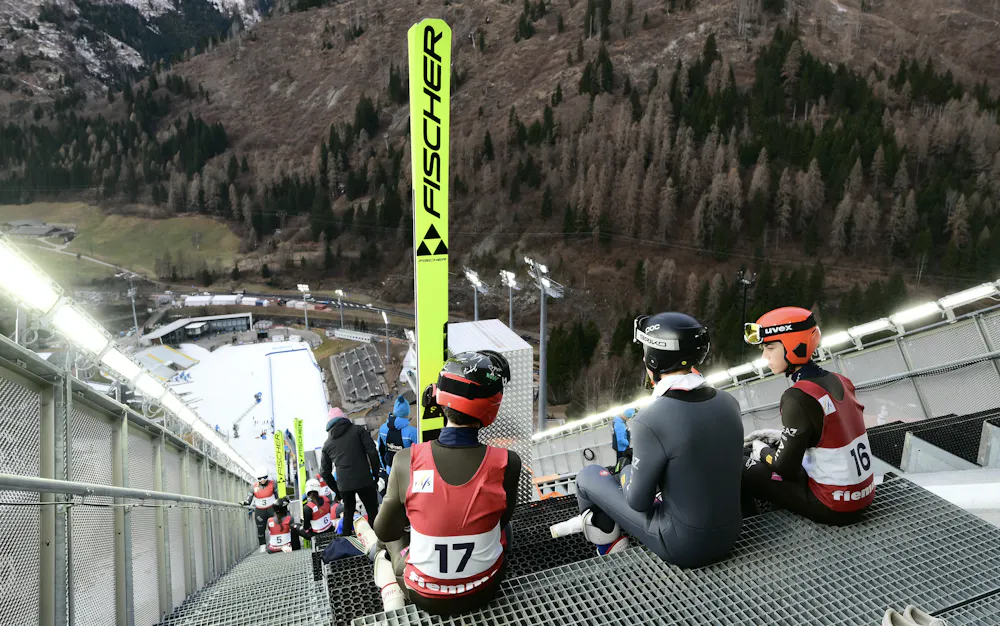
Three skiers sit at the top of a ski jump. Their view shows how much dry, snow-free ground is around the jump area
Athletes train at the ski jumping arena prior to the Open Italian Championship in Predazzo, a 2026 Winter Olympics venue, on Dec. 23, 2025. Stefano Rellandini/AFP via Getty Images

In clouds, each unique snowflake shape is determined by the temperature and humidity. Once formed, the iconic star shape begins to slowly erode as its crystals become rounded spheres. In this way, natural snow provides a variety of textures and depths: soft powder after a storm, firm or brittle snow in cold weather, and slushy, wet snow during rain or melt events.

Machine-made snow varies less in texture or quality. It begins and ends its life as an ice pellet surrounded by a thin film of liquid water. That makes it slower to change, easier to shape, and, once frozen, it hardens in place.

‘They’re faster, icier and carry more risk’

When artificial snow is being made, the sound is piercing – a high-pitched hiss roars from the pressurized nozzles of snow guns. These guns spew water mixed with compressed air, and it freezes upon contact with the cold air outside, creating small, dense ice particles. The drops sting exposed skin, as one of us, Agnes Macy, knows well as a former competitive skier.

Snow machines then push out artificial snow onto the racecourse. Often, the trails are the only ribbons of snow in sight – a white strip surrounded by brown mud and dead grass.

Female skiers race through a town with a church beside them, fans along the track and lots of snow-free ground outside the snowy race course.
The surrounding landscape was mostly snow-free when Rosie Brennan competed in the individual sprint at an FIS Cross-Country World Cup event in Drammen, Norway, on March 3, 2022. Federico Modica/NordicFocus/Getty Images

“Courses built for natural snow feel completely different when covered in man-made snow,” Brennan, 37, said. “They’re faster, icier, and carry more risk than anyone might imagine for cross-country skiing.”

There’s nothing quite like skiing on fresh snow. After a storm brings a blanket of light, fluffy powder, it can almost feel as though you’re floating. The snow is forgiving.

On artificial snow, skiers carry more speed into downhill runs. Downhill racers may relish the speed, but cross-country skis don’t have metal edges like downhill skis do, so step-turning or skidding around fast, icy corners can make an athlete feel out of control. It “requires a different style of skiing, skill sets and strengths than I grew up learning,” Brennan said.

How athletes adapt, with help from science

Athletes must adjust their technique and prepare their skis differently, depending on the snow conditions.

At elite levels, this is science. Snow crystal morphology, temperature, ski base material and structure, ski stiffness, skier technique and environmental conditions all interact to determine an athlete’s speed.

How snow forms. NBC News Learn.

Before cross-country, or Nordic, races, ski technicians compare multiple ski pairs prepared with different base surfaces and waxes. They evaluate how quickly each ski glides and how long it maintains that glide – traits that depend on the friction between the ski and the snow.

Compared to natural snow, machine-made snow generally provides a more durable and longer-lasting surface. In cross-country racing, that allows for more efficient and stronger pushes without skis or poles sinking deep into snow. Additionally, improvements in the machines used to groom snow now provide harder and more homogeneous surfaces that permit faster skiing.

Two male skiers on tangled on the ground after a crash.
Russia’s Alexander Terentev, right, and Czech Republic’s Michal Novak crash during a men’s cross-country sprint quarterfinal race at the FIS Nordic World Ski Championships in Oberstdorf, Germany, on Feb. 25, 2021. AP Photo/Matthias Schrader

While fast skiing is the goal, ski crashes are also the most common cause of injury in the Winter Olympics. With machine-made snow, ski jump competitors and anyone who falls is also landing on a harder surface, which can increase the risk of injury.

Why winters are changing

Weather can always deal surprises, but long-term climate trends are shifting what can be expected of a typical winter.

In the Alps, air temperature has increased by about 3.6 degrees Fahrenheit (2 degrees Celsius) since the late 1800s, before rising fossil fuel use began increasing the levels of greenhouse gases trapping heat in the atmosphere. Globally, 2025 was the third-warmest year on record, following 2024 and 2023.

For mountain regions, these warmer conditions have consequences. Snow melts earlier and more frequently in midwinter, especially during warm spells that used to be rare.

Midwinter snowmelt events are occurring more often at higher elevations and earlier in the season across many mountain ranges of western North America. At the same time, the snow line – the elevation where precipitation shifts from snow to rain – is moving upslope.

Warming in high mountain environments is also causing the threshold where rain turns to snow to rise by tens of meters per decade in some regions. This means storms that once blanketed entire valleys in snow now may deliver snow only to upper slopes, with rain falling below.

Male ski racers turn a corner on a race course.
Taking sharp corners on icy surfaces isn’t easy on cross-country skis. Here, U.S. Olympic skier Jack Young competes in the individual sprint finals of the FIS Cross-Country World Cup Oberhof on Jan. 17, 2026, in Oberhof, Germany. Leo Authamayou/NordicFocus/Getty Images

Together, these changes mean that many winter storms produce less snow, over less area, and for shorter durations than they did a generation ago.

Training venues

The changing winter landscape has also transformed how athletes train. Traditional training venues, such as glaciers once used for summer skiing, have become unreliable. In August 2025, the Hintertux Glacier – the only year-round training center operating in Austria – announced its first temporary closure.

“It’s been increasingly hard to make plans for locations to train between races,” Brennan said. “Snow reliability isn’t great in many places. We often rely on going to higher elevations for a better chance of snow.”

Athletes race on short skis on wheels.
Biathlon athletes practice their sport on wheels at the Loop One Festival in Munich’s Olympic Park on Oct. 19, 2025. Sven Hoppe/picture alliance via Getty Images

Higher-elevation training can help, but it concentrates athletes in fewer places, reduces access for younger skiers due to the remoteness and raises costs for national teams. Some of these glaciers – like Canada’s Haig Glacier or Alaska’s Eagle Glacier – are accessible only by helicopter. When skiers can’t get to snow, dryland training on rollerskis is one of the only options.

Winter athletes see the climate changing

Because winter is their workplace, athletes often notice subtle changes before those changes show up in long-term statistics.

Even athletes in their earlier 20s, like Young, said they have noticed the rapid expansion of snowmaking infrastructure at many racing venues in recent years. Snowmaking requires large amounts of energy and water. It is also a clear sign that organizers see winters becoming less dependable.

Winter athletes like Canadian Dahria Beatty are seeing their environment change as temperatures rise.

Athletes also witness how communities are affected when poor snow conditions mean fewer visitors. “In the Alps, when conditions are bad, it is obvious how much it affects the communities,” Ogden, 25, said. “Their tourism-based livelihoods are so often negatively affected, and their quality of life changes.”

Many winter athletes are speaking publicly about their concerns. Groups such as Protect Our Winters, founded by professional snowboarder Jeremy Jones, work to advance policies that protect outdoor places for future generations.

A wintry look, but an uncertain future

For athletes at the 2026 Olympics, the variability within the Olympic region – snow at higher elevations, rain at lower ones – reflects a broader truth: The stability of winter is diminishing.

Athletes know this better than anyone. They race in it. They train in it. They depend on it.

The Winter Games will go on this year. The snow will look good on television. But at the same time, winter is changing.The Conversation

Keith Musselman, Assistant Professor in Geography, Mountain Hydrology, and Climate Change, University of Colorado Boulder and Agnes Macy, Graduate Student in Geography, University of Colorado Boulder

This article is republished from The Conversation under a Creative Commons license. Read the original article.

Estate Planning: Using the right estate planning approach

Dennis Fordham. Courtesy photo.
Estate planning can involve a wide variety of asset types, such as, money, stocks and bonds, real estate, life insurance, personal property, and sometimes business interests. 

How these different assets are managed during the owner’s life and later distributed at death depends on the asset type, the person’s situation and estate planning approaches used. It may also depend on any existing court orders, such as from family court proceedings.

Does the asset or a court order restrict the owner’s options? Retirement accounts (e.g., 401(k) and Individual Retirement Accounts), for example, cannot be transferred to the participant’s trust.

They can be managed by the participant’s agent under a power of attorney and ultimately passed to the participant’s surviving designated death beneficiaries.

Also, a family court order may require certain estate planning to be in place for a minor. 

However, if there is no living death beneficiary who is named to inherit some or all of the retirement account then some or all of the account may pass under the deceased participant’s will or, failing a will, under the laws of intestate succession to the participant’s heirs. 

This is yet another reason why a will is always needed even when one has a trust and designated death beneficiary accounts because unforeseen events may upset the intended estate planning approach.

Do the circumstances of one or more death beneficiaries limit the estate planning options? For example, are one or more beneficiaries underaged minors, incapacitated persons, receiving needs based welfare benefits, or unable to manage inheritances for one reason or another? If so, then such person’s inheritances are usually held in further trust that can be designated as a beneficiary to receive any and all inheritance assets. Such trusts are drafted to meet the situation.

If real property is involved then a trust, or perhaps a Transfer on Death (“TOD”) beneficiary deed, is usually appropriate in order to avoid either a full probate court proceeding or at least a court petition to determine ownership of a decedent’s primary residence. 

Alternatively a joint tenancy or a life estate deed may be sufficient, depending on the situation.

If bank and brokerage accounts and personal property are involved, then a will, a power of attorney and pay on death beneficiary bank and transfer on death brokerage accounts may be sufficient estate planning. That depends on the situation of the beneficiaries and the person’s intentions for how they want their assets to be managed and distributed.

If an interest in a going business is involved, then it is typically advisable for the going business to be held in a legal entity such as an LLC, or a corporation or a partnership. Businesses that are operated as sole proprietorships do not continue at the death of the proprietor. The business assets, however, can still be transferred as assets. 

All said, however, if a person owns real property then a living trust is usually still the preferred estate planning vehicle as it allows for lifetime management and distribution of most asset types notably excluding retirement accounts. 

Trusts allow for contingency (‘what if’) planning by providing alternative solutions and special trustee authority to handle unforeseen eventualities, such as alternative beneficiaries and solutions to situations when the beneficiary cannot receive an outright distribution of their inheritance. 

The foregoing brief discussion is not legal advice. 

Dennis A. Fordham, attorney, is a State Bar-Certified Specialist in estate planning, probate and trust law. His office is at 870 S. Main St., Lakeport, California. He can be reached at This email address is being protected from spambots. You need JavaScript enabled to view it. and 707-263-3235.

Space News: NASA’s Artemis II plans to send a crew around the Moon to test equipment and lay the groundwork for a future landing

A banner signed by NASA employees and contractors outside Launch Complex 39B, where NASA’s Artemis II rocket is visible in the background. NASA/Joel Kowsky, CC BY-NC-ND

Almost as tall as a football field, NASA’s Space Launch System rocket and capsule stack traveled slowly – just under 1 mile per hour – out to the Artemis II launchpad, its temporary home at the Kennedy Space Center in Florida, on Jan. 17, 2026. That slow crawl is in stark contrast to the peak velocity it will reach on launch day, over 22,000 miles per hour, when it will send a crew of four on a journey around the Moon.

A rocket launch is always at the mercy of a variety of factors outside of the launch team’s control – from the literal position of the planets down to flocks of birds or rogue boats near the launchpad. While Artemis II is currently planned for March 2026, it may not launch until later in April. In fact, March already represents a small delay from the initially estimated February launch opportunity.

Artemis II’s goal is to send people to pass by the Moon and be sure all engineering systems are tested in space before Artemis III, which will land astronauts near the lunar south pole.

If Artemis II is successful, it will be the first time any person has been back to the Moon since 1972, when Apollo 17 left to return to Earth. The Artemis II astronauts will fly by the far side of the Moon before returning home. While they won’t land on the surface, they will provide the first human eyes on the lunar far side since the 20th century.

To put this in perspective, no one under the age of about 54 has yet lived in a world where humans were that far away from Earth. The four astronauts will orbit the Moon on a 10-day voyage and return through a splashdown in the Pacific Ocean. As a planetary geologist, I’m excited for the prospect of people eventually returning to the Moon to do fieldwork on the first stepping stone away from Earth’s orbit.

A walkthrough of the Artemis II mission, which plans to take a crew around the Moon.

Why won’t Artemis II land on the Moon?

If you wanted to summit Mount Everest, you would first test out your equipment and check to make sure everything works before heading up the mountain. A lunar landing is similar. Testing all the components of the launch system and crew vehicle is a critical part of returning people safely to the surface of the Moon and then flying them back to Earth.

And compared to the lunar surface, Everest is a tropical paradise.

NASA has accomplished lunar landings before, but the 54-year hiatus means that most of the engineers who worked on Apollo have retired. Only four of the 12 astronauts who have walked on the Moon are still alive.

Technology now is also vastly different. The Apollo lunar landing module’s computer only had about 4 kilobytes of RAM. A single typical iPhone photo is a few megabytes in size, over 1,000 times larger than the Apollo lunar landing module’s memory.

The two components of the Artemis II project are the rocket (the Space Launch System) and the crew capsule. Both have had a long road to the launchpad.

The Orion capsule was developed as part of the Constellation program, announced in 2005 and concluded in 2010. This program was a President George W. Bush-era attempt to move people beyond the space shuttle and International Space Station.

The Space Launch System started development in the early 2010s as a replacement vehicle for the Ares rocket, which was meant to be used with the Orion capsule in the Constellation program. The SLS rocket was used in 2022 for the Artemis I launch, which flew around the Moon without a crew. Boeing is the main contractor tasked with building the SLS, though over 1,000 separate vendors have been involved in the rocket’s fabrication.

The Apollo program, too, first sent a crewed capsule around the Moon without landing. Apollo 8, the first crewed spacecraft to leave Earth orbit, launched and returned home in December 1968. William Anders, one of the astronauts on board tasked with testing the components of the Apollo lunar spacecraft, captured the iconic “Earthrise” image during the mission.

The white and blue cloudy Earth is visible above a gray edge of the Moon's surface
The Apollo 8 ‘Earthrise’ image, showing the Earth over the horizon from the Moon. This image, acquired by William Anders, became famous for its portrayal of the Earth in its planetary context. NASA

“Earthrise” was the first time people were able to look back at the Earth as part of a spacefaring species. The Earthrise image has been reproduced in a variety of contexts, including on a U.S. postage stamp. It fundamentally reshaped how people thought of their environment. Earth is still far and beyond the most habitable location in the solar system for life as we know it.

Unique Artemis II science

The Artemis II astronauts will be the first to see the lunar far side since the final Apollo astronauts left over 50 years ago. From the window of the Orion capsule, the Moon will appear at its largest to be about the size of a beach ball held at arm’s length.

Over the past decades, scientists have used orbiting satellites to image much of the lunar surface. Much imaging of the lunar surface has been accomplished, especially at high spatial resolution, by the lunar reconnaissance orbiter camera, LROC.

LROC is made up of a few different cameras. The LROC’s wide angle and narrow angle cameras have both captured images of more than 90% of the lunar surface. The LROC Wide Angle Camera has a resolution on the lunar surface of about 100 meters per pixel – with each pixel in the image being about the length of an American football field.

The LROC narrow angle camera provides about 0.5 to 2 meters per pixel resolution. This means the average person would fit within about the length of one pixel from the narrow angle camera’s orbital images. It can clearly see large rocks and the Apollo lunar landing sites.

If the robotic LROC has covered most of the lunar surface, why should the human crew of Artemis II look at it, at lower resolution?

Most images from space are not what would be considered “true” color, as seen by the human eye. Just like how the photos you take of an aurora in the night sky with a cellphone camera appear more dramatic than with the naked eye, the image depends on the wavelengths the detection systems are sensitive to.

Human astronauts will see the lunar surface in different colors than LROC. And something that human astronauts have that an orbital camera system cannot have is geology training. The Artemis II astronauts will make observations of the lunar far side and almost instantly interpret and adjust their observations.

The proceeding mission, Artemis III, which will include astronauts landing on the lunar surface, is currently scheduled to launch by 2028.

What’s next for Artemis II

The Artemis II crew capsule and SLS rocket are now waiting on the launchpad. Before launch, NASA still needs to complete several final checks, including testing systems while the rocket is fueled. These systems include the emergency exit for the astronauts in case something goes wrong, as well as safely moving fuel, which is made of hydrazine – a molecule made up of nitrogen and hydrogen that is incredibly energy-dense.

Completing these checks follows the old aerospace adage of “test like you fly.” They will ensure that the Artemis II astronauts have everything working on the ground before departing for the Moon.

Editor’s note: This article was updated on Feb. 3, 2026, to represent the next possible launch window shifting into March.The Conversation

Margaret Landis, Assistant Professor of Earth and Space Exploration, Arizona State University

This article is republished from The Conversation under a Creative Commons license. Read the original article.

Officials discuss groundwater contamination, new equipment for residents in sewer spill impact area

Undersheriff Corey Paulich speaks during the sewer spill town hall on Wednesday, Feb. 4, 2026, at City Hall in Clearlake, California. Photo by Lingzi Chen/Lake County News.

CLEARLAKE, Calif. – Residents impacted by the Robin Lane sewage spill will receive home filtration and sanitization systems, officials said Wednesday, as groundwater restoration is expected to take a long time. 

After consulting with experts, including a hydrologist, the incident command team determined that groundwater contamination may persist despite temporary negative well test results for fecal bacteria, officials said at Wednesday’s town hall at Clearlake City Hall. 

“The path to the aquifer being clear – to the extent that our team and Public Health are comfortable saying your water is safe to drink again, for most properties at least – is going to be an extended period of time,” said Clearlake City Manager Alan Flora at the Wednesday town hall meeting. “Probably months.”

Given the length of time to clear the aquifer, Flora said each impacted residence will be offered a “whole-house filtration and sanitation system that includes sediment and carbon filters and a UV filter.” 

These systems are designed to disinfect water that may be "microbiologically unsafe, which is obviously the main issue here,” he said.

“The county will be covering the cost of the systems and the install,” Flora added.

The plan marks a shift from guidance given a week earlier, when officials said a well would be deemed safe for use after two negative test results taken 24 hours apart following sanitation. 

“Even if you got a zero-zero test, there could be the possibility of a reoccurrence,” said Undersheriff Corey Paulich, who also is the deputy director for the Office of Emergency Services. “So we don't want to take that chance – so that's why we kind of abandoned that plan.”

Incident team to offer additional equipment

The recovery efforts led by the city of Clearlake and the Lake County Office of Emergency Services, or Lake County OES, follow a massive sewage spill that began nearly a month ago, on Sunday, Jan. 11.

A 16-inch force main operated by the Lake County Sanitation District – overseen by the Lake County Special Districts – ruptured on Robin Lane, releasing 2.9 million gallons of sewage over a roughly 38-hour period.

The impacted area has expanded from the immediate vicinity of the rupture to about 550 acres – illustrated in a large color map hung on both sides of the Clearlake City Hall meeting room – impacting estimated 164 houses relying on private wells. 

Residents within the impacted zone remain under a public health advisory to avoid using water from their wells, amid ongoing well tests, sanitization and retests. 

According to the city’s latest update on Wednesday, a total of 33 water tanks had been installed to provide impacted residents with sufficient clean water, including eight through Lake County Social Services. The remaining 25 water tanks were installed by the incident management team using funds from the $750,000 approved by the Board of Supervisors on Jan. 21.

A total of 489 water samples had been collected from a total of 151 sites. And a total of 67 wells had been sanitized, up from 65 on Tuesday. 

Flora said Wednesday that the plan is to provide filtration and sanitization systems to all residences within the area that need them.

“We are working to identify contractors that will install those units,” Flora said at the town hall. “We intend to work with a large number of general contractors to complete those installs as soon as possible.”

On Thursday, Flora confirmed that 100 units of these systems had been ordered.

“That is what they have available,” Flora said in a text message to Lake County News. “Needed additional units will be ordered once they are available.”

Impacted residents must submit requests for the filtration and sanitization system through the online portal, Flora said. Residents experiencing difficulty accessing the portal may reach out to the city for assistance. 

Through the same portal, residents may also request water tanks, well testing and bottled water delivery.

“I know there's a lot of frustration out there from folks. It's taken too long to get where we are now,” Flora said during the Clearlake City Council’s meeting Thursday evening, adding that he’s incredibly proud of city staff who have been supporting the recovery effort.

The sewage spill event “is not something that is really the city's responsibility to deal with but we felt that it was imperative to step in and help the folks that do live within our community,” Flora said.

Flora also explained at the Thursday night council meeting that the hydrologist hired to assist in the recovery, who spoke at the Wednesday night town hall, concluded that “it’s unknown at this time how long it will take the sewer plume to dissipate from the aquifer."

The hydrologist: Impact on aquifer, caution to rainstorm

The incident occurred within the Burns Valley groundwater basin, specifically affecting a shallow alluvial aquifer composed of stream gravel and clay, according to Hydrologist Dr. Annjanette Dodd of Northpoint Consulting, hired by the incident command team to study the spill’s impact on the aquifer. 

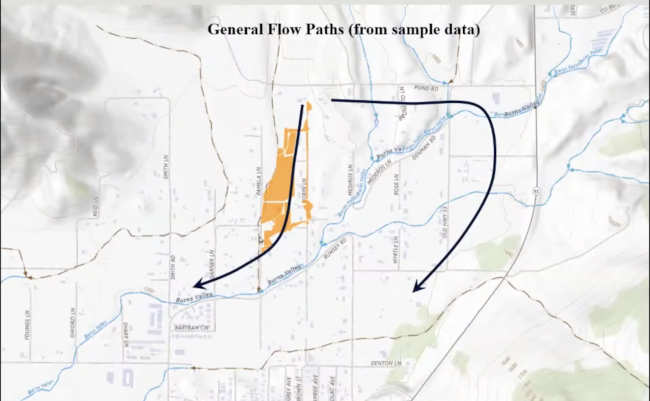
By analyzing aerial imagery and water quality samples over a 21-day period, Dodd identified two primary plume directions: one moving southeast and another moving southwest through the water-bearing gravel layers.

Dodd said the major challenge in her investigation is the lack of pre-spill data, which makes it difficult for her to “really ascertain baseline conditions.” So the assumption of her analysis: “If I see elevated levels of bacteria – there's something going on in that direction.”

A diagram showing the path of water flow in the aquifer in the Robin Lane sewer spill area. Courtesy image.


"Shallow groundwater wells are particularly vulnerable to contamination because they intersect the part of the aquifer system that is closest to the land surface, meaning it's less protected by natural barriers," she said.

Later, Lake County Environmental Health Director Craig Wetherbee said that the average well depth is about 74 feet and they ranged "anywhere between 34 feet to 140 feet.”

“Basically anything less than 100 feet is considered a very shallow well and lightly susceptible to surface water intrusions,” Wetherbee added. 

Dodd advised residents to adopt a proactive defense strategy with their wells: test well water at least once a year – ideally following significant rainfall – and implement point-of-entry treatment systems. Maintaining the physical integrity of wellheads and seals is critical, she said, as any changes in water taste, odor or clarity serve as immediate warning signs that the well’s natural or mechanical barriers have failed.

In response to a resident’s question on her observation of the movement of the plume, “I'm generally seeing things decrease and the plume slowing down,” she said. “I'm waiting for some more samples.”

As the spill plume moves further away from the ruptured force main, “I'm seeing numbers go down, and I'm seeing the spread lesson,” Dodd said. 

“What if we get significant rain?” a resident asked. 

“My intuition: if we get rain, we'll see dilution,” Dodd responded, adding that rainstorms will also cause “mobilization of what’s already there in the aquifer.”

“So after a rainstorm, we're going to want to continue sampling to see what things look like,” she added.

The costs of recovery

Cassandra Hulbert, a ground zero impacted resident living on Robin Lane, asked about expenditures related to recovery efforts at the town hall.

“I don’t have that number sitting right here today,” said Undersheriff Paulich, adding that the funds had been used for various expenses, including purchasing tanks and water deliveries. “A lot of that is very expensive.”

Each of the 25 tanks installed by the incident management team costs approximately $8,000, according to Lauren Berlinn, public information officer for Lake County OES, in an email response to Lake County News.

Regarding how frequently the tanks are being refilled for residents and the estimated weekly cost of refilling, Berlinn said delivery is as needed and invoices are still coming in so the cost can’t be calculated yet.

Filtration and sanitization systems cost about $1,800 per home to purchase, while installation costs will not be available until invoices are submitted, Berlinn said.

Flora said the systems carry an “NSF/ANSI-55 Class A” rating and are equipped with monitoring and alarm features that alert homeowners if the disinfection system experiences a problem.

An existing order of 100 units totals $180,000. Combined with the 25 tanks, total invoiced costs for the two items to date are at least about $380,000, according to a Lake County News calculation. 

“I’ve requested a financial update,” District 2 Supervisor Bruno Sabatier whose district includes the spill impact area said in a phone call with Lake County News on Thursday. 

Sabatier said he expected to hear the update early next week and bring up further requests for funds, if needed, to the Board of Supervisors. 

Sabatier also explained that the local emergency declarations have brought assistance from the state departments including Public Health, Water Board and OES. 

So far, the governor hasn’t declared a state emergency, which is a prerequisite for federal emergency declaration, according to Lauren Ott, communications director for Congressman Mike Thompson, in a Jan. 21 email response to Lake County News’ inquiries. 

“The sewage spill in Lake County is terrible and has disrupted families’ lives and risked making people ill,” Thompson said in a comment. “I contacted Lake County officials immediately upon news of the spill to offer my help if any federal needs arose.”

He added that he had remained in contact with local officials during this cleanup effort, and “prepared to help deliver all available federal resources as needed.”

Email staff reporter at Lingzi Chen at This email address is being protected from spambots. You need JavaScript enabled to view it.. 

  • 4
  • 5
  • 6
  • 7
  • 8
  • 9
  • 10
  • 11
  • 12
  • 13

Community

  • Lake County Wine Alliance offers sponsor update; beneficiary applications open 

  • Mendocino National Forest announces seasonal hiring for upcoming field season

Public Safety

  • Lakeport Police logs: Thursday, Jan. 15

  • Lakeport Police logs: Wednesday, Jan. 14

Education

  • Woodland Community College receives maximum eight-year reaffirmation of accreditation from ACCJC

  • SNHU announces Fall 2025 President's List

Health

  • California ranks 24th in America’s Health Rankings Annual Report from United Health Foundation

  • Healthy blood donors especially vital during active flu season

Business

  • Two Lake County Mediacom employees earn company’s top service awards

  • Redwood Credit Union launches holiday gift and porch-to-pantry food drives

Obituaries

  • Rufino ‘Ray’ Pato

  • Patty Lee Smith

Opinion & Letters

  • The benefits of music for students

  • How to ease the burden of high electric bills

Veterans

  • CalVet and CSU Long Beach team up to improve data collection related to veteran suicides

  • A ‘Big Step Forward’ for Gulf War Veterans

Recreation

  • Wet weather trail closure in effect on Upper Lake Ranger District

  • Mendocino National Forest seeking public input on OHV grant applications

  • State Parks announces 2026 Anderson Marsh nature walk schedule 

  • BLM lifts seasonal fire restrictions in central California

Religion

  • Kelseyville Presbyterian to host Ash Wednesday service and Lenten dinner Feb. 18

  • Kelseyville Presbyterian Church to hold ‘Longest Night’ service Dec. 21

Arts & Life

  • Auditions announced for original musical ‘Even In Shadow’ set for March 21 and 28

  • ‘The Rip’ action heist; ‘Steal’ grounded in a crime thriller

Government & Politics

  • Lake County Democrats issue endorsements in local races for the June California Primary

  • County negotiates money-saving power purchase agreement

Legals

  • March 3 hearing on ordinance amending code for commercial cannabis uses

  • Feb. 12 public hearing on resolution to establish standards for agricultural roads

How to resolve AdBlock issue?
Refresh this page