CLEARLAKE, Calif. – Clearlake Animal Control has several dogs that are continuing to wait for their forever homes.
The following dogs are ready for adoption or foster.
“Toby.” Photo courtesy of Clearlake Animal Control. ‘Toby’
“Toby” is a friendly senior male boxer mix.
He has a short tan and white coat.
Toby is house trained and neutered.
He is dog No. 4389.
“Sassy.” Photo courtesy of Clearlake Animal Control. ‘Sassy’
“Sassy” is a female Labrador Retriever and pit bull mix with a short black with white markings.
She is house-trained.
She is dog No. 4602.
“Inky.” Photo courtesy of Clearlake Animal Control. ‘Inky’
“Inky” is a male corgi and collie mix with a long black coat.
He has been neutered and is house-trained.
He is dog No. 4324.
“Hector.” Photo courtesy of Clearlake Animal Control. ‘Hector’
“Hector” is a male American Pit Bull Terrier mix with a short brindle coat.
He is dog No. 4697.
“Dusty.” Photo courtesy of Clearlake Animal Control. ‘Dusty’
“Dusty” is a male American Pit Bull Terrier with a tan and white coat.
He is dog No. 4750.
“Dorito.” Photo courtesy of Clearlake Animal Control. ‘Dorito’
“Dorito” is a male American Staffordshire Terrier mix with a short white and gray coat.
He has been neutered and is house trained.
He is dog No. 4576.
“Chiquita.” Photo courtesy of Clearlake Animal Control. ‘Chiquita’
“Chiquita” is a female shepherd and Labrador Retriever mix.
She has a short brindle and white coat.
Chiquita is house-trained.
“Bear.” Photo courtesy of Clearlake Animal Control. ‘Bear’
“Bear” is a male American Pit Bull Terrier and Labrador Retriever mix with a short brown coat.
He is dog No. 3476.
Call the Clearlake Animal Control shelter at 707-273-9440, or email This email address is being protected from spambots. You need JavaScript enabled to view it. to inquire about adoptions and schedule a visit to the shelter.
Visit Clearlake Animal Control on Facebook or on the city’s website.
Email Elizabeth Larson at This email address is being protected from spambots. You need JavaScript enabled to view it.. Follow her on Twitter, @ERLarson, or Lake County News, @LakeCoNews.
LAKE COUNTY, Calif. — The city of Lakeport is moving forward with a utility rate report that will detail increases to the city’s water and sewer services.
At the council’s May 4 meeting, its members voted unanimously to have the city’s consultant, Willdan Financial Services, move forward with completing the draft report to be brought back in June.
That report will delve more deeply into a scenario for instituting water rate adjustments as needed to fund operating and capital expenditures with debt, with separate annual increases for the wastewater system.
“The reality is that there is really no good time to increase rates,” said city Finance Director Nick Walker, adding that the costs of utility services are always changing.
The last rate study was in 2012, with the final rate increase from it implemented in 2017, Walker said.
In January, the council authorized the agreement with Willdan for the study. Since that time, Walker said he, Utilities Superintendent Paul Harris and City Manager Kevin Ingram have been working closely with the consultants on the potential costs.
Chris Fisher of Willdan said the last rate study resulted in a $21 increase in sewer and $17.40 for water services over a five-year period.
In 2016, the city issued $3.2 million in bonds that allowed for the purchase of Green Ranch, where the city’s water wells are located, as well as recoating of storage tanks and replacement of meters citywide, Fisher said.
Fisher shared a combined bill comparison that showed Lakeport’s water and sewer existing rates, based on 6,000 gallons of water a month, averaged $127.34 per month.
The presentation looked at four scenarios. The one the council ultimately chose to pursue included a proposed rate increase in the first year of 8 percent for water and 2 percent for sewer that would bring the monthly total average to $135.80 based on the same usage assumptions as the current average bill.
The current and proposed monthly rates are higher than Cloverdale, Esparto, Kelseyville and north Lakeport but lower than Ukiah, Hidden Valley Lake, Healdsburg, Calistoga and St. Helena, Fisher said. The average monthly bill for all of those communities is $143.29.
Fisher said the plan would increase the average monthly bill from $127.34 currently to $155.50 by 2026, or about $28 per month.
For water, the initial two years of increases in 2022 and 2023 would be 8 percent each, with increases of 2.5 percent annually through 2026. For sewer, it would be a 2-percent yearly increase over five years.
There are several more steps in the process, including completing the report to the council, setting a public hearing date, mailing out Proposition 218 notices 45 days before the public hearing, and adoption and implementation of the rates.
The council ultimately reached consensus to move forward with the proposed rate increase scenario, which the report will more fully detail.
Also at the May 4 meeting, the council presented a proclamation recognizing May 9 to 15 as Police Week.
Chief Brad Rasmussen thanked the council members and said he and his department appreciate their support. Council members, in turn, praised Rasmussen and his officers for their efforts.
The council also received a presentation by Pacific Gas and Electric about its Community Wildfire Safety Program and approved a memorandum of understanding between the city and the Lakeport Main Street Association for the period of July 1, 2021, through June 30, 2022, at a cost of $20,000.
Councilmembers gave their consent to a waiver request from Gary Cox of GAC Co. for accrued interest in the amount of $9,041.57 for the parcel located at 2403 Hartley St. in exchange for the full payment of the parcel’s base assessment in escrow and denied a reduction in the AB1600 water expansion fee for that same parcel.
The council also approved a resolution for an allocation of $10 million in funding and the execution of a grant agreement and any amendments from the Community Development Block Grant — Disaster Relief as well as a resolution authorizing the city manager to sign the statement of assurances and submit an application for the State Community Development Block Grant Coronavirus Aid, Relief, and Economic Security Act, Rounds 2 and 3 for $146,394.
At the request of Public Works Director Doug Grider, the council voted to terminate the construction contract with AFelix General Engineering, Inc. dba WestPac Construction under Section 6-5 of the contract’s standard specifications, and award a $725,000 construction contract for the 2021 Sewer Main Rehabilitation Project to Ghilotti Construction.
Email Elizabeth Larson at This email address is being protected from spambots. You need JavaScript enabled to view it.. Follow her on Twitter, @ERLarson, or Lake County News, @LakeCoNews.
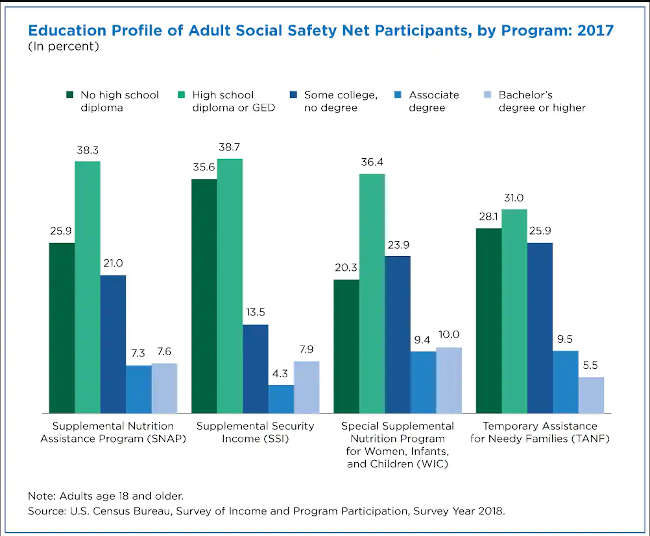
Adults without any post-secondary education made up the majority of participants in four key social safety net programs but college-educated adults account for over a third of some programs’ recipients.
These findings come from tables recently released by the U.S. Census Bureau, which provide detailed information on program participation and income transfers in 2017 from the Survey of Income and Program Participation, or SIPP.
Education profiles of four key government assistance programs — the Supplemental Nutrition Assistance Program, SNAP; Supplemental Security Income, SSI; the Special Supplemental Nutrition Program for Women, Infants, and Children, WIC; and Temporary Assistance for Needy Families, TANF — reveal the broad socioeconomic range of adults who rely on government assistance.
Education and program receipt
Adults with the lowest levels of educational attainment were the most likely to participate in assistance programs in 2017 but the education profiles of recipients varied across programs.
Those with a high school diploma or less accounted for over half of WIC participants and about three-quarters of SSI recipients.
Those with college degrees (either an associate or a bachelor’s degree) accounted for as many as one in five of some programs’ participants. They made up 19.4% of WIC recipients, for example.
More than one in three adults receiving SNAP had attended at least some college classes and about one in seven had earned a college degree. SNAP provides food assistance to families below certain income thresholds and is the largest assistance program examined here.
Social safety net participation among college educated
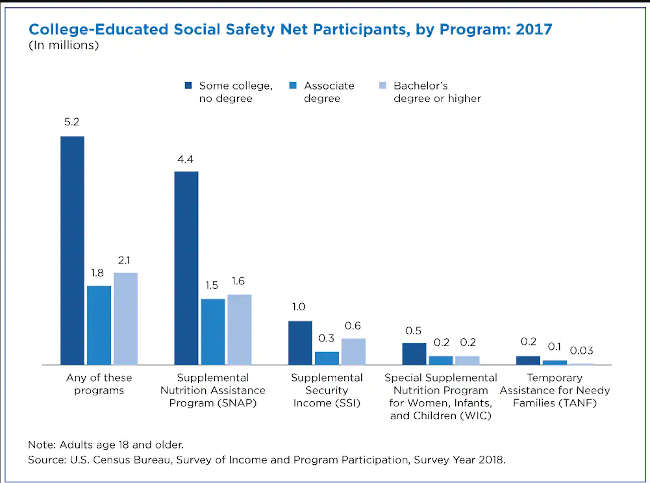
About nine million college-educated adults participated in at least one of the four government programs listed above.
This number includes those who attended college but never earned a degree, those who earned an associate degree (a two-year degree often earned at a community college) and those who earned a bachelor’s (or higher) degree.
Most of those who attended but had not graduated from college were not enrolled in any education program within the year, suggesting they were not actively pursuing a degree. This is consistent with many programs limiting access to benefits for many college students.
Among the college-educated recipients examined here, about four million had at least an associate degree and about two million had a bachelor’s (or higher) degree.
Roughly three million college graduates, including 1.6 million bachelor’s degree holders, received SNAP benefits.
Who are the college-educated SNAP recipients?
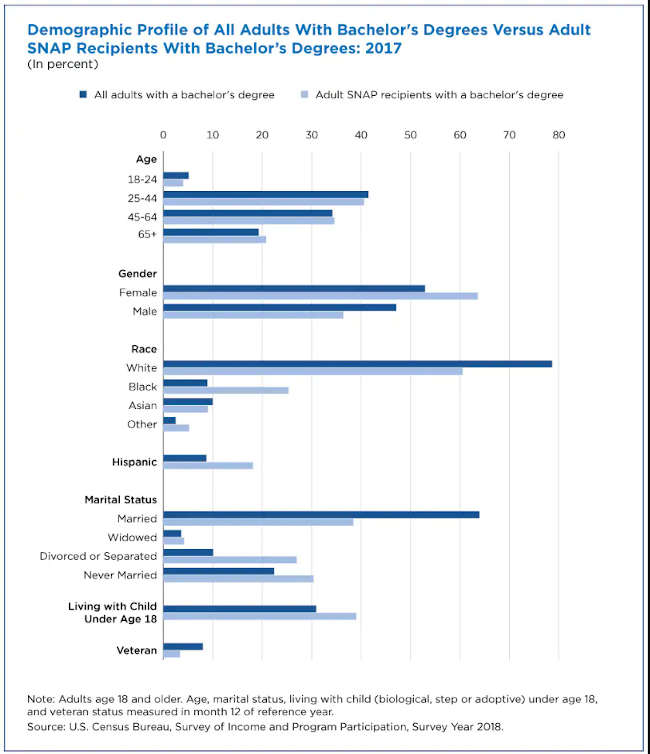
Drawing on additional SIPP data, we can compare all adults with a bachelor’s degree to those with the same degree who were also receiving SNAP in 2017.
The data show, for example, that while 52.9% of all bachelor’s degree holders were women, 63.6% of SNAP recipients with a bachelor’s degree were women.
Similarly, Black people made up 8.9% of all adults with a bachelor’s degree. But Black people were a quarter (25.3%) of those with a bachelor’s degree who were also getting SNAP.
The same pattern holds for Hispanic adults. They made up about 8.7% of all adults with a bachelor’s degree but 18.1% of those with a bachelor’s degree who received SNAP were Hispanic people.
There were also clear differences by marital status and the presence of children in the household.
Bachelor’s degree holders receiving SNAP were less likely than all bachelor’s degree holders to be married (38.4% compared to 63.9%), more likely to be divorced or separated (27.0% compared to 10.1%), and more likely to have children under 18 in the household (39.0% compared to 30.9%).
The estimates presented here are subject to sampling and nonsampling error. To learn more about the statistical guidelines used in producing these estimates, please visit the SIPP 2018 source and accuracy document.
Michael D. King is a survey statistician in the Census Bureau’s Program Participation and Income Transfers Branch.
LAKE COUNTY, Calif. – A Lakeport man who entered a plea in a child pornography possession case earlier this year had his sentencing continued this week.
Jeffery Scott Cramer, 59, had been set for sentencing on Monday.
However, District Attorney Susan Krones, who is personally handling the case, said the court needs to bring in a visiting judge because Judge David Markham and Judge Andrew Blum disqualified themselves, and Judge Michael Lunas is expected to do the same.
Krones said she didn’t know why the judges took the action.
The case will next be in court on June 14, at which time the new sentencing date will be set, Krones said.
In March, Cramer entered a no contest plea to felony possession of child pornography, as Lake County News has reported.
Last May, Lake County Sheriff’s detectives arrested Cramer following an investigation of several months that had included the service of search warrants at Main Street Bicycles, which Cramer then owned, and at a residence on Seventh Street in Lakeport. The searches resulted in detectives seizing digital devices.
Authorities said social media accounts associated with Cramer had been used to upload child pornography on at least five occasions between August 2019 and February 2020.
Because Cramer lacked a prior criminal record, Krones said she and the defense agreed to Cramer serving felony probation for two years and a jail sentence of up to 364 days.
He also will be required to participate in a year-long sex offender counseling program after he serves jail time and will have to register for his lifetime as a sex offender, Krone said.
Email Elizabeth Larson at This email address is being protected from spambots. You need JavaScript enabled to view it. . Follow her on Twitter, @ERLarson, or Lake County News, @LakeCoNews.
On Wednesday, Gov. Gavin Newsom unveiled another component of his $100 billion California Comeback Plan: transforming California public schools into gateways of equity and opportunity.
Newsom’s plan represents the highest level of state school funding in California history, investing an additional $20 billion to support the potential of every California student and make the structural change necessary to reduce barriers while increasing opportunities across the board, including massive investments in K-12 public schools, creating universal Pre-K and college savings accounts for 3.7 million low-income children in public schools.
“We’re doing more than just fully reopening for the upcoming school year, we’re proposing historic investments in public schools to create new opportunities for every student, especially for our neediest students, so that every child can thrive, regardless of their race or zip code,” said Gov. Newsom. “To achieve this goal, we’re going big – targeting $20 billion of investments to transform our public schools, including the creation of universal Pre-K and the establishment of college savings accounts for 3.7 million disadvantaged kids for higher education pursuits or to start their own business.”
Under the California Comeback Plan, the state will make targeted investments of $20 billion into public education to make sure every public school can fundamentally transform into the kind of complete campus every parent would want for their child: before- and after-school instruction, sports and arts, personalized tutoring, nurses and counselors, and nutrition — paired with new preventative behavioral health services for every kid in California.
This includes $3 billion to create thousands of full-service community schools, with wraparound mental health, social and family services; $4 billion over five years to transform the youth behavioral health system to identify and treat behavioral health needs early; and additional billions more toward investments in accelerated learning and our teachers and school staff.
“California kids and young adults need new investments and supports to make up for the burdens they faced over the past year – and even before the pandemic – and Gov. Newsom's California Comeback Plan goes above and beyond to put our students first," said California Health and Human Services Secretary Dr. Mark Ghaly. "By prioritizing the behavioral health needs of our young people – through before- and after-school instruction, behavioral health, social and family services – we can provide the younger generation with unparalleled opportunities to thrive."
To make college more accessible to low-income California kids, the Governor proposes investing $2 billion to seed college savings accounts for vulnerable students currently enrolled in K-12 public schools, including a $500 base deposit for students from low-income families, English learners and foster youth, and a $500 supplemental deposit for foster and homeless youth.
The savings account can be used later in life for higher education or to start their own business. California will also finally achieve universal Pre-K, providing high-quality, free transitional kindergarten to all four-year-olds in California, regardless of income or immigrations status.
The Comeback Plan also adds 100,000 child care slots and subsidies to bring down the cost of child care.
COVID-19 presented a crisis without precedent this century, especially for school communities throughout California and the nation.
As a result, the Newsom Administration said it is investing in a safe return to full in-person instruction for all schools, with $2 billion to implement health and safety measures, including improved ventilation and measures to expand access to vaccines and testing.
This is on top of a historic $6.6 billion investment earlier this year in schools to get local communities the resources they need to reopen safely.
LAKE COUNTY, Calif. — Following a presentation on the dry conditions Lake County is experiencing, the Board of Supervisors on Tuesday approved a drought emergency proclamation made by the sheriff on Thursday.
The board previously approved a drought emergency in 2014.
Before taking up Sheriff Brian Martin’s emergency proclamation, the board heard from Scott De Leon, the Public Works, Water Resources and Community Development director, on drought conditions.
De Leon showed historical precipitation numbers to date for Lake County, which is in the Upper Cache Creek Basin.
The average annual rainfall is 37.45 inches, said De Leon.
For 2021, the rainfall total is 12.28 inches. That’s compared to 12.19 inches in 1976 and 12.46 inches in 1977, 17.98 inches in 2014 and 16.87 inches in 2021. In 2017, the county recorded 53.24 inches of rain, and 45.45 inches in 2019, De Leon said.
De Leon said Clear Lake’s level in 1977 dropped to -3.5 feet Rumsey, the special measure for the lake. In 2014, it was down to -1 foot Rumsey, and as of Tuesday it was 0.7 foot Rumsey.
Well monitoring in the Big Valley Basin has shown dropping groundwater levels. One of the wells De Leon said they monitor is 5 feet below average.
De Leon predicted that Clear Lake will get down to -2.19 feet Rumsey this year.
Due to low water levels, several county-maintained ramps may be closed. De Leon recommended closing the Crystal Lake Way extension ramp in north Lakeport, the Clearlake Avenue extension in Lakeport, Lucerne Harbor Park’s ramp, and the ramps at Keeling Park and Rodman Slough, the latter which will still be open for kayakers.
Frank Costner, general manager of Konocti County Water District in Clearlake, told the board during public comment that his district — the source for which is surface water — is experiencing the effects of the low lake.
As the lake gets lower, the district’s pumps have a harder time pumping water into the treatment plant. Costner said the district is seeking emergency funding to address that issue and for an emergency intertie with the Lower Lake water district, which is served with wells. That way, if they’re no longer able to pump water out to the lake, they can supplement the supply with water from Lower Lake.
He said the board’s acceptance of the drought declaration will help his district and also will assist with messaging throughout the county.
Costner said Konocti County Water District has already implemented the first stage of its water conservation program, which calls for a 20-percent voluntary reduction. Stage two, which is a 25-percent mandatory reduction, should go into effect later this summer.
Sheriff discusses drought emergency proclamation
Following De Leon’s water situation update, Martin presented his drought emergency ratification request to the board.
He said he took the action after holding an April 30 meeting with County Administrative Officer Carol Huchingon, De Leon, Public Services Director Lars Ewing, Auditor-Controller Cathy Saderlund and Special Districts Administrator Scott Harter.
At that meeting, he said De Leon gave a similar presentation, and based on the discussion Martin decided to move forward.
“This is our second drought year with no apparent relief in sight. We anticipate further drought conditions. There’s no good news in the immediate future for any relief from this weather. And what we’re anticipating is that we’re going to have a very slow rolling emergency with this drought, with the impacts to be seen in various ways,” said Martin.
Martin also noted that on Monday Gov. Gavin Newsom expanded his April 21 drought emergency declaration to include 39 additional counties, with Lake being one of them, as Lake County News has reported.
As Costner had said, the proclamation will open up grant and awareness opportunities, Martin explained.
He said the Office of Emergency Services also will start a campaign with www.saveourwater.com.
Martin said he plans on convening meetings as early as Friday with county, city, tribal, fire, agricultural, cannabis and other representatives to discuss strategies and suggestions for handling the drought. He said he’ll report back to the board next week.
“I would hope that our emphasis is on voluntary compliance,” he said. “With every disaster comes opportunities.”
Martin also suggested the county should look at grant opportunities to extend the county’s boat ramps in order to ensure equitable access to Clear Lake.
For people who can’t afford to live on the lake, the only way they can get out and enjoy the water is by way of public boat ramps, he said.
Extending the ramps, Martin said, “would be good for our economy,” and good for people to be able to enjoy what they pay for with their tax dollars.
The county also needs to discuss impacts on households, businesses, agriculture, livestock, recreation and tourism, municipal water supplies and groundwater supplies, Martin said.
At Braito’s Marina, where the sheriff’s Marine Patrol is housed, Martin said it’s getting too shallow to use the majority of the division’s boats, which have been used during wildland fires to save people off the shores of Clearlake in addition to helping stranded boaters.
Martin said the county also needs to pay attention to tribal issues, referring to archaeological crimes that occurred during the last drought when low lake levels exposed artifacts.
Supervisor Jessica Pyska asked Martin to confirm if this was just the beginning of the conversation, with mandates not yet triggered.
Martin said the resolution includes the ability for Public Works, Water Resources and the sheriff to close boat ramps without further authority but doesn’t impose other measures.
Chair Bruno Sabatier said they don’t know if this will be a 2022 and a 2023 drought, and the county needs to think about the matter in the long-term.
Supervisor Tina Scott offered two separate motions. The first was to adopt the resolution proclaiming a declaration of a local emergency due to drought conditions. The second was to approve a resolution proclaiming a local emergency and requesting the governor make available state assistance funding, along with seeking all available forms of federal disaster assistance and relief programs, to include presidential declaration of emergency.
The board unanimously approved both motions.
Email Elizabeth Larson at This email address is being protected from spambots. You need JavaScript enabled to view it.. Follow her on Twitter, @ERLarson, or Lake County News, @LakeCoNews.
 How to resolve AdBlock issue?