 How to resolve AdBlock issue?
News
LAKE COUNTY, Calif. — The Lake County Planning Commission will continue its consideration this week of a large Clearlake Oaks cannabis project, and also will take up another cannabis project in Kelseyville and a property split in Middletown.
The meeting will begin at 9 a.m. Thursday, July 22, in the board chambers on the first floor of the Lake County Courthouse, 255 N. Forbes St., Lakeport.
The agenda is here.
To participate in real-time, join the Zoom meeting by clicking this link.
The webinar ID is 940 1721 4597, the pass code is 359803.
The meeting also can be viewed on the county of Lake website and on the county’s Facebook page.
At 9:15 a.m., in an item continued from the July 8 meeting, the commission will hold a public hearing to consider approving a use permit for Sourz HVR, Inc./Aviona LLC for a major cannabis operation at High Valley Ranch, located at 11650 High Valley Road in Clearlake Oaks.
The cultivation and related activities are proposed to take place on a 649-acre portion of the 1,640-acre ranch.
Combined canopy area is estimated at 3,485,000 square feet and 11 buildings totaling 110,000 square feet for storage and drying of cannabis. The existing 13,000 square foot conference center will be used for packing, distribution (shipping and receiving), and other ancillary uses such as office space.
The commission held the matter over from July 8 in order to get more information from the applicant on water, as Lake County News has reported.
The staff report includes an updated water report that explains that the project will use 353 acre feet, or 115 million gallons of water per year.
Other items on the agenda include a 9:05 a.m. public hearing for a major use permit for Pasta Farms LLC, located on 235 acres located at 10750 and 10417 Seigler Springs North Road and 10833 Diener Drive, Kelseyville. The applicant is Peter Simon, with DiCesare Vineyards owning the property.
The property currently includes a vineyard, a house, a well and septic system. Approximately 20 acres of vineyard would be removed as well as approximately 100 walnut trees to make room for the project.
The applicant also is proposing to add one 27,201 square foot nursery area, four 22,000 square foot greenhouses and 113 hoop houses. The project is to be phased over four years.
The available staff report does not give an estimated annual water usage.
Pasta Farms anticipates using what it claims is a shared well as a water source. However, planning documents include a letter from a nearby property owner stating that the water source identified for the project isn’t owned by Pasta Farms or located on the property, and that litigation is starting.
In other business, at 9:10 a.m. the commission will hold a public hearing to consider a parcel map to divide a 406.69 acre property to create three new parcels.
The property, located at 21700 and 22000 Butts Canyon Road in Middletown, is owned by Langtry Farms LP.
The property currently contains a vineyard, one single family dwelling, several small sheds, a well for potable water and several internal driveway, according to the staff report.
“No plans for development are proposed by the applicant, and the site has been significantly disturbed over the past several decades by the use of the property as a vineyard,” the staff report explains.
Email Elizabeth Larson atThis email address is being protected from spambots. You need JavaScript enabled to view it. . Follow her on Twitter, @ERLarson, or Lake County News, @LakeCoNews.
The meeting will begin at 9 a.m. Thursday, July 22, in the board chambers on the first floor of the Lake County Courthouse, 255 N. Forbes St., Lakeport.
The agenda is here.
To participate in real-time, join the Zoom meeting by clicking this link.
The webinar ID is 940 1721 4597, the pass code is 359803.
The meeting also can be viewed on the county of Lake website and on the county’s Facebook page.
At 9:15 a.m., in an item continued from the July 8 meeting, the commission will hold a public hearing to consider approving a use permit for Sourz HVR, Inc./Aviona LLC for a major cannabis operation at High Valley Ranch, located at 11650 High Valley Road in Clearlake Oaks.
The cultivation and related activities are proposed to take place on a 649-acre portion of the 1,640-acre ranch.
Combined canopy area is estimated at 3,485,000 square feet and 11 buildings totaling 110,000 square feet for storage and drying of cannabis. The existing 13,000 square foot conference center will be used for packing, distribution (shipping and receiving), and other ancillary uses such as office space.
The commission held the matter over from July 8 in order to get more information from the applicant on water, as Lake County News has reported.
The staff report includes an updated water report that explains that the project will use 353 acre feet, or 115 million gallons of water per year.
Other items on the agenda include a 9:05 a.m. public hearing for a major use permit for Pasta Farms LLC, located on 235 acres located at 10750 and 10417 Seigler Springs North Road and 10833 Diener Drive, Kelseyville. The applicant is Peter Simon, with DiCesare Vineyards owning the property.
The property currently includes a vineyard, a house, a well and septic system. Approximately 20 acres of vineyard would be removed as well as approximately 100 walnut trees to make room for the project.
The applicant also is proposing to add one 27,201 square foot nursery area, four 22,000 square foot greenhouses and 113 hoop houses. The project is to be phased over four years.
The available staff report does not give an estimated annual water usage.
Pasta Farms anticipates using what it claims is a shared well as a water source. However, planning documents include a letter from a nearby property owner stating that the water source identified for the project isn’t owned by Pasta Farms or located on the property, and that litigation is starting.
In other business, at 9:10 a.m. the commission will hold a public hearing to consider a parcel map to divide a 406.69 acre property to create three new parcels.
The property, located at 21700 and 22000 Butts Canyon Road in Middletown, is owned by Langtry Farms LP.
The property currently contains a vineyard, one single family dwelling, several small sheds, a well for potable water and several internal driveway, according to the staff report.
“No plans for development are proposed by the applicant, and the site has been significantly disturbed over the past several decades by the use of the property as a vineyard,” the staff report explains.
Email Elizabeth Larson at

LAKE COUNTY, Calif. — The Lake County Chamber of Commerce said it has selected Laura McAndrews Sammel as its new chief executive officer.
McAndrews Sammel will succeed Melissa Fulton, who retired at the end of June after more than 30 years.
After an open search, the chamber board of directors voted on July 12 to extend the offer of chief executive officer to McAndrews Sammel, which she accepted on July 16.
She will begin her new job in the middle of August.
McAndrews Sammel has numerous college degrees, including a Master’s of Business Administration from Western Governors University.
She leaves her role as chief financial officer and executive human resource and leadership coach at Combs Consulting to embark on this new challenge.
McAndrews Sammel has also served on many local volunteer organizations and committees, and currently serves as president of the Rotary Club of Lakeport.
She has been elected as a member of the Lake County Chamber Board of Directors before, so she is very familiar with the organization.
The chamber leadership said its mission is to promote the economic vitality and prosperity of
the region.
“We have no doubt that Laura will be a catalyst for our organization in that mission,” the chamber said in its statement on McAndrews Sammel’s hiring.
“We eagerly look forward to this new chapter in our organization’s future,” the chamber said.
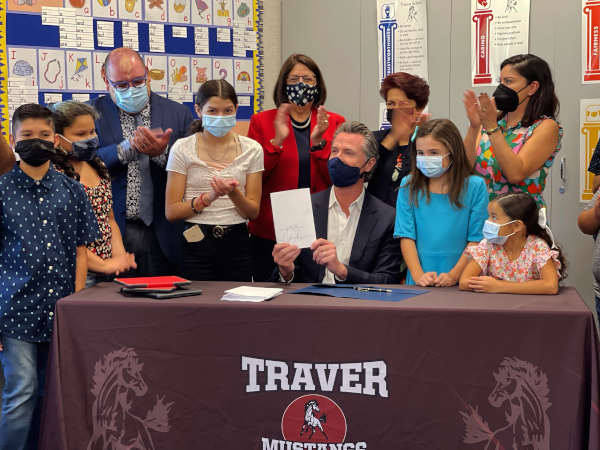
On Tuesday, at a rural elementary school in Tulare County, Gov. Gavin Newsom signed legislation to advance the state’s commitment to bridging the digital divide by increasing equitable, affordable access to high-speed internet service across California.
Through a $6 billion multi-year investment, more Californians will be able to access broadband coverage with the construction of a state-owned open access middle mile network and last mile projects that connect unserved households and businesses with local networks.
“As we work to build California back stronger than before, the state is committed to addressing the challenges laid bare by the pandemic, including the digital divide holding back too many communities in a state renowned for its pioneering technology and innovation economy,” said Gov. Newsom. “This $6 billion investment will make broadband more accessible than ever before, expanding opportunity across the spectrum for students, families and businesses — from enhanced educational supports to job opportunities to health care and other essential services. I thank the Legislature for its partnership on this critically important step to ensuring that California’s economic recovery will leave no part of our state behind.”
Gov. Newsom signed SB 156 at Traver Joint Elementary, a school serving diverse students in a rural Tulare County community. The school has distributed hotspot devices to students for internet access as part of the state’s cross-sector efforts launched during the pandemic.
The historic legislation, announced last week in partnership with legislative leaders, advances the statewide broadband plan with expanded infrastructure prioritizing unserved and underserved areas.
The legislation includes:
— $3.25 billion to build, operate and maintain an open access, state-owned middle mile network — high-capacity fiber lines that carry large amounts of data at higher speeds over longer distances between local networks.
— $2 billion to set up last-mile broadband connections that will connect homes and businesses with local networks. The legislation expedites project deployment and enables Tribes and local governments to access this funding.
— $750 million for a loan loss reserve fund to bolster the ability of local governments and nonprofits to secure financing for broadband infrastructure.
— Creation of a broadband czar position at the California Department of Technology, and a broadband advisory committee with representatives from across state government and members appointed by the Legislature.
Last year, the state mobilized companies, business leaders and philanthropists through public-private partnerships to facilitate distance learning at school districts in need across the state.
The effort helped connect students lacking high-speed internet or an appropriate computing device at home with donated mobile hotspots, laptops, Chromebooks, tablets and other devices.
The legislation signed today takes a comprehensive and long-term approach to tackling the broadband infrastructure deficiencies still impacting rural and low-income communities, bringing the state closer to achieving affordable, high-speed broadband internet service for all communities.
For the full text of the bill, visit http://leginfo.legislature.ca.gov.
LAKE COUNTY, Calif. — As California’s drought conditions worsen, local officials are facing increased water demands from proposed projects and, at the same time, pushback from residents and a request from the state to cut back on water use.
Those issues are coming to the fore increasingly during the Lake County Planning Commission’s twice-monthly meetings.
The commission last met on July 8, the same day that Gov. Gavin Newsom held a news conference at the diminishing Lopez Reservoir in San Luis Obispo County to ask Californians to reduce their water usage by 15% as the state’s drought deepens.
The conservation the state is seeking crosses all sectors — from residential to commercial, from industry to agricultural.
In Lake County, officials are facing a steady stream of hundreds of cannabis-related project permits, with many opponents of the project bringing up one main concern: water supply.
That was the case on July 8, when the commission voted to continue its discussion until later in the month on a large cannabis operation at High Valley Ranch due to water-related questions, while approving two smaller commercial cannabis projects that will use millions of gallons of water each month.
Lake County’s approach to the projects that will use large amounts of water hasn’t seemed to change in the wake of a local drought emergency declared by Sheriff Brian Martin and later ratified by the Board of Supervisors this spring.
The supervisors held a discussion on June 8 about the drought, with particular emphasis on water trucks drawing from the lake and illegal cannabis. But what they didn’t cover was whether there is a need to reconsider legal projects of all types that use large amounts of water.
For those projects in the proverbial pipeline that make it to the planning commission, water studies accompanying planning documents are either missing, brief or appear outdated, a fact the commissioners themselves have noted.
And commissioners have indicated that the lack of information is a challenge.
The July 8 meeting was notable for discussions the commission and county staff would have about what information they wanted and needed, and the discretion they have to seek it.
“I don’t feel like we’re getting consistent water information with each application,” said District 1 Commissioner John Hess, raising concern about being in a drought period, with the potential for the situation to worsen.
At another point in the meeting, Hess said all applications — including large ones — are undergoing increased scrutiny because of the drought.
He said the commission also has expressed that it wants more guidance from the Board of Supervisors on water and how to judge projects in light of water-related concerns.
Continuing a project over water
At the request of applicant Elli Hagoel, the commission agreed to bring the High Valley Ranch project back at its meeting set for this Thursday, July 22. Hagoel said that would give him more time to gather information to respond to the water-related questions.
Hagoel, along with SourzHVR Inc. and Avi Pollack, are seeking a major use permit and mitigated negative declaration for a proposed project on a 649-acre parcel that’s one of seven that make up the 1,640-acre High Valley Ranch.
Aviona LLC purchased the property from PSI World in February for a reported $8 million, according to online records.
Planning documents for the July 8 meeting showed that the project proposes a canopy area of 3,485,000 square feet and 11 buildings totaling 110,000 square feet for storage and drying of cannabis. Packing and distribution will be located in the 13,000 square foot conference center.
Large projects like the one proposed by Hagoel, Pollack and SourzHVR Inc. are appearing more commonly in Lake County, causing concerns for neighbors.
Over the last several months, proposals for big operations submitted by Joseph Gustafson near Lakeport and Zarina Otchkova of WeGrow LLC next to Hidden Valley Lake have gotten significant pushback from neighbors.
In the case of Gustafson, the commission put off a decision in May due to continuing questions about violations from the California Department of Fish and Wildlife that the state said had not yet been resolved.
The commission did approve Otchkova’s property, but neighbors appealed it and in June the Board of Supervisors upheld that appeal but without prejudice, allowing her to resubmit it. Otchkova’s consultant told the county they intend to resubmit the project in the near future.
Neighbors of High Valley Ranch also brought up concerns about quality of life — from dust to smell, traffic and impacts on the land. One asked how much marijuana Lake County needs.
At the same time, several neighbors and businesses — among them, Brassfield Winery — voiced support for the SourzHVR Inc. project, praising Hagoel and his team for doing extensive outreach to neighbors.
However, the drought and resulting water shortages turned out to be a factor that halted the commission’s forward motion on the project temporarily.
In fact, it would be revealed during the discussion that there had been water analysis done on the project, but that it wasn’t included in the staff report for the meeting.
Staff also told the commission that the California Department of Fish and Wildlife reported there were violations, which had to do with setbacks from creeks and tributaries. The California Highway Patrol’s Clear Lake Area office also had raised concerns about traffic.
Planner Katherine Schaefers, in going over a Lake County ordinance on groundwater usage with the commission, explained that the project was considered to meet the “safe yield” requirements.
A project falls under safe yield when the amount of water it will extract doesn’t exceed the water supply of the basin in any calendar year, doesn’t lower water levels so as to make further drilling of water wells uneconomical and doesn’t cause water pumped from the basin to deteriorate below water drinking standards.
She said the project’s initial study found that 60 to 70% of the irrigation water will be returned to the aquifer through infiltration in an average year and an aquifer performance test concluded the water supply and the property’s wells were more than adequate.
During the ensuing discussion, District 3 Commissioner and Chair Batsulwin Brown noted, “I’m really puzzled why an environmental impact report is not a part of the package.”
Brown, a member of the Elem Colony Pomo, also voiced concerns about traffic, water, the Fish and Game violations and the treatment of cultural resources.
Regarding the latter, a cultural resource report on the property referenced a prehistoric site that is said meets the criteria to be a significant historical resource. Brown was concerned about potential destruction of such archaeological sites.
“They’re nonrenewable,” Brown said of such sites, adding that if they are graded without data recovery or plans in place, “They’re gone forever.”
The project team noted that preconstruction surveys are going on and because they got their early activation late, they had to do a lot of the work in a very short period of time.
Among the neighbors raising objections, Doug Logan — who said his grandparents bought land in Clearlake Oaks more than 100 years ago and he now feels like he’s being forced off his property — noted his well is exhausted. He questioned how a planner can think that a project that uses so much water would be OK in the midst of the worst drought in 50 years.
Don Van Pelt, who lives next door to the ranch with his wife, said he was alarmed that the project was given early activation. He said the reports on the project are inadequate.
Richard Derum, a Realtor, cannabis consultant and grower, said Lake County is an ideal place to grow cannabis, and that if Lake County is to move forward and succeed with cannabis, it has to embrace big farms that can increase the poundage produced.
Jonathan Walters, director of vineyard and estate operations at Brassfield Winery, said they originally were hesitant when the company approached them, but he’s spent the last six month working with them on a weekly basis and he’s completely on board with it.
Hagoel said he had tried to talk to the neighbors, but after hearing their testimony, he thinks he didn’t scratch the surface, as he didn’t expect so much resistance.
During the commissioners’ discussion, Brown said he was concerned about the project’s overall impact on the community — from traffic to water, and biological and cultural resources. His tribe also was not a part of the process, some of his concerns weren’t addressed in the documents and he wasn’t prepared to support it.
Commissioner John Hess asked if his colleagues would be willing to continue the project discussion. They agreed, with both Brown and District 4 Commissioner Christina Price saying they wanted more information about hydraulics, water and the aquifer as a whole.
“Part of this is a question of drought,” said Hess, explaining the desire for more time as well as the greater scrutiny being placed on the projects.
Price said her main concern is recharge of the aquifer and the resulting impact on neighbors, noting they’re aware of multiple wells. “What my main concern is, is the ripple effect.”
The commission voted to continue the discussion until its July 22 meeting.
In the meantime, the applicants have submitted a new water report that shows the project will use 353 acre feet — or 115 million gallons — per year.
The report states, “The current and future water use demands for the cumulative area of impact constitute approximately 1.4% of the available groundwater.”
It does not, however, explain the impacts of drought on the aquifer or the project, and in fact the word “drought” is absent from the report.
Approving other projects
At the same meeting, the commission approved a cannabis project on 40 acres at 425 and 500 Voight Road in Lakeport owned by Voight Holdings LLC.
For the Voight project, water was again a concern, with businesswoman Toni Scully arguing that she didn’t agree with staff’s assessment of the Big Valley aquifer being “stout.” She also wanted to see a hydrology report.
Other neighbors would note a lack of recharge this year due to not enough rain, with their wells drying up.
In response to comments about the discussion and county staff about the information that would be helpful to have in considering these projects, Deputy County Counsel Nicole Johnson made clear that the commission has a lot of leeway — and the staff has a lot of discretion — to seek more information to make the analysis to that in turn helps the commission make necessary findings on such project.
“Land use is very fluid. Your analysis is site- and project-specific. It’s unique in time and place. So what may be appropriate for one project that seems similar may not be appropriate for the other project that seems similar. So thresholds are not a determinative for you in that way. The absence of one does not prevent you from acting. It doesn’t prevent you from asking for information. It doesn’t prevent you from requesting the data you need in order to make an informed decision,” Johnson said.
She said the county’s ordinance for cannabis projects does not prevent the staff and commission from asking for more information. If staff finds in their analysis that they need more authority, they can ask the Board of Supervisors.
“You are not restricted just because there isn't a threshold in the ordinance itself,” Johnson said.
Hess said that was helpful. He agreed with statements made during the meeting by Associate Planner Eric Porter that not every application has the same amount of detail. The result is that they get inconsistent information when they are trying to review projects on a case-by-case basis. Some of the data, he added, has appeared to be obsolete.
Porter said it’s a challenge for planning that there is no minimal threshold for water supply. He said he didn’t know many details about the aquifer.
“This particular well is strong,” he said referring to the data for the Voigt project. “I’m not convinced that the area water table is that strong based on testimony. But is it fixable? I don’t know.”
Nonetheless, the commission would unanimously approve the project permit, with the staff report not including the amount of water to be used.
The Coastle LLC project will be located on 244 acres at 6565 Wilkinson Road in Kelseyville. With a canopy size of 478,000 square feet — or nearly 11 acres — it is projected to use nearly 8.2 million gallons of water during the growing season, which runs from April to November, according to planning documents.
Concerns about Coastle were raised by neighbors concerned about its close proximity to a suburban area as well as Kelseyville Unified School District Superintendent Dave McQueen’s objections that the grow is close to local schools and its potential impact on traffic.
McQueen said one of the properties is only 200 feet from a school property line, and state education code requires a 1,000 foot setback. The applicants maintained that the closest property was 1,200 feet from a school.
The grow also is reported to be 1,500 feet from Grace Church.
The commission ultimately voted 3-1 for the project, with Price voting against it because of her concerns about the close proximity of schools and the presence of children playing in the residential area.
Commissioner Lance Williams was absent for the meeting.
Email Elizabeth Larson atThis email address is being protected from spambots. You need JavaScript enabled to view it. . Follow her on Twitter, @ERLarson, or Lake County News, @LakeCoNews.
Those issues are coming to the fore increasingly during the Lake County Planning Commission’s twice-monthly meetings.
The commission last met on July 8, the same day that Gov. Gavin Newsom held a news conference at the diminishing Lopez Reservoir in San Luis Obispo County to ask Californians to reduce their water usage by 15% as the state’s drought deepens.
The conservation the state is seeking crosses all sectors — from residential to commercial, from industry to agricultural.
In Lake County, officials are facing a steady stream of hundreds of cannabis-related project permits, with many opponents of the project bringing up one main concern: water supply.
That was the case on July 8, when the commission voted to continue its discussion until later in the month on a large cannabis operation at High Valley Ranch due to water-related questions, while approving two smaller commercial cannabis projects that will use millions of gallons of water each month.
Lake County’s approach to the projects that will use large amounts of water hasn’t seemed to change in the wake of a local drought emergency declared by Sheriff Brian Martin and later ratified by the Board of Supervisors this spring.
The supervisors held a discussion on June 8 about the drought, with particular emphasis on water trucks drawing from the lake and illegal cannabis. But what they didn’t cover was whether there is a need to reconsider legal projects of all types that use large amounts of water.
For those projects in the proverbial pipeline that make it to the planning commission, water studies accompanying planning documents are either missing, brief or appear outdated, a fact the commissioners themselves have noted.
And commissioners have indicated that the lack of information is a challenge.
The July 8 meeting was notable for discussions the commission and county staff would have about what information they wanted and needed, and the discretion they have to seek it.
“I don’t feel like we’re getting consistent water information with each application,” said District 1 Commissioner John Hess, raising concern about being in a drought period, with the potential for the situation to worsen.
At another point in the meeting, Hess said all applications — including large ones — are undergoing increased scrutiny because of the drought.
He said the commission also has expressed that it wants more guidance from the Board of Supervisors on water and how to judge projects in light of water-related concerns.
Continuing a project over water
At the request of applicant Elli Hagoel, the commission agreed to bring the High Valley Ranch project back at its meeting set for this Thursday, July 22. Hagoel said that would give him more time to gather information to respond to the water-related questions.
Hagoel, along with SourzHVR Inc. and Avi Pollack, are seeking a major use permit and mitigated negative declaration for a proposed project on a 649-acre parcel that’s one of seven that make up the 1,640-acre High Valley Ranch.
Aviona LLC purchased the property from PSI World in February for a reported $8 million, according to online records.
Planning documents for the July 8 meeting showed that the project proposes a canopy area of 3,485,000 square feet and 11 buildings totaling 110,000 square feet for storage and drying of cannabis. Packing and distribution will be located in the 13,000 square foot conference center.
Large projects like the one proposed by Hagoel, Pollack and SourzHVR Inc. are appearing more commonly in Lake County, causing concerns for neighbors.
Over the last several months, proposals for big operations submitted by Joseph Gustafson near Lakeport and Zarina Otchkova of WeGrow LLC next to Hidden Valley Lake have gotten significant pushback from neighbors.
In the case of Gustafson, the commission put off a decision in May due to continuing questions about violations from the California Department of Fish and Wildlife that the state said had not yet been resolved.
The commission did approve Otchkova’s property, but neighbors appealed it and in June the Board of Supervisors upheld that appeal but without prejudice, allowing her to resubmit it. Otchkova’s consultant told the county they intend to resubmit the project in the near future.
Neighbors of High Valley Ranch also brought up concerns about quality of life — from dust to smell, traffic and impacts on the land. One asked how much marijuana Lake County needs.
At the same time, several neighbors and businesses — among them, Brassfield Winery — voiced support for the SourzHVR Inc. project, praising Hagoel and his team for doing extensive outreach to neighbors.
However, the drought and resulting water shortages turned out to be a factor that halted the commission’s forward motion on the project temporarily.
In fact, it would be revealed during the discussion that there had been water analysis done on the project, but that it wasn’t included in the staff report for the meeting.
Staff also told the commission that the California Department of Fish and Wildlife reported there were violations, which had to do with setbacks from creeks and tributaries. The California Highway Patrol’s Clear Lake Area office also had raised concerns about traffic.
Planner Katherine Schaefers, in going over a Lake County ordinance on groundwater usage with the commission, explained that the project was considered to meet the “safe yield” requirements.
A project falls under safe yield when the amount of water it will extract doesn’t exceed the water supply of the basin in any calendar year, doesn’t lower water levels so as to make further drilling of water wells uneconomical and doesn’t cause water pumped from the basin to deteriorate below water drinking standards.
She said the project’s initial study found that 60 to 70% of the irrigation water will be returned to the aquifer through infiltration in an average year and an aquifer performance test concluded the water supply and the property’s wells were more than adequate.
During the ensuing discussion, District 3 Commissioner and Chair Batsulwin Brown noted, “I’m really puzzled why an environmental impact report is not a part of the package.”
Brown, a member of the Elem Colony Pomo, also voiced concerns about traffic, water, the Fish and Game violations and the treatment of cultural resources.
Regarding the latter, a cultural resource report on the property referenced a prehistoric site that is said meets the criteria to be a significant historical resource. Brown was concerned about potential destruction of such archaeological sites.
“They’re nonrenewable,” Brown said of such sites, adding that if they are graded without data recovery or plans in place, “They’re gone forever.”
The project team noted that preconstruction surveys are going on and because they got their early activation late, they had to do a lot of the work in a very short period of time.
Among the neighbors raising objections, Doug Logan — who said his grandparents bought land in Clearlake Oaks more than 100 years ago and he now feels like he’s being forced off his property — noted his well is exhausted. He questioned how a planner can think that a project that uses so much water would be OK in the midst of the worst drought in 50 years.
Don Van Pelt, who lives next door to the ranch with his wife, said he was alarmed that the project was given early activation. He said the reports on the project are inadequate.
Richard Derum, a Realtor, cannabis consultant and grower, said Lake County is an ideal place to grow cannabis, and that if Lake County is to move forward and succeed with cannabis, it has to embrace big farms that can increase the poundage produced.
Jonathan Walters, director of vineyard and estate operations at Brassfield Winery, said they originally were hesitant when the company approached them, but he’s spent the last six month working with them on a weekly basis and he’s completely on board with it.
Hagoel said he had tried to talk to the neighbors, but after hearing their testimony, he thinks he didn’t scratch the surface, as he didn’t expect so much resistance.
During the commissioners’ discussion, Brown said he was concerned about the project’s overall impact on the community — from traffic to water, and biological and cultural resources. His tribe also was not a part of the process, some of his concerns weren’t addressed in the documents and he wasn’t prepared to support it.
Commissioner John Hess asked if his colleagues would be willing to continue the project discussion. They agreed, with both Brown and District 4 Commissioner Christina Price saying they wanted more information about hydraulics, water and the aquifer as a whole.
“Part of this is a question of drought,” said Hess, explaining the desire for more time as well as the greater scrutiny being placed on the projects.
Price said her main concern is recharge of the aquifer and the resulting impact on neighbors, noting they’re aware of multiple wells. “What my main concern is, is the ripple effect.”
The commission voted to continue the discussion until its July 22 meeting.
In the meantime, the applicants have submitted a new water report that shows the project will use 353 acre feet — or 115 million gallons — per year.
The report states, “The current and future water use demands for the cumulative area of impact constitute approximately 1.4% of the available groundwater.”
It does not, however, explain the impacts of drought on the aquifer or the project, and in fact the word “drought” is absent from the report.
Approving other projects
At the same meeting, the commission approved a cannabis project on 40 acres at 425 and 500 Voight Road in Lakeport owned by Voight Holdings LLC.
For the Voight project, water was again a concern, with businesswoman Toni Scully arguing that she didn’t agree with staff’s assessment of the Big Valley aquifer being “stout.” She also wanted to see a hydrology report.
Other neighbors would note a lack of recharge this year due to not enough rain, with their wells drying up.
In response to comments about the discussion and county staff about the information that would be helpful to have in considering these projects, Deputy County Counsel Nicole Johnson made clear that the commission has a lot of leeway — and the staff has a lot of discretion — to seek more information to make the analysis to that in turn helps the commission make necessary findings on such project.
“Land use is very fluid. Your analysis is site- and project-specific. It’s unique in time and place. So what may be appropriate for one project that seems similar may not be appropriate for the other project that seems similar. So thresholds are not a determinative for you in that way. The absence of one does not prevent you from acting. It doesn’t prevent you from asking for information. It doesn’t prevent you from requesting the data you need in order to make an informed decision,” Johnson said.
She said the county’s ordinance for cannabis projects does not prevent the staff and commission from asking for more information. If staff finds in their analysis that they need more authority, they can ask the Board of Supervisors.
“You are not restricted just because there isn't a threshold in the ordinance itself,” Johnson said.
Hess said that was helpful. He agreed with statements made during the meeting by Associate Planner Eric Porter that not every application has the same amount of detail. The result is that they get inconsistent information when they are trying to review projects on a case-by-case basis. Some of the data, he added, has appeared to be obsolete.
Porter said it’s a challenge for planning that there is no minimal threshold for water supply. He said he didn’t know many details about the aquifer.
“This particular well is strong,” he said referring to the data for the Voigt project. “I’m not convinced that the area water table is that strong based on testimony. But is it fixable? I don’t know.”
Nonetheless, the commission would unanimously approve the project permit, with the staff report not including the amount of water to be used.
The Coastle LLC project will be located on 244 acres at 6565 Wilkinson Road in Kelseyville. With a canopy size of 478,000 square feet — or nearly 11 acres — it is projected to use nearly 8.2 million gallons of water during the growing season, which runs from April to November, according to planning documents.
Concerns about Coastle were raised by neighbors concerned about its close proximity to a suburban area as well as Kelseyville Unified School District Superintendent Dave McQueen’s objections that the grow is close to local schools and its potential impact on traffic.
McQueen said one of the properties is only 200 feet from a school property line, and state education code requires a 1,000 foot setback. The applicants maintained that the closest property was 1,200 feet from a school.
The grow also is reported to be 1,500 feet from Grace Church.
The commission ultimately voted 3-1 for the project, with Price voting against it because of her concerns about the close proximity of schools and the presence of children playing in the residential area.
Commissioner Lance Williams was absent for the meeting.
Email Elizabeth Larson at
State Controller Betty T. Yee has published 2020 self-reported payroll data for cities and counties on the Government Compensation in California website.
The data cover 665,721 positions and a total of more than $51.43 billion in 2020 wages.
The newly published data include 459 cities and 50 counties.
The small city of Vernon once again had the highest average city employee wage in California, followed by Hayward, Fairfield, and Pleasant Hill.
Topping the list for highest average county employee wage were the counties of Santa Clara, Alameda, Los Angeles, and Monterey.
The highest-salaried city employee in California was the city manager of Fontana, while the top 40 highest-paid county employees work in health care professions.
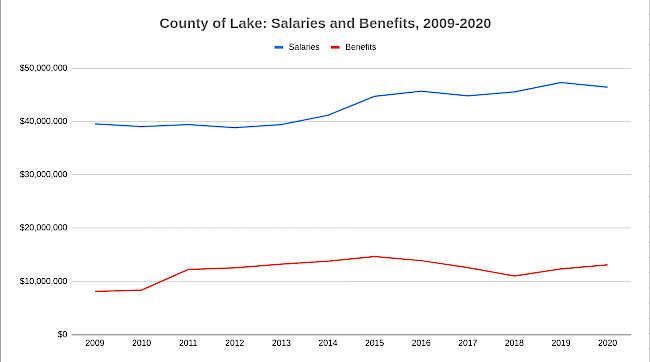
In Lake County in 2020, the county of Lake had 1,132 employees, with $46,423,592 in salaries and $13,082,520 in retirement and health contributions.
The Top 10 jobs pay for the county of Lake in 2020 were as follows:
Public Health officer: $182,314.
County counsel: $145,418.
County administrative officer: $141,309.
Sheriff-coroner: $140,185.
Social Services director: $128,266.
District attorney: $124,720.
Chief probation officer: $118,544.
Deputy sheriff sergeant: $114,746.
Sheriff’s captain: $114,721.
Chief deputy district attorney: $113,185.
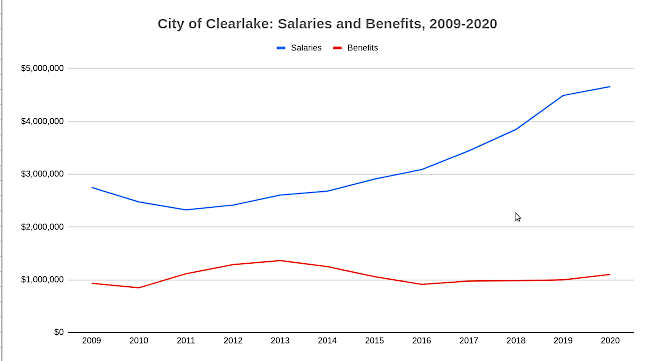
In the city of Clearlake, there were 80 employees with wages totaling $4,659,135 and $1,102,549 in retirement and health contributions in 2020.
Top 10 positions by salary were:
City manager: $169,552
Police chief: $163,924.
Police captain: $142,745.
Police sergeant: $139,813.
Police sergeant: $134,826.
Police lieutenant: $124,656.
Police sergeant: $119,513.
Administrative Services director/city clerk: $118,956.
Police officer II: $116,417.
Police officer II : $112,594.
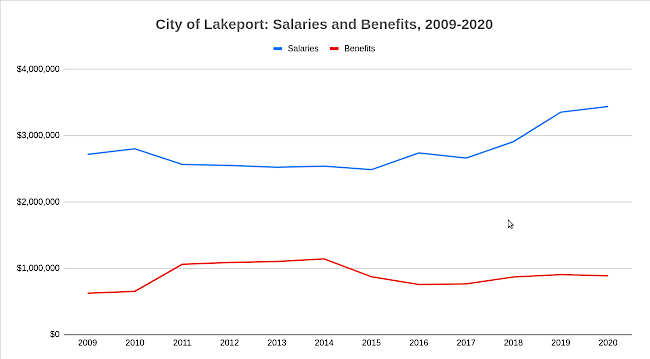
In the city of Lakeport, there were 65 employees in 2020, with total wages of $3,440,598 and total retirement and health contributions of $888,831.
Top 10 employees by salary were:
City manager (outgoing): $172,196.
City manager (successor): $149,536.
Police chief: $137,492.
Police lieutenant: $114,198.
Public Works director: $111,598.
Utilities superintendent II: $107,573.
Administrative Services director/city clerk: $106,706.
Finance director: $103,589.
Police sergeant: $90,530.
Police officer II : $88,120.
California law requires cities, counties, and special districts to annually report compensation data to the State Controller.
The state controller also maintains and publishes state and CSU salary data.
Seven counties and 23 cities failed to file or provided incomplete or late information. San Francisco is both a city and a county; the website reports San Francisco as a city.
Since the website launched in 2010, it has registered more than 13 million page views.
The site contains pay and benefit information on more than two million government jobs in California, as reported annually by each entity.
Users of the site can:
— View compensation levels on maps and search by region;
— Narrow results by name of the entity or by job title; and
— Export raw data or custom reports.
The data cover 665,721 positions and a total of more than $51.43 billion in 2020 wages.
The newly published data include 459 cities and 50 counties.
The small city of Vernon once again had the highest average city employee wage in California, followed by Hayward, Fairfield, and Pleasant Hill.
Topping the list for highest average county employee wage were the counties of Santa Clara, Alameda, Los Angeles, and Monterey.
The highest-salaried city employee in California was the city manager of Fontana, while the top 40 highest-paid county employees work in health care professions.
In Lake County in 2020, the county of Lake had 1,132 employees, with $46,423,592 in salaries and $13,082,520 in retirement and health contributions.
The Top 10 jobs pay for the county of Lake in 2020 were as follows:
Public Health officer: $182,314.
County counsel: $145,418.
County administrative officer: $141,309.
Sheriff-coroner: $140,185.
Social Services director: $128,266.
District attorney: $124,720.
Chief probation officer: $118,544.
Deputy sheriff sergeant: $114,746.
Sheriff’s captain: $114,721.
Chief deputy district attorney: $113,185.
In the city of Clearlake, there were 80 employees with wages totaling $4,659,135 and $1,102,549 in retirement and health contributions in 2020.
Top 10 positions by salary were:
City manager: $169,552
Police chief: $163,924.
Police captain: $142,745.
Police sergeant: $139,813.
Police sergeant: $134,826.
Police lieutenant: $124,656.
Police sergeant: $119,513.
Administrative Services director/city clerk: $118,956.
Police officer II: $116,417.
Police officer II : $112,594.
In the city of Lakeport, there were 65 employees in 2020, with total wages of $3,440,598 and total retirement and health contributions of $888,831.
Top 10 employees by salary were:
City manager (outgoing): $172,196.
City manager (successor): $149,536.
Police chief: $137,492.
Police lieutenant: $114,198.
Public Works director: $111,598.
Utilities superintendent II: $107,573.
Administrative Services director/city clerk: $106,706.
Finance director: $103,589.
Police sergeant: $90,530.
Police officer II : $88,120.
California law requires cities, counties, and special districts to annually report compensation data to the State Controller.
The state controller also maintains and publishes state and CSU salary data.
Seven counties and 23 cities failed to file or provided incomplete or late information. San Francisco is both a city and a county; the website reports San Francisco as a city.
Since the website launched in 2010, it has registered more than 13 million page views.
The site contains pay and benefit information on more than two million government jobs in California, as reported annually by each entity.
Users of the site can:
— View compensation levels on maps and search by region;
— Narrow results by name of the entity or by job title; and
— Export raw data or custom reports.
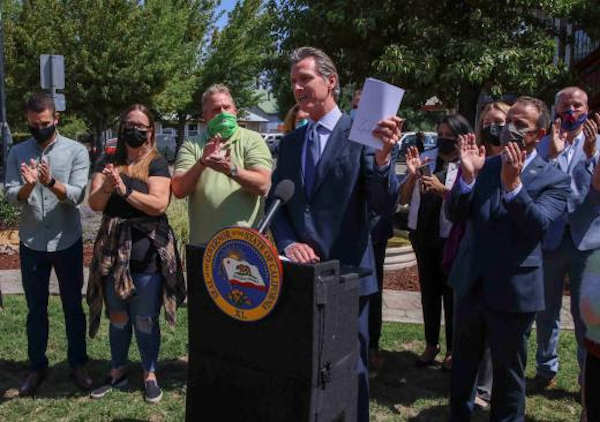
At a Homekey site in Sebastopol on Monday, Gov. Gavin Newsom signed the largest funding and reform package for housing and homelessness in California history as part of the $100 billion California Comeback Plan.
The package includes $10.3 billion for affordable housing and $12 billion over two years toward tackling the homelessness crisis head-on — helping tens of thousands of people off the streets while also demanding greater accountability and more urgency from local governments.
The new homelessness funding includes $5.8 billion to add 42,000 new housing units through Homekey — a national model for homeless housing. $3 billion of this investment is dedicated to housing for people with the most acute behavioral and physical health needs.
Gov. Newsom’s investment is the biggest expansion in decades in terms of clinically enhanced behavioral health housing in California.
“I don’t think homelessness can be solved – I know homelessness can be solved,” said Newsom. “We are going all-in with innovative solutions that we know work – with a focus on creating housing to support people with severe mental health challenges, and with more money than ever to move people out of encampments and into safer situations. With record investments tied to strong accountability and efficiency measures, California will continue to build on the groundbreaking success of Homekey, changing the lives of tens of thousands of Californians for the better and supporting communities across the state.”
The legislation signed Monday, AB 140, also includes $2 billion in aid to counties, large cities and Continuums of Care through the Homeless Housing, Assistance and Prevention grant program, or HHAP.
To qualify, recipients must follow strict accountability measures and submit a local homelessness action plan that includes quantifiable, data-driven goals that jurisdictions must commit to meeting.
$10.3 billion affordable housing package
$850 million incentivizing infill development and smart growth.
$800 million to preserve the state’s affordable housing stock.
$100 million promoting affordable homeownership.
Additional funding to scale up the state’s efforts to create more accessory dwelling units, build more housing on state-owned excess land and invest in farmworker housing.
$12 billion over two years to confront homelessness crisis
$5.8 billion for Homekey over two years, creating more than 42,000 new homeless housing units.
$2.75 billion for the Department of Housing and Community Development.
$3 billion for the Health and Human Services Agency to create clinically enriched behavioral health housing and funding for the renovation and acquisition of board and care facilities and residential care facilities for the elderly.
$2 billion in HHAP grants over two years with strong, new accountability requirements for local governments.
$1.75 billion to unlock up to 7,200 units of housing in the pipeline for extremely low-income families and people exiting homelessness.
$150 million to stabilize participants in Project Roomkey hotels.
$50.6 million for encampment resolution efforts.
$45 million for services and housing for homeless veterans.
In addition to these investments addressing homelessness and housing affordability, the California Comeback Plan includes $1.1 billion to clean up the streets of California by partnering with local governments to pick up trash and beautify downtowns, freeways and neighborhoods across California. The program is expected to generate up to 11,000 jobs over three years.
Newsom’s office said his Comeback Plan seizes this once-in-a-lifetime moment to address long-standing challenges by taking on threats to our state’s future and ensuring every California family — regardless of their race or ZIP code — can thrive.
CA Comeback Homelessness Plan by LakeCoNews on Scribd