LAKE COUNTY, Calif. — Lake County Animal Care and Control has several new dogs it’s seeking to rehome.
Dogs available for adoption this week include mixes of basset, boxer, bulldog, Chihuahua, husky, pit bull, Rhodesian Ridgeback, Rottweiler, shepherd and terrier.
Dogs that are adopted from Lake County Animal Care and Control are either neutered or spayed, microchipped and, if old enough, given a rabies shot and county license before being released to their new owner. License fees do not apply to residents of the cities of Lakeport or Clearlake.
The following dogs at the Lake County Animal Care and Control shelter have been cleared for adoption (additional dogs on the animal control website not listed are still “on hold”).
“Dash” is a 2-year-old female Rhodesian Ridgeback in kennel No. 15, ID No. LCAC-A-1183. Photo courtesy of Lake County Animal Care and Control. ‘Dash’
“Dash” is a 2-year-old female Rhodesian Ridgeback mix with a short tan coat.
She is in kennel No. 15, ID No. LCAC-A-1183.
This young male American pit bull is in kennel No. 18, ID No. LCAC-A-1028. Photo courtesy of Lake County Animal Care and Control. Male pit bull
This young male American pit bull has a short brown coat.
He is in kennel No. 18, ID No. LCAC-A-1028.
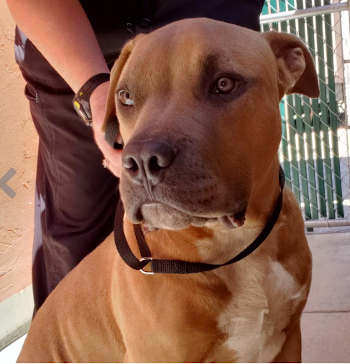
“Happy” is a 3-year-old female pit bull mix in kennel No. 19, ID No. LCAC-A-562. Photo courtesy of Lake County Animal Care and Control. ‘Happy’
“Happy” is a 3-year-old female pit bull mix with a short tan coat.
She is in kennel No. 19, ID No. LCAC-A-562.
This 2-year-old female basset-husky-hound is in kennel No. 21, ID No. LCAC-A-1331. Photo courtesy of Lake County Animal Care and Control. Basset-husky-hound mix
This 2-year-old female basset-husky-hound has a short black and tan coat.
She is in kennel No. 21, ID No. LCAC-A-1331.
“Dusty” is a 2-year-old female pit bull terrier mix in kennel No. 22, ID No. LCAC-A-611. Photo courtesy of Lake County Animal Care and Control. ‘Dusty’
“Dusty” is a 2-year-old female pit bull terrier mix with a short gray coat.
She is in kennel No. 22, ID No. LCAC-A-611.
“Jim” is a 2-year-old pit bull terrier mix in kennel No. 23, ID No. LCAC-A-810. Photo courtesy of Lake County Animal Care and Control. ‘Jim’
“Jim” is a 2-year-old pit bull terrier mix with a short black and white coat.
He is in kennel No. 23, ID No. LCAC-A-810.
This 6-year-old male terrier is in kennel No. 24, ID No. LCAC-A-1149. Photo courtesy of Lake County Animal Care and Control. Male terrier
This 6-year-old male terrier has a short black coat.
He is in kennel No. 24, ID No. LCAC-A-1149.
“Luna” is a 3-year-old female pit bull terrier mix in kennel No. 25, ID No. LCAC-A-1078. Photo courtesy of Lake County Animal Care and Control. ‘Luna’
“Luna” is a 3-year-old female pit bull terrier mix with a short red coat.
She is in kennel No. 25, ID No. LCAC-A-1078.
“Tinker” is a 4-year-old Chihuahua in kennel No. 26a, ID No. 1074. Photo courtesy of Lake County Animal Care and Control. ‘Tinker’
“Tinker” is a 4-year-old Chihuahua with a short tan coat.
She is in kennel No. 26a, ID No. 1074.
This female Rottweiler-pit bull mix is in kennel No. 27, ID No. LCAC-A-731. Photo courtesy of Lake County Animal Care and Control. Rottweiler-pit bull mix
This 1-year-old female Rottweiler-pit bull mix has a short black coat.
She has been spayed.
She is in kennel No. 27, ID No. LCAC-A-731.
“Brutus” is a male pit bull terrier in kennel No. 28, ID No. LCAC-A-670. Photo courtesy of Lake County Animal Care and Control. ‘Brutus’
“Brutus” is a 5-year-old male pit bull terrier with a short gray and white coat.
He is in kennel No. 28, ID No. LCAC-A-670.
This 4-year-old female pit bull terrier mix is in kennel No. 29, ID No. LCAC-A-812. Photo courtesy of Lake County Animal Care and Control. Female pit bull terrier
This 4-year-old female pit bull terrier mix has a short white coat.
She is in kennel No. 29, ID No. LCAC-A-812.
“Bubba” is a male pit bull terrier mix in kennel No. 30, ID No. LCAC-A-1306. Photo courtesy of Lake County Animal Care and Control. ‘Bubba’
“Bubba” is a male pit bull terrier mix with a short black coat.
He is in kennel No. 30, ID No. LCAC-A-1306.
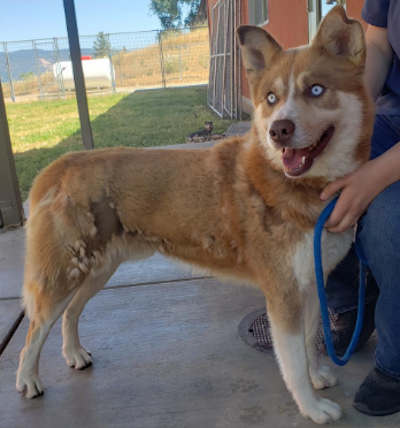
“Apollo” is a male husky mix in kennel No. 31, ID No. LCAC-A-783. Photo courtesy of Lake County Animal Care and Control. ‘Apollo’
“Apollo” is a 2-year-old male husky mix with a medium-length red and white coat and blue eyes.
He is in kennel No. 31, ID No. LCAC-A-783.
This 2-year-old male husky is in kennel No. 32, ID No. LCAC-A-1024. Photo courtesy of Lake County Animal Care and Control. Male husky
This 2-year-old male husky has a medium-length red and white coat.
He is in kennel No. 32, ID No. LCAC-A-1024.
“Dee” is a 1-year-old male shepherd mix in kennel No. 33, ID No. LCAC-A-1347. Photo courtesy of Lake County Animal Care and Control. ‘Dee’
“Dee” is a 1-year-old male shepherd mix with a black coat.
He’s in kennel No. 33, ID No. LCAC-A-1347.
“Ghost” is a 2-year-old female husky in kennel No. 34, ID No. LCAC-A-1167. Photo courtesy of Lake County Animal Care and Control. ‘Ghost’
“Ghost” is a 2-year-old female husky with an all-white coat and blue eyes.
She is in kennel No. 34, ID No. LCAC-A-1167.
Email Elizabeth Larson at This email address is being protected from spambots. You need JavaScript enabled to view it.. Follow her on Twitter, @ERLarson, or Lake County News, @LakeCoNews.
As a solar system forms, the young disk is initially bright and thick with dust. Within the first 10 million years or so, gaps appear within the disk as planets form and clear out paths. In time, this debris disk thins out as gravitational interactions with planets slowly sweep away the dust. Steady pressure from the starlight and stellar winds also blow out the dust. After approximately 10 million years, only a thin ring remains in the outermost reaches of the system, which is known as a debris disk. Credits: NASA/JPL-Caltech/R. Hurt (SSC/Caltech).
Researchers will use NASA’s upcoming James Webb Space Telescope to study Beta Pictoris, an intriguing young planetary system that sports at least two planets, a jumble of smaller, rocky bodies, and a dusty disk.
Their goals include gaining a better understanding of the structures and properties of the dust to better interpret what is happening in the system.
Since it’s only about 63 light-years away and chock full of dust, it appears bright in infrared light — and that means there is a lot of information for Webb to gather.
Beta Pictoris is the target of several planned Webb observing programs, including one led by Chris Stark of NASA’s Goddard Space Flight Center and two led by Christine Chen of the Space Telescope Science Institute in Baltimore, Maryland.
Stark’s program will directly image the system after blocking the light of the star to gather a slew of new details about its dust. Chen’s programs will gather spectra, which spread light out like a rainbow to reveal which elements are present. All three observing programs will add critical details to what’s known about this nearby system.
First, a review of what we know
Beta Pictoris has been regularly studied in radio, infrared, and visible light since the 1980s. The star itself is twice as massive as our Sun and quite a bit hotter, but also significantly younger. (The Sun is 4.6 billion years old, but Beta Pictoris is approximately 20 million years old.)
At this stage, the star is stable and hosts at least two planets, which are both far more massive than Jupiter. But this planetary system is remarkable because it is where the first exocomets (comets in other systems) were discovered. There are quite a lot of bodies zipping around this system!
Like our own solar system, Beta Pictoris has a debris disk, which includes comets, asteroids, rocks of various sizes, and plenty of dust in all shapes that orbit the star. (A debris disk is far younger and can be more massive than our solar system’s Kuiper Belt, which begins near Neptune’s orbit and is where many short-period comets originate.)
This outside ring of dust and debris is also where a lot of activity is happening. Pebbles and boulders could be colliding and breaking into far smaller pieces — sending out plenty of dust.
Scrutinizing this planetary system
Stark’s team will use Webb’s coronagraphs, which block the light of the star, to observe the faint portions of the debris disk that surround the entire system.
“We know there are two massive planets around Beta Pictoris, and farther out there is a belt of small bodies that are colliding and fragmenting,” Stark explained. “But what’s in between? How similar is this system to our solar system? Can dust and water ice from the outer belt eventually make its way into the inner region of the system? Those are details we can help tease out with Webb.”
Webb’s imagery will allow the researchers to study how the small dust grains interact with planets that are present in that system.
Plus, Webb will detail all the fine dust that streams off these objects, permitting the researchers to infer the presence of larger rocky bodies and what their distribution is in the system.
They’ll also carefully assess how the dust scatters light and reabsorbs and reemits light when it’s warm, allowing them to constrain what the dust is made of.
By cataloging the specifics of Beta Pictoris, the researchers will also assess how similar this system is to our solar system, helping us understand if the contents of our solar system are unique.
Isabel Rebollido, a team member and postdoctoral researcher at STScI, is already building complex models of Beta Pictoris. The first model combines existing data about the system, including radio, near-infrared, far-infrared, and visible light from both space- and ground-based observatories. In time, she will add Webb’s imagery to run a fuller analysis.
The second model will feature only Webb’s data — and will be the first they explore. “Is the light Webb will observe symmetrical?” Rebollido asked. “Or are there ‘bumps’ of light here and there because there is an accumulation of dust? Webb is far more sensitive than any other space telescope and gives us a chance to look for this evidence, as well as water vapor where we know there’s gas.”
Dust as a decoder ring
Think of the debris disk of Beta Pictoris as a very busy, elliptical highway — except one where there aren’t many traffic rules. Collisions between comets and larger rocks can produce fine dust particles that subsequently scatter throughout the system.
“After planets, most of the mass in the Beta Pictoris system is thought to be in smaller planetesimals that we can’t directly observe,” Chen explained. “Fortunately, we can observe the dust left behind when planetesimals collide.”
This dust is where Chen’s team will focus its research. What do the smallest dust grains look like? Are they compact or fluffy? What are they made of?
“We’ll analyze Webb’s spectra to map the locations of dust and gas – and figure out what their detailed compositions are,” Chen explained. “Dust grains are ‘fingerprints’ of planetesimals we can’t see directly and can tell us about what these planetesimals are made of and how they formed.”
For example, are the planetesimals ice-rich like comets in our solar system? Are there signs of high-speed collisions between rocky planetesimals? Clearly analyzing if grains in one region are more solid or fluffy than another will help the researchers understand what is happening to the dust, and map out the subtle differences in the dust in each region.
“I’m looking forward to analyzing Webb’s data since it will provide exquisite detail,” added Cicero X. Lu, a team member and a fourth-year Ph.D. student at Johns Hopkins University in Baltimore. “Webb will allow us to identify more elements and pinpoint their precise structures.”
In particular, there’s a cloud of carbon monoxide at the edge of the disk that greatly interests these researchers. It’s asymmetric and has an irregular, blobby side.
One theory is that collisions released dust and gas from larger, icy bodies to form this cloud. Webb’s spectra will help them build scenarios that explain its origin.
The reach of infrared
These research programs are only possible because Webb has been designed to provide crisp, high-resolution detail in infrared light.
The observatory specializes in collecting infrared light — which travels through gas and dust — both with images and spectra.
Webb also has another advantage — its position in space. Webb will not be hindered by Earth’s atmosphere, which filters out some types of light, including several infrared wavelength bands.
This observatory will allow researchers to gather a more complete range of infrared light and data about Beta Pictoris for the first time.
These studies will be conducted as part of Webb Guaranteed Time Observations, or GTO, and General Observers, or GO, programs.
The GTO programs are led by scientists who helped develop the key hardware and software components or technical and inter-disciplinary knowledge for the observatory.
GO programs are competitively selected using a dual-anonymous review system, the same system that is used to allocate time on the Hubble Space Telescope.
The James Webb Space Telescope will be the world's premier space science observatory when it launches in 2021. Webb will solve mysteries in our solar system, look beyond to distant worlds around other stars, and probe the mysterious structures and origins of our universe and our place in it. Webb is an international program led by NASA with its partners, ESA (European Space Agency) and the Canadian Space Agency.
Claire Blome works for the Space Telescope Science Institute in Baltimore, Maryland.
LAKEPORT, Calif. — A local tribe and members of partner organizations will be surveying Lake County residents and visitors this weekend as part of a larger effort to reliably track and prevent the health impacts of harmful algal blooms and communicate with the public about them.
Big Valley Band of Pomo Indians is partnering with Tracking California — a program of the Oakland-based Public Health Institute — along with the state agencies to carry out the California Water: Assessment of Toxins for Community Health Project, or Cal-WATCH.
The group sought funding for a five-year project through the Centers for Disease Control and Prevention's Environmental Health Capacity program.
The project summary explains that it’s working to increase the ability to reliably track and prevent harmful algal bloom illness statewide, with a special emphasis on Clear Lake, where those blooms, or HABs, have increased substantially since 2009.
Staff with the Public Health Institute and its Tracking California program, partners in Cal-WATCH, arrived in Lake County on Friday.
The team includes Susan Paulukonis, is a rare disease epidemiologist for the Public Health Institute and program manager for Cal-WATCH; Dr. Gina Solomon, MD, of the Public Health Institute and principal investigator of the Cal-WATCH project; Alexa Wilkie, program manager for Tracking California; David Chang, project coordinator for Tracking California; and Isadora Nogueira, research association with Tracking California.
Following a tour around the lake led by Karola Kennedy, water resources manager for Robinson Rancheria, the group gathered with Big Valley environmental staff, including Environmental Director Sarah Ryan, in Lakeport on Friday to plan a weekend of work.
Ryan said the group is “treading in new territory” in terms of public health.
The focus this weekend is on-the-ground outreach, one of the key purposes of which is to find out how people get their information about the lake and how informed they are, with a view to doing better public outreach, said Solomon.
The group is planning to do outreach on Saturday from 10 a.m. to 1 p.m. in Lakeport at Library Park and at the farmers market at the Lake County Fairgrounds, and also will be stopping at locations throughout Clearlake and Clearlake Oaks.
For those who participate, there is a raffle in which they can win $25 gift cards.
Solomon said they’re hoping that in the coming years they can improve the system used to alert people when there are toxic blooms on Clear Lake, especially in circumstances where the HABs don’t appear as evident.
“The aim of this weekend is to collect as many survey responses as we can,” Paulukonis added.
Ryan said they also will have the paper surveys available around Lake County, with signs in English and Spanish that also feature scan codes to go to the online version.
Based on early returns, “We’re going to get a lot,” said Ryan, and that’s what the group wants.
Paulukonis said they will stop collecting survey data around Labor Day weekend and will put together a presentation of the results that will target local health agencies, tribes and anyone doing health education outreach. She said there also will be a community component.
Tracking illness reports
Ryan said the tribe has been involved in lake monitoring since 1999.
She said a state blue green algae committee began in 2006 in response to issues the Klamath tribes were encountering, with more efforts to ramp up monitoring beginning around 2010.
The California State Water Resources Control Board began tracking blooms on public water bodies in 2016, according to the Tracking California website.
Solomon said the issues with HABs is a relatively new issue that’s been getting worse in recent years.
The Tracking California website shows that in 2016, there were 91 blooms reported across California and no illness reports, followed by 181 blooms with no illness reports in 2017. By 2018, blooms had increased to 190 with 19 illness reports, and rose again in 2019 to 241 blooms and 22 connected reports of illness.
“It screams for attention,” said Solomon.
She added, “Not all of what’s out there is toxic. And not all that’s toxic is noticeable, so it can be a little tricky.”
Paulukonis said the state started working with partner agencies in 2018 to report illness impacts. Since then, they’ve been collecting data on humans, animals and wildlife.
Tracking California works with entities like Big Valley, the State Water Resources Control Board, the state Office of Environmental Health Hazard Assessment, California Department of Fish and Wildlife and California Department of Public Health, she said.
“We investigate the reports that come in collectively and then report those that do seem to have some association with the bloom exposure up to the CDC’s reporting system,” which is called One Health, Paulukonis said.
She said part of the grant is to support Big Valley and Ryan’s team in responding to illness reports that come out of Clear Lake and the creeks feeding into it.
Of the reports received statewide of illness connected to HABs, 15% of the cases are coming from Clear Lake and its associated water bodies, Paulukonis said.
Paulukonis said when they get a report of a sick dog, human or wildlife in Lake County, Ryan and her team can be on the scene the same day to investigate. That rapid response is a huge advantage.
In one recent case, Ryan said they followed up with the owner of a dog that got sick after going into Kelsey Creek at the end of June. The dog, she added, survived.
While illness caused by HABs for humans, pets and wildlife is a chief area of focus for the project, it’s not the only one.
Another area of study is the safety of drinking water from the lake. Sixty percent of Lake County residents get their drinking water from Clear Lake, and so one facet of the project is to test drinking water from small water systems — as small as one to four connections — and from intakes and wells within 150 feet of the shoreline.
Ryan said the free testing project began in the fall, with water testing beginning earlier this year. She said those who are serviced by public water systems are not eligible.
So far, Ryan said they’ve identified some serious issues affecting private homeowners in terms of their private treatment systems, and the vulnerability they have to any Clear Lake water quality issues.
“They’re not regulated by anybody, these private systems,” she said, noting they are mostly in rentals, including vacation rentals, and they don’t have to meet Safe Drinking Water Act requirements, like the public water systems with certified managers do.
There are 430 parcels on Clear Lake that aren’t hooked up to a local water system, Ryan said.
Ryan said they mailed out packets, did door hangers and social media posts to alert property owners to the testing project. Sixty responses came in.
The first participants signed up around the end of February. So far they’ve sampled the tap water coming from 44 intakes and wells, Ryan said. Of that number, 14 were wells, 28 were intakes and two were not categorized.
Summary data showed that of the 14 wells, nine had nitrates detected and two had total coliform. Three wells had no detections of anything, Ryan said.
Of the 28 intakes, or pipes that run into the lake to extract water, Ryan said 15 had total coliform and two had total coliform and E. coli.
Solomon said total coliform is a bacteria that’s in the same general class as E. coli. While it may not make you sick, it’s an indicator that water isn’t clean and needs more treatment.
They also tested homes where herbicide treatment on the lake was happening nearby and had no detections of the chemicals, Ryan said.
The next phase of testing is on cyanotoxins, which are associated with HABs. Ryan said so far they’ve gotten initial surveillance reports for two homes, one with a well, one with an intake. Both had intact cyanotoxins coming out of their taps, even with water treatment in place.
She said they just tested 22 more homes for cyanotoxins and are waiting for the lab results.
The program gives the lab reports to participants along with guidance and a resource list on how to get help to set up a proper filtering system for their water.
Solomon said they are still recruiting participants for that project.
Paulukonis said they are planning a webinar for the project’s community drinking water component, with the goal of wanting people to understand the hazards of water that isn’t treated to a safe level.
Ryan said they’ve met with Lake County Environmental Health to let them know the concerning results from the testing.
She said there needs to be more support and help for private water systems.
Paulukonis said next year’s focus for drinking water will be similar, and will look at the water intake and wells on creeks that feed Clear Lake.
They also intend to look at fish tissue and crustaceans coming out of the lake, and the hazards in consuming those, Paulukonis said.
Ryan said good things are already coming from the collaboration, and Solomon said they are hoping the project continues long-term.
“We anticipate we will be here for years to come working on this in partnership with Big Valley,” she said. “There’s a lot of work to do.”
Email Elizabeth Larson at This email address is being protected from spambots. You need JavaScript enabled to view it.. Follow her on Twitter, @ERLarson, or Lake County News, @LakeCoNews.
The meeting ID is 961 3716 8087, passcode is 567514. The meeting also can be accessed via phone at 1-669-900-6833.
Under old business, they will discuss the pending request to clear Scotts Creek beginning at the bridge at Hendricks and Scotts Valley Road and ending downstream from a newly installed culvert, get a report on June 9 site visits from the Natural Resources Conservation Service and consider the bridge approach over Scotts Creek at Scotts Valley Road and Hendricks Road.
In new business, the group will hear about new use permits, community emergency notifications, Scotts Valley water usage by the city of Lakeport and the Scotts Valley Water Conservation District.
They also will discuss a request for a bike lane on Scotts Valley Road, get a report on the Scotts Valley Firewise Committee and consider whether to continue with Zoom meetings or resume in-person gatherings.
In a video conference joined by Assembly Speaker Anthony Rendon, members of the Legislative Women’s Caucus including Chair Assemblymember Cristina Garcia and Vice Chair Senator Nancy Skinner, and child care stakeholders and providers, Gov. Gavin Newsom on Friday signed legislation that adds thousands of new child care slots to expand access for working families and increases child care and preschool provider rates, among other supports.
AB 131, the child care budget trailer bill, will phase in 200,000 new child care slots by 2025-26, dramatically expanding access to child care for families. Over 145,000 new child care slots will be added by 2022-23.
“I’m proud to sign this legislation lifting up women and working families while supporting our dedicated early childhood professionals,” said Gov. Newsom. “With 200,000 new child care slots to help meet the needs of parents as they balance the demands of work with raising a family, and increased compensation and supports for child care and preschool providers, this package will help reinvigorate our essential care economy and invests in the health and well-being of families across the state.”
Under the legislation, child care and preschool providers around the state will receive significant rate increases, reflecting the agreement reached between the state and Child Care Providers United, which represents 40,000 family child care providers.
This is the first collective bargaining agreement between the state and the new union after the Governor in 2019 signed AB 378 — legislation by current Senator Monique Limόn that was championed by Senate President pro Tempore Toni G. Atkins and other child care advocates in the Legislature — to give child care workers the right to join a union and collectively bargain with the state.
It also provides $40 million one-time to help address workforce needs including education, training and professional development for family child care providers.
AB 131 includes $579 million for additional support to child care and preschool providers, including stabilization stipends, to ensure more can continue operating in the wake of unprecedented challenges over the past year.
Family fees will be waived for all families utilizing subsidized child care and state preschool, through June of next year.
The legislation also allows the state to deploy $250 million in infrastructure grants to build and renovate child care facilities, with a focus on underserved areas.
Under the budget agreement signed by the governor earlier this month, the state is investing $4.8 million for the Department of Social Services to lead the planning and development of a new child care data system, aligning with the Master Plan for Early Learning and Care, to meet the needs of families and providers.
The California Comeback Plan also includes investments to achieve free, high-quality universal transitional kindergarten for all four-year-olds by 2025 and to seed savings accounts for vulnerable students currently enrolled in K-12 public schools.
After testing a bristling array of instruments on its robotic arm, NASA’s latest Mars rover gets down to business: probing rocks and dust for evidence of past life.
NASA’s Mars 2020 Perseverance rover has begun its search for signs of ancient life on the Red Planet. Flexing its 7-foot mechanical arm, the rover is testing the sensitive detectors it carries, capturing their first science readings.
Along with analyzing rocks using X-rays and ultraviolet light, the six-wheeled scientist will zoom in for closeups of tiny segments of rock surfaces that might show evidence of past microbial activity.
Called PIXL, or Planetary Instrument for X-ray Lithochemistry, the rover’s X-ray instrument delivered unexpectedly strong science results while it was still being tested, said Abigail Allwood, PIXL’s principal investigator at NASA’s Jet Propulsion Laboratory in Southern California.
Located at the end of the arm, the lunchbox-size instrument fired its X-rays at a small calibration target – used to test instrument settings – aboard Perseverance and was able to determine the composition of Martian dust clinging to the target.
“We got our best-ever composition analysis of Martian dust before it even looked at rock,” Allwood said.
That’s just a small taste of what PIXL, combined with the arm’s other instruments, is expected to reveal as it zeroes in on promising geological features over the weeks and months ahead.
Scientists say Jezero Crater was a crater lake billions of years ago, making it a choice landing site for Perseverance. The crater has long since dried out, and the rover is now picking its way across its red, broken floor.
“If life was there in Jezero Crater, the evidence of that life could be there,” said Allwood, a key member of the Perseverance “arm science” team.
To get a detailed profile of rock textures, contours, and composition, PIXL’s maps of the chemicals throughout a rock can be combined with mineral maps produced by the SHERLOC instrument and its partner, WATSON. SHERLOC – short for Scanning Habitable Environments with Raman & Luminescence for Organics & Chemicals – uses an ultraviolet laser to identify some of the minerals in the rock, while WATSON takes closeup images that scientists can use to determine grain size, roundness, and texture, all of which can help determine how the rock was formed.
Early WATSON closeups have already yielded a trove of data from Martian rocks, the scientists said, such as a variety of colors, sizes of grains in the sediment, and even the presence of “cement” between the grains.
Such details can provide important clues about formation history, water flow, and ancient, potentially habitable Martian environments. And combined with those from PIXL, they can provide a broader environmental and even historical snapshot of Jezero Crater.
“What is the crater floor made out of? What were the conditions like on the crater floor?” asks Luther Beegle of JPL, SHERLOC’s principal investigator. “That does tell us a lot about the early days of Mars, and potentially how Mars formed. If we have an idea of what the history of Mars is like, we’ll be able to understand the potential for finding evidence of life.”
NASA’s Perseverance Mars rover took this close-up of a rock target nicknamed “Foux” using its WATSON camera on the end of the rover’s robotic arm. The image was taken July 11, 2021, the 139th Martian day, or sol, of the mission. Credits: NASA/JPL-Caltech/MSSS.
The science team
While the rover has significant autonomous capabilities, such as driving itself across the Martian landscape, hundreds of earthbound scientists are still involved in analyzing results and planning further investigations.
“There are almost 500 people on the science team,” Beegle said. “The number of participants in any given action by the rover is on the order of 100. It’s great to see these scientists come to agreement in analyzing the clues, prioritizing each step, and putting together the pieces of the Jezero science puzzle.”
That will be critical when the Mars 2020 Perseverance rover collects its first samples for eventual return to Earth. They’ll be sealed in superclean metallic tubes on the Martian surface so that a future mission could collect them and send back to the home planet for further analysis.
Despite decades of investigation on the question of potential life, the Red Planet has stubbornly kept its secrets.
“Mars 2020, in my view, is the best opportunity we will have in our lifetime to address that question,” said Kenneth Williford, the deputy project scientist for Perseverance.
The geological details are critical, Allwood said, to place any indication of possible life in context, and to check scientists’ ideas about how a second example of life’s origin could come about.
Combined with other instruments on the rover, the detectors on the arm, including SHERLOC and WATSON, could make humanity’s first discovery of life beyond Earth.
More about the mission
A key objective for Perseverance’s mission on Mars is astrobiology, including the search for signs of ancient microbial life. The rover will characterize the planet’s geology and past climate, pave the way for human exploration of the Red Planet, and be the first mission to collect and cache Martian rock and regolith (broken rock and dust).
Subsequent NASA missions, in cooperation with ESA (European Space Agency), would send spacecraft to Mars to collect these sealed samples from the surface and return them to Earth for in-depth analysis.
The Mars 2020 Perseverance mission is part of NASA’s Moon to Mars exploration approach, which includes Artemis missions to the Moon that will help prepare for human exploration of the Red Planet.
JPL, which is managed for NASA by Caltech in Pasadena, California, built and manages operations of the Perseverance rover.
PIXL, one of seven instruments aboard NASA's Perseverance Mars rover, is equipped with light diodes circling its opening to take pictures of rock targets in the dark. Using artificial intelligence, PIXL relies on the images to determine how far away it is from a target to be scanned. Credits: NASA/JPL-Caltech.
 How to resolve AdBlock issue?