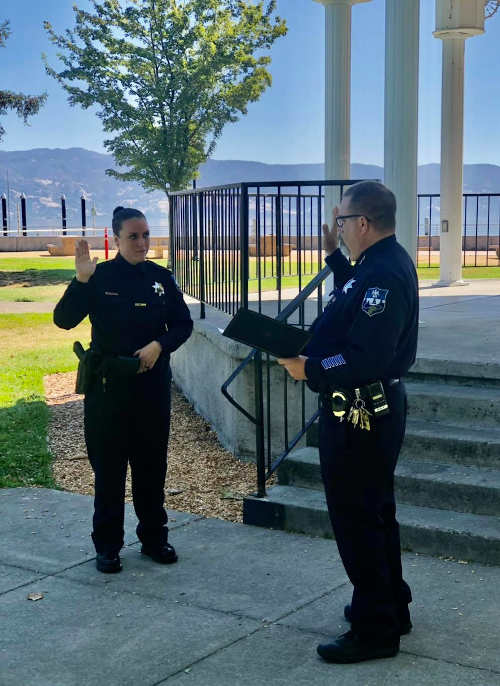
Lakeport Police Chief Brad Rasmussen swears in new officer Kaitlin Morfin at a ceremony at the gazebo in Library Park on Wednesday, July 21, 2021. Courtesy photo. LAKEPORT, Calif. — The Lakeport Police Department made history this week when it added another female officer to its ranks.
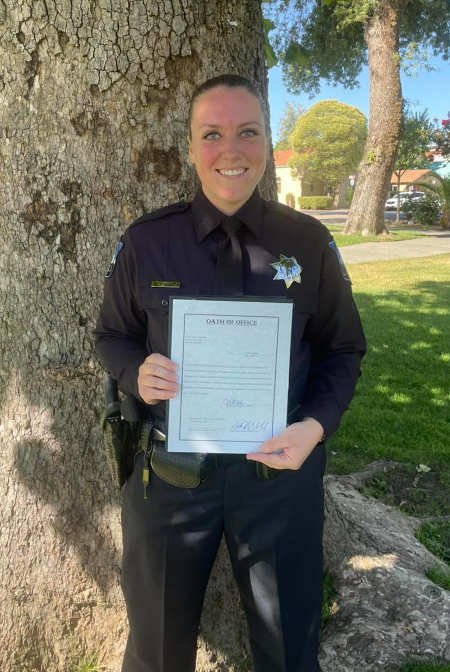
On Wednesday, Officer Kaitlin Morfin graduated from the police academy.
Later that same day, she took her oath from Lakeport Police Chief Brad Rasmussen at a ceremony at the Library Park gazebo.
A lifelong Lakeport resident, Morfin grew up in a family with a record of law enforcement service, including her father, Kory Reynolds, who was a longtime California Highway Patrol officer in the Clear Lake Area office.
Twelve years ago, she started her path toward a law enforcement career by working with the Lakeport Police Department as a cadet while in high school.
She went on to receive a college degree and then went to work for Lake County Probation.
In July 2020, Morfin was a successful candidate in a round of Lakeport Police trainee interviews.
Rasmussen introduced her to the Lakeport City Council in January, when she told the council she was excited for the opportunity.
In March, Morfin headed off to the academy, completing her training this week.
She is the latest of several officers to have come to the department as part of Rasmussen’s effort to train and hire officers from the community.
Rasmussen told the council earlier this year that he’s proud to be recruiting people locally “and investing back in our community.”
Morfin’s arrival as a newly sworn officer is a historic moment for the Lakeport Police Department: It’s the first time in the agency’s 133-year history that it has had three female officers working for the community at the same time.
“Congratulations Kaitlin, we are proud to have you on our team!” the agency said in a statement.
Email Elizabeth Larson at This email address is being protected from spambots. You need JavaScript enabled to view it.. Follow her on Twitter, @ERLarson, or Lake County News, @LakeCoNews.
Kaitlin Morfin is the newest officer at the Lakeport Police Department in Lakeport, California. Courtesy photo.
LAKE COUNTY, Calif. — After taking two weeks to get more information — particularly about water supply and use — the Lake County Planning Commission voted Thursday to approve a new commercial cannabis project on High Valley Ranch in Clearlake Oaks.
In separate 4-0 votes — with District 5 Commissioner Lance Williams absent — the commission voted following a continued public hearing to approve a mitigated negative declaration and grant a major use permit to Sourz HVR Inc./Aviona LLC for the operation at High Valley Ranch, located at 11650 High Valley Road in Clearlake Oaks.
The 1,640-acre ranch formerly was the home for decades to PSI World, which sold the ranch to Aviona LLC in February.
Sourz HVR Inc. proposes to conduct cultivation and distribution activities on a 649-acre portion of the ranch.
The cultivation area proposed is 3,485,000 square feet, or about 80 acres. There also will be 110,000 square feet for storage and drying of cannabis and the existing 13,000 square foot conference center will be used for packing, distribution and office space.
During that meeting, District 1 Commissioner John Hess had explained that the commission was seeking more guidance from the Board of Supervisors on how to look at these projects in light of water, and he reiterated on Thursday that such guidance would be helpful.
He said the commissioners are as sensitive to any county officials to water, and “excruciatingly aware” of the drought.
Hess said they are obligated to take every project on a case-by-case basis, and he expects to have more hearings where water is a concern. But they can’t make a blanket decision to not consider more projects due to water.
The ranch’s High Valley neighbors have brought up many concerns — among them traffic and odor — but the most pressing has been water usage, as several, like Maria Kann, argued that their wells are going dry.
One of the project owners, Elli Hagoel, asked to bring the matter back this week, and in the meantime he had his consultants from the firm Kimley-Horn provide more updated water analysis.
A revised hydrogeology technical memorandum from Jason Sheasley and Brad Stoneman of Kimley-Horn said the project will use 353 acre feet, or 115 million gallons of water per year or about 2.2 million gallons a week during the growing season, when the cannabis plants will be watered three times a week with drip irrigation.
The report said a groundwater evaluation concluded the aquifer has a storage capacity of approximately 27,799 acre feet with groundwater recharge of 2,321 acre feet. Current and future water use demands are estimated at 1.4% of the available groundwater.
Sheasley told the commission that the drip irrigation will draw out of the ranch’s deeper aquifer and help to recharge the shallower aquifer.
District 3 Commissioner and Chair Batsulwin Brown asked if the drought will have an impact on the aquifer and the rest of the valley.
Sheasley said the drought has a definite impact. “We’re in extraordinary circumstances with this drought, for sure.”
Looking back over 50 years, 1976 is most similar to today’s conditions, Sheasley said. It took roughly four to five years for groundwater levels to come back to pre-1976 conditions, which he said is normal under drought conditions, depending on the severity. Drought conditions, he added, come and go.
“It’s not a steady system that never changes. We have to anticipate those changes,” said Sheasley.
In looking at drought conditions, Sheasley said they need to adjust irrigation and consider potentially adjusting crop sizes or using other sources like reclaimed water instead of groundwater.
The additional two weeks also allowed staff and commission members to visit the site to get more information. Brown said his site visit on July 15 was very helpful.
Assistant Planner Katherine Schaefers said she visited the site last week along with state officials to look at remediation efforts regarding grading violations. Due to those remediations, she said the project no longer has violations with the county.
Tom Armstrong of Sourz HVR Inc. said they heard the concerns at the July 8 meeting and tried to address them, outlining in a PowerPoint more information on traffic, the distance from the nearest school, grading, and archaeological and biological resources.
He said the normal operations only require 10 people, with peak season to have 60 employees who would live in the existing and permitted employee housing.
While Kann and other neighbors argued that project impacts like water and odor can’t be mitigated, supporters like Richard Derum said the project proposal is one of the most comprehensive he’s seen, adding larger cannabis operations like the one proposed for High Valley Ranch are needed to move Lake County forward as a top cannabis producing area.
Hagoel said he took very seriously the concerns of the neighbors and the Planning Commission and tried to meet with most of the residents.
He said the area was designated by the county for cannabis cultivation and is surrounded by hundreds of acres of existing vineyards, away from the public eye.
In response to Kann’s concerts that the valley can’t support the operation, Hagoel said they are doing things out of good faith, not fear. “Change is here. It’s coming.”
During the meeting, it was noted that Hagoel had delivered water to some of the neighbors. Kann confirmed she was one of those, and that she appreciated it.
She and another neighbor, Doug Logan, both emphasized that Hagoel and his team are good people.
“The water is the issue,” Logan said.
Commission deliberates with more information
District 2 Commissioner Everardo Chavez Perez brought up a video posted to YouTube by Kann on Wednesday, which can be seen above. It featured drone footage of flying over pipes running from a Brassfield Winery reservoir to High Valley Ranch.
“Where is that water going to?” he asked.
Hagoel said the water is being used for agricultural operations. Armstrong also explained that they had county permits to run the pipe, which county staff confirmed.
Hagoel said they are running cattle for some neighbors and will plant more than 40 acres of sunflowers, rather than cannabis, on the east side of the property to block the grow from neighbors.
Regarding a hairpin turn on High Valley Road that was a concern for both neighbors and commissioners, Hagoel said he’s already agreed to fix that turn and a contractor is bidding to add a 15-foot culvert to the site.
Public Works Director Scott De Leon confirmed to the commission that Hagoel was in contact with Public Works staff to discuss those road improvements.
While Brassfield Winery has been paying 10 cents per case of wine sold toward road maintenance, De Leon said the challenge had been to settle on what unit of measure for cannabis. Instead, the decision was made to ask the Board of Supervisors for a percentage of the cannabis tax that will be paid on the project.
Hess, noting he was the “last standing commissioner” who worked on writing the county’s cannabis ordinance, said in his review the Sourz HVR Inc. proposal was one of the most comprehensive and carefully crafted applications he’s seen, and it was further buoyed by the additional information they received on Thursday. As such, he was prepared to move forward.
His fellow commissioners indicated the same, with Brown noting that after visiting the site last week and getting the updated information, a lot of his concerns — such as those focusing on water — were no longer valid.
District 4 Commissioner Christina Price said she felt the applicant had wanted to address every situation and that hadn’t gone unnoticed.
Chavez Perez said the applicant had put a lot of work into the project, and continues to go beyond to address neighbor and public concerns.
Hess made both motions, for the mitigated negative declaration and the major use permit, which the commission approved in 4-0 votes.
No action on one permit, approval of another
In other business on Thursday, commissioners chose to take no action on the major use permit application for Pasta Farms LLC, located on 235 acres located at 10750 and 10417 Seigler Springs North Road and 10833 Diener Drive, Kelseyville.
Applicant Peter Simon is proposing to add one 27,201 square foot nursery area, four 22,000 square foot greenhouses and 113 hoop houses. The project is to be phased over four years.
However, information was included in the agenda packet that raised questions about a well that is not part of the property and which was said to be a significant water source.
“It can’t be approved. There is a dispute about the water source,” said Associate Planner Eric Porter.
He said that the dispute came to light about a week ago and staff had to scramble to change its recommendation from an approval to a continuation.
Porter suggested they continue the matter to a date uncertain, noting there is also substantial public opposition for different reasons.
Commissioners agreed to refuse the item, meaning staff would need to reassess the project in order to bring it back in the future, explained Deputy County Counsel Nicole Johnson. Had they voted to deny it, the applicant would have had to reapply.
In its other agenda item, the commission voted to approve Langtry Farms’ request for a parcel map to divide a 406.69 acre property to create three new parcels at 21700 and 22000 Butts Canyon Road in Middletown.
It was clarified during the meeting that the property split is not connected to the larger Guenoc property that surrounds it. The Guenoc property is slated for a large resort development that’s already been approved but is being held up due to litigation.
The property currently has a vineyard, one single family dwelling, several small sheds, a well for potable water and several internal driveway, staff reported.
There are no development plans for the Langtry property, which will remain in agriculture and is almost fully developed for that purpose, it was noted during the meeting.
Email Elizabeth Larson at This email address is being protected from spambots. You need JavaScript enabled to view it.. Follow her on Twitter, @ERLarson, or Lake County News, @LakeCoNews.
CLEARLAKE, Calif. — If you’re looking for a cool new dog, Clearlake Animal Control is all stocked up.
The newest dog is at the top.
“Yule.” Photo courtesy of Clearlake Animal Control. ‘Yule’
“Yule” is a male husky with a medium-length black and white coat.
He is dog No. 4432.
“Bear.” Photo courtesy of Clearlake Animal Control. ‘Bear’
“Bear” is a male American Staffordshire terrier mix with a short brown coat.
He has been neutered.
He is dog No. 3476.
“Cleo.” Photo courtesy of Clearlake Animal Control. ‘Cleo’
“Cleo” is a female Doberman pinscher mix with a short gray coat who is new to the shelter.
She has been spayed.
She is dog No. 4865.
“Dusty.” Photo courtesy of Clearlake Animal Control. ‘Dusty’
“Dusty” is a male American Pit Bull Terrier with a tan and white coat.
He is dog No. 4750.
“Girly.” Photo courtesy of Clearlake Animal Control. ‘Girly’
“Girly” is a senior female Chihuahua mix.
She has a short tan coat.
Girly is house-trained.
She is dog No. 4940.
“Gizmo.” Photo courtesy of Clearlake Animal Control. ‘Gizmo’
“Gizmo” is a senior male Chihuahua mix with a short tan and white coat.
He is dog No. 4902.
“Ike.” Photo courtesy of Clearlake Animal Control. ‘Ike’
“Ike” is a senior male Chihuahua.
He has a short tan coat.
He is dog No. 4942.
“Jake.” Photo courtesy of Clearlake Animal Control. ‘Jake’
“Jake” is a senior male Chihuahua mix.
He has a short tan and white coat.
He is dog No. 4941.
“Mara.” Photo courtesy of Clearlake Animal Control. ‘Mara’
“Mara” is a female Rottweiler mix.
She has a short black and tan coat.
He is house-trained.
She is dog No. 4628.
“Mary J.” Photo courtesy of Clearlake Animal Control. ‘Mary J’
“Mary J” is a female pit bull terrier mix.
She has a white and tan coat.
She is house-trained.
She is dog No. 4927.
“Mitzy.” Photo courtesy of Clearlake Animal Control. ‘Mitzy’
“Mitzy” is a female shepherd mix with a medium-length black and white coat.
She is dog No. 4648.
“Mojo.” Photo courtesy of Clearlake Animal Control. ‘Mojo’
“Mojo” is a male Chihuahua mix with a short black and tan coat.
He has been neutered.
He is dog No. 4881.
“Oakley.” Photo courtesy of Clearlake Animal Control. ‘Oakley’
“Oakley” is a male pit bull terrier mix.
He has a short red and white coat.
He is dog No. 4934.
“Patches.” Photo courtesy of Clearlake Animal Control. ‘Patches’
“Patches” is a male Chihuahua mix with a short tricolor coat.
He is dog No. 4903.
“Sassy.” Photo courtesy of Clearlake Animal Control. ‘Sassy’
“Sassy” is a female American bully mix with a short black coat.
She has been spayed.
She is dog No. 4602.
“Tanisha.” Photo courtesy of Clearlake Animal Control. ‘Tanisha’
“Tanisha” is a female shepherd mix with a short orange and white coat.
She is dog No. 4647.
“Terry.” Photo courtesy of Clearlake Animal Control. ‘Terry’
“Terry” is a male Dutch shepherd mix with a smooth brindle coat.
He is dog No. 4880.
“Tinsel.” Photo courtesy of Clearlake Animal Control. ‘Tinsel’
“Tinsel” is a female American pit bull terrier mix with a short brindle and brown coat.
She is dog No. 4433.
Call the Clearlake Animal Control shelter at 707-273-9440, or email This email address is being protected from spambots. You need JavaScript enabled to view it. to inquire about adoptions and schedule a visit to the shelter.
Email Elizabeth Larson at This email address is being protected from spambots. You need JavaScript enabled to view it.. Follow her on Twitter, @ERLarson, or Lake County News, @LakeCoNews.
As part of Gov. Gavin Newsom’s investments in emergency preparedness and wildfire response, the California Department of Forestry and Fire Prevention, or Cal Fire, secured 12 additional firefighting aircraft this week for exclusive use in its statewide response efforts.
Within hours of securing these critical resources, nine of the 12 aircraft were immediately dispatched to new and emerging fires.
“Climate change is the driving force behind the extreme weather we see across the globe — creating hotter, drier conditions in Western States and contributing to unparalleled risk of catastrophic wildfire,” said Gov. Newsom. “Our investments in state-of-the-art firefighting technology and equipment, along with a focus on building resilience through fuel breaks, forest health projects and home hardening will ensure California is more prepared than ever to face an increasingly severe wildfire season.”
Gov. Newsom’s California Comeback Plan invests over $2 billion to combat and prepare for wildfires and advance emergency response, the largest investment in our state’s history. It also includes $5.1 billion over four years for immediate drought response and long-term water resilience.
The new aircraft bring Cal Fire’s aerial fleet to more than 60 fixed and rotary wing aircraft, augmenting what is already the largest civil aerial firefighting fleet in the world.
The 12 additional firefighting aircraft join Cal Fire’s world-renowned aviation program, which responds to thousands of wildland fires throughout California each year.
Since taking office, Gov. Newsom has consistently increased fire prevention and response resources. Cal Fire now has over 9,200 personnel, including 356 state fire engines, making it the second-largest fire department in the nation.
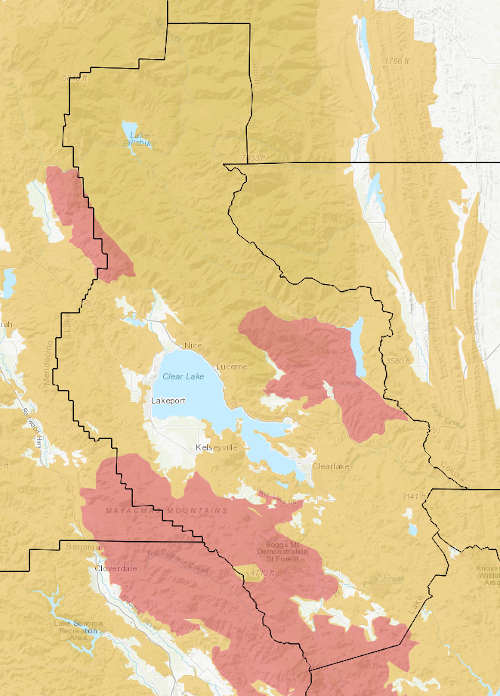
The California Public Utilities Commission Fire Map that shows fire threat, with this screen capture showing the boundaries of Lake County, California. The orange shows Tier 2 and the red shows Tier 3, both elevated fire risk areas. Pacific Gas and Electric Co. said it will undertake a new undergrounding effort in those high fire risk areas across its coverage area. LAKE COUNTY, Calif. — Following several years of devastating wildfires that have been caused, in some cases, by its electrical equipment, Pacific Gas and Electric announced Wednesday plans for a major new initiative to expand the undergrounding of electric distribution power lines in California’s high fire threat districts.
The company said the goal is to further harden its system and help prevent wildfires.
PG&E Chief Executive Officer Patti Poppe announced the initiative in Butte County, which has been hard-hit by fires caused by electrical infrastructure, including the deadly 2018 Camp fire.
The utility also said this week that a tree that fell into its power equipment may have been responsible for starting the Dixie fire, which by Wednesday night had burned more than 91,000 acres above the Feather River Canyon in Butte County.
“We want what all of our customers want: a safe and resilient energy system. We have taken a stand that catastrophic wildfires shall stop. We will partner with the best and the brightest to bring that stand to life. We will demand excellence of ourselves. We will gladly partner with policymakers and state and local leaders to map a path we can all believe in,” Poppe said.
Poppe, who joined the company this earlier year, said Wednesday, “I came to make it right and make it safe.”
She acknowledged that the company had planned to wait for a couple of months to make the announcement, but that they couldn’t wait due to the Dixie fire.
“We will make it safe and we will bury the lines,” Poppe said.
The new multiyear plan calls for undergrounding 10,000 miles of power lines in highest fire-threat areas.
The company said it maintains more than 25,000 miles of overhead distribution power lines in the highest fire-threat areas — Tier 2, Tier 3 and Zone 1 — which is more than 30% of its total distribution overhead system.
“The exact number of projects or miles undergrounded each year through PG&E’s new expanded undergrounding program will evolve as PG&E performs further project scoping and inspections, estimating and engineering review,” the company said in its Wednesday announcement.
PG&E reports that in Lake County, it serves a total of 37,780 customer accounts; of those, 15,719 are in the high fire threat areas.
Additionally, PG&E has 1,172 total miles of electric distribution lines in Lake County, of which 716 miles are in the high fire threat areas.
The company’s transmission line miles in Lake County total 199, with 175 miles of those lines in the high fire threat area.
Lake County officials have pressed PG&E previously on undergrounding in the county.
Those officials include Clearlake Mayor Dirk Slooten, whose city was impacted by the October 2017 Sulphur fire, part of the North Bay Fire Storm.
Cal Fire determined the 2,207 acre Sulphur Fire — which destroyed 162 structures — was caused by a failure of a PG&E-owned power pole near Pomo and Sulphur Bank roads in Clearlake Oaks.
Slooten also is a native of the Netherlands, a country that has placed much of its power distribution system underground and reportedly built it to withstand a 10,000 year flood.
At a May 20 Clearlake City Council meeting, PG&E updated the city on its plans to mitigate fire risks in the area, with company representative Jon Stallman acknowledging that conditions are drier than they have seen historically.
“We recognize that this could be a tough season, and I think we should all be prepared,” Stallman said.
Slooten pressed Stallman and another company representative, Melinda Rivera, on the company’s system hardening plans for the county, which include 24 miles of improvements.
At that point, only one mile had been completed, with Rivera quick to clarify that system hardening did not necessarily mean undergrounding.
During the discussion, Slooten said, “Undergrounding is the ultimate hardening,” and criticized the company for going “in the wrong direction” by not focusing more on undergrounding.
In response to Lake County News’ question about where PG&E might conduct undergrounding locally, company representative James Noonan said in an email, “Regarding specific locations for undergrounding in Lake County, we’ll be engaging customers and stakeholders as PG&E develops a plan and reviews potential additional undergrounding sites based on a variety of factors, including local municipal planning and safety considerations. Engineering an underground electric system requires designing the system around existing water, natural gas and drainage systems, as well as planning for future road widening. This work will be focused within the Tier 2 and Tier 3 High-Fire Threat Districts of our system, and we intend to work closely with customers and local, state, federal, tribal and regulatory officials throughout this new safety initiative.”
Company describes previous undergrounding projects
PG&E said its plan represents the largest effort in the U.S. to underground power lines as a wildfire risk reduction measure.
In the past company officials, when asked about undergrounding, have pointed to its high cost.
On Wednesday, the company said that undergrounding previously has been done on a select, case-by-case basis, and largely for reasons other than wildfire risk reduction.
“Thanks to breakthroughs PG&E has achieved on undergrounding projects in recent years, undergrounding can now play a much more prominent role in PG&E's ongoing efforts to harden the electric grid,” the company said.
PG&E said that, following the devastating October 2017 Northern California wildfires and the 2018 Camp fire — most of which were connected to the company’s equipment — PG&E began to evaluate placing overhead power lines underground as a wildfire safety measure, and to better understand the construction and cost requirements associated with undergrounding for system hardening purposes.
As part of its Community Wildfire Safety Program, PG&E said it completed multiple demonstration projects aimed at converting overhead power lines to underground in high fire-threat areas of Alameda, Contra Costa, Nevada and Sonoma counties from 2018 to 2020.
As a part of the rebuilding efforts following the October 2017 Northern California wildfires, PG&E said it completed undergrounding eight miles of power lines in the Larkfield Estates and Mark West Estates communities in Sonoma County in 2018.
In 2019, PG&E announced it would rebuild all its power lines underground in the town of Paradise as it helps the community recover from the Camp fire. PG&E also is rebuilding power lines underground within the 2020 North Complex Fire footprint in Butte County.
PG&E said those demonstration projects and rebuild efforts have helped it to refine the construction and cost requirements associated with targeted undergrounding, enabling the acceleration and expansion of undergrounding projects.
Email Elizabeth Larson at This email address is being protected from spambots. You need JavaScript enabled to view it.. Follow her on Twitter, @ERLarson, or Lake County News, @LakeCoNews.
This article has been updated and corrected regarding county involvement.
LAKE COUNTY, Calif. — Lawsuits brought by thousands of state and local governments against the opioid industry could soon be settled, but Lake County officials don’t yet know how the outcome will impact the effort to address the crisis at the local level.
California Attorney General Rob Bonta on Wednesday announced the historic $26 billion settlement that officials said will help bring desperately needed relief to people in California and across the country who are struggling with opioid addiction.
“Nothing can undo the devastating loss of life caused by the opioid epidemic, or stop the grief it has caused for its victims and their families, but this proposed settlement represents one step in the process of healing our communities,” said Attorney General Bonta. “Along with our coalition partners, our office has worked to hold accountable bad actors who fueled this public health crisis — including those who produced, distributed and marketed these dangerous drugs.”
The settlement includes Cardinal, McKesson and AmerisourceBergen — the nation’s three major pharmaceutical distributors — and Johnson & Johnson, a company that manufactured and marketed opioids.
A previous version of this deal in principle was announced in 2019 and included the opioid manufacturer Teva. Negotiations with Teva are ongoing and are no longer part of this agreement.
The participating attorneys general investigated whether the three distributors fulfilled their legal duty to refuse to ship opioids to pharmacies that submitted suspicious drug orders and whether Johnson & Johnson misled patients and doctors about the addictive nature of opioid drugs.
Officials said the settlement would resolve the suits filed by nearly 4,000 state and local governments in response to the opioid crisis.
Among those government entities are the cities of Clearlake and Lakeport.
The Board of Supervisors voted in June 2018 to join the opioid lawsuit, while the Lakeport City Council voted to join the suit in June 2020 and the city of Clearlake filed suit in September 2020.
Last week, the Clearlake City Council held a closed session to discuss the litigation against AmerisourceBergen Drug Corp.
What it means for Lake County and the two cities isn’t yet clear.
Clearlake City Manager Alan Flora said that, presumably, the litigation settlement will have “some future impact on the city, but it is too early to know if this will end up being finalized.”
He added, “There are thresholds built into the settlement before final approval can be reached. It remains to be seen if those high thresholds will be met.”
Lakeport City Manager Kevin Ingram said once the settlement is reached, “that should start a timeline for action by other litigating parties including Lakeport and Clearlake in the near future. We should be getting more information on the process in the coming days.”
The county of Lake did not respond to a request for comment by time of publication late Wednesday.
On Thursday, County Counsel Anita Grant said that, ultimately, the county did not join the litigation as the board had voted to do in 2018.
“However, the settlement under discussion now will not be limited to just the entities who initiated legal action,” Grant said.
With settlement discussions ongoing, Grant said she could not offer additional information.
"California strongly supports continued investment in combating the devastation that our communities have suffered because of the opioid epidemic,” said Gov. Gavin Newsom. “The opioid epidemic continues to pose a serious threat to the health of Californians.”
Newsom said California experienced nearly 12,000 opioid-related emergency department visits and more than 3,000 deaths in 2019.
“We eagerly anticipate the finalizing of the proposed opioid settlement and partnering with local governments across California to leverage the funding that will help expand opioid prevention and treatment resources,” Newsom said.
If approved, the Attorney General’s Office said the settlement would resolve investigations and litigation over the companies’ roles in creating and fueling the opioid epidemic.
The proposed settlement also requires significant industry changes that will help prevent this type of crisis from ever happening again, Bonta reported.
State negotiations were led by the attorneys general of North Carolina and Tennessee, along with the attorneys general of California, Colorado, Connecticut, Delaware, Florida, Georgia, Louisiana, Massachusetts, New York, Ohio, Pennsylvania and Texas.
This latest deal follows a previously announced $573 million opioid settlement with McKinsey & Company, which will bring more than $59 million to California for opioid abatement.
Bonta’s office said the participating states have 30 days to sign onto the deal and local governments in the participating states will have up to 150 days to join.
Settlement approval is contingent on a critical mass of states and local governments participating, the Attorney General’s Office said.
The terms call for the total funding distributed to be determined by the overall degree of participation by both litigating and non-litigating state and local governments.
The settlement amounts by state will be based on a formula that looks at impact, including number of overdose deaths, the number of residents with substance use disorder, the number of opioids prescribed and the state’s population.
As part of the proposed settlement, California stands to receive a maximum of nearly $2.34 billion if all California local governments sign on.
National, state and local impacts
Despite the increased focus on opioids, officials said that in 2020, opioid overdose deaths rose nationwide to a record 93,000, a nearly 30% increase over the prior year.
The Overdose Detection Mapping Application Program reports that national suspected overdoses in 2020 rose 18% in March, 29% in April and 42% in May compared to the same months in 2019.
In 2019, the California Department of Public Health reported 3,244 deaths related to an opioid overdose.
The opioid epidemic has had a serious impact on Lake County, which already struggles with poor health rankings nationwide.
The online Opioid Misuse Tool, created in partnership with the US Department of Agriculture and the NORC at the University of Chicago, shows that from 2010 to 2014, Lake County had an opioid overdose mortality rate of 34 per 100,000, which ranked it second statewide for opioid deaths behind Plumas County.
That rate dropped slightly to 31.6 for the time period of 2015 to 19, but at that time Lake County had the highest opioid overdose mortality rate statewide, based on the Opioid Misuse Tool.
The California Opioid Overdose Surveillance Dashboard, an ongoing collaboration between the California Department of Public Health, Office of Statewide Health Planning and Development, Department of Justice and the California Health Care Foundation, looks at opioid deaths by county and community.
It showed that Lake County had 23 opioid overdose deaths, for a death rate of 32.5 per 100,000, for 2019, the last year for which all data has been posted.
In 2019, Lake County had 56,927 opioid prescriptions, 17 hospitalizations and 32 emergency room visits related to opioid overdoses, the dashboard showed.
Settlement terms
Bonta’s office provided the following details for the settlement and its terms:
— The three opioid distributors will collectively pay up to $21 billion over 18 years; — Johnson & Johnson will pay up to $5 billion over nine years with up to $3.7 billion to be paid during the first three years; — The total funding distributed will be determined by the overall degree of participation by both litigating and non-litigating state and local governments; — The substantial majority of the money is to be spent on opioid treatment and prevention; and — Each state’s share of the funding has been determined by agreement among the states using a formula that considers the impact of the opioid crisis on the state — the number of overdose deaths, the number of residents with substance use disorder, and the number of opioids prescribed — and the population of the state.
The settlement also includes injunctive relief terms to help prevent this type of crisis from reoccurring.
It will result in court orders requiring Cardinal, McKesson, and AmerisourceBergen, for a period of 10 years, to:
— Establish a centralized independent clearinghouse to provide all three distributors and state regulators with aggregated data and analytics about where drugs are going and how often, eliminating blind spots in the current systems used by distributors; — Use data-driven systems to detect suspicious opioid orders from customer pharmacies; — Terminate customer pharmacies’ ability to receive shipments, and report those companies to state regulators when they show certain signs of drug diversion; — Report and prohibit shipping of suspicious opioid orders; — Prohibit sales staff from influencing decisions related to identifying suspicious opioid orders; and — Require senior corporate officials to engage in regular oversight of anti-diversion efforts.
The settlement includes court orders requiring Johnson & Johnson to:
— Stop selling opioids for 10 years; — Not fund or provide grants to third parties for promoting opioids; — Not lobby on activities related to opioids; and — Share clinical trial data under the Yale University Open Data Access Project.
Email Elizabeth Larson at This email address is being protected from spambots. You need JavaScript enabled to view it.. Follow her on Twitter, @ERLarson, or Lake County News, @LakeCoNews.
 How to resolve AdBlock issue?