 How to resolve AdBlock issue?
News
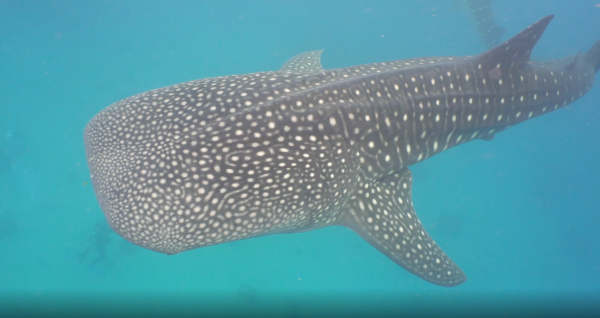
While scientists at our partner institutions are directly focusing on shark conservation, NASA's Earth-observing satellites collect key information about sharks' habitat — the ocean.
NASA's satellites measure the height of the ocean, track currents, monitor marine habitats, and oversee water quality events like harmful algal blooms.
Our long-term data sets also help us understand how climate change is affecting the ocean and marine life. NASA shares ocean data with conservation groups, researchers and partners like the National Oceanic and Atmospheric Administration, or NOAA.

1. NASA satellites help track marine animals' movement
NASA satellite data combined with field measurements help scientists construct a clearer picture of the travel routes of sharks and other marine animals.
In 2019 with the Cloud-Aerosol Lidar and Infrared Pathfinder Satellite, or CALIPSO, a joint venture between NASA and the French space agency, the Centre National D'Etudes Spatiales, or CNES, observed a massive animal migration that takes place on our planet.
In this case, marine animals such as fish, krill and squid rise from the ocean depths to the surface to feast on microscopic plants called phytoplankton as well as smaller zooplankton and other animals on a daily basis.
Studies like this provide information about the food supply available to sharks and how changes in ecosystems could impact the health of sharks and other large marine wildlife.
Knowing where marine animals are by using NASA satellite data and field observations also supports sustainable fishing practices and reduces bycatch.
2. NASA studies the productivity of Earth's oceans
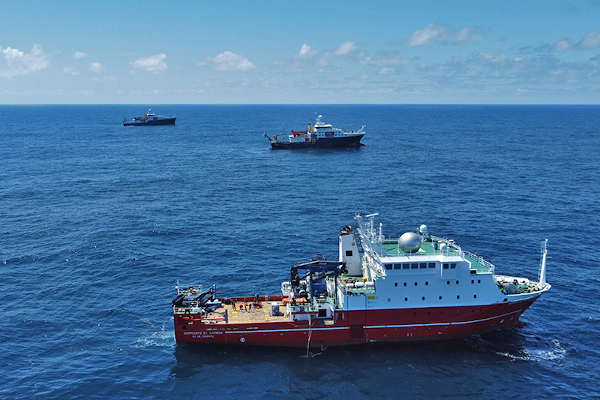
From space and ships and autonomous underwater vehicles, NASA's EXport Processes in the Ocean from Remote Sensing, or EXPORTS, campaign is studying the ocean's biological pump — the process by which carbon from the atmosphere and surface ocean is sequestered in the deep ocean.
This process starts at the surface, where phytoplankton draw carbon out of the atmosphere through photosynthesis.
This kicks off the marine food web because phytoplankton turn atmospheric carbon into food when they are eaten by tiny animals called zooplankton.
Those in turn are eaten by fish who are eaten by other fish and large marine animals, including sharks. When fish and marine animals die, they can carry the carbon stored in their bodies to the ocean floor.
3. A Hubble star-mapping algorithm tracks whale sharks
Back in 1986, a researcher at Princeton University developed an algorithm to map the stars and galaxies captured by NASA's Hubble Telescope.
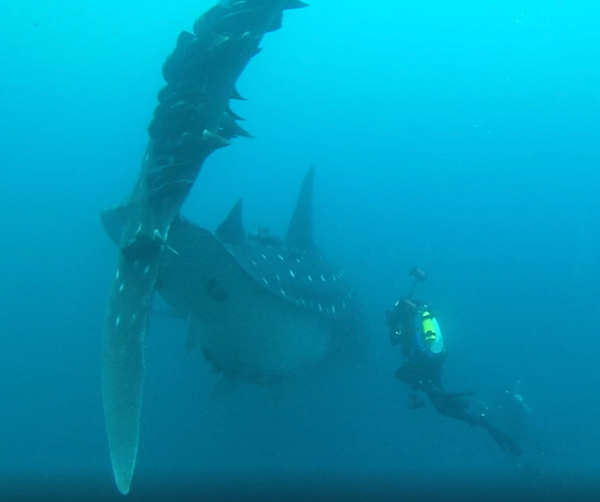
Now, that algorithm has been adapted to recognize the star-like patterns on speckle-skinned whale sharks.
This allows the algorithm to identify individual whale sharks, which helps scientists keep tabs on these rare, 40-foot-long sharks as part of the Australian nonprofit ECOCEAN's Whale Shark Photo-Identification Library.
4. NASA measures changes in sea level rise and climate patterns
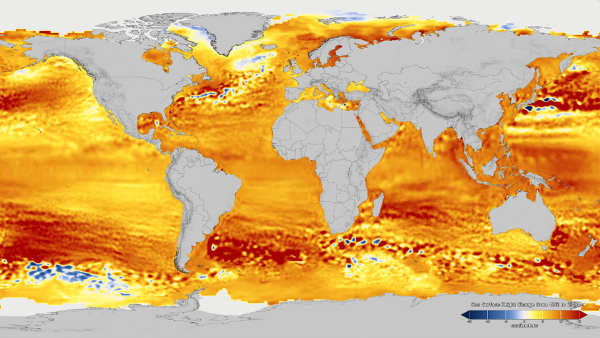
NASA has been measuring ocean height for almost 30 years, starting with the TOPEX/Poseidon satellite mission from 1992-2006 and continuing with the Jason-1, OSTM/Jason-2, Jason-3 and Sentinel-6 Michael Freilich missions.
These satellites can detect changes in ocean height within an inch, giving extremely precise measurements of sea level.
This information is crucial for understanding storm severity, sea level rise and climate patterns like La Niña, El Niño and the Pacific Decadal Oscillation that impact marine animals.
Sea surface height data is also useful for cleaning up marine oil spills, sustainably managing fisheries, routing ships and understanding the behavior of ocean animals like Stellar sea lions and whales.
In addition, sea level measurements are used to derive ocean surface currents and ocean eddies that continuously stir and mix the water, changing its biogeochemistry and thus impacting the behavior and migration patterns of sharks.

5. NASA is developing new missions to study Earth's oceans
NASA has three new missions planned to study the ocean. Scheduled to launch in 2022, the Surface Water and Ocean Topography, or SWOT, mission will measure small-scale ocean currents and swirling eddies to better understand the mixing and transport of water and nutrients as well as the dispersal of pollution into the ocean.
Monitoring ocean eddies is important to predict migratory patterns of megafauna, including sharks. SWOT is jointly developed by NASA and CNES with contributions from the Canadian Space Agency and United Kingdom Space Agency.
The Plankton, Aerosol, Cloud, ocean Ecosystem mission will use next generation "ocean color" technology to learn more about phytoplankton that live in the upper ocean. In addition to being the base of the marine food web, phytoplankton play a similar role to land plants by absorbing carbon dioxide and producing oxygen.
The Geosynchronous Littoral Imaging and Monitoring Radiometer (GLIMR) instrument will provide unique observations of ocean biology, chemistry and ecology in the Gulf of Mexico, portions of the southeastern United States coastline and the mouth of the Amazon River where it enters the Atlantic Ocean.
In the future, NASA's upcoming Earth System Observatory will use new and innovative techniques to study all facets of our planet, including the more than 70% of Earth's surface covered by ocean.
Sofie Bates is a member of NASA's Earth Science News Team based in Greenbelt, Maryland.

LAKE COUNTY, Calif. — The Lake County Sheriff’s Office has concluded that damage to a boat led to a fatal boating accident on Clear Lake that claimed the lives of a Fresno couple last month.
Webster Medley III, 51, and Novia Walton, 50, died as a result of the accident, which involved the capsizing of Medley’s 19-foot 1985 Bayliner.
Early on the morning of Saturday, June 5, Medley and Walton, along with three members of Medley’s family, were on a nighttime fishing trip offshore of Clearlake Oaks when the boat began to take on water and capsized, as Lake County News has reported.
Family members said Medley had tried to save Walton, who couldn’t swim, when he went missing in the lake. She was found a short time later, face down in the water, while the other three passengers made it to shore safely.
Walton was transported to an out-of-county trauma center where she died later on June 5.
Medley’s body was found not far from the accident scene on the morning of June 6.
Following the accident, the Bayliner was transported to a county facility where Lt. Rich Ward said the sheriff’s Marine Patrol conducted a secondary examination.
Ward said that in addition to the Marine Patrol’s examination of the boat, the investigation was based on witness statements Marine Patrol received.
Based on that evidence, Ward said Marine Patrol had reached a conclusion.
“The cause of the accident is directly related to a damaged outboard transom,” he said.
The transom is the vertical section at the rear of a boat that strengthens its structure. It’s also where the outboard motor is mounted.
Ward said the autopsies of Medley and Walton concluded that the cause of death for both was asphyxia brain injury due to submersion in water and drowning.
The couple’s family reported that celebrations of life for Medley and Walton were held three days apart at the end of June in Fresno.
Email Elizabeth Larson at
Assemblymember James C. Ramos (D-Highland) introduced HR 60, and the measure was the first proposal endorsed by the newly-formed California Native American Legislative Caucus which Ramos chairs.
The Assembly passed the measure on Thursday.
“Students were sent to these schools to coerce assimilation,” Ramos said. “They were punished for speaking their language and practicing their culture and religious beliefs. They were submitted to poor sanitation, disease, malnutrition and even starvation. Parents were not kept informed about the well-being of their children despite inquiries. Through Secretary Haaland’s investigation we have the opportunity to end the generations-long guessing game about what happened to those who did not return from the boarding schools.”
Native children were allowed to be separated from their families under the 1819 the Indian Civilization Act. The goal was to force assimilation by erasing Indian culture by separating Indigenous children from their parents and sending them to boarding schools.
Ramos added that a prevailing attitude was that of boarding school proponent, Capt. Richard Pratt: “Kill the Indian, and save the man.”
The U.S. government ran 25 boarding schools nationwide, of which three were in California, according to Gold Chains, a website dedicated to uncovering the hidden history of slavery in California.
Those schools were the Greenville School & Agency, founded in 1890; the Perris Indian School, which later became the Sherman Indian School, founded in 1892; and the Fort Bidwell Indian School, founded in 1898, according to the Carlisle Indian School Digital Resource Center.
However, several more schools, run by other organizations — including religious denominations — have been reported throughout California, with different groups studying the schools offering varying estimates of numbers.
Among those religious schools was St. Turibius Mission School in Kelseyville, run in the early 1900s.
The book “Lake County Schoolhouses,” by Antone Pierucci, Lake County’s former museum coordinator, explains, “From the latter part of the 19th century onward, Native children in Lake County were educated in segregated schools operated by a hodgepodge of the Bureau of Indian Affairs (BIA) and/or religious leaders. The reports sent to the state by the county superintendent indicate that at any one time, only two to three such segregated schools existed: Middle Creek north of Upper Lake, West Lake north of Lakeport, and Big Valley north of Kelseyville. Stories still told within families also suggest that many young children were sent to one of several BIA-operated boarding schools in the state.
Haaland’s investigation will identify boarding school facilities and sites, the location of known and possible student burial sites located at or near the school facilities and sites, and the identities and tribal affiliation of children interred at such locations.
Investigators will collect and review historical records including those at the American Indian Records Repository and the National Archives as well as school enrollment records, administrative reports, maps, photographs and other documents.
Haaland’s team will also formally consult with the tribal nations, Alaska Native corporations and Native Hawaiian organizations to determine the nature and scope of the proposed work, cultural concerns, potential dissemination of sensitive information and future protection of burial sites and repatriation of remains in compliance with the Native American Graves Protection and Repatriation Act.
A final report will be issued by April 1, 2022.
HR 60 was approved on a bipartisan unanimous voice vote with 71 Democrat and Republican members adding on as co-authors.

A determined group of California Highway Patrol cadets made it to graduation this week after a year of pandemic-related delays and challenges.
The long-awaited graduation of California Highway Patrol Cadet Training Class I-20 took place on Friday at the CHP Academy in West Sacramento.
The CHP’s 119 newest officers — 18 women and 101 men — received their badges following a swearing-in ceremony 75 weeks after their training began.
Lake County is among the many counties included in the CHP’s vast Northern Division.
A total of six new officers have been assigned to the following Northern Division offices: one, Garberville; one, Humboldt; two, Willow Creek Resident Post; and two, Garberville, Laytonville Resident Post, said CHP spokesperson Jaime Coffee.
Traditionally, cadet training at the CHP Academy takes place over 29 weeks.
However, a little more than a month after arriving at the academy on Feb. 10, 2020, safety precautions necessitated by the COVID-19 pandemic led to the closure of the live-in training facility in West Sacramento.
While away from the academy, cadets were assigned to CHP Area offices throughout the state to observe a wide variety of activities and tasks uniformed officers routinely perform, enhancing the knowledge they had gained in the classroom.
Cadets also participated in online learning for the first time.
“To say these cadets have been well-trained would be an understatement,” CHP Commissioner Amanda Ray said Friday. “Today’s graduates persevered through challenging circumstances over a lengthy period of time, demonstrating their commitment to serving the people of California.”
At the CHP Academy, cadet training starts with nobility in policing, leadership, professionalism and ethics, and cultural diversity. Cadets also receive instruction on mental illness response and crisis intervention techniques.
The training also covers vehicle patrol, accident investigation, first aid, and the apprehension of suspected violators, including those who drive under the influence of alcohol or drugs.
The cadets also receive training in traffic control, report writing, recovery of stolen vehicles, assisting the motoring public, issuing citations, emergency scene management, and knowledge of various codes including the California Vehicle Code, Penal Code and Health and Safety Code.
Upon graduation, these uniquely trained cadets will be reporting for duty to CHP Area offices throughout the state.
The mission of the CHP is to provide the highest level of safety, service and security.


Every summer on the Discovery Channel, “Shark Week” inundates its eager audiences with spectacular documentary footage of sharks hunting, feeding and leaping.
Debuting in 1988, the television event was an instant hit. Its financial success wildly exceeded the expectations of its creators, who had been inspired by the profitability of the 1975 blockbuster film “Jaws,” the first movie to earn US$100 million at the box office.
Thirty-three years later, the enduring popularity of the longest-running programming event in cable TV history is a testament to a nation terrified and fascinated by sharks.
Journalists and scholars often credit “Jaws” as the source of America’s obsession with sharks.
Yet as a historian analyzing human and shark entanglements across the centuries, I argue that the temporal depths of “sharkmania” run much deeper.
World War II played a pivotal role in fomenting the nation’s obsession with sharks. The monumental wartime mobilization of millions of people placed more Americans into contact with sharks than at any prior time in history, spreading seeds of intrigue and fear toward the marine predators.
America on the move
Before World War II, travel across state and county lines was uncommon. But during the war, the nation was on the move.
Out of a population of 132.2 million people, per the 1940 U.S. Census, 16 million Americans served in the armed forces, many of whom fought in the Pacific. Meanwhile, 15 million civilians crossed county lines to work in the defense industries, many of which were in coastal cities, such as Mobile, Alabama; Galveston, Texas; Los Angeles; and Honolulu.
Local newspapers across the country transfixed civilians and servicemen alike with frequent stories of bombed ships and aircraft in the open ocean. Journalists consistently described imperiled servicemen who were rescued or dying in “shark-infested waters.”
Whether sharks were visibly present or not, these news articles magnified a growing cultural anxiety of ubiquitous monsters lurking and poised to kill.
The naval officer and marine scientist H. David Baldridge reported that fear of sharks was a leading cause of poor morale among servicemen in the Pacific theater. General George Kenney enthusiastically supported the adoption of the P-38 fighter plane in the Pacific because its twin engines and long range diminished the chances of a single-engine aircraft failure or an empty fuel tank: “You look down from the cockpit and you can see schools of sharks swimming around. They never look healthy to a man flying over them.”
‘Hold tight and hang on’
American servicemen became so squeamish about the specter of being eaten during long oceanic campaigns that U.S. Army and Navy intelligence operations engaged in a publicity campaign to combat fear of sharks.
Published in 1942, “Castaway’s Baedeker to the South Seas” was a “travel” survival guide, of sorts, for servicemen stranded on Pacific islands. The book emphasized the critical importance of conquering such “bogies of the imagination” as “If you are forced down at sea, a shark is sure to amputate your leg.”
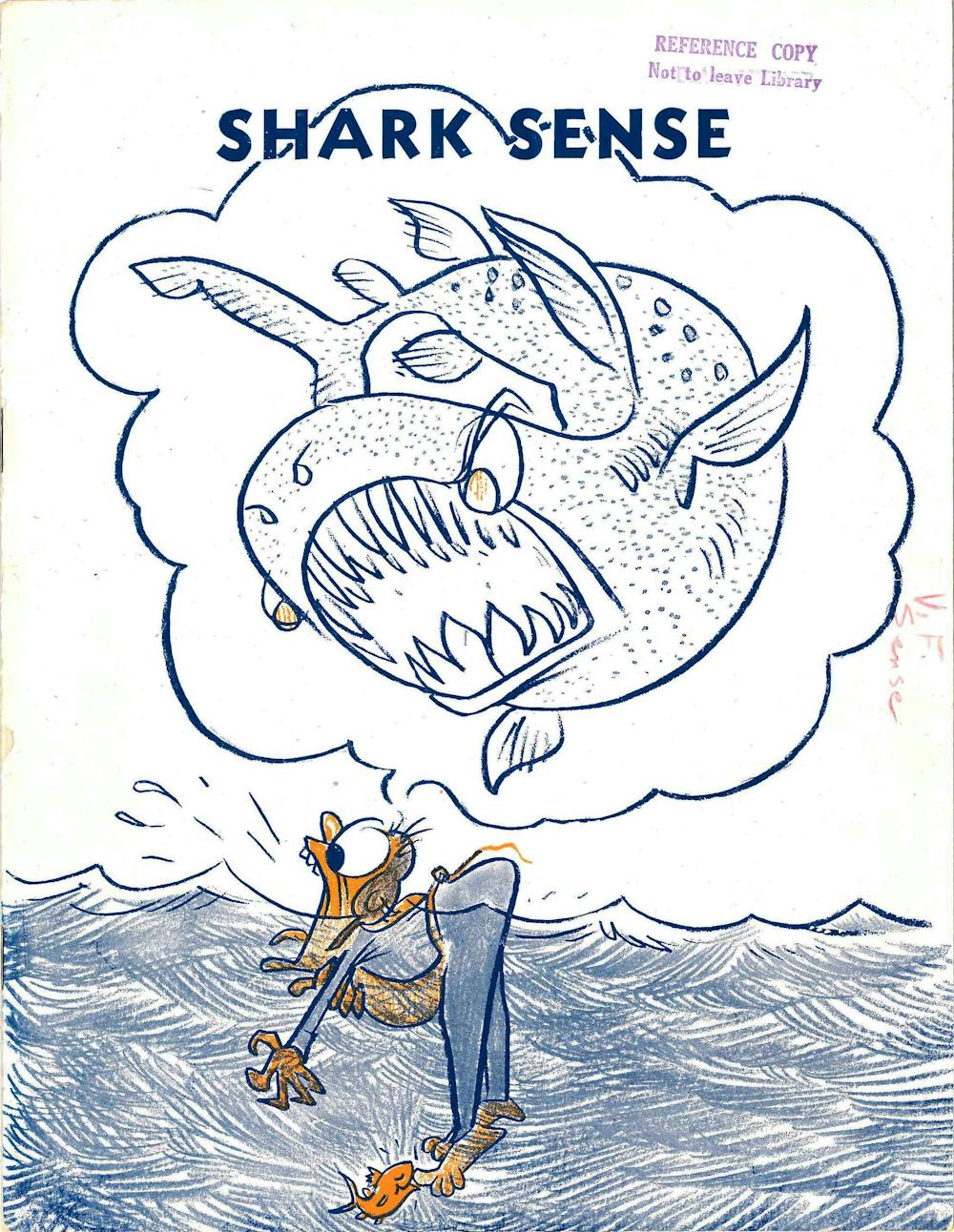
Similarly, the Navy’s 1944 pamphlet titled “Shark Sense” advised wounded servicemen stranded at sea to “staunch the flow of blood as soon as you disengage the parachute” to thwart hungry sharks. The pamphlet helpfully noted that hitting an aggressive shark on the nose might stop an attack, as would grabbing a ride on the pectoral fin: “Hold tight and hang on as long as you can without drowning yourself.”
The Department of the Navy also worked with the Office of Strategic Services, the wartime precursor to the Central Intelligence Agency, to develop a shark repellent.
Office of Strategic Services executive assistant and future chef Julia Child worked on the project, which tested various recipes of clove oil, horse urine, nicotine, rotting shark muscle and asparagus in hopes of preventing shark attacks. The project culminated in 1945, when the Navy introduced “Shark Chaser,” a pink pill of copper acetate that produced a black inky dye when released in the water – the idea being that it would obscure a serviceman from sharks.
Nonetheless, the U.S. military’s morale-boosting campaign was unable to vanquish the glaring reality of wartime carnage at sea. Military media correctly observed that sharks rarely attack healthy swimmers. Indeed, malaria and other infectious diseases took a far greater toll on U.S. servicemen than sharks.
But the same publications also acknowledged that an injured person was vulnerable in the water. With the frequent bombing of airplanes and ships during World War II, thousands of injured and dying servicemen bobbed helplessly in the ocean.
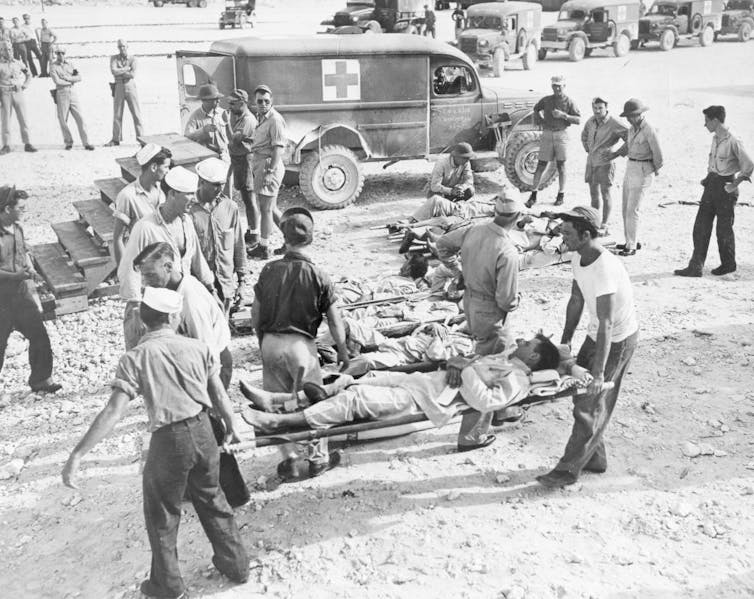
One of the worst wartime disasters at sea occurred on July 30, 1945, when pelagic sharks swarmed the site of the shipwrecked USS Indianapolis. The heavy cruiser, which had just successfully delivered the components of the Hiroshima atomic bomb to Tinian Island in a top-secret mission, was torpedoed by a Japanese submarine. Out of a crew of 1,196 men, 300 died immediately in the blast, and the rest landed in the water. As they struggled to stay afloat, men watched in terror as sharks feasted on their dead and wounded shipmates.
Only 316 men survived the five days in the open ocean.
‘Jaws’ has an eager audience
World War II veterans possessed searing lifelong memories of sharks – either from direct experience or from the shark stories of others. This made them an especially receptive audience for Peter Benchley’s taut shark-centered thriller “Jaws,” which he published in 1974.
Don Plotz, a Navy sailor, immediately wrote to Benchley: “I couldn’t put it down until I had finished it. For I have rather a personal interest in sharks.”
In vivid detail, Plotz recounted his experiences on a search and rescue mission in the Bahamas, where a hurricane had sunk the USS Warrington on Sept. 13, 1944. Of the original crew of 321, only 73 survived.
“We picked up two survivors who had been in the water twenty-four hours, and fighting off sharks,” Plotz wrote. “Then we spent all day picking up the carcasses of those we could find, identifying them and burying. Sometime only rib cages … an arm or leg or a hip. Sharks were all around the ship.”
Benchley’s novel paid little attention to World War II, but the war anchored one of the movie’s most memorable moments. In the haunting, penultimate scene, one of the shark hunters, Quint, quietly reveals that he is a survivor of the USS Indianapolis disaster.
“Sometimes the sharks look right into your eyes,” he says. “You know the thing about a shark, he’s got lifeless eyes, black eyes, like a doll’s eyes. He comes at you, he doesn’t seem to be living until he bites you.”
The power of Quint’s soliloquy drew upon the collective memory of the most massive wartime mobilization in American history. The oceanic reach of World War II placed greater numbers of people into contact with sharks under the dire circumstances of war. Veterans bore intimate witness to the inevitable violence of battle, compounded by the trauma of seeing sharks circle and feed opportunistically on their dead and dying comrades.
Their horrifying experiences played a pivotal role in creating an enduring cultural figure: the shark as a mindless, spectral terror that can strike at any moment, a haunting artifact of World War II that primed Americans for the era of “Jaws” and “Shark Week.”
[Get the best of The Conversation, every weekend. Sign up for our weekly newsletter.]
Janet M. Davis, University Distinguished Teaching Professor of American Studies, The University of Texas at Austin College of Liberal Arts
This article is republished from The Conversation under a Creative Commons license. Read the original article.

Having a broadly drafted power of attorney can enable an agent to act in a representative capacity in a multitude of situations.
If authorized, the agent can act to provide for the principal’s personal care, manage the principal’s assets, engage in estate planning, support dependents, make gifts (such as to qualify for Medi-Cal), and more.
Let us discuss.
If the principal needs personal care at home, at a hospital, or at a nursing care facility then an authorized agent can sign the personal care contracts and use the principal’s financial resources to pay the expenses.
The agent represents the principal's interests and pays for the health care expenses authorized by the agent under the principal’s advance health care directive. Oftentimes, one and the same person is the agent acting in both capacities.
Managing and using bank and brokerage accounts, including retirement accounts, depends on the financial institution accepting the power of attorney. Often they are reluctant to do so unless the power is on their own form, drafted by their own legal department.
Such powers are limited to managing accounts at the one institution only, and are limited in duration. They are necessary supplements to the generally applicable durable power of attorney.
A power of attorney can also be used for estate planning. It can authorize the agent to establish a trust and to transfer the principal’s assets into a trust on behalf of the principal to avoid probate. Avoiding probate is especially important to the family of anyone receiving Medi-Cal where estate recovery only applies if there is a probate.
Moreover, the power can also authorize — or not authorize — an agent to execute death beneficiary forms to name beneficiaries to pay on death bank accounts, transfer on death brokerage accounts and retirement plans (e.g., IRA’s and 401(k)’s).
If the principal financially supports someone the agent can be authorized to continue such support. This is especially relevant to supporting dependent adult children or parents.
For example, continuing to pay a child’s car insurance and a stipend while attending college. Also, for example, to pay utility expenses of a dependent parent.
Nowadays, with digital (online) financial assets, it is important to authorize an agent to access such online accounts in the event that the agent does not know the principal’s log-on username and password.
The same consent language can authorize access to email and social media accounts that become inaccessible.
Express limitations and prohibitions can be included to prevent the misuse of a power of attorney. For example, the document may prohibit an agent from changing death beneficiaries to accounts.
A power of attorney can either become effective immediately upon signing or later upon incapacity of the principal. Powers of attorney terminate, amongst other ways, upon revocation (if the principal has the capacity to revoke) or upon death of the principal.
Without a power of attorney, an expensive, time consuming and aggravating court supervised conservatorship proceeding is often necessary in order to manage an incapacitated person’s legal, financial and property affairs. Conservatorships can be contested, resulting in expensive and time consuming litigation.
The foregoing is a general discussion and is not legal advice. If needing guidance on such issues, consult a qualified attorney.
Dennis A. Fordham, attorney, is a State Bar-Certified Specialist in estate planning, probate and trust law. His office is at 870 S. Main St., Lakeport, Calif. He can be reached at