LAKE COUNTY, Calif. — The California Highway Patrol has released the name of a Clearlake man killed in a head-on crash on Highway 20 in Colusa County on Sunday evening.
Roman Calderon, 57, died of his injuries after being ejected from his pickup, the CHP’s Williams Area office reported.
Just before 8 p.m. Sunday, the CHP said Calderon — driving westbound on Highway 20 at Highway 16 at an undetermined rate of speed — crossed the double-yellow lines in his Toyota Tacoma pickup and hit a Dodge Durango driven by 27-year-old Orland resident Jacob Funk head-on.
The CHP said Calderon was not wearing his seat belt and was ejected from his pickup after the driver’s side door came off. He was declared dead at the scene.
Funk, his passenger Vicky Davis, 40, and two children, all of Orland — and all of whom were using safety equipment — were flown to regional trauma centers by air ambulance due to their injuries, the CHP said.
The CHP’s initial report said the investigation so far has indicated alcohol and/or drugs may have been factors, but the agency has not released additional information on the crash’s cause.
Email Elizabeth Larson at This email address is being protected from spambots. You need JavaScript enabled to view it.. Follow her on Twitter, @ERLarson, or Lake County News, @LakeCoNews.
LAKE COUNTY, Calif. — Lake County’s epidemiologist told the Board of Supervisors this week that the county’s COVID-19 daily case rate is growing and has recently been the highest rate in the entire state.
Sarah Marikos, who analyzes and tracks Lake County’s COVID-19 data, last spoke to the board in June.
She returned on Tuesday for an update during which she said that Lake County’s testing rate has declined to the lowest rate since the case surge at the start of the year.
The testing positivity rate had dropped to a low of less than 1% in mid-June but has since increased to a high of 6.3%, the highest rate since the winter surge, Marikos said. The state also is seeing a testing positive case increase.
Over the past three weeks, Lake County’s cases have increased. Marikos said they’ve identified 36 cases for the week beginning July 4.
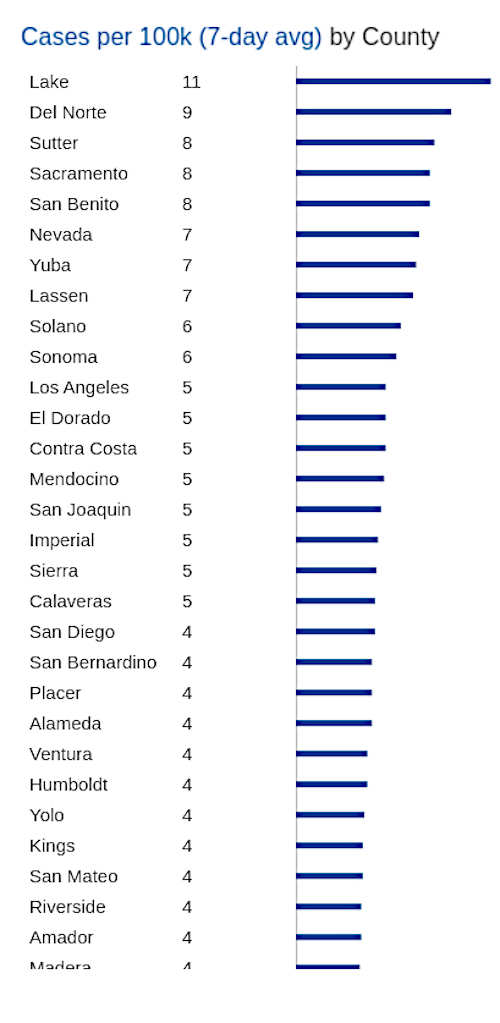
As of Tuesday, Lake County’s daily case rate, over a seven-day average, was 10.3 cases per 100,000, while Marikos said the state’s rate was between 3 and 4 per 100,000. That’s the highest daily case rate in the state.
On Wednesday, the California Department of Public Health reported that Lake County’s cases per 100,000 over a seven-day average had edged up further still, to 11, remaining the highest daily case rate in California.
Marikos said case rates also have doubled in recent weeks in the Bay Area, Southern California and the greater Sacramento region.
As of this week, Lake County’s COVID-19 deaths is at 63, Marikos said.
Earlier this month, Lake County Public Health reported that its medical staff was looking at documentation regarding deaths not previously recognized as COVID-related that the state had sent to Lake and other counties.
Since then, 18 deaths — none of which were recent, and which date back as far as October, officials said — have been added to the overall total, bringing it to 63.
“It’s standard best practice with any communicable disease to do a review of cases and deaths, and that’s what’s happened over the last couple of weeks. Many counties have undertaken that quality control effort as we’ve gotten through the surge and as we’ve gotten through the big vaccination push,” Marikos said.
In assessing Lake County’s cases, Marikos explained to the board that the majority of them are in younger people.
She said the 20 to 44 age group, which makes up only 26 percent of the county’s population, is disproportionately impacted by COVID-19, and makes up 55 percent of the caseload. That group, she noted, is of working age and is out and about in the community.
At the same time, three out of five people in the 18 to 49 age group are completely unvaccinated, she said.
Marikos said focusing on vaccinations for young people is very important as the county moves into the summer and as the more transmissible Delta variant — which already has been confirmed in Lake County — increases across the state.
She said 50.2%, or 27,700 Lake County residents age 12 and older, are fully vaccinated, while 6.9%, or 3,800, are partially vaccinated, and the remaining 42.9% of the population are not vaccinated.
In contrast, 61% of Californians are vaccinated. Marikos showed data putting Lake County in the middle of California’s counties for vaccination rates, with Lassen County at the bottom, with 30%, and Marin County at more than 80%.
Board Chair Bruno Sabatier asked Marikos about the percentage of those testing positive who have been vaccinated.
Marikos said she didn’t have that data in front of her, but that the number of people testing positive who have been vaccinated is extremely low.
However, she said a state report from a few weeks before had put the daily case rate for unvaccinated individuals at 4 to 5 per 100,000, while in vaccinated individuals it was 0.5 per 100,000.
Sabatier asked to have that information in the next presentation. Marikos said she would be happy to bring it.
At that point in the discussion, she reported that she had just gotten a note from her team that of the hundreds of cases they’ve had since the vaccine rollout, only about five involved vaccinated individuals.
Email Elizabeth Larson at This email address is being protected from spambots. You need JavaScript enabled to view it.. Follow her on Twitter, @ERLarson, or Lake County News, @LakeCoNews.
The Berryessa Snow Mountain National Monument. Photo by Eric Coulter/BLM. LAKE COUNTY, Calif. — The Bureau of Land Management Ukiah Field Office invites public comment on travel management planning for trails and roads within the Berryessa Snow Mountain National Monument on BLM-managed public lands.
BLM will host a virtual public meeting, via Zoom, on Wednesday, July 21, from 4:30 to 6:30 p.m., part of a 30-day public scoping period, which ends Aug. 16.
This scoping period provides an open process for determining the scope of issues to be addressed and builds upon public input received during two previous workshops held to identify existing trails and roads, determine appropriate uses and ways to improve the trail network.
Public input helps the BLM develop a range of alternatives to improve the recreational experience, while protecting natural and cultural resources.
Participants must register for the Zoom meeting here.
After registering, participants will receive a confirmation email with instructions, a link to join the meeting and phone numbers for those unable to join online.
Zoom virtual meeting tutorials can be viewed here. Please contact the BLM as soon as possible for reasonable accommodations to participate.
On July 10, 2015, the Berryessa Snow Mountain National Monument was designated by Presidential Proclamation.
It contains nearly 331,000 acres of public lands comanaged by the BLM and the U.S. Forest Service within Colusa, Glenn, Lake, Mendocino, Napa, Solano and Yolo counties.
The proclamation allows for continued historic uses of the area, including hunting, fishing and livestock grazing, while protecting important recreational areas for camping, biking, hiking, horseback riding, designated off-road vehicle trails, sightseeing, remote backcountry travel and white-water rafting.
The area also contains one of the greatest concentrations of biodiversity in California, and is home to threatened and endangered plant and wildlife species.
Learn more here about the Berryessa Snow Mountain National Monument.
More information about this planning effort can be found on the project website.
Written comments may be submitted electronically to the project ePlanning website; via email to This email address is being protected from spambots. You need JavaScript enabled to view it.; or by mail, BLM Ukiah Field Office, Attn: BSMNM Travel Management Planning EA, 2550 North State Street, Suite 2, Ukiah, CA 95482.
For specific questions, contact Monument Manager Rebecca Carr Wong at 707-468-4023 or This email address is being protected from spambots. You need JavaScript enabled to view it..
Deer fawns in the wild. Photo courtesy of the California Department of Fish and Wildlife. The California Department of Fish and Wildlife has confirmed outbreaks of adenovirus hemorrhagic disease in deer in several northern California counties and is asking California residents to help curb the spread by not feeding wild animals, and report potential cases to the department.
“Providing attractants for deer — food, salt licks or even water — is against the law for good reason,” said Dr. Brandon Munk, senior wildlife veterinarian with CDFW’s Wildlife Investigations Laboratory. “Because these artificial attractants can congregate animals and promote the spread of disease, it’s particularly imperative to leave wildlife alone during an outbreak. There is no cure or vaccine for this disease, so our best management strategies right now are to track it carefully, and to take preventive measures to limit the spread.”
Beginning in May, CDFW began receiving increased reports of mortality in deer, both free-ranging and at fawn rehabilitation facilities. With the assistance of wildlife rehabilitation facilities and the California Animal Health and Food Safety Laboratory, CDFW confirmed cervid adenovirus 1, or CdAdV-1, as the cause of hemorrhagic disease outbreaks this year in Kern, Napa and Nevada counties.
The disease is typically fatal to young deer, particularly fawns, and can be spread by animals in close contact with each other. The virus is not known to affect people, pets or domestic livestock.
CdAdV-1 was the cause of a 1993-1994 outbreak of hemorrhagic disease in black tailed deer and mule deer that spanned at least 18 California counties.
Since then, CdAdV-1 has been identified as the cause of sporadic, often widespread, outbreaks of hemorrhagic disease in California and other Western states.
Deer fawns are at greatest risk, with high rates of mortality following infection. Yearlings and adult deer are more resistant but mortalities in these age groups occur as well. Outbreaks can be widespread and may have significant impact on affected deer populations.
Affected deer are often found dead without any obvious symptoms. They may be found near water. Sick animals may have excessive salivation (drooling or foaming at the mouth), diarrhea, regurgitation or seizures.
In addition to removing food and other attractants, Californians can help wildlife veterinarians track and study the disease by reporting sightings of sick or dead deer.
Anyone who observes a deer exhibiting symptoms, or encountering a deer that has died from unknown causes, can submit the information to CDFW through the department’s online mortality reporting system.
A California licensed homeopathic doctor was arrested on Wednesday for her alleged scheme to sell homeoprophylaxis immunization pellets and falsify COVID-19 vaccination cards by making it appear that customers received the U.S. Food and Drug Administration authorized Moderna vaccine.
Juli A. Mazi, 41, of Napa, is charged with one count of wire fraud and one count of false statements related to health care matters.
The case is the first federal criminal fraud prosecution related to homeoprophylaxis immunizations and fraudulent Centers for Disease Control and Prevention COVID-19 vaccination record cards.
“This defendant allegedly defrauded and endangered the public by preying on fears and spreading misinformation about FDA-authorized vaccinations, while also peddling fake treatments that put people’s lives at risk. Even worse, the defendant allegedly created counterfeit COVID-19 vaccination cards and instructed her customers to falsely mark that they had received a vaccine, allowing them to circumvent efforts to contain the spread of the disease,” said Deputy Attorney General Lisa O. Monaco. “The Department of Justice and its law enforcement partners are committed to protecting the American people from fraudsters during this national emergency. This commitment is evident in this prosecution as well as in the ongoing work of the Department and our agency partners in the COVID-19 Fraud Enforcement Task Force established by the Attorney General earlier this year.”
“Steering through the challenges presented by COVID-19 requires trust and reliance on our medical professionals to provide sage information and guidance,” said Acting U.S. Attorney Hinds. “According to the complaint, instead of disseminating valid remedies and information, Juli Mazi profited from unlawfully peddling unapproved remedies, stirring up false fears, and generating fake proof of vaccinations. We will act to protect trust in the medical developments that are enabling us to emerge from the problems presented by the pandemic.”
According to court documents, in April 2021, an individual submitted a complaint to the Department of Health and Human Services Office of Inspector General hotline stating that family members purchased from Mazi.
The complainant stated that the family members had told them that Mazi stated that the pellets contained the COVID-19 virus and would create an antibody response in the immune system.
The complainant reported that her/his family did not receive injections of any of the three FDA-authorized COVID-19 vaccines.
However, in connection with the delivery of the homeoprophylaxis immunization pellets, Mazi sent COVID-19 Vaccination Record cards, with Moderna listed, to the complainant family. Mazi allegedly instructed the complainant family to mark the cards to falsely state that they received the Moderna vaccine on the date that they ingested the COVID-19 homeoprophylaxis immunization pellets.
According to court documents, Mazi offered homeoprophylaxis immunizations for childhood illnesses that she falsely claimed would satisfy the immunization requirements for California schools, and falsified immunization cards that were submitted by parents to California schools.
Homeoprophylaxis involves the exposure of an individual to dilute amounts of a disease, purportedly to stimulate the immune system and confer immunity.
Mazi is alleged to have falsely claimed that orally ingesting pellets with small amounts of COVID-19 would result in full lifelong immunity from COVID-19.
“This doctor violated the all-important trust the public extends to health care professionals — at a time when integrity is needed the most,” said Special Agent in Charge Steven J. Ryan of the Department of Health and Human Services Office of Inspector General, or HHS-OIG. “Working closely with our law enforcement partners, our agency will continue to investigate such fraudsters who recklessly endanger the public’s health during the unprecedented COVID-19 crisis.”
The affidavit alleges that Mazi used the COVID-19 pandemic to expand the preexisting immunization scheme by selling immunization pellets that she fraudulently claimed, in written documents and consensually monitored recordings, would provide “lifelong immunity to COVID-19.”
Mazi explained that the pellets contained a “very minute amount of this [COVID-19] disease” that can result in “infectious symptoms” of COVID-19 or “automatically flag[] the immune system’s attention, inducing immunity.”
To encourage customers to purchase the pellets, Mazi allegedly exploited disinformation and fear by falsely claiming that the FDA-authorized COVID-19 vaccines contain “toxic ingredients.” Mazi further stated that her customers could provide the pellets to children for COVID-19 immunity, and that the “dose is actually the same for babies.”
“Spreading inaccurate or false medical information about COVID-19 for personal gain, as the complaint alleges, is dangerous and only seeds skepticism among the public,” said Special Agent in Charge Craig D. Fair of the FBI's San Francisco Field Office. “As the government continues to work to provide current and accurate information to help slow the spread of COVID-19, the FBI will continue to pursue those who attempt to fraudulently profit from spreading misinformation and providing false documentation.”
Mazi also provided CDC COVID-19 vaccination record cards to her customers with instructions on how to fraudulently complete the cards to falsely make it appear as if a customer had received two doses of the Moderna vaccine. As part of her scheme, Mazi provided customers with specific Moderna vaccine lot numbers to enter onto the cards and with instruction on how to select the purported dates on which they had received the Moderna vaccines to evade suspicion.
Mazi is charged with wire fraud, in violation of 18 U.S.C. § 1343, and making false statements related to health cases, in violation of 18 U.S.C. § 1035.
If convicted, Mazi faces a maximum statutory prison sentence of 20 years for the wire fraud charge and 5 years for the false statements charge.
In addition, each charge carries a maximum $250,000 fine and 3 years of supervised release.
However, any sentence following conviction would be imposed by the court after consideration of the U.S. Sentencing Guidelines and the federal statute governing the imposition of a sentence, 18 U.S.C. § 3553.
HHS-OIG’s San Francisco Regional Office and the FBI’s San Francisco Field Office are investigating the case.
Assistant U.S. Attorney Christiaan Highsmith of the U.S. Attorney’s Office for the Northern District of California and Trial Attorney Sridhar Babu Kaza of the Department of Justice Criminal Division Fraud Section’s National Rapid Response Strike Force are prosecuting the case.
The case was brought in coordination with the Health Care Fraud Unit’s COVID-19 Interagency Working Group, which is chaired by the National Rapid Response Strike Force and organizes efforts to address illegal activity involving health care programs during the pandemic.
The Fraud Section leads the Health Care Fraud Strike Force. Since its inception in March 2007, the Health Care Fraud Strike Force, which maintains 15 strike forces operating in 24 federal districts, has charged more than 4,200 defendants who have collectively billed the Medicare program for nearly $19 billion.
In addition, the HHS Centers for Medicare and Medicaid Services, working in conjunction with the HHS-OIG, are taking steps to increase accountability and decrease the presence of fraudulent providers.
In May, the Attorney General established the COVID-19 Fraud Enforcement Task Force to marshal the resources of the Department of Justice in partnership with agencies across government to enhance efforts to combat and prevent pandemic-related fraud.
The Task Force bolsters efforts to investigate and prosecute the most culpable domestic and international criminal actors and assists agencies tasked with administering relief programs to prevent fraud by, among other methods, augmenting and incorporating existing coordination mechanisms, identifying resources and techniques to uncover fraudulent actors and their schemes, and sharing and harnessing information and insights gained from prior enforcement efforts. For more information on the department’s response to the pandemic, please visit https://www.justice.gov/coronavirus.
Anyone with information about allegations of attempted fraud involving COVID-19 can report it by calling the Department of Justice’s National Center for Disaster Fraud Hotline at 866-720-5721 or via the NCDF Web Complaint Form at https://www.justice.gov/disaster-fraud/ncdf-disaster-complaint-form.
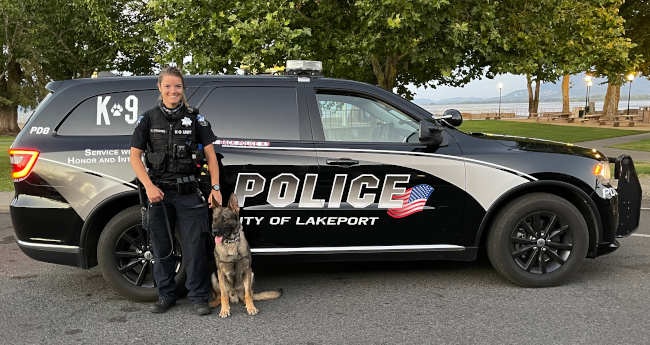
Lakeport Police Department’s new K-9 Olin and his handler, Officer Kaylene Strugnell, with the agency’s state-of-the art K-9 patrol vehicle. Photo courtesy of the Lakeport Police Department.
LAKEPORT, Calif. — After more than a decade without a police dog of its own, the Lakeport Police Department is introducing a new K-9 team.
Lakeport Police Chief Brad Rasmussen said his department is launching a new police dog program and, as part of that, is welcoming Police K-9 Olin.
Olin is a young male German shepherd. His handler is Officer Kaylene Strugnell.
Olin is one of several new K-9s who have started serving Lake County this year.
This spring, another German shepherd, Vern, joined California Department of Fish and Wildlife Warden Wyatt Moore to work in the Cannabis Enforcement Program.
Earlier this month, the Lake County Sheriff’s Office introduced Rex, a 2-year-old Belgian Malinois, who has been assigned to Deputy Joe Lyons.
Rasmussen has been working for several years to bring a K-9 back to his department.
He said planning began in the fall of 2018 when his department presented the Lakeport City Council with a request to apply for United States Department of Agriculture community facilities grant funding to start the K-9 Unit. The City Council supported and authorized the request.
The city received a USDA grant of approximately $38,000 to be used in combination with other private and public funding to establish the program, which includes a state-of-the art patrol vehicle with built-in protection for the dog.
The department had approximately $40,000 in other law enforcement grants and asset forfeiture funds reserved for the program. Additional funding and a nonprofit partner were needed to build and sustain the program.
In April 2019, the Lakeport Police Department submitted a proposal to the Sean M. Walsh K-9 Memorial Foundation for funding to purchase the dog. The foundation, which has served communities nationwide since 2012, awarded a grant in the amount of $10,000 to purchase the dog.
Sean Walsh was a military police soldier in the California National Guard serving in Operation Enduring Freedom when he was killed in action in the Khost province of Afghanistan on Nov. 16, 2011.
Walsh was focused on his goal to be a police officer, serving as an Explorer Cadet with the Santa Clara Sheriff’s Department, and then with the Santa Clara Police Department.
Walsh joined the Army National Guard as an MP at the age of 18 to gain additional experience toward his goal. After returning from deployment, his plans were to continue his education and become a cadet with the Santa Clara Police Department, where he hoped to join their ranks as a police officer.
Walsh was dedicated to his goal of becoming a law enforcement officer; during his Afghanistan deployment, he vigorously studied and memorized the California Penal Code, preparing himself to become a police cadet.
Inspired in part by his love for animals and the adoption of an abandoned German shepherd when he was 12, Walsh’s dream and ultimate goal was to be a law enforcement officer with a K-9 partner.
His friends and family established the Sean M. Walsh K-9 Memorial Foundation with the main goal of assisting law enforcement agencies to establish a K-9 team in memory of Walsh.
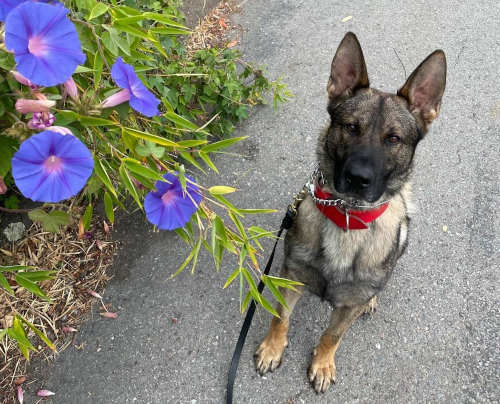
Lakeport Police Department’s new K-9 Olin. Photo courtesy of the Lakeport Police Department. Lakeport Police’s K-9 Olin is the 32nd K-9 made possible by grants from Walsh’s memorial fund.
In December 2020, the Lucerne Area Revitalization Association, or LARA, offered to serve as the nonprofit partner and donated the startup funds for the Lakeport Police K-9 account. After this account was created, two local citizens donated $4,000 and $5,000, respectively, for the program. Local businesses have made significant contributions for program infrastructure.
A significant partner is Bruno’s Shop Smart and their parent company, C&K Markets, who make donations based on customers signing up and connecting their club cards to the LPD canine program. This program does not cost the customer; C&K Markets makes a donation from every purchase made by the customer.
Susie Q’s Donuts is starting a major fundraiser this month by selling Support Lakeport Police K-9 Program coffee cups with raffle tickets for a chance to win a major prize. Lake County News, another program partner, has donated startup funding for this fundraiser.
In May of this year, based on the support of the USDA, Sean’s K-9’s, local businesses, nonprofit partner LARA, local community members, and city and police department staff, the Lakeport Police Department was able to select its K-9, Olin.
Olin and Officer Strugnell took their initial six weeks of training through CJ’s Police K-9’s in Novato.
Training was completed on June 25 and Olin and Officer Strugnell started working together on June 29.
Olin is trained in narcotic detection including methamphetamine, heroin and cocaine, as well as patrol certification including suspect tracking and apprehension.
“I am excited to once again have a police canine serving the Lakeport community; the police department appreciates all the public support, without which this program would not be possible,” Rasmussen said.
“I have had the pleasure of training with Olin and I am looking forward to working with him in our community. Olin loves his work and is very proficient and dedicated,” said Officer Strugnell.
Police K-9 Olin will be formally introduced to the community during the Lakeport City Council meeting on Tuesday, July 20, the first in-person session open to the public since March of 2020.
Rasmussen said community support will be important to maintain this program which has an estimated annual cost of $15,000.
Contributions may be provided by making donations to the Lakeport Police K-9 nonprofit and the Susie Q’s Donuts fundraiser, to future fundraising events and by participating in the Bruno’s Shop Smart program.
For more information, contact Chief Rasmussen, Lieutenant Dale Stoebe, Officer Strugnell or K-9 Unit Supervisor Sergeant Victor Rico at the Lakeport Police Department, 707-263-5491, or by email, This email address is being protected from spambots. You need JavaScript enabled to view it..
 How to resolve AdBlock issue?