 How to resolve AdBlock issue?
News
The death occurred in San Luis Obispo County.
“West Nile virus activity in the state is increasing, so I urge Californians to take every possible precaution to protect against mosquito bites,” said Dr. Tomás J. Aragón, director of the California Department of Public Health and State Public Health officer.
West Nile virus is transmitted to humans and animals by the bite of an infected mosquito. As of July 9, WNV has been detected in 45 dead birds from 6 counties and 177 mosquito samples from 13 counties.
No WNV activity — either in animals, insects or humans — has been reported in Lake County to date.
Hot temperatures this month are contributing to increasing numbers of mosquitoes and the increased risk of virus transmission to humans.
So far this season, activity is within expected levels. The risk of disease due to WNV usually increases at this time of year and is highest throughout the summer and early fall.
West Nile virus is influenced by many factors, including climate, the number and types of birds and mosquitoes in an area, and the level of WNV immunity in birds.
The risk of serious illness to most people is low. However, some individuals — less than 1% — can develop serious neurological illnesses such as encephalitis or meningitis.
People 50 years of age and older, and individuals with diabetes or high blood pressure, have a higher chance of getting sick and are more likely to develop complications from WNV infection.
CDPH recommends that individuals protect against mosquito bites and WNV by practicing the “Three Ds”:
— DEET: Apply insect repellent containing DEET, picaridin, oil of lemon eucalyptus or IR3535 according to label instructions. Repellents keep the mosquitoes from biting you. Insect repellents should not be used on children under two months of age.
— DAWN AND DUSK — Mosquitoes that transmit WNV usually bite in the early morning and evening so it is important to wear proper clothing and repellent if outside during these times. Make sure that your doors and windows have tightfitting screens to keep out mosquitoes. Repair or replace screens that have tears or holes.
— DRAIN: Mosquitoes lay their eggs on standing water. Eliminate all sources of standing water on your property by emptying flower pots, old car tires, buckets, and other containers. If you know of a swimming pool that is not being properly maintained, please contact your local mosquito and vector control agency.
California’s West Nile virus website includes the latest information on WNV activity in the state. Californians are encouraged to report dead birds on the website or by calling toll-free 1-877-WNV-BIRD (968-2473).
The newest dog is at the top.

‘Jake’
“Jake” is a senior male Chihuahua mix.
He has a short tan and white coat.

‘Bear’
“Bear” is a male American Staffordshire terrier mix with a short brown coat.
He has been neutered.
He is dog No. 3476.

‘Cleo’
“Cleo” is a female Doberman pinscher mix with a short gray coat who is new to the shelter.
She has been spayed.
She is dog No. 4865.

‘Dusty’
“Dusty” is a male American Pit Bull Terrier with a tan and white coat.
He is dog No. 4750.

‘Girly’
“Girly” is a senior female Chihuahua mix.
She has a short tan coat.
Girly is house-trained.

‘Gizmo’
“Gizmo” is a senior male Chihuahua mix with a short tan and white coat.
He is dog No. 4902.

‘Ike’
“Ike” is a senior male Chihuahua.
He has a short tan coat.

‘Lucky’
“Lucky” is a male Labrador retriever mix with a short yellow coat.
He is dog No. 4908.

‘Mara’
“Mara” is a female Rottweiler mix.
She has a short black and tan coat.
He is house-trained.

‘Mary J’
“Mary J” is a female pit bull terrier mix.
She has a white and tan coat.
She is house-trained.

‘Mitzy’
“Mitzy” is a female shepherd mix with a medium-length black and white coat.
She is dog No. 4648.

‘Mojo’
“Mojo” is a male Chihuahua mix with a short black and tan coat.
He has been neutered.
He is dog No. 4881.

‘Oakley’
“Oakley” is a male pit bull terrier mix.
He has a short red and white coat.

‘Patches’
“Patches” is a male Chihuahua mix with a short tricolor coat.
He is dog No. 4903.

‘Tanisha’
“Tanisha” is a female shepherd mix with a short orange and white coat.
She is dog No. 4647.

‘Terry’
“Terry” is a male Dutch shepherd mix with a smooth brindle coat.
He is dog No. 4880.
Call the Clearlake Animal Control shelter at 707-273-9440, or email
Email Elizabeth Larson at

Less than a month into North America’s official summer, heat waves are blistering much of the West. California and the Southwest are facing excessive heat watches for the second time, after a mid-June heat wave pushed temperatures above 100 F (38 C).
And in late June an intense heat dome settled over the Pacific Northwest for four days, setting all-time temperature records in Oregon, Washington and British Columbia. The effects were most evident in Lytton, British Columbia, which reported a temperature of 121 F (49.5 C) on June 29, far above its average high for the date of 76 F (24.4 C). A day later, the town was engulfed by a wildfire.
As an exercise physiologist, I know that the human body is an amazing machine. But like all machines, it functions effectively and safely only under certain conditions.
People frequently debate whether wet heat in places like Florida or dry heat in desert locations like Nevada is worse. The answer is that either setting can be dangerous. Hot desert climates are stressful due to extreme temperatures, while humid subtropical climates are stressful because the body has trouble removing heat when sweat doesn’t evaporate readily. As recent events have shown, hot is hot.
The influence of humidity
North America has a wide range of climates, but when people talk about heat, they often compare the Southwest and the Southeast. Some communities in the Southwest’s hot desert climates, such as Las Vegas, have average summer high temperatures over 100 F (38 C), with relative humidity typically around 20%. This means the air is holding about one-fifth of the maximum amount of moisture it can hold at that temperature and pressure.
In contrast, Southeast locations like Orlando, Florida, typically have average temperatures around 90 F (32.2 C), with humidity regularly approaching 80%. Looking only at temperature, the desert clearly is hotter on average.
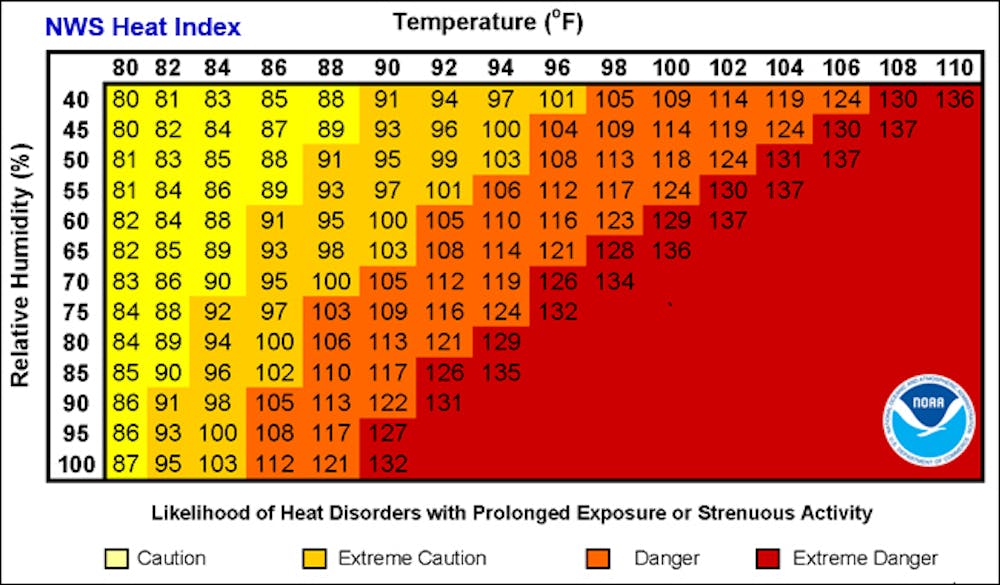
However, it’s also important to consider how heat affects the body. Weather reports often do this using the heat index, which calculates how the human body perceives conditions factoring in humidity as well as heat.
Sweating is your body’s primary way of cooling you off. When sweat evaporates away from your skin, it takes heat with it. But when humidity is high, the air already holds a lot of moisture, so the sweat remains on your skin. As it saturates clothing and drips from the body, it can remove only a small amount of heat compared with the cooling that comes with the evaporation of sweat.
As a result, when we account for humidity, the heat exposures people experience in Las Vegas and Orlando are very similar.
Adapting people and places to heat stress
As people go through their daily lives, their bodies work continuously to maintain a temperature close to a normal level of about 98.6 F (37 C). In regions that regularly experience high heat stress, such as the Southeast and Southwest, most buildings and homes now have air conditioning, which helps people maintain healthy temperatures.
But in areas where heat is unusual, such as the Pacific Northwest, many buildings and residences lack cooling. As a result, people are exposed to higher heat for longer periods of time during events like the region’s late June heat wave than they would be in regions where hot weather is the norm.
Just as buildings and residences in areas chronically exposed to heat are equipped with ceiling fans and air conditioning, bodies that are regularly exposed to heat can acclimatize, or adapt and improve their ability to cool. This starts to occur with the first heat exposure – for example, the beginning of fall sports practices in August – but take weeks of regular exposure to reach maximal levels.
One of the first things our bodies do in adapting to heat is to produce more plasma – the watery portion of blood. This enables our circulatory systems to move heat to the skin more effectively so that sweating can remove it from the body.
We also begin sweating earlier than people who are not acclimatized to heat, and our maximal sweat rate increases. These adaptations improve our bodies’ ability to dissipate heat to the environment.
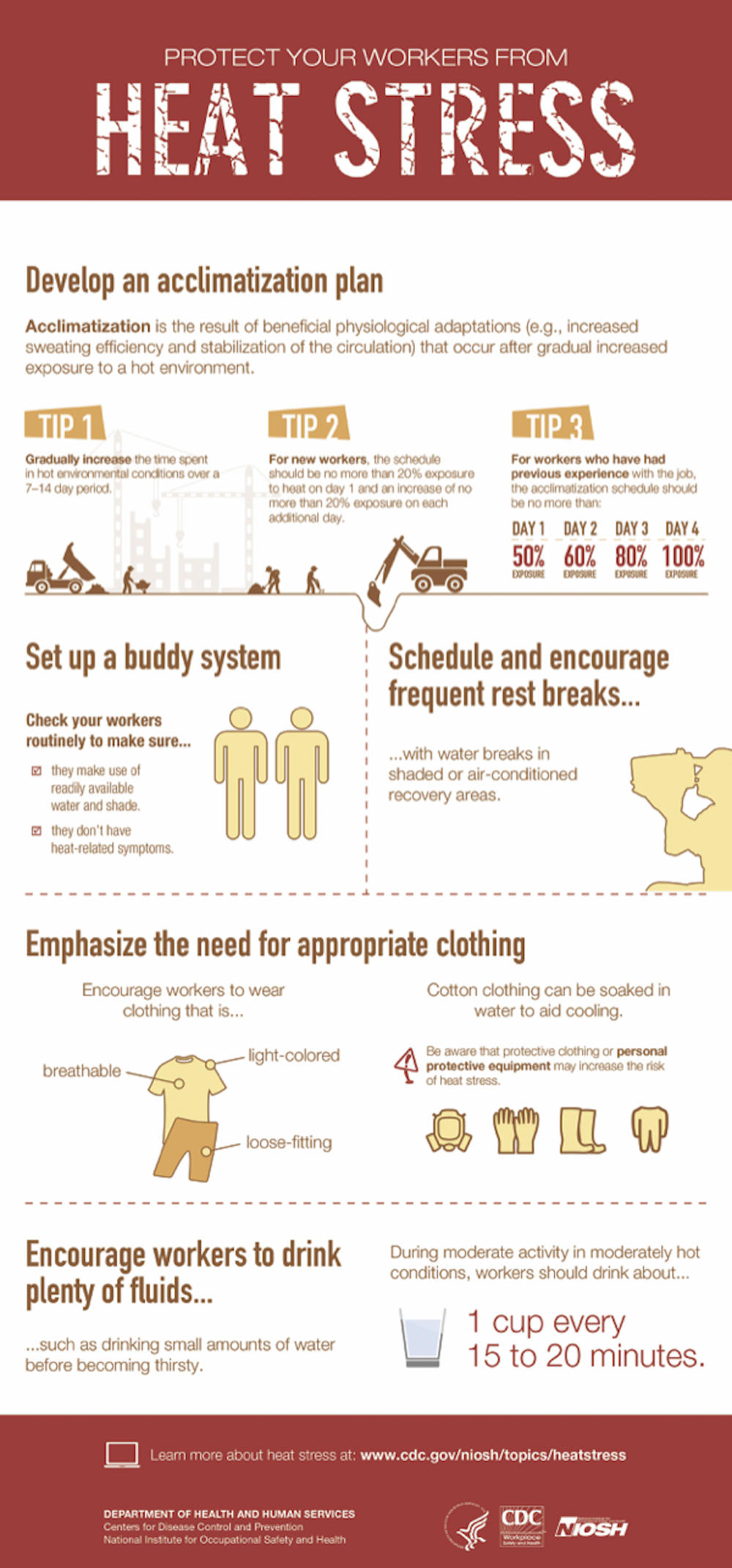
Behavior changes are another way of adapting to heat stress. Since midday is typically the hottest part of the day, it makes sense to avoid physical work and exercise then. When people are active, their bodies break down nutrients – carbohydrates, fats and protein – into energy. This powers movement and also generates metabolic heat, which adds to the body’s heat stress.
Taking advantage of shade is another important strategy. Heat radiating from the Sun adds to the stress produced by warm air temperatures. Staying in the shade can significantly reduce the external heat load on people who have to be outdoors during hot spells.
Many of the hundreds of deaths and hospitalizations that experts have attributed to the recent heat dome in the Northwest probably reflect that buildings there were less equipped to keep people cool than in hotter regions, and residents were less acclimatized to heat.
The old and young are most vulnerable
A healthy adult body can acclimatize to heat, but older people and children are less able to adjust. As people age, their cardiovascular systems change in ways that cause them to pump blood less effectively. This reduces the body’s ability to move heat to the skin to be transferred to the environment.
[The Conversation’s science, health and technology editors pick their favorite stories. Weekly on Wednesdays.]
Children and older adults may also have less active sweat responses, which can reduce their potential to cool off through sweating.
Humans can tolerate most areas of the Earth, but extreme heat requires extra steps. If there’s a heat wave in your local forecast, seek out shade and begin to acclimatize by increasing your activity gradually when things get too hot. Drink more fluids to account for increased fluid loss from sweat, while also making sure not to overhydrate. And avoid outdoor activity during the hottest hours of the day if possible.
Whether heat waves are humid or dry, they are health threats that everyone should take seriously.
JohnEric W. Smith, Associate Professor of Exercise Physiology, Mississippi State University
This article is republished from The Conversation under a Creative Commons license. Read the original article.
Those nominated to the Court of Appeal are Justice Alison M. Tucher as presiding justice of the First District Court of Appeal, Division Three; Justice Teri L. Jackson as presiding justice of the First District Court of Appeal, Division Five; Judge Cynthia C. Lie as an associate justice of the Sixth District Court of Appeal; and Judge Charles E. Wilson II as an associate justice of the Sixth District Court of Appeal.
For the Superior Courts, the governor appointed two judges in Alameda County, one in Fresno County, two in Kern County, two in Los Angeles County, one in Orange County, one in Riverside County, two in Sacramento County, two in San Bernardino County, one in San Diego County, one in San Francisco County, three in San Mateo County and one in Santa Cruz County.
First District Court of Appeal

Alison M. Tucher
Justice Alison M. Tucher, 58, of Berkeley, has been nominated to serve as presiding justice of the First District Court of Appeal, Division Three. She has served as an associate justice of the First District Court of Appeal, Division Four since 2018.
Justice Tucher served as a judge at the Alameda County Superior Court from 2014 to 2018. She was a partner at Morrison and Foerster from 2004 to 2014 and a litigation associate there from 1998 to 2003.
She served as a deputy district attorney at the Santa Clara County District Attorney’s Office from 1995 to 1998 and was assistant director of the U.S. Department of the Treasury’s White House Security Review Team from 1994 to 1995.
Justice Tucher served as a law clerk for the Honorable David H. Souter at the U.S. Supreme Court and for the Honorable William A. Norris at the U.S. Court of Appeals, Ninth Circuit.
She earned a Juris Doctor degree from Stanford Law School and a Master of Arts degree in engineering from the University of Cambridge.
Justice Tucher fills the vacancy created by the retirement of Justice Peter J. Siggins.
This position requires the completion of a review by the State Bar’s Commission on Judicial Nominees Evaluation and confirmation by the Commission on Judicial Appointments.
The Commission consists of Chief Justice Tani Cantil-Sakauye, Attorney General Rob Bonta and Senior Presiding Justice J. Anthony Kline.
Justice Tucher is a Democrat.

Teri L. Jackson
Justice Teri L. Jackson, 64, of San Mateo, has been nominated to serve as presiding justice of the First District Court of Appeal, Division Five. She has served as an associate justice of the First District Court of Appeal, Division Three since 2019.
Justice Jackson served as a Judge at the San Francisco County Superior Court from 2002 to 2019. She was of counsel at Orrick, Herrington & Sutcliffe LLP from 1997 to 2002 and served as an assistant district attorney in the San Francisco District Attorney’s Office from 1984 to 1997.
She served as a deputy district attorney in the San Mateo County District Attorney’s Office from 1981 to 1984. Justice Jackson was an Adjunct Professor at the University of California, Hastings College of the Law from 2006 to 2019 and at the University of San Francisco School of Law from 2004 to 2019.
She earned a Juris Doctor degree from the Georgetown University Law Center.
Justice Jackson fills the vacancy created by the retirement of Justice Barbara J.R. Jones.
This position requires the completion of a review by the State Bar’s Commission on Judicial Nominees Evaluation and confirmation by the Commission on Judicial Appointments.
Justice Jackson is a Democrat.
Sixth District Court of Appeal

Cynthia C. Lie
Judge Cynthia C. Lie, 53, of Oakland, has been nominated to serve as an Associate Justice of the Sixth District Court of Appeal. She has served as a judge in the Santa Clara County Superior Court since 2015.
Judge Lie served as an assistant federal public defender at the San Jose Branch of the Office of the Federal Public Defender, Northern District of California from 2003 to 2014.
She served as a staff attorney at the city and county of San Francisco Office of Citizen Complaints from 2002 to 2003 and was a sole practitioner from 2001 to 2003.
Judge Lie was a litigation associate at Sheppard, Mullin, Richter and Hampton LLP in 2000 and served as a deputy public defender at the San Diego County Public Defender’s Office from 1995 to 2000.
She earned a Juris Doctor degree from the University of California, Berkeley School of Law.
She fills the vacancy created by the retirement of Justice Nathan D. Mihara.
This position requires the completion of a review by the State Bar’s Commission on Judicial Nominees Evaluation and confirmation by the Commission on Judicial Appointments.
Judge Lie is registered without party preference.

Charles E. Wilson II
Judge Charles E. Wilson II, 46, of East Palo Alto, has been nominated to serve as an associate justice of the Sixth District Court of Appeal. He has served as a Judge at the Santa Clara County Superior Court since 2014.
Judge Wilson served as a deputy district attorney at the Alameda County District Attorney’s Office from 2007 to 2014. He was an associate at Gordon and Rees LLP from 2003 to 2007 and at Phillips, Spallas and Angstadt in 2003.
Judge Wilson earned Juris Doctor and Master of Business Administration degrees from the University of San Francisco.
He fills the vacancy created by the retirement of Justice Eugene M. Premo.
This position requires the completion of a review by the State Bar’s Commission on Judicial Nominees Evaluation and confirmation by the Commission on Judicial Appointments.
Judge Wilson is a Democrat.
The compensation for each of these positions is $245,578.
An unprecedented heat wave that started around June 26 smashed numerous all-time temperature records in the Pacific Northwest and western Canada. NASA’s Atmospheric Infrared Sounder, or AIRS, aboard the Aqua satellite, captured the progression of this slow-moving heat dome across the region from June 21 to 30.
An animation of some of the AIRS data show surface air temperature anomalies – values above or below long-term averages. Surface air temperature is something that people directly feel when they are outside.
In many cases, the highs exceeded previous temperature records by several degrees or more. On June 28, Quillayute, Washington, set an all-time high temperature record of 110 degrees Fahrenheit, shattering the old record of 99 degrees Fahrenheit.
Numerous weather stations broke records on consecutive days, showing the unprecedented nature of this extreme heat, which is also being blamed for a number of fatalities.
In British Columbia, the village of Lytton set a new all-time record for Canada at 119 degrees Fahrenheit on June 29, only to break it the next day with a reading of 121 degrees Fahrenheit.
The AIRS instrument recorded similar temperature anomalies at an altitude of about 10,000 feet, showing that the extreme heat also affected mountainous regions. And temperature anomalies at roughly 18,000 feet demonstrated that the heat dome extended high into Earth’s troposphere, creating the conditions for intense heat at the planet’s surface that are normally found farther south.
AIRS, in conjunction with the Advanced Microwave Sounding Unit, or AMSU, senses emitted infrared and microwave radiation from Earth to provide a three-dimensional look at the planet’s weather and climate.
Working in tandem, the two instruments make simultaneous observations down to Earth’s surface.
With more than 2,000 channels sensing different regions of the atmosphere, the system creates a global, three-dimensional map of atmospheric temperature and humidity, cloud amounts and heights, greenhouse gas concentrations and many other atmospheric phenomena.
Launched into Earth orbit in 2002 aboard NASA’s Aqua spacecraft, the AIRS and AMSU instruments are managed by NASA’s Jet Propulsion Laboratory in Southern California, under contract to NASA. JPL is a division of Caltech.
More information about AIRS can be found at https://airs.jpl.nasa.gov/.
Jamie Rae Lukens, 34, who police said is a transient and Lakeport resident, was taken into custody on Wednesday night, the agency reported.
At 8:45 p.m. Wednesday, Lakeport Police Department officers received information from the Lake County Sheriff’s Office Dispatch Center of an active fire in the area of WestAmerica Bank, located at 650 N. Main St.
The department said its officers quickly arrived, along with fire service personnel from the Lakeport Fire Protection District, and located shrubs and a tree burning in the parking lot immediately adjacent to the bank building.
Fire personnel successfully suppressed the fire with only property damage to the nearby vegetation, the department said.
Officers received information from two witnesses who described a female subject who they said set the fire before leaving the scene on foot before first responders arrived. They provided police with descriptions of her physical appearance and what she was wearing.
Police conducted an intensive investigation which, along with further assistance from the two community members that witnessed the event, led them to arresting Lukens just before 9:30 p.m.
Lukens was arrested for the felony violation of arson with the malicious intent of causing damage to the personal property of another.
She was booked into the Lake County Jail on $15,000 bail and remained in custody on Thursday.
Booking records show she is due to appear in Lake County Superior Court for arraignment on Friday.
Anyone with information regarding this incident is asked to contact LPD Officer Ryan Cooley at