 How to resolve AdBlock issue?
News
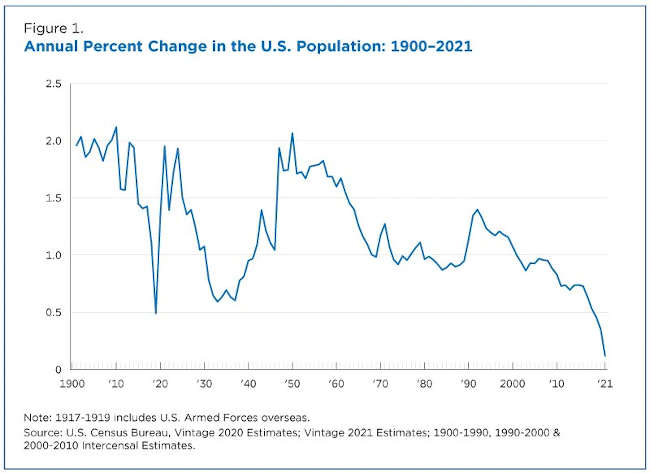
The U.S. population grew at a slower rate in 2021 than in any other year since the founding of the nation, based on historical decennial censuses and annual population estimates.
The U.S. Census Bureau Vintage 2021 Population Estimates released this week show that population grew only 0.1% and that the COVID-19 pandemic exacerbated the slower growth the country has experienced in recent years.
The year 2021 is the first time since 1937 that the U.S. population grew by fewer than one million people, featuring the lowest numeric growth since at least 1900, when the Census Bureau began annual population estimates.
Apart from the last few years, when population growth slowed to historically low levels, the slowest rate of growth in the 20th century was from 1918-1919 amid the influenza pandemic and World War I.
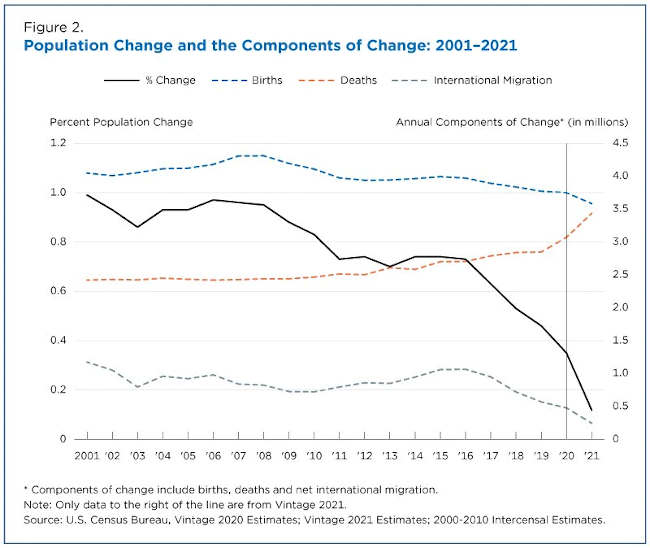
Slower population growth has been a trend in the United States for several years, the result of decreasing fertility and net international migration, combined with increasing mortality due to an aging population.
In other words, since the mid-2010’s, births and net international migration have been declining at the same time deaths have been increasing. The collective impact of these trends is slower population growth.
This trend has been amplified by the COVID-19 pandemic, resulting in a historically slow population increase in 2021 (Figure 2).
The release of the Vintage 2021 estimates includes a blog and America Counts stories that explain how the impacts of COVID-19 and other unique challenges were accounted for in this year’s estimates, including more detail on net international migration and Puerto Rico migration.
The Census Bureau will continue to release more details from Vintage 2021 next year, including more comprehensive data and analyses on the distinctive trends in this series of estimates.
State population changes
The tables below show the states that gained the most population and those that lost the most from 2020 to 2021.
Luke Rogers is chief of the Census Bureau’s Population Estimates Branch.


Call Lake County Animal Care and Control at 707-263-0278 or visit the shelter online for information on visiting or adopting.
The following cats at the shelter have been cleared for adoption.

‘Punky’
“Punky” is a 4-year-old male domestic shorthair cat with a yellow tabby coat.
He is in cat room kennel No. 6, ID No. LCAC-A-2417.

‘Dinky’
“Dinky” is a 10-year-old female domestic shorthair cat with a tortie coat.
She is in cat room kennel No. 24, ID No. LCAC-A-2375.

‘Coco’
“Coco” is a 3-year-old female Siamese mix with a short gray, black and white coat, and blue eyes.
She is in cat room kennel No. 33, ID No. LCAC-A-2426.

Male domestic shorthair
This young male domestic shorthair cat has a gray and white coat.
He is in cat room kennel No. 53a, ID No. LCAC-A-2384.

‘Blackette’
“Blackette” is a young male domestic shorthair with a black and white coat.
He is in kennel No. 53b, ID No. LCAC-A-2385.

‘Blackie’
“Blackie” is a young male domestic shorthair with a black and white coat.
He is in cat room kennel No. 53c, ID No. LCAC-A-2386.

Male domestic shorthair
This young male domestic shorthair has a unique striped gray tabby coat.
He is in cat room kennel No. 53d, ID No. LCAC-A-2383.

‘Puff’
“Puff” is a 3-year-old female domestic shorthair mix with white, black, gray and tan markings, and blue eyes.
She is in cat room kennel No. 68, ID No. LCAC-A-2425.

Male domestic shorthair kitten
This male domestic shorthair kitten has an orange tabby coat.
He is in cat room kennel No. 96a, ID No. LCAC-A-1871.

Male domestic shorthair kitten
This male domestic shorthair kitten has an orange tabby coat.
He is in cat room kennel No. 96c, ID No. LCAC-A-1873.

Female domestic shorthair kitten
This female domestic shorthair kitten has an orange tabby coat.
She is in cat room kennel No. 96d, ID No. LCAC-A-1874.

Female domestic shorthair kitten
This female domestic shorthair kitten has a gray tabby coat.
She is in cat room kennel No. 101a, ID No. LCAC-A-1945.

‘Brutus’
“Brutus” is a 6-year-old male domestic shorthair with a brown tabby coat.
He is in cat room kennel No. 146, ID No. 2416.
Email Elizabeth Larson at

Before COVID-19, there was tuberculosis. Twentieth century British physician Thomas McKeown controversially proposed that the sharp declines in infectious disease death rates in the late 1900s were due to improved economic and social conditions – not medical and public health measures like antibiotics and improved sanitation.
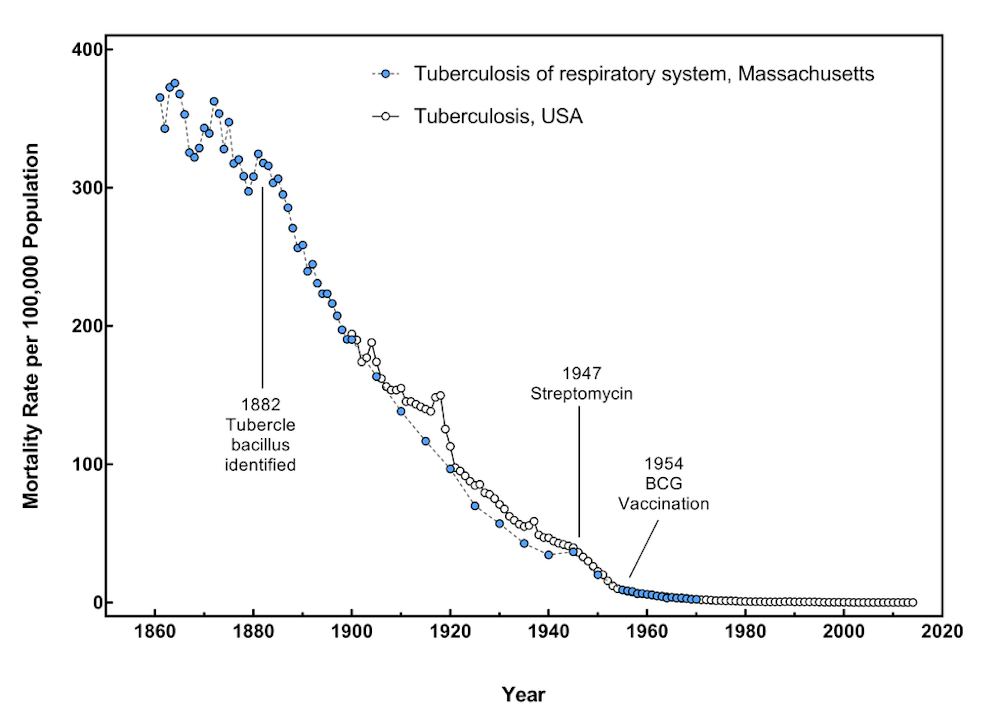

His theory was later partly discredited. But the central question behind it – whether medical interventions or social factors make the biggest impact on infectious diseases – remains relevant in the current pandemic.
When COVID-19 first arrived in the U.S., the only tool public health officials had to stop its spread was behavior change through lockdowns, social distancing and face masks. With vaccines, the tide seemed to turn. But with new variants, waning immunity and ongoing vaccine hesitancy, the pandemic is still far from over.
So which are more successful at driving down rates of disease and death – social behaviors or medical technologies?
As an infectious disease and social epidemiologist, I have been particularly interested in how new medical technologies affect existing health disparities. I believe that understanding the interplay between behavior and technology will be key to surviving the pandemic and emerging as a stronger society.
Do technologies help or make things worse?
Biomedicine has clearly played a critical role in mitigating COVID-19. Less than a year after discovering the virus that causes COVID-19, researchers were able to develop multiple vaccines that are highly effective in preventing severe infection and transmission from most variants. They’re also likely to reduce the risk of long COVID-19, the ongoing symptoms that can persist for months after initial recovery. COVID-19 vaccines are estimated to have saved almost 140,000 lives in the U.S. in the first five months of 2021.
There has also been remarkable medical progress in other arenas. Even though antivirals are notoriously difficult to manufacture, there are finally options for treating COVID-19. Merck’s molnupiravir cuts hospitalization risks for adults in half, and Pfizer’s paxlovid has 89% efficacy at preventing hospitalization and death. Additional treatments are expected in the coming months.

Researchers have also developed and scaled up a variety of innovative diagnostic technologies. These range from using PCR tests to predict the trajectory of the pandemic to implementing blood tests that can simultaneously measure antibody levels against COVID-19 and other pathogens for quicker diagnosis.
Collaboration across both public and private sectors has also been fairly unprecedented. Large-scale government funding has aided these efforts. The U.S. National Institutes of Health’s Rapid Acceleration of Diagnostics, or RADx, initiative, for example, has worked to contain outbreaks in schools by providing COVID-19 test kits across the country.
Social factors as drivers of health
Despite these technological advancements, the COVID-19 pandemic has illuminated long-standing health disparities. In 2020, Latino and Black people died from COVID-19 at a rate almost three times higher than white people.
Systemic structural and social inequities are some of the reasons behind these disparities in the U.S. For example, communities of color are disproportionately represented in essential occupations that are at the front lines of potential COVID-19 exposure. In addition, Black and Hispanic Americans have higher rates of obesity, hypertension and type 2 diabetes, known risk factors for severe COVID-19 complications. Children in communities of color also experienced the death of a primary caregiver at a rate up to 4.5 times higher than non-Hispanic white children.

Technologies intended to improve health care can themselves exacerbate health disparities. This results in a digital divide where certain populations continue to have poor health despite technological improvements. For example, the safety and convenience of remote videoconferencing is a privilege unavailable for those who need to go to public workspaces to access these technologies.
This divide extends to medical devices used in routine care. Oximeters that measure oxygen levels in the blood tend to produce inflated results for people with darker skin because they were calibrated in clinical trials with mostly white participants. This racial bias may result in denial of care if someone with darker skin gets a normal reading despite actually having dangerously low oxygen levels.
Health disparities persist despite technology
These inequities are often derived from ongoing historical biases and discrimination.
Socioeconomic status, occupation and economic mobility are primary drivers of unequal health outcomes. In 2020, 5.4 million laid-off workers became uninsured in just four months. In 2019, 55% of retail and food workers at large firms didn’t have access to paid sick leave. Many immigrants, whether undocumented or legal U.S. residents, are likely to avoid the health care system due to fear of deportation and limited insurance coverage and public assistance.
Difficulty parsing through health information is another factor. In addition to abundant misinformation about COVID-19, nearly 9 in 10 adults struggle with health literacy. A July 2020 study found that Black men were less likely to know about COVID-19 symptoms and how the virus spreads than white men. For some groups, limited English proficiency and cultural beliefs are barriers to health communication.

Even more critical is distrust in the medical system. Historical unethical experimentation and everyday racism have led to a lack of confidence in scientists and clinicians among vulnerable populations. Two-thirds of Black adults believe the government can rarely or never be trusted to look out for the interests of their community.
Conversely, that COVID-19 hospitalizations and deaths disproportionately affect lower-income populations and communities of color reinforces the need for greater diversity in clinical research participants. Over 80% of participants in the Pfizer-BioNTech COVID-19 vaccine trial identified as white. Having clinical trials that reflect the patients who will be treated ensures that the drug will work for all and encourages confidence among those communities.
The importance of social factors in health
While technology has greatly improved U.S. pandemic response, broader societal ills continue to impede the nation’s ability to control COVID-19.
The McKeown debate exposes a common misconception that improving health is a binary: a choice between improving social conditions or developing new technologies and medicines. But a growing body of research shows that social factors, or the conditions where people live, work and play, are key to health outcomes.
There are numerous strategies that can increase health equity in this time of crisis. These include tackling food insecurity, flexibility in work conditions, targeted vaccine initiatives and culturally competent health care. Engaging with communities as partners in health also advances the nation’s ability to cope during a crisis.
Nobel prize-winning economist Amartya Sen hypothesized that increases in life expectancy in the 20th century occurred in periods marked by a strong emphasis on social sharing and public provision of health care. To me, it’s clear that the time has come to invest not just in new technologies and medical treatments, but also in communities.
[Get the best of The Conversation’s politics, science or religion articles each week.Sign up today.]
Eyal Oren, Professor of Epidemiology, San Diego State University
This article is republished from The Conversation under a Creative Commons license. Read the original article.

LAKE COUNTY, Calif. — What happens on New Year's Eve in other parts of the world? You might be surprised, as I was, at the unique and unusual ways that 2022 will be ushered in around the globe.
Scotland rings in the new year with a variety of fervent celebrations, including street dances, bonfires, and parading with fireballs swinging from sticks.
New Year’s Eve there is called Hogmanay and brings with it the custom of “first footing.” In this tradition, the first person to cross the threshold of one’s home in the new year brings either good or bad luck.
A dark-haired male is considered good luck, while light- or red-haired men are said to bring bad, perhaps because of the history of invasion by Vikings with such coloring. The first footer is supposed to bear traditional gifts of coal, salt, shortbread and whiskey.
Emphasis on New Year’s Eve celebrations in Scotland may stem from the banning of Christmas festivities in Britain during the 17th and 18th centuries.
In Spain, 12 grapes are eaten at midnight to bring luck and prosperity for each month of the new year. They must be eaten before the 12 chimes of the clock are complete, however, or their luck is forfeited.
The Swiss drop dollops of whipped cream or ice cream on the floor to symbolize the richness of the year to come.
Romanians don bear costumes or furs and dance to the pan flute to drive away evil spirits that may invade the new year.
In the Netherlands, balls of deep-fried dough called oliebollen are eaten. This stems from an ancient tradition related to the Germanic goddess Perchta, scarily known as the Belly Slitter. The story goes that her goal was to punish those who failed to celebrate the yuletide well by cutting open their stomachs and filling them with trash. The fat from oliebollen was believed to be protective, causing Perchta’s sword to slide off harmlessly.
The color white is considered good luck in Brazil and is worn on New Year’s Eve to ward off evil spirits and invite prosperity. White flowers and candles are thrown into the water as offerings to the sea goddess Yemoja with hopes for her blessings in the year to come.
Brazilians may also gather at the beach to jump over seven waves, a lucky number there. Lentils, which represent money and good fortune, are eaten on New Year’s Eve.
Wearing red underwear is traditional in Italy on New Year's Eve, particularly if one desires children, as red is symbolic of fertility there.
In Colombia, a walk around the block with an empty suitcase is done at midnight in hopes of bringing a year of travel and adventure.
Columbians also practice a form of fortune telling by placing three potatoes under their pillows, one unpeeled, one half peeled, and one fully peeled. At midnight they pull out the first one they touch, hoping for the unpeeled one, which represents abundance. The peeled potato portends financial problems and the half peeled one means that fortunes in the new year will be somewhere in the middle.
In the Philippines, round shapes signify wealth and prosperity, so people wear clothes with shapes such as polka dots. They also eat spherical fruits and fill their pockets with coins to attract wealth.
Strings of onions are hung on the outside of doors on New Year’s Eve in Greece as a symbol of rebirth. Onions have been long associated with growth and development in Greek culture.
Another food, the pomegranate, represented fertility, life, and abundance in ancient Greece, and the fruit continues to be associated with good fortune there in modern times. Just after midnight on New Year’s Eve, pomegranates are smashed against one’s front door. It is said that the number of pomegranate seeds scattered correlate to the amount of good luck one will have in the new year.
In Chile, New Year’s Eve masses are celebrated in cemeteries so deceased family members can join in the festivities.
Soba noodles are slurped on New Year’s Eve in Japan as their length represents a long and healthy life. Because the buckwheat plant used to make these noodles is so resilient, it’s thought that eating the noodles can also bring strength.
Buddhist temples in Japan ring their bells 108 times in honor of the new year — 107 times on New Year’s Eve and once again when the clock strikes midnight. This is meant to dispel the 108 evil human desires and cleanse the previous year of past sins. The practice is known as joyanokane.
Plates are smashed on the front stoops of friends and neighbors in Denmark to bring them good luck. It’s a point of pride to have a large amount of broken crockery in front of one’s home on New Year’s Day. Some say it’s a means of leaving aggression and ill will behind before the new year begins. Danes also jump off chairs to “leap” into the new year.
In Ecuador, straw effigies are made of famous figures — politicians, pop stars, and the like — and are carried through the streets. They’re then burned on bonfires to represent cleansing the world of evil and making room for good in the new year.
Bleigiessen, or lead pouring, is a fortune telling tradition at the center of German and Finnish New Year’s Eve festivities. A small bit of lead or tin is melted using flames from a candle and then dropped into cold water. The shape that forms is thought to predict events in the coming year. For example, a ring or heart represents a wedding, a pig abundance and a ship travel.
In Russia, wishes for the new year are written out and then burned with a candle. The ashes are put into one’s champagne glass to drink.
Puerto Ricans throw water out of windows to ward off evil spirits and sprinkle sugar outside for good luck.
In the Czech Republic, fortunes are predicted for those gathered at New Year’s Eve celebrations by cutting apples in half. If the core looks like a star, everyone there will soon meet again in happiness and health, but if it looks like a cross, someone will fall ill in the upcoming year.
Many meals are eaten on New Year’s Eve in Estonia, either seven, nine or 12 of them, as those numbers are considered lucky. It’s believed that this will bring good things in the year to come. It’s customary to leave some food on the plate at each meal for family members visiting in spirit form to enjoy.
Armenians knead wishes for good luck into every loaf of bread that’s made on the last day of the year.
In Turkey it’s considered good luck to spill salt on your doorstep when the clock strikes midnight to promote peace and prosperity through the new year.
In Ireland, single women sleep with mistletoe under their pillows on New Year’s Eve in hopes of finding true love – or perhaps a husband – in the coming year.
In the southeastern United States, Hoppin’ John, a favorite dish made with black-eyed peas and greens (usually collards), is eaten on New Year’s Day to bring luck and prosperity, and that’s the recipe I offer today. The greens, because of their color, symbolize money, and black-eyed peas have long represented good luck.
Below is a vegetarian version of the dish, but feel free to add a ham hock to the mix or fry some bacon in the pot first if a meaty version is desired. Either way, be sure to serve it with plenty of cornbread.
If you don’t have time to soak the beans overnight, put them in a pot with water to cover, bring to a boil, then turn off the heat and let the beans sit for an hour. Drain the water and cook as directed below. You can also substitute frozen or canned black-eyed peas. Just add them to the pot once the vegetables have had a chance to cook a bit.
Enjoy! And best wishes for a happy, healthy, prosperous 2022.
Hoppin’ John
2 cups dried black-eyed peas
6 cups water
1 medium white or yellow onion, chopped
Several sprigs fresh thyme (tied with kitchen string for use as a bouquet garni or the chopped leaves of the sprigs)
2 bay leaves
1 medium green or red bell pepper, seeded and chopped
1 large bunch kale, stems removed and chopped
1 cup long-grain rice
2 medium cloves garlic, minced
1 tablespoon smoked paprika
Leaves from 3 or 4 sprigs thyme leaves (1 tablespoon; may substitute 1 teaspoon dried thyme)
Salt & freshly ground black pepper to taste
Tabasco sauce (optional)
Rinse black-eyed peas and soak in water to cover for six hours or overnight. Drain peas and transfer to a large soup pot.
Add water, onions, kale, garlic, thyme, and bay leaves. Simmer until beans are tender but still whole, about 45 minutes.
Add rice, green or red pepper, paprika, salt, and pepper. Cover and simmer until rice is tender, about 15 to 20 minutes.
If desired, season with Tabasco sauce. Remove thyme (if in bouquet garni) and bay leaves before serving. Ladle into bowls and enjoy with cornbread.
Makes four servings.
Recipe by Esther Oertel.
Esther Oertel is a writer and passionate home cook from a family of chefs. She grew up in a restaurant, where she began creating recipes from a young age. She’s taught culinary classes in a variety of venues in Lake County and previously wrote “The Veggie Girl” column for Lake County News. Most recently she’s taught culinary classes at Sur La Table in Santa Rosa. She lives in Middletown, California.
Dogs available for adoption this week include mixes of beagle, border collie, Chihuahua German shepherd, Labrador retriever, mastiff, pit bull, Rhodesian ridgeback and terrier.
Dogs that are adopted from Lake County Animal Care and Control are either neutered or spayed, microchipped and, if old enough, given a rabies shot and county license before being released to their new owner. License fees do not apply to residents of the cities of Lakeport or Clearlake.
The following dogs at the Lake County Animal Care and Control shelter have been cleared for adoption (additional dogs on the animal control website not listed are still “on hold”).
Call Lake County Animal Care and Control at 707-263-0278 or visit the shelter online at http://www.co.lake.ca.us/Government/Directory/Animal_Care_And_Control.htm for information on visiting or adopting.

Black lab mix puppy
This male black Labrador retriever mix puppy has a short black coat.
He is in kennel No. 10, ID No. LCAC-A-2428.

Male German shepherd
This 1-year-old male German shepherd has a black and tan coat.
He is in kennel No. 12, ID No. LCAC-A-1892.

‘Cinnamon’
“Cinnamon” is a 5-year-old female chocolate Labrador retriever-pit bull mix with a short chocolate-colored coat.
She is in kennel No. 13, ID No. LCAC-A-1769.

‘Bruce’
“Bruce” is a 2-year-old male pit bull terrier with a short brown coat.
He is in kennel No. 14, ID No. LCAC-A-2351.

Female mastiff
This 3-year-old female mastiff has a short brindle coat.
She is in kennel No. 15, ID No. LCAC-A-1868.

Male beagle-terrier mix
This young male beagle-terrier mix has a short tan coat.
He is in kennel No. 18, ID No. LCAC-A-2389.

Male Chihuahua
This 1-year-old male Chihuahua has a short brown coat.
He is in kennel No. 19, ID No. LCAC-A-2393.

Female border collie mix
This 2-year-old female border collie mix has a black and white coat.
She is in kennel No. 23, ID No. LCAC-A-2207.

Male German shepherd
This 2-year-old male German shepherd has a black and tan coat.
He is in kennel No. 26, ID No. LCAC-A-1903.

‘Duke’
“Duke is a 1-year-old male Rhodesian ridgeback with a short brown coat.
He is in kennel No. 30, ID No. LCAC-A-2219.
Email Elizabeth Larson at
University of California, San Francisco experts were asked to weigh in on the most common questions about Omicron prevalence, transmission and severity; the safety of holiday gatherings and travel; the new FDA-approved antiviral, and more.
Experts include Peter Chin-Hong, MD, UCSF professor in the Division of Medicine, and Associate Dean for Regional Campuses; Charles Chiu, MD, PhD, MD, PhD, professor of medicine and laboratory medicine, UCSF Division of Infectious Diseases; Sarah Doernberg, MD, MAS, associate professor in UCSF’s Division of Infectious Diseases ; Monica Gandhi, MD, MPH, professor of medicine in the Division of HIV, Infectious Diseases, and Global Medicine; Nevan Krogan, PhD, UCSF professor of Cellular and Molecular Pharmacology, director of UCSF’s Quantitative Biosciences Institute; and George Rutherford, MD, UCSF professor in the Department of Epidemiology and Biostatistics
How much Omicron and COVID-19 are we seeing now in the Bay Area and beyond?
Chiu: Omicron is circulating in the Bay Area and is rapidly spreading. We see these same trends – rapidly rising case numbers and proportion of Omicron in California generally and in multiple other states.
Our lab, in collaboration with the San Francisco Department of Public Health and Color Genomics, has found a significant rise in positive tests, with an increasing proportion of Omicron cases. During the first 3 weeks of December, Omicron cases rose from 0 percent of the total positive tests in San Francisco to 68% of the total, while the number of positive cases more than tripled from 38 per week to 128 per week. From December 17 to 20, we had 96 positive samples and 74 (77 percent) of them were Omicron.
CDC data suggest that the proportion of Omicron cases is 90 percent in some parts of the country. This rapid increase is similar to what has been seen across the world. Data from South Africa suggest, however, that Omicron cases may be less severe overall and are less likely to require hospital treatment.
How worried should we be about Omicron?
Gandhi: Omicron is massively more transmissible than delta, perhaps 4 times more. However, there is now evidence that Omicron is less severe than previous strains. We do not know yet if this is because of increasing cellular immunity in the population now or an inherent property of the strain that makes it less virulent, or both.
Two new studies out of the UK and South Africa showed that patients with Omicron were 60 percent to 70 percent less likely to be hospitalized than those with Delta. Other data released from South Africa indicate that average hospital days are shorter than with previous variants (2.8 days compared to eight days); that 90 percent of patients admitted don’t need oxygen therapy with the Omicron variant compared to earlier strains; and that 3% of patients hospitalized recently with COVID-19 have died, versus about 20 percent in the country’s earlier outbreaks.
This reduced severity may be due to increasing immunity in the population or could be partially because the strain is less virulent.
Chin-Hong: South Africa is a younger population, with not as many comorbidities. It has also been recently hit hard by successive waves of natural infection, mostly with Delta. Consequently, there’s a higher population level of immunity (natural plus vaccine) that may not be generalizable to other countries like the U.S. However, this was recently confirmed in studies from England and Scotland showing that omicron infection results in up to two thirds fewer hospitalizations when compared with delta. But the data is evolving. Stay tuned.
What do we know about Omicron and children?
Chin-Hong: We don’t know a lot yet, and what we know mainly comes from South Africa. They saw a lot of kids under age 5 in the hospital with Omicron, but many of them were going in for other reasons. So far, there haven’t been any confirmed deaths of children in South Africa, but they are getting infected because it’s very contagious.
So, children will be protected as long as they can wear a mask and the adults around them are vaccinated. We don’t think outdoors will be that risky; we’re a lot more worried about kids indoors, with all of those mouths and noses close together. We should aim to use the same protocols we did in spring of 2020 – masks, distancing, being outside – to protect ourselves.
Should people be changing their plans for the holidays in light of Omicron?
Chin-Hong: Domestically, I think it’s OK to travel, but you need to up your COVID-safety game. You could double mask or get an N95 mask and make sure it’s tightly fit. If you’re planning on getting together with older members of your family or vulnerable people, you should get tested before that get-together. If you’ll be returning home to immunocompromised or elderly relatives, you’ll want to get a test three or four days after you get back.
What makes the Omicron variant unusual?
Doernberg: This variant’s two most concerning features are: 1) it is very highly contagious and so it is spreading really rapidly, and 2) Omicron is able to get around some of the defenses we have developed over the past couple of years, namely vaccines and monoclonal antibodies.
Information about the severity of infection from Omicron continues to emerge; some reports suggest that severe infections may be less common, but this is a quickly evolving area. Even if this variant proves milder than others, the sheer number of people infected will result in many hospitalizations and will cause many disruptions.
While vaccine effectiveness appears lower for Omicron, the vaccines do still protect against severe disease, and having a booster dose increases the level of protection. Getting vaccinated remains one of the most important defenses. Unfortunately, many of the monoclonal antibodies that we had previously been using for treatment of mild and moderate infections and for post-exposure prevention do not have activity against Omicron. The monoclonal antibody predicted to retain activity, sotrovimab, is in extremely short supply.
What about Omicron’s genetics makes it more transmissible?
Krogan: Scientists have watched closely as new variants of the virus have amassed mutations in the spike region of the virus's genome, because SARS-CoV-2 uses its spikey outer proteins to get into our cells. Some of these mutations are contributing to increased transmissibility of variants like Alpha, Delta, and now Omicron. The Alpha variant had eight spike mutations; Omicron has more than 30.
But changes are accumulating elsewhere in the virus genome, as well, and it’s important to understand their impact. For this reason, we have been studying mutations outside of spike that could also be contributing to increased transmissibility.
These mutations turn up the expression of certain SARS-CoV-2 proteins that we think help the virus evade the immune response, which could increase the viral load. We’re continuing to study this on a systematic level across all variants to try to understand which mutations make the virus more contagious.
How likely is it with the Omicron variant that people will experience a breakthrough infection if they’ve gotten vaccines and a booster?
Chin-Hong: It’s still possible to get a breakthrough after a booster because this variant looks a little different, but fully vaccinated folks are going can be confident that they’re protected more than most against getting really sick, going to the hospital and dying. I can’t say they won’t get infected, but they’ll have the best chance of anybody of withstanding an infection.
If you’re unvaccinated, you’re going to be very vulnerable to this variant. With two doses of vaccine, you’ll be about 30 percent protected. Boosted, it will be about 80 percent protection.
One relatively small study found that if you have a breakthrough case and both vaccine doses, your immune level goes through the roof. You have 1,000 times the antibodies compared to people two weeks after their second dose.
And if you’re boosted and get an infection, the chances of you withstanding a future variant is the highest on the planet. If you’re walking on the street, COVID will probably be running away from you.
What do we know about vaccines, boosters and long COVID?
Rutherford: We don’t know anything about long COVID among people who are vaccinated and boosted, but we expect that it will be a lot less common.
Why is it so hard to get boosters? Is there a shortage?
Rutherford: There is a mismatch between supply and demand for boosters. In some areas, like San Francisco, demand is high but the number of people available to give the vaccines is insufficient. In other parts of California, there is a sufficient supply of boosters and people to give them, but the demand has not yet increased to match the available supply. The bottom line is that in some places, you’re going to have to work to get a booster (lots of calls, etc.) while in others it will be easy.
The FDA just approved Pfizer’s antiviral pill, Paxlovid, to treat COVID-19 in high-risk individuals who are at least 12 years old and weigh at least 88 pounds. What impact will this antiviral have?
Doernberg: I think the drug has really great promise for patients at high risk for complications from COVID, like those with medical comorbidities. There will be some barriers as we are getting off the ground. One is that the drug was shown to be effective within five days of symptoms and ideally should be taken within three days of symptoms. It can be hard to get a COVID test and a result in five days, especially in times when there are surges.
The other thing is that the drug will be in short supply initially; it won’t be available at first to every patient. Also, it will likely take several days before the drug is allocated and delivered to pharmacies. Medical systems will need to build out their electronic medical records so they can prescribe it. There are some drug interactions to consider, as some of the patients who are at highest risk of COVID, like transplant patients, are also on medications that would have a bad interaction with the antiviral – so that adds complexity in terms of prescribing it.
Are we headed for further restrictions?
Rutherford: I think it’s quite possible. In California, for instance, a mask restriction has been put into effect for one month through mid-January. I don’t think we’ll be seeing business closures again. Some businesses are having trouble getting workers, so that may have an impact, but I don’t see us returning to widespread shelter-in-place orders.