How to resolve AdBlock issue?
News

The James Webb Space Telescope was launched into space on Dec. 25, 2021, and with it, astronomers hope to find the first galaxies to form in the universe, will search for Earthlike atmospheres around other planets and accomplish many other scientific goals.
I am an astronomer and the principal investigator for the Near Infrared Camera – or NIRCam for short – aboard the Webb telescope. I have participated in the development and testing for both my camera and the telescope as a whole.
To see deep into the universe, the telescope has a very large mirror and must be kept extremely cold. But getting a fragile piece of equipment like this to space is no simple task. There have been many challenges my colleagues and I have had to overcome to design, test and soon launch and align the most powerful space telescope ever built.
Young galaxies and alien atmospheres
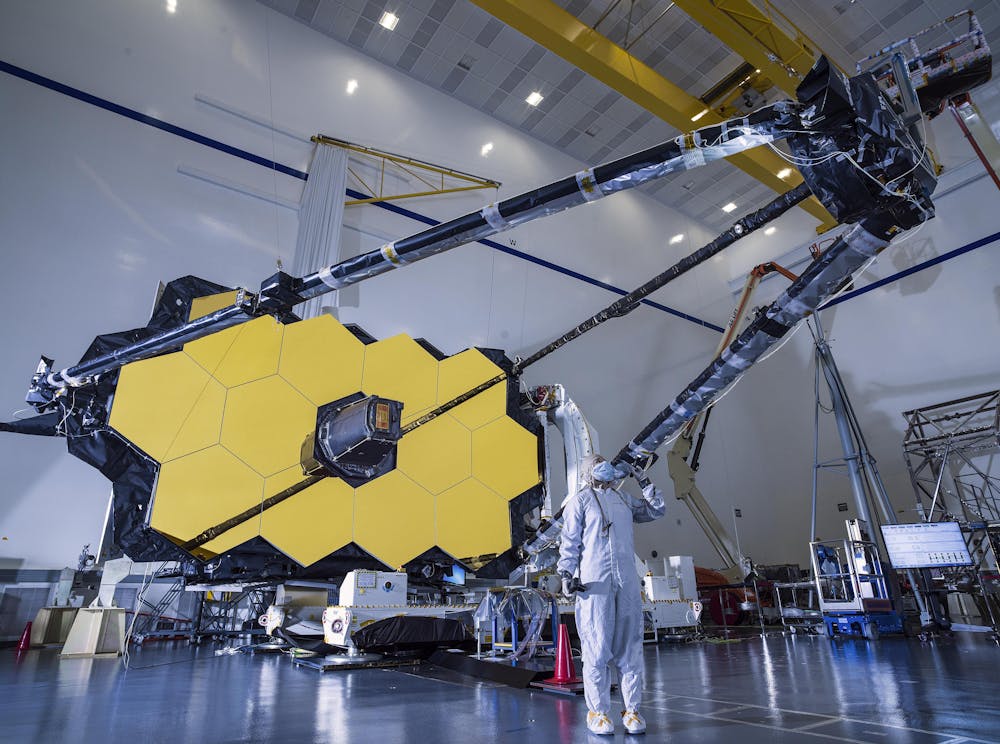
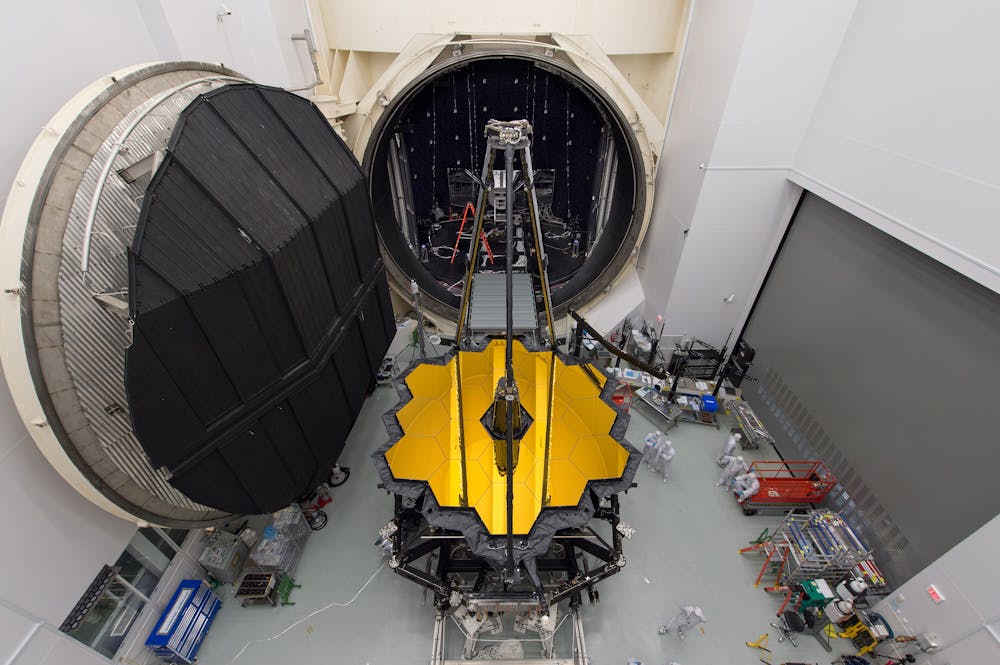
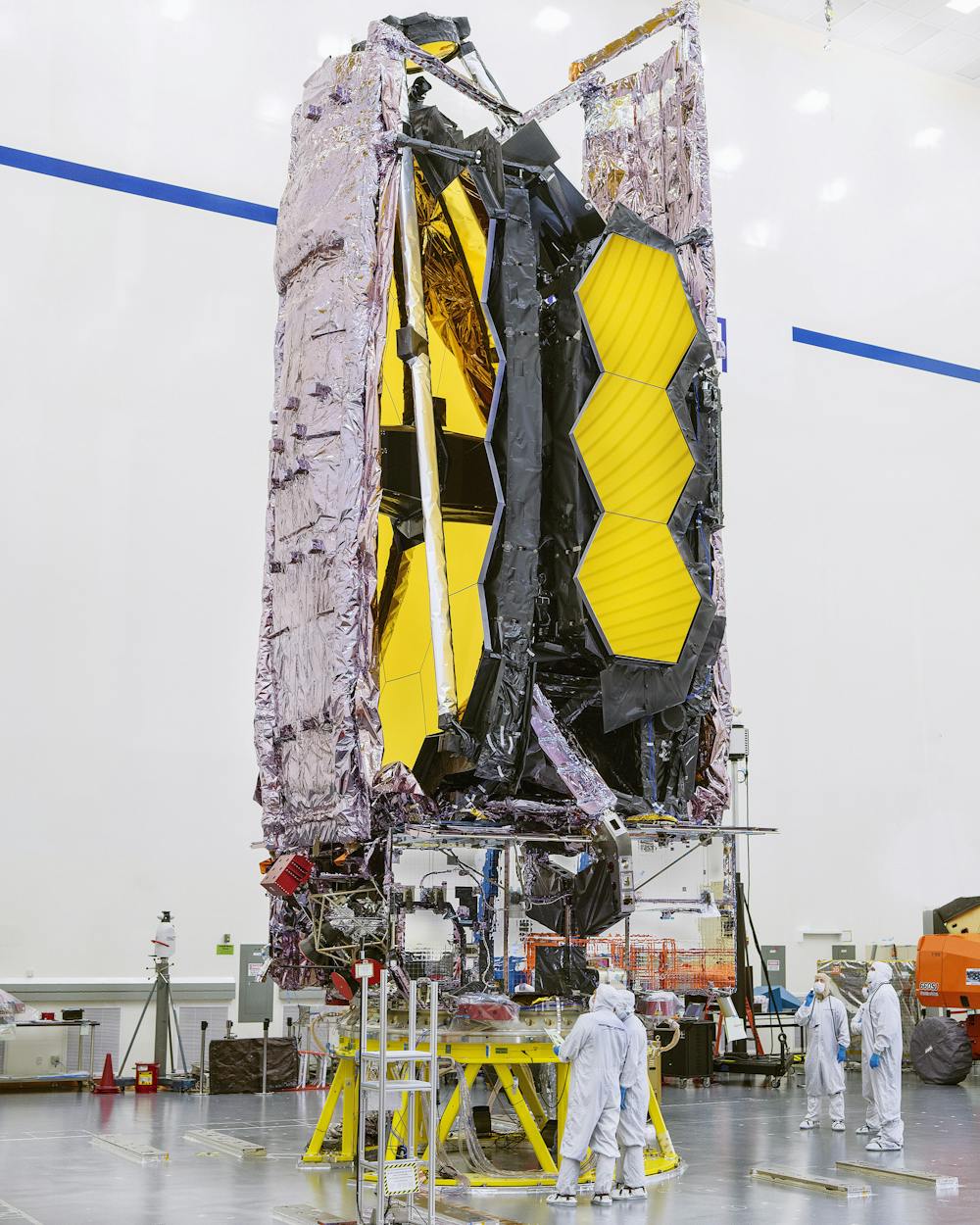
The Webb telescope has a mirror over 20 feet across, a tennis-court sized sun shade to block solar radiation and four separate camera and sensor systems to collect the data.
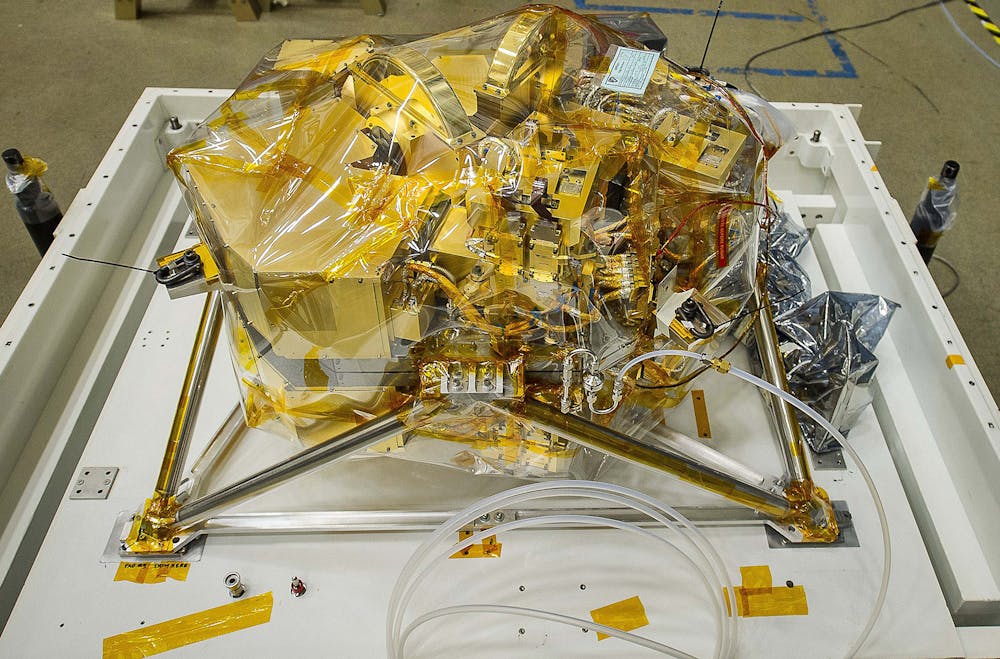
It works kind of like a satellite dish. Light from a star or galaxy will enter the mouth of the telescope and bounce off the primary mirror toward the four sensors: NIRCam, which takes images in the near infrared; the Near Infrared Spectrograph, which can split the light from a selection of sources into their constituent colors and measures the strength of each; the Mid-Infrared Instrument, which takes images and measures wavelengths in the middle infrared; and the Near Infrared Imaging Slitless Spectrograph, which splits and measures the light of anything scientists point the satellite at.
This design will allow scientists to study how stars form in the Milky Way and the atmospheres of planets outside the Solar System. It may even be possible to figure out the composition of these atmospheres.
Ever since Edwin Hubble proved that distant galaxies are just like the Milky Way, astronomers have asked: How old are the oldest galaxies? How did they first form? And how have they changed over time? The Webb telescope was originally dubbed the “First Light Machine” because it is designed to answer these very questions.
One of the main goals of the telescope is to study distant galaxies close to the edge of observable universe. It takes billions of years for the light from these galaxies to cross the universe and reach Earth. I estimate that images my colleagues and I will collect with NIRCam could show protogalaxies that formed a mere 300 million years after the Big Bang – when they were just 2% of their current age.
Finding the first aggregations of stars that formed after the Big Bang is a daunting task for a simple reason: These protogalaxies are very far away and so appear to be very faint.
Webb’s mirror is made of 18 separate segments and can collect more than six times as much light as the Hubble Space Telescope mirror. Distant objects also appear to be very small, so the telescope must be able to focus the light as tightly as possible.
The telescope also has to cope with another complication: Since the universe is expanding, the galaxies that scientists will study with the Webb telescope are moving away from Earth, and the Doppler effect comes into play. Just like the pitch of an ambulance’s siren shifts down and becomes deeper when it passes and starts moving away from you, the wavelength of light from distant galaxies shifts down from visible light to infrared light.
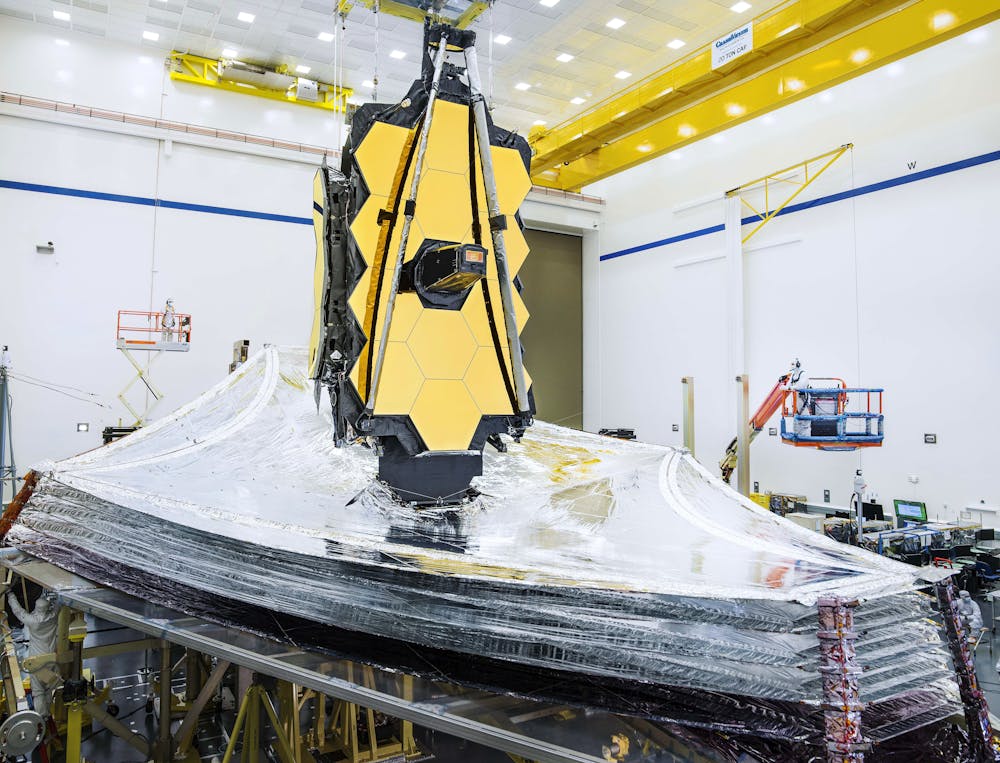
Webb detects infrared light – it is essentially a giant heat telescope. To “see” faint galaxies in infrared light, the telescope needs to be exceptionally cold or else all it would see would be its own infrared radiation. This is where the heat shield comes in. The shield is made of a thin plastic coated with aluminum. It is five layers thick and measures 46.5 feet (17.2 meters) by 69.5 feet (21.2 meters) and will keep the mirror and sensors at minus 390 degrees Fahrenheit (minus 234 Celsius).
The Webb telescope is an incredible feat of engineering, but how does one get such a thing safely to space and guarantee that it will work?
Test and rehearse
The James Webb Space Telescope will orbit a million miles from Earth – about 4,500 times more distant than the International Space Station and much too far to be serviced by astronauts.
Over the past 12 years, the team has tested the telescope and instruments, shaken them to simulate the rocket launch and tested them again. Everything has been cooled and tested under the extreme operating conditions of orbit. I will never forget when my team was in Houston testing the NIRCam using a chamber designed for the Apollo lunar rover. It was the first time that my camera detected light that had bounced off the telescope’s mirror, and we couldn’t have been happier – even though Hurricane Harvey was fighting us outside.
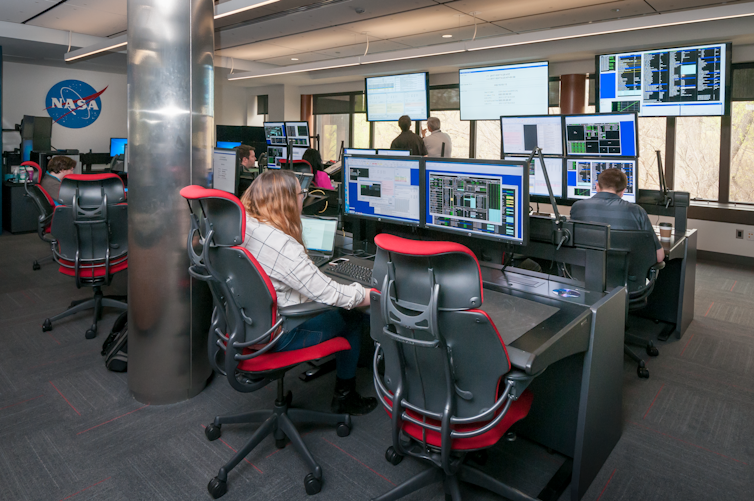
After testing came the rehearsals. The telescope will be controlled remotely by commands sent over a radio link. But because the telescope will be so far away – it takes six seconds for a signal to go one way – there is no real-time control. So for the past three years, my team and I have been going to the Space Telescope Science Institute in Baltimore and running rehearsal missions on a simulator covering everything from launch to routine science operations. The team even has practiced dealing with potential problems that the test organizers throw at us and cutely call “anomalies.”
Some alignment required
The Webb team continued to rehearse and practice until the launch date, but our work is far from done now.
[Understand new developments in science, health and technology, each week. Subscribe to The Conversation’s science newsletter.]
We need to wait 35 days after launch for the parts to cool before beginning alignment. After the mirror unfolds, NIRCam will snap sequences of high-resolution images of the individual mirror segments. The telescope team will analyze the images and tell motors to adjust the segments in steps measured in billionths of a meter. Once the motors move the mirrors into position, we will confirm that telescope alignment is perfect. This task is so mission critical that there are two identical copies of NIRCam on board – if one fails, the other can take over the alignment job.
This alignment and checkout process should take six months. When finished, Webb will begin collecting data. After 20 years of work, astronomers will at last have a telescope able to peer into the farthest, most distant reaches of the universe.
This story was updated with the launch.
Marcia Rieke, Regents Professor of Astronomy, University of Arizona
This article is republished from The Conversation under a Creative Commons license. Read the original article.
Newsom proclaimed a state of emergency in Alameda, Amador, Calaveras, El Dorado, Humboldt, Lake, Los Angeles, Marin, Monterey, Napa, Nevada, Orange, Placer, Sacramento, San Bernardino, San Luis Obispo, San Mateo, Santa Cruz, Sierra and Yuba counties to support the ongoing response to the recent storms, which have included heavy rainfall and snow.
The proclamation notes that, beginning on or about Dec. 10, 16 and 21, “a series of winter storm systems struck California, bringing substantial precipitation, including record-breaking snowfall, damaging winds, and flooding, and storms continue to impact significant portions of the state.”
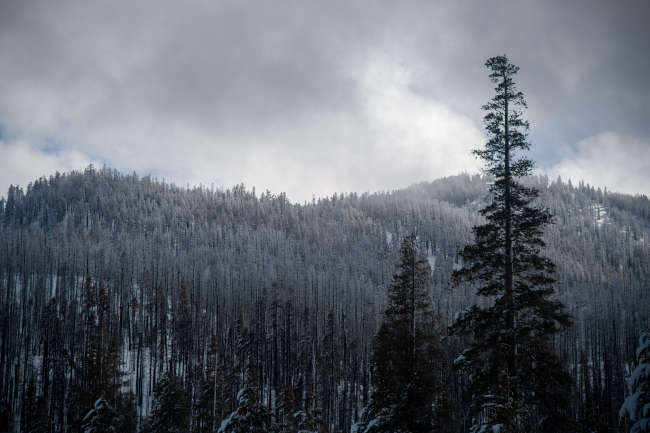
Lake County has not been as hard hit as other areas. While some snow has fallen down to the lake level it quickly melted off. Deeper snowfall has taken place at higher elevations, with the mountains ringing Clear Lake capped with snow on Thursday.
In other parts of the state, the situation has been more severe.
This week, Caltrans urged drivers to avoid traveling to the Sierra due to record snowfall.
Caltrans also has closed 45 state highways since Dec. 24 due to record snowfall in the Sierra Nevada. Most of those highways have reopened although there are areas where chain controls and delays continue.
Newsom’s Thursday emergency proclamation supports response and recovery efforts, including expanding access to state resources for counties under the California Disaster Assistance Act to support their recovery and response efforts, directing Caltrans to request immediate assistance through the Federal Highway Administration's Emergency Relief Program in order to obtain federal assistance for highway repairs or reconstruction, and easing access to unemployment benefits for those unemployed as a result of the storms.
“This order clears regulatory hurdles and increases the states capacity to rapidly respond to the impact of these storms and will bolster long term recovery,” said Mark Ghilarducci, director of the California Governor’s Office of Emergency Services, or Cal OES.
Ghilarducci said the governor activated the State Operations Center to monitor storm conditions and coordinate the states response and support requests for assistance from local governments.
“We are also closely coordinating with and supporting the work of state partners like Caltrans, the California Highway Patrol, Cal Fire and others to rapidly respond to issues as they arise,” he said.
Caltrans has 1,350 field staff clearing mountain highways, working around the clock in 12-hour shifts and has deployed more than 600 snowplows statewide, Ghilarducci said, while the CHP is monitoring road conditions, responding to calls for assistance and working to keep travelers safe.
The state also is working to ensure supply chain continuity and to make sure utility companies restore power as quickly as possible with support to the most vulnerable in the community , he said.
Other efforts include staging fire and rescue resources near burn scar areas in case of significant new weather events, which Ghilarducci said will allow teams to quickly mobilize in the event of mud flows, avalanches or flash floods.
The full proclamation is below.
WHEREAS beginning on or about December 10, 2021, December 16, 2021, and December 21, 2021, a series of winter storm systems struck California, bringing substantial precipitation, including record-breaking snowfall, damaging winds, and flooding, and storms continue to impact significant portions of the state; and
WHEREAS these storms affected communications and other critical infrastructure, resulted in power outages to thousands of households and businesses, and caused trees and free limbs to fall, damaging structures and obstructing major highways and local roads; and
WHEREAS these storms damaged and forced the closure of dozens of major highways and local roads, including primary corridors into the Tahoe Basin; and
WHEREAS these storms have resulted in the threat of mud and debris flows, particularly on burn scars from recent wildfires, necessitating the prepositioning of emergency response resources; and
WHEREAS under the provisions of Government Code section 8558(b), I find that conditions of extreme peril to the safety of persons and property exist due to these storms; and
WHEREAS under the provisions of Government Code section 8558(b), I find that the conditions caused by these storms, by reason of their magnitude and combined impact, are or are likely to be beyond the control of the services, personnel, equipment, and facilities of any single local government and require the combined forces of a mutual aid region or regions to appropriately respond; and
WHEREAS under the provisions of Government Code section 8625(c), I find that local authority is inadequate to cope with the magnitude of the damage caused by these storms; and
WHEREAS under the provisions of Government Code section 8571, I find that strict compliance with various statutes and regulations specified in this Proclamation would prevent, hinder, or delay the mitigation of the effects of these storms.
NOW, THEREFORE, I, GAVIN NEWSOM, Governor of the State of California, in accordance with the authority vested in me by the State Constitution and statutes, including the California Emergency Services Act, and in particular, Government Code section 8625,
HEREBY PROCLAIM A STATE OF EMERGENCY to exist in Alameda, Amador, Calaveras, El Dorado, Humboldt, Lake, Los Angeles, Marin, Monterey, Napa, Nevada, Orange, Placer, Sacramento, San Bernardino, San Luis Obispo, San Mateo, Santa Cruz, Sierra, and Yuba counties due to these storms.
IT IS HEREBY ORDERED THAT:
1. All agencies of the state government utilize and employ state personnel, equipment, and facilities for the performance of any and all activities consistent with the direction of the Office of Emergency Services and the State Emergency Plan. Also, all residents are to obey the direction of emergency officials with regard to this emergency in order to protect their safety
2. The Office of Emergency Services shall provide assistance, if appropriate, under the authority of the California Disaster Assistance Act, Government Code section 8680 et seq., and California Code of Regulations, Title 19, section 2900 et seq.
3. As necessary to assist local governments and for the protection of public health and the environment, state agencies shall enter into contracts to arrange for the procurement of materials, goods, and services necessary to quickly assist with the response to and recovery from the impacts of these storms. Applicable provisions of the Government Code and the Public Contract Code, including but not limited to travel, advertising, and competitive bidding requirements, are suspended to the extent necessary to address the effects of these storms.
4. The provisions of Unemployment Insurance Code section 1253 imposing a one-week waiting period for unemployment insurance applicants are suspended as to all applicants who are unemployed as a direct result of these storms and who applied for unemployment insurance benefits during the time period beginning December 10, 2021 and ending on the close of business on June 21, 2022, and who are otherwise eligible for unemployment insurance benefits.
5. The California Department of Transportation shall formally request immediate assistance through the Federal Highway Administration's Emergency Relief Program, United States Code, Title 23, section 125, in order to obtain federal assistance for highway repairs or reconstruction.
I FURTHER DIRECT that as soon as hereafter possible, this Proclamation be filed in the Office of the Secretary of State and that widespread publicity and notice be given of this proclamation.
IN WITNESS WHEREOF I have hereunto set my hand and caused the Great Seal of the State of California to be affixed this 30th day of December 2021.
GAVIN NEWSOM
Governor of California
ATTEST:
SHIRLEY N. WEBER, PH.D.
Secretary of State
Email Elizabeth Larson at
The CHP is planning its New Year’s maximum enforcement period, or MEP, from 6:01 p.m. on Friday, Dec. 31, through 11:59 p.m. on Sunday, Jan. 2.
The agency also held a maximum enforcement period to ensure road safety over the Christmas weekend, from Friday, Dec. 24, to Sunday, Dec. 26.
Officer Efrain Cortez of the Clear Lake Area CHP office reported that during that Christmas enforcement, 28 people were killed in vehicle crashes throughout California.
Cortez said no fatalities occurred in Lake County over the Christmas weekend.
That's compared to at least 38 people who were killed in crashes throughout the state during the Christmas holiday enforcement period of 2020, Cortez said.
As wet weather and heavy snow continue to cover Northern California, Cortez said the CHP is advising drivers to pay attention to road hazards, Caltrans employees and emergency personnel.
“Please be aware of the road conditions, wear your seat belt, turn on your headlights when your windshield wipers are activated, and please don’t drive while impaired,” he said.
Email Elizabeth Larson at
Dr. Gary Pace said surrounding counties are finding Omicron, which he said “almost certainly is spreading through our community.”
“We anticipate a large climb in cases in the coming weeks, and encourage businesses, schools, and families to prepare for many people testing positive and getting sick. Unvaccinated people are considered especially vulnerable to severe illness,” Pace said Thursday.
Statewide, Pace said there is a rapid increases in cases, with a slower increase in the hospitalizations. Death rates have remained stable.
“The lower proportion of serious illness may be due to Omicron causing milder disease, or simply lag time from catching the virus and having the infection become severe. Hospitals locally and around the state are pretty full, as is often the case this time of year. Further surges in COVID cases could quickly become overwhelming,” Pace said.
Pace said businesses and health care facilities are concerned about staffing. If large numbers of workers get sick and have to isolate, or have to quarantine as a close contact, it can cause real strain.
He urged residents to get vaccinated. “Without a doubt, the best strategy to slow this wave of Omicron-driven COVID-19 infections is to get fully vaccinated and boosted.”
Vaccination with a booster seems to provide good protection from serious illness, as seen in the United States and around the world. Pace said vaccinated people are still getting infected and can be contagious, although at lower rates than unvaccinated people. “The booster offers important additional protection, and everyone who is eligible should get one ASAP.”
In Lake County, Pace said more than one-third of the total population, greater than 20,000 people, have no vaccine-related immunity (residents younger than age 5 remain ineligible to be vaccinated, and 32-33% of those eligible are unvaccinated).
Lake County’s eight regular ICU beds and ongoing shortages in EMS ambulance transport out of county make it particularly vulnerable if large numbers of people get ill at once, Pace said.
Pace said the Health Department, county leaders, healthcare partners, and community organizations are all trying to work together to prepare, in case things get worse.
He encouraged people to wear masks indoors, and to upgrade to KN95 or N95 masks, when possible as Omicron appears especially able to transmit through the air.
In addition, Pace suggested those who are symptomatic or who have come into close contact with an infected person to get tested. Testing resources are available here.
Pace said the county is requesting state resources to help get a van that can be part of providing mobile vaccine sites in the coming weeks.
In other parts of the world, Pace said the Omicron spike rose rapidly, then dropped four to six weeks later.
“We encourage people to take extra precautions in the next few weeks, especially if you are at higher risk or unvaccinated. Hopefully, this wave will pass fairly quickly, and we can return to a more regular lifestyle. Taking some extra steps these next few weeks could be critical in preventing severe outcomes,” Pace said.
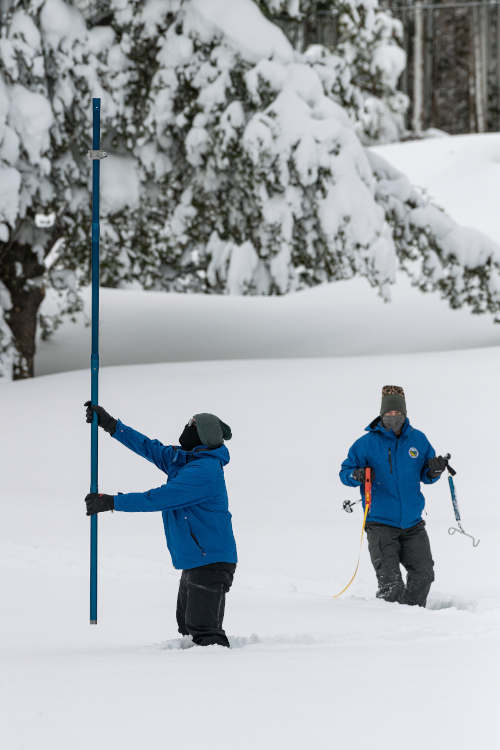
Early winter storms this month provided a strong start to the season and some drought relief, but California remains in a drought.
That was the report from the California Department of Water Resources, which conducted the first snow survey of the season at Phillips Station on Thursday.
Thursday’s manual survey recorded 78.5 inches of snow depth and a snow water equivalent of 20 inches, which is 202 percent of average for this location on this date.
The snow water equivalent measures the amount of water contained in the snowpack and is a key component of DWR’s water supply forecast. Statewide the snowpack is 160 percent of average for this date.
“We could not have asked for a better December in terms of Sierra snow and rain,” said DWR Director Karla Nemeth. “But Californians need to be aware that even these big storms may not refill our major reservoirs during the next few months. We need more storms and average temperatures this winter and spring, and we can’t be sure it’s coming. So, it’s important that we continue to do our part to keep conserving – we will need that water this summer.”
Californians only need to look to last winter and the state’s disappointing snowpack runoff due to high temperatures, dry soil and evaporation as a reminder that changes to our climate mean it will take more than an average year to recover from drought.
“California continues to experience evidence of climate change with bigger swings between wet and dry years and even extreme variability within a season. A wet start to the year doesn’t mean this year will end up above average once it’s all said and done,” said Sean de Guzman, Manager of DWR’s Snow Surveys and Water Supply Forecasting Unit.
December is the first of the three typically wettest months of California’s water year. Significant January and February precipitation would be required to generate enough runoff to make up for the previous two winters that were California’s fifth- and second-driest water years on record.
California has experienced wet Decembers before only to have storms disappear for the remainder of the season.
In 2013, the first snow survey provided promising results after a wet December, similar to this year. However, the following January and February were exceptionally dry, and the year ended as the driest on record, contributing to a record-breaking drought.
On average, the Sierra snowpack supplies about 30 percent of California’s water needs and the snowpack is an important factor in determining how DWR manages the state’s water resources. Its natural ability to store water is why the Sierra snowpack is often referred to as California's “frozen reservoir.”
As spring sets in, the snowpack begins to melt. Water that is not absorbed into the ground, called “runoff,” trickles into mountain streams, which feed rivers and eventually aqueducts and reservoirs, where it can be stored for use throughout the dry season. Climate change is affecting California’s snowpack, as more precipitation falls as rain and less as snow. Excessively dry soils and dry, warm spring temperatures are also reducing yearly runoff.
Due to these climate-induced changes, DWR is investing in partnerships and implementing emerging and proven technologies to improve forecasts of precipitation, seasonal snowpack, and runoff to support more efficient water management now and to help estimate the impacts of climate change on future flood and drought conditions. Forecast improvements and monitoring enhancements increase the reliability of data used to inform water managers about flood risks, allowing opportunities to create more storage in reservoirs ahead of big storms while also ensuring water supply reliability in periods of dry or drought conditions.
DWR conducts five media-oriented snow surveys at Phillips Station each winter near the first of each month from January through April and, if necessary, May.
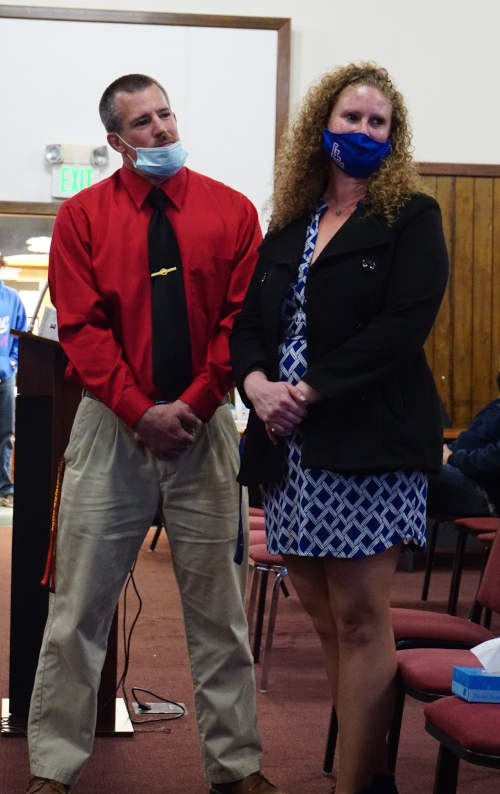
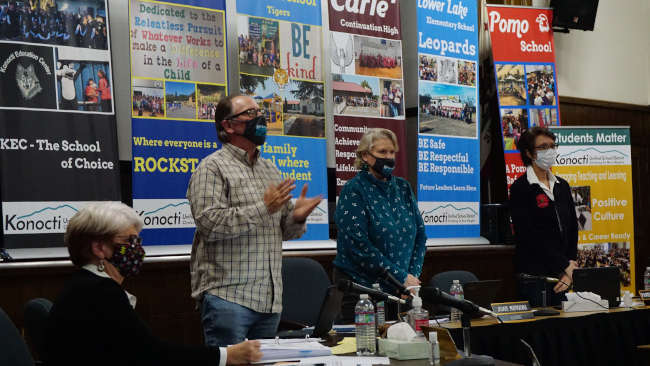
It was during the district’s Dec. 8 board meeting that it formally accepted the resignations of Ed and Sarah Fuchs.
Their last day with the district is this Friday, Dec. 31.
They’ve been in the community for 25 years and said they are excited for the next adventure, which will take them to Wisconsin.
Ed Fuchs is an eighth grade physical education teacher, eighth grade class adviser and boys’ wrestling coach, while his wife has worked as the College and Career Center adviser, testing coordinator and athletic director at Lower Lake High School.
Beginning as an assistant football coach and working up to a PE position, Ed Fuchs said in his resignation letter that he was “beyond grateful to have been able to give back to my community that I grew up in for over 20 years.”
He said the decision to leave wasn’t an easy one. “I will bleed Trojan Blue for as long as I live and I will never forget where I come from,” and he concluded by thanking the board and Superintendent Dr. Becky Salato for the “the greatest opportunity that I have experienced in my life.”
Sarah Fuchs also grew up in the community, graduating from Lower Lake High in 2002 and coming back to work in the district. “Coming to work for Konocti was one of the best decisions I could have made for my career and future,” she wrote in her resignation letter.
They also spoke briefly during the meeting’s public comment portion, and received a standing ovation.
Ed Fuchs said he was “beyond grateful.”
“You’ll be greatly missed. Greatly missed,” said Board member Mary Silva.
During the agenda item in which the board needed to accept personnel changes, including the resignations, Board member Bill Diener thanked the couple, noting the difficulty of losing staff members who are so special to the community and are in the middle of their careers.
“I love both of you,” said Diener, who has worked with Sarah Fuchs and coached with her husband.
He said he’s going to miss them a lot. “I can’t explain how much you’ve done for the community, this district and the students you’ve touched,” noting they’ve touched a lot of students’ lives and changed things for the better.
Despite them moving to Wisconsin, Diener said he will “never, ever” be a Green Bay Packers fan.
Board member Joan Mingori said that as athletic director, Sarah Fuchs didn’t miss games. She also took over ACT and SAT testing.
“You don’t realize how much you have touched the lives of this community,” said Mingori.
The board then voted unanimously to accept the resignations. As they did so, Sarah Fuchs, who had a box of tissue sitting beside her, wiped her eyes.
Salato told them they will never be gone due to the hearts they’ve touched in the community.
“Always remember where you came from,” Silva said.
In her resignation letter, Sarah Fuchs offered her gratitude for opportunities to grow professionally, and to work with incredible co-workers “whose dedication to these students has always been a constant reminder of why we do what we do.”
She said she will be forever grateful to everyone who gave her the chance to make a difference in the lives of students.
She concluded, “How lucky am I to have something that makes saying goodbye so hard?”
Email Elizabeth Larson at