 How to resolve AdBlock issue?
News
NASA’s Parker Solar Probe has taken its first visible light images of the surface of Venus from space.
Smothered in thick clouds, Venus’ surface is usually shrouded from sight. But in two recent flybys of the planet, Parker used its Wide-Field Imager, or WISPR, to image the entire nightside in wavelengths of the visible spectrum – the type of light that the human eye can see – and extending into the near-infrared.
The images, combined into a video, reveal a faint glow from the surface that shows distinctive features like continental regions, plains, and plateaus. A luminescent halo of oxygen in the atmosphere can also be seen surrounding the planet.
“We’re thrilled with the science insights Parker Solar Probe has provided thus far,” said Nicola Fox, division director for the Heliophysics Division at NASA Headquarters. “Parker continues to outperform our expectations, and we are excited that these novel observations taken during our gravity assist maneuver can help advance Venus research in unexpected ways.”
Such images of the planet, often called Earth’s twin, can help scientists learn more about Venus’ surface geology, what minerals might be present there, and the planet’s evolution. Given the similarities between the planets, this information can help scientists on the quest to understand why Venus became inhospitable and Earth became an oasis.
“Venus is the third brightest thing in the sky, but until recently we have not had much information on what the surface looked like because our view of it is blocked by a thick atmosphere,” said Brian Wood, lead author on the new study and physicist at the Naval Research Laboratory in Washington, DC. “Now, we finally are seeing the surface in visible wavelengths for the first time from space.”
Unexpected capabilities
The first WISPR images of Venus were taken in July 2020 as Parker embarked on its third flyby, which the spacecraft uses to bend its orbit closer to the Sun. WISPR was designed to see faint features in the solar atmosphere and wind, and some scientists thought they might be able to use WISPR to image the cloud tops veiling Venus as Parker passed the planet.
“The objective was to measure the speed of the clouds,” said WISPR project scientist Angelos Vourlidas, co-author on the new paper and researcher at Johns Hopkins University Applied Physics Laboratory.
But instead of just seeing clouds, WISPR also saw through to the surface of the planet. The images were so striking that the scientists turned on the cameras again during the fourth pass in February 2021. During the 2021 flyby, the spacecraft’s orbit lined up perfectly for WISPR to image Venus’ nightside in entirety.
“The images and video just blew me away,” Wood said.
Glowing like an iron from the forge
Clouds obstruct most of the visible light coming from Venus’ surface, but the very longest visible wavelengths, which border the near-infrared wavelengths, make it through. On the dayside, this red light gets lost amid the bright sunshine reflected off Venus’ cloud tops, but in the darkness of night, the WISPR cameras were able to pick up this faint glow caused by the incredible heat emanating from the surface.
“The surface of Venus, even on the nightside, is about 860 degrees,” Wood said. “It's so hot that the rocky surface of Venus is visibly glowing, like a piece of iron pulled from a forge.”
As it passed by Venus, WISPR picked up a range of wavelengths from 470 nanometers to 800 nanometers. Some of that light is the near-infrared – wavelengths that we cannot see, but sense as heat – and some is in the visible range, between 380 nanometers and about 750 nanometers.
Venus in a new light
In 1975, the Venera 9 lander sent the first tantalizing glimpses of the surface after landing on Venus. Since then, Venus’ surface has been revealed further with radar and infrared instruments, which can peer through the thick clouds by using wavelengths of light invisible to the human eye.
NASA’s Magellan mission created the first maps in the 1990s using radar and JAXA’s Akatsuki spacecraft gathered infrared images after reaching orbit around Venus in 2016. The new images from Parker add to these findings by extending the observations to red wavelengths at the edge of what we can see.
The WISPR images show features on the Venusian surface, such as the continental region Aphrodite Terra, the Tellus Regio plateau, and the Aino Planitia plains. Since higher altitude regions are about 85 degrees Fahrenheit cooler than lower areas, they show up as dark patches amidst the brighter lowlands. These features can also be seen in previous radar images, such as those taken by Magellan.
Beyond looking at surface features, the new WISPR images will help scientists better understand the geology and mineral make-up of Venus. When heated, materials glow at unique wavelengths.
By combining the new images with previous ones, scientists now have a wider range of wavelengths to study, which can help identify what minerals are on the surface of the planet.
Such techniques have previously been used to study the surface of the Moon. Future missions will continue to expand this range of wavelengths, which will contribute to our understanding of habitable planets.
This information could also help scientists understand the planet’s evolution. While Venus, Earth, and Mars all formed around the same time, they are very different today. The atmosphere on Mars is a fraction of Earth’s while Venus has a much thicker atmosphere.
Scientists suspect volcanism played a role in creating the dense Venusian atmosphere, but more data are needed to know how. The new WISPR images might provide clues about how volcanoes may have affected the planet’s atmosphere.
In addition to the surface glow, the new images show a bright ring around the edge of the planet caused by oxygen atoms emitting light in the atmosphere. Called airglow, this type of light is also present in Earth’s atmosphere, where it’s visible from space and sometimes from the ground at night.
Flyby science
While Parker Solar Probe’s primary goal is solar science, the Venusian flybys are providing exciting opportunities for bonus data that wasn’t expected at the mission’s launch.
WISPR has also imaged Venus’ orbital dust ring – a doughnut-shaped track of microscopic particles strewn in the wake of Venus’ orbit around the Sun – and the FIELDS instrument made direct measurements of radio waves in the Venusian atmosphere, helping scientists understand how the upper atmosphere changes during the Sun’s 11-year cycle of activity.
In December 2021, researchers published new findings about the rediscovery of the comet-like tail of plasma streaming out behind Venus, called a “tail ray”. The new results showed this tail of particles extending nearly 5,000 miles out from the Venusian atmosphere. This tail could be how Venus’ water escaped from the planet, contributing to its current dry and inhospitable environment.
While the geometry of the next two flybys likely won’t allow Parker to image the nightside, scientists will continue to use Parker’s other instruments to study Venus’ space environment. In November 2024, the spacecraft will have a final chance to image the surface on its seventh and final flyby.
The future of Venus research
Parker Solar Probe, which is built and operated by the Johns Hopkins Applied Physics Laboratory in Laurel, Maryland, isn’t the first mission to gather bonus data on flybys, but its recent successes have inspired other missions to turn on their instruments as they pass Venus.
In addition to Parker, the ESA (European Space Agency) BepiColombo mission and the ESA and NASA Solar Orbiter mission have decided to gather data during their flybys in the coming years.
More spacecraft are headed to Venus around the end of this decade with NASA’s DAVINCI and VERITAS missions and ESA’s EnVision mission. These missions will help image and sample Venus’ atmosphere, as well as remap the surface at higher resolution with infrared wavelengths. This information will help scientists determine the surface mineral make-up and better understand the planet’s geologic history.
“By studying the surface and atmosphere of Venus, we hope the upcoming missions will help scientists understand the evolution of Venus and what was responsible for making Venus inhospitable today,” said Lori Glaze, director of the Planetary Science Division at NASA Headquarters. “While both DAVINCI and VERITAS will use primarily near-infrared imaging, Parker’s results have shown the value of imaging a wide range of wavelengths.”
Mara Johnson-Groh works for NASA’s Goddard Space Flight Center in Greenbelt, Maryland.
Sheriff Brian Martin, District Attorney Susan Krones and Chief Deputy District Attorney Richard Hinchcliff spoke to MATH members and fielded questions during the first half of the group’s monthly meeting, held via Zoom.
They were asked to speak to the group, whose members have been concerned about crime in their communities.
One aspect of the discussion involved homelessness. Martin explained that driving factors include mental health, drug and alcohol abuse, high housing costs, voluntariness, domestic violence and lack of family support.
He referenced the 2021 point in time count that found 241 people in Lake County who met the federal definition of homeless, down from 572 the previous year. Of those, 36% self-identified as having chronic health issues, 19% said they receive disability benefits and 227 said they have lived in Lake County for more than five years.
Of that group, 177 people said they were homeless because of Lake County’s wildland fires.
Among those reported to be homeless, Martin said the ages range from 5 months to 94 years old.
Martin also discussed the impacts of prison realignment, which began in 2011. By 2014, county jail populations had skyrocketed and the Lake County Jail capacity, which was rated for 286 inmates, reached its highest level, at more than 400.
He said lawsuits were filed in several counties due to jail overpopulation, and in 2014, 19 of 58 county jail systems were operating under court-ordered population caps.
Martin, Krones and Hinchcliff would fault voter ballot measures such as Proposition 47, the “Safe Neighborhood and Schools Act, passed in 2014, and Proposition 57, passed in 2016, for negatively impacting efforts to reduce crime.
Martin said Proposition 47 reduced a number of felonies to misdemeanors, including property crimes valued at less than $950 — shoplifting, grand theft, receiving stolen property, forgery, fraud and bad checks — as well as personal use of most illegal drugs.
Adding to the challenge are record case backlogs. Martin said many offenders now are failing to even show up for court appearances. Court clerks in Lake County are now adding a notation to case numbers indicating how many times a person has failed to appear in the same case. Martin said one individual has failed to appear eight separate times.
Martin said the 2021 Humphrey decision by the California Supreme Court found that the state's practice of requiring cash bail in most cases is unconstitutional. As a result, courts must now consider all non-monetary alternatives to detention, such as electronic monitoring, check-ins with pretrial case managers, community housing or shelter, stay away orders, and drug and alcohol testing and treatment.
He said courts also must consider a defendant's ability to pay and set bail at the defendant can reasonably pay.
If the court concludes that public or victim safety, or the arrestee's appearance in court, can't be reasonably assured if the individual is released, it may detain them only if it finds clear and convincing evidence that no nonfinancial condition of release can reasonably protect those interests, Martin said.
Martin also discussed the challenges in staffing for his department while at the same time incidents are growing in number.
In 2005, the sheriff's department had 163 employees. Today it has 118, with Martin noting during the discussion that he has 30 vacancies. The sheriff’s office received reports of 39,799 incidents in 2021, of which 5,337 were in the Middletown area.
In reviewing crime statistics for 2021, Martin said he noted that burglaries jumped for some reason in Middletown and Hidden Valley Lake.
Out of the 19 burglaries that occurred in that area, five were in Hidden Valley — three of them took place outside of the gates in the shopping center — and 14 occurred in Middletown.
The Hidden Valley Lake cases included a pharmacy smash-and-grab, a golf cart that was stolen and recovered and appeared to be the work of juveniles — deputies found tracks from “smaller than adult size feet” during the investigation — along with a stolen firearm from a house in which the suspect likely knew the victim, and two construction site burglaries, Martin said.
In one of those construction site burglaries, the victim is not assisting. However, in the second, a suspect has been identified and linked to crimes in the city of Clear Lake. Martin said the property has been recovered and they are awaiting an arrest warrant from the District Attorney's Office.
Regarding the 14 burglaries in the Middletown area, Martin said one of them involved the theft of three bags of pellets from a store, theft of money from a laundromat, a weed eater that was stolen from a storage shed in an apartment complex, money stolen from the closet of a residence, two residential burglaries at homes near Highway 29, a storage container lock that was cut and a weed eater stolen, a suspect arrested for being under the influence and found to have committed a burglary earlier in which he stole a car and a residential burglary in which guns were stolen in the victim is not assisting.
Another residential and community burglary involved a suspect who was arrested and has had seven counts filed against him by the district attorney. However, that suspect, identified by Martin as 29-year-old Luke Parker of Kelseyville, was released from jail and is at large. Martin warned people not to attend to apprehend Parker themselves.
Other burglaries in that group of 14 included one in connection to a domestic violence case, commercial burglaries on Main and one at Crazy Creek Gliders, for which there was a partial property recovery, and a burglary at an antique store, Martin said.
Martin urged community members to secure their property, don't leave items in plain sight, get security cameras, and alarm systems, know their neighbors and get serial numbers of property.
Those with security cameras can join the sheriff’s camera registry program at http://www.lakesheriff.com/Programs/Cameras.htm.
District attorney’s staff discusses law changes
Krones said under the new laws there is no incentive for people to stop stealing.
She said she’s among a group of 27 district attorneys from across the state that have filed an injunction against the California Department of Corrections for an increase to good conduct credits given to prisoners convicted of serious violent felonies.
She said new laws that went into effect in January take away the discretion of judges in sentencing in some situations, requiring them to give the middle terms unless aggravating factors are proved.
Another sentencing guideline involves younger offenders. If an individual is under age 26 when offense committed, the presumptive term is the low term, she said.
“We have an uphill battle to get even to the midterm, even in the most horrendous of offenses,” Krones said.
She also explained the no bail practice, which was implemented for most offenses due to COVID-19. “This has continued for the last two years.”
No bail and the Humphreys decision have added to the problem, with most people now being released or cited. As a result, “We’ve had a lot of failures to appear over the last two years,” Krones said.
Hinchcliff said Proposition 47 has “caused a huge increase in petty thefts in this county and all across the state,” explaining that people can commit repeated crimes with thefts of under $950 and never be prosecuted for a felony.
Hinchcliff, who was raised in Lake County and has been with the District Attorney’s Office for 27 years, said there are many people working in the agency who care about the community and have stayed to serve it.
“We’re doing everything that we can,” but Hinchcliff said their hands have been tied by voters passing bad laws that impact law enforcement.
He outlined the three biggest problems that he thinks need to be addressed to reduce crime:
• There is not enough treatment for people with mental health issues and drugs. He said it’s estimated that more than 90% of homeless individuals who are committing crimes day after day have serious mental health and drug issues.
• People must quit voting for laws that reduce the seriousness of crimes and law enforcement’s ability to arrest and prosecute people. “We need to reverse some of the damage that has been done in the last 15 years” by changing the laws back, Hinchcliff said.
• The District Attorney’s Office needs more staff. After a decade of getting only one 3% raise, the county has found money for raises and Hinchcliff said he hopes it helps. About five years ago, he said the office had 13 trial prosecutors, in addition to him and the district attorney. Now, those 13 have been reduced to eight. At the same time, they have just over half of the four secretary positions they have filled, which can cause case backlogs.
During a question and answer period, community members pressed Martin in particular on what they can do to partner with the sheriff’s office to get more response and presence.
Martin suggested involvement in Neighborhood Watch and volunteering at the sheriff’s office. He also urged them to reach out to their legislators about the tools that have been taken away from law enforcement.
He also fielded complaints about dispatcher responses to callers.
When asked about whether he had enough money to cover his hiring needs, Martin said yes, but added that money isn’t the issue and that if he can’t find the people to hire, the money doesn’t matter.
Email Elizabeth Larson at
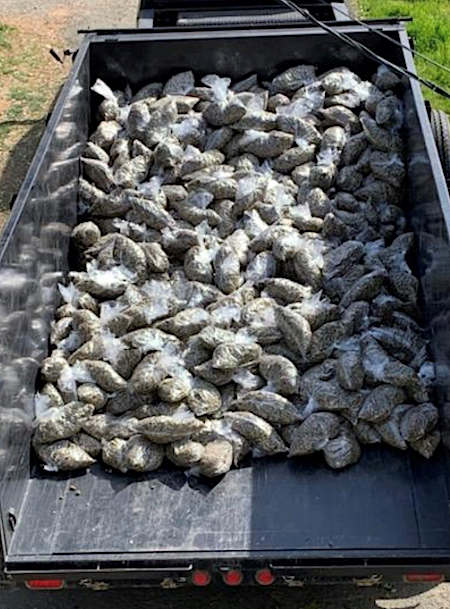
LAKE COUNTY, Calif. — The investigation of a water theft in the Clearlake Oaks area led this week to an arrest and the Lake County Sheriff’s Office’s largest seizure of illegal marijuana, estimated to be worth several million dollars.
On Tuesday, the Lake County Sheriff’s Office Roadmap Task force and the Sheriff’s Office Marijuana Enforcement Unit, conducted an investigation regarding water theft in the area of Henderson Drive.
During their investigation, detectives located three residences used to dry and process marijuana, the sheriff’s office reported.
Authorities said the investigation revealed all three residences were being used to illegally process marijuana for sales and were connected with the reported theft of water.
The sheriff’s office said the residences were secured by detectives and a search warrant for all three residences was obtained and executed late on Tuesday afternoon.
Detectives located and seized a 12 gauge shotgun, 2,326 marijuana plants and approximately 7,600 pounds of processed marijuana, a large majority of which was packaged and ready for sale.
The marijuana is estimated to have an approximate value of $7 million, the sheriff’s office said.
Detectives contacted and detained Salvador Diaz Maciel, 52, at one of the residences. Maciel was subsequently arrested and initially booked at the Lake County Correctional Facility for illegal cultivation and processing of marijuana.
The seizure of 7,600 pounds is the single largest seizure of processed marijuana by the Lake County Sheriff’s Office, to date, the agency reported.
“While licensed cannabis growers struggle to remain compliant with the regulations required of this industry, and further struggle to remain financially viable while dealing with the associated costs, such as fees, permits, and taxes, there continues to be a black market for this product,” said Sheriff Brian Martin.
“Operations such as this one pump large amounts of unregulated and untaxed cannabis into the market,” Martin said. “They avoid the costs that legitimate growers have to encumber by stealing water, avoiding taxes, and not complying with any regulations. These operations adversely impact the legal industry, have negative impacts on the environment, and are frequently the cause of other criminal activity. We will continue our efforts against large scale illegal operations such as this one.”
Anyone with information related to this investigation is asked to contact the Lake County Roadmap Task Force or Lake County Sheriff’s Office Marijuana Enforcement Unit at 707-262-4200.

Congressman Thompson said he worked to secure these investments to create good-paying jobs, improve charger access for California drivers, help protect California’s environment and support American car manufacturers’ rapidly growing EV production.
“Electric vehicles play a vital role in combating climate change and providing a cleaner environment by reducing carbon pollution across the country,” said Thompson. “The EV investments from the Infrastructure Investment and Jobs Act will create good-paying jobs by incentivizing the production of electric vehicles and investing in the expansion of EV charging stations across the country. As more money comes to California from this law, I look forward to ensuring that it is distributed equitably to all of our communities.”
The United States’ network of 100,000 chargers is currently insufficient to service the growing number of EV owners — and also struggles with inconsistent plug types, payment options and data availability.
The Infrastructure Investment and Jobs Act is investing in good-paying union jobs to address these shortcomings, advancing our goal to expand the U.S. network to 500,000 chargers and grow electric vehicle sales to 50 percent of the automobile market by 2030.
Thompson represents California’s Fifth Congressional District, which includes all or part of Contra Costa, Lake, Napa, Solano and Sonoma counties.
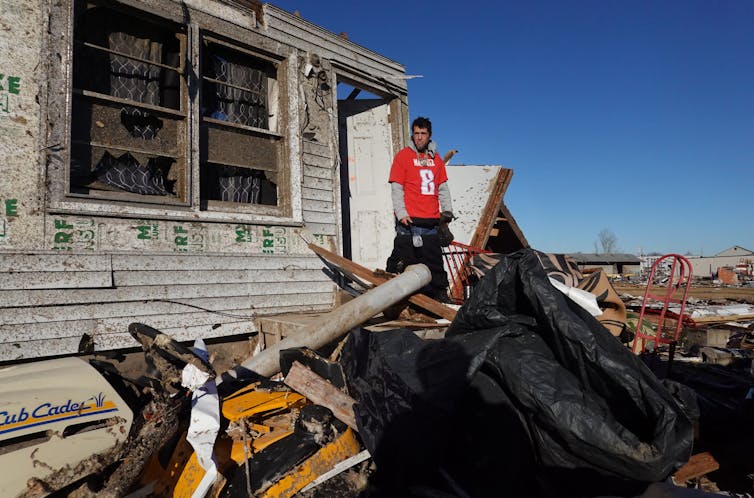
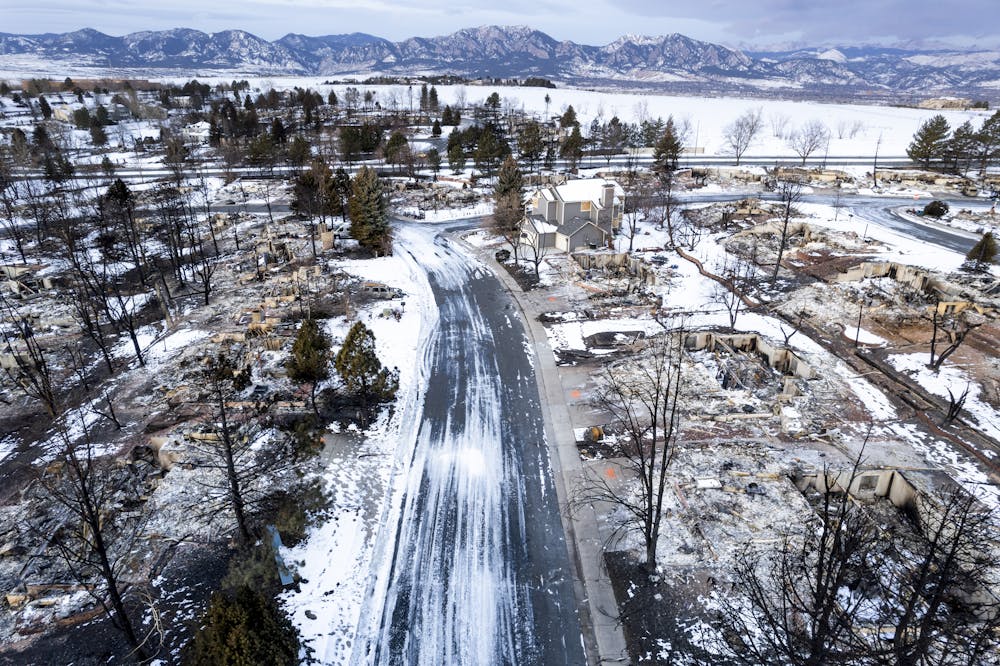
The tornadoes and wildfires that devastated communities from Kentucky to Colorado in the final weeks of 2021 left thousands of people displaced or homeless. For many of them, it will be months if not years before their homes are rebuilt.
That’s especially hard on low-income residents.
As a professor of urban planning, I study the impact of disasters on affordable housing, resilience and recovery. The losses of hundreds of homes in towns across the Midwest and in Boulder County, Colorado, show two sides of that impact and illustrate why communities need to plan now to protect their most vulnerable residents as their towns recover. In doing so, they also protect their economies.
Why low-income households face higher risks
Middle- and low-income households tend to occupy the riskiest homes in communities for a few key reasons.
First, land values tend to be lower in areas that are risky or otherwise less desirable, such as low-lying areas that are known to flood, near toxic facilities or in outlying areas that fail to enforce codes designed to protect homes. The housing that gets built there tends to be more affordable.

Second, as communities grow, older homes become more affordable through a process called “filtering,” where wealthier households move into newer housing, leaving older, more dilapidated homes available for lower-income households. Older homes were often built under less stringent building codes and typically are less-well maintained, which can make them more physically vulnerable.
Third, durable patterns of historical segregation and ongoing discrimination in real estate and lending can compound these problems by limiting Black and Hispanic families’ ability to afford lower-risk neighborhoods.
Research has shown consistently that lower-income households are not only more likely to suffer damage in a natural disaster, but they are more likely to take much longer – two to three times longer – to recover.
Poverty and other household characteristics, such as being headed by a single mother, having racial or ethnic minority status, low levels of education, a disability, or renting rather than owning one’s home, define what researchers call “social vulnerability.”

The location and quality of housing, combined with the vulnerability of residents, means that those most affected by disasters are often those least able to recover from them.
Slow recovery affects the entire community
Communities need to understand that slow recovery for vulnerable households can slow the recovery of the overall community.
Researchers have found that housing recovery is strongly linked to business recovery. Workers need housing so they can return to work, and businesses need workers so they can resume operations.
Rockport, Texas, where Hurricane Harvey made landfall in 2017, offers a cautionary tale. A year after the hurricane, hotels and restaurants – even those that were part of national chains – struggled to reopen for Rockport’s critical tourist season due to the loss of affordable housing for workers. Many of those workers had relocated to San Antonio, two and a half hours away.

Many homes can’t be replaced for the same price
Housing recovery typically gets left to the market. For homeowning households with good insurance, the market works reasonably well. But for lower-income households, including renters, it can be difficult to return to their homes or even their original neighborhoods.
In depressed markets with low-value homes, like many of those impacted by the December tornadoes in Kentucky and the Midwest, replacement values are not enough to rebuild equivalent housing. Home values in these areas may average under US$100,000. It is nearly impossible to build a home for that today.
Hot markets like Boulder County, Colorado, face a different challenge. Rebuilding in those markets allows developers and speculators to take advantage of redevelopment opportunities. Research suggests that affordable housing will almost always be replaced by more expensive housing targeted to a wealthier demographic. And for low-income residents who rent and lose their homes to disasters, there is little chance that they will be able to return to their original development. Little is known about where they end up.
Safety nets exist but are inadequate.
Short-term assistance from FEMA’s Individual Assistance Program helps displaced households find temporary housing and make repairs to homes that qualify. Assistance can also come from Community Development Block Grants from the Department of Housing and Urban Development, but these funds take months and even years to arrive, and spending plans submitted by states often misdirect funds and have almost no oversight.
What can be done?
What then, can be done to ensure vulnerable residents can rebuild and return? A few communities have tried new ideas.
La Grange, Texas, which flooded during Hurricane Harvey in 2017, is experimenting with community land trusts. These involve cooperative ownership of land coupled with individual ownership of units. Residents must occupy the unit for a prescribed period of time and gain only a small percentage of increases in land value, with the rest going to the co-op. This approach allows residents to pool resources for land purchases and maintains affordability over time.
Boulder County relaxed its rental rules to help displaced residents find temporary homes after the fire.
Monitoring recovery funds closely is also important to ensure they help those most in need. Following the 2008 Hurricanes Ike and Dolly, the Texas Low Income Housing Information Service, now called Texas Housers, sued the State of Texas, claiming the state recovery plan failed to address the needs of the most vulnerable Texans. The resulting agreement brought an additional $3 billion in aid, and ongoing monitoring of funding has ensured it helped rebuild hundreds of homes for low-income families.
Nearly every community in the United States is increasingly vulnerable to some kind of natural disaster due to climate change. A Washington Post analysis of federal disaster declarations found that 40% of Americans lived in counties that were hit with extreme climate-related weather in 2021 alone.
Planning disaster recovery to ensure that the most vulnerable members of communities can return will result in greater resilience and community vitality.
[Learn more about disaster recovery and resilience in The Conversation’s climate change webinar with Shannon Van Zandt on Feb. 23, 2022. Register here.]
Shannon Van Zandt, Professor of Architecture and Urban Planning, Texas A&M University
This article is republished from The Conversation under a Creative Commons license. Read the original article.
The Office of Education’s new program, Communities for School Success, was implemented in partnership with Lake County school districts to address the high chronic absenteeism rates in Lake County schools. Chronic absenteeism is defined as missing two or more days of school, excused or unexcused, a month.
Angie DeMaria, a former Teacher at Terrace Middle School in Lakeport, is responsible for the implementation of this program and overseeing a staff of seven attendance liaisons.
An attendance liaison is an individual who works directly with students to find solutions to improve their attendance rates. Each liaison is assigned to a single school district.
Since the start of the 2021-22 school year, the attendance liaisons have reached out to 675 K-12 Lake County students. Of those students contacted, 65% of them showed improvement in their attendance.
“When students improve their attendance rates, they improve their academic prospects and chances for graduating,” said Lake County Superintendent of Schools Brock Falkenberg.
Students who are chronically absent are more likely to be behind in core subjects and drop out of school.
"I had a student that had an attendance rate of 53% in September. I worked with the school to enroll them in an alternate education program. Since enrollment in November, their attendance rate has been 100 percent,” said Attendance Liaison Brianna Kauble.
Barriers that are preventing regular school attendance include trauma, transportation, cultural differences or even students not finding school engaging or fun.
“Upon our first site visit, it was clear that the student had a major disconnect from school,” said another attendance liaison, Reyna Looney. “With incentives in place, the student has not missed a day of school for any reason since the 15th of November.”
Attendance Liaison Natahsa McKenny said COVID-19 has created anxiety and depression for students due to distance learning. Coming back to campus was not an easy transition for them.
“There are two students that stand out the most. Both were having anxiety about being back on campus. They made the decision to transfer to the continuation school. Since the students have made the transfer, they have gone to school every day and seem much happier,” McKenny said.
This Learning Communities for School Success program is a partnership between the Lake County Office of Education and the Lake County school districts and is grant funded through the California Department of Education.
For more information on attendance, visit www.lakecoe.org/Attendance.