When our thoughts turn to the “Big Game” or the championship game of the National Football League, we think food — especially of the snack variety.
Whether we gather around a big-screen TV at home or enjoy a pre-game tailgate party in the stadium’s parking lot, it’s all about the food: chips, popcorn, pretzels, dip, crackers and the like are “Big Game” staples.
How much do we love our snacks around this time of year? The U.S. Census Bureau serves up plenty of data providing a glimpse into our passion for snacks.
We love our snacks
Snack food manufacturing consists of establishments primarily engaged in one or more of the following:
• Salting, roasting, drying, cooking or canning nuts. • Processing grains or seeds into snacks. • Manufacturing peanut butter. • Manufacturing potato chips, corn chips, popped popcorn, pretzels (except soft), pork rinds and similar snacks.
According to the 2019 County Business Patterns (CBP), there were 717 Snack Food Manufacturing establishments in the United States that employed 62,758 paid workers during the pay period including March 12 in 2019.
The CBP shows that the state with the greatest number of snack food manufacturing establishments was California with 141, followed by Texas (59) and Pennsylvania (56).
There are other Census Bureau data sources for snack food manufacturing establishments, too.
According to the 2017 Economic Census, there were 667 establishments in the United States, with 56,516 employees and sales of $38.8 billion in 2017.
More data available on the Manufacturing: Summary Statistics for the U.S., States, and Selected Geographies: 2017.
According to the 2020-2019 Annual Survey of Manufactures (ASM), snack food manufacturing establishments had sales of $40.4 billion in 2020 and $39.6 billion in sales in 2019.
More data available on the Annual Survey of Manufactures: Summary Statistics for Industry Groups and Industries in the U.S.: 2018 - 2020.
Adam Grundy and Tonja White are supervisory statisticians in the Census Bureau’s Economic Management Division.
Exoplanets come in shapes and sizes that are not found in our solar system. These include small gaseous planets called mini-Neptunes and rocky planets several times Earth's mass called super-Earths.
Now, astronomers have identified two different cases of "mini-Neptune" planets that are losing their puffy atmospheres and likely transforming into super-Earths. Radiation from the planets' stars is stripping away their atmospheres, driving the hot gas to escape like steam from a pot of boiling water.
The new findings help paint a picture of how exotic worlds like these form and evolve, and help explain a curious gap in the size distribution of planets found around other stars.
Mini-Neptunes are smaller, denser versions of the planet Neptune in our solar system, and are thought to consist of large rocky cores surrounded by thick blankets of gas. In the new studies, a team of astronomers used NASA's Hubble Space Telescope to look at two mini-Neptunes orbiting HD 63433, a star located 73 light-years away.
And they used the W. M. Keck Observatory in Hawaii to study one of two mini-Neptune planets in the star system called TOI 560, located 103 light-years away.
Their results show that atmospheric gas is escaping from the innermost mini-Neptune in TOI 560, called TOI 560.01 (also known as HD 73583b), and from the outermost mini-Neptune in HD 63433, called HD 63433c. This suggests that they could be turning into super-Earths.
"Most astronomers suspected that young, mini-Neptunes must have evaporating atmospheres," said Michael Zhang, lead author of both studies and a graduate student at Caltech. "But nobody had ever caught one in the process of doing so until now."
The study also found, surprisingly, that the gas around TOI 560.01 was escaping predominantly toward the star.
"This was unexpected, as most models predict that the gas should flow away from the star," said professor of planetary science Heather Knutson of Caltech, Zhang's advisor and a co-author of the study. "We still have a lot to learn about how these outflows work in practice."
New clues to missing link in planetary types
Since the first exoplanets orbiting sun-like stars were discovered in the mid-1990s, thousands of other exoplanets have been found. Many of these orbit close to their stars, and the smaller, rocky ones generally fall into two groups: the mini-Neptunes and super-Earths.
The super-Earths are as large as 1.6 times the size of Earth (and occasionally as large as 1.75 times the size of Earth), while the mini-Neptunes are between 2 and 4 times the size of Earth. Planets of these types are not found in our solar system. In fact, few planets with sizes between these two ranges have been detected around other stars.
One possible explanation for this size-gap is that the mini-Neptunes are transforming into the super-Earths. The mini-Neptunes are theorized to be cocooned by primordial atmospheres made of hydrogen and helium. The hydrogen and helium are left over from the formation of the central star, which is born out of clouds of gas.
If a mini-Neptune is small enough and close enough to its star, stellar X-rays and ultraviolet radiation can strip away its primordial atmosphere over a period of hundreds of millions of years, scientists theorize. This would then leave behind a rocky super-Earth with a substantially smaller diameter (which could, in theory, still retain a relatively thin atmosphere similar to that surrounding our planet Earth).
"A planet in the size-gap would have enough atmosphere to puff up its radius, making it intercept more stellar radiation and thereby enabling fast mass loss," said Zhang. "But the atmosphere is thin enough that it gets lost quickly. This is why a planet wouldn't stay in the gap for long."
Other scenarios could explain the size-gap, according to the astronomers. For instance, the smaller rocky planets might have never gathered gas envelopes in the first place, and mini-Neptunes could be water worlds and not enveloped in hydrogen gas.
This latest discovery of two mini-Neptunes with escaping atmospheres represents the first direct evidence to support the theory that mini-Neptunes are indeed turning into super-Earths.
Signatures in the sunlight
The astronomers were able to detect the escaping atmospheres by watching the mini-Neptunes cross in front of, or transit, their host stars.
The planets cannot be seen directly but when they pass in front of their stars as seen from our point of view on Earth, telescopes can look for absorption of starlight by atoms in the planets' atmospheres.
In the case of the mini-Neptune TOI 560.01, the researchers found signatures of helium. For the star system HD 63433, the team found signatures of hydrogen in the outermost planet they studied, called HD 63433c, but not the inner planet, HD 63433b.
"The inner planet may have already lost its atmosphere," explained Zhang.
"The speed of the gases provides the evidence that the atmospheres are escaping. The observed helium around TOI 560.01 is moving as fast as 20 kilometers per second, while the hydrogen around HD 63433c is moving as fast as 50 kilometers per second. The gravity of these mini-Neptunes is not strong enough to hold on to such fast-moving gas. The extent of the outflows around the planets also indicates escaping atmospheres; the cocoon of gas around TOI 560.01 is at least 3.5 times as large as the radius of the planet, and the cocoon around HD 63433c is at least 12 times the radius of the planet."
The observations also revealed that the gas lost from TOI 560.01 was flowing toward the star. Future observations of other mini-Neptunes should reveal if TOI 560.01 is an anomaly or whether an inward-moving atmospheric outflow is more common.
"As exoplanet scientists, we've learned to expect the unexpected," Knutson said. "These exotic worlds are constantly surprising us with new physics that goes beyond what we observe in our solar system."
The findings are being published in two separate papers in The Astronomical Journal.
The Hubble Space Telescope is a project of international cooperation between NASA and the European Space Agency. NASA's Goddard Space Flight Center in Greenbelt, Maryland, manages the telescope. The Space Telescope Science Institute (STScI) in Baltimore, Maryland, conducts Hubble science operations. STScI is operated for NASA by the Association of Universities for Research in Astronomy in Washington, D.C.
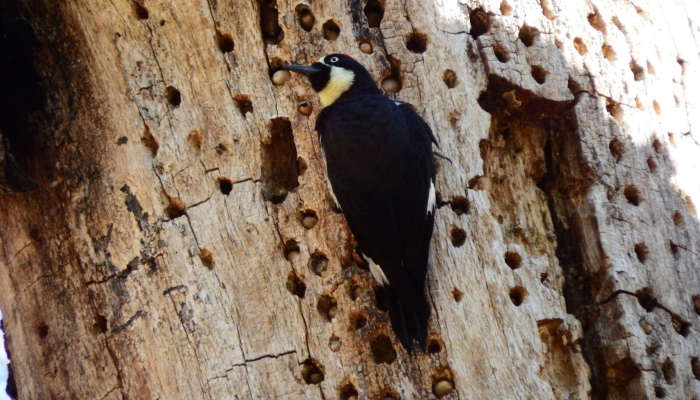
An acorn woodpecker. Photo courtesy of Tuleyome. NORTHERN CALIFORNIA — I grew up believing that food is meant to be shared with family. To my great surprise, my family is not the only one who thinks so.
Among oak woodlands and local parks is the charismatic acorn woodpecker (Melanerpes formicivorus), a social, rowdy and extremely hardworking species of bird.
The acorn woodpecker also is known as the “clown” bird because of its striking facial color pattern, red crown, and yellowish forehead and throat. Its back is black and slightly bluish with pale white eyes. And like a true clown you can hear it clowning around, projecting big laughs and calls to its family.
When they fly they seem to bounce, going up and down imaginary hills in the air until they reach their destination. It usually inhabits oak forests (Quercus spp.), mixed forests with pine (Pinus) and oak, in addition to spruce (Pseudotsuga) and redwood (Sequoia sempervirens) forests.
The acorn woodpecker family is like a small colony, composed of a dozen or more birds. They may be monogamous, polyandrous or polygynous. When caring for young, their parenting style is cooperative — one for all and all for one! They take turns feeding and protecting the family's young.
In mid-fall, acorn woodpecker families are in search of acorns. Acorns are the fruits of oak trees. The acorn is a fruit with a hard shell that protects the seed and is protected by a cup-shaped dome on top. Like everything in nature, they are varied, some elongated, others round.
Oak trees have irregular cycles. In some years they produce many acorns, where the floors of trails and parks are covered with these nuts. In a great year, an oak tree can produce up to 10,000 nuts! But curiously in other years, there is no trace of any.
Most species of woodpeckers typically use their chisel-like beaks to peck trees and build their nests. In the bird world, the acorn woodpecker is the only one that, apart from using its beak to build nests, also uses it to store food. This behavior and great strength help to create holes and store acorns to eat in the winter.
These acorns are collected by and for the whole family. The family cares for and protects the same oak tree that is maintained and used for generations.
Holes are drilled in dry trunks and branches. Dry trees are preferred, as the sap can affect the acorns. One family may drill millions of holes in a single tree. This is known as a granary tree. But the work doesn’t end after the holes are created — the fun is just beginning!
The birds will now have the responsibility of checking that the acorns are not loose. If they are, they are moved to a better fitting hole, because if the acorns get loose, they will be food for other companions — such as the California ground squirrel or the California scrub jay.
Oak trees are not the only places where acorns are stored. These clever birds have adapted to using human-made structures. Holes can be seen in telephone poles, house shingles, virtually any structure made of wood. In some cases, they use natural holes.
And as in any family pantry, food varies. The diet of the acorn woodpecker, in addition to acorns, includes fruits, insects, flowers and sap.
This season, remember that where there’s an oak tree, there’s sure to be an acorn woodpecker. When you least expect it, you will hear the “waka, waka, waka” cackle echoing around. When you hear it, you may not be able to see it, but you will still be able to appreciate what a determined, family bird it is.
Martha Cerda is a naturalist in Pleasanton, a city in the East Bay. She works at a historic park interpreting the local and natural history of the site. In her spare time, she enjoys exploring the endless beauty of nature and connecting with diverse communities. Tuleyome is a Woodland, California-based nonprofit conservation organization.
LAKE COUNTY, Calif. — On Feb. 7, the California Department of Public Health announced modifications to state-mandated COVID-19 precautions, which had been enhanced this winter to slow the spread of the Omicron variant.
Effective Wednesday, Feb. 16, the requirement for all individuals, regardless of vaccination status, to wear masks in all indoor public settings will be lifted.
“Since California’s peak during the Omicron surge, the state has experienced a 65% decrease in case rates,” the California Department of Public Health reported.
State Public Health officials continue to recommend indoor masking “when [COVID-19] risk may be high.” The current hospital census remained “over capacity” at the time of their announcement.
Dr. Gary Pace, who has been acting at interim Public Health officer, advised Lake County residents that masking will still be required for unvaccinated individuals in all indoor public settings.
In addition, all individuals in high risk settings will be required to mask, including on public transit and transportation hubs, indoors in K-12 schools and child care settings, emergency shelters and cooling and heating centers, health care settings, state and local correctional facilities and detention centers, homeless Shelters, and long-term care settings and adult and senior care facilities.
The Board of Supervisors will discuss masking in county facilities on Tuesday, Feb. 15.
COVID-19 risk in Lake County compared to other areas of the state
Pace said Lake County lagged broader statewide trends in entering the Omicron surge.
“While new cases are likewise trending downward here, our case rate remains higher than the statewide rate,” Pace said.
As of Wednesday, Feb. 9, testing positivity sat at 20.0%, more than double the 8.7% Statewide rate.
Pace said COVID-19 remains prevalent in Lake County’s communities, and decreased masking in public settings will bring some increased general risk of transmission.
Lessening of statewide mandates is a sign of positive trends around the state, he said.
“We ask that all Lake County residents remain sensitive to the fact COVID-19 still presents significant risk, particularly to the most medically vulnerable among us,” Pace said.
“Continuing to voluntarily take common sense measures to reduce risk will be important as we work together to navigate this next phase,” Pace added. “Thank you all for your tremendous sacrifices and efforts over the past two years. You have made, and continue to make, a difference.”
Dennis Fordham. Courtesy photo. Being married is significant both for a married person’s lifetime estate planning and subsequent administration of the estate at death. Important rights and responsibilities exist between married persons.
The capacity — or understanding — necessary to be able to marry is low. It is very difficult to invalidate a marriage afterward.
In California, “[t]wo unmarried persons 18 years of age or older, who are not otherwise disqualified, are capable of consenting to and consummating marriage [section 301 Family Code].”
Even a person who is conserved due to being severely incapacitated can marry unless there a court order says otherwise. Unfortunately, predatory persons sometimes marry susceptible persons to take advantage of being married.
Sometimes a person may in good faith believe themselves married when they are not. A so-called, “putative spouse” is someone who is found by a court to have genuinely believed that he or she was legitimately married although the marriage was invalid, void or voidable due to some legal defect affecting the union, e.g., bigamy.
Once married, each spouse owes the other spouse a, “ … duty of the highest good faith and fair dealing … and neither shall take unfair advantage of the other [section 721(b) Family Code].”
Marital earnings are community property and belong equally to both spouses. Anything acquired while married and living together in California is presumed to be community property.
Community property assets are generally liable for the debts of either spouse incurred before or during marriage (Family Code sections 900 et. seq.).
It is possible for the earnings of the non-debtor spouse to become answerable for the premarital debts of the debtor spouse. This is true even if only one spouse is a party to the debt or to the judgment (Family Code section 910(a)).
Two important exceptions exist: First, if a married person puts his or her earnings during marriage (i.e community property) into a separate bank account that their spouse cannot access then these deposited earnings are not liable for the debtor spouse’s debts incurred prior to marriage; and second, the debts of a deceased spouse’s last illness and funeral are chargeable against the deceased spouse’s own estate, i.e., the deceased spouse’s separate property and one-half of the community property estate.
Conversely, a married person’s own separate property is not answerable for their spouse’s own premarital debts or for any marital debts allocated by court order, either at divorce or at death, to their spouse.
If a married person dies intestate, i.e., without a will, the surviving spouse is entitled to inherit all of the couple’s community property and either one-third or one-half of the deceased spouse’s own separate property.
Similarly if a married person dies without having updated their estate planning after getting married, the surviving spouse is presumed to be an unintentionally, “omitted spouse” and so is entitled to an intestate share.
Moreover, if a probate is commenced, a surviving spouse can petition for a probate homestead to be set-aside for the decedent’s surviving spouse and minor children. Probates are generally not used by a spouse to inherit from a deceased spouse’s estate. A so-called “spousal property petition” allows the surviving spouse to claim assets either under the decedent’s will or the laws of intestacy without probate.
In California, pre and post marital agreements allow couples an opportunity to dictate their property rights and legal obligations to each other once married in some important ways. Such agreements require separate representation of each party and full disclosure of each party’s assets and income.
Premarital agreements, for example, can be used to confirm one’s property rights in each party’s separate property and prevent the community estate from gaining an interest in either spouse’s own separate property. It can also address spousal support but cannot address child support.
In sum, marriage creates rights and responsibilities that have affect during life and at death. Estate planning is done with these rights and responsibilities in mind.
The foregoing is a brief discussion of a more complex and broader subject. It is not legal advice. Anyone confronting such issues should consult with a qualified attorney.
Dennis A. Fordham, attorney, is a State Bar-Certified Specialist in estate planning, probate and trust law. His office is at 870 S. Main St., Lakeport, Calif. He can be reached at This email address is being protected from spambots. You need JavaScript enabled to view it. and 707-263-3235.
CLEARLAKE, Calif. — Clearlake Animal Control continues to offer a large number of dogs to new homes.
The City of Clearlake Animal Association also is seeking fosters for the animals waiting to be adopted.
Call the Clearlake Animal Control shelter at 707-273-9440, or email This email address is being protected from spambots. You need JavaScript enabled to view it. to inquire about adoptions and schedule a visit to the shelter.
Visit Clearlake Animal Control on Facebook or on the city’s website.
The newest dogs are listed at the top of the following list.
“Andy.” Photo courtesy of Clearlake Animal Control. ‘Andy’
“Andy” is a male American pit bull mix with a short gray and white coat.
He is dog No. 48995415.
“Annie.” Photo courtesy of Clearlake Animal Control. ‘Annie’
“Annie” is a female Labrador retriever mix with a short black coat.
She is dog No. 49409961.
“Arnold.” Photo courtesy of Clearlake Animal Control. ‘Arnold’
“Arnold” is a male American Staffordshire terrier mix with a short brindle coat with white markings.
He is dog No. 49029348.
“Bear.” Photo courtesy of Clearlake Animal Control. ‘Bear’
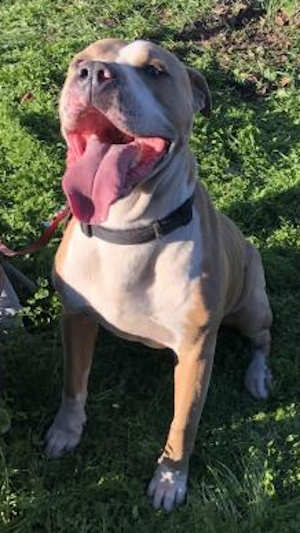
“Bear” is a male Labrador retriever-American pit bull mix with a short charcoal and fawn coat.
“Bear No. 2” is a male American pit bull mix with a short tan coat.
He has been neutered.
He is dog No. 48731556.
“Bella.” Photo courtesy of Clearlake Animal Control. ‘Bella’
“Bella” is a female American pit bull mix with a short gray brindle coat.
She has been spayed.
She is dog No. 48448381.
“Chai.” Photo courtesy of Clearlake Animal Control.‘Chai’
“Chai” is a female Alaskan husky mix with a gray and white coat.
She has been spayed.
She is dog No. 49279552.
“Claire.” Photo courtesy of Clearlake Animal Control. ‘Claire’
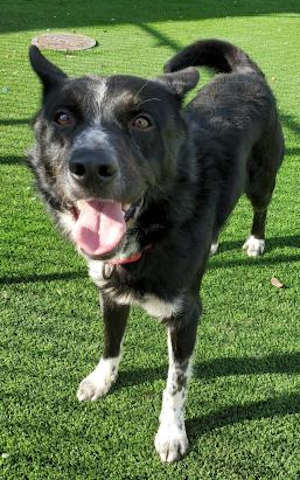
“Claire” is a female border collie mix with a short black and white coat.
She has been spayed.
Claire is dog No. 49397880.
“Ebenezer.” Photo courtesy of Clearlake Animal Control. ‘Ebenezer’
“Ebenezer” is a male American pit bull terrier mix with a short tan and white coat.
He is dog No. 49191651.
“Edgar.” Photo courtesy of Clearlake Animal Control. ‘Edgar’
“Edgar” is a male terrier-American pit bull mix with a black and cream coat.
He has been neutered.
He is dog No. 48634546.
“Fritz.” Photo courtesy of Clearlake Animal Control. ‘Fritz’
“Fritz” is a male Australian shepherd mix with a black and white coat.
He is dog No. 49278179.
“Isabella.” Photo courtesy of Clearlake Animal Control. ‘Isabella’
“Isabella” is a female Chihuahua mix with a short tan coat.
She is dog No. 49292130.
“Jaxx.” Photo courtesy of Clearlake Animal Control. ‘Jaxx’
“Jaxx” is a male Doberman pinscher mix with a black and rust-colored coat.
He has been neutered.
He is dog No. 49022184.
“Levi.” Photo courtesy of Clearlake Animal Control. ‘Levi’
“Levi” is a male golden retriever-Labrador retriever mix.
He has a short golden coat.
He is dog No. 48975687.
“Maria.” Photo courtesy of Clearlake Animal Control. ‘Maria’
“Maria” is a female Shar-Pei mix with a short tan coat.
She is dog No. 49047315.
“Maui.” Photo courtesy of Clearlake Animal Control. ‘Maui’
“Maui” is a male Labrador retriever mix with a short black coat and white markings.
He is dog No. 49334317.
“Nala.” Photo courtesy of Clearlake Animal Control. ‘Nala’
“Nala” is a 1-year-old female German shepherd mix.
She has a medium-length black and tan coat.
She is dog No. 48289638.
“Noodle.” Photo courtesy of Clearlake Animal Control. ‘Noodle’
“Noodle” is a male Alaskan husky mix with a black and white coat.
He is dog No. 49375787.
“Priscilla.” Photo courtesy of Clearlake Animal Control. ‘Priscilla’
“Priscilla” is a female Brittany spaniel mix with a white and copper coat.
She is dog No. 49089138.
“Sassy.” Photo courtesy of Clearlake Animal Control. ‘Sassy’
“Sassy” is a female American pit bull mix with a short black coat.
She has been spayed.
She is dog No. 48443128.
“Snowball.” Photo courtesy of Clearlake Animal Control. ‘Snowball’
“Snowball” is a male American Staffordshire mix terrier with a white coat.
He is dog No. 49159168.
“Terry.” Photo courtesy of Clearlake Animal Control. ‘Terry’
“Terry” is a male shepherd mix with a short brindle coat.
He is dog No. 48443693.
“Turk.” Photo courtesy of Clearlake Animal Control. ‘Turk’
“Turk” is a male chocolate Labrador retriever mix.
He is dog No. 48911836.
Email Elizabeth Larson at This email address is being protected from spambots. You need JavaScript enabled to view it.. Follow her on Twitter, @ERLarson, or Lake County News, @LakeCoNews.
 How to resolve AdBlock issue?