 How to resolve AdBlock issue?
News
Daylight Saving Time begins at 2 a.m. Sunday, March 13.
California goes from Pacific Standard Time to Pacific Daylight Time when clocks “spring forward” by one hour.
Besides adjusting the clock, fire officials urge community members to use the beginning of Daylight Saving Time to remember to change batteries in smoke and carbon monoxide detectors as well as in NOAA weather radios.
This year, Daylight Saving Time ends on Sunday, Nov. 6.
Email Elizabeth Larson at

The world is in the grip of an oil price shock. In just a few months, prices have risen from US$65 a barrel to over $130, causing fuel costs to surge, inflationary pressure to rise and consumer tempers to flare. Even before Russia’s invasion of Ukraine, prices were climbing rapidly because of roaring demand and limited supply growth.
Price shocks aren’t new. Viewed historically, they are an integral part of oil market dynamics, not anomalies. They have occurred since the birth of the industry.
Many factors can trigger oil price shocks. They include large shifts in either demand or supply anywhere in the world, since oil is a global commodity. Shocks can also result from war and revolution; periods of rapid economic growth in major importing nations; and domestic problems in supplier countries, such as political conflict or lack of investment in the oil industry. Overall, the worst spikes have combined two or more of these factors – and that’s the situation today.
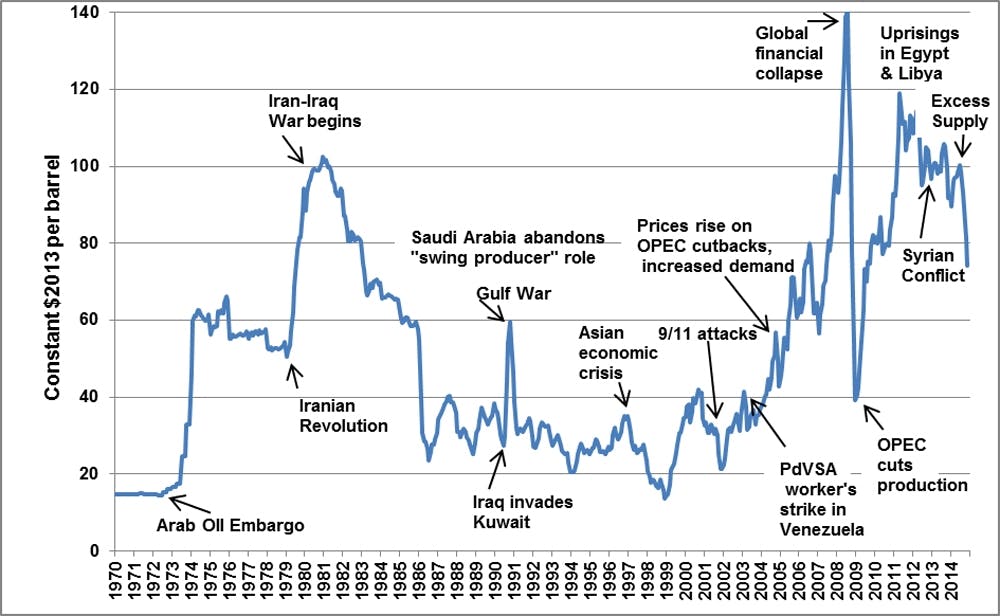
50 years of ups and downs
Global oil production began in the mid-1800s and grew rapidly in the first half of the 20th century. For much of that time, oil majors – companies like Chevron, Amoco and Mobil that were created after the Supreme Court ordered the breakup of Standard Oil in 1911 – operated effectively as a cartel, maintaining production at levels that kept oil abundant and cheap to encourage its consumption.
This ended when Iran, Iraq, Kuwait, Saudi Arabia and Venezuela formed the Organization of Petroleum Exporting Countries in 1960, nationalizing their oil reserves and gaining real supply power. Over the following decades, other nations in the Middle East, Asia, Africa and Latin America joined – some temporarily, others permanently.
In 1973, Arab members of OPEC cut their oil production when Western countries supported Israel in the Yom Kippur War with Egypt and Syria. World oil prices shot up fourfold, from an average of $2.90 per barrel to $11.65.
In response, government leaders in wealthy countries introduced policies to stabilize oil supplies. These included finding more oil, investing in energy research and development, and creating strategic oil reserves that governments could use to mitigate future price shocks.
But six years later, oil prices more than doubled again when Iran’s revolution halted that country’s output. Between mid-1979 and mid-1980, oil rose from $13 per barrel to $34. Over the next several years, a combination of economic recession, replacing oil with natural gas for heating and industry, and shifting to smaller vehicles helped to mitigate oil demand and prices.
The next major shock came in 1990 when Iraq invaded Kuwait. The United Nations imposed an embargo on trade with Iraq and Kuwait, which raised oil prices from $15 per barrel in July 1990 to $42 in October. U.S. and coalition troops moved into Kuwait and defeated the Iraqi army in just a few months. During the campaign, Saudi Arabia increased oil production by more than 3 million barrels per day, roughly the amount previously supplied by Iraq, to help dampen the increase and shorten the period of higher prices.

More disruptive price shocks occurred in 2005-2008 and 2010-2014. The first resulted from increased demand generated by economic growth in China and India. At that time, OPEC was unable to expand production due to long-term lack of investment.
The second shock reflected the impacts of Arab Spring pro-democracy protests in the Middle East and North Africa, combined with conflict in Iraq and international sanctions that Western nations placed on Iran to slow its nuclear weapons program. Together, these events pushed oil prices above $100 per barrel for a four-year stretch – the longest such period on record. Relief finally came via a flood of new oil from shale production in the U.S..
A pefect storm in 2022
Today, multiple factors are raising oil prices. There are three key elements:
-
Oil demand has grown more rapidly than expected in recent months as countries emerged from pandemic lockdowns.
-
OPEC+, a loose partnership between OPEC and Russia, has not raised production at a commensurate level, and neither have U.S. shale oil companies.
-
Countries have drawn on stocks of oil and fuel to fill the supply gap, reducing this emergency cushion to low levels.
These developments have made oil traders worry about looming scarcity. In response, they have bid oil prices up. It’s worth noting that while consumers often blame oil companies (and politicians) for high oil prices, these prices are set by commodity traders in venues such as the New York, London and Singapore stock exchanges.
Against this backdrop, Russia attacked Ukraine on Feb. 24, 2022. Traders saw the potential for sanctions on Russian oil and gas exports and bid energy prices even higher.
Unexpected factors also have emerged. Major oil companies including Shell, BP and ExxonMobil are ending their operations in Russia. Spot market buyers have rejected seaborne Russian crude, probably for fear of sanctions.
And on March 8, the U.S. and U.K. governments announced bans on imports of Russian oil. Neither country is a major Russian buyer, but their actions set a precedent that some analysts and traders fear could lead to escalation, with Russia reducing or eliminating exports to U.S. allies.
In my view, this set of conditions is unprecedented. It reflects not just increased complexity in the global market, but also an imperative for energy firms – which already are under pressure from shareholder climate activists – to avoid further reputational damage and leave one of the most oil-rich countries in the world. Some companies, such as BP, are abandoning assets worth tens of billions of dollars.
What could ease this shock?
As I see it, the key players that can help curtail this price shock are OPEC – mainly, Saudi Arabia – and the U.S. For these entities, holding back oil supply is a choice. However, there’s no evidence yet that they are likely to change their positions.
Restoring the Iran nuclear deal and lifting sanctions on Iranian oil would add oil to the market, though not enough to greatly reduce prices. More output from smaller producers, such as Guyana, Norway, Brazil and Venezuela, would also help. But even combined, these countries can’t match what the Saudis or the U.S. could do to increase supply.
All of these uncertainties make history only a partial guide to this oil shock. Currently there is no way to know how long the factors driving it will last, or whether prices will go higher. This isn’t much comfort to consumers facing higher fuel costs around the world.
[Climate change, AI, vaccines, black holes and much more. Get The Conversation’s best science and health coverage.]
Scott L. Montgomery, Lecturer, Jackson School of International Studies, University of Washington
This article is republished from The Conversation under a Creative Commons license. Read the original article.
What's up for March? Meet the morning planets, the nearest star cluster, and some do-it-yourself exoplanets.
Saturn joins Venus and Mars this month in the morning sky. Beginning around March 18 or 19, early risers may notice Saturn steadily moving toward Mars and Venus each day, to form a trio low in the east before sunrise.
The crescent moon joins the crowd on March 27 and 28. Saturn and Mars are headed toward a super-close meeting at the start of April. (More about that in next month's video.)
Look high in the southwest on March evenings, and you'll find the tall, Y-shaped constellation Taurus, the bull. And at the center of Taurus, forming the bull's face, is a grouping of stars known as the Hyades star cluster. It's the closest open star cluster to our solar system, containing hundreds of stars.
Now, an open cluster is a group of stars that are close together in space and loosely bound together by their mutual gravity. These are stars that formed together around the same time, from the same cloud of dust and gas. Over time they blow away that leftover nebula material and drift apart.
Because of this and their open, or diffuse, structures, they're called "open" clusters. Our own Sun formed in a cluster like this, and studying these structures helps us understand how stars form and evolve.
Another well-known open cluster is the Pleiades, which is also located in Taurus. The Hyades and the Pleiades are actually about the same size, at about 15 or so light-years across. But the Pleiades is about 3 times farther away, so it appears more compact.
You don't need a telescope to find the Hyades. Look for this V-shaped grouping of stars in Taurus. Use the stars of Orion's belt as a handy pointer, leading you to bright orange Aldebaran. (Aldebaran isn't actually part of the star cluster. It's located halfway to the Hyades, and just happens to be visible in the foreground.)
So check out the Hyades in March, where you'll see a handful of stars with the unaided eye, and more than a hundred with binoculars.
March skies contain several easy-to-find, bright stars that are known to have planets of their own orbiting around them. Locate these distant "suns" for yourself and you'll know you're peering directly at another planetary system.
First is Epsilon Tauri, the right eye of Taurus the bull. This orange dwarf star has a gas giant planet around 8 times the mass of Jupiter. Next is 7 Canis Majoris. This is the star at the heart of the dog constellation that contains blazing bright Sirius. This star is known to have two planets: a gas giant nearly twice the mass of Jupiter and another just a little smaller than Jupiter.
Moving on, we find Tau Geminorum, the star at the heart of Castor — northernmost of the twins in Gemini. Tau Geminorum has a huge gas giant planet 20 times the mass of Jupiter in an orbit only slightly larger than that of Earth. And finally, wheeling around to the north, is Beta Ursae Minoris, the brightest star in the bowl of the Little Dipper. This star has a 6-Jupiter-mass planet in orbit around it.
Researchers expect that most stars have a family of planets orbiting them, because forming planets is a natural part of forming stars. And now you know how to find a few of them yourself, no telescope required.
Preston Dyches works for NASA's Jet Propulsion Laboratory.
District 5 Supervisor Jessica Pyska hosted the tree mortality and fire prevention town hall, which was presented by the Lake County Risk Reduction Authority and the Tree Mortality Task Force, the latter created recently in response to the extensive dieoff of so many Lake County trees.
A key presenter on Thursday was Dr. Michael Jones, University of California Cooperative Extension forestry advisory for Lake County and an entomologist, who discussed the county’s conifer mortality.
Jones said this is a forest health issue, explaining that forests are very dynamic systems. “Disturbances are incredibly important in forests,” he said, adding that fire is crucial in the health of our forests.
He suggested thinking about it from two perspectives: ecological, the natural process that leads to sustainable ecological conditions; and utilitarian, the production of forest conditions which directly satisfy human needs.
It’s important to consider how to think about the situation. “It really dictates how we think about managing our forests” and what we do when we have outbreaks, Jones said.
Jones said disturbances can be abiotic, which includes weather, earthquakes, floods, snow, ice mudslides, climate, drought, fire and asteroids, the latter a reference to the Tunguska 1908 incident in Siberia in which an asteroid or meteor leveled a forest.
They also can be biotic, which includes the impacts of humans — historical land management practices, changes in land use, fire suppression and climate change — as well as animals, insects and diseases, Jones said.
Looking at all of the dead trees on the landscape, it’s known that they’re caused by bark beetles and pests. “But it’s really important to remember that insects are a natural disturbance,” Jones explained.
“The insects that we are observing and detecting in this current infestation are all native,” he said.
Those insects serve an important ecological process, helping maintain the dynamic heterogeneity of forest structure. Jones said they also serve as food for wildlife, help cull dead, dying and diseased trees, and are crucial to maintaining the health of systems.
From a utilitarian perspective, they become forest pests because they have economic impacts and are competing for resources, Jones said.
Those insects are always present but a lot of mortality isn’t seen all the time. Disturbances have to align to cause a high level of mortality, and a lot of different factors have to come into play, he said.
Jones is part of an effort to track the landscape-level mortality event from northern Mendocino County, through Lake, Sonoma and Napa counties. “It’s a pretty significant outbreak we're experiencing,” and one they’re comparing to the one that happened in the Sierra a few years ago.
Explaining how the system moves from stressed to dying trees, Jones noted Lake County’s significant years of wildfire and pointed out that wildfire stressed trees are attractive to these beetles and prove to be ideal bark beetle hosts.
He said they feed on dead trees and can complete multiple generations each year. The beetles then spread to other stressed trees and exponentially increase in population as they go.
When they run out of the fire-stressed trees, they move to healthier trees, with the beetles doing a “mass attack” on one tree at a time.
Jones said healthy and vigorous trees can defend against the beetles, pushing them out with sap or pitch. However, if it’s stressed from fire damage, in a dense forest or water stressed due to drought, the tree won’t produce pitch and then the beetles’ feeding eventually kills it.
Outbreaks don’t end from management, Jones said, explaining that the synergistic conditions need to fall apart to stop infestation.
The main insect impacting Lake County’s trees is the western pine beetle, with the ponderosa pine as its host. Jones said it’s typically found in stressed trees and isn’t usually the primary agency of mortality; typically it's the last part of a larger suite of forest health issues.
Other beetles impacting Lake County’s forests include the red turpentine beetle, which is hosted by pines; the ips bark beetle, which targets western pine species; and the flatheaded fir borer, which is hosted by fir and Douglas fir.
Handling bark beetles is a very complicated process that comes down to integrated management. “There’s no one right answer,” Jones said.
Options are thinning, pheromones, insecticides, removing and destroying infested material and planting nonsusceptible hosts. Jones said there are no effective pheromone treatments for the species they’re dealing with and while insecticides work well with bark beetle, they’re reserved for high value trees due to cost.
Once an infestation is established, it can’t be eradicated and the best strategy is to remove and destroy the affected trees, Jones said.
PG&E assessment finds hundreds of dead trees
Pacific Gas and Electric representatives Melinda Rivera and Dan Kida participated in the town hall, giving an update on the company’s midyear patrol of the Cobb Mountain area.
Rivera said they found an exponential number of trees that were dying from drought or beetle kill — more than they’ve found in prior years.
“We are making plans now to mobilize additional tree crews,” Rivera said.
While the company doesn’t usually do wood hauling, due to the unprecedented impact of the dying trees, she said they will offer parcel owners the opportunity to have wood removed this year.
Kida, who works for PG&E in vegetation management, said they recognized that just going through and conducting an annual patrol was not enough to pick up all dead and dying trees.
Now they do an additional patrol six months after the annual patrol and have added enhanced vegetation management, Kida said.
In the Cobb area, Kida said they have identified 750 dead and dying trees, significantly more than forecasted.
The company expects to start tree work in the next week or two. Meantime, Kida said they have enhanced vegetation patrols taking place around Loch Lomond and Middletown.
“We realize this is an unprecedented event,” and they are trying to work quickly to address it, Rivera said.
Rivera said community members wanting more information can call 877-295-4949 or email
More information on PG&E’s work is available here.
Fire chief warns of dry conditions
Paul Duncan, Cal Fire North Division operations chief, gave an update on the weather and fire conditions in Lake County.,
“We have not had significant rain since december. That’s really causing our environment to dry out here,” Duncan said.
He noted there have been several escaped control burns as well as higher fire spread.
“March 10 is really acting like June 10 for burning intensity,” Duncan said.
Duncan said Cal Fire is working to hire its seasonal firefighters by the first part of April.
Resources will be staffed up earlier, and large type one helicopters are going to be based in Sonoma and Napa counties.
Defensible space inspections will be taking place, Lake County County Fire will be working on escape corridors thanks to new grant-funded equipment and they've also been working to increase clearances around communications infrastructure, Duncan reported.
“Just be a good neighbor,” said Duncan, explaining that community safety is really about everybody in the community, not just one person, and it’s important to work on vegetation clearing.
He suggested that people report owners who are not clearing their property of hazardous vegetation should make a complaint to the Community Development Department.
Pyska noted on Thursday night, “A lot is happening. We take this work very seriously.”
Email Elizabeth Larson at

LAKE COUNTY, Calif. — A veteran Lake County Sheriff’s detective is being honored by a statewide organization for his work to investigate sexual assaults.
On Thursday, Det. Todd Dunia was recognized as the California Sexual Assault Investigator’s Association’s Patrick Sullivan Investigator of the Year.
This award is given annually and named after Fresno Police Detective Patrick Sullivan.
Det. Dunia is the 17th California investigator to receive this prestigious award.
The award recognizes Dunia’s professionalism, commitment to his community and his outstanding work in the field of Sexual Assault Investigations.
Det. Dunia has worked for the Lake County Sheriff’s Office for 15 years and has been the agency’s sexual assault investigator for 10 years.
In a Thursday statement, the Lake County Sheriff’s Office said it is proud of Det. Dunia’s achievement and thanked him for his professionalism, commitment to our community and dedication to the victims of sexual assault.
As part of PG&E’s ongoing response to years of drought, hotter temperatures, an increase in bark beetle infestation and sudden oak death, inspectors have increased patrols and tree work to mitigate these hazards.
To address the wood debris stemming from the increased volume in hazardous trees in this specific area, PG&E is offering landowners the opportunity to have the dead trees that PG&E cut down for safety in 2022 removed from their property, provided it is safe to do so.
Because the wood is the landowner’s property, removal of the wood is optional, and landowners must provide written permission to PG&E to have the wood removed.
“We have been listening to our customers. I’ve recently visited the Cobb area to see the tree mortality impact for myself and it’s unprecedented. We have not seen this anywhere else and we are having to fell more than the normal number of trees because of the increased hazard,” said Ron Richardson, regional vice president for PG&E’s North Coast Region. “No other county in California has been hit harder from the effects of wildland fires over recent years than Lake County and we know how damaged trees have impacted the area over the years, but this amount of tree mortality is another level.”
The Lake County Board of Supervisors has also created a Tree Mortality Task Force, in which PG&E has been participating.
“The more trees that PG&E cuts down for safety means our residents and businesses will be seeing more logs and wood on their property. We thank PG&E for deciding to offer residents an option to remove the wood. We want everyone to know that not only are we working with PG&E on different options but other partners as well to address parcels impacted by high tree mortality,” said District 5 Supervisor Jessica Pyska.
Patrols yield high levels of tree mortality
The inspections will mark the second time PG&E has patrolled trees along overhead power lines in Lake County the past year. PG&E uses different color markings and flags, depending whether the tree needs to be pruned or felled.
“We haven’t seen this much Bark Beetle infestation in a specific area of Northern and Central California in several years. During inspections, we typically see about a hundred dead or dying trees in the Cobb area every year, for example. In February alone, we have already identified far more than that,” said James Ash, Supervisor for Vegetation Management in Lake and Sonoma Counties. “This means our customers may have noticed more markings on trees than usual.”
All woody debris less than 4 inches in diameter will be chipped or lopped and scattered according to Forest Practice Rules. Customers will have an option when it comes to where they would like wood chips scattered.
“PG&E must mitigate the threat to the public by felling these dead trees before they have a chance to strike electric facilities and spark an ignition; however, the felled large wood is the property of the homeowner and it’s up to the homeowner to indicate if they would like us to dispose of their asset,” said Ash.
Additional patrols to begin in April
To further mitigate wildfire risk, Enhanced Vegetation Management (EVM) inspections will begin in April in Lake County. This program addresses vegetation that poses a higher potential for wildfire risk in elevated (Tier 2) and extreme (Tier 3) high fire-threat districts (HFTD’s), as identified by the California Public Utilities Commission.
PG&E will remove associated wood at no direct cost to the customer as part of both these programs if it is safely accessible and permitted by the property owner.
Customers who have questions about the Wood Management Program for 2022 tree mortality in Cobb Mountain, please call 1-877-295-4949.