 How to resolve AdBlock issue?
News
Following the completion of critical mirror alignment steps, NASA’s James Webb Space Telescope team expects that Webb’s optical performance will be able to meet or exceed the science goals the observatory was built to achieve.
On March 11, the Webb team completed the stage of alignment known as “fine phasing.” At this key stage in the commissioning of Webb’s Optical Telescope Element, every optical parameter that has been checked and tested is performing at, or above, expectations.
The team also found no critical issues and no measurable contamination or blockages to Webb’s optical path. The observatory is able to successfully gather light from distant objects and deliver it to its instruments without issue.
While the purpose of this image was to focus on the bright star at the center for alignment evaluation, Webb's optics and NIRCam are so sensitive that the galaxies and stars seen in the background show up.
Although there are months to go before Webb ultimately delivers its new view of the cosmos, achieving this milestone means the team is confident that Webb’s first-of-its-kind optical system is working as well as possible.
“More than 20 years ago, the Webb team set out to build the most powerful telescope that anyone has ever put in space and came up with an audacious optical design to meet demanding science goals,” said Thomas Zurbuchen, associate administrator for NASA’s Science Mission Directorate in Washington. “Today we can say that design is going to deliver.”
While some of the largest ground-based telescopes on Earth use segmented primary mirrors, Webb is the first telescope in space to use such a design. The 21-foot, 4-inch (6.5-meter) primary mirror — much too big to fit inside a rocket fairing — is made up of 18 hexagonal, beryllium mirror segments.
It had to be folded up for launch and then unfolded in space before each mirror was adjusted — to within nanometers — to form a single mirror surface.
“In addition to enabling the incredible science that Webb will achieve, the teams that designed, built, tested, launched, and now operate this observatory have pioneered a new way to build space telescopes,” said Lee Feinberg, Webb optical telescope element manager at NASA’s Goddard Space Flight Center in Greenbelt, Maryland.
With the fine phasing stage of the telescope’s alignment complete, the team has now fully aligned Webb’s primary imager, the Near-Infrared Camera, to the observatory’s mirrors.
“We have fully aligned and focused the telescope on a star, and the performance is beating specifications. We are excited about what this means for science,” said Ritva Keski-Kuha, deputy optical telescope element manager for Webb at NASA Goddard. “We now know we have built the right telescope.”
Over the next six weeks, the team will proceed through the remaining alignment steps before final science instrument preparations.
The team will further align the telescope to include the Near-Infrared Spectrograph, Mid-Infrared Instrument, and Near InfraRed Imager and Slitless Spectrograph. In this phase of the process, an algorithm will evaluate the performance of each instrument and then calculate the final corrections needed to achieve a well-aligned telescope across all science instruments.
Following this, Webb’s final alignment step will begin, and the team will adjust any small, residual positioning errors in the mirror segments.
The team is on track to conclude all aspects of Optical Telescope Element alignment by early May, if not sooner, before moving on to approximately two months of science instrument preparations. Webb’s first full-resolution imagery and science data will be released in the summer.
Webb is the world's premier space science observatory and once fully operational, will help solve mysteries in our solar system, look beyond to distant worlds around other stars, and probe the mysterious structures and origins of our universe and our place in it. Webb is an international program led by NASA with its partners at ESA (European Space Agency) and the Canadian Space Agency.
For more information about the Webb mission, visit https://www.nasa.gov/webb.


LAKEPORT, Calif. — A new playground recently opened at Westside Community Park.
This project is the dream of the Lakeport Lions Club and is named the “Lakeport Lions Legacy Playground” in recognition of the group’s vision and support.
The development of the playground was overseen and fundraised by the Westside Community Park Committee, or WCPC.
This $154,000 project was started with substantial seed money from the Lakeport Lions Club.
Additional contributions were received from the Ustrud-Rollins Family, Lake County Tribal Health Consortium, the Habematolel Band of Pomos and Susan King, along with dozens of cash and in-kind contributions from individuals and local small businesses.
The Lakeport Public Works Department partnered with the WCPC to provide trees, planting them and setting up the irrigation system, as well as offering technical assistance throughout the project’s development.
The new playground is seeing daily use by families and their children.
In addition to its daily use, the playground will provide a play space for siblings of children participating in sports leagues run by the Konocti Youth Soccer League and the Westshore Little League at the Westside Community Park.
The playground is in and open to children from around the county. Children have been playing there every day since it opened.
The Westside Community Park Committee would like to complete the landscaping started with support of the Lakeport Public Works Department.
However, funds raised for the development of the playground have been utilized and the WCPC is soliciting donations to add a grass area adjacent to the lion bench and hardscape on the other sides of the play structure area.
Tax-deductible donations to support the completion of the playground can be made to the Westside Community Park Committee, 1350 Berry St., Lakeport, CA 95453.


LAKE COUNTY, Calif. — A Lake County woman with experience in government and business said she is running for the job of county assessor-recorder.
Hannah Lee will challenge incumbent Richard Ford in the June primary.
Lee said part of the reason she’s running is due to the urging of professional acquaintances, business owners and friends.
Lee said her decision to run for assessor-recorder is also influenced by a powerful sense of duty to serve the public efficiently, timely and with utmost respect.
“What I commonly hear is that service is slow, office availability for title companies has been limited for several years, and communication is lacking. These issues impact people directly. Backlogs in assessments, and delays in real estate closings, result in a loss of revenues for the County. I see many opportunities to improve direct services to the public,” Lee said.
The assessor-recorder is responsible for assessing property values for taxation purposes and the security, recording of and access to, legal documents.
The office works hand in hand with the Treasurer-Tax Collector’s Office, the Auditor-Controller’s Office, the Board of Supervisors and other agencies. Communication is essential.
Everyone who files, or has a need to access, legal documents or who owns property — a home or a business — private or commercial, will at some point interact with the Assessor-Recorder’s Office, which affects the public directly.
As a local business owner and deputy public guardian, Lee said she understands that leadership must be responsive to the needs of its customers.
One priority Lee said she will immediately implement is an open-door policy. “It’s important to be receptive to the concerns and input of those who interact with the assessor-recorder. My door will be open.”
High on her long priority list of actions needed include faster turnaround times for accessing legal documents; expanded office hours for title companies to record legal documents; regular and clear communication to constituents — especially about pending changes that impact pocketbooks; fair assessments of property values; eliminating backlogs that can impact revenue streams to the county; instituting electronic recording; modernizing the office; and modifying or eliminating unnecessarily restrictive policies and practices. These will be major changes.
Referring to recent changes of property values resulting in tax increases, Lee said: “I work with people of meager means — people who can ill afford costly surprises to their finances. Surprises in tax bills can be an extreme burden and a shock to those on limited or fixed incomes. People need to be given time to plan for increases, time to adjust personal budgets, and time to seek assistance from families, friends, and support agencies when the costs are too much to bear.”
Most people understand that change needed for years could not happen overnight, but many, it seems, have lost patience.
“I don’t presume to have all the answers, but I bring a unique perspective to government leadership — new energy and a fresh look is certain to reveal opportunities for improvement,” said Lee.
Formerly an analyst in Adult Services, Lee was tasked with conducting efficiency studies, writing policies and procedures, streamlining and automating processes, and making recommendations to managers for improvements to daily operations.
Currently, as a business owner, she supervises employees and is accountable for product delivery, customer service and the financial stability of the business.
Also, as a deputy public guardian, Lee works with a team and is responsible to the courts for her own performance as well as that of her team.
Lee holds a Bachelor of Science degree in management and psychology, and associates degrees in business administration and tax preparation.
She said she understands the regulatory and human side of management and will bring this combined outlook to the job.
The public is invited to join Lee at her campaign kickoff event on Friday, March 25, from 5 to 7 p.m. at 125 N. Main St. in Lakeport. Refreshments will be served.
Lee will take questions and welcomes the opportunity to get input on how the assessor-recorder can better meet the needs of the public.
For more information, visit www.hannahleeforassessorrecorder.com and her campaign Facebook page, Hannah Lee for Assessor-Recorder. She can also be reached by phone at 707-350-3647.

Brace yourselves, allergy suffers – new research shows pollen season is going to get a lot longer and more intense with climate change.
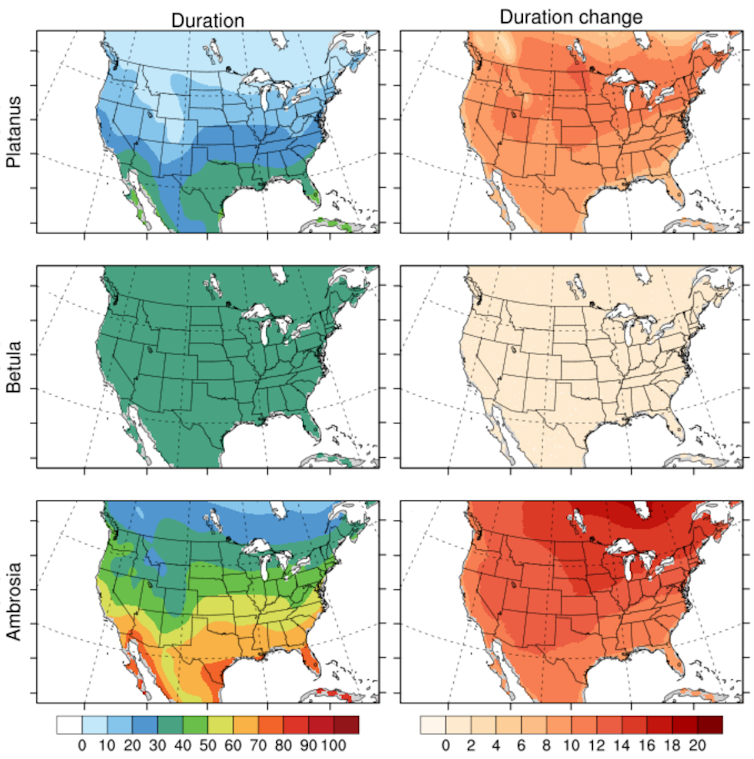
Our latest study finds that the U.S. will face up to a 200% increase in total pollen this century if the world continues producing carbon dioxide emissions from vehicles, power plants and other sources at a high rate. Pollen season in general will start up to 40 days earlier in the spring and last up to 19 days longer than today under that scenario.
As atmospheric scientists, we study how the atmosphere and climate affect trees and plants. While most studies focus on pollen overall, we zoomed in on more than a dozen different types of grasses and trees and how their pollen will affect regions across the U.S. in different ways. For example, species like oak and cypress will give the Northeast the biggest increase, but allergens will be on the rise just about everywhere, with consequences for human health and the economy.
If your head is pounding at just the thought of it, we also have some good news, at least for knowing in advance when pollen waves are coming. We’re working on using the model from this study to develop more accurate local pollen forecasts.
Why pollen is increasing
Let’s start with the basics. Pollen – the dust-like grains produced by grasses and plants – contains the male genetic material for a plant’s reproduction.
How much pollen is produced depends on how the plant grows. Rising global temperatures will boost plant growth in many areas, and that, in turn, will affect pollen production. But temperature is only part of the equation. We found that the bigger driver of the future pollen increase will be rising carbon dioxide emissions.
The higher temperature will extend the growing season, giving plants more time to emit pollen and reproduce. Carbon dioxide, meanwhile, fuels photosynthesis, so plants may grow larger and produce more pollen. We found that carbon dioxide levels may have a much larger impact on pollen increases than temperature in the future.


Pollen changes will vary by region
We looked at 15 different pollen types, rather than treating all pollen the same as many past studies have.
Typically, pollination starts with leafy deciduous trees in late winter and spring. Alder, birch and oak are the three top deciduous trees for causing allergies, though there are others, like mulberry. Then grasses come out in the summer, followed by ragweed in late summer. In the Southeast, evergreen trees like mountain cedar and juniper (in the cypress family) start in January. In Texas, “cedar fever” is the equivalent of hay fever.
We found that in the Northeast, pollen seasons for a lot of allergenic trees will increasingly overlap as temperatures and carbon dioxide emissions rise. For example, it used to be that oak trees would release pollen first, and then birch would pollinate. Now we see more overlap of their pollen seasons.
In general, pollen season will change more in the north than in the south, because of larger temperature increases in northern areas.
Southeastern regions, including Florida, Georgia and South Carolina, can expect large grass and weed pollen increases in the future. The Pacific Northwest is likely to see peak pollen season a month earlier because of the early pollen season of alder.
Silver lining: We can improve pollen forecasting
Most pollen forecasts right now provide a very broad estimate. Part of the problem is that there aren’t many observing stations for pollen counts. Most are run by allergy clinics, and there are less than 100 of these stations distributed across the country. Michigan, where we live, doesn’t have any.
It’s a very labor-intensive process to actually measure different types of pollen. As a result, current forecasts have a lot of uncertainties. These likely are based in part on what a station has observed in the past and the weather forecast.

Our model, if integrated into a forecasting framework, could provide more targeted pollen forecasts across the country.
We can estimate where the trees are from satellite data and on-the-ground surveys. We also know how temperature influences when pollen comes out – what we call the phenology of the pollen. With that information, we can use meteorological factors like wind, relative humidity and precipitation to figure out how much pollen gets into the air, and atmospheric models can show how it moves and blows around, to create a real-time forecast.
All of that information allows us to look at where pollen might be in space and time, so people dealing with allergies will know what’s coming in their area.
We’re currently talking with a National Oceanic and Atmospheric Administration lab about ways to integrate that information into a tool for air quality forecasting.

There are still some unknowns when it comes to long-term pollen projections. For example, scientists don’t fully understand why plants produce more pollen in some years than others. There’s not a good way to include that in models. It’s also not fully clear how plants will respond if carbon dioxide levels go through the roof. Ragweed and residential trees are also hard to capture. There are very few ragweed surveys showing where these plants are growing in the U.S., but that can be improved.
Pollen levels are already on the rise
A study in 2021 found that the overall pollen season was already about 20 days longer in North America than it was in 1990 and pollen concentrations were up about 21%.
Increasing pollen levels in the future will have a much broader impact than a few sniffles and headaches. Seasonal allergies affect about 30% of the population, and they have economic impacts, from health costs to missed working days.
[Over 150,000 readers rely on The Conversation’s newsletters to understand the world. Sign up today.]
Yingxiao Zhang, Ph.D. Student in Atmospheric Science, University of Michigan and Allison L. Steiner, Professor of Atmospheric Science, University of Michigan
This article is republished from The Conversation under a Creative Commons license. Read the original article.
Asteroid 2022 EB5 was too small to pose a hazard to Earth, but its discovery marks the fifth time that any asteroid has been observed before impacting into the atmosphere.
A small asteroid hit Earth’s atmosphere over the Norwegian Sea before disintegrating on March 11, 2022. But this event wasn’t a complete surprise: Astronomers knew it was on a collision course, predicting exactly where and when the impact would happen.
Two hours before the asteroid made impact, K. Sarneczky at the Piszkéstető Observatory in northern Hungary first reported observations of the small object to the Minor Planet Center – the internationally recognized clearinghouse for the position measurements of small celestial bodies.
The object was posted on the Minor Planet Center’s Near-Earth Object Confirmation Page to flag it for additional observations that would confirm it as a previously unknown asteroid.
NASA’s “Scout” impact hazard assessment system then took these early measurements to calculate the trajectory of 2022 EB5.
As soon as Scout determined that 2022 EB5 was going to hit Earth’s atmosphere, the system alerted the Center for Near Earth Object Studies, or CNEOS, and NASA’s Planetary Defense Coordination Office, and flagged the object on the Scout webpage to notify the near-Earth object observing community.
Maintained by CNEOS at NASA’s Jet Propulsion Laboratory in Southern California, Scout automatically searches the Minor Planet Center’s database for possible new short-term impactors.
CNEOS calculates every known near-Earth asteroid orbit to improve impact hazard assessments in support of the Planetary Defense Coordination Office.
“Scout had only 14 observations over 40 minutes from one observatory to work with when it first identified the object as an impactor. We were able to determine the possible impact locations, which initially extended from western Greenland to off the coast of Norway,” said Davide Farnocchia, a navigation engineer at JPL who developed Scout. “As more observatories tracked the asteroid, our calculations of its trajectory and impact location became more precise.”
Scout determined that 2022 EB5 would enter the atmosphere southwest of Jan Mayen, a Norwegian island nearly 300 miles (470 kilometers) off the east coast of Greenland and northeast of Iceland.
At 5:23 p.m. EST (2:23 p.m. PST), 2022 EB5 hit the atmosphere as predicted by Scout, and infrasound detectors have confirmed the impact occurred at the predicted time.
From observations of the asteroid as it approached Earth and the energy measured by infrasound detectors at time of impact, 2022 EB5 is estimated to have been about 6 1/2 feet (2 meters) in size.
Tiny asteroids of this size get bright enough to be detected only in the last few hours before their impact (or before they make a very close approach to Earth). They are much smaller than the objects that the Planetary Defense Coordination Office is tasked by NASA with detecting and warning about.
“Tiny asteroids like 2022 EB5 are numerous, and they impact into the atmosphere quite frequently – roughly every 10 months or so,” said Paul Chodas, the director of CNEOS at JPL. “But very few of these asteroids have actually been detected in space and observed extensively prior to impact, basically because they are very faint until the last few hours, and a survey telescope has to observe just the right spot of sky at the right time for one to be detected.”
A larger asteroid with hazardous impact potential would be discovered much farther from Earth. NASA’s goal is to keep track of such asteroids and to calculate their trajectories in order to have many years’ notice ahead of a potential impact should one ever be identified.
But this real-world event with a very small asteroid allowed the planetary defense community to exercise capabilities and gave some confidence that the impact prediction models at CNEOS are highly capable of informing the response to the potential impact of a larger object.
2022 EB5 is only the fifth small asteroid to be detected in space before hitting Earth’s atmosphere. The first asteroid to be discovered and tracked well before hitting Earth was 2008 TC3, which entered the atmosphere over Sudan and broke up in October 2008. That 13-foot-wide (4-meter-wide) asteroid scattered hundreds of small meteorites over the Nubian Desert. As surveys become more sophisticated and sensitive, more of these harmless objects will be detected before entering the atmosphere.
More information about CNEOS, asteroids, and near-Earth objects can be found at https://cneos.jpl.nasa.gov and https://www.jpl.nasa.gov/asteroid-watch.
For more information about NASA’s Planetary Defense Coordination Office, visit https://www.nasa.gov/planetarydefense.
For asteroid and comet news and updates, follow @AsteroidWatch on Twitter.

LAKE COUNTY, Calif. — Lake County’s administrative officer said Thursday that she is stepping down from her job after six years.
Carol Huchingson’s last day with the county of Lake will be April 29.
She has been county administrative officer since April 2016, and is the first woman to hold the job.
Her office issued a lengthy first person statement from Huchingson on Thursday afternoon in which she promoted what she believed to be her accomplishments.
“I have now made the difficult decision to retire, as of the end of April. When looking back on my career, I am overwhelmingly grateful for all of the people that have invested and believed in me, and for the opportunities I have had to help others grow their skill sets, and rise to meet community needs,” she said.
“When things end, new opportunities present themselves,” Supervisor Bruno Sabatier told Lake County News in response to the announcement. “With County Administrative Officer Huchingson retiring, it will be critical for the board to make wise decisions for the stability and growth of the county, and I look forward to those discussions.”
Huchingson did not specifically explain why she is retiring.
When asked for the actual reason for her departure — which Sabatier indicated was not expected — her chief deputy, Matthew Rothstein, cited her plans to retire after “34 years of intensive and distinguished public service.”
Rothstein said he expected the board was to soon discuss the process moving forward.
Later on Thursday afternoon, the clerk to the Board of Supervisors released next week’s agenda a day early. The agenda includes an untimed action item to consider the recruitment strategy for a new county administrative officer.
By the time of her retirement, Huchingson will have spent 29 years with the county of Lake.
She started with the county in June 1993 and spent 22 years as the Social Services director.
Huchingson also worked for several months as the county’s Valley fire long-term recovery coordinator before the board decided to hire her as county administrative officer in February 2016 from a field of seven candidates. She officially stepped into the role two months later, after the retirement of Matt Perry.
The announcement of Huchingson’s retirement comes days after longtime County Clerk/Auditor-Controller Cathy Saderlund confirmed that she has chosen not to seek reelection.
Huchingson’s friend and colleague Carmel Angelo, the chief executive officer of Mendocino County for the past 12 years, announced her retirement in January. Her last day is March 19.
It also is six months after Huchingson finished pushing through the second wave of county raises during the course of the pandemic. The raises included up to $5 million approved in October 2020 — in which Huchingson received a 30% raise — and another $16 million in September, when her raise totaled 54.5%, plus a 2.5% longevity increase.
Sabatier told Lake County News that he was not anticipating Huchingson to retire at this time, but had known Saderlund had been weighing her final decision up to Friday’s filing deadline. Saderlund told Lake County News that personal decisions over the last month led her to decide to retire at the end of her term.
Huchingson’s departure also comes as county department heads are in the midst of crafting their 2022-23 proposed budgets, which will be presented in the initial form in June and usually are approved as part of the final recommended budget in September.
It’s an effort that has traditionally been guided by the County Administrative Office, with both of Huchingson’s immediate predecessors, Kelly Cox and Matt Perry, having brought extensive knowledge and experience to the budgeting process.
Sabatier acknowledged that the county will have to figure out how to handle budgeting in Huchingson’s
It’s anticipated that Saderlund — whose term expires at the year — will continue to play an important role in that work.
Also still in play is a federal lawsuit filed against the county and Huchingson in July 2020 by Pamela Nichols, the county’s former human resources director.
Nichols is alleging race discrimination, violation of her First Amendment free speech rights, retaliation for exercising free speech, wrongful termination and intentional infliction of emotional distress.
She claims that Huchingson and the county terminated her employment after she exercised her free speech rights “pertaining to matters of public concern, including complaining about discrimination in the workplace.”
The case is set to go to trial in March of 2023, according to federal filings.
The Board of Supervisors had a closed session discussion about the case on Tuesday. County Counsel Anita Grant did not respond to a request for comment about whether there were any actions taken out of that closed session or if there were any additional updates on the case.
Huchingson’s statement on her departure is published below in its entirety.
“It has been my privilege to serve in local government for 34 years, the past 29 with the County of Lake. Over two decades as Social Services Director, I had the opportunity to work with hundreds of incredible people dedicated to serving Lake County residents facing food and housing insecurity, and many deep personal challenges. As Valley Fire Recovery Coordinator, I stood with friends and neighbors as they took their first steps to recover and rebuild. I found great meaning in that work, and continue to value relationships built during that time.
“However, there has been no greater honor than being entrusted by the Board of Supervisors to lead as County Administrative Officer. Since my appointment to the CAO role in 2016, I have worked to promote policies that well serve every resident, and recognize and celebrate the rich diversity of Lake County’s communities.
“When the COVID-19 pandemic brought historic disruption, for example, I fought to ensure local residents had a voice. Lake County was among the first to implement “hybrid” Board meetings, inviting live participation via Zoom, and broadcasting meetings on social media and Lake County PEG TV.
“Leadership means making the best available decisions, whatever challenges may arise. I have always sought to lead with that lens, and take the right action, even when what I was proposing was unpopular.
“It has been a significant focus for me, as CAO, to ensure County employees are valued, recognized for exceptional contributions, and fairly compensated. Some disagreed with recent County decisions to increase employee wages. Those actions positioned us for decades of greater stability and stronger performance throughout our workforce. Our Board’s resolve in taking that on was truly extraordinary.
“I have now made the difficult decision to retire, as of the end of April. When looking back on my career, I am overwhelmingly grateful for all of the people that have invested and believed in me, and for the opportunities I have had to help others grow their skill sets, and rise to meet community needs.
“Thank you, everyone. I look forward to seeing Lake County continue to thrive.”
— Carol J. Huchingson, County Administrative Officer
Email Elizabeth Larson at