 How to resolve AdBlock issue?
News
Call Lake County Animal Care and Control at 707-263-0278 or visit the shelter online for information on visiting or adopting.
The following cats at the shelter have been cleared for adoption.

‘Bruno’
“Bruno” is a young male Siamese with red markings and blue eyes.
He is in kennel No. 255, ID No. LCAC-A-2828.

‘Precious’
“Precious” is a 2-year-old female domestic longhair with a gray and white coat.
She is in cat room kennel No. 103, ID No. LCAC-A-3070.
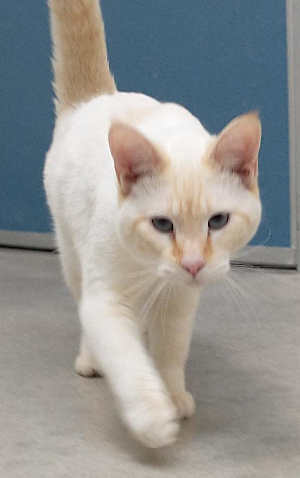
‘Sticks’
“Sticks” is a young male Siamese with red markings and blue eyes.
He is in kennel No. 255, ID No. LCAC-A-2829.
Email Elizabeth Larson at
Forecasters said a fast-moving cold front was expected to bring showers and gusty winds to much of northwest California overnight, with a wetter front to bring steadier rains and gusty winds on Sunday and into Monday night before showers taper off on Tuesday.
Trace amounts of rain were recorded in Lake County on Saturday afternoon, with rain expected overnight.
The forecast for Lake County calls for rain from Sunday through Tuesday, during which time about a quarter inch is expected to fall.
There will be a break for sunny and partly cloudy conditions on Wednesday and Thursday, respectively, forecasters said.
Rain is likely on Friday night and on Saturday, the National Weather Service reported.
Conditions early this week also are expected to include winds with speeds above 10 miles per hour through Tuesday night, forecaster said.
Temperatures this week will range from the low to high 40s at night and the mid 50s to high 60s during the day, the National Weather Service reported.
Email Elizabeth Larson at

As clocks march ahead and daylight saving time begins, there can be anxiety around losing an hour of sleep and how to adjust to this change.
Usually an hour seems like an insignificant amount of time, but even this minimal loss can cause problems. There can be significant health repercussions of this forcible shift in the body clock.
Springing forward is usually harder that falling backward. Why?
The natural internal body clock rhythm in people tends to be slightly longer than 24 hours, which means that every day we tend to delay our sleep schedules. Thus, “springing forward” goes against the body’s natural rhythm. It is similar to a mild case of jet lag caused by traveling east – in which you lose time and have trouble falling asleep at an earlier hour that night.
Even though it’s technically just one hour lost due to the time change, the amount of sleep deprivation due to disrupted sleep rhythm lasts for many days and often throws people off schedule, leading to cumulative sleep loss.
We lead a sleep evaluation center at the University of Pittsburgh Medical Center Children’s Hospital of Pittsburgh and regularly see patients who are dealing with sleep loss and internal clocks that are not synchronized with external time. Our experience has shown us that it’s important to prepare, as much as possible, for the time shift that occurs every spring.

Consequences of sleep loss vary
Many studies have demonstrated that there is an increased risk of heart attack, stroke and high blood pressure associated with sleep deprivation. Workplace injuries increase and so do automobile accidents. Adolescents often find it harder to wake up in time to get to school and may have difficulties with attention and school performance or worsening of mental health problems.
Is there something to be done to help to deal with this loss of sleep and change of body clock timing?
Of course. The first step is increasing awareness and using the power of knowledge to combat this issue. Here are some quick tips to prepare yourself for the upcoming weekend.
-
Do not start with a “sleep debt.” Ensure that you and, if you’re a parent, your child get adequate sleep on a regular basis leading up to the time change each year. Most adults need anywhere from seven to nine hours of sleep daily to perform adequately. Children have varying requirements for sleep depending on their age.
-
Prepare for the time change. Going to bed – and for parents, putting your kids to bed – 15 to 20 minutes earlier each night in the week preceding the time change is ideal. Having an earlier wake time can help you get to sleep earlier. Try to wake up an hour earlier than is customary on Saturday, the day before the time change. If you have not been able to make any changes to your sleep schedule in advance, then keep a very consistent wake time on weekdays as well as weekends to adjust to the time change more easily.
-
Use light to your advantage. Light is the strongest cue for adjusting the internal body clock. Expose yourself to bright light upon waking as you start getting up earlier in the week before daylight saving time. If you live in a place where natural light is limited in the morning after clocks change, use bright artificial light to signal your body clock to wake up earlier. As the season progresses, this will be less of an issue as the sun rises earlier in the day.
-
At night, minimize exposure to bright light and especially the blue light emitted by the screens of electronic media. This light can shift your body rhythm and signal your internal clock to wake up later the next day. If your devices permit, set their screens to dim and emit less blue light in the evening.
-
In some geographic locations, it might be helpful to have room-darkening curtains at bedtime depending on how much sunlight your room gets at bedtime. Be sure to open the curtains in the morning to allow the natural morning light to set your sleep-wake cycle.
-
Carefully plan your day and evening activities. The night before the time change, set yourself up for a good night’s sleep by incorporating relaxing activities that can help you wind down, such as reading a book or meditating.
-
Incorporate exercise in the morning or early in the day. Take a walk, even if it is just around the house or your office during the day.
-
Consider starting with a protein-heavy breakfast, since sleep deprivation can increase appetite and craving for high-carbohydrate foods and sugars.
-
Stop using caffeine after noon. Use of caffeine too late in the day can lead to trouble falling asleep and even disrupted sleep.
-
Adults, decline that wine at bedtime. Wine and other kinds of alcohol can also disturb sleep.
-
If you’re a parent or caregiver, try to be patient with your kids as they adjust to the new times. Sleep deprivation affects the entire family, and some kids have a harder time adjusting to the time change than others. You may notice more frequent meltdowns, irritability and loss of attention and focus. Set aside more quiet, electronic media-free time in the evening. Consider a brief 20-minute nap in the early afternoon for younger children who are having a difficult time dealing with this change.
[Over 150,000 readers rely on The Conversation’s newsletters to understand the world. Sign up today.]
Prioritizing sleep pays off in the short term and over the years. A good night’s sleep is a necessary ingredient for a productive and fulfilling day all year long.
This is an updated version of an article originally published on March 7, 2019.
Deepa Burman, Co-Director Pediatric Sleep Evaluation Center and Associate Professor of Pediatrics, University of Pittsburgh Health Sciences and Hiren Muzumdar, Director of the Pediatric Sleep Evaluation Center, UPMC Children’s Hospital of Pittsburgh, University of Pittsburgh Health Sciences
This article is republished from The Conversation under a Creative Commons license. Read the original article.
Dogs available for adoption this week include mixes of Anatolian shepherd, Australian cattle dog, Australian Kelpie, border collie, Catahoula leopard dog, Chihuahua, German shepherd, Great Pyrenees, husky, Labrador retriever, shepherd and pit bull.
Dogs that are adopted from Lake County Animal Care and Control are either neutered or spayed, microchipped and, if old enough, given a rabies shot and county license before being released to their new owner. License fees do not apply to residents of the cities of Lakeport or Clearlake.
The following dogs at the Lake County Animal Care and Control shelter have been cleared for adoption (additional dogs on the animal control website not listed are still “on hold”).
Call Lake County Animal Care and Control at 707-263-0278 or visit the shelter online for information on visiting or adopting.

‘Barney’
“Barney” is a 3-year-old male retriever with a brown and black coat with white markings.
He is in kennel No. 3, ID No. LCAC-A-2856.

Female German shepherd
This young female German shepherd has a black and tan coat.
She is in kennel No. 5, ID No. LCAC-A-2853.

‘Jasmine’
“Jasmine” is a young female husky with a gray and white coat.
She is in kennel No. 4, ID No. LCAC-A-2850.

Female pit bull mix
This young female pit bull terrier mix has a short brown coat.
She is in kennel No. 8, ID No. LCAC-A-2890.

Female shepherd mix
This 5-year-old female shepherd mix has a tricolor coat.
She was in kennel No. 9, ID No. LCAC-A-2793.

Female shepherd mix
This 7-year-old female shepherd mix has a tricolor coat.
She was in kennel No. 10, ID No. LCAC-A-2792.

‘Jingo’
“Jingo” is a 3-year-old male Labrador retriever with a short black coat.
He is in kennel No. 12, ID No. LCAC-A-2636.

Male Chihuahua
This 3-year-old male Chihuahua has a short tan coat.
He is in kennel No. 13a, ID No. LCAC-A-2992.

Male Chihuahua
This 2-year-old male Chihuahua has a short brown coat.
He is in kennel No. 13b, ID No. LCAC-A-2993.

Female Labrador retriever
This 4-year-old female Labrador retriever has a short black coat.
She is in kennel No. 14, ID No. LCAC-A-2694.

Female German shepherd mix
This 2-year-old female German shepherd mix has a short brown and white coat.
She is in kennel No. 15, ID No. LCAC-A-2812.

‘Spike’
“Spike” is a 2-year-old male German shepherd with a black and tan coat.
He is in kennel No. 17, ID No. LCAC-A-2809.

‘Max’
“Max” is a 4-year-old male Australian Kelpie mix with a black and tan coat with white markings.
She is in kennel No. 18, ID No. LCAC-A-2852.

Female German shepherd
This 2-year-old female German shepherd has a black coat.
She is in kennel No. 19, ID No. LCAC-A-2844.

Female shepherd mix
This 1-year-old female shepherd mix has a short tricolor coat.
She is in kennel No. 20, ID No. LCAC-A-2843.

Male pit bull terrier
This 3-year-old male pit bull terrier has a short tan and white coat.
He is in kennel No. 21, ID No. LCAC-A-2948.

‘Blue’
“Blue” is a 4-year-old female husky with a gray and white coat, and blue eyes.
She is in kennel No. 25, ID No. LCAC-A-2816.

Anatolian shepherd-Great Pyrenees
This 2-year-old male Anatolian shepherd-Great Pyrenees has a short white coat.
He is in kennel No. 26, ID No. LCAC-A-2536.

Female pit bull
This 1-year-old female pit bull has a short black coat.
She is in kennel No. 27, ID No. LCAC-A-2824.

Australian cattle dog
This 1-year-old male Australian cattle dog has a short blue and black coat.
He is in kennel No. 28, ID No. LCAC-A-2754.

‘Marmalade’
“Marmalade” is a 1-year-old female Catahoula leopard dog with a brown brindle coat.
She is in kennel No. 30, ID No. LCAC-A-2823.

‘Bruno’
“Bruno” is a 2-year-old male Catahoula leopard dog with a brown and white coat.
He is in kennel No. 31, ID No. LCAC-A-2825.

Female pit bull terrier
This 2-year-old female pit bull terrier has a short black and white coat.
She is in kennel No. 33, ID No. LCAC-A-3085.
Email Elizabeth Larson at
NASA’s Psyche mission is almost ready for its moment in the Sun — a 1.5-billion-mile solar-powered journey to a mysterious, metal-rich asteroid of the same name.
Twin solar arrays have been attached to the spacecraft body, unfolded lengthwise and then restowed. This test brings the craft that much closer to completion before its August launch.
“Seeing the spacecraft fully assembled for the first time is a huge accomplishment; there’s a lot of pride,” said Brian Bone, who leads assembly, test, and launch operations for the mission at NASA’s Jet Propulsion Laboratory in Southern California. “This is the true fun part. You’re feeling it all come together. You feel the energy change and shift.”
At 800 square feet, the five-panel, cross-shaped solar arrays are the largest ever installed at JPL, which has built many spacecraft over the decades. When the arrays fully deploy in flight, the spacecraft will be about the size of a singles tennis court.
After a 3 ½-year solar-powered cruise, the craft will arrive in 2026 at the asteroid Psyche, which is 173 miles (280 kilometers) at its widest point and thought to be unusually rich in metal. The spacecraft will spend nearly two years making increasingly close orbits of the asteroid to study it.
Venturing to the asteroid belt between Mars and Jupiter, far from the Sun, presents challenges for this mission, which adapted standard Earth-orbiting commercial satellite technology for use in the cold and dark of deep space. Near Earth, the solar arrays generate 21 kilowatts — enough electricity to power three or four average U.S. homes. But at Psyche, they’ll produce only about 2 kilowatts — sufficient for little more than a hair dryer.
The underlying technology isn’t much different from solar panels installed on a home, but Psyche’s are hyper-efficient, lightweight, radiation resistant, and able to provide more power with less sunlight, said Peter Lord, Psyche technical director at Maxar Technologies in Palo Alto, California, where the arrays and solar electric propulsion chassis were built.
“These arrays are designed to work in lowlight conditions, far away from the Sun,” he added.
After the successful installation and deployment of the three center panels inside a clean room at JPL, Psyche’s arrays were folded back against the chassis and stowed for additional spacecraft testing.
The arrays will return to Maxar, which has specialized equipment to test the deployment of the two perpendicular cross panels. Later this spring, the arrays will be reunited with the spacecraft at NASA’s Kennedy Space Center in Florida and stowed for launch from Cape Canaveral.
About an hour after launch, the arrays will deploy and latch into place in a process that will take 7 ½ minutes per wing. They will then provide all the power for the journey to asteroid Psyche, as well as the power needed to operate the science instruments: a magnetometer to measure any magnetic field the asteroid may have, imagers to photograph and map its surface, and spectrometers to reveal the composition of that surface.
The arrays also power the Deep Space Optical Communications technology demonstration that will test high-data-rate laser communications.
What those instruments relay to scientists will help them better understand the mysterious asteroid. One possible explanation for Psyche’s unusually high metal content is that it formed early in our solar system’s history, either as remnant core material from a planetesimal — one of the building blocks of rocky planets — or as primordial material that never melted.
This mission aims to find out, and to help answer fundamental questions about Earth’s own metal core and the formation of our solar system.
Arizona State University leads the Psyche mission. JPL, which is managed for NASA by Caltech in Pasadena, California, is responsible for the mission’s overall management, system engineering, integration and test, and mission operations. Maxar is providing the high-power solar electric propulsion spacecraft chassis. Psyche was selected in 2017 as the 14th mission under NASA’s Discovery Program.
For more information about NASA’s Psyche mission go to http://www.nasa.gov/psyche and https://psyche.asu.edu/.
The California Nurses Association/National Nurses United said the picket in Lakeport will take place at the hospital from 9 to 10:30 a.m. Tuesday, March 15.
“We have been on the front lines before and during this pandemic,” said Amy Erb, critical care RN at California Pacific Medical Center of San Francisco. “Throughout this time, we have witnessed Sutter Health become profitable while they refuse to invest in the resources we need in order for us to provide safe and effective care to our patients and community.”
Nurses notified Sutter Health corporate officials on March 4 that they would hold an informational picket.
The unions said Sutter Health RNs have been in contract negotiations since June 2021 for a new contract with little to no movement on key issues.
The RNs are asking Sutter’s management to invest in nursing staff and agree to a contract that provides safe staffing that allows nurses to provide safe and therapeutic care; pandemic readiness protections that require the hospitals to invest in personal protective equipment stockpiles and comply with California's PPE stockpile law; presumptive eligibility for workers’ compensation that covers infectious diseases and protocols that ensure nurses have the resources needed to keep their patients and themselves safe; and workplace violence protections that include plans to mitigate and prevent violence within the hospitals and comply with the state's workplace violence prevention law.
“Sutter Health is not investing in us, the nurses, or the community they should be serving,” said Renee Waters, RN in the trauma neuro intensive care unit at Sutter Roseville. “Instead, they are frequently using the word ‘commitment’ in their responses to us without actually agreeing to proposals that hold them accountable. Sutter failed us during the pandemic. Our proposals are intended to correct Sutter’s gaps in pandemic readiness and workplace violence prevention. We want to have a proactive approach to the protections we deserve. We need Sutter to back up their statements that we are heroes and valued, with agreements to our proposals at the bargaining table.”