How to resolve AdBlock issue?
Refresh this page
How to resolve AdBlock issue?
Refresh this page
Lake County News,California
  • Home
    • Registration Form
  • News
    • Education
    • Veterans
    • Community
      • Obituaries
      • Letters
      • Commentary
    • Police Logs
    • Business
    • Recreation
    • Health
    • Religion
    • Legals
    • Arts & Life
    • Regional
  • Calendar
  • Contact us
    • FAQs
    • Phones, E-Mail
    • Subscribe
  • Advertise Here
  • Login

News

Thompson, Steube, Panetta, LaMalfa introduce bipartisan bill extending federal disaster tax relief

On Tuesday, Rep. Mike Thompson (D-CA) and Reps. Greg Steube (R-FL), Jimmy Panetta (D-CA), and Doug LaMalfa (R-CA) announced the introduction of the Federal Disaster Tax Relief Act of 2025. 

This bill extends Thompson and Steube’s landmark 2024 law providing tax relief for individuals impacted by federally declared disasters. 

The bill will permit victims to claim disaster-related personal casualty losses without having to itemize deductions through 2026.

"After disaster strikes, survivors face not only the loss of their loved ones, homes, and livelihoods, but they also face the uncertainty of how to begin again," said Rep. Thompson. "In those moments, the last thing a survivor should fear is whether they qualify for tax relief. I am proud to work with my colleagues to expand on our disaster tax relief work and ensure survivors have the certainty and support they deserve."

“Allowing taxpayers to write off damages from natural disasters is a no-brainer. Millions of Floridians have already benefited from my Federal Disaster Tax Relief Act as they rebuild from the last several hurricane seasons. This law provides a much-needed lifeline to families as they navigate the most difficult of times," said Rep. Steube. "I am grateful to partner with Senator Rick Scott to extend this critical part of the federal government's emergency response."

“Families and communities recovering from natural disasters shouldn’t face the added burden of arbitrary deadlines that cut off their access to critical tax relief,” said Rep. Panetta. “Our bipartisan bill extends those deadlines and ensures that wildfire relief payments and hurricane losses continue to qualify for fair tax treatment.  By providing this certainty, we can give disaster-impacted Americans the time and tools they need to rebuild and move forward.”

“Families who lose their homes and livelihoods in a wildfire shouldn’t be hit with the possibility of a tax bill on their equity affecting the very payments meant to help them recover," said Rep. LaMalfa. "This bill ensures disaster relief is treated fairly and victims aren’t left fighting with the IRS on top of other challenges they may face. I'm pleased to join Congressman Steube in leading it.”

Rep. Thompson, who represents Lake County, serves as the Ranking Member of the Subcommittee on Tax for the Ways and Means Committee. 

He introduced the original legislation with Rep. Doug LaMalfa in the House of Representatives to provide tax relief to PG&E fire victims in the 117th Congress and worked with Sen. Padilla and Rep. LaMalfa to advance the legislation.

Last year, Rep. Thompson and Rep. Steube led a bipartisan group of 218 Members of Congress to successfully advance a discharge petition which forced House Speaker Mike Johnson to bring the Federal Disaster Tax Relief Act of 2023 to the House floor for a vote. 

The historic advancement of Rep. Thompson and Rep. Steube’s petition marked only the third time a House discharge petition had succeeded in the 21st Century. 

H.R. 5863 passed the Senate by unanimous consent and was signed into law by President Joe Biden in December of 2024.

Tuesday’s legislation would build upon this landmark law. Read the full bill here.

Facing a shutdown, budget negotiations are much harder because Congress has given Trump power to cut spending through ‘rescission’

Will Congress keep the government running? Phil Roeder/Getty Images

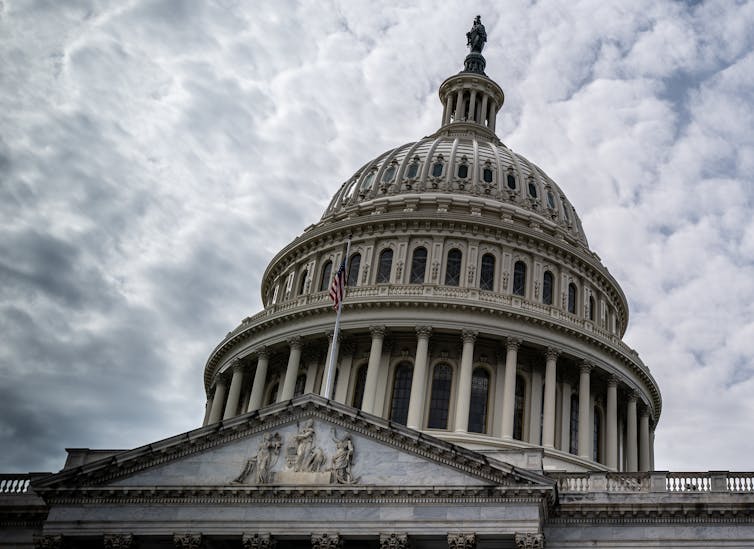
Congress faces a deadline of Oct. 1 to adopt a spending measure to keep the federal government open. Various reporters will be interviewing serious people saying serious things in the basement corridors of the U.S. Capitol. There will also be political posturing, misrepresentation and either braggadocio or evasion. Politics editor Naomi Schalit interviewed congressional expert Charlie Hunt, a political scientist at Boise State University, about the now-perennial drama over spending in Congress and what’s very different about this year’s conflict.

In the past, how did Congress pass budgets so that government could keep operating?

Typically, you would get an actual passage of a full budget for a year. But in the last 20 or 30 years or so, since we’ve become a more polarized country with a polarized Congress, we have a lot of what are called continuing resolutions, or CRs.They’re stopgap measures – not the full budget – and don’t tend to make a lot of changes on a lot of the spending priorities that Congress has.

Continuing resolutions usually just extend current levels of spending for a short time so that the two parties can continue negotiating. But as negotiations over long-term budgets have tended to fail more and more, these CR’s are becoming more common, and Congress almost never passes a full budget on a yearly basis at this point.

A bunch of people in office clothes, crowded around something in a hallway.
You’ll be seeing a lot of this sort of scrum – reporters interviewing members of Congress – as spending gets wrangled over. Matt McClain/The Washington Post via Getty Images

What’s the role of the president here?

The president has the power to veto any piece of legislation, and that includes the federal budget. Essentially, what majorities in Congress need when they are going into a budget fight is either the president’s implicit sign-off on whatever they pass, or they need enough votes to override the president’s veto.

Congress and the presidency right now are both held by Republicans, they’re in pretty deep alignment, so that’s not as much of a concern this time. It’s really just what Trump wants that needs to be a part of this legislation, and if there’s something in it that he really doesn’t like, then Congress needs to go back to the drawing board and the Republicans need to find out a way to get that into the bill.

What is driving each party in these negotiations?

Two different things are at work here. One is that Congress, as I mentioned, is really polarized. The two parties are farther apart from each other than they used to be. So the average Democrat and the average Republican aren’t going to agree as much on policy priorities and funding priorities than they did, say, in the 1980s or 1970s or before that.

The other thing is that Congress in recent decades has been more closely divided than they have been in the recent past, say, the last century. In both chambers, House and Senate, it’s very rare for one party or the other to have some massive majority. You need a majority of 60 in the Senate to have a chance at passing most legislation, for example, and this big a majority hasn’t happened since 2009. That’s something President Obama enjoyed with the Democrats for just a short period of time.

Since then, there have been very closely divided chambers in Congress, and that means that you need, at least in the Senate, some bipartisanship in order to pass that 60-vote threshold to break a filibuster. That’s what’s really gumming up the works right now. Democrats don’t feel like they’re being included in negotiations, and so they’re not likely to agree to a Republican-only budget in the Senate.

A man in a suit and wearing glasses, surrounded by reporters with mobile phones used to record him.
Speaker of the House Mike Johnson, a Republican from Louisiana, has been key to rallying House Republicans behind a stopgap funding bill to avert a shutdown. Kent Nishimura/Getty Images

What is different about the 2025 budget fight than previous ones?

A lot of the dynamics are still the same. You still have partisan fighting. And you still have some divides within the two parties that I think are worth mentioning. One example: There was a Senate vote just the other day on one of these budget resolutions, and a couple of Republicans voted with the Democrats. So for some of these more deficit-hawk Republicans, that concern is still playing a role.

What’s new this time around is this element of rescissions. This is a tool that’s been available since the 1970s in which presidents ask Congress to rescind spending that they had allocated. This is what happened earlier this year with the rescissions on public broadcasting – NPR and PBS – that got a lot of attention, as well as on USAID. Trump said he wanted to cut funding for public broadcasting – the GOP in the Senate and House voted to let him. They didn’t need 60 votes in the Senate for a rescission, either. Just a majority for this move.

So in this case, Democrats are looking at this and thinking, “Why should we negotiate, if you’re just going to rescind that later on without our consent?” That’s a major element that’s changed. While it’s a power that has been in place for a while, Trump and the Republicans have been really willing to wield that.

Do you see this rescission power being exercised with every budget or continuing resolution that Congress passes?

This is a pretty serious breach of what we call Congress’ “power of the purse.” That spending power is set out in Article 1 of the Constitution. It is a key power, maybe their most important power and point of leverage they have in going back and forth with the president and making sure the executive branch doesn’t accrue too much power.

But if this rescission authority is going to be used in this way going forward, where basically any spending priority that the president doesn’t want or doesn’t want to fund is going to be subject to rescission, then Congress doesn’t really have the power of the purse, right? They have a president who is going to veto anything that doesn’t live up to their expectations, or they can just sign it and then ask for these rescissions later.

The key thing here is that President Trump currently has in Congress a set of Republicans in both the House and the Senate who are willing to do virtually anything he wants and are subject to a lot of the political pressures in their districts that put him in office in the first place. So if they don’t go along with rescissions, they’re going to face the wrath of their Republican voters in their district.

That’s one thing that’s really changed in the last 30 years that I think gives the president a lot more authority in these matters, and makes rescission such a powerful tool that did not exist before.The Conversation

Charlie Hunt, Associate Professor of Political Science, Boise State University

This article is republished from The Conversation under a Creative Commons license. Read the original article.

Sheriff’s office identifies homicide victim; investigation continuing

LAKE COUNTY, Calif. — The Lake County Sheriff’s Office on Tuesday identified a Lower Lake man who authorities said was murdered last week in Lower Lake. 

The homicide victim is Luis Padilla Pina, 25, said sheriff’s spokesperson Lauren Berlinn.

At 7 a.m. Friday deputies responded to the 12000 block of South State Highway 29 in Lower Lake following a report of a possible home invasion, as Lake County News has reported.

When they entered the residence, they found Padilla Pina’s body, the sheriff’s office said.

Since then, Berlinn said sheriff’s detectives have confirmed that the case is a homicide investigation.  

“At this time, the incident appears to be isolated to the parties involved,” Berlinn said.

“The investigation remains active and ongoing as detectives work to determine the circumstances surrounding this incident and identify those responsible,” she added.

Berlinn said additional information will be released as the investigation continues and as details become available.

Anyone with information related to this incident is encouraged to contact Lake County Sheriff’s Office Dispatch at 707-263-2690.

Email Elizabeth Larson at This email address is being protected from spambots. You need JavaScript enabled to view it.. Follow her on Twitter, @ERLarson, and on Bluesky, @erlarson.bsky.social. Find Lake County News on the following platforms: Facebook, @LakeCoNews; X, @LakeCoNews; Threads, @lakeconews, and on Bluesky, @lakeconews.bsky.social. 

Lake County officials challenge PG&E’s claims about Potter Valley Project’s seismic safety

LAKE COUNTY, Calif. — There was another development on Monday in the county of Lake’s ongoing effort to push back against Pacific Gas and Electric’s effort to remove the dams in the Potter Valley Project, including the Scott Dam that forms Lake Pillsbury, a plan the Board of Supervisors chair called “reckless.”

County officials issued a Monday statement that challenged PG&E’s recent assertions that a reason for decommissioning and removing the project was due to seismic issues.

The Potter Valley Project, which PG&E has owned since 1930, is located in Lake and Mendocino counties. 

The project consists of the Scott Dam and the Cape Horn Dam, both of which are located on the upper main stem of the Eel River, as well as the Potter Valley powerhouse, the 80,000-acre-foot Lake Pillsbury in Lake County, the Van Arsdale Reservoir, a fish passage structure and salmon and steelhead counting station at the Cape Horn Dam, and and 5,600 acres of land.

The Scott Dam diverts water from the Eel River to the Russian River, which county officials said sustains agriculture, contains critical water for fire suppression, aids local economies
and provides water supplies to property owners from Mendocino to Marin counties. 

In 2017, PG&E announced it would auction off the project the following year, and since then the project has moved forward over the objections of the Lake County government and the Lake Pillsbury community. 

In that time, PG&E has gathered allies for the decommissioning around the North Coast, including counties, cities and tribes in line to get water and monetary benefits from a “two basin solution,” a plan that includes adding new diversions and increasing storage elsewhere, such as at the Coyote Dam at Lake Mendocino.

PG&E’s justifications for abandoning the project have included its age and reported financial losses. More recently, the company has claimed seismic risk is a reason for walking away from the dam’s maintenance.

Lake County officials pointed out that, despite those reported drawbacks to the project, PG&E has still noted water storage and diversion benefits of the Potter Valley Project within its own company reports.

Then, on Monday, the county of Lake said that newly obtained reports from the California Department of Water Resources’ Division of Safety of Dams show the Potter Valley dams slated for removal are, “suitable for continued safe and reliable operation” — despite claims by PG&E and supporters of the decommissioning plan to the contrary.

The reports are now published on a dedicated page on the county of Lake website.

County officials said they obtained the state reports from 2023 “after repeated attempts for their public disclosure.”

The county also noted in its statement that, “For years, proponents of the dam removal effort have described the Potter Valley project as a seismic risk — citing safety concerns as justification for their removal. In the report, analysis indicates, that per ‘known information and visual inspection, the dam, reservoir and appurtenances are judged safe for continued use.’”

The county’s statement cited a study conducted by the University of California, Davis that found losing the Potter Valley Project diversion — which encompasses both Scott and Cape Horn dams — would reduce the reliability of Lake Mendocino’s water storage and would affect Lake Pillsbury. 

Water from Lake Pillsbury was used to combat the 2018 Mendocino Complex fire and the 2020 August Complex fire, a point made repeatedly during a May town hall on the Potter Valley Project situation.

“For years, we’ve heard about safety issues surrounding the dam; today, armed with facts and  data from the State’s dam safety authority, those allegations are in serious doubt,” said Board of Supervisors Chair Eddie Crandell. “PG&E’s decommissioning plan is reckless and puts our county at risk. We will continue to work with regional leaders and partners to reach resolution without negatively affecting our communities and residents.”

The county referenced findings in the state dam safety surveillance monitoring report and visual inspections by PG&E, the Federal Energy Regulatory Commission and the Division of Safety of Dams – Department of Water Resources that concluded that “the dam is judged to be performing satisfactorily.” 

Those documents also quote an expert review by the Division of Safety of Dams that stated, “The project is suitable for continued safe and reliable operation. The dam surveillance and monitoring program is adequate.”

Earlier this year, the Board of Supervisors voted to write to state and federal officials about their concerns about the removal of the Scott Dam and Lake Pillsbury. 

“PG&E’s proposed decommissioning conflicts with state and federal priorities to increase water supply and storage capacity, especially in fire-prone regions, in response to the Los Angeles fires earlier this year,” the county’s Monday statement said.

PG&E submitted its surrender application and decommissioning plan for the Potter Valley Project with the Federal Energy Regulatory Commission, or FERC, on July 25.

FERC is now in the process of reviewing the application, which can take up to two years, county officials said.

PG&E responds to county

Lake County News asked PG&E for a response to the county’s statements.

On Monday evening, PG&E offered the following:

“PG&E made the challenging and irreversible decision not to relicense the Potter Valley Project as it was uneconomic for our customers. Over time, PVP became non-economic for PG&E’s customers as the cost of generating has exceeded the cost of alternative sources of renewable power on the open market. 

“Realizing that agriculture and communities had come to rely upon the water, nearly 10 years ago, PG&E reached out to stakeholders and suggested they take over the project. When no one did, PG&E issued a request for proposals from interested parties such as other hydropower producers. No one sought ownership then.

“In 2019, PG&E withdrew its application for a new FERC license. The decision to cease relicensing of the project is not one PG&E took lightly, as we recognize the important regional and state significance, particularly around water supply, recreation, and the project’s effects on the Eel and Russian Rivers. 

“We have always said the dams are safe, otherwise we would not be operating them. In 2023 PG&E completed a study showing the seismic concerns at Scott Dam were greater than previously understood and required mitigation to meet PG&E’s safety standards and those of our dam safety regulators.  As mitigation, PG&E kept the maximum reservoir elevation at least 10 feet below the full elevation. Well before the updated analyses, PG&E made the decision to decommission the Potter Valley Project as it is uneconomical.  The updated analysis is not the driver of decommissioning, despite what some claim,” the statement said.

New comment period to be announced

On Monday, the county said that, following PG&E’s submission of its July FERC filing, FERC was expected to announce a new 30-day period allowing the public to comment on proposed action for the Potter Valley Project. 

The county said that no new public comment period has so far been established.

In response, PG&E said, “FERC will announce when the public comment period will open and we do not know when that will be determined.”

The company said FERC will notify subscribers to the P-77 Docket when the public comment period opens. Subscribe here.

To be considered, comments must be submitted directly to FERC.

Email Elizabeth Larson at This email address is being protected from spambots. You need JavaScript enabled to view it.. Follow her on Twitter, @ERLarson, and on Bluesky, @erlarson.bsky.social. Find Lake County News on the following platforms: Facebook, @LakeCoNews; X, @LakeCoNews; Threads, @lakeconews, and on Bluesky, @lakeconews.bsky.social. 

Shooting reported in Clearlake Monday night

LAKE COUNTY, Calif. — A shooting reported on Monday night sent two people to regional trauma centers.

The incident was first reported shortly after 8 p.m. at WestAmerica Bank, 15342 Lakeshore Drive.

Medics were cleared by Clearlake Police to enter the scene shortly after dispatch, according to radio traffic.

There were reported to be two adult patients in the bank’s back parking lot with multiple gunshot wounds to their lower extremities. 

Two air ambulances were requested to respond to Adventist Health Clear Lake Hospital and to the former Pearce Field airport, where ground ambulances took the patients for transport.

No additional details were immediately available on the shooting.

Email Elizabeth Larson at This email address is being protected from spambots. You need JavaScript enabled to view it.. Follow her on Twitter, @ERLarson, and on Bluesky, @erlarson.bsky.social. Find Lake County News on the following platforms: Facebook, @LakeCoNews; X, @LakeCoNews; Threads, @lakeconews, and on Bluesky, @lakeconews.bsky.social. 

Hidden Valley Lake man arrested for Sonoma Valley home invasion robbery

NORTH COAST, Calif. — The Sonoma County Sheriff's Office said it has arrested two suspects from Hidden Valley Lake and Santa Rosa as part of its investigation into a violent home invasion robbery in Sonoma earlier this month.

Hugo Alexander Matamoros-Acosta, 20, of Hidden Valley Lake, and Sincere Nasir Rush Tanner, 22, of Santa Rosa, were taken into custody in the case, the agency said.

Authorities said the home invasion occurred at approximately 4:14 a.m. Sept. 12 in the 3000 block of Wood Valley Road in Sonoma. 

Deputies responded to reports of an armed robbery where masked subjects, armed with firearms, forcibly entered a residence and restrained three victims, two of them being elderly, officials said.

The subjects threatened the victims, demanding valuables and, during the incident, one of the robbers struck a victim over the head with a blunt object, resulting in injury. The subjects fled the scene with stolen items.

Following the incident, detectives from the Sonoma County Sheriff’s Violent Crimes Unit were dispatched to the scene and assumed responsibility for the investigation, the agency said.

Based on the information they gathered, detectives were able to track down Matamoros-Acosta and Tanner at Twin Pine Casino in Middletown, the report said. 

During the execution of a search warrant, the sheriff’s office said detectives recovered a firearm in Rush Tanner's car that they suspect was used in the robbery. 

Both suspects were arrested and booked into the Sonoma County Main Adult Detention Facility on multiple charges.

Rush Tanner is being held on $1 million bail for felony charges including elder abuse, kidnapping to commit robbery, vehicle theft, altering a firearm ID number, first-degree robbery, assault with a deadly weapon, possession of a large-capacity magazine and conspiracy.

Matamoros-Acosta is being held on $1,031,000 bail for felony charges including elder abuse, kidnapping to commit robbery, vehicle theft, first-degree robbery, assault with a deadly weapon and conspiracy, and a misdemeanor violation of probation.

Both remain in custody.

Court records show both Matamoros-Acosta and Rush Tanner were arraigned on Sept. 16 and are due to return to court on Oct. 7 to enter their pleas.

Detectives from the Violent Crimes Unit are actively investigating this incident to identify all those involved. Anyone with information about this incident to contact the Sonoma County Sheriff’s Office at 707-565-2185, or submit an anonymous tip through the agency’s website.

  • 99
  • 100
  • 101
  • 102
  • 103
  • 104
  • 105
  • 106
  • 107
  • 108

Community

  • Lake County Wine Alliance offers sponsor update; beneficiary applications open 

  • Mendocino National Forest announces seasonal hiring for upcoming field season

Public Safety

  • Lakeport Police logs: Thursday, Jan. 15

  • Lakeport Police logs: Wednesday, Jan. 14

Education

  • Woodland Community College receives maximum eight-year reaffirmation of accreditation from ACCJC

  • SNHU announces Fall 2025 President's List

Health

  • California ranks 24th in America’s Health Rankings Annual Report from United Health Foundation

  • Healthy blood donors especially vital during active flu season

Business

  • Two Lake County Mediacom employees earn company’s top service awards

  • Redwood Credit Union launches holiday gift and porch-to-pantry food drives

Obituaries

  • Rufino ‘Ray’ Pato

  • Patty Lee Smith

Opinion & Letters

  • The benefits of music for students

  • How to ease the burden of high electric bills

Veterans

  • CalVet and CSU Long Beach team up to improve data collection related to veteran suicides

  • A ‘Big Step Forward’ for Gulf War Veterans

Recreation

  • Wet weather trail closure in effect on Upper Lake Ranger District

  • Mendocino National Forest seeking public input on OHV grant applications

  • State Parks announces 2026 Anderson Marsh nature walk schedule 

  • BLM lifts seasonal fire restrictions in central California

Religion

  • Kelseyville Presbyterian to host Ash Wednesday service and Lenten dinner Feb. 18

  • Kelseyville Presbyterian Church to hold ‘Longest Night’ service Dec. 21

Arts & Life

  • Auditions announced for original musical ‘Even In Shadow’ set for March 21 and 28

  • ‘The Rip’ action heist; ‘Steal’ grounded in a crime thriller

Government & Politics

  • Lake County Democrats issue endorsements in local races for the June California Primary

  • County negotiates money-saving power purchase agreement

Legals

  • March 3 hearing on ordinance amending code for commercial cannabis uses

  • Feb. 12 public hearing on resolution to establish standards for agricultural roads

How to resolve AdBlock issue?
Refresh this page