How to resolve AdBlock issue?
Refresh this page
How to resolve AdBlock issue?
Refresh this page
Lake County News,California
  • Home
    • Registration Form
  • News
    • Education
    • Veterans
    • Community
      • Obituaries
      • Letters
      • Commentary
    • Police Logs
    • Business
    • Recreation
    • Health
    • Religion
    • Legals
    • Arts & Life
    • Regional
  • Calendar
  • Contact us
    • FAQs
    • Phones, E-Mail
    • Subscribe
  • Advertise Here
  • Login

News

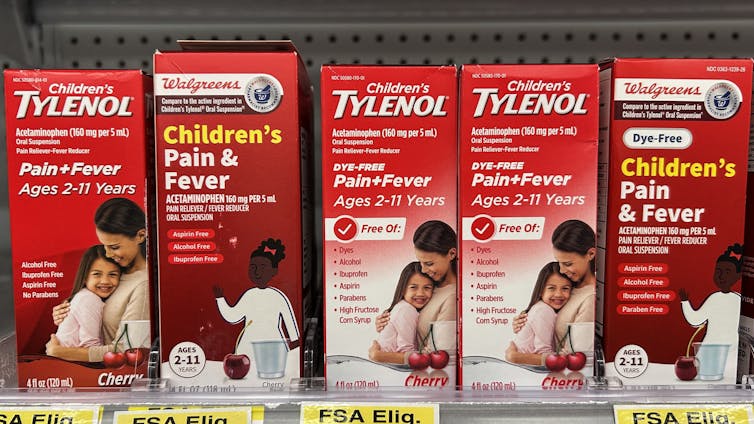
What parents need to know about Tylenol, autism and the difference between finding a link and finding a cause in scientific research

In cases where associations are found, researchers must consider dosage response, differences between siblings and other factors to determine a cause-and-effect relationship. Ronaldo Schemidt/AFP via Getty Images

Claims from the Trump White House about links between use of the painkiller acetaminophen – often sold under the brand name Tylenol in the U.S. – during pregnancy and development of autism have set off a deluge of responses across the medical, scientific and public health communities.

As a father of a child with level 2 autism – meaning autism that requires substantial support – and a statistician who works with such tools as those used in the association studies cited by the White House, I find it useful to think about the nuances of association versus causation in observational studies. I hope that this explanation is helpful to parents and expecting parents who, like me, are deeply invested in the well-being of their children.

a bunch of white pills are shown with the words tylenol 500 on them in red
The painkiller acetominophen is often sold under the brand name Tylenol in the U.S. AP Photo/Jae C. Hong

Association is not causation, but …

Most people have heard this before, but it bears repeating: Association does not imply causation.

An often-cited example is that there is a very strong association between ice cream sales and incidents of shark attacks. Of course, it goes without saying that shark attacks aren’t caused by ice cream sales. Rather, in the summertime, hot weather drives more appetite for ice cream and beach time. The increased number of people at the beach does, in turn, cause the likelihood of shark attacks to increase.

Yet pointing this out on its own is neither intellectually satisfying nor emotionally appeasing when it comes to real-life medical concerns, since an association does suggest potential for a causal relationship.

In other words, some associations do end up being convincingly causal. In fact, some of the most consequential discoveries of the past century in public health, like the links between smoking and lung cancer or the human papillomavirus (HPV) and cervical cancer, started out as findings of very strong association.

So when it comes to the issue of prenatal acetaminophen use and autism development, it is important to consider how strong the association found is, as well as the extent to which such an association could be considered causal.

Establishing causal association

So how do scientists determine if an observed association is actually causal?

The gold standard for doing so is conducting what are called randomized, controlled experiments. In these studies, participants are randomly assigned to receive treatment or not, and the environment where they are observed is controlled so that the only external element that differs among participants is whether they received treatment or not.

In doing this, researchers reasonably ensure that any difference in the outcomes of the participants can be directly attributed as being caused by whether they received the treatment. That is, any association between treatment and outcome can be considered causal.

Yet oftentimes, conducting such an experiment is impossible, unethical or both. For instance, it would be highly difficult to gather a cohort of pregnant women for an experiment and extremely unethical to randomly assign half of them to take acetaminophen, or any other medication for no particular reason, and the other half not to.

So when experiments are simply infeasible, an alternative is to make some reasonable assumptions on how observational data would behave if the association was causal and then see if the data aligns with these causal assumptions. This can very broadly be referred to as observational causal inference.

Parsing what the studies mean

So how does this apply to the current controversy over the potential for acetaminophen use during pregnancy to affect the fetus in a way that could result in a condition like autism?

Researchers who try to understand causal roles and links between one variable and potential health outcomes do so by considering: 1) the size and consistency of the association across multiple attempts to estimate it, and 2) the extent to which such association has been established under observational causal inference frameworks.

As early as 1987, researchers have been working to measure possible associations between acetaminophen use during pregnancy and autism. A number of these studies, including multiple large systematic reviews, have found evidence of such associations.

For instance, a 2025 review of 46 studies that examined association between acetaminophen use and an array of neurodevelopmental disorders, including autism, identified papers with five positive associations between acetaminophen and autism.

In one of those studies, which examined 73,881 births, the researchers found that children who were exposed to acetaminophen prenatally were 20% more likely to develop borderline or clinical autism spectrum conditions. Another examined 2.48 million births and reported an estimated association of only 5%.

Both of those are weak associations. For context, estimations of increased lung cancer risk from smoking in the 1950s were between 900% to 1,900%. That is, a smoker is 10 to 20 times more likely than a nonsmoker to develop lung cancer. By comparison, in the two autism studies above, a pregnant woman who takes acetaminophen is 1.05 to 1.20 times more likely than one who does not take the drug to have a child who would be later diagnosed with autism.

It’s also important to keep in mind that many factors can affect how well a study is able to estimate an association. In general, larger sample sizes provide both greater power to detect an association if one does exist, as well as improved precision over estimating the value of the association. This does not mean that studies with smaller sample sizes are not valid, only that from a statistical perspective, researchers like me place greater confidence in an association drawn from a larger sample size.

Once an association – even a small one – is established, researchers then must consider the extent to which causation can be claimed. One way to do this is through what’s called dose-response. This means looking at whether the association is higher among women who took higher doses of acetaminophen during pregnancy.

The study mentioned above that looked at 2.48 million births shows an example of dose-response. It found that pregnant women who reported taking higher doses have higher autism risk.

Another way to examine possible causality in this context is to analyze sibling outcomes, which that same paper did. Researchers looked at whether associations between acetaminophen and autism persisted within families with more than one child.

For example, in a family with two children, if the mother used acetaminophen during one pregnancy and that child was later diagnosed with autism, but she did not use it during the other pregnancy and that child was not diagnosed, then this strengthens the causal claim. Conversely, if acetaminophen was used during the pregnancy of the child who was not diagnosed with autism and not used during the pregnancy of the child who was, then that weakens the causal claim. When this was included in the analysis, the dose-response disappeared, and in fact the overall 5% increased risk mentioned before likewise disappeared. This weakens the claim of a causal relationship.

Consult your doctor

At present, there is clearly not enough evidence to establish a causal association between prenatal acetaminophen use and autism.

Yet as a parent who wonders if my daughter will ever be able to write her name, or hold a job or raise kids of her own, I understand that such explanations may not appease the fears or concerns of an expecting mother who is suffering from a fever.

Naturally, all of us want absolute certainty.

But that’s not possible when it comes to acetaminophen use, at least not at this time.

Your doctor will be able to provide you with much sounder advice than any existing study on this topic. Your OB-GYNs are very likely aware of these studies and have much better judgment as to how these results should be considered in the context of your personal medical history and needs.

Researchers, meanwhile, will continue to dig deeper into the science of this critically important issue and, hopefully, provide greater clarity in the years to come.The Conversation

Mark Louie Ramos, Assistant Research Professor of Health Policy and Administration, Penn State

This article is republished from The Conversation under a Creative Commons license. Read the original article.


Three local governments to jointly explore power option with Sonoma Clean Power

LAKE COUNTY, Calif. — The Board of Supervisors and the Clearlake and Lakeport City Councils will hold a joint discussion Tuesday evening to discuss a proposal for public power generation. 

The joint workshop on Tuesday will take place at 5 p.m. in the board chambers at 255 N Forbes St. The public is invited to attend.

Earlier this year, the three local governments asked Sonoma Clean Power, or SCP to consider extending service into Lake County. 

SCP, a community-owned organization, supplies renewable energy at lower rates. 

Starting in 2014, it has replaced PG&E’s power sources for most customers across Mendocino and Sonoma counties. According to a Lakeport City Council staff report, SCP now serves 87% of electric customers in those two counties.

In 2019, SCP determined it could not offer competitive rates in Lake County. But market and regulatory conditions have since improved, and a new feasibility study this year suggests potential bill savings of 4.2% to 12.9%, according to SCP’s presentations to local governments earlier this year. 

The county staff report said the meeting will cover:

• General background on Community Choice Aggregation; 
• Information on Sonoma Clean Power;
• SCP’s Offer for Service, and benefits for Lake County residents;
• The process to join SCP; 
• Customer support available through SCP; 
• Sonoma Clean Power’s state-level policy impact. 

The workshop is informational only; no decisions will be made. 

Actions are expected later: the Board of Supervisors and Lakeport City Council on Tuesday, Oct. 21, at their respective meetings, and the Clearlake City Council on Thursday, Oct. 2.

The‌ ‌meeting‌ ‌can‌ ‌be‌ ‌watched‌ ‌live‌ ‌on‌ ‌Channel‌ ‌8, ‌online‌ and‌ ‌on‌ ‌the‌ ‌county’s‌ ‌Facebook‌ ‌page. ‌Accompanying‌ ‌board‌ ‌documents, ‌the‌ ‌agenda‌ ‌and‌ ‌archived‌ ‌board‌ ‌meeting‌ ‌videos‌ ‌also‌ ‌are‌ ‌available‌ ‌at‌ ‌that‌ ‌link. ‌ ‌

To‌ ‌participate‌ ‌in‌ ‌real-time, ‌join‌ ‌the‌ ‌Zoom‌ ‌meeting‌ ‌by‌ ‌clicking‌ ‌this‌ ‌link‌. ‌ ‌

The‌ ‌meeting‌ ‌ID‌ ‌is‌ 865 3354 4962, ‌pass code 726865.‌ ‌The meeting also can be accessed via one tap mobile at +16694449171,,86533544962#,,,,*726865#. The meeting can also be accessed via phone at 669 900 6833.

Email staff reporter Lingzi Chen at This email address is being protected from spambots. You need JavaScript enabled to view it.. 

September is Childhood Cancer Awareness Month

Acting Governor Eleni Kounalakis last week issued a proclamation declaring September 2025 as "Childhood Cancer Awareness Month."

The text of the proclamation follows.

PROCLAMATION

During Childhood Cancer Awareness Month, we honor the hundreds of thousands of children who have faced or continue to face the terrifying ordeal of cancer. We stand with families suffering the loss of children taken too soon by the disease and reaffirm our commitment to helping find a cure for cancer and ending childhood cancer as we know it.

Cancer is the second most common cause of death among children ages 1 to 14, and the rate of cancer incidence for children has been increasing since the 1970s. In that time, we have also seen huge improvements in both methods of treatment and survival rates – but we owe it to our children to do more.

California is home to some of the leading research hospitals in the country – including the University of California, San Francisco and University of California, Davis Medical Centers – that support ground-breaking research in treating childhood cancer. Even as the federal government slashes critical funding for cancer care and research, California has created essential funding streams for childhood cancer research that make it easier for the public to help.

In California, we have dramatically increased access to health care for families across the state. We work to protect our kids from toxic substances and pollution that can cause cancer and other diseases, including keeping synthetic food dyes out of school meals and working to better understand the risks of ultra-processed foods, both of which have been linked to cancer. We focus on preventative care and research, while offering some of the best care in the nation when the unimaginable happens.  

No child should have to worry about a cancer diagnosis, about balancing school or play dates with chemotherapy and recovery time. This month, we extend our gratitude to those searching for a cure and those supporting young patients through these heartbreaking times. We stand with families who fight and care for their kids. But above all, we honor the brave children, those lost and those still thankfully with us today – it is these kids who are the bravest and strongest among us. They are the reasons we cannot give up in the search for a cure, and this month, California recommits to doing all that we can to end this terrible disease.

NOW THEREFORE I, ELENI KOUNALAKIS, Acting Governor of the State of California, do hereby proclaim September 2025 as “Childhood Cancer Awareness Month.”

IN WITNESS WHEREOF I have hereunto set my hand and caused the Great Seal of the State of California to be affixed this 20th day of September 2025.
 
ELENI KOUNALAKIS
Governor of California

ATTEST:
SHIRLEY N. WEBER, Ph.D.
Secretary of State

New report looks at growth of U.S. centenarian population

In 2020, centenarians — people who have reached the age of 100 — accounted for just 2 out of 10,000 people, according to the “Centenarians: 2020” special report released by the U.S. Census Bureau.

Though a small proportion of the total population, the centenarian population in the United States increased by 50% from 53,364 in 2010 to 80,139 in 2020. 

This percentage increase was also faster than the growth of other age groups among older adults since 2010.

The report provides an updated portrait of the centenarian population in the United States and is based on age, sex, race, Hispanic origin, living arrangements and geographic distribution information from the 2020 Census. 

The characteristic profile and geographic distribution of centenarians are compared with those of other age groups in the older population to illustrate how centenarians are distinct. 

Other highlights include:

Sex composition

• In 2020, centenarians were overwhelmingly female at 78.8%. This was a slight decline from 2010, when centenarians were 82.8% female.

• Between 2010 and 2020, the male centenarian population grew by 85.3% versus a 42.9% increase for female centenarians.

Racial and ethnic composition

• Centenarians, a largely white alone and female population, became slightly more racially diverse and male in 2020. The increase in racial diversity (i.e., about an 8 percentage-point decline in the white alone share) was on par with what was shown for other age groups among the older population, but it was less than the increase in racial diversity for the population under age 65 (i.e., about a 12 percentage-point decline in the white alone share). Black or African American alone centenarians were an exception to the general pattern. The percentage of centenarians who were Black or African American alone declined from 12.2% in 2010 to 10.3% in 2020.

Regional and state

• Compared with the national centenarian proportion of 2.42 per 10,000 people in the population, the Northeast had the highest centenarian proportion among regions at 3.19 centenarians per 10,000 people.

• Hawaii was the only state with more than 4 centenarians per 10,000 (4.44) people in 2020. Puerto Rico joined it, having 4.14 centenarians per 10,000 people. On the other end of the spectrum, no state had less than 1 centenarian per 10,000 people in 2020. Utah came the closest with 1.04, and Alaska was close behind with 1.28 centenarians per 10,000 people.

• States with the highest proportion of centenarians were similar in pattern to that for the population ages 85 to 99 (i.e., Midwest and Northeast concentration of the high-proportion states), but they were dissimilar from the pattern for the population ages 65 to 84 (i.e., high-proportion states were outside the central United States).

Living arrangements

• In 2020, female centenarians lived alone without familiar household members to a much greater extent than male centenarians.

• About half (49.7%) of male centenarians lived with others in a household, while only about a third (33.8%) of female centenarians lived with others in a household.

• When we focus on group quarters living, such as nursing homes, female centenarians were about twice as likely to experience this living arrangement than male centenarians. Among centenarians, 27.6% of females were living in a nursing home, while only 14.2% of males were living in a nursing home. 

• Putting the above two points together, about two-thirds (66.2%) of centenarian females were living alone or in a group living situation. In contrast, about half (50.3%) of centenarian males were in that living situation.

• The centenarian living arrangement with notably more racial and ethnic diversity in 2020 was “living with others in a household,” while the centenarian living arrangements with the least racial and ethnic diversity were nursing homes and “living alone in a household.”

• Centenarians who were Hispanic or Latino, Asian alone, and “All Other Races” were notably more likely to live with others in a household (i.e., each group having over 60% living with others in a household), while white alone and not Hispanic centenarians were much less likely to live with others in a household (i.e., each less than 35% living with others in a household). Black or African American alone centenarians were in the middle with about half living with others in a household.

Even a brief government shutdown might hamper morale, raise costs and reduce long-term efficiency in the federal workforce

A sign indicates the closing of federal services during the government shutdown in 2013. AP Photo/Susan Walsh

As the federal fiscal year draws to a close, an increasingly familiar prospect is drawing near in Washington, D.C.: a possible government shutdown. And for federal workers, it couldn’t come at a worse time.

In the fractious and polarized political landscape of the United States, Democrats and Republicans have come to rely on short-term, stopgap funding bills to keep the government operating in the absence of elusive longer-term budget deals.

With the parties currently wide apart over the terms of even a short-term budget resolution, the government is set to shut down on Oct. 1, 2025, barring an 11th-hour deal that appears far off. If the shutdown does happen, it would mark another difficult moment this year for a federal workforce that has so far shed more than 300,000 jobs. This is largely due to ongoing Trump administration efforts to downsize parts of the federal government and restructure or largely eliminate certain government agencies with the stated aim of increasing efficiency.

With a government shutdown, hundreds of thousands of federal employees would be furloughed – sent home without pay until funding resumes.

As a team of financial economists who study labor markets and public sector employment and have examined millions of federal personnel records spanning such government shutdowns in the past, we have found that the consequences reach far beyond the now-familiar images of closed national parks and stalled federal services. Indeed, based on our study of an October 2013 shutdown during which about 800,000 federal employees were furloughed for 16 days, shutdowns leave an enduring negative effect on the federal workforce, reshaping its composition and weakening its performance for years to come.

What happens to workers

Millions of Americans interact with the federal government every day in ways both big and small. More than one-third of U.S. national spending is routed through government programs, including Medicare and Social Security. Federal workers manage national parks, draft environmental regulations and help keep air travel safe.

Whatever one’s political leanings, if the goal is a government that handles these responsibilities effectively, then attracting and retaining a talented workforce is essential.

Yet the ability of the federal government to do so may be increasingly difficult, in part because prolonged shutdowns can have hidden effects.

When Congress fails to pass appropriations, federal agencies must furlough employees whose jobs are not deemed “excepted” – sometimes commonly referred to as essential. Those excepted employees keep working, while others are barred from working or even volunteering until funding resumes. Furlough status reflects funding sources and mission categories, not an individual’s performance, so it confers no signal about an employee’s future prospects and primarily acts as a shock to morale.

Importantly, furloughs do not create long-term wealth losses; back pay has always been granted and, since 2019, is legally guaranteed. Employees therefore recover their pay even though they may face real financial strain in the short run.

A cynical observer might call furloughs a paid vacation, yet the data tells a different story.

An empty hallway in the U.S. Capitol.
An American flag is seen inside the U.S. Capitol Building on Sept. 23, 2025, ahead of a looming government shutdown. Photo by Anna Moneymaker/Getty Images

Immediate consequences, longer-term effects

Using extensive administrative records on federal civilian workers from the October 2013 shutdown, we tracked how this shock to morale rippled through government operations. Employees exposed to furloughs were 31% more likely to leave their jobs within one year.

These departures were not quickly replaced, forcing agencies to rely on costly temporary workers and leading to measurable declines in core functions such as payment accuracy, legal enforcement and patenting activity.

Further, we found that this exodus builds over the first two years after the shutdown and then settles into a permanently lower headcount, implying a durable loss of human capital. The shock to morale is more pronounced among young, female and highly educated professionals with plenty of outside options. Indeed, our analysis of survey data from a later 2018-2019 shutdown confirms that morale, not income loss, drives the exits.

Employees who felt most affected reported a sharp drop in agency, control and recognition, and they were far more likely to plan a departure.

The effect of the motivation loss is striking. Using a simple economic model where workers can be expected to value both cash and purpose, we estimate that the drop in intrinsic motivation after a shutdown would require a roughly 10% wage raise to offset.

Policy implications

Some people have argued that this outflow of employees amounts to a necessary trimming, a way to shrink government by a so-called starving of the beast.

But the evidence paints a different picture. Agencies hit hardest by furloughs turned to temporary staffing firms to fill the gaps. Over the two years after the shutdown we analyzed, these agencies spent about US$1 billion more on contractors than they saved in payroll.

The costs go beyond replacement spending, as government performance also suffers. Agencies that were more affected by the shutdown recorded higher rates of inaccurate federal payments for several years. Even after partial recovery, losses amounted to hundreds of millions of dollars that taxpayers never recouped.

Other skill-intensive functions declined as well. Legal enforcement fell in agencies that became short of experienced attorneys, and patenting activity dropped in science and engineering agencies after key inventors left.

Official estimates of shutdown costs typically focus on near-term GDP effects and back pay. But our findings show that an even bigger bill comes later in the form of higher employee turnover, higher labor costs to fill gaps, and measurable losses in productivity.

Shutdowns are blunt, recurring shocks that demoralize the public workforce and erode performance. These costs spill over to everyone who relies on government services. If the public wants efficient, accountable public institutions, then we should all care about avoiding shutdowns.

After an already turbulent year, it is unclear whether an upcoming shutdown would significantly add to the strain on federal employees or have a more limited effect, since many who were considering leaving have already left through buyouts or forced terminations this year. What is clear is that hundreds of thousands of federal employees are likely to experience another period of uncertainty.The Conversation

Gonzalo Maturana, Associate Professor of Finance, Emory University; Andrew Teodorescu, Ph.D. Candidate in Finance, Stanford University, and Christoph Herpfer, Assistant Professor of Business Administration, University of Virginia

This article is republished from The Conversation under a Creative Commons license. Read the original article.

Thousands turn out to enjoy annual Pear Festival

It was all about the pear during the 31st annual Kelseyville Pear Festival on Saturday, Sept. 27, 2025, in Kelseyville, California. Photo by Lingzi Chen/Lake County News.

KELSEYVILLE, Calif. — Beautiful fall weather and a day full of fun activities drew thousands of people to downtown Kelseyville on Saturday for the 31st annual Pear Festival.

The daylong event celebrated Lake County’s agricultural history and one of its most enduring crops.

Kicking off with a pancake breakfast and the morning parade, the day was filled with color, music, dance, art and great food.

In the Grande Pear Parade, Clear Lake State Park took top honors for its float, followed by Realtor Anne Mary Skeen, with Latinos United of Lake County and Kelseyville High School’s Homecoming float tying for third place.

Judges tasted 26 entries in the annual pear dessert contest on Friday, Sept. 26, 2025, at Kelseyville Presbyterian Church in Kelseyville, California. Photo by Elizabeth Larson/Lake County News.

Lining the town’s streets, there were vendors of every kind — from food to pear souvenirs — plus tractors and other farm equipment, and classic cars.

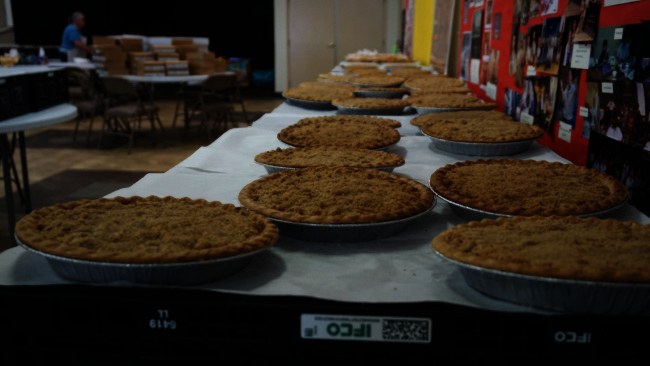
The California Women for Agriculture spent Friday baking 100 pear pies and more than 700 pear popovers, which people lined up to buy.

Some of the 100 pear pies baked by the California Women for Agriculture on Friday, Sept. 26, 2025, at Kelseyville Presbyterian Church in Kelseyville, California. Photo by Elizabeth Larson/Lake County News.

Across the way at Kelseyville Presbyterian Church, the Presbyterian Women once again presented their beloved cool treat — pear milkshakes. 

On Friday, judges in the pear dessert contest considered 26 entries, which organizers said was an increase over the previous year.

Emily Navarro won for her holiday pear cake balls. Rebecca Molloy took second place for her buttermilk-cheddar-pear biscuits with pear blend ice tea and pear jalapeno jam, Isabella Mays won third place for pear cream cheese danishes, fourth place went to Erin Malaspina for her “pearadise swirls” and the fifth place award went to Heather Brown for her “I can’t believe it’s not pears” dessert.

Email Elizabeth Larson at This email address is being protected from spambots. You need JavaScript enabled to view it.. Follow her on Twitter, @ERLarson, and on Bluesky, @erlarson.bsky.social. Find Lake County News on the following platforms: Facebook, @LakeCoNews; X, @LakeCoNews; Threads, @lakeconews, and on Bluesky, @lakeconews.bsky.social. 

A youngster checks out fresh pears during the 31st annual Kelseyville Pear Festival on Saturday, Sept. 27, 2025, in Kelseyville, California. Photo by Lingzi Chen/Lake County News.


Attendees enjoy time downtown during the 31st annual Kelseyville Pear Festival on Saturday, Sept. 27, 2025, in Kelseyville, California. Photo by Lingzi Chen/Lake County News.


  • 95
  • 96
  • 97
  • 98
  • 99
  • 100
  • 101
  • 102
  • 103
  • 104

Community

  • Lake County Wine Alliance offers sponsor update; beneficiary applications open 

  • Mendocino National Forest announces seasonal hiring for upcoming field season

Public Safety

  • Lakeport Police logs: Thursday, Jan. 15

  • Lakeport Police logs: Wednesday, Jan. 14

Education

  • Woodland Community College receives maximum eight-year reaffirmation of accreditation from ACCJC

  • SNHU announces Fall 2025 President's List

Health

  • California ranks 24th in America’s Health Rankings Annual Report from United Health Foundation

  • Healthy blood donors especially vital during active flu season

Business

  • Two Lake County Mediacom employees earn company’s top service awards

  • Redwood Credit Union launches holiday gift and porch-to-pantry food drives

Obituaries

  • Rufino ‘Ray’ Pato

  • Patty Lee Smith

Opinion & Letters

  • The benefits of music for students

  • How to ease the burden of high electric bills

Veterans

  • CalVet and CSU Long Beach team up to improve data collection related to veteran suicides

  • A ‘Big Step Forward’ for Gulf War Veterans

Recreation

  • Wet weather trail closure in effect on Upper Lake Ranger District

  • Mendocino National Forest seeking public input on OHV grant applications

  • State Parks announces 2026 Anderson Marsh nature walk schedule 

  • BLM lifts seasonal fire restrictions in central California

Religion

  • Kelseyville Presbyterian to host Ash Wednesday service and Lenten dinner Feb. 18

  • Kelseyville Presbyterian Church to hold ‘Longest Night’ service Dec. 21

Arts & Life

  • Auditions announced for original musical ‘Even In Shadow’ set for March 21 and 28

  • ‘The Rip’ action heist; ‘Steal’ grounded in a crime thriller

Government & Politics

  • Lake County Democrats issue endorsements in local races for the June California Primary

  • County negotiates money-saving power purchase agreement

Legals

  • March 3 hearing on ordinance amending code for commercial cannabis uses

  • Feb. 12 public hearing on resolution to establish standards for agricultural roads

How to resolve AdBlock issue?
Refresh this page