How to resolve AdBlock issue?
Refresh this page
How to resolve AdBlock issue?
Refresh this page
Lake County News,California
  • Home
    • Registration Form
  • News
    • Education
    • Veterans
    • Community
      • Obituaries
      • Letters
      • Commentary
    • Police Logs
    • Business
    • Recreation
    • Health
    • Religion
    • Legals
    • Arts & Life
    • Regional
  • Calendar
  • Contact us
    • FAQs
    • Phones, E-Mail
    • Subscribe
  • Advertise Here
  • Login

News

Giusti reappointed to state water board

LAKE COUNTY, Calif. — A respected local biologist has been reappointed to a state water board.

The Governor’s Office said Gregory Giusti of Kelseyville has been reappointed to the North Coast Regional Water Quality Control Board, where he has served since 2013. 

Giusti has been director and advisor of forests and wildlands ecology at the University of California Cooperative Extension since 1985. 

He was an agricultural biologist for the San Mateo County Department of Agriculture from 1981 to 1985. 

Giusti was chief biologist at the Marine Ecological Institute from 1978 to 1981. 

He is a member of the California Forest Pest Council and of the Western Section of Wildlife Society. 

Giusti earned a Master of Arts degree in ecology and population biology and a Bachelor of Arts degree in systemic biology from California State University, San Francisco. 

This position requires Senate confirmation, and the compensation is $250 per diem. 

Giusti is registered without party preference. 

Fed rate cut is attempt to prevent recession without sending prices soaring

The Fed’s job can seem like a balancing act. Dimitri Otis/DigitalVision via Getty Images

The Federal Reserve on Sept. 17, 2025, cut its target interest rate as it shifts focus from fighting inflation to supporting the choppy labor market.

As financial markets expected, the Fed lowered rates a quarter point to a range of 4% to 4.25%, its first cut since December 2024.

The Fed’s decision to begin cutting rates comes as evidence mounts that the U.S. labor market is losing momentum. The headline unemployment rate has stayed steady at near record lows, but the underlying trends are more concerning.

At the same time, the fight against inflation is not over yet. While a cooling jobs market could lead to a recession, cutting rates too much could drive inflation higher.

So if you’re the Fed, what do you do?

I’m an economist who tracks labor market data and monetary policy, examining how changes in hiring, wages and unemployment influence the Federal Reserve’s efforts to steer the economy. There’s an incredibly large amount of data the Fed, investors, economists like me and many others use to understand the state of the economy – and much of it often tells conflicting stories.

Here are some the data points I’ve been following most closely to better understand where the U.S. economy might go from here – and the tough choices the Fed has to make.
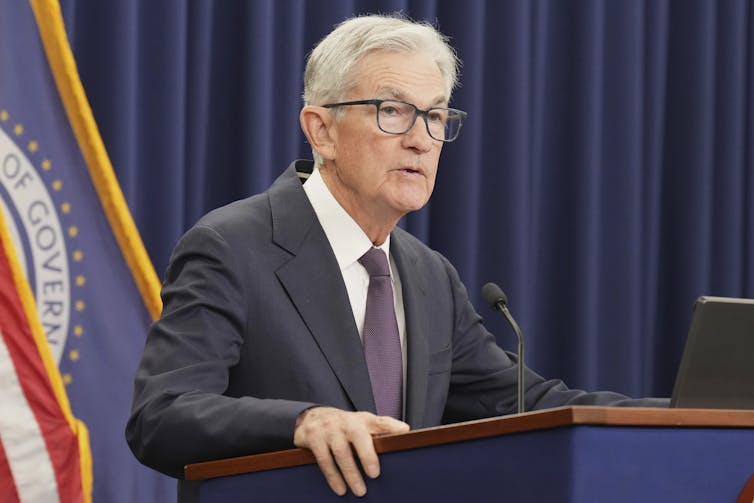
a bespectacled white man in a suit stands before a podium with a micrphone
Fed Chairman Jerome Powell speaks during a news conference after the rate-cut decision. AP Photo/Jacquelyn Martin

Underlying trouble in the labor market

The labor market looks stable on the surface, but more granular data tells a different story.

The unemployment rate has remained close to historic lows at 4.3% as of August 2025, according to the U.S. Bureau of Labor Statistics.

But the number of long-term unemployed – people out of work for 27 weeks or longer – rose to 1.9 million in August, up 385,000 from a year earlier. These workers now make up 25.7% of all unemployed people, the highest share since February 2022. Persistent long-term joblessness often signals deeper cracks forming in the labor market.

At the same time, new claims for unemployment benefits are spiking. Initial claims for unemployment insurance – a leading indicator of labor market stress – jumped by 27,000 to 263,000 for the week ending Sept. 6, according to the U.S. Department of Labor. That’s the sharpest increase in months and well above economists’ forecasts. It suggests layoffs are becoming more common.

We also got news that past payroll growth was overstated. In a process the Bureau of Labor Statistics undertakes annually to double-check its data, the bureau recently revised its jobs data downward from April 2024 through March 2025 by 911,000. In other words, the economy created roughly 75,000 fewer jobs per month than previously reported. This implies the labor market was weaker than it appeared all along.

Finally, workers are losing confidence. The Federal Reserve Bank of New York reported in August that the confidence of people who lost their jobs in finding another fell to its lowest level – 44.9% – since it started surveying consumers in June 2013. That’s another sign workers are feeling less secure about their prospects.

Taken together, these data points paint a clear picture: The labor market is not collapsing, but it is softening. That helps explain why the Fed is beginning to cut rates now – hoping to stimulate spending – before the job market breaks more sharply.
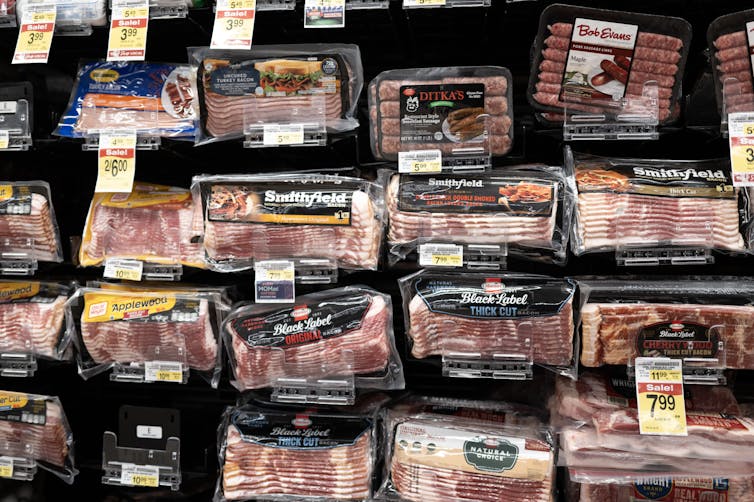
packages of bacon and other meat are on display in a grocery store
Prices of meat and other groceries have been on the rise recently. Scott Olson/Getty Images

Tariffs are complicating the inflation data

Even as the labor market softens, tariffs are pushing certain prices higher than they otherwise would be, complicating the Federal Reserve’s effort to bring inflation down.

Government data shows that businesses have begun passing the costs of President Donald Trump’s new import tariffs to consumers. In August, clothing prices rose 0.5% and grocery prices rose 0.6%, with especially strong gains for tariff-sensitive items such as coffee.

Lower-income households are getting hit hardest because they spend more of their budget on imported goods, which tend to be the lower-cost items most affected by tariffs. A report from the Yale Budget Lab found that core goods prices are about 1.9% above pre-2025 trends as tariffs raise costs for basic items such as appliances and electronics.

Phillip Swagel, director of the Congressional Budget Office, said recently that Trump’s tariffs have pushed inflation higher than CBO analysts had expected, even as overall economic activity has weakened since January.

Typically, a slowdown in the labor market is met with slower inflation. But while the CBO now projects that the tariffs will reduce the federal budget deficit by about US$4 trillion over the next decade – roughly $3.3 trillion in new revenue and $700 billion in lower debt service costs – but it will come at the cost of near-term upward pressure on prices.

This creates a difficult balancing act for the Fed: Cut rates too quickly, and tariff-driven price pressures could reignite inflation; move too slowly, and the softening labor market could tip into recession.
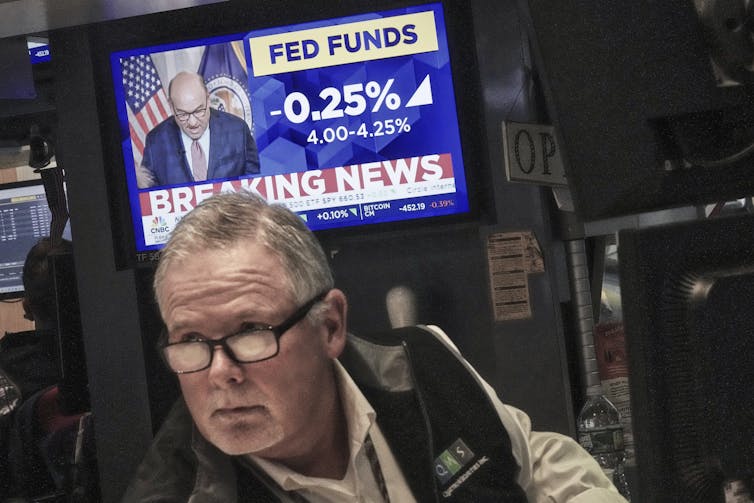
a bespectacled white man in a vest look on as a tv screen shows news of fed rate cut behind him
Traders react to the Fed news. AP Photo/Richard Drew

A narrow path to a soft landing

As it resumes cutting rates, the Federal Reserve is trying to thread a narrow needle – easing policy enough to keep the labor market from cracking while not reigniting inflation, which is proving stickier in part because of tariffs.

Markets are betting the Fed will keep cutting. The futures market is betting the Fed will cut rates by another half point by the end of the year. And the one-year Treasury yield has dropped about 150 basis points (1.5%) since June, signaling that investors expect a series of rate cuts through 2025 and into 2026.

At its latest meeting, the Fed signaled two more rate cuts in 2025 and at least one rate cut in 2026.

Such cuts would ultimately bring the federal funds rate closer to 3% and hopefully reduce 30-year mortgage rates to around 5% – from an average of 6.35% as of Sept. 11. If the labor market continues to weaken – with jobless claims climbing, payrolls revised down and more workers stuck in long-term unemployment – that expectation will likely harden into consensus.

But the path is far from certain. Cutting rates too quickly could cause inflation to spike, while going too slow could lead to further deterioration in the labor market. Either outcome would jeopardize the Fed’s credibility – whether by appearing unable to control prices or by allowing unemployment to rise unnecessarily. That would undermine its ability to influence markets and enforce its dual mandate of maximum employment and stable prices.

Another tricky issue is Trump’s public campaign to push the Fed to cut rates – appearing to do his bidding could also undercut Fed credibility. For what it’s worth, the Sept. 17 rate cut appears driven less by politics than by economic data. The Fed itself was projecting a year ago that rates would be much lower today than they actually are, suggesting it’s been following the data.

The economy appears to be slowing but remains resilient, which is why the Fed is likely to move gradually. The risk is that the window for a soft landing is closing. The coming months will determine whether the Fed can ease early enough to avoid recession, or whether it has already waited too long.The Conversation

Ryan Herzog, Associate Professor of Economics, Gonzaga University

This article is republished from The Conversation under a Creative Commons license. Read the original article.

Man sentenced to prison for teen’s fentanyl death

LAKEPORT, Calif. — A Lucerne man arrested last year in connection with the fentanyl death of a teenager has been sentenced to state prison.

Joe Nathan Boggs Jr., 28, was in court on Friday for sentencing before Judge J. David Markham.

Boggs was arrested in June of 2024 for what officials said at the time was Lake County’s first charged fentanyl homicide case for the death of 17-year-old Illeanna Makena Frease of Lakeport.

Frease died Nov. 10, 2023, after authorities said Boggs furnished her with fentanyl.

The District Attorney’s Office originally filed four felony counts against Boggs: second-degree murder; an adult using a minor as an agent to violate controlled substance law; sale, distribution or transportation of a controlled substance; and possession for sale of a controlled substance, as Lake County News has reported.

Boggs, who has remained in the Lake County Jail since his arrest, was set for trial to begin on Sept. 17, according to court records.

However, he reached an agreement with the District Attorney’s Office and entered a plea in the case on Aug. 8, court records show.

Chief Deputy District Attorney Rich Watson told Lake County News that Boggs pleaded no contest to furnishing a controlled substance to a minor and involuntary manslaughter. 

Judge Markham sentenced Boggs to 10 years in state prison, Watson said.

Frease was a member of the Elem Colony of Pomo. At the time of her death, her mother, Michaela John, went public with allegations that Boggs — who also is Indigenous — had trafficked her daughter.

John also said that Boggs, who has a lengthy criminal history, “operated both on and off tribal lands openly, with no regard for the damage he was causing. Without accountability.”

Frease’s family attended one of Boggs’ early court appearances wearing red t-shirts with Frease’s picture on them.

A year after Boggs’ arrest, the Lake County Sheriff’s Office made its second fentanyl homicide arrest when it took Ryan John Stahl, 40, of Lucerne, into custody for the February death of Carissa Morton, 28, of Nice.

Stahl, who also remains in custody in the Lake County Jail, was held to answer in the case after his Aug. 28 preliminary hearing and is scheduled for trial in December. 

Email Elizabeth Larson at This email address is being protected from spambots. You need JavaScript enabled to view it.. Follow her on Twitter, @ERLarson, and on Bluesky, @erlarson.bsky.social. Find Lake County News on the following platforms: Facebook, @LakeCoNews; X, @LakeCoNews; Threads, @lakeconews, and on Bluesky, @lakeconews.bsky.social. 

Clearlake Police seeking missing juvenile

Mayaa Alexis Perez. Courtesy photo.


CLEARLAKE, Calif. — The Clearlake Police Department is asking for the community’s help in locating a missing teenager.

Mayaa Alexis Perez, 15, was last seen on Olympic Drive in Clearlake on Tuesday.

She is described as 5 feet 4 inches tall and 150 pounds, with red shoulder length hair and wearing a black shirt, black pants, and silver or grey shoes.

If you have any information on her whereabouts, please call the Clearlake Police Department at 707-994-8251, Extension 1.

Congressman Thompson to host Sept. 18 virtual town hall 

LAKE COUNTY, Calif. — Congressman Mike Thompson will host a virtual town hall this week to discuss the economy.

The event will take place via Zoom beginning at 6 p.m. Thursday, Sept. 18.

During the Thursday event, Thompson will host author and economic commentator, Kyla Scanlon. 

Together, they will discuss the state of the nation’s economy and answer questions about how current economic and trade policies are affecting the community. 

To RSVP for Zoom, visit this link. 

The town hall also may be watched on Thompson’s Facebook page. 


West Coast states issue unified vaccine recommendations; California breaks from future federal guidance with new law

On Wednesday, Gov. Gavin Newsom of California, Gov. Tina Kotek of Oregon, Gov. Bob Ferguson of Washington and Gov. Josh Green of Hawaii announced coordinated winter virus vaccination recommendations through the West Coast Health Alliance, or WCHA.

These recommendations include the 2025–26 COVID-19, influenza, and RSV vaccines.

In addition, Gov. Newsom signed AB 144, authorizing California to base future immunization guidance on credible, independent medical organizations rather than the CDC’s increasingly politicized Advisory Committee on Immunization Practices.

“Our states are united in putting science, safety, and transparency first — and in protecting families with clear, credible vaccine guidance. The West Coast Health Alliance stands united in protecting public health and always putting safety before politics,” the governors said in a joint statement.

Vaccination is safe, effective and the best protection available against respiratory viruses like COVID-19, influenza and RSV.

Seasonal vaccination is also a critical public health tool to reduce serious illness, community transmission, and strain on hospitals. 

“We want the people who live and work in our states to know that there is a strong public health, healthcare & scientific community that will continue to stand together to provide and use the data and evidence needed for you to make healthy choices, and we are here to protect our communities,” said Dr. Erica Pan, director of the California Department of Public Health

"As a physician, I swore an oath to do no harm — and we know vaccines are among the most powerful tools to prevent illness and save lives. As a new mother, I want the same protection for my newborn that every Oregon family deserves. At a time when Washington is undermining our most basic public health safeguards, Oregon is charting a different course. Our actions today affirm that here, public health is about protecting people, not playing politics—and that every family who wants protection this respiratory virus season should be able to get it simply, safely, and affordably,” said Dr. Sejal Hathi, MD, MBA, director of the Oregon Health Authority.

“Vaccines protect more than just ourselves — they help safeguard our families, neighbors, and communities. By staying up to date, Washingtonians can reduce the spread of illness and keep our state strong this season. The Alliance’s recommendations are rooted in science, giving our communities confidence in the guidance we provide,” said Washington State Secretary of Health Dennis Worsham.

“The effectiveness of public health institutions depends on the public’s trust. We understand our responsibility to earn that trust by helping people protect themselves, their families and their community. These recommendations represent a collaborative effort, done with humility and based on science, to meet our responsibilities to our communities and the public at large,” said Kenneth S. Fink, MD, MGA, MPH, director, Hawaiʻi Department of Health.

Truth under assault

In recent weeks, Secretary Robert F. Kennedy, Jr. has aggressively weaponized the CDC by purging its vaccine advisory committee, firing all 17 members and replacing them with cherry-picked appointees who include vaccine skeptics. 

He’s forced out the CDC director, triggered high-level and career-staff resignations, and scheduled expedited meetings where this reshaped panel will vote on critical recommendations that guide national vaccine policy and insurance coverage. 

Public health leaders warn these moves dismantle independent, science-based oversight and inject politics into decisions that protect Americans’ health — undermining the CDC’s credibility at a moment when trust and clarity are most needed.

States stepping in 

Alliance states are fighting back against the Trump administration’s assault on science — sharing a commitment to ensuring that health recommendations are guided by safety, efficacy, transparency, access, and trust. 

To develop these recommendations, health officers, who are all medical doctors, and subject matter experts from each of the WCHA states reviewed guidelines from credible national medical organizations, including the American Academy of Pediatrics, the American College of Obstetricians and Gynecologists and the American Academy of Family Physicians.

Alliance members believe that all clinically recommended vaccinations should be accessible to the people of our states.

In its Wednesday statement, the WCHA said it will continue to build its structure, evaluate new evidence and recommendations as they become available, and determine how to ensure the review process is transparent. 

“WCHA is committed to sharing any updated assessments with our communities,” the statement said.

To learn more about these updated recommendations, click here.

  • 103
  • 104
  • 105
  • 106
  • 107
  • 108
  • 109
  • 110
  • 111
  • 112

Community

  • Lake County Wine Alliance offers sponsor update; beneficiary applications open 

  • Mendocino National Forest announces seasonal hiring for upcoming field season

Public Safety

  • Lakeport Police logs: Thursday, Jan. 15

  • Lakeport Police logs: Wednesday, Jan. 14

Education

  • Woodland Community College receives maximum eight-year reaffirmation of accreditation from ACCJC

  • SNHU announces Fall 2025 President's List

Health

  • California ranks 24th in America’s Health Rankings Annual Report from United Health Foundation

  • Healthy blood donors especially vital during active flu season

Business

  • Two Lake County Mediacom employees earn company’s top service awards

  • Redwood Credit Union launches holiday gift and porch-to-pantry food drives

Obituaries

  • Rufino ‘Ray’ Pato

  • Patty Lee Smith

Opinion & Letters

  • The benefits of music for students

  • How to ease the burden of high electric bills

Veterans

  • CalVet and CSU Long Beach team up to improve data collection related to veteran suicides

  • A ‘Big Step Forward’ for Gulf War Veterans

Recreation

  • Wet weather trail closure in effect on Upper Lake Ranger District

  • Mendocino National Forest seeking public input on OHV grant applications

  • State Parks announces 2026 Anderson Marsh nature walk schedule 

  • BLM lifts seasonal fire restrictions in central California

Religion

  • Kelseyville Presbyterian to host Ash Wednesday service and Lenten dinner Feb. 18

  • Kelseyville Presbyterian Church to hold ‘Longest Night’ service Dec. 21

Arts & Life

  • Auditions announced for original musical ‘Even In Shadow’ set for March 21 and 28

  • ‘The Rip’ action heist; ‘Steal’ grounded in a crime thriller

Government & Politics

  • Lake County Democrats issue endorsements in local races for the June California Primary

  • County negotiates money-saving power purchase agreement

Legals

  • March 3 hearing on ordinance amending code for commercial cannabis uses

  • Feb. 12 public hearing on resolution to establish standards for agricultural roads

How to resolve AdBlock issue?
Refresh this page