 How to resolve AdBlock issue?
News
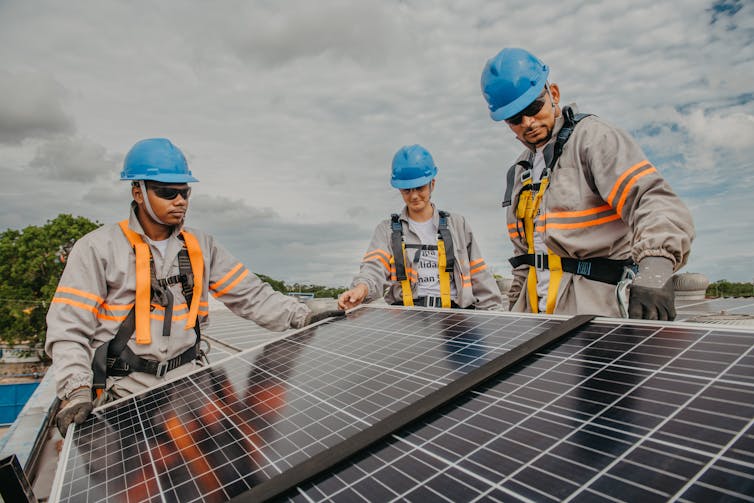
When President Joe Biden signed the Inflation Reduction Act in August 2022, he called it the “largest investment ever” to fight climate change. He also said it would lead to the creation of well-paying union jobs to help “reduce emissions across every sector of our economy.” These jobs are also known as “clean energy jobs,” and the number of these jobs is expected to increase in the coming years as a result of the act’s US$369 billion investment in energy security and climate change.
Here, Shaun Dougherty, an expert in career and technical education, answers five questions about clean energy jobs, their expected growth and what kind of education a person needs to get one.
1. What is a ‘clean energy’ job?
In general, the term applies to any job that is related to producing goods and delivering services focused on conserving or protecting natural resources, or reducing their use.
So, there are jobs in manufacturing equipment for solar panel and wind turbine components. There are also sales jobs in solar energy – that is, selling solar panels to homeowners and landlords – as well as in installation, maintenance and repair in both the solar and wind industries. There is also growing demand for environmental engineers and scientists, whose jobs include helping to design solar panels and wind turbines and determine where they are placed.
2. How many green jobs will be created in the next few years?
About 9 million clean energy jobs will be created over the next decade, according to an analysis from the Political Economy Research Institute at UMass Amherst.
The federal government has also projected strong growth in clean energy jobs in the coming decade. Many of these jobs are expected expected to be as installers and technicians for both solar and wind energy. For instance, there is a projected 68% increase in wind turbine service technician jobs, and a projected 52% increase in solar panel installation jobs over the next decade. However, the growth in the actual number of such jobs will be relatively small: 4,700 and 6,100, respectively.
There is also a growing need for environmental scientists and specialists, who use their knowledge of science to protect the environment and people’s health. The federal government projects there will be 7,300 new jobs in these fields over the next decade.
3. How much do these jobs pay?
Clean energy jobs pay at least $2 more per hour – or nearly 10% more – than the national average of $23.86 per hour.
Estimates from the Department of Labor show that across occupations, clean energy jobs pay well. For example, solar installers could make about $47,000 per year, wind turbine technicians about $52,000 annually and engineers nearly $100,000.
4. What kind of education do you need to get a green job?
Not a whole lot beyond high school. Solar installation jobs usually require only a high school diploma. Turbine technicians need more advanced training, but that’s usually a certificate that can be earned at a technical or community college. The highest-paying jobs as environmental scientists or engineers, however, require a two- or four-year college degree.
Also, college isn’t the only way to get a clean energy job. You can get a clean energy job through Job Corps, a federal program that works with young people who have had difficulty getting an education or employment. Research shows Job Corps, at least historically, boosts earnings for the young people it serves.
It might be difficult, however, to get the kind of technical education you need from your local high school. It also depends on where you live.
5. Where’s the best place to live to get a green job?
Right now, there are more green jobs in the places that are set up to supply renewable energy and that have created incentives to build the infrastructure for clean energy. For solar, this means famously sunny places like California, Nevada, New Mexico, Utah, Texas, Florida and Colorado. It also includes states that have created incentives to increase the potential for clean energy use, such as North Carolina, New York and Massachusetts. Texas is top for wind energy employment, but other Plains states, like the Dakotas, also fare well.
A recent report from the Brookings Institution – a nonprofit public policy organization based in Washington, D.C. – highlighted where it is cheapest to produce wind and solar energy. This includes areas where there a lot of jobs in nonrenewable energies, as opposed to clean energy.
This is a hopeful sign. It suggests that clean energy jobs may be coming to areas that might otherwise lose out as the country moves toward greater reliance on renewable energy.
Shaun M. Dougherty, Professor of Education & Policy, Boston College
This article is republished from The Conversation under a Creative Commons license. Read the original article.

LAKE COUNTY, Calif. — Firefighters contained a small wildland fire in the Black Forest on Mount Konocti on Monday, a fire that appeared shortly after a brief thunderstorm.
The Konocti fire was reported shortly after 1:30 p.m. Monday. It was said to be about half a mile up the mountain, with crews accessing it from the Riviera Heights subdivision.
Posts from readers on Lake County News’ Facebook page explained that there had been lightning and rain in the area.
One woman said she saw a lightning strike hit and start the fire as she was watching the rainstorm.
Crews that hiked into the area found a small spot and a tree on fire, according to radio traffic.
Cal Fire sent air resources, with air attack directing helicopters and tankers that were able to quickly hit the blaze before ground crews could get to it.
The fire was reported to be contained just before 4 p.m. at one tenth of an acre.
Firefighters were on scene for several hours afterward for mop up.
Email Elizabeth Larson at
The council will meet at 6 p.m. Thursday, Sept. 1, in the council chambers at Clearlake City Hall, 14050 Olympic Drive.
The meeting will be broadcast live on the city's YouTube channel or the Lake County PEGTV YouTube Channel. Community members also can participate via Zoom or can attend in person.
The agenda can be found here.
Comments and questions can be submitted in writing for City Council consideration by sending them to City Clerk Melissa Swanson at
To give the council adequate time to review your questions and comments, please submit your written comments before 4 p.m. Thursday, Sept. 1.
Each public comment emailed to the city clerk will be read aloud by the mayor or a member of staff for up to three minutes or will be displayed on a screen. Public comment emails and town hall public comment submissions that are received after the beginning of the meeting will not be included in the record.
On the Thursday agenda is a proclamation declaring September 2022 as Senior Center Month.
City staff also will give the council an update on the plans for a new city recreation and events department.
In June, the council approved the new division, which is within the city’s Administrative Services Department.
Staff will report on what they’ve done since the council approved the division’s creation and what activities they have planned for the rest of the fiscal year.
On the meeting's consent agenda — items that are considered routine in nature and usually adopted on a single vote — are warrants; the second reading of Ordinance No. 266-2022 Amending Chapter 2, Section 2-7 of the Clearlake Municipal Code relating to traffic engineer and city engineer; continuation of the authorization to implement and utilize teleconference accessibility to conduct public meetings pursuant to Assembly Bill 361; and adoption of the first amendment to the FY 2022/23 Budget to appropriate funds for design and road paving services; Resolution No. 2022-55.
The council also will hold a closed session to discuss negotiations for a property at 6828 Old Highway 53, Clearlake.
Email Elizabeth Larson at
The “Feather Alert” bill, AB 1314, was introduced by Assemblymember James C. Ramos, the first and only California Native American serving in the state’s legislature.
“My bill, AB 1314, would help us get the word out sooner when an individual is missing or endangered, by asking the public for tips and leads as soon as possible when quick action is critical,” Ramos said. “Creating an alert or advisory system was a top recommendation from tribal leaders at a May 4 hearing to highlight this issue.”
Ramos also noted that California, the state with the greatest population of Native Americans in the nation, is also among the states with the highest rates of reported cases of missing and murdered Indigenous people.
Various studies found there are more than 5,700 cases of missing and murdered Indigenous women, or MMIW, but only 116 of the women in the cases were placed on the United States Department of Justice missing persons list.
In 2020, the Sovereign Bodies Institute found only 165 Missing and Murdered Indigenous Women, Girls, and Two-Spirit, or MMIWG2, were reported across California.
The report was funded and co-authored by the Yurok Tribe.
AB 1314 creates a state Endangered Missing Advisory, or EMA, system when Native Americans are at risk.
Currently, law enforcement agencies use the EMA to investigate suspicious disappearances of at-risk missing children or other threatened persons.
The California Highway Patrol’s website states, “EMAs provide immediate information to the public to aid in the swift recovery of at-risk persons.”
In April, Washington state approved similar legislation, and Colorado is considering implementing an alert program.
Ramos added, “The Legislature and administration are listening to those in the trenches fighting these crimes. These violent acts affect not only victims, but also families — and in too many instances, the lives of children who are left without a parent. We have much more work to do, but this is one step that can help now.”
“Assemblymember James Ramos has repeatedly worked to remind us that California’s indigenous peoples are still here, and their needs must be recognized,” said Assembly Speaker Anthony Rendon stated. “Establishing the Feather Alert to help stem the high rate of disappearances and violence against native Californians is another important way to do that.”
AB 1314 is sponsored by the Shingle Springs Band of Miwok Indians and the Tachi Santa Rosa Rancheria.
Also supporting the bill are the Yurok Tribe, the San Manuel Band of Mission Indians, Picayune Rancheria of the Chukchansi Indians, Santa Ynez Band of Chumash Indians, California State Sheriff’s Association, California Tribal Families Coalition, Los Coyotes Band of Cahuilla Cupeno Indians, Torrez Martinez Band of Desert Cahuilla Indians and Yocha Dehe Wintun Nation, California Consortium for Urban Indian Health and California Tribal Business Alliance.
Assemblymembers Cristina Garcia (D-Bell Gardens) and Devon Mathis (R-Visalia) are joint authors and co-authors are Assemblymembers Joaquin Arambula (D-Fresno), Lisa Calderon (D-Whittier), Wendy Carrillo (D-Los Angeles), Sabrina Cervantes (D-Corona), Eduardo Garcia (D-Coachella), Mike Gipson (D-Carson), Reggie Jones-Sawyer (D-South Los Angeles), Luz Rivas (D-San Fernando), Rudy Salas (D-Bakersfield), and Phil Ting (D-San Francisco). Senators Lena Gonzalez (D-Long Beach), Monique Limón (D-Santa Barbara), Rosilicie Ochoa Bogh (R-Redlands) and Nancy Skinner (D-Berkeley) are also authors.
The meeting will begin at 5:30 p.m. at the Habematolel community center, 9460 Main St. in Upper Lake.
Community members also can attend via Zoom. The link is here.
The meeting ID is 982988 4555 1078, pass code is 988681. Dial by location: +1 669 900 6833.
The group will discuss matters related to a proposed workshop for the Middle Creek Flood Project.
They will set a date for the workshop, choose a workshop postcard form and discuss when to send the postcard mailing to community members.
Everyone is welcome to attend the special Wednesday meeting.
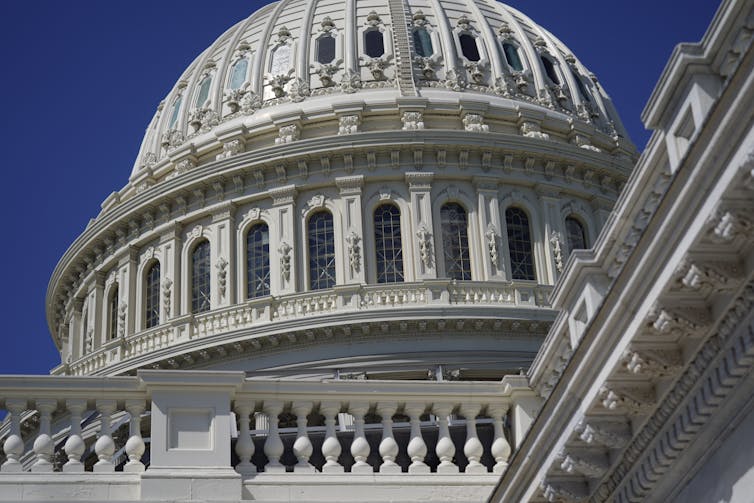
Americans dislike Congress, especially when it fails to act on pressing problems. They are then surprised by legislative accomplishments on climate change, gun control and maintaining competitiveness with China.
But Congress does much more on a daily basis than deal – or fail to deal – with high-profile issues.
We have spent more than a decade exploring the thousands of bills and hundreds of laws produced by members of Congress each year. We find that individual representatives and senators vary dramatically in how interested they are in lawmaking and how effectively they advance their proposals. And we see opportunities to build a better Congress.
We have devised and generated a “Legislative Effectiveness Score” for each member of the House and Senate for each two-year Congress for the past 50 years. These scores are based on 15 metrics, capturing how many bills each lawmaker sponsors, how far they progress toward law and how substantively significant they are. The scores are politically neutral, with members of both parties scoring higher upon advancing whatever policies they think are best.
Voters can use these scores to see how their political representatives have fared in this measure, perhaps finding them among the 23% of representatives or 19% of senators who were highly effective in the most recently completed Congress. And researchers use them to determine the factors that make lawmakers effective in Congress.
Based on our work, we have identified five ways that legislators, reformers and voters can help promote effective lawmaking in Congress.
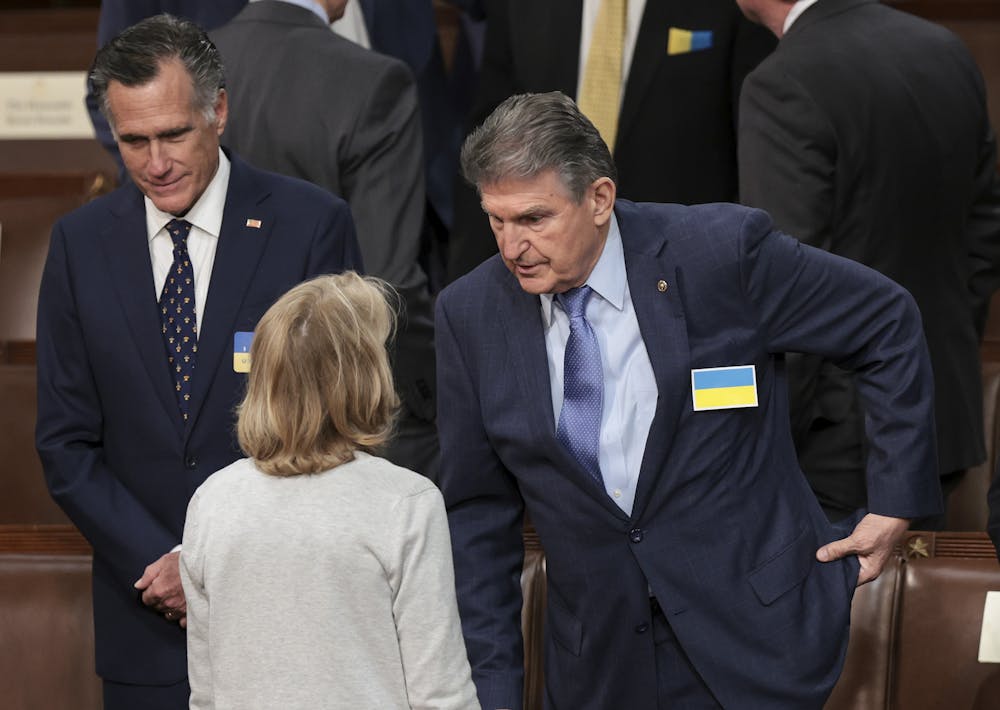
1. Lawmakers can focus their legislative agendas on their interests, committee assignments and constituency needs
Members of Congress face many demands on their time. They are almost always campaigning or raising money for the next election. Their time on Capitol Hill is punctuated with committee meetings and calls to votes on the House or Senate floor.
Such pressures leave little time to formulate new policies, build coalitions and advance their proposals. Effective lawmakers do not have more time than others – they simply align these various activities toward a common goal of lawmaking.
Effective lawmakers introduce bills that combine their own interests and passions with the needs of their constituencies and their committee assignments.
Thus, time spent away from Washington, in their home states and districts, is focused on identifying the policy needs of their constituents and highlighting their policy successes; time in committee is spent making and refining their policy proposals; time milling around between votes is used to build coalitions.
For the effective lawmaker, all these different activities form a coherent whole.
2. Legislators can view lawmaking as a team sport
No member of Congress can accomplish anything by himself or herself. Effective lawmakers recognize this and build a successful team.
Our analysis found that effective lawmakers avoid the pitfall of hiring loyal campaign staffers to handle the legislative work of their offices. Starting on Day One, they hire – and subsequently retain – legislative staff who have extensive experience on Capitol Hill.
They then join with like-minded colleagues to take advantage of the added resources provided by legislative caucuses, such as additional staff support and independent policy analyses, apart from the help provided by party leadership.
Moreover, for effective lawmakers, their team is not limited to their political party. Those willing to co-sponsor bills written by members of the other party find more bipartisan support for their own efforts. Our analysis demonstrates that such bipartisan lawmakers are the most successful at advancing their bills through Congress.
3. Lawmakers can specialize and develop policy expertise
Members of Congress need to be generalists to vote knowledgeably on diverse policy topics on any given day. Many take that generalist view to their lawmaking portfolio, sponsoring legislation in each of the 21 major issue areas addressed by Congress.
But we find that the most effective lawmakers dedicate about half of their time, attention and legislative proposals to a single issue area. By becoming an acknowledged experts in issues of health or education or international affairs, for example, lawmakers become central to policy formulation in their area of interest.
4. Reforms can reinforce good lawmaking habits
Individual lawmakers in Congress could adopt any of the practices above to become more effective. But institutional reforms could help reinforce such good behaviors.
The Select Committee on the Modernization of Congress has put forward dozens of reform proposals in the House of Representatives over the past three years. Based on our extensive research, we believe the proposals that would attract and retain experienced staff, promote bipartisanship or encourage the development of expertise through committee-centered lawmaking can increase the lawmaking effectiveness of Congress as a whole.
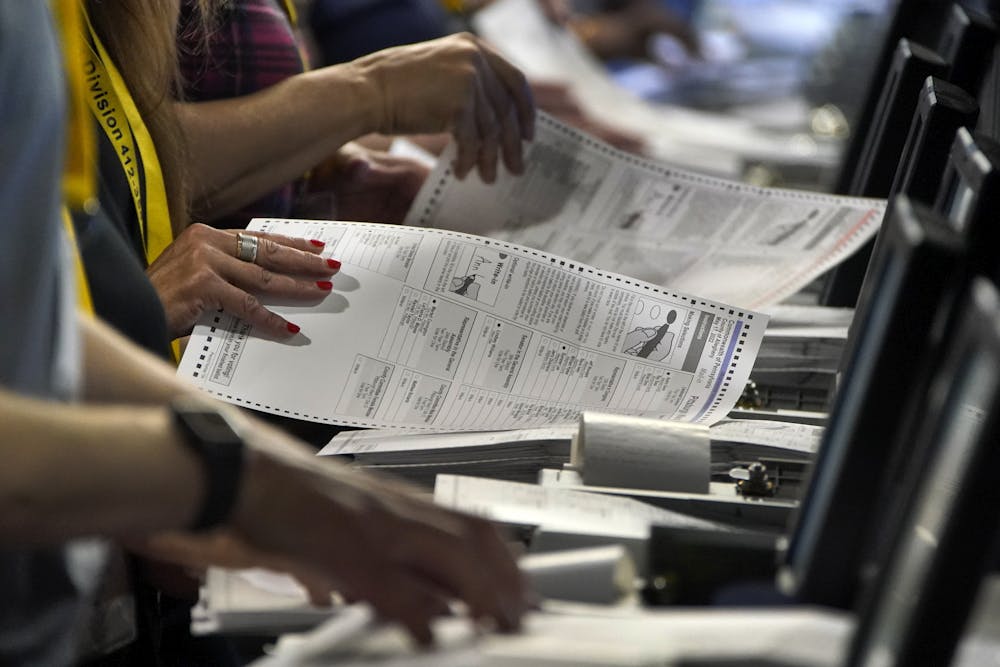
5. Voters can reward effective lawmaking
Without electoral rewards for effective lawmaking, members of Congress may focus on being show horses rather than legislative workhorses.
The role of voters starts with the initial selection of candidates. Voters might consider whether candidates demonstrate policy expertise and speak about the benefits of bipartisanship, for example. They might consider our analysis showing that effective state legislators and women tend to be more effective lawmakers in Congress, on average.
Among incumbents, voters do strongly prefer effective over ineffective lawmakers at reelection time. However, when voters lack credible information about how effective their representative is, it is much easier to vote simply based on partisanship or other considerations.
On the whole, Congress can function much better. Effective lawmakers from the past have shown the path forward. Our analysis of 50 years of data offers lessons that any representative or senator can adopt, as well as reforms and electoral pressures that can nudge them in the right direction.
Craig Volden, Professor of Public Policy and Politics, University of Virginia and Alan E. Wiseman, Cornelius Vanderbilt Professor of Political Economy, Professor of Political Science and Law, Vanderbilt University
This article is republished from The Conversation under a Creative Commons license. Read the original article.