CLEARLAKE, Calif. — Clearlake Animal Control has many dogs waiting to be adopted, and officials are asking people to consider adding new pets to their family.
The City of Clearlake Animal Association also is seeking fosters for the animals waiting to be adopted.
Call the Clearlake Animal Control shelter at 707-273-9440, or email This email address is being protected from spambots. You need JavaScript enabled to view it. to inquire about adoptions and schedule a visit to the shelter.
Visit Clearlake Animal Control on Facebook or on the city’s website.
The following dogs are available for adoption. New additions are at the top.
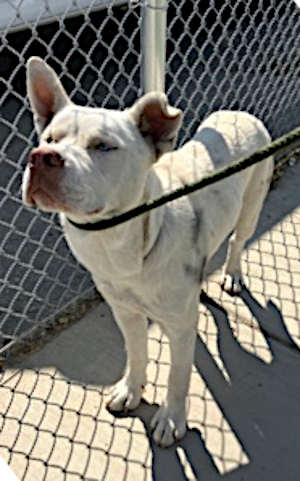
“Andy.” Photo courtesy of Clearlake Animal Control. ‘Andy’
“Andy” is a male American pit bull mix with a short gray and white coat.
He is dog No. 48995415.
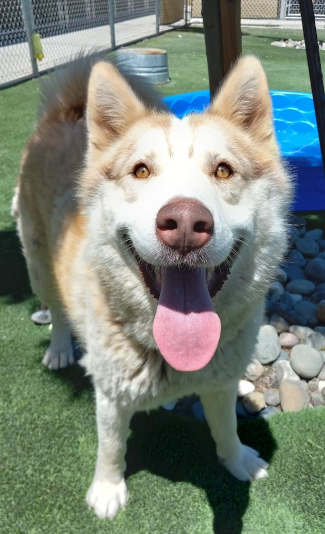
“Aoki.” Photo courtesy of Clearlake Animal Control. ‘Aoki’
“Aoki” is a male Siberian husky mix with a white coat.
He has been neutered.
He is dog No. 50905477.
“Babs.” Photo courtesy of Clearlake Animal Control. ‘Babs’
“Babs” is a female Labrador retriever mix with a short black coat.
She has been spayed.
She is dog No. 49505856.
“Baby.” Photo courtesy of Clearlake Animal Control. ‘Baby’
“Baby” is a female American pit bull mix with a white coat.
She has been spayed.
She is dog No. 50933640.
“Bear.” Photo courtesy of Clearlake Animal Control. ‘Bear’
“Bear” is a male Labrador retriever-American pit bull mix with a short charcoal and fawn coat.
He has been neutered.
He is dog No. 48443153.
“Big Phil.” Photo courtesy of Clearlake Animal Control. ‘Big Phil’
“Big Phil” is a 13-year-old male American pit bull terrier mix with a blue coat.
He has been neutered.
He is dog No. 49951647.
“Bruce.” Photo courtesy of Clearlake Animal Control. ‘Bruce’
“Bruce” is a 2-year-old American pit bull mix with a short gray coat with white markings.
He has been neutered.
He is dog No. 50684304.
“Buster.” Photo courtesy of Clearlake Animal Control. ‘Buster’
“Buster” is a male pit bull mix with a short tan coat.
He has been neutered.
He is dog No. 50762164.
“Eros.” Photo courtesy of Clearlake Animal Control. ‘Eros’
“Eros” is a male Rottweiler mix with a short black and tan coat.
He has been neutered.
He is dog No. 50754504.
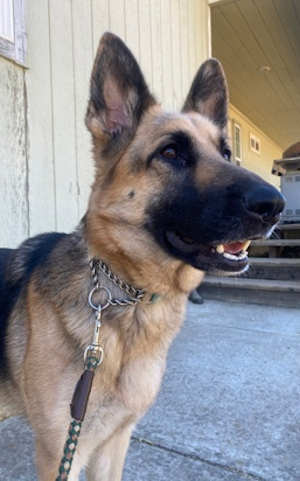
“Foxie.” Photo courtesy of Clearlake Animal Control. ‘Foxie’
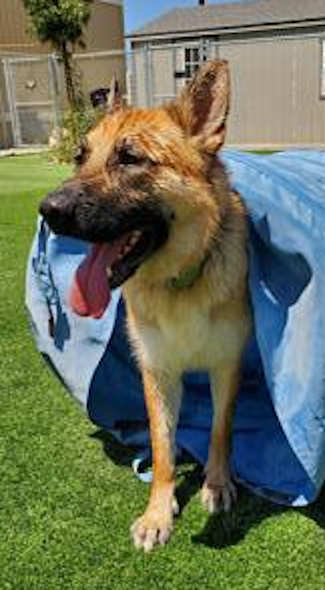
“Foxie” is a female German shepherd with a red, black and white coat.
She has been spayed.
She is dog No. 49702845.
“Goliath.” Photo courtesy of Clearlake Animal Control. ‘Goliath’
“Goliah” is a male Rottweiler mix with a short black and tan coat.
He is dog No. 50754509.
“Hakuna.” Photo courtesy of Clearlake Animal Control.“Hakuna.” Photo courtesy of Clearlake Animal Control. ‘Hakuna’
“Hakuna” is a male shepherd mix with a tan coat.
He has been neutered.
He is dog No. 50176912.
“Herman.” Photo courtesy of Clearlake Animal Control. ‘Herman’
“Herman” is a 7-year-old male American pit bull terrier mix with a brown coat.
He has been neutered.
He is dog No. 51236411.
“Hondo.” Photo courtesy of Clearlake Animal Control. ‘Hondo’
“Hondo” is a male Alaskan husky mix with a buff coat.
He has been neutered.
He’s dog No. 50227693.
“Keilani.” Photo courtesy of Clearlake Animal Control. ‘Keilani’
“Keilani” is a 3-year-old female German shepherd mix with a black and tan coat.
She has been spayed and she is house trained.
She is dog No. 50427566.
“Little Boy.” Photo courtesy of Clearlake Animal Control. ‘Little Boy’
“Little Boy” is a male American pit bull terrier mix with a short tan coat.
He has been neutered.
He is dog No. 50075256.
“Luciano.” Photo courtesy of Clearlake Animal Control. ‘Luciano’
“Luciano” is a male Siberian husky mix with a short black and white coat.
He has been neutered.
He is dog No. 50596272.
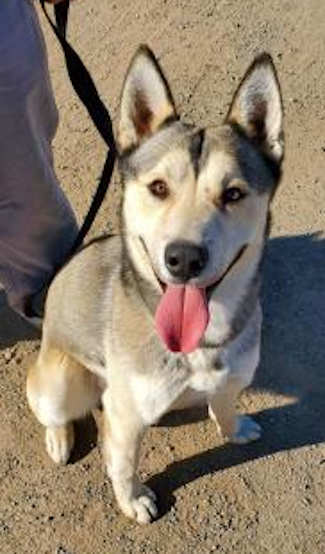
“Mamba.” Photo courtesy of Clearlake Animal Control. ‘Mamba’
“Mamba” is a male Siberian husky mix with a gray and cream-colored coat.
He has been neutered.
He is dog No. 49520569.
“Matata.” Photo courtesy of Clearlake Animal Control. ‘Matata’
“Matata” is male shepherd mix with a tan coat.
He has been neutered.
He is dog No. 50176912.
“Maya.” Photo courtesy of Clearlake Animal Control. ‘Maya’
“Maya” is a female German shepherd with a black and tan coat.
She has been spayed.
She is dog No. 50428151.
“Mikey.” Photo courtesy of Clearlake Animal Control. ‘Mikey’
“Mikey” is a male German shepherd mix with a short brown and tan coat.
He has been neutered.
He is dog No. 51012855.
“Poppa.” Photo courtesy of Clearlake Animal Control. ‘Poppa’
“Poppa” is a 3-year-old male American pit bull terrier mix with a short red and white coat.
He has been neutered.
He is dog No. 50773597.
“Rascal.” Photo courtesy of Clearlake Animal Control. ‘Rascal’
“Rascal” is a male shepherd mix with a black and brown coat.
He has been neutered.
He is dog No. 50806384.
“Sadie.” Photo courtesy of Clearlake Animal Control. ‘Sadie’
“Sadie” is a female German shepherd mix with a black and tan coat.
She has been spayed.
She is dog No. 49802563.
“Snowball.” Photo courtesy of Clearlake Animal Control. ‘Snowball’
“Snowball is a 1 and a half year old male American Staffordshire terrier mix with a short white coat.
He has been neutered.
He is dog No. 49159168.
“Terry.” Photo courtesy of Clearlake Animal Control. ‘Terry’
“Terry” is a handsome male shepherd mix with a short brindle coat.
He gets along with other dogs, including small ones, and enjoys toys. He also likes water, playing fetch and keep away.
Staff said he is now getting some training to help him build confidence.
He is dog No. 48443693.
“Willie.” Photo courtesy of Clearlake Animal Control. ‘Willie’
“Willie” is a male German shepherd mix with a black and tan coat.
He has been neutered.
He is dog No. 50596003.
“Zeda.” Photo courtesy of Clearlake Animal Control. ‘Zeda’
“Zeda” is a female Labrador retriever mix.
She has been spayed.
She is dog No. 51108916.
Email Elizabeth Larson at This email address is being protected from spambots. You need JavaScript enabled to view it.. Follow her on Twitter, @ERLarson, or Lake County News, @LakeCoNews.
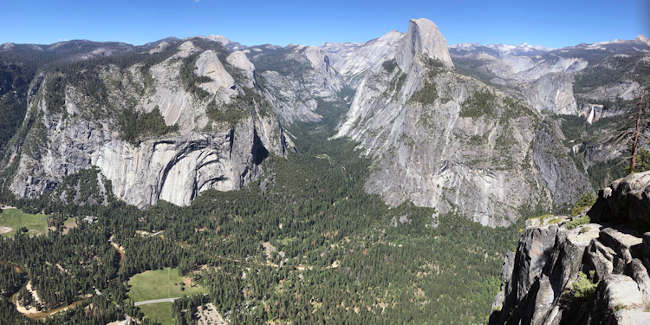
Tenaya Canyon (center) and part of Yosemite Valley (foreground) as seen from Glacier Point in Yosemite National Park. Tenaya Creek likely started to scour this granite canyon below Half Dome (center right) about 5 to 10 million years ago, with glaciers arriving about 2.5 million years ago to sculpt the classic glacial valley outlines. Photo credit: Greg Stock/National Park Service. BERKELEY, Calif. — First-time visitors to Yosemite Valley gape in awe at the sheer granite wall of El Capitan and the neatly sliced face of Half Dome, aware, perhaps vaguely, that rain and glaciers must have taken a long time to cut and sculpt that landscape. But how long?
Did it all start 50 million years ago, when the granite through which the valley cuts was first exposed to the elements? Was it 30 million years ago, when data suggest canyons in the southern Sierra Nevada began to form? Did the valley only begin to form after the Sierra tilted toward the west some 5 million years ago, or was it mostly due to glaciers that formed in a cooling climate 2 to 3 million years ago?
Geologists from the University of California, Berkeley, employed a novel technique of rock analysis to get a more precise answer, and concluded that much of Yosemite Valley’s impressive depth was carved since 10 million years ago, and most likely even more recently — over the past 5 million years. This shaves about 40 million years off the oldest estimates.
Rivers performed the initial carving in a preexisting shallow valley, they determined, and then both rivers and ice contributed recently.
While the scientists are unable to be more precise, the new estimate is the first to be based on an experimental study of the granite rocks in and near Yosemite, rather than on inferences based on what was going on elsewhere in the Sierra Nevada.
“Yosemite Valley is one of the most famous topographic features on the planet,” said glaciologist Kurt Cuffey, UC Berkeley professor of geography and of earth and planetary science. “And of course, if you go to Yosemite Park and read the signage, they will give you numbers for when it became a deep canyon. But up until this project, every single claim about how old this valley is, when it formed a deep canyon, was just based on assumptions and speculation.”
Yosemite National Park geologist Greg Stock admits that the story told about the origin of the park’s iconic granite topography has been a little vague, because geologists still do not agree about what has happened since the Sierra’s signature granite formed underground between about 80 and 100 million years ago, up to 10 kilometers (6 miles) under a mountain range that looked a lot different than it does today.
“We know that the Sierra was a high mountain range 100 million years ago, when the granite was forming at depth. It was a chain of volcanoes that might have looked a bit like the Andes Mountains in South America,” Stock said. “The question really is whether the elevation has just been coming down through erosion since that time or whether it came down some and then was uplifted again more recently. At this point, based on studies I've done for most of my career and supported by this study, I see a lot of evidence for recent uplift happening sometime in the last 5 million years.”
That uplift, which happened at the same time that earthquake faulting in the eastern Sierra Nevada created an escarpment several kilometers high, steepened the western slopes and rivers, causing them to incise valleys more quickly.
Cuffey, UC Berkeley geochemist David Shuster and their colleagues, including Stock, published the findings this week in the journal Geological Society of America Bulletin.
Rock cooldown
Shuster, a professor of earth and planetary science, developed a technique 15 years ago that he thought at the time might shed light on the origins of the valley, something that has fascinated both him and Cuffey since they first saw Yosemite as kids. Shuster, a California native, has visited it since early childhood. Cuffey, from central Pennsylvania, made his first trip to the park at the age of 15.
Much of what they remember learning is that the valley was carved by glaciers, giving short shrift to what happened before Ice Age glaciers arrived in the Pleistocene some 2.5 million years ago.
“What I learned from the signage in the valley when I was a kid wasn't quite right, given what the scientific literature said at the time. Nevertheless, the topography has been interpreted to be significantly modified by ice,” Shuster said. “How to quantify that with geochronological tools, rather than just make up a story about it based on geomorphology, is one thing we were trying to do here.”
Shuster’s technique, called helium-4/helium-3 thermochronometry, reconstructs the temperature history of a sample of rock based on the spatial distribution of natural helium-4 in minerals, which is measured by comparison to an artificially-produced uniform distribution of helium-3. Because temperature increases with depth underground, the temperature history can tell when a rock was uncovered as the landscape eroded.
“The temperature of the rock is a function of the surface lowering down into it,” Shuster said. “It's very analogous to removing a down comforter — the rock beneath it progressively gets colder. This progression through time with the rock cooling is what we get from the geochemistry and thermochronometry.”
The expectation is that granite bedrock exposed on the broad uplands of the Sierra should show a long history of cool surface temperatures, since they’ve been exposed for tens of millions of years longer than bedrock more recently exposed on the floor of Tenaya Canyon, which feeds into Yosemite Valley from the northeast.
The experiments, conducted at the Berkeley Geochronology Center, indicated that, while rock from the uplands has been close to the surface for about 50 million years, bedrock at the bottom of Tenaya Canyon has been exposed much more recently. The temperature history of the rock obtained from the bottom of Tenaya Canyon — from an exposed area of bedrock at the base of Half Dome — indicates that it was more than a kilometer underground 10 million years ago, and most likely only 5 million years ago. This means that a kilometer of rock was eroded away since that time.
“This upland surface that people are familiar with from parts of the Tioga Road and Tuolumne Meadows — that's a very old landscape,” said Cuffey, who is the Martin Distinguished Chair in Ocean, Earth and Climate Science. “The question is: What about the deep canyon? Is that also very old, or is it relatively young? And what we found in our study, our big contribution, is that it's fairly young. The best guess for the timing is in the last 3 to 4 million years, but maybe as far back as 10 million years for the start of the rapid incision.”
Bedrock studies
The geologists collected samples of granite bedrock from nearby highlands and the bottom of Tenaya Canyon, but not from the bedrock bottom of Yosemite Valley itself, which lies buried under about 500 meters (1/3 mile) of sediment that today forms the valley floor. But since the two formed at the same time, one can infer the timing of the formation of Yosemite Valley from the time of the scouring of Tenaya Canyon.
“The brief history of Yosemite Valley would be that there was some kind of valley in place for tens of millions of years — a river-carved canyon associated with the ancient Sierra Nevada. And then, in the last 5 million years or so, renewed uplift of the range through westward tilting caused rivers to steepen and deepen the canyons that they were in,” Stock said. “So, that probably carved out more of Yosemite Valley and may have started forming Tenaya Canyon. And then in the last 2 to 3 million years, as the climate cooled and glaciers came down through Tenaya Canyon and into Yosemite Valley, they further sculpted the rock, deepening those valleys. And in the case of Yosemite Valley, widening it out considerably. So, there's some component of an old Yosemite Valley. But I think this recent work shows that much more of that topography is younger, rather than older.”
Stock, who has held the position of park geologist for 17 years and is the park’s first geologist, said the new study will revise how the park tells the geological history of Yosemite Valley.
“The timing of this new study is perfect in the sense that, over the next several years, we’re hoping to completely redo the Geology Hut displays at Glacier Point. I'm very excited to include these new results in those displays,” he said. “It's a perfect place to tell that story, because there's a view straight up Tenaya Canyon.”
Robert Sanders writes for the UC Berkeley News Center.
The Herbig-Haro objects HH 1 and HH 2. Photo courtesy of ESA/Hubble & NASA, B. Reipurth, B. Nisini. The lives of newborn stars are tempestuous, as this image of the Herbig-Haro objects HH 1 and HH 2 from the NASA/ESA Hubble Space Telescope depicts.
Both objects are in the constellation Orion and lie around 1,250 light-years from Earth. HH 1 is the luminous cloud above the bright star in the upper right of this image, and HH 2 is the cloud in the bottom left.
While both Herbig-Haro objects are visible, the young star system responsible for their creation is lurking out of sight, swaddled in the thick clouds of dust at the center of this image.
However, an outflow of gas from one of these stars is streaming out from the central dark cloud and is visible as a bright jet. Astronomers once thought the bright star between that jet and the HH 1 cloud was the source of these jets, but it is an unrelated double star that formed nearby.
Herbig-Haro objects are glowing clumps found around some newborn stars. They form when jets of gas thrown outwards from these young stars collide with surrounding gas and dust at incredibly high speeds. In 2002, Hubble observations revealed that parts of HH 1 are moving at more than 248 miles per second!
Hubble’s Wide Field Camera 3 captured this turbulent stellar nursery using 11 different filters at infrared, visible, and ultraviolet wavelengths.
Each of these filters is sensitive to just a small slice of the electromagnetic spectrum, and they allow astronomers to pinpoint interesting processes that emit light at specific wavelengths.
In the case of HH 1 and 2, two groups of astronomers requested Hubble observations for two different studies.
The first delved into the structure and motion of the Herbig-Haro objects visible in this image, giving astronomers a better understanding of the physical processes occurring when outflows from young stars collide with surrounding gas and dust.
The second study investigated the outflows themselves to lay the groundwork for future observations with the NASA/ESA/CSA James Webb Space Telescope. Webb, with its ability to peer past the clouds of dust enveloping young stars, will revolutionize the study of outflows from young stars.
LAKE COUNTY, Calif. — Power could be cut to some parts of Lake County early next week due to high winds.
Pacific Gas and Electric said a public safety power shutoff, or PSPS, is likely on Sunday, Oct. 23, and Monday, Oct. 24, as a result of high winds and dry conditions.
In addition to Lake, counties under watch for Sunday are Butte, Colusa, Fresno, Glenn, Kern, Napa, Stanislaus, Tehama and Yolo.
On Monday, counties under watch are Lake, Butte, Kern, Napa and Tehama.
PG&E said specific addresses, maps and shutoff details are typically available two days before a shutoff.
Email Elizabeth Larson at This email address is being protected from spambots. You need JavaScript enabled to view it.. Follow her on Twitter, @ERLarson, or Lake County News, @LakeCoNews.
LAKEPORT, Calif. — The Lakeport Police Department is once again participating in the United States Drug Enforcement Administration National Prescription Drug Take Back Day.
This year’s event takes place from 10 a.m. to 2 p.m. Saturday, Oct. 29, at the front lobby entrance of the police station at 2025 S. Main St.
During the event, the agency will accept all over-the-counter or prescription medications in pill, tablet, liquid, cream or capsule form including schedule II-V controlled and non-controlled substances.
Pills need to be emptied out of their containers and placed in a zip lock plastic bag — not paper — so they can easily see the contents to make sure there is nothing in the bag they can’t take.
The department said it will collect vape pens or other e-cigarette devices from individual consumers only after the batteries are removed from the devices.
Items that will not be accepted during the event are illegal drugs, needles, inhalers or aerosol cans.
Since the Lakeport Police Department started participating with the prescription Take Back Program in January of 2019, it has collected over 978 pounds of prescription drugs, many of which were dangerous narcotics including opioids.
“This protects our community by keeping these drugs from being diverted to illegal use and keeps it out of our environment and water,” the department said.
As our youth learn to get behind the wheel, their safety and protection is of critical importance.
The California Highway Patrol, with the support of the grant-funded Start Smart Teen Driver Safety Education Program XV, has launched new Start Smart classes.
These classes coincide with National Teen Driver Safety Week, which runs Oct. 16 to 22.
Drivers between 15 and 19 years of age are at greater risk of being involved in fatal crashes.
The Start Smart program is designed to help teens learn how to avoid distractions and address the dangers typically encountered by drivers in their age group.
According to the California Department of Motor Vehicles, there are nearly 792,970 licensed teenage drivers in California, which increased by 6% since last year.
Data from the CHP’s Statewide Integrated Traffic Records System indicated that in 2020 there were 6,644 fatal and injury crashes involving teen drivers between 15 to 19 years of age.
This age group has the largest proportion of drivers who were distracted at the time of the fatal crashes.
Start Smart is a free class aimed at helping teenage drivers become aware of the responsibilities that accompany the privilege of being a licensed California driver.
Parents or guardians are required to attend with their teenage driver as they participate in this
two-hour Start Smart class, completion of which may lower the cost of a young driver’s vehicle insurance. The class is being offered at CHP Area offices throughout the State.
“The Start Smart program exists to save young lives as they move into their journey behind the wheel,” said CHP Commissioner Amanda Ray.
Parents and teenagers can register for a Start Smart class by contacting their local CHP Area office. More information about Start Smart and California’s provisional licensing law is available on the free CHP Start Smart mobile app.
This mobile app includes access to the California Driver Handbook and a trip logger to track driving time as teens prepare to obtain their driver license.
Funding for this program was provided by a grant from the California Office of Traffic Safety, through the National Highway Traffic Safety Administration.
 How to resolve AdBlock issue?