 How to resolve AdBlock issue?
News
On Friday, the California Transportation Commission, or CTC, allocated more than $988 million to repair and improve transportation infrastructure throughout the state.
This funding includes more than $450 million from the federal Infrastructure Investment and Jobs Act of 2021, or IIJA, and more than $250 million from Senate Bill 1, the Road Repair and Accountability Act of 2017.
“The CTC’s investments will help rebuild California’s transportation infrastructure while increasing transit and active transportation options. These projects reflect the CTC and Caltrans’ commitment to safety and meeting future challenges,” said Caltrans Director Tony Tavares.
The CTC approved approximately $20.9 million, including more than $18.7 million in federal IIJA funding toward roadway, guardrail and other improvements from west of Irvine Avenue to east of Mid Lake Road near Upper Lake along Route 20 in Lake County.
In another project that will benefit Lake County, approximately $3.1 million was allocated toward the removal of hazardous trees on U.S. 101, and Routes 1 and 175 at various locations in Mendocino and Lake counties.
Other projects in the region the CTC approved on Friday include:
• Approximately $7.2 million including more than $6.3 million in federal IIJA funding toward the construction of an auxiliary lane on U.S. 101 from Route 299 to south of Giuntoli Lane in Arcata, Humboldt County.
• Approximately $34 million including more than $30.1 million in federal IIJA funding and $397,000 in SB1 funding toward median barrier and culvert repairs and roadway improvements on U.S. 101 near Willits from north of West Road to South of the Haehl Bridge in Mendocino County.
• Approximately $2.2 million toward the removal of hazardous trees on U.S. 101, and Routes 199 and 254 at various locations in Humboldt, Del Norte and Mendocino counties.
SB 1 provides $5 billion in transportation funding annually that is shared equally between the state and local agencies.
Road projects progress through construction phases more quickly based on the availability of SB 1 funds, including projects that are partially funded by SB 1.
For more information about transportation projects funded by SB 1, visit RebuildingCA.ca.gov.
Jordan Daniel Alger, 18, is the suspect in those cases, police said.
Over the past several weeks, Lakeport Police Department officers have been investigating a series of residential burglaries, thefts and vehicle thefts.
In addition to two vehicles, the stolen items included thousands of dollars of tools, firearms and other items.
Numerous LPD officers were involved in the ongoing and active investigation and, from multiple methods, were able to identify Alger as a suspect.
On Jan. 7, the Lakeport Police Department arrested Alger for burglary, conspiracy, possession of a controlled substance and possession of drug paraphernalia.
Subsequently, Alger was identified as a suspect in a total of five additional cases, including the ones described above that involved vehicles, burglary and theft of firearms.
While the investigation was active, the Lake County Sheriff’s Office arrested Alger in another part of Lake County on several charges, including possession of controlled substances while armed with a loaded firearm and possession of a short-barrel rifle. He has been in custody since Jan. 20.
During followup investigations this week, Lakeport Police officers recovered a stolen vehicle in Nice which was connected to Alger.
Additionally, a stolen gun belt from one of the Lakeport burglaries was in the vehicle, police said.
Based on all the evidence, facts and circumstances gathered to date, Lakeport Police officers are placing additional charges and booking Alger on two counts of felony vehicle theft, two counts of burglary, felony conspiracy and felony theft of a firearm.
Based on an affidavit from Lakeport Police requesting bail enhancement, a Lake County Superior Court Judge set bail on these charges at $250,000.
“Our investigation remains active, and we seek additional leads that may connect Alger to additional crimes while Alger remains in custody,” police sadi in a Frida statement.
Anyone with information related to Alger’s criminal activities in January is asked to contact Lakeport Police Sgt. Andrew Welter at 707-263-5491,
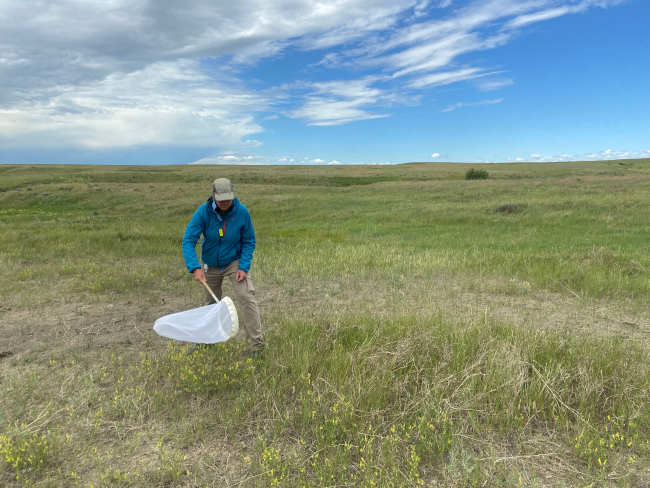
BOZEMAN, Mont. — The western bumble bee was once common in western North America, but increasing temperatures, drought, and pesticide use have contributed to a 57% decline in the occurrence of this species in its historical range, according to a new U.S. Geological Survey-led study.
Using data from 1998 to 2020, scientists determined that increasing summer temperatures and drought partly drove declines of the native western bumble bee in recent decades, with rising temperatures being particularly important. The decline in pollinators is a cause for concern because most flowering plants depend on pollinators such as the western bumble bee to promote reproduction. Pollinators are also essential to our agriculture industry and economy and provide fruits, seeds and nuts that both humans and wildlife rely on. To further complicate matters for the western bumble bee, climate change continues to make rising temperatures and drought more common in the western states.
“There has been an ongoing global decline in pollinators, including in North America,” said Will Janousek, USGS scientist and co-lead author of the study. “The decline in the once common western bumble bee shows that common, widespread species are not excluded from this trend and our study showed that climate change is an important reason for the decline of this native bee species.”
The research team found another reason for the reduced distribution of the once common western bumble bee in a pesticide use dataset spanning 2008-2014: a group of insecticides called neonicotinoids, which are commonly used in agriculture. In areas where neonicotinoids were applied, the western bumble bee was less likely to occur and as the rate of neonicotinoid application increased, the bumble bee’s presence declined further.
The scientists also projected the future status of the western bumble bee in 16 regions of the western United States in the 2050s under different future scenarios, considering increasing levels of future climate stressors, changing forest and shrub cover, and other factors.
“Even considering the most optimistic scenario, western bumble bee populations are expected to continue to decline in the near future in nearly half of the regions across the bumble bee’s range,” said Tabitha Graves, USGS scientist and co-lead author on the study. “Considering the more severe, but probably more likely scenarios, western bumble bee populations are expected to decline an additional 51% to 97% from 2020 levels depending on the region.”
This study was a collaborative effort between the USGS, U.S. Fish and Wildlife Service, U.S. Department of Agriculture-Agriculture Research Service, Dickinson College, Canadian Wildlife Service, Montana State University, Xerces Society for Invertebrate Conservation, University of Colorado Boulder, The Ohio State University, and the University of Wyoming. It is published in the journal Proceedings of the National Academy of Sciences. For more information on bumble bee research in the West, please visit the USGS Northern Rocky Mountain Science Center website.

Curious Kids is a series for children of all ages. If you have a question you’d like an expert to answer, send it to
How does the inside of the Earth stay boiling hot for billions of years? Henry, age 11, Somerville, Massachusetts
Our Earth is structured sort of like an onion – it’s one layer after another.
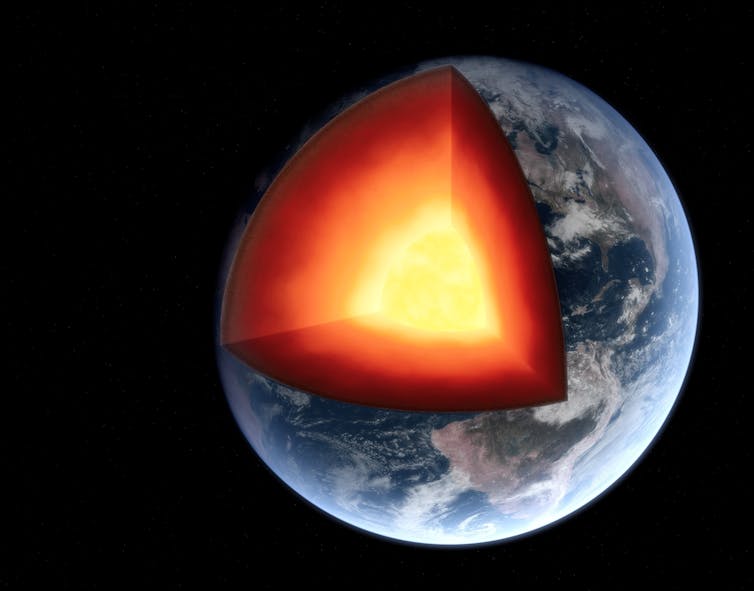
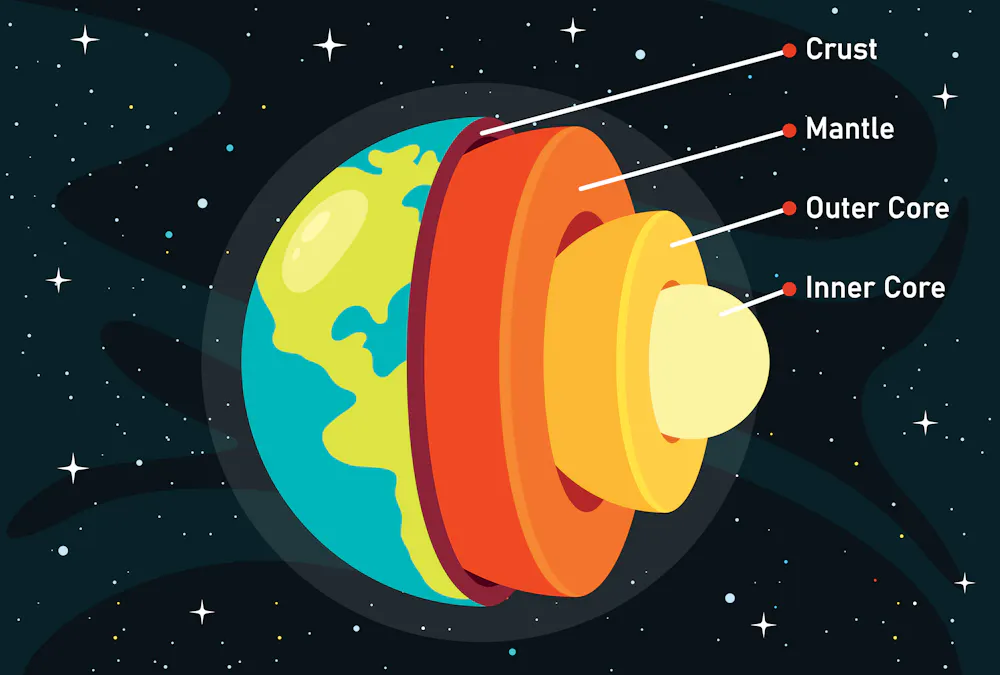
Starting from the top down, there’s the crust, which includes the surface you walk on; then farther down, the mantle, mostly solid rock; then even deeper, the outer core, made of liquid iron; and finally, the inner core, made of solid iron, and with a radius that’s 70% the size of the Moon’s. The deeper you dive, the hotter it gets – parts of the core are as hot as the surface of the Sun.
Journey to the center of the Earth
As a professor of earth and planetary sciences, I study the insides of our world. Just as a doctor can use a technique called sonography to make pictures of the structures inside your body with ultrasound waves, scientists use a similar technique to image the Earth’s internal structures. But instead of ultrasound, geoscientists use seismic waves – sound waves produced by earthquakes.
At the Earth’s surface, you see dirt, sand, grass and pavement, of course. Seismic vibrations reveal what’s below that: rocks, large and small. This is all part of the crust, which may go down as far as 20 miles (30 kilometers); it floats on top of the layer called the mantle.
The upper part of the mantle typically moves together with the crust. Together, they are called the lithosphere, which is about 60 miles (100 kilometers) thick on average, although it can be thicker at some locations.
The lithosphere is divided into several large blocks called plates. For example, the Pacific plate is beneath the whole Pacific Ocean, and the North American plate covers most of North America. Plates are kind of like puzzle pieces that fit roughly together and cover the surface of the Earth.
The plates are not static; instead, they move. Sometimes it’s the tiniest fraction of inches over a period of years. Other times, there’s more movement, and it’s more sudden. This sort of movement is what triggers earthquakes and volcanic eruptions.
What’s more, plate movement is a critical, and probably essential, factor driving the evolution of life on Earth, because the moving plates change the environment and force life to adapt to new conditions.
The heat is on
Plate motion requires a hot mantle. And indeed, as you go deeper into the Earth, the temperature increases.
At the bottom of the plates, around 60 miles (100 kilometers) deep, the temperature is about 2,400 degrees Fahrenheit (1,300 degrees Celsius).
By the time you get to the boundary between the mantle and the outer core, which is 1,800 miles (2,900 kilometers) down, the temperature is nearly 5,000 F (2,700 C).
Then, at the boundary between outer and inner cores, the temperature doubles, to nearly 10,800 F (over 6,000 C). That’s the part that’s as hot as the surface of the Sun. At that temperature, virtually everything – metals, diamonds, human beings – vaporizes into gas. But because the core is at such high pressure deep within the planet, the iron it’s made up of remains liquid or solid.
Collisions in outer space
Where does all that heat come from?
It is not from the Sun. While it warms us and all the plants and animals on Earth’s surface, sunlight can’t penetrate through miles of the planet’s interior.
Instead, there are two sources. One is the heat that Earth inherited during its formation 4.5 billion years ago. The Earth was made from the solar nebula, a gigantic gaseous cloud, amid endless collisions and mergings between bits of rock and debris called planetesimals. This process took tens of millions of years.
An enormous amount of heat was produced during those collisions, enough to melt the whole Earth. Although some of that heat was lost in space, the rest of it was locked away inside the Earth, where much of it remains even today.
The other heat source: the decay of radioactive isotopes, distributed everywhere in the Earth.
To understand this, first imagine an element as a family with isotopes as its members. Every atom of a given element has the same number of protons, but different isotope cousins have varying numbers of neutrons.
Radioactive isotopes are not stable. They release a steady stream of energy that converts to heat. Potassium-40, thorium-232, uranium-235 and uranium-238 are four of the radioactive isotopes keeping Earth’s interior hot.
Some of those names may sound familiar to you. Uranium-235, for example, is used as a fuel in nuclear power plants. Earth is in no danger of running out of these sources of heat: Although most of the original uranium-235 and potassium-40 are gone, there’s enough thorium-232 and uranium-238 to last for billions more years.
Along with the hot core and mantle, these energy-releasing isotopes provide the heat to drive the motion of the plates.
No heat, no plate movement, no life
Even now, the moving plates keep changing the surface of the Earth, constantly making new lands and new oceans over millions and billions of years. The plates also affect the atmosphere over similarly lengthy time scales.
But without the Earth’s internal heat, the plates would not have been moving. The Earth would have cooled down. Our world would likely have been uninhabitable. You wouldn’t be here.
Think about that, the next time you feel the Earth under your feet.
Hello, curious kids! Do you have a question you’d like an expert to answer? Ask an adult to send your question to 
Shichun Huang, Associate Professor of Earth and Planetary Sciences, University of Tennessee
This article is republished from The Conversation under a Creative Commons license. Read the original article.
Treasurer-Tax Collector Patrick Sullivan urged the board not to accept the offer from North State Solutions, based in Chico, for numerous reasons, ranging from the below-market-value offer to the challenge of monitoring the project.
“My office has a number of concerns about this application,” he said Tuesday evening.
Brenda Pickern of Chico submitted filings to the Secretary of State’s Office on Sept. 4 to form North State Solutions, the specific purpose of which “is to acquire single-family dwellings for rehabilitation and sale to low-income persons, vacant land for construction of low-income housing, or vacant land to be dedicated to public use.”
Pickern is a disability rights advocate who also has filed numerous lawsuits against businesses — including Safeway and Pier 1 Imports — due to accessibility issues.
While North State Solutions has filed with the Secretary of State, it so far is not shown as having been registered in the California Attorney General’s Office online database of charitable organizations.
Eight days after filing with the Secretary of State’s Office, Pickern’s organization transmitted an offer to the Treasurer-Tax Collector’s Office to purchase all remaining tax-defaulted properties that did not sell at the June 2022 sale, Sullivan said.
Altogether, North State Solutions offered to purchase the 548 remaining properties for $354,934.60 in cash, which Sullivan said actually represented 5% of the land value and is “a significant potential discount from the assessed value.”
He said the offer came in the form of an “Application to Purchase Tax Defaulted Property” using a template designated by the State Controller’s Office.
Sullivan’s written report said sales of this type are permissible pursuant to Chapter 8 of the Revenue and Taxation Code.
“Eligible entities include government agencies and nonprofit organizations, for purposes including the utilization of vacant land for public use, including preservation of open space; rehabilitation or construction of residential dwellings for either sale or rent to low-income persons; or for other use to serve low-income persons,” his written report explained.
Sullivan said North State Solutions “may preliminarily meet the criteria for eligibility,” however, he couldn’t recommend approving the proposed agreement.
While his office encourages Chapter 8 sales to agencies and nonprofit organizations, “these proposals should generally be more targeted to specific properties with a carefully proposed project,” Sullivan wrote.
“In this case, North State, a newly created entity without a record of experience in this field, has submitted a proposal that is beyond the typical scope of such an offer, which can impose a substantial burden on County staff. The properties included in this proposal are from a variety of locations throughout the County with varying types of zoning, making the monitoring of this agreement challenging,” he said in his written report.
He told the board on Tuesday, “There’s not really any rhyme or reason geographically,” with the properties in question including some paper lots.
Sullivan said the scope of the application and the purchase offer “is just too vast for us to take on,” and it would place a significant burden on his office and also would require assistance from other county departments.
For that reason, he suggested denial. Until the offer was addressed, Sullivan said he couldn’t offer the properties to other agencies or put them back up for future tax sale.
The board took Sullivan’s suggestion and unanimously voted to deny the proposal.
Lake County News reviewed about 30 lots in the Lucerne area that were included in the proposed sale agreement. While about seven or eight appeared to be buildable, the rest were not, and either were located on creeks along roadsides or in the paper subdivisions above town.
The county’s 2015 paper lot subdivision management plan had stated that the county had been pulling paper lots from tax sales in order to prevent them from recirculating and being sold and resold as they have been for nearly a century.
Lake County News followed up with Sullivan on the issue of paper lots getting back onto the tax sale list.
Sullivan, who took office at the start of January, said in an email that based on what he’s learned over the past month, “the best available list of paper subdivision parcels is not comprehensive, so there were still paper parcels that slip into the auctions.There are also parcels that share those characteristics that do not actually fall into those one of the identified subdivisions.”
Sullivan added, “The County has now committed to attempting to sell 1,000 tax defaulted properties per year to clear the existing tax defaulted inventory, so that prior directive not to list them is now removed.”
He said he has plans moving forward to address the problem of the paper subdivision lots, which he said will need to be developed over the next several months.
Sullivan’s plans include creating a low value ordinance to take to the Board of Supervisors, building a list of parcels for which the debt could be discharged, doing outreach to agencies and nonprofits that would be interested in purchasing such properties — an action already being discussed with the city of Clearlake — and also pursuing bids from adjacent landowners.
Based on recent data, Sullivan concluded that there are less than 1,300 tax defaulted properties eligible for sale with an assessed value over $5,000. Many of those properties will be included on a list being developed for the May tax default sale.
As such, Sullivan said he has to develop his actions to address the paper lots quickly. Otherwise, starting in the fall, when the next auction list goes into development, “the County’s remaining inventory would begin to exist solely of the low value parcels other than newly eligible defaulted properties.”
He added, “Given the default rate, we would find ourselves perpetually listing these parcel types in annual auctions, in a sporadic manner and at great expense.”
Sullivan wants to provide the county with an opportunity to develop a plan to address the paper subdivisions “without thousands of them appearing in tax sales where individual buyers may be purchasing without the intent or capacity to address the existing issues.”
Email Elizabeth Larson at

CLEARLAKE, Calif. — Clearlake Animal Control has more new dogs waiting to be adopted this week.
Among those still waiting for homes is Terry, a 3-year-old shepherd mix with a short brown coat.
Staff said he has been neutered and so is ready to go to a new home.
The shelter reported that Snowball, who was at the shelter for several months, has been adopted and is enjoying life in his new home.
There currently are 41 adoptable dogs at the shelter, with staff hoping to find them loving homes.
The shelter is located at 6820 Old Highway 53. It’s open from 9 a.m. to 6 p.m. Tuesday through Saturday.
For more information, call the shelter at 707-762-6227, email
This week’s adoptable dogs are featured below.
Email Elizabeth Larson at