 How to resolve AdBlock issue?
News
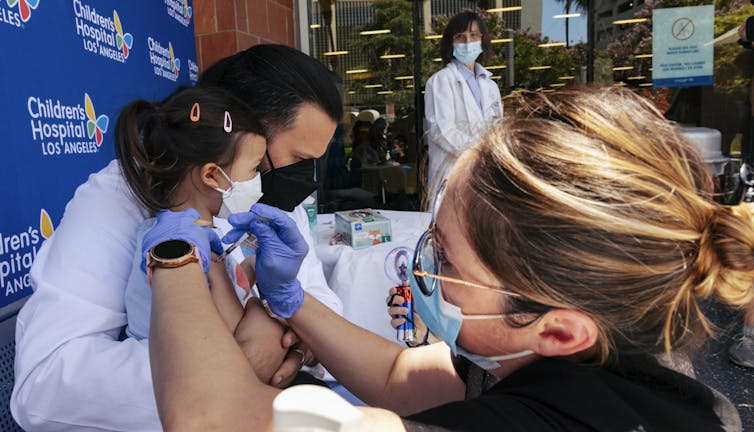
President Joe Biden announced on Jan. 30, 2023, that he intends to end both the national emergency and the public health emergency declarations related to COVID-19 on May 11, 2023.
Biden’s announcement came on the same day that the World Health Organization said it still considers the COVID-19 pandemic to be a public health emergency of international concern, or PHEIC, a status that is reassessed every three months. The WHO’s advisory committee noted that although the pandemic is at a turning point, “COVID-19 remains a dangerous infectious disease with the capacity to cause substantial damage to health and health systems.”
The Conversation asked public health experts Marian Moser Jones and Amy Lauren Fairchild to put these statements into context and to explain their ramifications for the next stage of the pandemic.
What does ending the emergency phase of the COVID-19 pandemic mean?
Ending the federal emergency reflects both a scientific and political judgment that the acute phase of the COVID-19 pandemic crisis has ended and that special federal resources are no longer needed to prevent disease transmission across borders.
In practical terms, it means that two declarations – the federal Public Health Emergency, first declared on Jan. 31, 2020, and the COVID-19 national emergency that President Donald Trump announced on March 13, 2020 – will be allowed to expire in May 2023.
Declaring those emergencies enabled the federal government to cut through a mountain of red tape, with the goal of responding to the pandemic more efficiently. For instance, the declarations allowed funds to be made available so that federal agencies could direct personnel, equipment, supplies and services to state and local governments wherever they were needed. In addition, the declarations made resources available to launch investigations into the “cause, treatment or prevention” of COVID-19 and to enter into contracts with other organizations to meet needs stemming from the emergency.
The emergency status also allowed the federal government to make health care more widely available by suspending many requirements for accessing Medicare, Medicaid and the Children’s Health Program. And they made it possible for people to receive free COVID-19 testing, treatment and vaccines and enabled Medicaid and Medicare to more easily cover telehealth services.
What policy changes will occur once the emergency is declared over?
The end to the federal emergency could substantially reduce the number of people insured under Medicaid. Before the pandemic, states required people to prove every year that they met income and other eligibility requirements.
In March 2020, Congress enacted a continuous enrollment provision in Medicaid that prevented states from removing anyone from their rolls during the pandemic. In a December 2022 appropriations bill, Congress passed a provision that will end continuous enrollment on March 31, 2023.
The Biden administration has defended this time frame as sufficient to ensure that “patients do not lose access to care unpredictably” and that state Medicaid budgets – which have been infused with emergency funds since 2020 – “don’t face a radical cliff.” But many people with Medicaid may be unaware of these changes until they actually lose their benefits.
Some states have already indicated that they will begin disenrolling members in April 2023 or require members to apply to be considered for renewal. This could result in between 5 million and 14 million people losing coverage.
People with Medicare do not have to worry about losing their benefits, since this program is age-based, not income-based. The array of telehealth services that Medicare began covering during the pandemic will continue to be covered through December 2023. Medicare coverage for many telehealth services could also be made permanent after this year.
The end of the emergency could additionally curb access to COVID-19 drugs, tests and vaccines. Federal emergency funding for free treatment or vaccination will end when the emergency status is lifted on May 11. If such programs are to continue, the cost will fall to state and local health agencies or insurance companies.
We are concerned that the withdrawal of federal emergency funds for vaccination may further slow the already sluggish uptake of boosters. As of Jan. 25, 2023, about 20% of the population ages 5 and up and only 40.1% of those 65 and older – who are at the highest risk of death from COVID-19 – had received an updated bivalent booster dose. Once the emergency ends, measures that allowed a broad array of health providers – from pharmacist interns to retired nurses and even veterinarians – to administer vaccines will expire, which could lead to decreased access to vaccination in many parts of the U.S.
What does this mean for the status of the pandemic?
A pandemic declaration represents an assessment that human transmission of a disease, whether well known or novel, is “extraordinary,” that it constitutes a public health risk to two or more states and that controlling it requires an international response.
At some point the WHO will end its pandemic declaration. On Jan. 30, 2023, World Health Organization Director-General Tedros Adhanom Ghebreyesus described the pandemic as being “at a transition point.” But the WHO’s assessment is that the risks are still considerable. Ghebreyesus noted that COVID-19 continues to strain health care systems, exacerbate health care workforce shortages and exceed surveillance system capacities.
The U.S. remains one of the global COVID-19 hot spots. With more than 3,500 hospitalizations per week on average in January 2023, and 3,452 deaths per week as of early February 2023, the U.S. has among the highest deaths per capita in the world.
How does the Biden administration’s stance differ from the WHO’s position?
In some ways they are very similar. The WHO is looking at the pandemic from a global perspective while the Biden administration is examining it from a national perspective. The WHO’s stance reflects the assessment that the world is not sufficiently vaccinated, that health care systems remain vulnerable and that unchecked disease transmission in some parts of the world should remain a source of international concern and attention.
China’s massive outbreak after the lifting of its zero-COVID policy in early December 2022 has received a great deal of media attention. But less noted is the fact that vaccination rates across African nations average 40%, and that vaccination rates are very low in countries that are experiencing conflict, such as Syria, where only 15% of the population has received any COVID-19 vaccine.
The WHO’s continuation of the global pandemic status signals that there is more international coordination and work to be done. In contrast, the Biden administration is making a social and political judgment that it is time to wind down the federal role.
Biden’s order will not affect state-level or local-level emergency declarations. These declarations have allowed states to allocate resources to meet pandemic needs and have included provisions allowing them to respond to surges in COVID-19 cases by allowing out-of-state physicians and other health care providers to practice in person and through telehealth.
Almost all U.S. states, however, have ended their own public health emergency declarations. Eight states – California, Colorado, Delaware, Georgia, Illinois, New Mexico, Rhode Island and Texas – still have emergency declarations in effect, but all of them will expire by the end of February 2023 unless renewed.
While some states may choose to make permanent some COVID-era emergency standards, such as looser restrictions on telemedicine or out-of-state health providers, it could be a long time before either politicians or the public regain an appetite for any emergency orders directly related to COVID-19.
Amy Lauren Fairchild, Dean and Professor of Public Health, The Ohio State University and Marian Moser Jones, Associate Professor and Graduate Director of Family Science, The Ohio State University
This article is republished from The Conversation under a Creative Commons license. Read the original article.
Call Lake County Animal Care and Control at 707-263-0278 or visit the shelter online at http://www.co.lake.ca.us/Government/Directory/Animal_Care_And_Control.htm for information on visiting or adopting.
The following cats at the shelter have been cleared for adoption.

‘Wednesday’
“Wednesday” is a 3-year-old female domestic shorthair cat with a gray tabby coat.
She is in kennel No. 77b, ID No. LCAC-A-4463.

Male domestic medium hair
This 3-year-old male domestic medium hair cat has a gray coat.
He is in cat room kennel No. 13, ID No. LCAC-A-4559.

‘Halo’
“Halo” is a 3-year-old male domestic shorthair cat with a gray tabby coat.
He is in kennel No. 77a, ID No. LCAC-A-4466.
Email Elizabeth Larson at

LAKE COUNTY, Calif. — The 2023 NEA Big Read hosted by the Lake County Library has partnered with the Lake County Campus of Woodland Community College for the program’s formal kickoff event.
The kickoff event will take place in the campus library in Building 100, located at 15880 Dam Road Extension in Clearlake, on Thursday, Feb. 9, from noon to 2 p.m.
The Valentine’s Day-themed event will feature an information session, free copies of the NEA Big Read book, and an open forum to celebrate love stories and language.
District supervisors Bruno Sabatier and Eddie Crandall will be joining college and library staff and the public to celebrate. Light snacks and refreshments will be provided.
The public is invited to join in on the festivities and share their own love stories, whether romantic love with significant others or life partners, love of nature, love of community, or love of culture and ethnic heritages.
The first week of the 2023 NEA Big Read will continue with the Second Thursday Writing Circle with Richard Schmidt on Thursday, Feb. 9, at 5:30 p.m. at the Main Street Gallery in Lakeport.
Lake County Farmers’ Finest will host the NEA Big Read on Saturday, Feb. 11, from 10 a.m. to 1 p.m. at The Mercantile located at 4350 Thomas Drive in Lakeport.
Later that afternoon, Schmidt will host a “Taste of Poetry” event at the Lakeport Library at 2 p.m.
NEA Big Read events will continue throughout February and March and will include a diverse calendar of events from book discussions and writing workshops, to museum presentations on family and local water history, and poetry readings.
O'Meara Bros. Brewing Co. in Lakeport has once again partnered with the Library for the NEA Big Read by crafting a new, unique beer to commemorate the program. The Post-Colonial Love Poem ale will be available to order beginning in February.
A children’s Little Read will also be offered with four Storytimes at library branches, featuring age-appropriate books with themes relating to the NEA Big Read book.
The public is invited to attend all NEA Big Read events at no cost, and free books are provided at each event and all library branches until supply runs out.
To view the full schedule of events, go to http://www.lakecountybigread.com/. Follow the Big Read on Facebook by visiting https://www.facebook.com/LakeCountyBigRead/.
The NEA Big Read is a program of the National Endowment for the Arts in partnership with Arts Midwest, which seeks to broaden our understanding of our world, our communities, and ourselves through the joy of sharing a good book.
The NEA Big Read showcases a diverse range of contemporary titles that reflect many different voices and perspectives, aiming to inspire conversation and discovery.
The Lake County Library is a recipient of a $9,500 grant to host the NEA Big Read countywide with dynamic community reading programs, and selected “Postcolonial Love Poem” by Natalie Diaz for 2023 programming.
Winner of the 2021 Pulitzer Prize in Poetry, “Postcolonial Love Poem” is a collection of poetry by Arizona poet Natalie Diaz, who is Mojave, an enrolled member of the Gila River Indian Tribe, Latinx and queer.
The poems push against the forces of racism, environmental destruction, addiction, and mental illness with the power of desire, love and language.
From publisher Gray Wolf Press, “‘Postcolonial Love Poem’ is an anthem of desire against erasure. Natalie Diaz’s brilliant second collection demands that every body carried in its pages — bodies of language, land, rivers, suffering brothers, enemies, and lovers — be touched and held as beloveds.”
Follow the Lake County Library on Facebook, Instagram, and Twitter, or sign up for the online newsletter for updates. Visit the Lake County Library’s website at http://library.lakecountyca.gov.
Visit arts.gov/neabigread for more information about the NEA Big Read. Organizations interested in applying for an NEA Big Read grant in the future should visit Arts Midwest’s at https://artsmidwest.org/ for more information.

Over the past year, cities across the United States have unveiled new policy plans to address homelessness amid rising concerns about health and crime – for homeless people themselves, as well as for surrounding communities. Notably, several proposals include civil commitment, also referred to as involuntary treatment, for people with severe mental illness or substance use disorders.
In November 2022, for example, New York City Mayor Eric Adams announced a plan to use mental health laws to facilitate involuntary treatment when people are unable to care for themselves, or when their actions endanger others.
Court-mandated treatment could include therapy, social workers, housing referrals, medication or other interventions, either in hospitals or on an outpatient basis. New York’s plan builds on other recent initiatives to connect more homeless and mentally ill people with shelters or supportive housing.
Political leaders in California and Portland, Oregon, have approved similar plans to use civil commitment laws.
As a health law and medical ethics professor, I believe it’s worth explaining how these laws work and the ethical issues they raise.
How civil commitment works
Civil commitment laws have been around for decades. However, they only recently appear to have regained traction as a strategy for addressing the intersection of homelessness, mental illness and substance use disorder.
States have enacted these laws based on two theories. First, under the doctrine of parens patriae, a Latin phrase that means “parent of the nation,” states have a legal and ethical obligation to step in and help vulnerable people who cannot act for themselves. Second, in public health law, the concept of police power means that states have a duty to pass and enforce laws to preserve public health and safety, which can be impacted by homelessness.
Every state has different laws outlining civil commitment. Importantly, these laws are a civil mechanism for courts to oversee a treatment plan for people with severe mental illness or substance use disorders that meet specific criteria. For example, a court could assess testimony and evidence from clinicians that a person has such a severe substance use disorder that he repeatedly loses consciousness, will not accept assistance and risks freezing to death outside. These laws do not “criminalize” or punish homelessness.
During the initial assessment process, the person receives care in a hospital, where clinicians determine their medical needs. Afterward, the court may order a treatment plan that would outline requirements for the person to accept shelter and maintain weekly appointments such as attending therapy or drug treatment. Treatment in inpatient hospitals are generally only used in cases of severe illness, and laws require using the least restrictive plan possible.
Civil commitment laws also require due process, or a fair procedure for people to participate in the process, object and have assistance from legal counsel.
Understanding chronic homelessness
What is often called “the homeless” population is actually multiple groups with different needs, including youth, families, veterans, people with short episodes of homelessness spurred by job loss or unexpected bills, and the chronically homeless.
However, the most visible population – those who are chronically homeless without shelter – suffer from high rates of untreated severe substance use disorders and mental illness, though estimates vary. The University of California’s California Policy Lab analyzed surveys of 64,000 people who were homeless across 15 different states and found that 78% of the unsheltered homeless suffered from mental illness and 75% from a substance abuse disorder. Fifty percent experienced both.
Clinicians note that mental illness and substance use disorders can contribute to homelessness, and worsen it, too.
Ethical issues
Civil commitment aims to improve the well-being of individuals and communities. But it raises difficult questions about core ethical issues such as autonomy – people’s right to make medical decisions for themselves – and beneficence, or ensuring that interventions provide more benefit than harm.
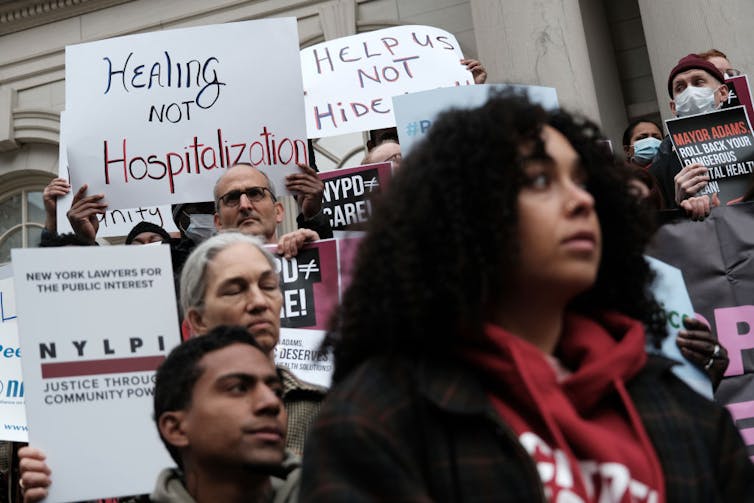
Some experts oppose using civil commitment laws and assert that states should rely on voluntary services. Voluntary treatment, some of them contend, is just as effective but preserves autonomy and the freedom to choose or decline treatment.
Critics also assert that involuntary commitment violates the principle of beneficence, because it can stigmatize homeless people with severe mental health and substance use disorders by implying that they do not belong in public. Others contend it is cruel and coercive.
Advocates for plans like New York City’s, on the other hand, assert that civil commitment laws are not only effective at connecting people with help, but fulfill a moral obligation to prevent people from suffering on city streets.
In most instances, health care workers and ethicists presume that adults can make their own medical choices in line with their values and needs. But people with severe mental illness or substance use disorder may experience impairment in their ability to deliberate, assess their needs and make decisions, which compromises their autonomy. Though involuntary treatment violates autonomy, it can also help people regain it through stabilization and recovery.
Many clinicians and outreach workers argue that glossing over the impact of untreated mental illness and substance use disorder violates the principle of beneficence, because avoiding treatment may result in more health harms.
Wider effects
Ethics debates must also grapple with how treatment affects the surrounding community, such as safety – including for other people experiencing homelessness. As one data point, the San Diego District Attorney’s Office has compiled data showing people who are homeless are far more likely to be the victims of crime. Its data found that this population commits dramatically higher rates of vandalism, arson, assault and burglary as well, although there are few nationwide studies. And while most people who are homeless, have a mental health illness or have a substance use disorder are not violent, some studies suggest people with a severe mental health illness are three to four times more likely to display violent behavior.
Some evidence suggests that civil commitment can increase follow-through with treatment plans, reduce acute hospitalization and decrease violent behavior. Proponents assert that despite the coercive nature of civil commitment, it provides benefit as a step toward restoring the health of each person, and of society.
Katherine Drabiak, Associate Professor of Health Law, Public Health Law and Medical Ethics, University of South Florida
This article is republished from The Conversation under a Creative Commons license. Read the original article.

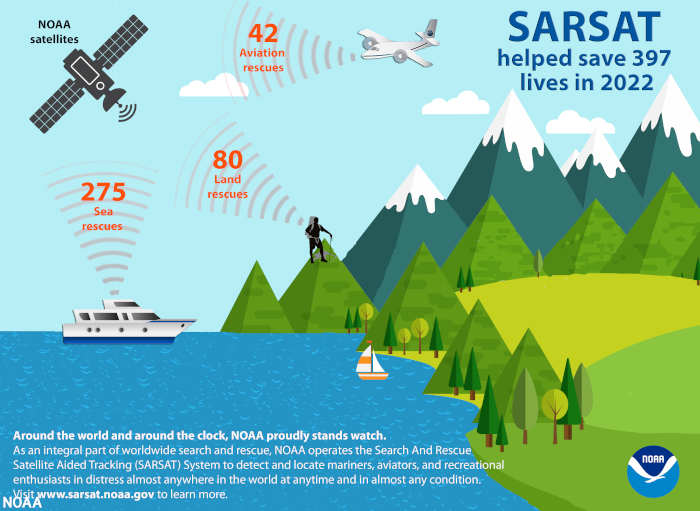
NOAA satellites, which are crucial in weather and climate forecasts, helped rescue 397 people from potentially life-threatening situations throughout the U.S. and its surrounding waters in 2022.
NOAA’s polar-orbiting and geostationary satellites are part of the global Search and Rescue Satellite Aided Tracking system, or COSPAS-SARSAT, which uses a network of U.S. and international spacecraft to detect and locate distress signals sent from emergency beacons from aircraft, boats and handheld personal locator beacons, or PLBs, anywhere in the world.
Of the 397 U.S. rescues last year, 275 were water rescues, 42 were from downed aircraft and 80 were on land involving PLBs. Florida had the most SARSAT rescues with 106, followed by Alaska with 56 and Utah with 20.
Since its start in 1982, COSPAS-SARSAT has been credited with supporting more than 50,000 rescues worldwide, including more than 10,100 in the U.S. and its surrounding waters.
When a NOAA satellite pinpoints the location of a distress signal in the U.S., the information is relayed to the SARSAT Mission Control Center at NOAA’s Satellite Operations Facility in Suitland, Maryland. From there, the information is sent quickly to Rescue Coordination Centers, operated either by the U.S. Air Force for land rescues, or the U.S. Coast Guard for water rescues. NOAA also supports rescues globally by relaying distress signal information to international SARSAT partners.
“The value of NOAA satellites goes well beyond forecasting,” said Steve Volz, Ph.D., assistant administrator for NOAA’s Satellite and Information Service. "The life-saving ability of SARSAT is a credit to the teamwork with the U.S. Coast Guard, the U.S. Air Force NASA and our international partners.”
Here’s a look at three of the most notable events from 2022:
• On June 10, a group of 17 hikers were hoisted to safety after they were stranded on a ridge in Sandthrax Canyon, Utah. The Air Force Rescue Coordination Center received the alert from a PLB and notified the Garfield County Sheriff’s Office, which launched a Utah Department of Public Safety helicopter to the coordinates where the distressed hikers were located.
• On Nov. 20, seven people were rescued from a commercial plane after it was forced to land on a frozen lake near Bethel, Alaska, as a result of engine failure. The Alaska Rescue Coordination Center, which obtained the coordinates of the downed plane, alerted another aircraft company, which made the rescue.
• On Aug. 5, a U.S. Coast Guard helicopter pulled a sailor to safety from his capsized boat off the coast of New Smyrna Beach, Florida. The sailor grabbed the life raft and activated his beacon before his boat sank.
By law, beacon owners are required to register their devices online with NOAA. Registration information helps provide better and faster assistance to people in distress, reduces false alarms and may also indicate what type of help is needed.
“In keeping with its mission, the SARSAT Program truly takes the ‘search’ out of search and rescue,” Volz added.
Dogs available for adoption this week include mixes of Akita, American blue heeler, German shepherd, hound, husky, Labrador retriever, pit bull, shepherd and terrier.
Dogs that are adopted from Lake County Animal Care and Control are either neutered or spayed, microchipped and, if old enough, given a rabies shot and county license before being released to their new owner. License fees do not apply to residents of the cities of Lakeport or Clearlake.
The following dogs at the Lake County Animal Care and Control shelter have been cleared for adoption.
Call Lake County Animal Care and Control at 707-263-0278 or visit the shelter online for information on visiting or adopting.

‘Boopie’
“Boopie” is a 12-year-old female Chihuahua-terrier mix with a short tricolor coat.
She is in kennel No. 18a, ID No. LCAC-A-4643.

‘Jay’
“Jay” is a 12-year-old male Chihuahua-terrier with a short white coat.
He is in kennel No. 18b, ID No. LCAC-A-4644.

Lab-pit bull mix puppy
This female Labrador retriever-pit bull mix puppy has a short black coat with white markings.
She is in kennel No. 2, ID No. LCAC-A-4451.

American blue heeler-hound
This 5-month-old female American blue heeler-hound has a short brown and white coat.
She is in kennel No. 5, ID No. LCAC-A-4521.

American blue heeler-hound
This 5-month-old female American blue heeler-hound has a short brown and white coat.
She is in kennel No. 6, ID No. LCAC-A-4524.

Male American blue heeler-hound
This 5-month-old male American blue heeler-hound has a short brown coat.
He is in kennel No. 9b, ID No. LCAC-A-4523.

Male Akita-shepherd mix
This 2-year-old male Akita-shepherd mix has a long brown coat.
He is in kennel No. 12, ID No. LCAC-A-4539.

Male Akita-shepherd
This 2-year-old male Akita-shepherd has a short fawn-colored coat.
He is in kennel No. 13, ID No. LCAC-A-4538.

Male terrier
This 6-month-old male terrier has a short black coat.
He is in kennel No. 14, ID No. LCAC-A-4596.

Female husky
This 1-year-old female husky has a black and white coat.
She is in kennel No. 16, ID No. LCAC-A-4562.

Female pit bull-Labrador retriever mix
This female pit bull-Labrador retriever mix has a short tricolor coat.
She is in kennel No. 17, ID No. LCAC-A-4692.

Female shepherd-pit bull mix
This 2-month-old female shepherd-pit bull mix has a short tricolor coat.
She is in kennel No. 24a, ID No. LCAC-A-4693.

Female shepherd-pit bull mix
This 2-month-old female shepherd-pit bull mix has a short tricolor coat.
She is in kennel No. 24b, ID No. LCAC-A-4694.

Female shepherd-pit bull mix
This 2-month-old female shepherd-pit bull mix has a short tricolor coat.
She is in kennel No. 24c, ID No. LCAC-A-4695.

‘Frankie’
“Frankie” is a 7-year-old male pit bull terrier with a short gray and white coat.
He is in kennel No. 27, ID No. LCAC-A-4551.
Male shepherd-pit bull mix
This 2-month-old male shepherd-pit bull mix has a short tricolor coat.
He is in kennel No. 28a, ID No. LCAC-A-4696.

Male shepherd-pit bull mix
This 2-month-old male shepherd-pit bull mix has a short tricolor coat.
He is in kennel No. 28b, ID No. LCAC-A-4697.

Male shepherd-pit bull mix
This 2-month-old male shepherd-pit bull mix has a short tricolor coat.
He is in kennel No. 28c, ID No. LCAC-A-4698.

Female German shepherd
This 1-year-old female German shepherd has a black and tan coat.
She is in kennel No. 30, ID No. LCAC-A-4486.

‘Diesel’
“Diesel” is a 2-year-old male pit bull terrier with a short white coat with black markings.
He’s in kennel No. 31, ID No. LCAC-A-4549.

Male Newfoundland
This 1-year-old male Newfoundland has a short black and white coat.
He is in kennel No. 33, ID No. LCAC-A-4540.

Female pit bull terrier mix
This 2-year-old female pit bull terrier mix has a short brown and white coat.
She is in kennel No. 34, ID No. LCAC-A-4599.
Email Elizabeth Larson at