 How to resolve AdBlock issue?
News

The Research Brief is a short take about interesting academic work.
The big idea
Despite the heightened poverty and unemployment seen when the COVID-19 pandemic got underway, many low-income U.S. children did not experience a decline in their emotional and mental health, we found in a new study.
We looked specifically at kids whose families were participating in the Supplemental Nutrition Assistance Program – commonly known as SNAP – the government program that helps low-income Americans afford food.
The government began to boost SNAP benefits in early 2020 to help offset pandemic-driven food insecurity for participating families, which now number around 41 million.
As a result, families got an extra US$95 or more per month for groceries to replace the meals children were missing at schools that had closed. Some eligibility rules were loosened to expand the program’s reach, and for the first time, people could buy groceries online with their SNAP benefits.
To learn whether these extra benefits affected children’s mental and emotional health, we analyzed five years of data collected by the National Survey of Children’s Health on 30,748 low-income families with children aged 6 to 17 years. The data, which included both families who were and were not getting SNAP benefits, covered the four years prior to the pandemic, as well as 2020.
Among the 8,680 families getting SNAP benefits during this period, 38% had at least one child with problems such as doctor-diagnosed mental, emotional, developmental or behavioral health issues – including anxiety and depression.
To assess whether the temporarily expanded benefits had an impact on these children, we conducted a “difference in differences” analysis: We compared data regarding children whose families enrolled in the SNAP program over time with children whose families didn’t get those benefits. In addition, we considered the potential influence of several factors that could play a role, such as parents’ mental health.
We found that children in families getting SNAP benefits in 2020 did not generally experience any change in their mental or emotional health compared to prior years, despite the heavy stress of the pandemic.
Why it matters
Typically, low-income children are more at risk of developing mental health or emotional problems, compared with high-income children. Our study adds to earlier evidence that SNAP benefits can lower that risk by reducing psychological distress and improving food security.
While 2020’s extra SNAP benefits protected children’s mental and emotional health, they did not improve it. This suggests that actually reducing food insecurity for low-income families would have required additional steps.
In March 2023, the federal government ended the pandemic-era SNAP expansions in 35 states and territories that hadn’t yet rolled them back. With inflation driving the cost of groceries up 11.4% in 2022, we believe that losing these benefits threatens the well-being of millions of families.
What’s next
We are now studying the effects of pandemic-related changes to the Special Supplemental Nutrition Program for Women, Infants and Children, better known as WIC.
We are looking at, for example, how expanding WIC benefits to cover canned, frozen and dried fruits and vegetables in addition to fresh produce has affected the low-income families’ purchasing behavior. Our team for this research also includes public health and nutrition scholars Alexandra MacMillan Uribe and Elizabeth Racine,
What is not known
When we did our study, data from the years after 2020 wasn’t yet available, so we couldn’t investigate the potential impact of subsequent pandemic-related changes to SNAP benefits. Notably, in 2021, the federal government increased maximum benefit levels by 15% and extended the extra $95 or more in monthly food assistance for the lowest-income households.
Grace Melo, ACES Faculty Fellow, Texas A&M University; Pourya Valizadeh, Research Assistant Professor of Agricultural Economics, Texas A&M University, and Rodolfo M. Nayga Jr., Professor of Agricultural Economics, Texas A&M University
This article is republished from The Conversation under a Creative Commons license. Read the original article.
The National Weather Service has issued a hazardous weather outlook or Lake County, along with a freeze warning in effect until 9 a.m. Monday, a wind advisory for Monday at 8 p.m. to Tuesday at 5 a.m. and a winter weather advisory from 8 p.m. Tuesday to 5 a.m. Thursday.
“A strong storm system will impact the region Monday through Wednesday, resulting in heavy snow occurring across the interior mountains, as well as strong gusty winds developing over exposed ridges and coastal headlands,” the forecast explained. “After Wednesday, an additional period of wet weather is forecast to develop across Northwest California next weekend.”
The forecast said that Lake County’s highest ridges — primarily in the backcountry — will experience warning level snowfall amounts.
The specific Lake County forecast calls for rain beginning on Monday night and continuing through Wednesday night.
Thursday will be clear and sunny, before chances of rain return to the forecast Friday through Sunday.
The forecast expects winds with gusts of more than 20 miles per hour on Monday evening, with wind gusts of close to 40 miles per hour expected on Tuesday night.
Daytime temperatures this week and early into next week will range from a high of 50 degrees on Monday to a low of 45 degrees on Wednesday.
Conditions at night will range from the mid to high 30s, the forecast said.
Email Elizabeth Larson at
The board will meet beginning at 9 a.m. Tuesday, March 28, in the board chambers on the first floor of the Lake County Courthouse, 255 N. Forbes St., Lakeport.
The meeting can be watched live on Channel 8, online at https://countyoflake.legistar.com/Calendar.aspx and on the county’s Facebook page. Accompanying board documents, the agenda and archived board meeting videos also are available at that link.
To participate in real-time, join the Zoom meeting by clicking this link.
The meeting ID is 914 4033 2898, pass code 404471. The meeting also can be accessed via one tap mobile at +16694449171,,91440332898#,,,,*404471#.
All interested members of the public that do not have internet access or a Mediacom cable subscription are encouraged to call 669-900-6833, and enter the Zoom meeting ID and pass code information above.
To submit a written comment on any agenda item visit https://countyoflake.legistar.com/Calendar.aspx and click on the eComment feature linked to
the meeting date. If a comment is submitted after the meeting begins, it may not be read during the meeting but will become a part of the record.
At 10:30 a.m., Supervisor EJ Crandell will ask the board to consider transitioning the Lucerne Area Town Hall to the Central Region Town Hall, or CeRTH, which will change its boundaries.
“As of right now the map for the MAC known as LATH consists of solely the community growth boundary of Lucerne,” Crandell wrote in an agenda item to the board. “With the implementation of CeRTH, the boundaries will include the full zip code boundaries of Lucerne. The concept is to ensure more inclusivity and engagement from the Central Region of District 3.”
Since the start of the year, Crandell has not brought forth any new appointments to the Lucerne Area Town Hall, other than Kevin Waycik, who was reappointed on Jan. 10 but died at the end of February.
Crandell has not explained his reasons to community members or to Lake County News until putting the matter on the agenda.
Crandell and the town hall’s members have been at odds since December, when he attempted to cancel a meeting at which the group planned to speak about its concerns with a plan by the Scotts Valley Pomo tribe to turn the Lucerne Hotel into a homeless housing facility.
The town hall’s leadership moved forward with a meeting in December in which they unanimously approved a resolution condemning the project at the hotel, a project for which Crandell’s wife has publicly advocated.
Since then, the town hall has continued to meet to discuss town business, but Crandell has not participated.
In other business, in untimed items, the board will consider a letter regarding Cal Fire’s State Responsibility Area Fire Hazard Severity Zones Maps and discuss the scope of the Lake County Fish & Wildlife Advisory Committee, the needs to support the population of the Clear Lake hitch and possible direction to staff.
The full agenda follows.
CONSENT AGENDA
5.1: Appoint Supervisor Bruno Sabatier as the voting delegate for the 2023 NACo Annual Conference & Exposition to be held in Austin, Texas, July 21 through 24, 2023.
5.2: Adopt resolution approving Agreement No.23-7306-0265-RA with the USDA Animal and Plant Health Inspection Services for the period July 1, 2023, through June 30, 2024, for the amount of $ 127,629.36.
5.3: Approve Amendment No. 1 to the agreement between the county of Lake and Lisa Warner, MBA for support services for managed care for fiscal year 2022-23 in the amount of $40,000 and authorize the board chair to sign.
5.4: Approve Amendment No. 1 to the agreement between Davis Guest Home and Lake County Behavioral Health Services increasing the total compensation payable under the agreement to $310,000 for FY 2022-23 and authorize the board chair to sign.
5.5: Approve lease agreement between county of Lake and Berg Investments LP for lease of the commercial space at 13300 East Highway 20, Clearlake Oaks beginning March 1, 2023, through Feb. 29, 2028, and authorize the Behavioral Health director or their designee to sign.
5.6: ERRATUM — Approve Board of Supervisors minutes from March 7, 2023, and March 14, 2023.
5.7: Adopt resolution adopting a continuous record retention and destruction schedule for the Office of the Registrar of Voters.
5.8: Adopt proclamation of appreciation for Registrar of Voters Staff, poll workers, and county key staff on successfully conducting the June and November 2022 Elections.
5.9: Approve lease for commercial property located at 858 Lakeport Blvd., Lakeport, from Feb. 1, 2023, through Feb. 28, 2024, and authorize the chair to sign.
5.10: Approve temporary reduced hours of Vital Statistics due to staffing shortages for the period of April 3, 2023, through April 7, 2023, to be closed from noon to 5 p.m. each day.
5.11: Waive competitive bidding per 38.2(3) and approve amendment to agreement between the county of Lake and Tyler Technologies to provide case management software and associated services for the period of April 1, 2023, to March 31, 2024, for an amount not to exceed $46,880 for the first year, $57,474 for the second year, and $72,498 for the third year, and authorize the chair to sign.
5.12: Sitting as the Lake County Sanitation District Board of Directors, a) waive the competitive bidding process, pursuant to Lake County Code Section 2-38.4 Cooperative Purchases; b) authorize Special Districts Administrator/assistant purchasing agent to issue a purchase order not to exceed $130,000 to U-Rock Utility Equipment for the purchase of a Portable Rovver X Basic System; c) Approve budget transfer allocating money from object code 63.05 to 62.74.
TIMED ITEMS
6.2, 9:07 a.m.: Presentation of proclamation of appreciation for Registrar of Voters staff, poll workers, and county key staff on successfully conducting the June and November 2022.
6.3, 9:30 a.m.: a) Consideration of overview of Big Valley Band of Pomo Indians and Lake County Watershed Protection Districts Adobe Creek Managed Flow Strategy Project being submitted under the Office of Planning and Research’s 2022-2023 Adaptation Planning Grant Program; and b) review and consideration of letter of support from the Board of Directors of the Watershed Protection District for the proposed project.
6.4, 10:30 a.m.: Consideration of Municipal Advisory Committee (MAC) transition of the Lucerne Area Town Hall (LATH), initially known as (MRTH) Middle Region Town Hall; to (CeRTH) Central Region Town Hall.
UNTIMED ITEMS
7.2: Consideration of a letter documenting written comments in response to Cal Fire’s State Responsibility Area (SRA) Fire Hazard Severity Zones (FHSZ) Maps.
7.3: Consideration of consistency of the scope of the Lake County Fish & Wildlife Advisory Committee with needs to support the population of the chi/Clear Lake hitch, and possible direction to staff.
7.4: Consideration of the county of Lake acting as lead agency on a grant application to provide funding for the Lake County Risk Reduction Authority, Lake County Resource Conservation District, Lake County Fire Safe Council, and the Lake County Office of Climate Resiliency as well as funding to implement four hazard mitigation actions from the county of Lake’s 2018 Local Hazard Mitigation Plan.
7.5: Consideration of agreement between the county of Lake and Redwood Community Services Inc. for supportive employment and supportive education program services for fiscal years 2023-2026 for $408,282.
7.6: Consideration of the following advisory board appointments: Child Care Planning Council, Emergency Medical Care Committee, Fish and Wildlife Advisory Committee and Mental Health Board.
7.7: Consideration of updated advisory board application.
CLOSED SESSION
8.1: Conference with legal counsel: Existing litigation pursuant to Gov. Code sec. 54956.9 (d)(1) – FERC Project No. 77, Potter Valley Hydroelectric Project.
8.2: Conference with legal counsel: Existing litigation pursuant to Gov. Code sec. 54956.9(d)(1): In re National Prescription Opiate Litigation MDL No. 2804/Case No. 17-MD-2804.
8.3: Public employee evaluation: Information Technology Director Shane French.
8.4: Public employee evaluation: Health Services Director Jonathan Portney.
Email Elizabeth Larson at

MIDDLETOWN, Calif. — The Middletown Art Center has received a major grant award for a new project focused on the Latinx community.
The $188,744 grant from the California Natural Resources Agency and California Cultural and Historical Endowment will fund the center’s “Raíces Hermosas — Gorgeous Roots” project.
The Middletown Art Center, or MAC, designed “Raíces Hermosas” to uplift and connect the Latinx community, both seen and hidden, to the center to the community at large through art, culturally focused events and art making.
“We have to build trust with our Latinx community so that they feel welcome at all decision-making tables,” said Zabdy Neria, a MAC Board director, Konocti Unified School Board trustee and behavioral health practitioner who initiated the project. “Through the shared language of art, music and dance, we can instill the message that they (we) belong.”
At the center of the Raíces Hermosas project is a curated exhibit of contemporary expressions of Latinx culture, roots, and issues by local and regional Latinx artists.
Project activities include guided school field trips to the gallery and art studio during the exhibit for 3,600 Lake County students as well as pre/post visit curriculum, weekend artmaking workshops and cultural events at MAC, and community-engaged artmaking at festivals.
“We are excited to share this project with the people of Lake County! It raises awareness, has a robust education component, and brings us together. It also brings funding for jobs into our local economy during the year-long grant period,” said MAC’s Executive and Artistic Director Lisa Kaplan. “We are grateful for the opportunity to contribute to the local economy and community in a meaningful way and look forward to welcoming people from across Lake County and beyond to MAC.”
Right now, the MAC is seeking bilingual project coordination support. You can learn more about this job opportunity on MAC’s website.
“This funding will support projects across the state that lift up history and culture that has been underrepresented in the past and enable more people to learn these remarkable stories,” said California Natural Resources Secretary Wade Crowfoot.
Learn more about the scope and significance of this state funded grant visit the California Natural Resources Agency website.
This grant award, while a significant amount, is entirely dedicated to the Raíces Hermosas project, meaning, MAC must continue its regular fundraising activities and relies on community support for regular operations.
Visit https://middletownartcenter.org/index.html to support and be a part of their impactful work in Lake County.
When Silicon Valley and Signature banks failed in early March 2023, government regulators rushed in to guarantee deposits and protect bank customers. Under current banking regulations, though, there was no obligation for the government to step in.
Now, both Democratic and Republican politicians are making pronouncements about whether bipartisan-backed deregulation in 2018 led to the banks’ collapse and whether the banking industry needs more government intervention.
Sen. Elizabeth Warren of Massachusetts and U.S. Rep. Katie Porter of California, both Democrats, introduced a bill on March 15, 2023, to restore stiff banking regulations that they maintain would have prevented the practices that led to the recent bank collapses. But some Republicans, including U.S. Rep. Andy Barr of Kentucky, say lax government policy that included overspending – which Barr says, fueled inflation, as well as long-term low interest rates – not deregulation, was behind the banks’ failures.
In dispute are requirements in the 2010 Dodd-Frank Wall Street Reform and Consumer Protection Act that were rolled back in 2018. Dodd-Frank put in place financial regulatory changes in response to the 2008 global financial meltdown. The legislation included among its requirements one that banks with US$50 billion in assets be subject to strict standards. Some lawmakers, including Porter and Warren, say those requirements should have remained intact.
But the Economic Growth, Regulatory Relief and Consumer Protection Act of 2018 loosened the standards, raising the asset threshold to $250 billion, meaning fewer banks were under strict controls.

The Conversation asked Gerard W. Comizio, a law professor, former Wall Street attorney and former senior Treasury Department official, to explain some of the problems that spurred Silicon Valley Bank, Signature Bank and another bank to fail.
What caused Silicon Valley, Signature and a third bank, Silvergate, to fail?
Significant withdrawals at all three banks caused cash crises that could not be addressed by selling assets, such as bank notes and bonds. In the case of all three banks, sales of their assets would have triggered significant additional losses, since their portfolios were worth less than they paid for them and interest rates were rising.
While some aspects of each failure were different, there were common elements, and a certain level of Murphy’s law – the idea that if something can go wrong, it will. In the case of these banks, everything went wrong.
In the last three months of 2022, Silvergate had a record $1 billion loss, due to heavy lending to troubled and failed crypto trading exchanges. And its interest rate-sensitive securities portfolio became kindling for the current crisis.
During 2022, Silvergate’s deposit base grew dramatically, almost doubling its assets to $210 billion. But the bank did not have either the administrative capacity or market demand to lend out all of the money, as banks normally do. So, it invested the excess deposits in Treasury bonds and mortgage investment products.
But the bond purchases became a problem as the Federal Reserve began to raise interest rates to address inflation. As Business Insider reported, a two-year U.S. Treasury note that offered nearly triple the amount of Silicon Valley Bank’s portfolio of long-term bonds – which generated income at an average of just 1.6% – was much more attractive.
Bond prices plunged, creating billions of dollars in paper losses for Silicon Valley Bank, popularly known as SVB.
To shore up its cash assets, in the face of increasing customer withdrawals, SVB sold $21 billion in bonds at a $1.8 billion loss.

Which regulations from the 2010 Dodd-Frank Act were designed to prevent banking failures?
Section 165 of the Dodd-Frank Act adopted so-called “enhanced prudential regulation” rules for all banking organizations with more than $50 billion in assets, designating them as “systemically important financial institutions,” popularly known by the term “too big to fail.” These standards were designed to be more stringent than those applied to smaller banks. Lawmakers believed the larger institutions posed far greater risk to the financial stability of the U.S.
These stricter rules required, among other things, that the banks deemed too big to fail periodically update for the Federal Reserve and the Federal Deposit Insurance Corp. a comprehensive resolution plan. Dubbed the Living Will, that plan details a company’s plans for a “rapid and orderly” dissolution of the bank in the event it is failing or has already failed. In addition, these too-big-to-fail banks had a requirement to periodically assess their risk under a variety of market conditions, including rises in interest rates and risk hedging strategies. The rules also said designated banks had significantly higher capital requirements.
No longer required to adhere to those key provisions of the Dodd-Frank Act, the failed banks did not. Arguably, the provisions could have saved them.
Why weren’t the banks subject to those regulations?
Industry leaders, among them Greg Becker, CEO of Silicon Valley Bank, lobbied Congress in 2015 to roll back some of the Dodd-Frank Act provisions.
Arguing that the $50 billion threshold needed to be raised, Becker said the restrictions on midsize banks under the Dodd-Frank Act were too burdensome and inhibited banks’ ability to “provide the banking services our clients need.”
In 2018, Congress, in a bipartisan vote, with the support of then-President Donald Trump’s administration, all of the federal banking agencies and the banking industry, passed the Economic Growth, Regulatory Relief and Consumer Protection Act. It amended the Dodd-Frank Act to substantially reduce the number of banks subject to the more stringent regulation by raising the threshold at which banks posed potential systemic risk, from $50 billion up to $250 billion.
On July 6, 2018, all of the banking agencies issued a statement confirming the elimination of these requirements.

If the Dodd-Frank Act had remained intact, would the banks have failed?
There are a number of arguments as to whether these failures could have been prevented and addressed faster if the Dodd-Frank standards had still been in place. These standards were arguably designed to specifically prevent and address the type of circumstances that triggered these recent bank failures: multiple failures and contagion in the financial system, market panic, deposit runs and liquidity crisis.
For example, abiding by Living Wills and stress testing would have identified problems far earlier and potentially required these banks to address a number of potential red flags that constituted higher risk, such as:
-
Interest rate risk in the banks’ securities portfolio investments, and the consequences of liquidating those investments at a significant loss in the event of a cash crisis;
-
Lack of interest rate risk hedging strategies;
-
Excessive uninsured deposits that posed a risk to the bank if customers withdrew their money en masse; and
-
The need to hold higher-than-normal levels of money to address their risks.
Ironically, in taking steps to provide unprecedented deposit insurance coverage to uninsured deposits at these banks, the U.S. Treasury, the Fed and the FDIC issued a joint statement on March 12 that they were invoking the systemic risk exception which allowed them to replace depositors’ money, even though the law was changed in 2018 to make clear banks of their size no longer posed systemic risk.
V. Gerard (Jerry) Comizio, Professor of Law, American University
This article is republished from The Conversation under a Creative Commons license. Read the original article.
The lake levels are rising and while it’s going to make for an amazing summer with fishing and boating, right now we are concerned about flooding in our channel. What resources are out there? What about debris like logs and docks or other floating hazards in the Lake?
Thanks!
- Falerie in Finley
Dear Falerie,
What a great set of questions! Also, you are not the only one who has asked about lake levels, flooding and debris. These are all timely topics so I will provide some details and additional resources for each one.
Firstly, let’s revisit the way Clear Lake water level is measured, using the Rumsey Gage. Daily lake level data is measured from an in-lake gauge (#11450000) operated and maintained by the United States Geological Survey (USGS). The gauge has historically been located on a pier at Lake County Vector Control District in Lakeport, but is sometimes relocated during low water, like our past drought events required the gage to be moved to another dock location at Lakeport Library park.
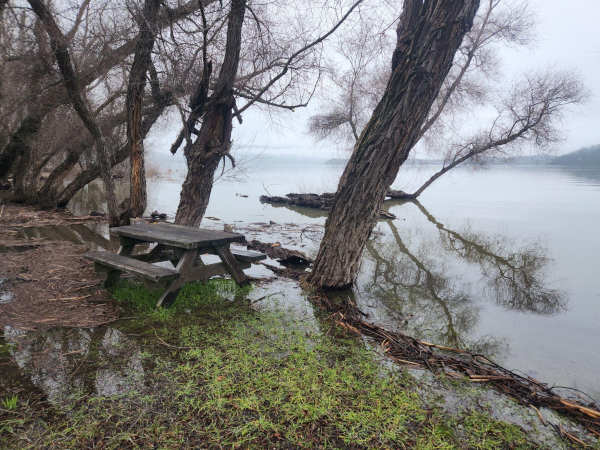
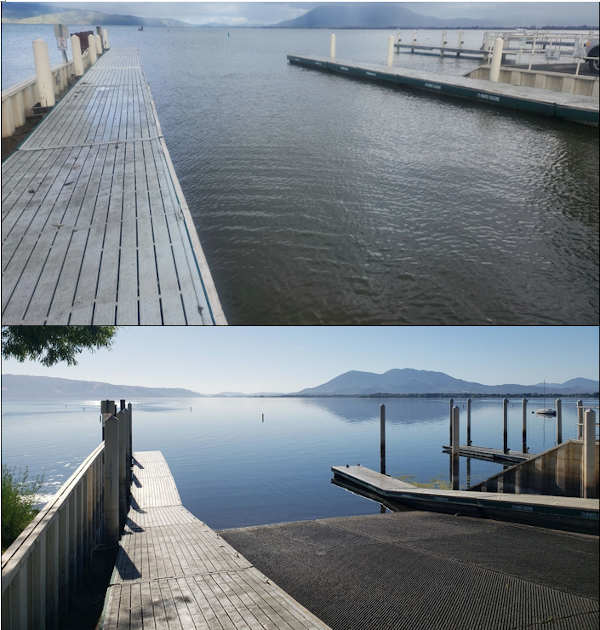
Right away let me address the gage issue; I have received many, many emails providing me the right gage/gauge to use. Here are some gauge facts: the vernacular use of “gage” and “gauge” can be used interchangeably and both can be used as a verb or a noun. Technically, the word “gage” is a different word altogether (it means to throw down a challenge, like a knight proposing combat). But while knighthood battles are mostly extinct, the word “gage” is still maintained in the English language. The USGS has a historical affinity for the use of “gauge”, but more recently uses gage (see the graphic below and “Rumsey Gage”). According to Merriam-Webster Dictionary, considering global use, “gauge” is the preferred variant of this word and is more commonly used than “gage”. According to ESL.com, the word “gage” is becoming obsolete. Even as I type this, my spellcheck autocorrect wants to change the “gages” to “gauges”. If you ask the Lady of the Lake, life is too short to gauge your success by the amount and type of gages being counted, but don’t mind me and pick the gauge/gage that is right for you!
It makes sense that Vector Control would be good partners for a lake gauge as low and high water levels influence habitat availability for mosquitos. Also, believe it or not, before the internet, folks would call into the Vector Control District and ask for the current lake levels; now they are simply a few clicks away on your computer or smartphone!
The lake level data is available online in graph or tabulated format at the USGS Clearlake Lakeport CA station.
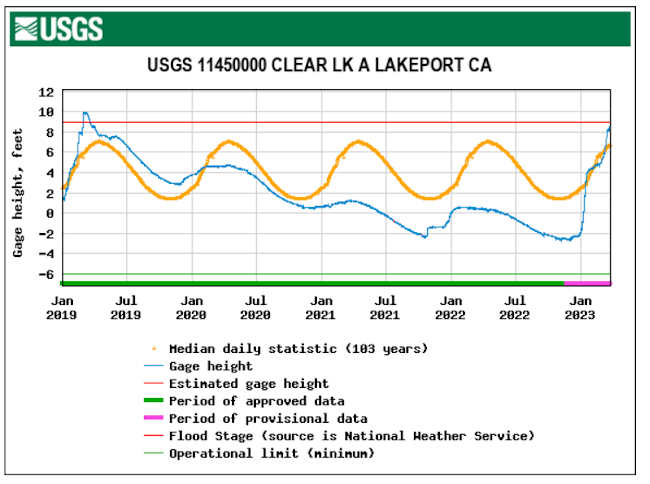
Figure. Lake Level data for the last 4 years (Jan 2019 - March 2023). Orange line depicts the average lake level over the last 103 years. Red solid line demonstrates the flood stage at 9 ft.Rumsey (while listed in the legend, there is no estimate gauge height depicted on this graphic). Blue line is the actual recorded gauge height. Source: USGS
Data is available for other stream, lake, and reservoir gauges around the state. I suggest you explore the Sierra Nevada River Forcast Network Interactive Map. On this site, you can find different lakes or rivers with real-time gages measuring lake levels, stream height and stream flow.
Also, the Lake County Water Resources Department monitors the daily lake level and can provide that to you by phone at 707-263-2344, if you do not have access to the website.
Determining Lake Level
Clear Lake is different then every other lake, reservoir, or water body out there when it comes to the lake level measurement method. Clear Lake uses the “Rumsey Gage” unit of measurement. This measurement was established by Captain Rumsey in 1873. The measurement was derived from the natural levels of the lake as determined by the Grisby Riffle, with a range between zero and 7.56 feet Rumsey, which is the natural low and high levels of the lake. For example, the low level at “zero rumsey” is the point at which water is too low to pass the Riffle and flow down Cache Creek; it’s the “natural low” level of the lake.
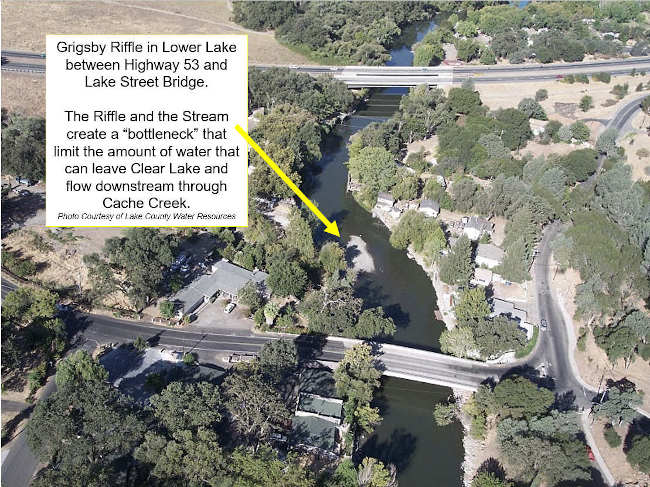
Unlike reservoirs, Clear Lake’s water level is naturally controlled by the Grigsby Riffle. The Grigsby Riffle is a naturally formed rock gravel formation at the confluence of Cache Creek and Seigler Creek; this spot can be easily observed from the Lake Street Bridge in Lower Lake. The combination of elevation, gravel accumulation, and creek bed constriction physically limits the maximum amount of water that can pass through from the lakeside downstream to the rest of Cache Creek.
The Grigsby Riffle is what ultimately limits flow, even though the Cache Creek dam, operated by the Yolo County Flood Control and Watershed Conservation District, is currently open to allow maximum flow (currently at 2,750 cubic feet per second or CFS) to pass through the structure and down Cache Creek.
Sometimes the lake can fill up faster than the water can pass through the Grigsby Riffle, even if the dam is allowing maximum flow. That is why some years Clear Lake does reach a major flood stage and low lying homes get waves right up to their windows. There is nothing that can be done when this occurs.
There is a decree that prevents Yolo County from closing the dam when Clear Lake is at risk of flooding, but the nature of the physical outflow channel restricts flow sometimes during flood conditions.
Living on Clear Lake means you learn to live with the fluctuating conditions, there is not magic plug that can be pulled when the lake is too full and there is no magic spout to turn on when the lake is too low - it’s a natural lake and we all have to learn to love and appreciate that fact, during good times and even more so, during the difficult times.
If you don’t know about Yolo County’s Water rights over Clear Lake, and why they operate and control the lake level of Clear Lake, I suggest you visit my previous column from November 2021, “Wondering about Water Rights.”
I also recommend the information provided online by the County of Lake Water Resources including “The History of Clear Lake” and “How Yolo Obtained Water Rights.”
Indian Valley Reservoir
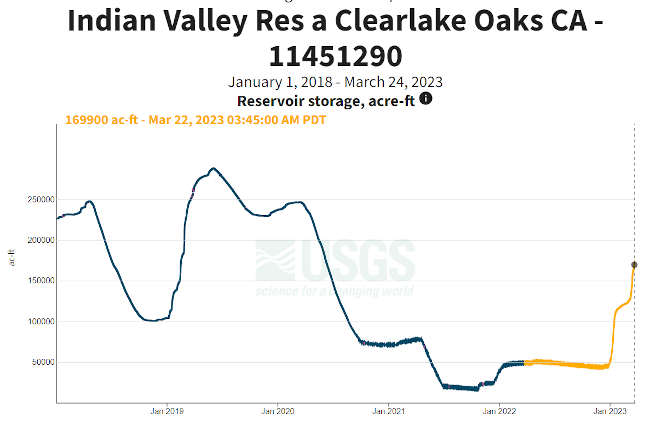
Yolo County also manages Indian Valley Reservoir, and while they are letting out maximum flow from Clear Lake through Cache Creek, they are keeping Indian Valley dam mostly closed so that reservoir can fill up to its maximum capacity.
Currently the water releases through Indian Valley dam are at a measly 11 CFS and the reservoir is only about half way full at about 175,000 acre feet. Yolo County is properly utilizing their reservoir storage while they are required to release water from Cache Creek to prevent flooding in Clear Lake.
If you want to know more about Yolo County water operations, or the water release amounts, you can visit their website here.
Flooding
Now that Clear Lake is more than full, we are hoping to only get rain in scattered, small bursts so we don’t reach a concerning flood stage on the lake. However, some low lying areas are seeing inundation, and may already be experiencing minor flooding.
As I stated above, If the lake reaches critical flood stage, there is nothing that can be done to magically make the water recede until it works its way out through the Grigsby Riffle and Cache Creek dam. Therefore, it’s up to the residents who live in low lying areas to be prepared in the event of a flood.
First, be aware of current conditions, bookmark the lake gauges on your browser, on your computers and mobile phones. Check them often as storm events occur and after, as stream flow continues to increase lake water levels even after precipitation has stopped.
Check your flood zone area on the county of Lake Flood Plain map page, but be aware that for some areas around Clear Lake, the flood zone distinctions have recently been updated, so calling the Water Resources Department, 707-263-2344 and asking the National Flood Insurance Program (NFIP) Coordinator about the most recent information is the best solution.
In the meantime, the best course of action to prevent loss or damage to property due to flood, is to be prepared. The county of Lake Office of Emergency Services released a series of “Flood Prep” best practice tips for being prepared against disaster during flood season.
Road closures, due to flooded conditions, can be located on Zone Haven along with information for when they are reopened and safe for travel.
Additionally, the Lake County Department of Public Works - California facebook page posted a list of locations to purchase sandbags and sand bag assembly materials. According to the Public Works Office administrator and facebook page manager, Lori Price, “Sandbag/sand locations updated as of 11:00 AM on 3/9/23. This post is pinned at the top of the page for easy access. We will try to update it as time allows.”
For more information about shelters, or emergency services, contact the Lake County Office of Emergency Services or call them at 707-263-3450.
Now is the time to help Lake County prepare and plan for natural disasters by being informed and involved in the Update to the Natural Hazard Mitigation Plan. Participation in this plan update is essential for appropriate emergency service planning and response. It’s also important for the County to acquire funds from FEMA for disaster mitigation, which can bring more resources to the County for disaster prevention.
Debris in Clear Lake
All this rain, storms, and water means that many tree branches, docks, yard furniture, and random other natural and man-made items, can now float away and become floating debris, or boating hazards, if they make it out to the open waters of the lake.
The seasonally-small team at Lake County Marine Patrol and the staff-strapped boat operators at Water Resources are working together to coordinate the towing of debris to public locations so they are not dangerous boating hazards. Once materials are towed to shore, Parks staff at Lake County and the two cities of Lakeport and Clearlake, can help to remove items and transport them to the lake county dump, or contact the owners for pickup. Some of this work is being supported by a Cannabis Tax grant.
If you see debris in the lake, or even beached detached buoys, you can report the locations to the Water Resources Department using this online “Boating Hazards Survey.” The survey takes about 1-2 minutes, and you can fill it out from your mobile phone if you are on the lake, notice the debris from shore, or later once you come off the water.
Debris does float, and crews are not on the lake 24/7 to respond to the survey, so please only report items that are landlocked, beached, grounded, or attached to something else so they don’t float away. A survey point for a floating object on the move is basically useless and those items can be called into Marine Patrol and a description and general location provided.
For property owners who live on the lake, it’s actually a requirement that docks or structures display or affix the owners address or contact information, as per County Code Chapter 23 section 6.5 (G) (H). Additionally, as part of lakebed lease agreements, it’s the owners responsibility to maintain and secure their lake structures so they don’t break loose or dislodge and float away, potentially destroying others’ property such as neighboring docks or passing boats.
Lastly, if you live on the lake, or visited the lakeshore recently, you might have noticed a bunch of dead tule stems crowding the shoreline. They look like large, round, hollow sticks. This material is rich in the nutrient nitrogen and once it decomposes along the shoreline, will help to provide nutrition for the new tules that are going to sprout up this spring.
If this material is a nuisance to you on your property, it’s okay to rake it up and dispose of it into a green waste container, or your compost bin. There is a plethora of nitrogen in the lake, and the new tule sprouts won’t be missing out, don’t worry.
However, if you don’t want to clean up the dead tule materials, they will be broken down soon by naturally-occurring bacteria and microbes, and wildlife, such as ducks and fish, will also use them for refugia and consume the algae that grows on them for snacks.
Let’s take some time to embrace and appreciate how wonderful it is that our lake is now, once again, full and vibrant. But let’s be mindful that another drought is only, perhaps, a year away.
Sincerely,
Lady of the Lake
Angela De Palma-Dow is a limnologist (limnology = study of fresh inland waters) who lives and works in Lake County. Born in Northern California, she has a Master of Science from Michigan State University. She is a Certified Lake Manager from the North American Lake Management Society, or NALMS, and she is the current president/chair of the California chapter of the Society for Freshwater Science. She can be reached at
The Lady of the Lake would like to acknowledge and thank Wiliam Fox from the County of Lake Water Resources Department for contribution to this column.