 How to resolve AdBlock issue?
News
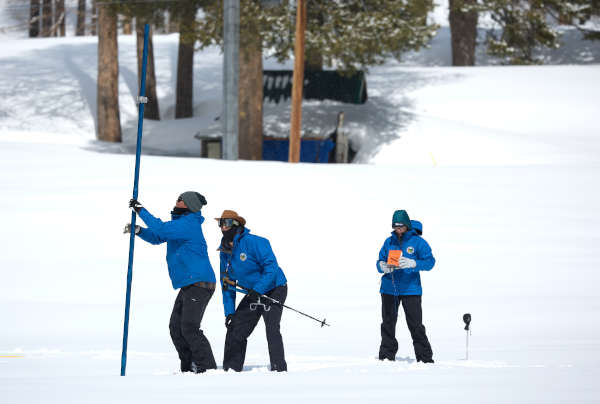
The storms that began in December have led to a very large snowpack for California, easing concerns about water supply for the time being but raising the potential for flooding.
The California Department of Water Resources, or DWR, on Monday conducted the fourth snow survey of the season at Phillips Station.
The manual survey recorded 126.5 inches of snow depth and a snow water equivalent of 54 inches, which is 221% of average for this location on April 3.
The snow water equivalent measures the amount of water contained in the snowpack and is a key component of DWR’s water supply forecast. DWR’s electronic readings from 130 snow sensors placed throughout the state indicate the statewide snowpack’s snow water equivalent is 61.1 inches, or 237% of average for this date.
“This year’s severe storms and flooding is the latest example that California’s climate is becoming more extreme,” said DWR Director Karla Nemeth. “After the driest three years on record and devastating drought impacts to communities across the state, DWR has rapidly shifted to flood response and forecasting for the upcoming snowmelt. We have provided flood assistance to many communities who just a few months ago were facing severe drought impacts.”
Just as the drought years demonstrated that California’s water system is facing new climate challenges, this year is showing how the state’s flood infrastructure will continue to face climate-driven challenges for moving and storing as much of these flood water as possible.
This year’s April 1 result from the statewide snow sensor network is higher than any other reading since the snow sensor network was established in the mid-1980s.
Before the network was established, the 1983 April 1 statewide summary from manual snow course measurements was 227% of average.
The 1952 April 1 statewide summary for snow course measurements was 237% of average.
“This year’s result will go down as one of the largest snowpack years on record in California,” said Sean de Guzman, manager of DWR’s Snow Surveys and Water Supply Forecasting Unit. “While 1952’s snow course measurements showed a similar result, there were fewer snow courses at that time, making it difficult to compare to today’s results. Because additional snow courses were added over the years, it is difficult to compare results accurately across the decades with precision, but this year’s snowpack is definitely one of the biggest the state has seen since the 1950s.”
For California’s snow course measurements, only 1952, 1969 and 1983 recorded statewide results above 200% of the April 1 average.
While above average across the state this year, snowpack varies considerably by region.
The Southern Sierra snowpack is currently 300% of its April 1 average and the Central Sierra is at 237% of its April 1 average. However, the critical Northern Sierra, where the state’s largest surface water reservoirs are located, is at 192% of its April 1 average.
The size and distribution of this year’s snowpack is also posing severe flood risk to areas of the state, especially the Southern San Joaquin Valley. DWR’s State-Federal Flood Operations Center, or FOC, is supporting emergency response in the Tulare Lake Basin and Lower San Joaquin River by providing flood fight specialists to support ongoing flood response activities and by providing longer-term advanced planning activities.
The FOC and DWR’s Snow Surveys and Water Supply Forecasting Unit are helping local agencies plan for the spring snowmelt season by providing hydraulic and hydrologic modeling and snowmelt forecasts specific to the Tulare Lake Basin that are informed by DWR’s snowmelt forecasting tools, including Airborne Snow Observatory, or ASO, surveys.
Storms this year have caused impacts across the state including flooding in the community of Pajaro and communities in Sacramento, Tulare and Merced counties.

The FOC has helped Californians by providing over 1.4 million sandbags, over 1 million square feet of plastic sheeting, and over 9,000 feet of reinforcing muscle wall, across the state since January.
On March 24, DWR announced an increase in the forecasted State Water Project, or SWP, deliveries to 75%, up from 35% announced in February, due to the improvement in the state’s water supplies.
Gov. Gavin Newsom has rolled back some drought emergency provisions that are no longer needed due to improved water conditions, while maintaining other measures that continue building up long-term water resilience and that support regions and communities still facing water supply challenges.
While winter storms have helped the snowpack and reservoirs, groundwater basins are much slower to recover. Many rural areas are still experiencing water supply challenges, especially communities that rely on groundwater supplies which have been depleted due to prolonged drought.
Long-term drought conditions in the Colorado River Basin will also continue to impact the water supply for millions of Californians. The state continues to encourage Californians to make water conservation a way of life as more swings between wet and dry conditions will continue in the future.
DWR conducts five media-oriented snow surveys at Phillips Station each winter near the first of each month, January through April and, if necessary, May.
Given the size of this year’s snowpack with more snow in the forecast, DWR anticipates conducting a May snow survey at Phillips Station.
That is tentatively scheduled for May 1.
SACRAMENTO – California Attorney General Rob Bonta on Monday announced the release of the 2022 Armed and Prohibited Persons System, or APPS, annual program report. In 2006, California became the first and only state in the nation to establish a system for tracking firearm owners who fall into a prohibited status.
The APPS database works to identify individuals who procured firearms and later became prohibited from legally owning them.
It remains the only system of its kind in the nation. In general, prohibited persons in APPS include individuals who were convicted of a felony or violent misdemeanor, were placed under a domestic violence or other restraining order, or suffer from serious mental illness.
Through the APPS program in 2022, DOJ recovered 1,437 firearms — including 712 handguns, 360 rifles, 194 shotguns, 80 assault weapons, 54 ghost guns, 43 receivers or frames, three short-barreled shotguns and one machine gun.
Agents also seized 308 large-capacity magazines, 2,123 standard capacity magazines, and 281,299 rounds of ammunition through APPS enforcement actions.
As of Jan. 1, 2023, there were 3,347,221 known registered firearm owners in California of which 23,869 are prohibited from owning or possessing firearms, making up less than 1%.
“As California’s chief law enforcement officer, protecting public safety and our communities from the threat of gun violence is my top priority,” said Attorney General Bonta. “I’m proud of the work our Special Agents do on behalf of the people of California. These brave agents are rarely in the spotlight, but they are working every day to prevent gun violence from ever happening by removing dangerous weapons from communities. When guns are in dangerous hands, it puts the public at risk. We will continue working with the Governor’s Office, Legislature, and our local partners to address gun violence.”
The Bureau of Firearms, or BOF, within the California Department of Justice's Division of Law Enforcement leads the DOJ’s APPS efforts. The 2022 APPS report provides an analysis of the APPS database and an overview of the Gun Violence Reduction Program grant.
It also describes how BOF staff and Special Agents increased enforcement efforts after COVID-19 restrictions were lifted, decreased staff vacancies, and collaborated with local law enforcement.
Key statistics from the 2022 report include:
• DOJ recovered 1,437 firearms as part of the APPS program in 2022. Of these, 916 were firearms identified in the APPS database and 521 were not previously known to be associated with a prohibited individual in APPS.
• Agents seized 54 ghost guns, a 38% increase from 2021, and a 575% increase since 2018, when DOJ seized 8 ghost guns.
• In 2022, DOJ investigated approximately 7,946 individuals who were identified as armed and prohibited persons in the APPS database.
• More individuals were removed from the prohibited list than added in 2022. Of the 9,917 prohibited people removed from the APPS database this year, 3,598 removals were the result of enforcement efforts – 377 more removals compared to 2021, an increase of almost 12%.
• As of Jan. 1, 2023, the APPS database contained 23,869 armed and prohibited persons. Of these, 9,294 cases were Active. The remaining 14,575 cases were listed as Pending. Pending cases are generally ones in which DOJ has thoroughly analyzed the case and exhausted all investigative leads or determined that the person is not within the DOJ’s jurisdiction.
• Last year, Special Agents made nearly 24,000 contacts based on an average of 57 contacts per month per agent. This is the highest number of contacts since the APPS program came into existence.
• As of Jan. 1, 2022, the BOF had 76 authorized permanent Special Agent Trainee, Special Agent, Special Agent Supervisor and Special Agent in Charge positions. Of those positions, 53 were filled and 23 were vacant. By December 2022, BOF continued to have 76 authorized permanent positions, of which 64 were filled and 13 were vacant.
In response to the overall increase in ghost gun seizures across the state, BOF will be expanding its investigative efforts focused on ghost guns. DOJ is actively working with law enforcement partners to establish collaborative investigative efforts aimed at addressing ghost gun activity.
Ghost guns are firearms constructed by private citizens that do not have a serial number, which means they are not registered. By definition, ghost guns do not appear in the APPS database and cannot be tracked by law enforcement.
BOF agents seized a total of 54 ghost guns in 2022, a 38% increase compared to the 39 ghost guns seized during 2021 APPS investigations.
When looking at data from the Unique Serial Number Application, or USNA, process, which shows how many California residents have applied to legally make personally manufactured firearms, there has been a slight decline in applications since 2018. However, the number of illegal ghost guns seized by law enforcement agencies continues to rise.
This contrast demonstrates illegal ghost guns remain difficult to track and represent a persistent threat to public safety. DOJ is actively combating illegal manufacturing and possession of ghost guns by bringing legal action against the Bureau of Alcohol, Tobacco, Firearms and Explosive, or ATF, and ghost gun manufacturers.
To maximize its investigative efforts, DOJ uses information from recently denied ammunition eligibility checks of APPS individuals who had attempted to purchase ammunition. In 2022, the DOJ received reports of 194 armed and prohibited individuals who attempted to purchase ammunition and were denied through the ammunition eligibility check process. BOF agents used these reports to investigate 194 individuals and seize 56 firearms, four large-capacity magazines, 55 standard magazines, and 6,621 rounds of ammunition.
2022 APPS operations
DOJ collaborates with local law enforcement agencies (LEA) throughout the state in individual APPS operations, as well as sweeps, or operations that occur over multiple days within a specific area. A list of operations can be found at the back of the report. Some notable examples include:
Los Angeles County: In February, agents completed a five-day sweep in Los Angeles County that targeted APPS suspects in 51 cities in Los Angeles County and resulted in 13 arrests, as well as the seizure of 114 firearms — including assault weapons, ghost guns, lower receivers, handguns, rifles and shotguns — as well as 49,148 rounds of ammunition, and 87 high-capacity magazines.
Bay Area: In January, agents from throughout the state consolidated their investigative efforts in a three-day sweep in Bay Area with local and federal law enforcement. The teams thoroughly analyzed and exhausted their leads in 338 cases in the counties of Contra Costa, Santa Clara, San Francisco, San Mateo, Sonoma, and Solano. The sweep resulted in the seizure of 30 firearms and eight arrests.
Orange County: In October, DOJ and the Costa Mesa Police Department (CMPD) arrested a suspect in Costa Mesa after a more than eight-hour standoff involving special agents and CMPD officers. The suspect, Luis Mendez Jr., was prohibited from owning firearms due to a misdemeanor conviction for domestic violence, and had an active misdemeanor arrest warrant. The special agents had a warrant to seize his weapons and attempted to serve that warrant when Mendez discharged a firearm. After more than eight hours of negotiations, Mendez surrendered and was placed under arrest with no injuries sustained by law enforcement or Mendez. Officers recovered a rifle, a shotgun, and multiple handguns at the scene.
Riverside County: During the month of August, DOJ collaborated with Menifee Police Department to serve a search warrant that resulted in the seizure of 54 guns — including two AR-15 style assault rifles, two UZI assault weapons, and 35 handguns — as well as 157 magazines and 2,200 rounds of ammunition from two individuals in Riverside County, one of whom was prohibited from possessing firearms.
Sacramento County: In October, Special Agents with the assistance of the Elk Grove Police Department Special Weapons and Tactics (SWAT) Team, served a search warrant at an APPS subject’s residence. As a result of the search warrant, agents seized one AR-15 style rifle machine gun, one AR-15 style pistol machine gun, one Polymer 80 handgun (ghost gun) with a full-auto switch attached, one stolen handgun, one complete Polymer 80 handgun (ghost gun), three suppressors, 15 ghost gun receivers/frames, 15 large capacity magazines, and approximately 1,200 rounds of ammunition. Special Agents also located ten 3D-printed handgun receivers and frames, two 3D printers, and filament for the printers.
Gun Violence Reduction Program
To expand upon collaborative efforts, on January 1, 2022, DOJ awarded the first cycle of grant funding to county sheriff’s departments to support seizures of firearms and ammunition from prohibited individuals through the new Gun Violence Reduction Program.
In the first grant cycle, DOJ awarded over $4.9 million to 10 county sheriff’s departments to support activities related to seizing weapons and ammunition from individuals prohibited from possessing them. The sheriffs of Contra Costa, Lake, Los Angeles, Orange, Sacramento, San Francisco, Santa Barbara, Santa Clara, Santa Cruz, and Ventura counties were awarded grants. The continued expansion of these collaborative efforts is an important tool with the common goal of protecting public safety.
About the Bureau of Firearms
BOF serves the people of California through education, regulation, and enforcement actions regarding the manufacture, sale, ownership, safety training, and transfer of firearms and ammunition. BOF staff are leaders in providing firearms expertise and information to law enforcement, legislators, and the general public in a comprehensive program to promote legitimate and responsible firearms possession and use by California residents. BOF is looking to hire additional Special Agents and more information on assessments for relevant job openings can be found on DOJ's website here: oag.ca.gov/careers/exams.
A copy of the report can be found here.
The council will meet at 5:30 p.m. Tuesday, April 4, in the council chambers at Lakeport City Hall, 225 Park St.
The agenda can be found here.
The council chambers will be open to the public for the meeting. Masks are highly encouraged where 6-foot distancing cannot be maintained.
If you cannot attend in person, and would like to speak on an agenda item, you can access the Zoom meeting remotely at this link or join by phone by calling toll-free 669-900-9128 or 346-248-7799.
The webinar ID is 973 6820 1787, access code is 477973; the audio pin will be shown after joining the webinar. Those phoning in without using the web link will be in “listen mode” only and will not be able to participate or comment.
Comments can be submitted by email to
The council will meet beginning at 5:30 p.m. with a reception for council members and city committees and commissions.
At the start of the regular meeting at 6 p.m., Mayor Stacey Mattina to read proclamations designating April 2023 as Child Abuse Prevention Month, Sexual Assault Awareness Month and Arts, Culture & Creativity Month.
Mattina also will read a proclamation honoring city committee and commission members.
The council also will hear a presentation from the Lakeport Economic Development Advisory Committee, or LEDAC, on the 2022 Business Walks.
One of the meeting’s main agenda items is a public hearing to adopt a resolution approving a mitigated negative declaration for the Martin Street Phase III Project general plan amendment and zone change, as well as an ordinance to amend city zoning maps to facilitate the project.
The project, which received Lakeport Planning Commission approval on Jan. 11, is a 40-unit “affordable housing community” to be built by AMG & Associates LLC on a 3.7-acre site at 519 S. Smith St., next to the Phase I and II of the Martin Street Apartments, also built by AMG.
Another key city project to be discussed on Tuesday is the demolition of the structure at 800 N. Main St., formerly known as the Natural High Continuation School, next to the new Lakefront Park.
Public Works Director Ron Ladd will ask the council to award a $79,000 construction contract to Unlimited Environmental Inc. for the Natural High demolition and authorize the city manager to execute the construction contract for the bid amount.
Ladd’s report said the building foundation, underground utilities, fencing and several trees will also be removed.
He said bids were opened March 20 with 12 bids received. Unlimited Environmental Inc. was the low bidder at $79,000, followed by Walberg Inc. at $85,525. The engineer’s estimate for this project was $125,000.
“Demolition is anticipated to begin in mid-June and be complete by the end of July 2023,” Ladd wrote.
In other business, City Attorney David Ruderman will give the council an update on the national opioid litigation, including the city’s involvement and status of prior settlements with three distributors and Janssen, and proposed settlements with Teva, Allergen, Walgreens, Walmart and CVS. The council also is set to hold a closed session to discuss the opioid litigation.
City Manager Kevin Ingram will present to the council a resolution to submit the recreation/community center project for consideration as a community project funding proposal in Congress.
Assistant City Manager Nick Walker will take to the council the second quarter financial update.
On the consent agenda — items considered noncontroversial and usually accepted as a slate on one vote — are ordinances; minutes of the regular council meeting on March 21; approval of
application 2023-009, with staff recommendations, for the 2023 Bicoastal Media Summer Concerts in the Park; and authorization for out-of-state travel for three utility staff members to attend the California Rural Water Association Expo.
After the open portion of the meeting, the council will have a closed session to discuss property negotiations with the Lake County Tax Collector’s Office and a case of ongoing litigation, City of Lakeport, California et al v. AmerisourceBergen Drug Corporation et al.
Email Elizabeth Larson at
The board will meet beginning at 9 a.m. Tuesday, April 4, in the board chambers on the first floor of the Lake County Courthouse, 255 N. Forbes St., Lakeport.
The meeting can be watched live on Channel 8, online at https://countyoflake.legistar.com/Calendar.aspx and on the county’s Facebook page. Accompanying board documents, the agenda and archived board meeting videos also are available at that link.
To participate in real-time, join the Zoom meeting by clicking this link.
The meeting ID is 974 3510 7207, pass code 394763. The meeting also can be accessed via one tap mobile at +16699006833,,97435107207#,,,,*394763#.
All interested members of the public that do not have internet access or a Mediacom cable subscription are encouraged to call 669-900-6833, and enter the Zoom meeting ID and pass code information above.
On Tuesday, the board will consider an agreement with Dewberry Architects Inc. for architectural/engineering services for the remodel of the former California Army National Guard Armory, located at 1431 Hoyt Ave. next to the Lake County Jail.
The contract, not to exceed $247,926, will be part of the work to convert the former armory into the Lake County Sheriff’s Office’s new headquarters.
Currently, the agency is headquartered in an aging facility at 1220 Martin St. in Lakeport.
Last year, the county and the state completed a land swap in which the county received the armory and traded to the state a vacant 15.5-acre property at 15837 18th Ave. in Clearlake.
The Clearlake property is now being developed for low-income housing.
In other business, the supervisors also will consider raising the maximum monthly county contribution of insurance coverage for each employee enrolled in a county sponsored group medical, dental, vision insurance plan.
The board also will hear a presentation from staff on the Lake County Hiring and Diversity Report for 2022 and consider a proposal to draft a request for a proposal to hire a diversity and inclusion consultant to help develop training, goals, and a plan to improve diversity and inclusion within Lake County’s workforce.
In timed items, at 9:07 a.m. the board will meet the pet of the week, will hear the poem of the week at 9:08 a.m. in honor of National Poetry Month, at 9:09 a.m. will present a proclamation designating April 2023 as National Poetry Month in Lake County as proposed by 2020-2024 Lake County Poet Laureate Georgina Marie Guardado, present a proclamation at 9:10 a.m. designating the week of April 3 to 9, 2023, as National Public Health Week, the Employee Service Awards at 9:15 a.m., a proclamation designating the month of April 2023 as Child Abuse Prevention Month at 9:19 a.m. and at 9:20 a.m. will hear a presentation by the Child Care Planning and Development Committee.
The full agenda follows.
CONSENT AGENDA
5.1: Approve agreement between county of Lake and Lower Lake Community Action Agency Group for tree removal services for the amount of $62,600 and authorize the board chair to sign.
5.2: Approve the continuation of the proclamation declaring a shelter crisis due to the current need for sheltering for those experiencing homelessness during the weather and temperature patterns that the county of Lake has been experiencing.
5.3: Approve continuation of proclamation declaring a Clear Lake hitch emergency.
5.4: Approve continuation of proclamation of the existence of a local emergency due to pervasive tree mortality.
5.5: Adopt proclamation designating the month of April 2023 as Child Abuse Prevention Month.
5.6: Adopt proclamation designating April 2023 as National Poetry Month in Lake County as proposed by Lake County Poet Laureate for 2020-2024, Georgina Marie Guardado.
5.7: Approve Board of Supervisors meeting minutes for March 21, 2023.
5.8: Adopt proclamation designating the week of April 3 to 9, 2023, as National Public Health Week.
5.9: Approve continuation of an emergency declaration for drought conditions.
5.10: Approve continuation of a local emergency by the Lake County Sheriff/OES director for the January 2023 Atmospheric River Event.
5.11: Approve continuation of proclamation of the existence of a local emergency due to low elevation snow and extreme cold.
5.12: a) Waive the competitive bidding process, pursuant to Lake County Code Section 2-38.4 Cooperative Purchases; b) authorize Special Districts administrator/assistant purchasing agent to issue a purchase order not to exceed $125,000 to Control Systems West Inc. for the purchase of a programmable logic controller.
5.13: a) Waive the formal bidding requirement per Section 2-38.4 (Cooperative Purchases) of the Lake County Purchasing Ordinance; and b) approve purchase order in the amount of $163,949.67 and authorize the Social Services director to sign for the purchase of 107 laptops, 162 docking stations, and 260 monitors to Dell Marketing LP.
5.14: Sitting as the Board of Housing Commissioners, approve Lake County Housing Commission Housing Choice Voucher Program Administrative Plan for 2023 and signing of the Annual Civil Rights Certification (HUD Form HUD-50077-CR).
TIMED ITEMS
6.2, 9:07 a.m.: Pet of the Week.
6.3, 9:08 a.m.: National Poetry Month — Poem of the Week.
6.4, 9:09 a.m.: Presentation of proclamation designating April 2023 as National Poetry Month in Lake County as proposed by 2020-2024 Lake County Poet Laureate Georgina Marie Guardado.
6.5, 9:10 a.m.: Presentation of proclamation designating the week of April 3 to 9, 2023, as National Public Health Week.
6.6, 9:15 a.m.: Presentation of Employee Service Awards.
6.7, 9:19 a.m.: Presentation of proclamation designating the month of April 2023 as Child Abuse Prevention Month.
6.8, 9:20 a.m.: Presentation by the Child Care Planning and Development Committee.
UNTIMED ITEMS
7.2: Review and consideration of increasing the maximum monthly county contribution of insurance coverage for each employee enrolled in a county sponsored group medical, dental, vision insurance plan effective July 1, 2023.
7.3: Presentation of Lake County Hiring and Diversity Report for 2022 and consideration of drafting a request for proposal to hire a diversity and inclusion consultant to help develop training, goals, and a plan to improve diversity and inclusion within Lake County’s workforce.
7.4: Consideration of agreement between the county of Lake and Dewberry Architects Inc., for architectural/engineering services for the remodel of the former California Army National Guard Armory.
7.5: Consideration of Contract Change Order No. 2 for the Hill Road Correctional Facility Tower Electronics Security Upgrade Project, Bid No. 22-30.
Email Elizabeth Larson at
The meeting will begin at 4 p.m. at the Moose Lodge, located at 15900 Moose Lodge Lane in Clearlake Oaks.
The meeting will be available via Zoom. The meeting ID is 986 3245 2684, pass code is 666827.
On the agenda will be guest speaker Lt. Richard Ward of the Lake County Sheriff’s Office, who will give an update on the progress of the Roadmap Task Force.
Other ongoing agenda items include the Clearlake Oaks consolidated lighting district, the Lake County Geothermal Project Watchlist, commercial cannabis cultivation projects and a cannabis ordinance task force update, and a report on upcoming proposed commercial and residential project applications requiring use permits within ERTH’s boundaries.
There also will be updates on Spring Valley, the Northshore Fire Protection District, and the Oaks Arm and Keys Restoration projects, a report from Supervisor EJ Crandell and public outreach on the U.S. Environmental Protection Agency’s Sulphur Bank Mine Superfund site.
The group’s next meeting will take place on May 3.
ERTH’s members are Denise Loustalot, Jim Burton, Tony Morris and Pamela Kicenski.
For more information visit the group’s Facebook page.
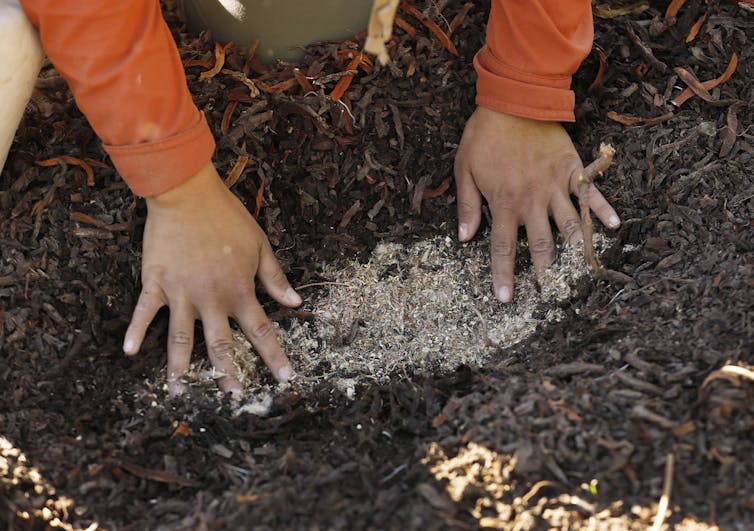
Spring is planting time for home gardeners, landscapers and public works agencies across the U.S. And there’s rising demand for native plants – species that are genetically adapted to the specific regions where they are used.
Native plants have evolved with local climates and soil conditions. As a result, they generally require less maintenance, such as watering and fertilizing, after they become established, and they are hardier than non-native species.
Many federal, state and city agencies rank native plants as a first choice for restoring areas that have been disturbed by natural disasters or human activities like mining and development. Repairing damaged landscapes is a critical strategy for slowing climate change and species loss.
But there’s one big problem: There aren’t enough native seeds. This issue is so serious that it was the subject of a recent report from the National Academies of Sciences, Engineering and Medicine. The study found an urgent need to build a native seed supply.
As plant scientists who have worked on ecological restoration projects, we’re familiar with this challenge. Here’s how we are working to promote the use of native plants for roadside restoration in New England, including by building up a seed supply network.
The need for native plants
Many stressors can damage and degrade land. They include natural disasters, such as wildfires and flooding, and human actions, such as urbanization, energy production, ranching and development.
Invasive plants often move into disturbed areas, causing further harm. They may drift there on the wind, be excreted by birds and animals that consume fruit, or be introduced by humans, unintentionally or deliberately.
Ecological restoration aims to bring back degraded lands’ native biological diversity and the ecological functions that these areas provided, such as sheltering wildlife and soaking up floodwater. In 2021, the United Nations launched the U.N. Decade on Ecosystem Restoration to promote such efforts worldwide.
Native plants have many features that make them an essential part of healthy ecosystems. For example, they provide long-term defense against invasive and noxious weeds; shelter local pollinators and wildlife; and have roots that stabilize soil, which helps reduce erosion.
Restoration projects require vast quantities of native seeds – but commercial supplies fall far short of what’s needed. Developing a batch of seeds for a specific species takes skill and several years of lead time to either collect native seeds in the wild or grow plants to produce them. Suppliers say one of their biggest obstacles is unpredictable demand from large-scale customers, such as government and tribal agencies, that don’t plan far enough ahead for producers to have stocks ready.
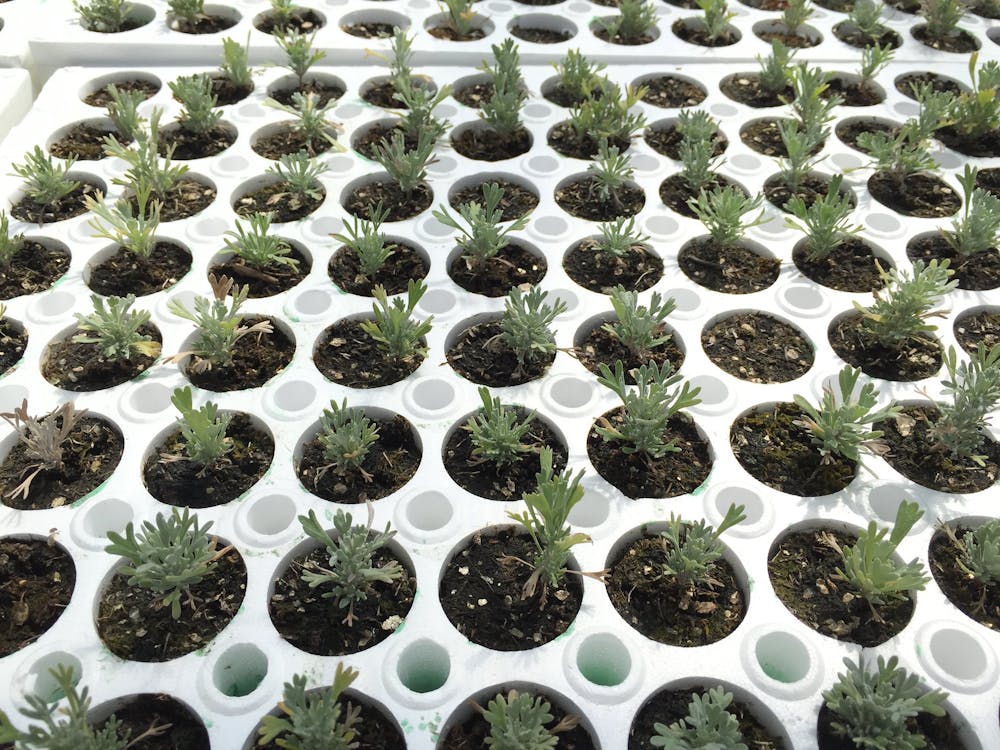
Restoring roadsides in New England
Most drivers give little thought to what grows next to highways, but the wrong plants in these areas can cause serious problems. Roadsides that aren’t replanted using ecological restoration methods may erode and be taken over by invasive weeds. Ecological restoration provides effective erosion control and better habitat habitats for wildlife and pollinators. It’s also more attractive.
For decades, state transportation departments across the U.S. used non-native cool-season turfgrasses, such as fescue and ryegrass, to restore roadsides. The main benefits of using these species, which grow well during the cooler months of spring and fall, were that they grew fast and provided a quick cover.
Then in 2013 the New England Transportation Consortium – a research cooperative funded by state transportation agencies – commissioned our research team to help the states transition to native warm-season grasses instead. These grasses grow well in hot, dry weather and need less moisture than cool-season grasses. One of us, John Campanelli, developed the framework for selecting plant species based on conservation practices and identified methods for establishing native plant communities for the region.
We recommended using warm-season grasses that are native to the region, such as little bluestem, purple lovegrass, switchgrass and purpletop. These species required less long-term maintenance and less-frequent mowing than the cool-season species that agencies had previously used.
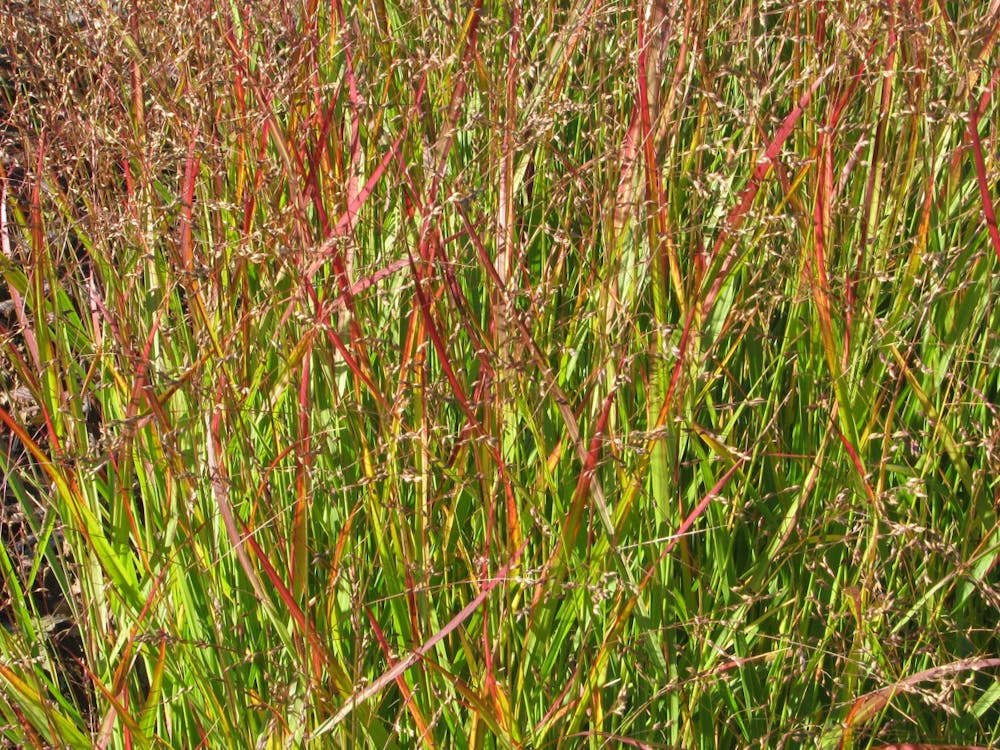
To ensure sound conservation practices, we wanted to use seeds produced locally. Seeds sourced from other locations would produce grasses that would interbreed with local ecotypes – grasses adapted to New England – and disrupt the local grasses’ gene complexes.
At that time, however, there was no reliable seed supply for local ecotypes in New England. Only a few sources offered an incomplete selection of small quantities of local seeds, at prices that were too expensive for large-scale restoration projects. Most organizations carrying out ecological restoration projects purchased their bulk seeds mainly from large wholesale producers in the Midwest, which introduced non-local genetic material to the restoration sites.
Improving native seed supply chains
Many agencies are concerned that lack of a local seed supply could limit restoration efforts in New England. To tackle this problem, our team launched a project in 2022 with funding from the New England Transportation Consortium. Our goals are to increase native plantings and pollinator habitats with seeds from local ecotypes, and to make our previous recommendations for roadside restoration with native grasses more feasible.
As we were analyzing ways to obtain affordable native seeds for these roadside projects, we learned about work by Eve Allen, a master’s degree student in city planning at the Massachusetts Institute of Technology. For her thesis, Allen used supply chain management and social network analysis to identify the best methods to strengthen the native seed supply chain network.
Her research showed that developing native seed supplies would require cooperative partnerships that included federal, state and local government agencies and the private and nonprofit sectors. Allen reached out to many of these organizations’ stakeholders and established a broad network. This led to the launch of the regional Northeast Seed Network, which will be hosted by the Massachusetts-based Native Plant Trust, a nonprofit that works to conserve New England’s native plants.
We expect this network will promote all aspects of native seed production in the region, from collecting seeds in the wild to cultivating plants for seed production, developing regional seed markets and carrying out related research. In the meantime, we are developing a road map for new revegetation practices in New England.
We aim to build greater coordination between these agencies and seed producers to promote expanded selections of affordable native seeds and make demand more predictable. Our ultimate goal is to help native plants, bees and butterflies thrive along roads throughout New England.
Julia Kuzovkina, Professor of Horticulture, University of Connecticut and John Campanelli, PhD Student in Plant Science and Landscape Architecture, University of Connecticut
This article is republished from The Conversation under a Creative Commons license. Read the original article.