 How to resolve AdBlock issue?
News
The Clearlake Animal Control website continues to list 35 dogs for adoption.

This week’s dogs include “Red,” a male German shepherd mix.
There also is Maya,” a female German shepherd mix and Atlas, another German shepherd.

The shelter is located at 6820 Old Highway 53. It’s open from 9 a.m. to 6 p.m. Tuesday through Saturday.
For more information, call the shelter at 707-762-6227, email

This week’s adoptable dogs are featured below.
Email Elizabeth Larson at
The report covers the month of May, when a total of 92 single family homes were sold through the multiple listing service, compared to 67 in April and 109 sold during the same time last year.
These include traditionally built “stick-built” houses as well as manufactured homes on land.
There were five sales of mobile homes in parks, compared to 5 in April and nine sold during the same time period last year, and 21 sales of bare land (lots and acreage) sales, compared to 24 in April and 33 during the same time last year.
There are 382 “stick built” and manufactured homes on the market right now, compared to 344 listed in April.
If the rate of sales stays the same at 92 homes sold per month, there are currently 4.15 months of inventory on the market at the moment compared to 5.1 months of inventory in April, and 3.6 months of inventory in March.
That means that if no new homes are brought to the market for sale, in 4.15 months all of these homes would be sold and there would be none available.
Less than six months of inventory is generally considered to be a “sellers’ market” while more than 6 months of inventory is often called a “buyers’ market.
Total percentage of homes bought for all cash in May was 21%, compared to 27% for April and 28% for this same time last year; 47% were financed by Fannie Mae or Freddie Mac (“conventional loans”) compared to 48% in April and 41% for the same time last year; and 21% were financed by FHA (compared to 15% for in April and 18% for this time last year); and 5% were financed by the VA or CalVet (compared to 4% for March and 7% for this time last year); 5% had other financing such as private loans, USDA, or seller financed notes (compared to 6% in April and 6% last year at this time).
The homes in May were selling at an average of 96% of the asking price at the time the property went under contract, but an average of 92% when compared to the original asking price when the property first came on the market.
In April it was roughly the same at 97% of the asking price at the time the property went under contract, but 92% of the original asking price.
A year ago at this time, homes were selling at 98% of the asking price at the time the property went under contract and 96 % when compared to the original asking price.
The median time on the market in May was 39 days, compared to 41 days for the previous month and 22 days for this time last year.
The median sale price of a single family home in Lake County in May was $341,000, compared to $307,500 for the previous month and similar to the median sale price of $339,000 during this time period last year.
This would indicate that in May the higher priced homes were selling in greater numbers to bring the median sale price up compared to the previous year.
In May, 46% of homes sold had seller concessions for an average concession of $8,540. In April, 42% of homes had seller concessions for an average concession of $6,648 and a year ago 34% of homes sold had an average seller concession of $6,773.
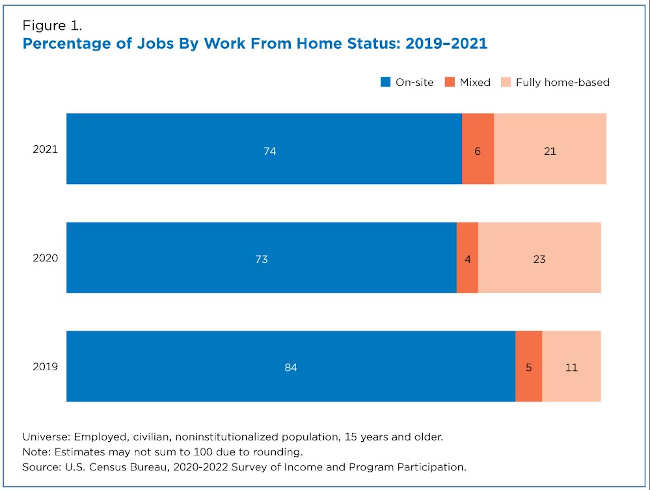
The share of U.S. jobs worked on-site dropped roughly 10 percentage points from 84% in 2019 to 74% in 2021, the first full year of the pandemic, according to the Survey of Income and Program Participation, or SIPP.
The share of jobs done exclusively from home (fully home-based jobs) roughly doubled from 11% of all jobs in 2019 to 23% in 2020, before declining to about 21% in 2021.
Jobs worked some days on-site and other days from home — referred to as mixed or hybrid work — represented the smallest share of all jobs worked each year, but increased from around 4% in 2020 to 6% in 2021.
Essential work more commonly performed on-site
The category of essential worker was created by the Department of Homeland Security to characterize workers employed in occupations considered vital to the continued operation of the economy during the COVID-19 pandemic. According to DHS methodology, around 7 in 10 jobs overall were deemed essential in each survey year.
A significantly larger percentage of on-site jobs (compared to mixed and fully home-based jobs) were considered essential in 2019 through 2021. By 2021 roughly 75% of on-site jobs were classified as essential, compared to about 60% of hybrid and 61% of fully home-based jobs.
Other highlights of the table package include:
Work schedule
• Workers with mixed schedules were more likely to work from home at the start or end of the work week. For this set of workers, the most common days to work from home in 2021 were Fridays (53%) and Mondays (50%).
• The share of mixed jobs with a standard, predictable schedule increased from 81% in 2019 to 84% in 2021. And among jobs that allowed working fully from home, the share that offered a standard, predictable schedule went from 66% in 2019 to about 77% in 2021. The percentage of on-site jobs offering a standard, predictable work schedule decreased from 73% in 2019 to 71% in 2021.
Industry and occupation
• The share of jobs in finance and insurance, real estate and rental and leasing industries that were conducted on-site dropped from 67% in 2019 to 43% in 2021.
• The percentage of on-site public administration jobs declined from 86% in 2019 to 67% in 2021.
• Computer and mathematical occupations had a noticeable shift from the majority of jobs worked on-site in 2019 (60%) to a majority not worked on-site in 2020 (32%) and 2021 (30%).
• The material moving occupations, which include jobs that often must be performed on-site such as stocker and order fillers, hand packers and packagers and industrial truck and tractor operators, had relatively low percentages of home-based jobs: 97% of jobs were on-site in 2019 and 2020, and 96% in 2021.
Recently released American Community Survey data shed some light on the effect of increased remote work on the commuting landscape since the onset of the COVID-19 pandemic. The 2019-2021 SIPP Home-Based Workers Table Package offers substantial new detail on how home-based work has changed over the past few years.
Related information
All comparative statements in this report have undergone statistical testing and, unless otherwise noted, all comparisons are statistically significant at the 10% significance level.
Survey statistics are subject to sampling and nonsampling error. For further information on the source of the data and accuracy of the estimates, including standard errors and confidence intervals, refer to the SIPP website.
Clayton Gumber is a survey statistician in the Industry and Occupation Branch of the Census Bureau’s Social Economic, and Housing Statistics Division, or SEHSD. Michael Burrows is a survey statistician in the Journey to Work and Migration Statistics Branch in SEHSD.
In addition to Thompson and Gallagher, the bill is led by Reps. John Garamendi (CA-08), Dan Newhouse (WA-04), Ed Case (HI-01), Bill Johnson (OH-06), Jim Costa (CA-21), Elise Stefanik (NY-21), Jimmy Panetta (CA-19), Frank Lucas (OK-03), Jason Crow (CO-06), Rob Wittman (VA-01), Salud Carbajal (CA-24), Randy Feenstra (IA-04) and Mary Sattler Peltola (AK-AL).
The bill text can be found here.
“Protecting national security and food security go hand in hand in our region — which is why it is vital to know who owns land around national security sites,” said Rep. Thompson. “The bipartisan legislation I am introducing with Chairman Gallagher will help identify foreign actors who are seeking to purchase land near military installations while maintaining food security throughout our country.”
Rep. Thompson sent a letter to the United States Department of the Treasury Committee on Foreign Investment in the United States, or CFIUS, calling for a review of the purchases in Solano County.
“The United States cannot allow foreign adversaries like the Chinese Communist Party and its proxies to acquire real estate near sensitive sites like military bases or telecom infrastructure, potentially exploiting our critical technology and endangering our service members. This bill gives CFIUS jurisdiction over foreign adversary real estate transactions to guard against the threat of the CCP and other adversaries purchasing land for malign purposes, and it also encourages CFIUS to consider food security issues as it evaluates the national security risk of a given transaction,” said Rep. Gallagher.
“Safeguarding our food supply chains and national security from foreign adversaries like the Chinese Communist Party will always be a top priority of mine. We must ensure our government agencies have the necessary resources to stop bad actors from gaining a foothold in our homeland. I am proud to introduce this legislation as a continuation of my efforts to stop the CCP and all foreign adversaries from putting our food supply and national security at risk,” said Rep. Newhouse.
“As the proud Representative of Travis Air Force Base in Congress for over a decade, the recent land purchases near the base by unknown investors raise serious questions and concerns. Travis, also known as the ‘Gateway to the Pacific,’ is one of the most strategically valuable installations within the U.S. military. We must do everything in our capacity to ensure Travis is fully protected and supported,” said Rep. Garamendi. “Though Flannery Associates claims that it is not controlled by foreign entities, they have shockingly failed to provide any proof to local and federal officials. This issue raises serious security concerns for our community and the critical military operations at Travis. That's why I greatly appreciate this important bipartisan legislation and look forward to continuing to work with my colleagues to protect our communities and defend our national security.”
“Food security is national security, and I’ve been fighting to get the Secretary of Agriculture a seat at the table for a long time — this bill builds on that fight. As we witness growing threats from foreign adversaries on American soil, Congress should work overtime to ensure our military bases, food sources, and research facilities are protected. Our bill provides CFIUS with the tools needed to keep America’s enemies away from our most sensitive areas,” said Rep. Johnson.
“The People’s Republic of China has an alarming history of leveraging foreign investment to gain access to sensitive information,” said Rep. Case. “ This type of foreign espionage is a serious threat to national security. This bill will help close the gaps in our oversight of foreign purchases and their use of agricultural land, especially near our military bases and training sites. This will help ensure that the Committee on Foreign Investment in the United States can fully assess investments that can compromise our security and intelligence sites.”
“Food security is national security. Communist China buying up U.S. agricultural land is just one of the CCP’s many attempts to subvert our sovereignty and threaten our national security. I will continue to fight to protect our agricultural land and to ensure that our country’s food security and national security are prioritized. I am proud to support this legislation that will mandate heightened scrutiny over adversarial land purchases near our military installations,” said Chair Stefanik.
"Food is a national security issue. Increasing foreign ownership of American farms and farmland is a threat to our food security,” said Rep. Costa. “We need to prevent foreign adversaries like China from undermining the American agricultural industry. This bill will ensure American agriculture is operated by American businesses.”
“A resilient food supply is essential to national security, which is why the rise of foreign investments in our nation’s farmlands deserves increased scrutiny. I have long supported adding the Secretary of Agriculture on CFIUS, which will equip the Committee with the expertise needed to identify potential threats to our national security,” said Rep. Lucas. “I’m pleased to be an original cosponsor and commend Congressman Gallagher for his work on this important legislation.”
“Our geopolitical adversaries are exploiting loopholes in regulations to purchase farmland and other agricultural assets, threatening our national and food security,” said Rep. Panetta. “I’m proud to join this bipartisan effort to ensure CFIUS has the jurisdiction and mandate needed to properly vet these foreign purchases as in the best interest of the United States. This is a necessary step to counter any malign efforts to weaken U.S. agricultural independence and security.”
“The scope and scale of the Chinese Communist Party’s activities in the United States is deeply alarming,” said Rep. Wittman. “Entities with clear ties to foreign adversaries should not be permitted to purchase land near U.S. military bases, intelligence facilities, or national laboratories. I’m proud to join this effort to equip the Committee on Foreign Investment in the United States with the tools it needs to protect our national interests.”
American farmland belongs to American farmers — period. For the sake of our national, energy, and food security, we cannot let China, or any other foreign adversary, buy our fertile farmland, prevent our young producers from planting their roots, or jeopardize our agricultural supply chains,” said Rep. Feenstra. “I am proud to work with my colleagues to introduce legislation to protect American farmland from foreign acquisition, particularly the Chinese Communist Party, and keep American farmland where it rightfully belongs — in the hands of American farmers.”
An entity called Flannery Associates has spent nearly $1 billion over the last five years to become the largest landowner in Solano County. The land purchases go up to the fence of Travis Air Force Base, the home of the largest wing of the Air Force’s Air Mobility Command.
CFIUS is an interagency committee authorized to review certain transactions involving foreign investment in the United States and certain real estate transactions by foreign persons, in order to determine the effect of such transactions on the national security of the United States. However, there are significant gaps in the current process.
The Protecting U.S. Farmland and Sensitive Sites From Foreign Adversaries Act would:
• Give CFIUS jurisdiction over all land purchases (with exceptions for real estate in urban areas and single housing units) by foreign adversary entities. This would avoid a repeat of the “FuFeng incident” where, despite a clear national security concern to a military installation in North Dakota, CFIUS claimed it was unable to even review (let alone block) the transaction because the land was outside the scope of CFIUS jurisdiction.
• Authorize CFIUS to consider U.S. food security, including via biotechnology acquisition, as a factor in its national security reviews and require the Secretary of Agriculture have a vote in CFIUS reviews of transactions that involve farmland or agriculture technology.
• Establish a “presumption of non-resolvability” by CFIUS that raises the approval threshold for CFIUS transactions by a foreign adversary entity purchasing near sensitive sites (e.g., major military sites, acknowledged intelligence facilities, etc.) CFIUS will be required to review these transactions with the presumption that the national security concerns cannot be resolved.
• Mandatory CFIUS filing for foreign adversary entities making land purchases near sensitive sites. This will ensure CFIUS remains apprised of ongoing real estate purchases by foreign adversary entities.
• Expand the list of sensitive national security sites designated for CFIUS jurisdiction. Require CFIUS to expand the list of sensitive national security sites to all military facilities, acknowledged intelligence sites, national laboratories, and defense-funded university-affiliated research centers, critical telecommunication nodes, and more. Current CFIUS regulations only cover a limited number of sensitive sites, and does not include all military facilities, national laboratories, and other sites. CFIUS is also limited to sensitive sites that are U.S. government property.
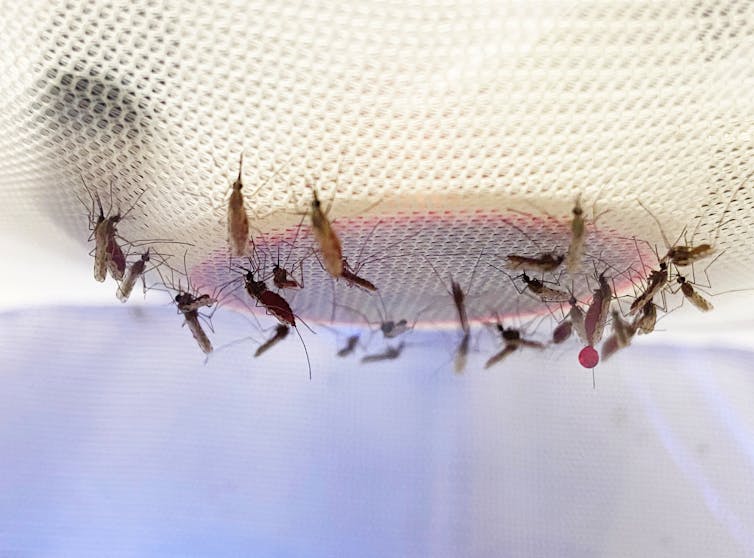
Now that summer is in full swing, mosquitoes have come out across the United States. The use of mosquito repellents can protect both your health and sanity this summer.
While mosquitoes leave bothersome, itchy bites on your skin, they can also pose a serious and sometimes deadly risk to your health. When a mosquito bites you, it may transmit harmful pathogens that cause dangerous diseases like malaria, Dengue fever, Zika and West Nile.
Avoiding mosquito bites
Mosquito females bite people to get vital nutrients from our blood. They then use these nutrients to make their eggs. One single blood meal can give rise to about 100 mosquito eggs that hatch into wiggling larvae.

There are several ways to avoid getting bitten by mosquitoes, from wearing long, loose clothing and limiting time outside to placing screens over your windows and getting rid of standing water that mosquitoes might use to breed.
However, one of the best ways to protect yourself when you’re going to a place where hungry mosquitoes will be buzzing around is by using mosquito repellents.
Our team at the New Mexico State University Molecular Vector Physiology Laboratory has studied different types of mosquito repellents and their efficacy for over a decade. Here’s what you need to know to protect yourself this summer:
All about repellents
The use of mosquito repellents goes far back in history, certainly predating written historical accounts. Some of the oldest records of the use of mosquito repellents date back to early Egyptian and Roman history. During this period, smoke from smudge fires was often used to repel mosquitoes.
Today, we have more options than our ancestors when it comes to choosing what type of mosquito repellent to use – sprays and lotions, candles, coils and vaporizers, to name some.
These repellents interfere with a mosquito’s sense of smell, taste or both. The repellent either blocks or overstimulates these senses. Scientists understand how certain repellents like DEET work at the molecular level, but for many of them, it is still unknown why exactly they repel mosquitoes.
Testing repellents
We used a variety of scientific laboratory experiments and field tests to find out what works. For some products, testing was as simple as putting a volunteer’s treated arm into a cage with 25 mosquitoes and waiting for the first mosquito bite.

For others, like citronella candles, we used a slow-speed wind tunnel and put a candle or device between a person and a cage of mosquitoes. Depending on the repellent efficacy of the device, mosquitoes either flew toward the person or away. Another experiment we conducted was the Y-tube choice assay where mosquitoes chose to fly toward someone’s hand or, if repelled, fly toward the blank or empty option.
Mosquito repellents that don’t work
Bracelets don’t work. Department stores and pharmacy chains sell hundreds of different varieties of bracelets. They are marketed as “mosquito repellent” bands, wristbands and watches, and their materials can vary from plastic to leather. Even if they are loaded with repellents, they can’t protect your whole body from mosquito bites.
Ultrasonic repellent devices don’t work. These come as electrical plug-ins, free-standing varieties or watchlike accessories that claim to emit a high-frequency sound that deters mosquitoes by mimicking bats. However, in scientific studies, ultrasonic repellent devices fail to repel mosquitoes. In fact, when our lab tested one of these devices, we found a slight increase in mosquito attraction to the wearer.
Dietary supplements – vitamin B, garlic and so on – don’t work. No scientific evidence shows these supplements protect people from mosquito bites.
Light-based repellents don’t work. These devices come as colored light bulbs, and they don’t attract insects that fly toward white light. This approach works well on moths, beetles and stinkbugs, but not on mosquitoes.
Mosquito repellents that work
And here is our ranking of what does work, starting with the best repellent/active ingredient.
-
DEET works. DEET, chemical name, N,N-diethyl-meta-toluamide, was developed in the 1950s by the U.S. Army and is a well-established mosquito repellent with a long history of use. The higher the percentage, the longer the protection time is – up to six hours.
-
Picaridin works. This synthetic repellent can protect for up to six hours at a 20% concentration. This repellent is a promising alternative for DEET.
-
Oil of lemon eucalyptus, or OLE, works. OLE, with the active ingredient PMD, is a plant-based alternative to DEET and picaridin. Its repellent properties can last for up to six hours.
-
Other essential oils – some work, some not so much. We applied 20 different essential oils in a 10% essential oil lotion mixture to volunteers’ skin. Here’s what we found:
Clove oil works. This oil, with the active ingredient eugenol, can protect from mosquito bites for over 90 minutes at a 10% concentration in lotion. Cinnamon oil works. This oil, with the active ingredients cinnamaldehyde and eugenol, can protect from mosquitoes for over 60 minutes at a 10% concentration in lotion. Geraniol and 2-PEP, or 2-phenylethyl propionate, work for about 60 minutes at a 10% concentration in lotion. Citronella oil works, just not so great. We found citronella oil at a 10% concentration only protected from mosquito bites for about 30 minutes.
If you are planning to mix your own plant-based mosquito repellent this summer, remember that essential oils are complex mixtures of plant-made chemicals that can cause skin irritations at high concentrations.
Based on our study, we recommend using repellents with the active ingredient DEET if you live in or are traveling to regions with a high risk of vector-borne disease transmission. However, plant-based repellents will work just fine to prevent nuisance mosquito bites in low-risk areas, as long as you reapply them as needed.
Immo A. Hansen, Associate Professor of Biology, New Mexico State University and Hailey A. Luker, Ph.D. Student in Biology, New Mexico State University
This article is republished from The Conversation under a Creative Commons license. Read the original article.
At its meeting on Thursday, the Clearlake City Council unanimously approved the renovation of the building, located at 14085 Olympic Drive, as part of its consent agenda.
The City Hall Remodel Project was released on May 31, with the six bids the city received opened on June 26.
Adams Commercial General Contracting Inc. submitted a $1,281,110 bid and won the contract. The high bidder, coming in at $1,615,000, was GCCI Inc.
As part of its approval, the City Council authorized City Manager Alan Flora to approve change orders up to 10% of the contract price, a common practice on city projects.
With the project set to start, officials said the City Hall administration offices — which include The Building and Planning, Public Works, Administrative Services and Finance Departments — will move operations temporarily to the Lake County Campus of Woodland Community College, located at 15880 Dam Road in Clearlake.
Administration operations will be closed for staff transition on Thursday, July 13, and will reopen at the Woodland Community College site on Monday, July 17.
The Police Department operations, including Code Enforcement, will not be impacted by the renovations and will continue normal operations at 14050 Olympic Drive in Clearlake.
Additionally, City Council and Planning Commission meetings will continue to be held in the City Council chambers, the city reported.
Due to the renovations, there may be times when the public restrooms will be temporarily unavailable.
The funding for the project comes from the American Rescue Plan Act of 2021, or ARPA.
The $350 million that ARPA distributed to state and local governments was meant to mitigate the fiscal effects of the COVID-19 emergency, Administrative Services Director/City Clerk Melissa Swanson explained to the council in her written report for the meeting.
“ARPA also established the Coronavirus Local Fiscal Recovery Fund (“CLFRF”) for local government allocations and provide flexibility for each government to meet local needs to respond to the COVID-19 public health emergency and to support various activities to decrease the spread of the virus. The funds must be encumbered by Dec. 31, 2024 and spent by Dec. 31, 2026,” Swanson explained.
The city of Clearlake’s ARPA allocation totaled $2.87 million, Swanson reported.
The city reported that the funding will be used, in part, “to fund capital improvements to City Hall geared toward mitigating the spread of COVID-19 and other infectious diseases.”
Those measures include updating the public and employee restrooms to touchless fixtures, improved privacy stalls and shower facilities, improving the security at the administration front counter with electronic entry points for employees that’s identical to the system at the Clearlake Police Department entrances, transitioning the administration workplace from open and shared cubicle spaces to individual offices to prevent the spread of COVID-19 or other infectious disease, improving public lobby areas, and creating more open space and an improved customer service window for the police lobby and window area.
“City operations have existed at the Olympic Drive location since the mid-1990s,” said Flora in a Tuesday statement from the city. “In the last few years, we have renovated the police department, police dispatch center and City Council chambers. The ARPA funds will allow us to complete the renovations and improve our ability to serve the community in a cleaner and safer City Hall.”
Swanson reported that during its existence, the City Hall building has had several different uses, including a Safeway grocery store in the late 1970s and early 1980s, and a clothing store in the late 1980s and early 1990s before finally becoming City Hall in 1996.
“Since then, there have been little improvements or changes to the office spaces or restrooms, including flooring, shelving, cubicles and furniture,” Swanson wrote in her report to the council.
Email Elizabeth Larson at