 How to resolve AdBlock issue?
News
To complete the project, the county of Lake, and cities of Lakeport and Clearlake have contributed a total of $20,000 in matching funds.
The CEDS update is a locally driven effort to guide the economic prosperity and resiliency and serves to engage community leaders, private sector firms and industries in the development of the five-year plan.
The completed CEDS will act as a road map for future economic development efforts and provide supporting documents when seeking federal grant funding to complete projects that fit within priorities named within the CEDS.
Lake EDC will be seeking community input and collaboration during the 12-month process.
Steps in the process will include data analysis, community listening sessions and engagement with agencies involved in infrastructure, private sector industry, healthcare, resiliency, education, natural environment, and government.
Additionally, Lake EDC will be publishing a request for proposals, or RFPs, to assist in the development of the CEDS.
To find out more about the CEDS process, how you can participate, or how to bid on the RFPs, visit https://lakecountycaedc.org/CEDS/.

Weather forecasts have gotten quite good over the years, but their temperatures aren’t always spot on – and the result when they underplay extremes can be lethal. Even a 1-degree difference in a forecast’s accuracy can be the difference between life and death, our research shows.
As economists, we have studied how people use forecasts to manage weather risks. In a new working paper for the National Bureau of Economic Research, we looked at how human survival depends on the accuracy of temperature forecasts, particularly during heat waves like large parts of the U.S. have been experiencing in recent days.
We found that when the forecasts underplayed the risk, even small forecast errors led to more deaths.
Our results also show that improving forecasts pays off. They suggest that making forecasts 50% more accurate would save 2,200 lives per year across the country and would have a net value that’s nearly twice the annual budget of the National Weather Service.
Forecasts that are too mild lead to more deaths
In the U.S. alone, the National Oceanic and Atmospheric Administration issues 1.5 million forecasts per year and collects around 76 billion weather observations that help it and private companies make better forecasts.
We examined data on every day’s deaths, weather and National Weather Service forecast in every U.S county from 2005 to 2017 to analyze the impact of those forecasts on human survival.
We then compared deaths in each county over the week following a day with accurate forecasts to deaths in the same county over the week following a day with inaccurate forecasts but the same weather. Because weather conditions were the same, any differences in mortality could be attributed to how people’s reactions to forecasts affected their chance of dying in that weather.
We found similar results when the forecast was wrong on hot days with temperatures above 86 degrees Fahrenheit (30 Celsius) and on cold days with temperatures below freezing. Both summer days that were hotter than forecast and winter days that were colder had more deaths. Forecasts that went the other way and overestimated the summer heat or winter cold had little impact.
That doesn’t mean forecasters should exaggerate their forecasts, however. If people find that their forecasts are consistently off by a degree or two, they might change how they use forecasts or come to trust them less, leaving people at even higher risk.
People are paying attention
People do pay attention to forecasts and adjust their activities.
The American Time Use Survey, conducted continuously for the U.S. Bureau of Labor Statistics, shows what Americans across the country are doing on any given day. We found that on days when the forecast called for temperatures to be milder than they turned out to be – either cooler on a hot day or warmer on a cold day – people in the survey spent more time on leisure and less in home or work settings.
Electricity use also varies in sync with forecasts, suggesting that people’s use of air conditioning does not just respond to the weather outside but also depends on how they planned for the weather outside.

However, forecasts are not used equally across society. Deaths among racial minorities are less sensitive to forecast errors, we found. That could be due in part to having less flexibility to act on forecasts, or not having access to forecasts. We will dig into this difference in future work, as the answer determines how the National Weather Service can best reach everyone.
The value of better forecasts
It’s clear that people use forecasts to make decisions that can matter for life and death – when to go hiking, for example, or whether to encourage an elderly neighbor to go to a cooling center.
So, what is the value of accurate forecasts?
We combined our theoretical model with federal cost-benefit estimates of how people value improvements in their chances of survival. From those, we estimated people’s willingness to pay for better forecasts. That calculation accounts for the risk of dying from extreme weather and for the costs of using forecasts to reduce their risk of dying, such as the costs of altering work and play schedules or using electricity.
The result shows that 50% more accurate forecasts are worth at least US$2.1 billion per year based on the mortality benefits alone. In comparison, the 2022 budget of the National Weather Service was less than $1.3 billion.
Weather forecasts have gotten steadily better over the past decades. About 68% of the next-day temperature forecasts now have an error of less than 1.8 degrees. Our results suggest investing in improved forecast accuracy would probably be worth the cost.
Past improvements have come from better models, better observations and better computers. Future improvements could come from similar channels or from applying recent innovations in machine learning and artificial intelligence to weather prediction and communication.
Climate change will increase the frequency of extremely hot days, which are especially important for human health and survival to forecast accurately. Climate change will make the weather weirder, but weird weather can do less harm when we can see it coming.
Derek Lemoine, Associate Professor of Economics, University of Arizona; Jeffrey Shrader, Assistant Professor of International and Public Affairs, Columbia University, and Laura Bakkensen, Associate Professor of Economics and Policy, University of Arizona
This article is republished from The Conversation under a Creative Commons license. Read the original article.

Astronomers have discovered more than 5,000 planets outside of the solar system to date. The grand question is whether any of these planets are home to life. To find the answer, astronomers will likely need more powerful telescopes than exist today.
I am an astronomer who studies astrobiology and planets around distant stars. For the last seven years, I have been co-leading a team that is developing a new kind of space telescope that could collect a hundred times more light than the James Webb Space Telescope, the biggest space telescope ever built.
Almost all space telescopes, including Hubble and Webb, collect light using mirrors. Our proposed telescope, the Nautilus Space Observatory, would replace large, heavy mirrors with a novel, thin lens that is much lighter, cheaper and easier to produce than mirrored telescopes. Because of these differences, it would be possible to launch many individual units into orbit and create a powerful network of telescopes.


The need for larger telescopes
Exoplanets – planets that orbit stars other than the Sun – are prime targets in the search for life. Astronomers need to use giant space telescopes that collect huge amounts of light to study these faint and faraway objects.

Existing telescopes can detect exoplanets as small as Earth. However, it takes a lot more sensitivity to begin to learn about the chemical composition of these planets. Even Webb is just barely powerful enough to search certain exoplanets for clues of life – namely gases in the atmosphere.
The James Webb Space Telescope cost more than US$8 billion and took over 20 years to build. The next flagship telescope is not expected to fly before 2045 and is estimated to cost $11 billion. These ambitious telescope projects are always expensive, laborious and produce a single powerful – but very specialized – observatory.
A new kind of telescope
In 2016, aerospace giant Northrop Grumman invited me and 14 other professors and NASA scientists – all experts on exoplanets and the search for extraterrestrial life – to Los Angeles to answer one question: What will exoplanet space telescopes look like in 50 years?
In our discussions, we realized that a major bottleneck preventing the construction of more powerful telescopes is the challenge of making larger mirrors and getting them into orbit. To bypass this bottleneck, a few of us came up with the idea of revisiting an old technology called diffractive lenses.
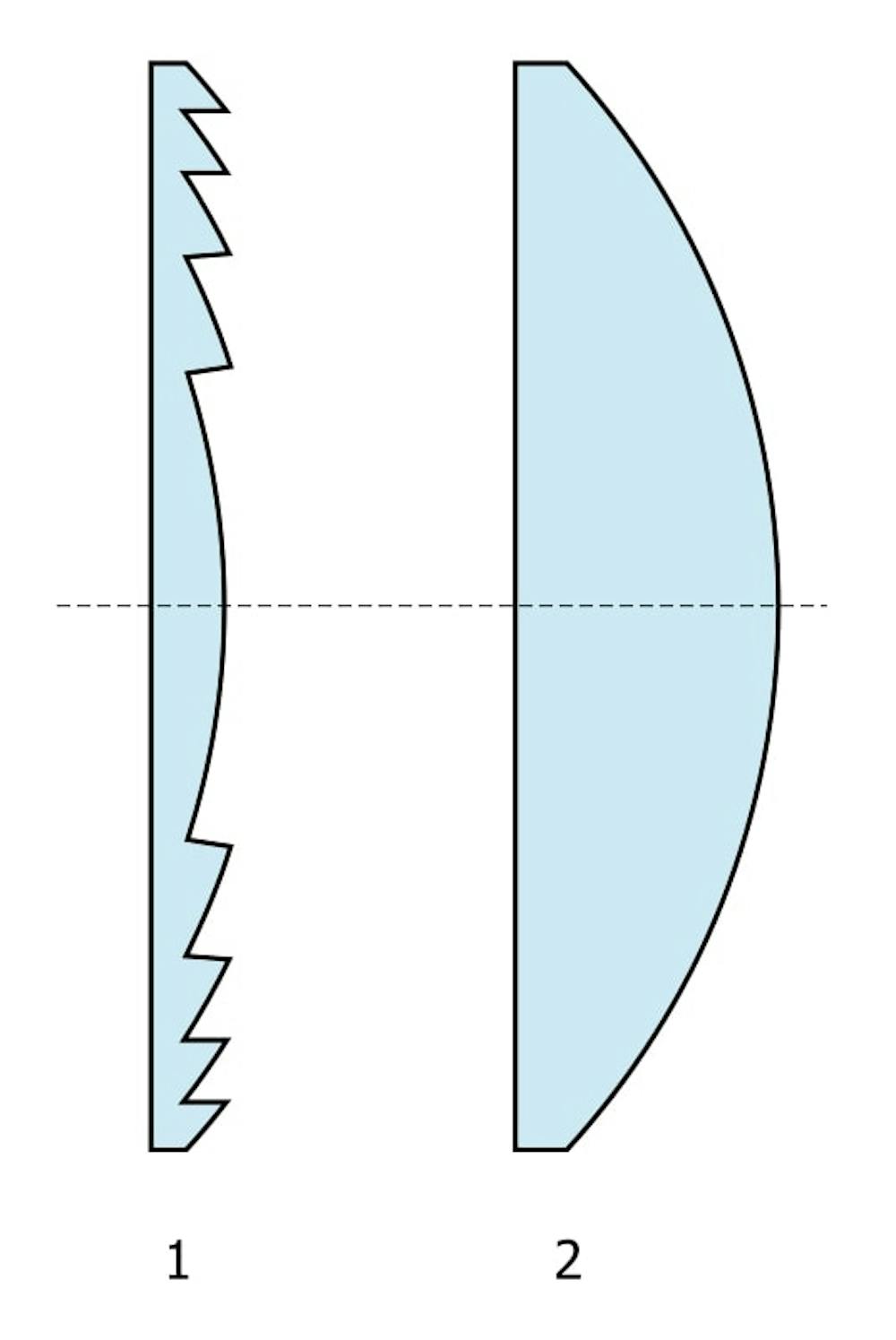

Conventional lenses use refraction to focus light. Refraction is when light changes direction as it passes from one medium to another – it is the reason light bends when it enters water. In contrast, diffraction is when light bends around corners and obstacles. A cleverly arranged pattern of steps and angles on a glass surface can form a diffractive lens.
The first such lenses were invented by the French scientist Augustin-Jean Fresnel in 1819 to provide lightweight lenses for lighthouses. Today, similar diffractive lenses can be found in many small-sized consumer optics – from camera lenses to virtual reality headsets.
Thin, simple diffractive lenses are notorious for their blurry images, so they have never been used in astronomical observatories. But if you could improve their clarity, using diffractive lenses instead of mirrors or refractive lenses would allow a space telescope to be much cheaper, lighter and larger.

A thin, high-resolution lens
After the meeting, I returned to the University of Arizona and decided to explore whether modern technology could produce diffractive lenses with better image quality. Lucky for me, Thomas Milster – one of the world’s leading experts on diffractive lens design – works in the building next to mine. We formed a team and got to work.
Over the following two years, our team invented a new type of diffractive lens that required new manufacturing technologies to etch a complex pattern of tiny grooves onto a piece of clear glass or plastic. The specific pattern and shape of the cuts focuses incoming light to a single point behind the lens. The new design produces a near-perfect quality image, far better than previous diffractive lenses.
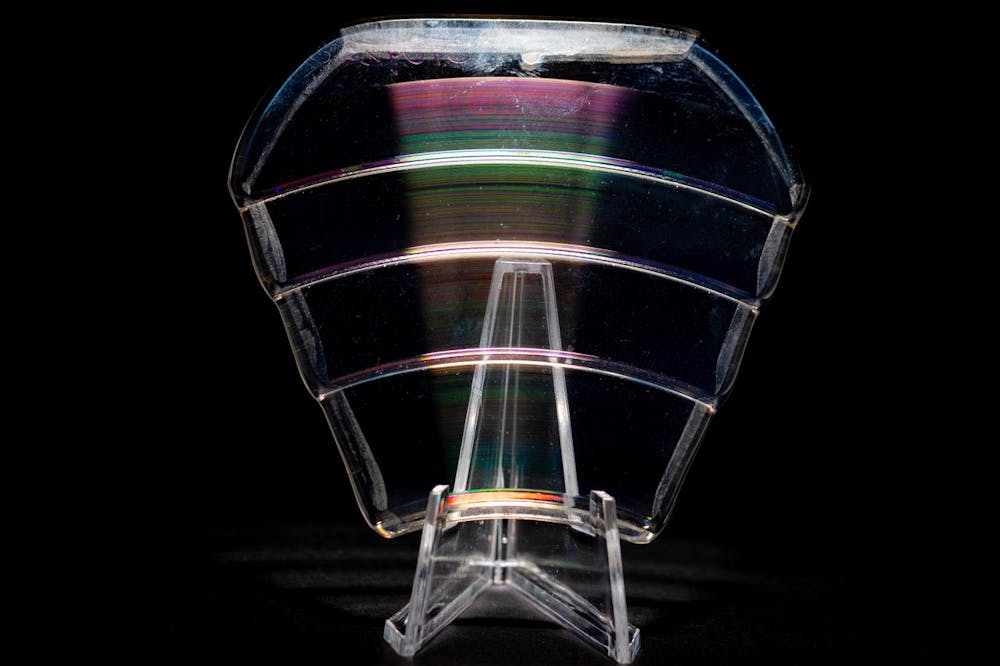
Because it is the surface texture of the lens that does the focusing, not the thickness, you can easily make the lens bigger while keeping it very thin and lightweight. Bigger lenses collect more light, and low weight means cheaper launches to orbit – both great traits for a space telescope.
In August 2018, our team produced the first prototype, a 2-inch (5-centimeter) diameter lens. Over the next five years, we further improved the image quality and increased the size. We are now completing a 10-inch (24-cm) diameter lens that will be more than 10 times lighter than a conventional refractive lens would be.
Power of a diffraction space telescope
This new lens design makes it possible to rethink how a space telescope might be built. In 2019, our team published a concept called the Nautilus Space Observatory.
Using the new technology, our team thinks it is possible to build a 29.5-foot (8.5-meter) diameter lens that would be only about 0.2 inches (0.5 cm) thick. The lens and support structure of our new telescope could weigh around 1,100 pounds (500 kilograms). This is more than three times lighter than a Webb–style mirror of a similar size and would be bigger than Webb’s 21-foot (6.5-meter) diameter mirror.
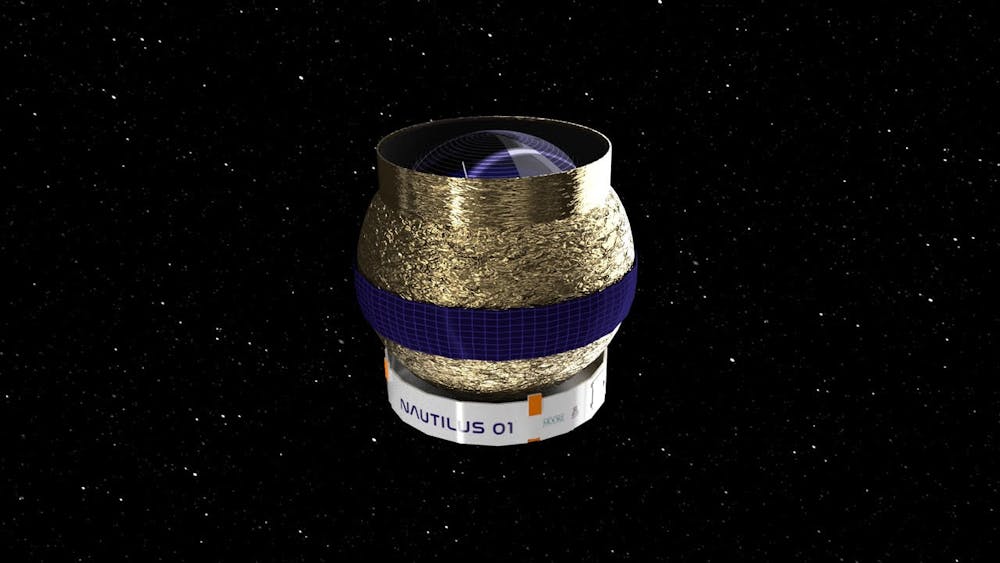
The lenses have other benefits, too. First, they are much easier and quicker to fabricate than mirrors and can be made en masse. Second, lens-based telescopes work well even when not aligned perfectly, making these telescopes easier to assemble and fly in space than mirror-based telescopes, which require extremely precise alignment.
Finally, since a single Nautilus unit would be light and relatively cheap to produce, it would be possible to put dozens of them into orbit. Our current design is in fact not a single telescope, but a constellation of 35 individual telescope units.
Each individual telescope would be an independent, highly sensitive observatory able to collect more light than Webb. But the real power of Nautilus would come from turning all the individual telescopes toward a single target.
By combining data from all the units, Nautilus’ light-collecting power would equal a telescope nearly 10 times larger than Webb. With this powerful telescope, astronomers could search hundreds of exoplanets for atmospheric gases that may indicate extraterrestrial life.
Although the Nautilus Space Observatory is still a long way from launch, our team has made a lot of progress. We have shown that all aspects of the technology work in small-scale prototypes and are now focusing on building a 3.3-foot (1-meter) diameter lens. Our next steps are to send a small version of the telescope to the edge of space on a high-altitude balloon.
With that, we will be ready to propose a revolutionary new space telescope to NASA and, hopefully, be on the way to exploring hundreds of worlds for signatures of life.
Daniel Apai, Associate Dean for Research and Professor of Astronomy and Planetary Sciences, University of Arizona
This article is republished from The Conversation under a Creative Commons license. Read the original article.
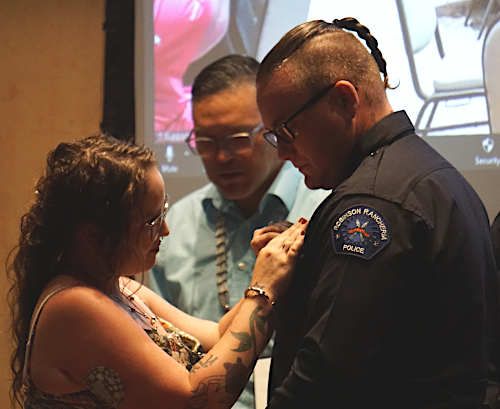
As his family, tribal members and local dignitaries looked on, Officer Kyle Wheeler became the first federally commissioned police officer in Robinson Rancheria's history to attend and successfully complete a police academy while representing the Robinson Rancheria Police Department.
His proud chief, Derrell Hochstein, called it a “historical evening.”
It’s not just historical for the tribe but for the community as a whole, as Robinson Rancheria is Lake County’s only tribal police department.
Probably the most heartfelt tribute of the evening came from Wheeler’s wife, Kaitlyn Carter, who called him “our wonderful man in blue.”
Together, Hochstein and Wheeler make up the tribal police department, with Hochstein recruiting to continue to build the agency’s sworn personnel.
Hochstein lauded the tribal leadership and members for supporting Wheeler’s training and education as part of elevating the department.
However, Wheeler’s achievement of reaching Special Law Enforcement Commission, or SLEC, status came in no small part due to Hochstein’s efforts.
Hochstein took over as the chief at the Robinson Rancheria Police Department in January of 2022.
He brought with him almost 20 years of law enforcement experience, including working with other tribes at Fort Independence in Inyo County and with the Lovelock Tribal Police in Nevada, as well as serving in policing in Kern County.
Dignitaries taking part in the Thursday evening ceremony and dinner included Tribal Chair Beniakem Cromwell and Secretary-Treasurer Irenia Quitiquit; Sheriff Rob Howe; District 1 Supervisor Moke Simon, who chairs the Middletown Rancheria of Pomo Indians; District 4 Supervisor Michael Green; Terre Logsdon, the county’s climate resiliency officer and tribal liaison; sheriff’s Lt. Corey Paulich; and sheriff’s public information officer Lauren Berlinn.
They were joined by Wheeler’s family, including his wife, their children, his parents, grandparents and mother-in-law.
Simon and Green presented a certificate from Congressman Mike Thompson, who was unable to attend, recognizing Wheeler’s achievement.
Simon said that, from the county perspective, the milestone was about collaboration and cooperation.
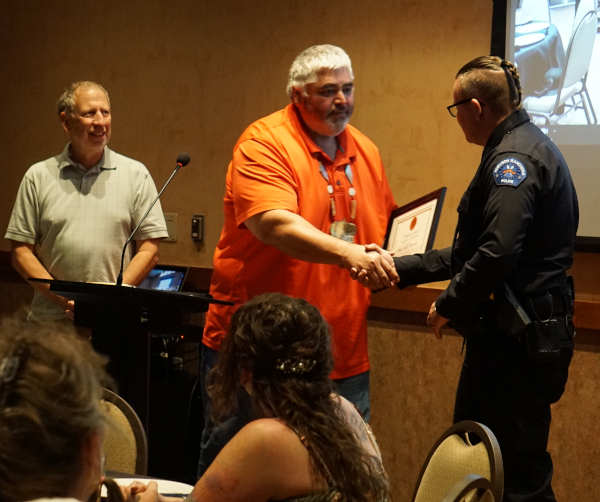
He said he’s always admired how Robinson Rancheria has handled its police force.
During his remarks, Simon said that the milestone was one that all tribal nations in Lake County can be proud of.
“It’s a good night to be here,” Simon said.
For tribes, having a police department isn’t just another administrative function, but a way of reflecting their sovereignty, explained Christopher Lorenz, special agent in charge for the Bureau of Indian Affairs’ District IX, based in Sacramento.
Lorenz oversees the 104 tribes located completely within the state of California. Altogether, there are 109 tribes with a presence in the state.
Of those, Lorenz said Robinson Rancheria is one of only 22 with a federal cross-deputization agreement for policing, which Chief Hochstein said was a six-month process to complete.
Lorenz underlined the importance of having a police department, adding that it says a lot about what Robinson Rancheria wants in the future.
It sets a good example for other tribes and encourages them to have departments of their own, Lorenz said.
“Partnership is really the key,” said Lorenz, adding that he sees tribe officers as “free” officers for the county in which they are located, as they can be available to assist other agencies.
Sheriff Howe said that in today’s society, making the decision to get into law enforcement is a difficult one, with the work being important but often thankless.
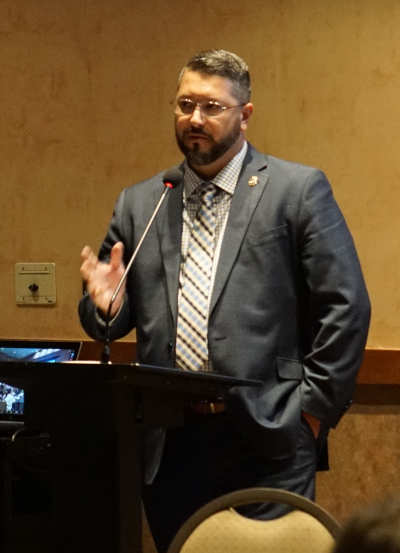
He thanked Wheeler for getting into the profession at a time when society needs him the most.
Howe emphasized three words to Wheeler: Honor, integrity and respect.
He said for Wheeler to honor himself, the tribe and his family, to live his life and do his job with integrity, which no one can take from \him; and to treat all with respect, remembering that some may not respect him in turn, and others may not deserve his respect.
If Wheeler did those things, Howe added, he would make a difference.
Wheeler’s family also spoke, including his parents, Kelly and Becky Willard, and grandmother, Arlene Willard, who expressed to him how proud they are of his achievements.
His wife said he’s dedicated his life to protecting people, and has run through fires to save people, protected children from predators and given first aid.
“This is what he was meant to do,” Carter said, adding that his family will be there to support him.
The highlight of the evening was when Cromwell led Wheeler through a code of ethics before Hochstein gave him his oath and Carter pinned on his new badge.
Wheeler, who started with the tribe’s casino security department, recounted how tribal members welcomed his questions, and shared with him their culture and language.
He said he started his new journey into policing on Jan. 18, and on April 1 started the academy in Artesia, New Mexico, where he spent long days but created deep bonds with other officers in training from tribes around the country.
“I came back home with a larger fire inside of me,” Wheeler said, adding that he wants to learn more about the Pomo tribe and that he’ll do his best every day.
Hochstein pledged to support Wheeler and give him everything he needs to succeed in the days ahead.
Hochstein said anyone interested in joining the Robinson Rancheria Police Department can call the agency’s duty phone number at 707-533-0011 for more information.
Email Elizabeth Larson at

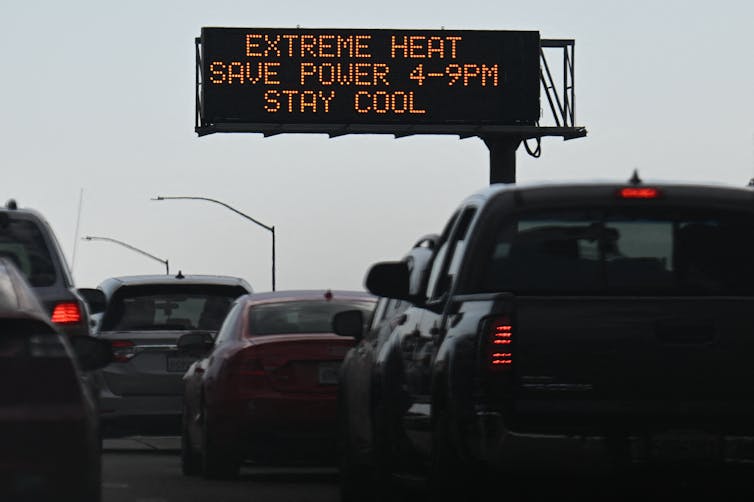
Triple-digit temperatures are forecast in Lake County during the warmest portions of at least Friday, Saturday and Sunday, and many members of our communities will be seeking opportunities to escape the heat.
Residents are encouraged to take precautionary measures. The National Weather Service recommends the following:
• Drink plenty of fluids, stay in an air-conditioned room, stay out of the sun, and check up on relatives and neighbors. Young children and pets should never be left unattended in vehicles under any circumstances.
• Take extra precautions if you work or spend time outside. When possible, reschedule strenuous activities to early morning or evening. Know the signs and symptoms of heat exhaustion and heat stroke. Wear lightweight and loose-fitting clothing when possible. To reduce risk during outdoor work, the Occupational Safety and Health Administration recommends scheduling frequent rest breaks in shaded or air-conditioned environments. Anyone overcome by heat should be moved to a cool and shaded location.
• Heat stroke is an emergency! Call 9-1-1.
In recognition of expected high temperatures, staff from the Lake County Library system and County-operated Peer Support Centers want to ensure members of the public know their facilities’ doors will be open Friday and portions of this weekend.
Many thanks, particularly, to the staff of The Big Oak Peer Support Center in Clearlake Oaks for opening their doors this Sunday, July 16, when temperatures could reach 105 to 110 degrees in portions of Lake County.
Shopping at local businesses and eating at local restaurants with air-conditioned facilities during the warmest hours of the day can also be great ways to support your communities while cooling off!
Friday-Sunday excessive heat warning in effect: What facilities are open?
Friday, July 14
Clearlake: Redbud Library, open 10 a.m. to 5 p.m. (14785 Burns Valley Rd, 707-994-5115); La Voz de la Esperanza Centro Latino, open 8:30 a.m. to 4:30 p.m. (14092 Lakeshore Drive, 707-994-4261).
Clearlake Oaks: The Big Oak Peer Support Center, open 8:30 a.m. to 4:30 p.m. (13300 East Highway 20, Suite O, 707-998-0310).
Lakeport: Lakeport Library, open 10 a.m. to 5 p.m., (1425 N. High St., 707-263-8817); Circle of Native Minds Cultural Center, open 8:30 a.m. to 4:30 p.m. (525 N. Main St., 707-263-4880).
Middletown: Middletown Library, open 10 a.m. to 5 p.m. (21256 Washington St., 707-987-3674).
Upper Lake: Upper Lake Library, open noon to 5 p.m. (310 Second St., 707-275-2049).
Saturday, July 15
Clearlake: Redbud Library, open 10 a.m. to 5 p.m. (14785 Burns Valley Road, 707-994-5115).
Clearlake Oaks: The Big Oak Peer Support Center, open 9 a.m. to 4:30 p.m. (13300 East Highway 20, Suite O, 707-998-0310).
Lakeport: Lakeport Library, open 10 a.m. to 5 p.m. (1425 N. High St.t, 707-263-8817).
Middletown: Middletown Library, open 10 a.m. to 5 p.m. (21256 Washington St., 707-987-3674).
Upper Lake: Upper Lake Library, open 10 a.m. to 3 p.m. (310 Second St., 707-275-2049).
Sunday, July 16
Clearlake Oaks: The Big Oak Peer Support Center, open 9 a.m. to 4:30 p.m. (13300 East Highway 20, Suite O, 707-998-0310)
Beating the heat at Lake County’s libraries and peer support centers
While none of these are formal cooling centers, and capacity is limited at each site, they are invaluable community resources, as temperatures rise.
Here is information on normal operating hours and services available at each facility.
County library facilities
Lake County’s four public library branches are open and accessible to all during their normal business hours. While you cool off, check out the many new materials and digital services the library has to offer – there is something for everyone.
Here is a list of Lake County Library locations, and their customary hours of operation:
Lakeport Library
1425 N. High St.
707-263-8817
Tuesday, 10 a.m. to 5 p.m.; Wednesday, 10 a.m. to 7 p.m.: Thursday through Saturday, 10 a.m. to 5 p.m.
Redbud Library
14785 Burns Valley Road, Clearlake
707-994-5115
Tuesday, 10 a.m. to 5 p.m.; Wednesday, 10 a.m. to 7 p.m.: Thursday through Saturday, 10 a.m. to 5 p.m.
Middletown Library
21256 Washington St.
707-987-3674
Tuesday through Friday, 10 a.m. to 5 p.m.; Saturday, 10 a.m. to 5 p.m.
Upper Lake Library
310 Second St.
707-275-2049
Tuesday through Friday, noon to 5 p.m.; Saturday, 10 a.m. to 3 p.m.
Please note, all county library branches are closed each Monday (including July 17).
Peer support centers
Lake County Behavioral Health Services also reminds their peer support centers are open as a refuge from the heat. Each provides an air-conditioned place to sit and rest. Water and light snacks are offered to guests, and restrooms are available. Referrals to social services can also be made. All are welcome.
Below is a list of peer support centers, with their customary hours and locations (Please note, only The Big Oak Peer Support Center will be open Saturday, July 15, and Sunday, July 16):
The Big Oak Peer Support Center
13300 East Highway 20, Suite O
Clearlake Oaks
707-998-0310
Sunday-Saturday: 8:30 a.m. to 4:30 p.m.
Open Saturday, July 15, 9 a.m. to 4:30 p.m.
Open Sunday, July 16, 8:30 a.m. to 4:30 p.m.
Circle of Native Minds Cultural Center
525 N. Main St., Lakeport
707-263-4880
Monday through Friday, 8:30 a.m. to 4:30 p.m.
Closed Saturdays and Sundays (including July 15 and 16)
The Harbor on Main
154 South Main St., Lakeport
707-994-5486
Monday through Friday, 8:30 a.m. to 4:30 p.m.
Closed Saturdays and Sundays (including July 15 and 16)
La Voz de la Esperanza Centro Latino
14092 Lakeshore Drive, Clearlake
707-994-4261
Monday through Friday, 8:30 a.m. to 4:30 p.m.
Closed Saturdays and Sundays (including July 15 and 16)

A powerful storm system that hit the U.S. Northeast on July 9 and 10, 2023, dumped close to 10 inches of rain on New York’s Lower Hudson Valley in less than a day and sent mountain rivers spilling over their banks and into towns across Vermont, causing widespread flash flooding. Vermont Gov. Phil Scott said he hadn’t seen rainfall like it since Hurricane Irene devastated the region in 2011.
Extreme water disasters like this have disrupted lives in countries around the world in the past few years, from the Alps and Western Europe to Pakistan, India and Australia, along with several U.S. states in 2022 and 2023.
The role of climate change is becoming increasingly evident in these types of deluges.
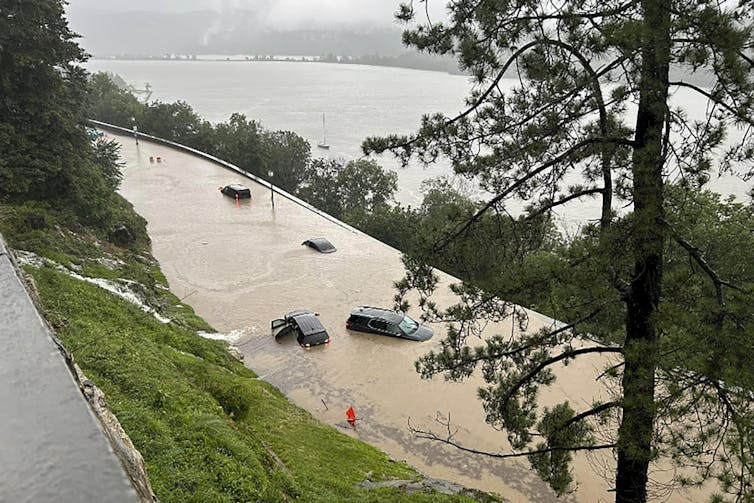
Studies by scientists around the world show that the water cycle has been intensifying and will continue to intensify as the planet warms. An international climate assessment I co-authored in 2021 for the Intergovernmental Panel on Climate Change reviewed the research and laid out the details.
It documented an increase in both wet extremes, including more intense rainfall over most regions, and dry extremes, including drying in the Mediterranean, southwestern Australia, southwestern South America, South Africa and western North America. It also shows that both wet and dry extremes will continue to increase with future warming.
Why is the water cycle intensifying?
Water cycles through the environment, moving between the atmosphere, ocean, land and reservoirs of frozen water. It might fall as rain or snow, seep into the ground, run into a waterway, join the ocean, freeze or evaporate back into the atmosphere. In recent decades, there has been an overall increase in the rates of precipitation and evaporation.
A number of factors are intensifying the water cycle, but one of the most important is that warming temperatures raise the upper limit on the amount of moisture in the air. That increases the potential for more rain.
This aspect of climate change is confirmed across all of our lines of evidence. It is expected from basic physics, projected by computer models, and it already shows up in the observational data as a general increase of rainfall intensity with warming temperatures.
Understanding this and other changes in the water cycle is important for more than preparing for disasters. Water is an essential resource for all ecosystems and human societies, and particularly agriculture.
What does this mean for the future?
An intensifying water cycle means that both wet and dry extremes and the general variability of the water cycle will increase, although not uniformly around the globe.
Rainfall intensity is expected to increase for most land areas, but the largest increases in dryness are expected in the Mediterranean, southwestern South America and western North America.
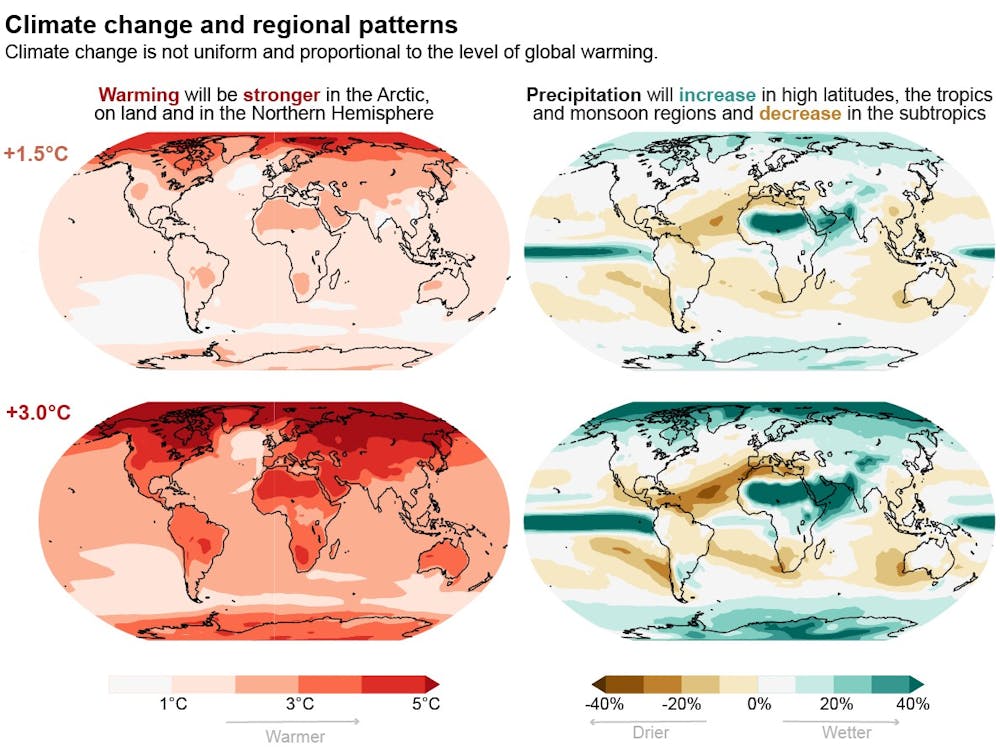
Globally, daily extreme precipitation events will likely intensify by about 7% for every 1 degree Celsius (1.8 degrees Fahrenheit) that global temperatures rise.
Many other important aspects of the water cycle will also change in addition to extremes as global temperatures increase, the report shows, including reductions in mountain glaciers, decreasing duration of seasonal snow cover, earlier snowmelt and contrasting changes in monsoon rains across different regions, which will impact the water resources of billions of people.
What can be done?
One common theme across these aspects of the water cycle is that higher greenhouse gas emissions lead to bigger impacts.
The IPCC does not make policy recommendations, but the results show what the implications of different choices are likely to be.
One thing the scientific evidence in the report clearly tells world leaders is that limiting global warming to the international target of 1.5 C (2.7 F) will require immediate, rapid and large-scale reductions in greenhouse gas emissions.
As the evidence shows, every fraction of a degree matters.
This updates an article originally published July 29, 2022, with flash flooding in the Northeast.
Mathew Barlow, Professor of Climate Science, UMass Lowell
This article is republished from The Conversation under a Creative Commons license. Read the original article.