 How to resolve AdBlock issue?
News
An official ceremony will take place Thursday, July 27, at 2:15 p.m., at the Camp Smokey Incident Command post at the Cal Expo grounds in Sacramento.
The memorial was designed in remembrance of all wildland firefighters who have made the ultimate sacrifice and will be a place where everyone can pay respects to fallen firefighters across this great nation.
Fire management leaders and guest speakers will be on hand to share the journey of this memorial from its concept and design to creation and installation.
Camp Smokey’s participating agencies would like to remind everyone to be careful while engaged in any activity that can cause a spark or fire — indoors or out. Remember, only you can prevent wildfires.
The 2023 California State Fair in Sacramento opened on Friday July 14. Every year through a coordinated interagency collaboration the U.S. Forest Service, Cal Fire, Bureau of Land Management, Bureau of Indian Affairs, and the Firefighters Burn Institute bring visitors of all ages a fun, educational and interactive fire safety and prevention exhibit called Camp Smokey.
This event will be open to the public inside the California State Fair.
For more information on Camp Smokey, please visit the Camp Smokey Facebook page.
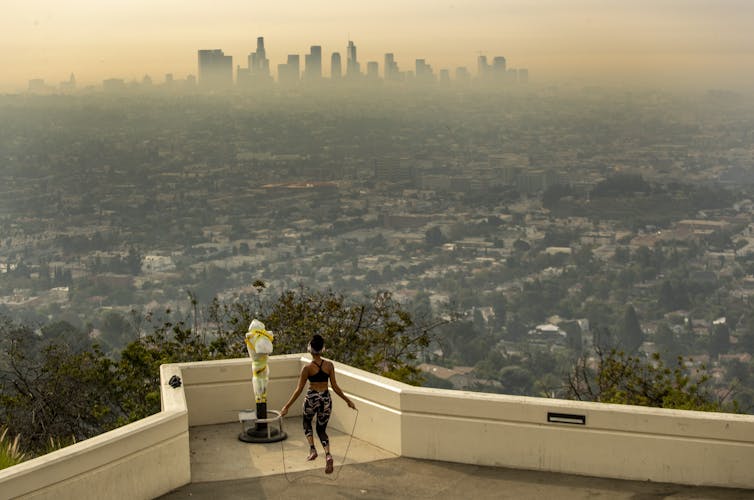
Heat waves and air pollution from wildfire smoke and other sources are each problematic for human health, particularly for vulnerable populations such as older adults. But what happens when they hit at the same time?
We examined over 1.5 million deaths from 2014 to 2020 registered in California – a state prone to summer heat waves and air pollution from wildfires – to find out.
Deaths spike when both risks are high
The number of deaths rose both on hot days and on days with high levels of fine particulate air pollution, known as PM2.5. But on days when an area was hit with a double whammy of both high heat and high air pollution, the effects were much higher than for each condition alone.
The risk of death on those extra-hot and polluted days was about three times greater than the effect of either high heat or high air pollution alone.
The more extreme the temperatures and pollution, the higher the risk. During the top 10% of hottest and most polluted days, the risk of death increased by 4% compared to days without extremes. During the top 1%, it increased by 21%; and among older adults over age 75, the risk of death increased by more than a third on those days.
Why risks are higher when both hit at once
There are several ways the combined exposure to extreme heat and particulate air pollution can harm human health.
Oxidative stress is the most common biological pathway linked with particulate air pollution and heat exposure. Oxidative stress is an imbalance between production of highly reactive molecules known as reactive oxygen species, or ROS, and the body’s ability to remove them. It’s been linked with lung diseases, among other illnesses.
Antioxidants help clean up these molecules, but particulate air pollution and heat disrupt this balance through excessive metabolic ROS production and lowered antioxidant activity.
Our research also showed that the effects of particulate air pollution and heat extremes were larger when high nighttime temperature and pollution occurred together. High nighttime temperatures can interfere with normal sleep and potentially contribute to chronic health conditions such as heart disease and obesity, and disrupt how the body regulates temperature.
Older adults may be more susceptible to effects of extreme heat and air pollution exposure, in part because this stress comes on top of age-related chronic health conditions like heart disease, high blood pressure, diabetes or chronic lung disease. Impaired body temperature regulation in response to heat can also occur with aging. And older adults may be less mobile and therefore less able to get to cooling centers or to medical care and be less able to afford air conditioning.
A future of high temperatures and air pollution
This isn’t just a California problem. Climate change will increase exposure to high heat and air pollution in many parts of the country.
Yearly average temperatures in the U.S. are already more than 1.8 degrees Fahrenheit (1 degree Celsius) warmer than at the beginning of the 1900s. By the end of this century, global temperatures are on pace to be nearly 5 F (2.7 C) warmer. Dangerous extreme heat waves, currently rare, will become more common.
Changing climate is also affecting levels of outdoor fine particulate pollution – for example, through weather changes such as air stagnation events, wind and dust storms, and drier and warmer conditions that contribute to increasingly frequent and intense wildfires.
What to do to stay safe
Further research is needed to better understand these effects, such as the full impact of wildfire smoke exposure. However, enough is known that people should take measures to reduce their risk of harm during periods of extreme heat or air pollution.
That means staying well hydrated and keeping cool. Shopping malls and other air-conditioned public spaces can provide a refuge from heat. Home air conditioning, especially during nighttime, can reduce mortality. A portable air filter in the bedroom can markedly reduce particle pollution levels.
People with symptoms of heat stress, such as headache, nausea, dizziness or confusion, especially the elderly, should seek medical care.
Many county and state health departments already provide alerts about extreme heat and extreme air pollution. Developing a special category of alert during co-occurring extremes may be beneficial to public health.
Governments also need to take steps now to avoid the worst future climate change scenarios. Some best practices for cities include creating cooling shade cover and green space that will also reduce particle pollution.
Erika Garcia, Assistant Professor of Population and Public Health Sciences, University of Southern California; Md Mostafijur Rahman, Postdoctoral Scholar and Research Associate in Environmental Health, University of Southern California, and Rob Scot McConnell, Professor of Population and Public Health Sciences, University of Southern California
This article is republished from The Conversation under a Creative Commons license. Read the original article.
A private professional fiduciary (a licensed and bonded representative) can play a necessary and key representative role in administering a person’s estate plan.
They can assist in a wide variety of ways, including the following: To settle a deceased person’s trust or probate estate; to administer a special needs trust; to administer a support trust; to administer a disabled person’s household finances; to make personal care decisions and arrangements as an agent for a disabled person; and to advocate, as a representative, for a disabled person’s government benefits.
When there is neither a suitable family member nor a close trusted friend to act in a representative capacity (e.g., as a successor trustee or as an agent under a power of attorney or health care directive), then nominating a professional fiduciary merits consideration.
Also a private fiduciary can be nominated as a backup alternative trustee or agent, behind one or more family members.
Having an alternative may mean avoiding otherwise unnecessary court proceedings, including even a conservatorship, when the time arises for administration.
Even when there are family or friends who would be willing to serve, difficult or complex situations may make a professional fiduciary better suited to serve.
In a family where conflict amongst the children is expected over the administration of a parents’ estate, having a neutral private fiduciary instead of one of the conflicted family members may alleviate and facilitate the proper and more amicable administration of the estate.
Another reason why professional fiduciaries are desirable is the fact that they are professionals. In California, the Department of Consumer Affairs – Professional Fiduciaries Bureau (“PFD”), oversees the licensing and, where necessary, disciplining of professional fiduciaries.
To become licensed, a fiduciary must pass an examination, meet thirty hours of approved education courses, have experience (or training) relevant to being a fiduciary, such as working as a bank or trust company officer, attorney, accountant or social worker.
In addition, professional fiduciaries must pass a background check and be bonded.
A fiduciary’s bond is an important additional assurance to whomever the fiduciary serves. A bond pays, up to its coverage limits, for damages caused by the negligence or misconduct of a fiduciary.
For example, if a private fiduciary were to embezzle (steal) money, then the persons directly harmed by the embezzlement would be able to claim against the bond. Unfortunately, this does happen from time to time.
Professional fiduciaries vary significantly in their skills and competencies. When selecting a professional fiduciary due diligence is needed.
That is, check the PFB’s website both to verify the fiduciary is licensed and to see if their record shows any disciplinary action; ask the fiduciary for references; go to the Professional Fiduciary Association of California (www.pfac.org) for a directory of member fiduciaries doing business in your location; and do a search on google using the fiduciary’s name to read any reviews that exist online.
A private fiduciary is typically compensated on an hourly basis, which varies mostly based on the fiduciary’s experience and geographic location. The cost is an important factor in deciding whether to hire a private fiduciary. Of course, there is also a cost with not having a trust, estate or personal care needs properly administered.
The foregoing discussion is neither exhaustive nor legal advice regarding how to proceed when considering a professional fiduciary. Discuss the possible benefits, risks and expenses associated with having a professional fiduciary with your estate planning attorney.
Dennis A. Fordham, attorney, is a State Bar-Certified Specialist in estate planning, probate and trust law. His office is at 870 S. Main St., Lakeport, Calif. He can be reached at

New research by scientists from NASA and Japan’s Osaka University suggests that rogue planets — worlds that drift through space untethered to a star — far outnumber planets that orbit stars.
The results imply that NASA’s Nancy Grace Roman Space Telescope, set to launch by May 2027, could find a staggering 400 Earth-mass rogue worlds. Indeed, this new study has already identified one such candidate.
“We estimate that our galaxy is home to 20 times more rogue planets than stars — trillions of worlds wandering alone,” said David Bennett, a senior research scientist at NASA’s Goddard Space Flight Center in Greenbelt, Maryland, and a co-author of two papers describing the results. “This is the first measurement of the number of rogue planets in the galaxy that is sensitive to planets less massive than Earth.”
The team’s findings stem from a nine-year survey called MOA (Microlensing Observations in Astrophysics), conducted at the Mount John University Observatory in New Zealand.
Microlensing events occur when an object such as a star or planet comes into near-perfect alignment with an unrelated background star from our vantage point. Because anything with mass warps the fabric of space-time, light from the distant star bends around the nearer object as it passes close by.
The nearer object acts as a natural lens, creating a brief spike in the brightness of the background star’s light that gives astronomers clues about the intervening object that they can’t get any other way.
“Microlensing is the only way we can find objects like low-mass free-floating planets and even primordial black holes,” said Takahiro Sumi, a professor at Osaka University, and lead author of the paper with a new estimate of our galaxy’s rogue planets. “It’s very exciting to use gravity to discover objects we could never hope to see directly.”
The roughly Earth-mass rogue planet the team found marks the second discovery of its kind. The paper describing the finding will appear in a future issue of The Astronomical Journal. A second paper, which presents a demographic analysis that concludes that rogue planets are six times more abundant than worlds that orbit stars in our galaxy, will be published in the same journal.
Pint-size planets
In only a few decades, we've gone from wondering whether the worlds in our solar system are alone in the cosmos to discovering more than 5,300 planets outside our solar system. The vast majority of these newfound worlds are either huge, extremely close to their host star, or both. By contrast, the team’s results suggest that rogue planets tend to be on the petite side.
“We found that Earth-size rogues are more common than more massive ones,” Sumi said. “The difference in star-bound and free-floating planets’ average masses holds a key to understanding planetary formation mechanisms.”
World-building can be chaotic, with all of the forming celestial bodies gravitationally interacting as they settle into their orbits. Planetary lightweights aren’t tethered as strongly to their star, so some of these interactions end up flinging such worlds off into space. So begins a solitary existence, hidden amongst the shadows between stars.
In one of the early episodes of the original Star Trek series, the crew encounters one such lone planet amid a so-called star desert. They were surprised to ultimately find Gothos, the starless planet, habitable.
While such a world may be plausible, the team emphasizes that the newly detected “rogue Earth” probably doesn’t share many other characteristics with Earth beyond a similar mass.
Roman’s hunt for hidden worlds
Microlensing events that reveal solitary planets are extraordinarily rare, so one key to finding more is to cast a wider net. That’s just what Roman will do when it launches by May 2027.
“Roman will be sensitive to even lower-mass rogue planets since it will observe from space,” said Naoki Koshimoto, who led the paper announcing the detection of a candidate terrestrial-mass rogue world. Now an assistant professor at Osaka University, he conducted this research at Goddard. “The combination of Roman’s wide view and sharp vision will allow us to study the objects it finds in more detail than we can do using only ground-based telescopes, which is a thrilling prospect.”
Previous best estimates, based on planets found orbiting stars, suggested Roman would spot 50 terrestrial-mass rogue worlds. These new results suggest it could actually find about 400, though we’ll have to wait until Roman begins scanning the skies to make more certain predictions.
Scientists will couple Roman’s future data with ground-based observations from facilities such as Japan's PRIME (Prime-focus Infrared Microlensing Experiment) telescope, located at the South African Astronomical Observatory in Sutherland. This 1.8-meter telescope will build on MOA’s work by conducting the first wide-area microlensing survey in near-infrared light.
It’s equipped with four detectors from Roman’s detector development program, contributed by NASA as part of an international agreement with JAXA (Japan Aerospace Exploration Agency).
Each microlensing event is a one-time occurrence, meaning astronomers can’t go back and repeat the observations once they’re over. But they’re not instantaneous.
“A microlensing signal from a rogue planet can take from a few hours up to about a day, so astronomers will have a chance to do simultaneous observations with Roman and PRIME,” Koshimoto said.
Seeing them from both Earth and Roman’s location a million miles away will help scientists measure the masses of rogue planets much more accurately than ever before, deepening our understanding of the worlds that grace our galaxy.
The Nancy Grace Roman Space Telescope is managed at NASA’s Goddard Space Flight Center in Greenbelt, Maryland, with participation by NASA's Jet Propulsion Laboratory and Caltech/IPAC in Southern California, the Space Telescope Science Institute in Baltimore, and a science team comprising scientists from various research institutions. The primary industrial partners are Ball Aerospace and Technologies Corporation in Boulder, Colorado; L3Harris Technologies in Melbourne, Florida; and Teledyne Scientific & Imaging in Thousand Oaks, California.
Ashley Balzer works for NASA’s Goddard Space Flight Center in Greenbelt, Maryland.
On Tuesday, Public Works Director Scott De Leon requested, and received, the approval from the Board of Supervisors to establish just compensation for properties to be purchased for the Hill Road Slide Repair and Restoration Project.
Early in 2013, a landslide developed at the 29-home Lakeside Heights subdivision, which sits above Hill Road and across from the Sutter Lakeside Hospital campus.
Ultimately, the slide would destroy six homes and lead to repeated wintertime closures of Hill Road when rain would cause the slide to move across the roadway.
Those closures of Hill Road have been a particular concern. “Hill Road is our primary route to Sutter Hospital from the Northshore communities so it's a very important road for us to keep open,” De Leon said.
In 2014, the homeowners filed suit against the county, alleging that its water system was to blame. The county settled with the homeowners for $4.5 million in 2017.
The work to plan and design the project has been underway for years. De Leon said numerous issues led to the project delays, including the lawsuit.
However, now the repair project has finally been designed and De Leon said his staff is in the process of acquiring the right of way necessary to complete the project.
De Leon said the item he took to the board on Tuesday was meant to accomplish a few things, including meeting the requirements of federal and state codes.
Because federal funds are being used for the project, De Leon said the board needed to establish just compensation for the properties that the county wants to acquire in order to be in accordance with federal code requirements. That compensation cannot be less than the approved appraisal of the fair market value of the property.
De Leon’s report included a document that listed nine properties that the county wants to purchase for the project, as well as the fair market value of each, determined by an appraisal by the county’s consultant, Bender Rosenthal Inc., and formally reviewed and certified by Sierra West Valuation in accordance with federal code requirements.
A review of a Lake County GIS map shows that the properties in question are vacant lots, primarily located at the edge of the Lakeside Heights subdivision and overlooking Hill Road.
The properties proposed for purchase and their base market value are as follows:
• 5417 Lancaster Road, $9,200.
• 5406 Lancaster Road, $9,200.
• 5432 Lancaster Road, $9,200.
• 5377 Hill Road, $10,700.
• 5396 Lancaster Road, $9,200.
• 5436 Lancaster Road, $9,200.
• 5392 Lancaster Road, $9,200.
• 5412, 5416, 5422, 5427 and 5433 Lancaster Road, $43,600.
• 1025 Downing Drive, $2,200.
De Leon said state code says that a legislative body of a local agency has to grant authority to a negotiator regarding the price and terms of payment before a purchase, sale or exchange, and also has to identify its negotiators, the people with whom they can negotiate and the real property that is the subject of the negotiations.
He said he and Bender Rosenthal representatives will be negotiators on behalf of the county with the property owners.
Any subsequent negotiations will be held in closed session with proper notice, said De Leon.
He said he staff recommended that the board determine that the just compensation for the properties listed is not less than the fair market values.
Supervisor Bruno Sabatier asked about the timeline for the project’s completion, explaining that he had issues with liability with property that may be sliding onto vehicles and pedestrians. “We do continue to see that each winter.”
Sabatier said the process was done correctly and he agreed with the quotes and appraisals presented. “What liability are we taking on if this is a 10-year project versus if it’s going to happen within the next foreseeable future?”
“We have some funding deadlines for construction. We need to get this project built,” said De Leon.
He said there won’t be a 10-year delay between acquisition of properties and construction.
While he doesn’t think it will be built this year, if the process goes smoothly, at the latest it would be constructed by next summer.
Sabatier said he felt that timeline was doable.
De Leon said all of the property acquisitions are going to be incorporated into the repair project’s design.
Supervisor Michael Green, in whose district the project is located, questioned what the board would be negotiating in closed session if they can’t go below the minimum prices or above fair market value.
He said he wasn’t going to ask De Leon for the reasoning behind the item, but added, “It’s going to box us in during the closed session.”
“Let’s just wait and have that conversation,” said Board Chair Jessica Pyska.
Green moved to approve the item, with Sabatier seconding and the board voting 4-0. Supervisor Moke Simon was absent for the discussion.
Email Elizabeth Larson at
“Fire weather” is a term used when hot temperatures combine with low relative humidity and gusty winds to increase the risk of fire starts and rapid spread, OES said.
The National Weather Service also has issued a heat advisory from 11 a.m. Friday to 11 p.m. Saturday due to high temperatures up to 107 degrees throughout Lake County.
OES and fire officials are asking people to follow simple tips to avoid starting a fire.
Those tips include:
• Do not drive onto tall vegetation;
• Do not participate in any spark producing activities including, but not limited to, outdoor welding or grinding and mowing.
• When towing, ensure chains are not dragging.
• Do not conduct outdoor cooking, such as barbecues, near dry vegetation. Always have a fire extinguisher nearby.
Beyond Friday, daytime temperatures also are expected to top the century mark on Saturday before dropping into the high 90s on Sunday and the lower 90s early next week. Conditions at night are anticipated to be in the low to mid 60s.
While the temperatures remain high, officials remind community members to drink plenty of fluids, stay in an air-conditioned room and out of the sun, and check up on relatives and neighbors.
Take extra precautions if you work or spend time outside, rescheduling strenuous activities to early morning or evening.
Know the signs and symptoms of heat exhaustion and heat stroke, and wear lightweight and loose fitting clothing when possible.
Lake County OES’ website has additional preparedness information including how-to pack a go-bag on a reduced budget video, children’s activities and links to other agency websites.
Follow Lake County OES, Lake County Sheriff and fire districts on social media for ongoing information.
Email Elizabeth Larson at