 How to resolve AdBlock issue?
News
Dear Lady of The Lake,
I am an avid fisherman and moved to Lake County to enjoy my retirement fishing on Clear Lake. I recently purchased a bass boat and had to purchase a Lake County quagga mussel sticker. I don’t know much about these mussels or what would happen if they got into our lake. Can you provide some information so I can make sure we are doing all we can to protect Clear Lake?
Thanks,
Frank the fisherman
Dear Fisherman Frank,
Thanks for this very important and timely question. This is a question I get asked about quite frequently, and I am glad to be able to “dive” into this topic in breadth. Since this topic is so important, I will be writing about it in two columns.
In part 1, we will discuss the origins of invasive mussels, how they came to the United States and what it would mean for Clear Lake should an invasive mussels become introduced or established in the Lake, or any Lake County water bodies.
In my next column, part 2, I will describe our prevention program and how it works and how we can all help keep invasive mussels out of Clear Lake. Lastly, we will talk about what would happen if we got an introduction into Clear Lake, and the County of Lake’s current plans for a rapid response, control, eradication and containment plan. There is even a way for the public — you! — to be involved in the planning process.
Before we go further, let’s be clear about what defines an invasive species. According to the US EPA Watershed Academy, an invasive species is defined as “ A species that is not native in origin, whose presence in the environment causes economic or environmental harm or harm to human health.”
A non-native species that becomes introduced, or brought into a new environment, but does not successfully reproduce and become prolific is not considered an invasive species.
A non-native species that is introduced into a new environment, and successfully reproduces, and those offspring reproduce, is also not considered an invasive species. For this last one think about the Florida Black Bass in Clear Lake, who are successfully established and whose presence is a benefit to the local economy.
For a species to be really considered invasive, they must be introduced into a new environment, successfully reproduce, thrive, and cause some damage to native species, the environment in general, cause economic negative impacts, or cause human or public health impacts.
We will discuss how invasive mussels will impact the environment, or ecology, of Clear Lake, and the local economy. Invasive mussels can indirectly impact human health.
As an example, an invasive species that facilitates public health or human harm can include the invasive creeping water primrose that stagnates channels and coves and creates habitat havens for West Nile mosquitoes. Invasive species that directly cause human harm are perfectly exemplified in the several invasive mosquitos that carry and transmit diseases such as the Asian tiger mosquito (Aedes albopictus) that can transmit West Nile and Dengue fever.
In this case, invasive mussels as demonstrated in other aquatic systems, where they have been introduced and established, have caused impacts on all three facets of the US EPA definition.
Where invasive mussels are native
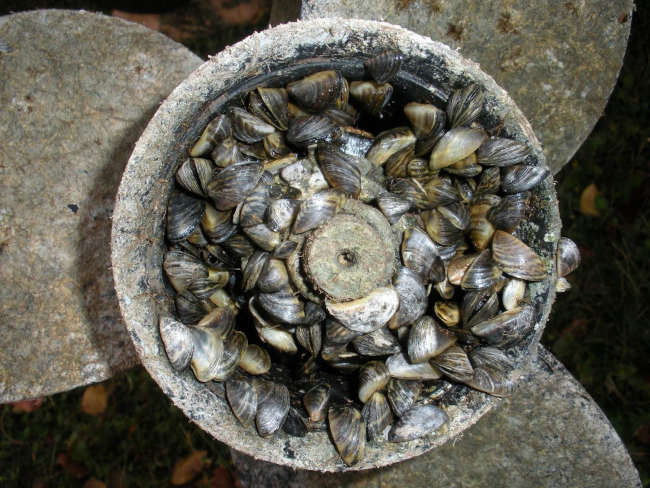
Invasive mussels, or specifically Quagga (Dreissena rostriformis bugensis) and Zebra (Dreissena polymorpha) mussels, are freshwater mussels in the Dreissenidae family. I will refer to these mussels as invasive dreissenid mussels. They are relatively small mussels and at a maximum cna grow up to 2 inches. They are shaped like a “D”, with a straight edge and striped shells, with black, gray, brown and white patterns — hence the reference to zebra common name.
Dreissenid mussels are native to lakes and tributaries in the region around southern Russia, Ukraine, Georgia, Romania, and Uzbekistan in water bodies such as the Black Sea, Sea of Azov, Caspian Sea, and Aral Sea. While there are fish and diving ducks native to the eastern european region where Dreissenid mussels are from, there are not the same predators in North American waters where these mussels have been introduced. Some natural predators of dreissenid mussels have also been introduced to North America, but they don’t prey upon the mussels like they do in their native habitat.
The round goby fish is an example, as it’s a species native to the eastern european waters alongside dreissenid mussels, where they are a main food source. Round gobies have been introduced into the Great Lakes, yet they are a food source for many native and invasive species, which keeps their abundance regulated. Round gobies have also been shown to prefer to forage on native north american mussels compared to their homeland’s Dreissenids.
How invasive mussels got to the United States
Invasive dreissenid mussels were introduced into North America through transatlantic freighter ships that started their voyage in the Black Sea and traveled across the Atlantic and through the St. Lawrence Seaway channel and lock system between US and Canada and into the Great Lakes.
From the Black Sea, freighter ships would drop off and pick up goods while also picking up water in their ballast tanks. Large ships use ballast tanks, which are large holding tanks with pumps, to balance loads and distribute weight evenly across the vessel, to ensure stability and safety when the ship is traveling and when they are loading or unloading cargo.
Ships leaving the Black Sea would travel through the Turkish Straits, a system of international water passages that connects the Black Sea ultimately to the Mediterranean Sea and then the Atlantic.
Once the ships had crossed the Atlantic, to gain access to large, safe ports of Canada such as Quebec City, Toronto, Hamilton, and Thunder Bay and US ports such as Toledo, Chicago, Duluth-Superior, Thunder Bay, they would have to enter the St. Lawrence River and into the man-made channel and lock system of the Great Lakes St. Lawrence Seaway.
The system of Canadian and US locks, canals, and channels has several locations where ships have to raise and lower to be level with the seaway, and at each of these junctions, they can release and take on water in their ballasts, to balance their load and adjust the weight of their ship. Likewise, any stops at ports along the Seaway, or within any of the Great Lakes, would require a release and intake of ballast water, to adjust as loads are changed.
During all this movement of water coming and going from a ship’s ballast tanks, there is ample opportunity for aquatic invasive species, that have been picked up in the ballast water from the ships point of origin — or anywhere else along their route — to be released into the “new environment” during a ballast adjustment.
Normally, and obviously, freshwater species and saltwater species don’t occur in the same habitat, so one way for freighter ships to prevent the spread of invasives along transatlantic routes is to implement ballast water management. The requirements are designed by the International Maritime Organization or IMO. The US governmental arm that participates in the IMO is the Shipping Coordinating Committee which is part of the Office of Ocean and Polar Affairs within the State Department.
Besides invasive dreissenid mussels, proper ballast water management programs have been successful in preventing the spread of other threatening and dangerous invasive species such as Asian Kelp, cholera, European green crab, and North Pacific seastar. Each of these species, in areas where they have been introduced and established, have caused significant economic and ecological harm, and in the case of cholera, significant human harm.
Invasive dreissenid mussels, once introduced into the Great Lakes, found suitable habitat in the freshwaters that were similar in latitude and habitat to their native waters. Once established in an area, they proliferated throughout the entire watershed, downstream throughout the Mississippi Basin, the Ohio River, and throughout the midwest, eastern seaboard, and into the Southern United States.
While it’s unknown when the first introductions took place, the first detections of mussels occurred in New York in the 1980s. By the 1990s mussels had been found west of the Rockies and the first detection in California occurred in 2007 in several border counties in southern California.
Invasive dreissenid mussels spread throughout non-connected water bodies on trailered boats overland. While adult mussels are sessile and attach to substrates and structures in water bodies, the juveniles, called veligers, are free floating in the water column and can survive in very small amounts of water that doesn’t get above 120 degrees F. Any boat or watercraft that has a compartment or space that holds water, could potentially be moving veliger - mussel - infested water over land.
Once a veliger, or adult mussel is introduced to a new water body, and the local water conditions are suitable, they can easily reproduce and a population is therefore established.
A single mussel can produce a million gametes sometimes up to six times a year. When fertilization occurs in the water column, the fertilized zygote turns into the larvae stage of a juvenile mussel, called a veliger. While the individual number of veligers that survive is low, the abundance of gamete production ensures high reproductive rates and lakes that were previously uninfested, quickly transform once the mussels spread.
Impacts of invasive mussels
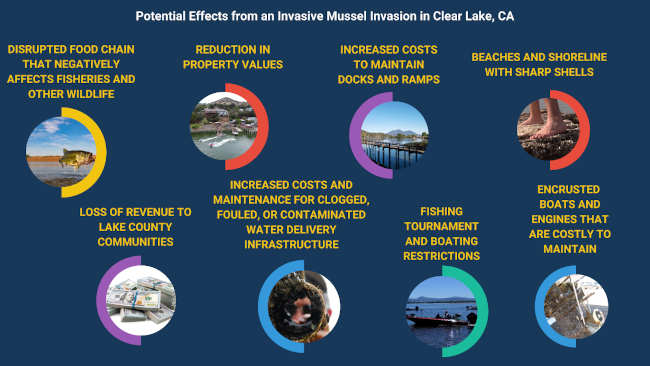
Invasive Quagga and Zebra mussels, if introduced into Clear Lake, would cause significant negative impacts. These impacts can be divided into ecological, economical, and public health. And some impacts overlap more than one category.
For example, invasive dreissenid mussels are filter feeders, removing green algae from the water column, sometimes up to 3 liters a day. Green algae is the base of the food web in fish-dominated lakes like Clear Lake. Drastic changes to the food web will impact the current lake ecology and the local economy that depends on current lake ecology - like the presence of large and abundant game fish like catfish, black bass, and crappie.
Green algae are consumed by zooplankton (small aquatic insects or copepods) which is the main food source for small bait fish, like minnows, shad and sunfish. Larger game fish can consume both bait fish and zooplankton. Almost all small, juvenile fish feed off both green algae and zooplankton. If Invasive dreissenid mussels were introduced into Clear Lake, they would significantly disrupt the base of the food web, with high probability of causing a fishery decline or crash.
This effect has been identified in other aquatic ecosystems with most impacts occurring to recreationally and commercially important species. For example, in Lake Ontario, following Zebra mussel introduction, Lake Whitefish and Walleye populations declined and recruitment reduced as the mussels compete directly with preferred fish food.
Some local myths exist that suggest that mussels would “clear up the water” and “take care of our harmful algae problem” in Clear Lake. Unfortunately, lab and field studies have demonstrated that this would not be true. Laboratory studies have shown that dreissenid mussels selectively eat green algae (phytoplankton) as opposed to cyanobacteria (which is the category of organism responsible for creating harmful algal blooms in Clear Lake).
Specifically, the dreissenid mussels will spit out the cyanobacteria, and only metabolize the green algae. And since cyanobacteria are not fish food, we will see declines in food available for fisheries, and more space and resources available for cyanobacteria as the valuable green algae declines.
One just has to look to Toledo, Ohio, located on Lake Erie, which has an abundance of invasive dreissenid mussel populations and worsening annual cyanobacteria blooms, to understand that the presence of invasive dreissenid mussels does not benefit water quality.
Invasive dreissenid mussels can have direct impacts to the economy through their disruption to drinking water systems. Clear Lake provides drinking water to about 60% of the Lake County population via 17 private and public drinking water purveyor systems. Intakes located within the lake could suck in juvenile mussels, or veligers.
Once inside the drinking water intake infrastructure, the dreissenid mussels could settle and attach and eventually accumulate within the pipes reducing the available space for water volume. Additionally, the dreissenid mussels produce waste and as they die, the bacteria can contaminate the water headed to treatment, creating complications for treatment systems. This is where invasive dreissenid mussels could heavily harm human health and could cause public health concerns.
As dreissenid mussels in drinking water pipes die, they decompose and the bacteria, smells, and particulates within the systems would lead to cost increases to produce safe drinking water. And if the water couldn’t be treated adequately, the system would have to be purged, wasting millions of gallons of Clear Lake water. The time, staff, tools, and effort needed to remove the mussels from the infrastructure within the lake would also be expensive.
All these costs would be passed down to the consumers, or residents of Lake County. I would further suggest that the costs associated with mitigating invasive dreissenid mussels in drinking water would bankrupt some of the smaller water treatment systems, as water rates from Clear Lake are already the 3rd highest rate in the state.
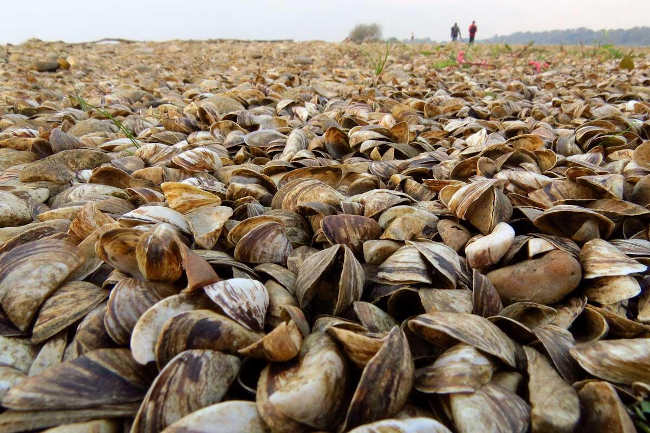
Additionally, invasive dreissenid mussels can cause economic impacts by their contribution to the decrease in recreational value in freshwater lakes. Dreissenid mussels grow exponentially and when they die, their sharp shells can accumulate on beaches and shorelines causing difficulty for people and animals to safely access the water.
Some beaches in Michigan, and other states, that have miles of dunes composed of sharp, dead mussel shells, are basically abandoned, and can’t serve any recreational purpose. Businesses that rely on that water access struggle to survive and stay afloat.
Adult mussels can also settle and attach to any structure in the water, including ramps, docks, anchor lines, and boat hulls and propellers. Imagine having to laboriously scrape your boat hull of mussels twice a year, or not being able to launch your kayak on your ramp because it’s covered in sharp mussels.
This is the reality of people with lakeside properties that live on mussel-infested lakes and could be the fate of Clear Lake shoreline residents should mussels become established in our lake.
To be continued…
I hope you learned a little bit about invasive dreissenid mussels, Fisherman Frank. I hope you read my next column, where I will focus on our Invasive Mussel Prevention Plan and Program, including how the stickers work to prevent mussels in our lake and how the ramp monitors are key in the prevention program.
Also in my next column, I will discuss what is being planned at the County of Lake Water Resources Department, should an invasive mussel make it to Clear Lake and a population establish. The goal is to maintain Clear Lake ecology so that we can maintain our way of life, and prevent the spread to other northern California lakes.
If you wanted to learn more about the current prevention program, you can visit the County of Lake Invasive Mussel webpage at www.nomussels.com.
To learn more about Invasive Dreissenid mussels in general, you can visit very user-friendly and interactive Invasive Mussel Collaborative website here: https://invasivemusselcollaborative.net/.
Sincerely,
Lady of the Lake
Angela De Palma-Dow is a limnologist (limnology = study of fresh inland waters) who lives and works in Lake County. Born in Northern California, she has a Master of Science from Michigan State University. She is a Certified Lake Manager from the North American Lake Management Society, or NALMS, and she is the current president/chair of the California chapter of the Society for Freshwater Science. She can be reached at
The County of Lake Water Resources Department wants to know what you know about invasive mussels! Take this 2-minute survey and get entered to win a FREE 2024 resident or visitor sticker for your boat (a $20 value!). You can access the survey from a computer, tablet, or smartphone at this link: https://forms.gle/5YRq5hPcAdR8NBm56
Hope Center is a 20-bed transitional housing facility owned and housing navigation hub
located at 3400 Emerson St. in Clearlake.
It’s operated by Adventist Health Clear Lake and staffed by Adventist Health associates around the clock, seven days a week.
On Wednesday, July 5, six participants and one associate at Hope Center tested positive for COVID-19, said Luke McMurray, director of marketing and communications for Adventist Health.
“Each experienced mild flu-like symptoms. An RN [registered nurse] on staff assessed everyone. No one required further treatment,” McMurray said.
“To ensure safety, protocols developed by the Lake County Department of Health and Adventist Health Clear Lake Hospital Infection Control were strictly followed. Hope Center remained open, and new participants were not admitted,” he said.
As of Saturday, July 15, there were no new cases, all participants and associates are testing negative and Hope Center is accepting new participants, McMurray said.
McMurray said Adventist Health Clear Lake and Hope Center continue to keep safety their top priority.

A national health advisory issued by U.S. Surgeon General Vivek Murthy on May 3, 2023, sheds light on the urgent public health issues of loneliness and isolation.
The report reflects Dr. Murthy’s personal and professional experience with the damaging health impacts of loneliness. As surprising as it sounds, social isolation and loneliness have the same effect on human health as smoking 15 cigarettes a day, which is to say, it can shorten life span by up to 15 years.
I’m a leader in academic and clinical medicine and I served as the COVID-19 czar for the state of West Virginia, so I have experience in thinking about public health emergencies and how to fix them.
Let’s first look at the problem and then examine some solutions and what the nation would gain by implementing them.
Defining the issue
Loneliness and social isolation are widespread. A 2021 survey by Cigna shows nearly 1 in 6 Americans reported feeling lonely or isolated. That means these conditions likely affect either you or someone you know.
In the same survey, young adults were nearly twice as likely as those over age 65 to report feeling lonely or isolated. In addition, 75% of Hispanics and 68% of Black or African American people reported these conditions, as did a majority of lower-income respondents and single parents.

While there are no definitive explanations for these high numbers, experts have suggested several possible determinants: the mobility of the population, the shift from in-person to remote work and learning since the beginning of the pandemic, and the deep divides in society caused by social media and irresponsible news sites. To grab the attention of viewers, some advertisers and media leaders understand that human beings are biased toward messages that activate fear and loss. In fact, the scientific term “aversion bias” demonstrates people are twice as fearful of loss as happy for gain.
When we feel socially isolated and lonely, our vigilance for threat activates our core survival instincts, which are rooted in evolutionary times. For early humans, being accepted and belonging to a group or community were key factors in survival. Being separated or ousted from one’s tribe meant almost certain death.
Thriving relationships became critical to human feelings of safety and well-being. In fact, longevity studies consistently find that the strength of one’s lifelong relationships is the most important driver of a long and healthy life.
Stress and loneliness are connected
The human nervous system is balanced into two modes: the “fight or flight” of the sympathetic system and the “rest and digest” of the parasympathetic system.
Loneliness and isolation drive unbalanced activation of the sympathetic nervous system, leading to hypervigilance, or scanning the environment for threats. Once this threat response is activated, people see their environment as unsafe, leading to release of hormones that interfere with our trust and pleasure responses. As this stress-response heightens, people experience surges in hormones that elevate their heart rate and blood pressure.
Over time, release of these hormones damages our blood vessels, heart, brain, blood and liver and our metabolic and musculoskeletal systems. Much like a car engine that is continually over-revved, our body’s systems begin to break down and our perceived experience of pain is heightened.
Feelings of worthlessness and fear increase the risk of substance use, mental health challenges, a variety of chronic diseases and obesity – all of which can contribute to a reduced life span.
In other words, loneliness and isolation drive disease and shorten life spans through unbalanced activation of the sympathetic nervous system induced by the perception of threat and chronic stress.
Of course, stress can also lead people to isolate themselves, so the effects do go both ways.
Finding relief
A primary solution to loneliness and social isolation is meaningful social connection.
Societal connections boost our perceptions of psychological and physical safety, worth and value and enhance feelings of belonging and contributing.
These critical relationships branch out from our families to our friends to form networks of trust and community. These networks of relationships are termed “social capital.”
Princeton University economists Anne Case and Angus Deaton hypothesize that the reduction of social capital and hope stemming from the loss of jobs in Appalachia and the Ohio River Valley from 1999 to 2013 was a key driver of deaths from overdose, suicide and liver disease in these areas.
So what can be done to address the loneliness epidemic?
In his Framework for a National Strategy to Advance Social Connection, Murthy provides a practical call for action to address the public health problem of social disconnection and to strengthen social connection and community. These strategies include being open to new relationships, reconnecting with friends and distant family members and serving others by volunteering. The framework includes shareable tools and resources for individuals and organizations to invest in community-based social relationships and improve their community’s mental health.
One reason I am answering this call is that my home state of West Virginia is the only one located entirely in Appalachia.
Appalachia is the central location of “deaths of despair,” meaning people living here are disproportionately affected by the loss of jobs, social capital, purpose and relationships that result in the experience of loneliness and social isolation.
This may explain why West Virginians have the second-lowest life expectancy in the country and some of the poorest health metrics.
But I would argue West Virginia also has resilient people who care about one another. There is a real goodness and kindness in our people. To serve our state better, the staff at the flagship university academic medical center is building more sophisticated and better health care access. My colleagues in business and government are focusing on reversing loneliness and social isolation through jobs that provide income, social capital and caring relationships.
Like the COVID-19 pandemic, the isolation and loneliness pandemic requires us to work together in community to make a positive difference.
Clay Marsh, Chancellor and Executive Dean for Health Sciences, West Virginia University
This article is republished from The Conversation under a Creative Commons license. Read the original article.
Dogs available for adoption this week include mixes of Anatolian shepherd, Belgian malinois, Catahoula leopard dog, Chihuahua, German shepherd, hound, mastiff, pit bull, plott hound and terrier.
Dogs that are adopted from Lake County Animal Care and Control are either neutered or spayed, microchipped and, if old enough, given a rabies shot and county license before being released to their new owner. License fees do not apply to residents of the cities of Lakeport or Clearlake.
The following dogs at the Lake County Animal Care and Control shelter have been cleared for adoption.
Call Lake County Animal Care and Control at 707-263-0278 or visit the shelter online for information on visiting or adopting.
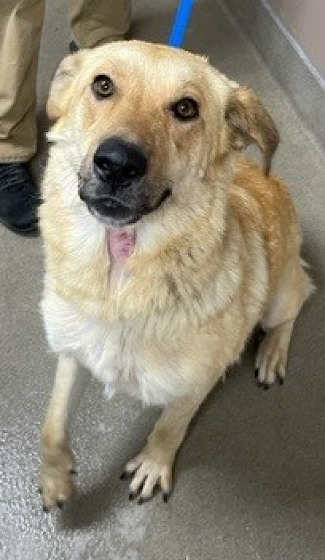
Female shepherd mix
This 2-year-old female shepherd mix has a short yellow coat.
She is in kennel No. 33, ID No. LCAC-A-5277.

Male Chihuahua
This 5-year-old male Chihuahua has a short tricolor coat.
He is in kennel No. 6, ID No. LCAC-A-5500.
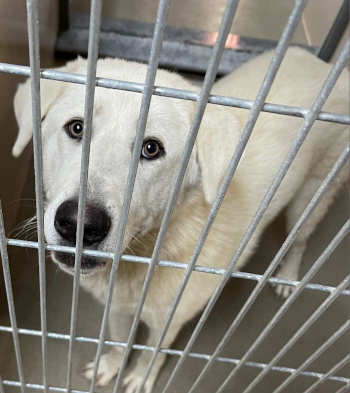
Male Great Pyrenees
This 1 and a half year old male Great Pyrenees has a white coat.
He is in kennel No. 3, ID No. LCAC-A-5469.

‘Trixie’
“Trixie” is a 3-year-old female hound with a short brown coat.
She is in kennel No. 9, ID No. LCAC-A-5433.
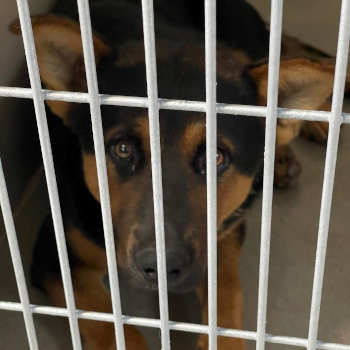
Male shepherd
This 2 and a half year old male shepherd has a short black and tan coat.
He is in kennel No. 14, ID No. LCAC-A-5479.
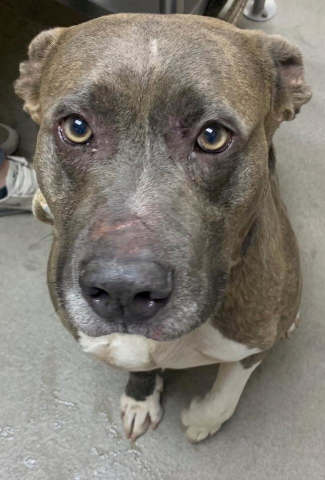
Male pit bull terrier
This 4-year-old male pit bull terrier has a short gray coat with white markings.
He is in kennel No. 25, ID No. LCAC-A-5446.
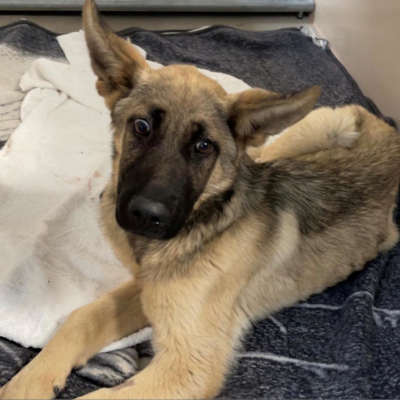
Male German shepherd puppy
This 6-month-old male German shepherd puppy has a black and tan coat.
He is in kennel No. 2, ID No. LCAC-A-5315.
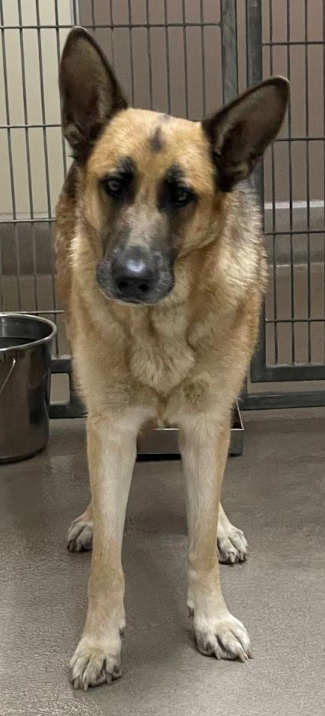
Female German shepherd
This 3-year-old female German shepherd has a black and tan coat.
She is in kennel No. 4, ID No. LCAC-A-5396.
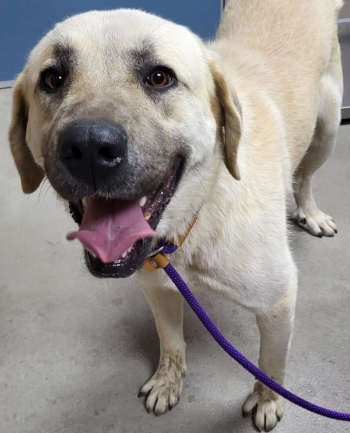
Anatolian shepherd-mastiff mix
This 3-year-old male Anatolian shepherd-mastiff mix has a short fawn coat.
He is in kennel No. 5, ID No. LCAC-A-5276.
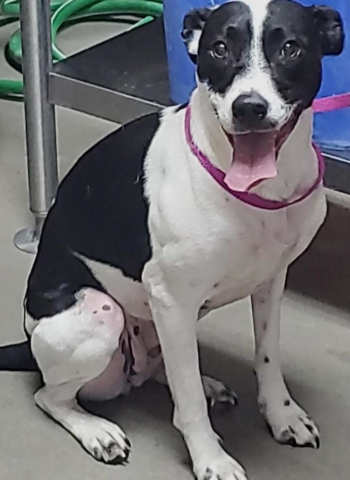
‘Roasie’
“Roasie”is a 2-year-old female pit bull terrier with a short black and white coat.
She is in kennel No. 7, ID No. LCAC-A-5434.
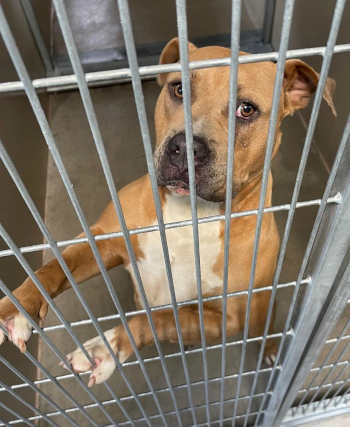
Female pit bull terrier
This 3-year-old female pit bull terrier has a brown and white coat.
She is in kennel No. 10, ID No. LCAC-A-5400.

Female hound-shepherd mix puppy
This 3-month-old female hound-shepherd mix puppy has a black and tan coat.
She is in kennel No. 11, ID No. LCAC-A-5370.

Male Catahoula leopard dog puppy
This 3-month-old male Catahoula leopard dog puppy has a short tan and white coat.
He is in kennel No. 13, ID No. LCAC-A-5354.
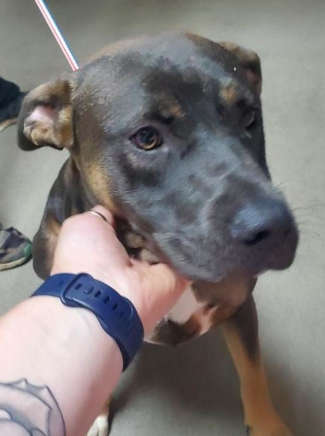
‘Zeta’
“Zeta” is a 1-year-old female pit bull terrier with a black and tan coat.
She is in kennel No. 16, ID No. LCAC-A-5427.
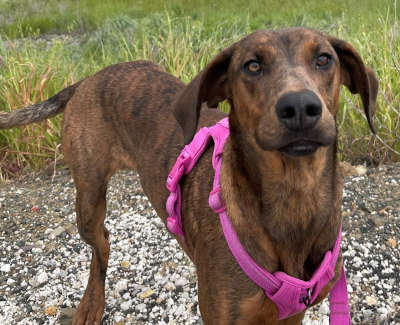
Male plott hound
This 2-year-old male plott hound has a short brown coat.
He is in kennel No. 18, ID No. LCAC-A-5143.
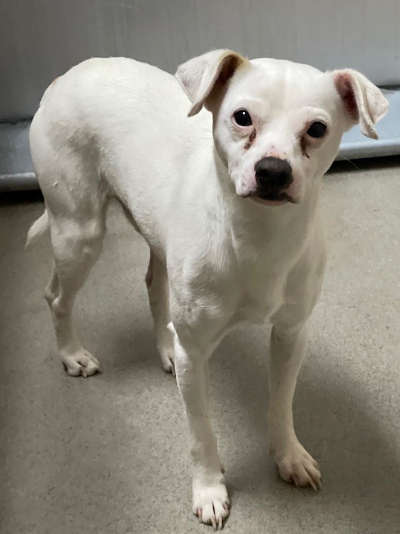
Male Chihuahua-terrier mix
This 2-year-old male Chihuahua-terrier mix has a short white coat.
She is in kennel No. 20, ID No. LCAC-A-5381.

Female Chihuahua
This 2-year-old female Chihuahua has a short brown and white coat.
She is in kennel No. 21, ID No. LCAC-A-5379.

Male shepherd
This 2-year-old male shepherd has a black and tan coat.
He is in kennel No. 22, ID No. LCAC-A-5423.
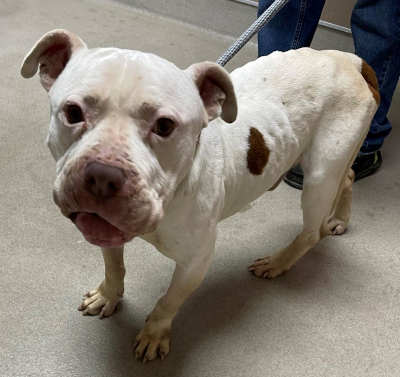
Male pit bull terrier
This 5-year-old male pit bull terrier has a short white coat with red markings.
He is in kennel No. 23, ID No. LCAC-A-5322.
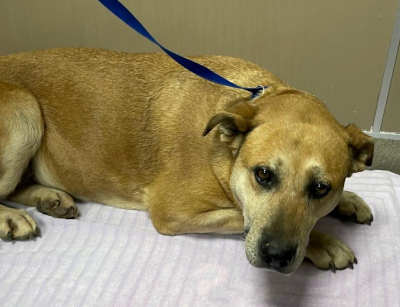
Female pit bull terrier
This 6-year-old female pit bull terrier has a short tan coat.
She is in kennel No. 24, ID No. LCAC-A-5410.
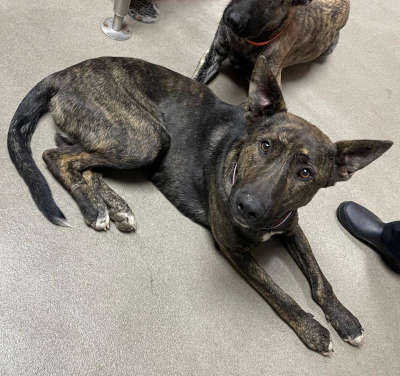
Male shepherd
This 1 and a half year old male shepherd has a short tricolor coat.
He is in kennel No. 26, ID No. LCAC-A-5424.
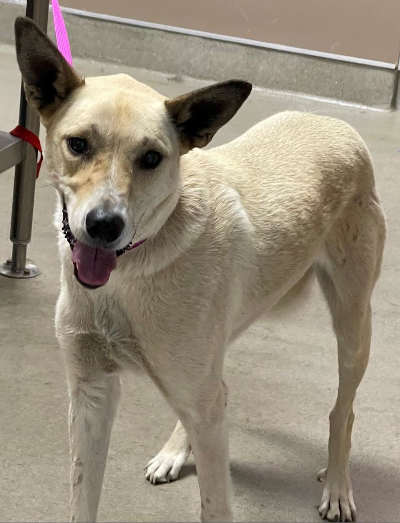
Female shepherd
This 2-year-old female shepherd has a short yellow and white coat.
She is in kennel No. 27, ID No. LCAC-A-5369.
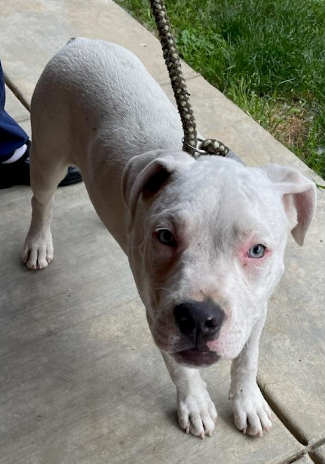
Male pit bull puppy
This 5-month-old male pit bull puppy has a white coat.
He is in kennel No. 29, ID No. LCAC-A-5325.

Male Belgian malinois
This 1 and a half year old male Belgian malinois has a tan and black coat.
He is in kennel No. 30, ID No. LCAC-A-5409.
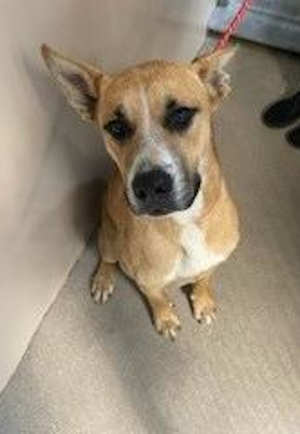
Male shepherd
This 2-year-old male shepherd has a short tan coat with white markings.
He is in kennel No. 31, ID No. LCAC-A-5344.
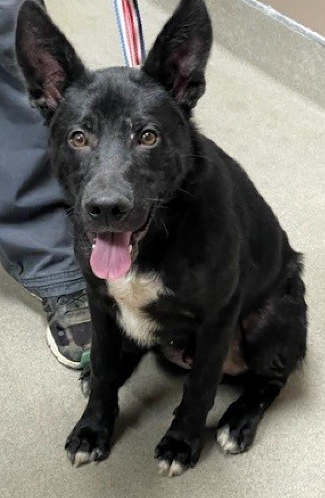
Male shepherd mix puppy
This 6-month-old male shepherd mix puppy has a black coat with white markings.
He is in kennel No. 32, ID No. LCAC-A-5408.

Female shepherd
This 10-month-old female shepherd has a tricolor coat.
She is in kennel No. 34, ID No. LCAC-A-5323.

‘Jojo’
“Jojo” is a one and a half year old female pit bull terrier with a short tricolor coat.
She is in kennel foster care, ID No. LCAC-A-5312.
Email Elizabeth Larson at
Space News: Webb telescope celebrates first year of science with close-up on birth of sun-like stars

From our cosmic backyard in the solar system to distant galaxies near the dawn of time, NASA’s James Webb Space Telescope has delivered on its promise of revealing the universe like never before in its first year of science operations.
To celebrate the completion of a successful first year, NASA has released Webb’s image of a small star-forming region in the Rho Ophiuchi cloud complex.
“In just one year, the James Webb Space Telescope has transformed humanity’s view of the cosmos, peering into dust clouds and seeing light from faraway corners of the universe for the very first time. Every new image is a new discovery, empowering scientists around the globe to ask and answer questions they once could never dream of,” said NASA Administrator Bill Nelson. “Webb is an investment in American innovation but also a scientific feat made possible with NASA’s international partners that share a can-do spirit to push the boundaries of what is known to be possible. Thousands of engineers, scientists, and leaders poured their life’s passion into this mission, and their efforts will continue to improve our understanding of the origins of the universe — and our place in it.”
The new Webb image released today features the nearest star-forming region to us. Its proximity at 390 light-years allows for a highly detailed close-up, with no foreground stars in the intervening space.
“On its first anniversary, the James Webb Space Telescope has already delivered upon its promise to unfold the universe, gifting humanity with a breathtaking treasure trove of images and science that will last for decades,” said Nicola Fox, associate administrator of NASA’s Science Mission Directorate in Washington. “An engineering marvel built by the world’s leading scientists and engineers, Webb has given us a more intricate understanding of galaxies, stars, and the atmospheres of planets outside of our solar system than ever before, laying the groundwork for NASA to lead the world in a new era of scientific discovery and the search for habitable worlds.”
Webb’s image shows a region containing approximately 50 young stars, all of them similar in mass to the Sun, or smaller.
The darkest areas are the densest, where thick dust cocoons still-forming protostars. Huge bipolar jets of molecular hydrogen, represented in red, dominate the image, appearing horizontally across the upper third and vertically on the right. These occur when a star first bursts through its natal envelope of cosmic dust, shooting out a pair of opposing jets into space like a newborn first stretching her arms out into the world.
In contrast, the star S1 has carved out a glowing cave of dust in the lower half of the image. It is the only star in the image that is significantly more massive than the Sun.
“Webb’s image of Rho Ophiuchi allows us to witness a very brief period in the stellar life cycle with new clarity. Our own Sun experienced a phase like this, long ago, and now we have the technology to see the beginning of another’s star’s story,” said Klaus Pontoppidan, who served as Webb project scientist at the Space Telescope Science Institute in Baltimore, Maryland, since before the telescope’s launch and through the first year of operations.
Some stars in the image display telltale shadows indicating protoplanetary disks — potential future planetary systems in the making.
A full year, across the full sky
From its very first deep field image, unveiled by President Joe Biden, Vice President Kamala Harris and Nelson live at the White House, Webb has delivered on its promise to show us more of the universe than ever before. However, Webb revealed much more than distant galaxies in the early universe.
“The breadth of science Webb is capable of exploring really becomes clear now, when we have a full year’s worth of data from targets across the sky,” said Eric Smith, associate director for research in the Astrophysics Division at NASA Headquarters and Webb program scientist. “Webb’s first year of science has not only taught us new things about our universe, but it has revealed the capabilities of the telescope to be greater than our expectations, meaning future discoveries will be even more amazing.” The global astronomy community has spent the past year excitedly poring over Webb’s initial public data and getting a feel for how to work with it.
Beyond the stunning infrared images, what really has scientists excited are Webb’s crisp spectra — the detailed information that can be gleaned from light by the telescope’s spectroscopic instruments. Webb’s spectra have confirmed the distances of some of the farthest galaxies ever observed, and have discovered the earliest, most distant supermassive black holes.
They have identified the compositions of planet atmospheres (or lack thereof) with more detail than ever before, and have narrowed down what kinds of atmospheres may exist on rocky exoplanets for the first time.
They also have revealed the chemical makeup of stellar nurseries and protoplanetary disks, detecting water, organic carbon-containing molecules, and more. Already, Webb observations have resulted in hundreds of scientific papers answering long-standing questions and raising new ones to address with Webb.
The breadth of Webb science is also apparent in its observations of the region of space we are most familiar with — our own solar system.
Faint rings of gas giants appear out of the darkness, dotted by moons, while in the background Webb shows distant galaxies.
By comparing detections of water and other molecules in our solar system with those found in the disks of other, much younger planetary systems, Webb is helping to build up clues about our own origins — how Earth became the ideal place for life as we know it.
“With a year of science under our belts, we know exactly how powerful this telescope is, and have delivered a year of spectacular data and discoveries,” said Webb Senior Project Scientist Jane Rigby of NASA's Goddard Space Flight Center. “We've selected an ambitious set of observations for year two — that builds on everything we've learned so far. Webb's science mission is just getting started — there's so much more to come.”
The James Webb Space Telescope is the world's premier space science observatory. Webb is solving mysteries in our solar system, looking beyond to distant worlds around other stars, and probing the mysterious structures and origins of our universe and our place in it. Webb is an international program led by NASA with its partners, European Space Agency and the Canadian Space Agency.

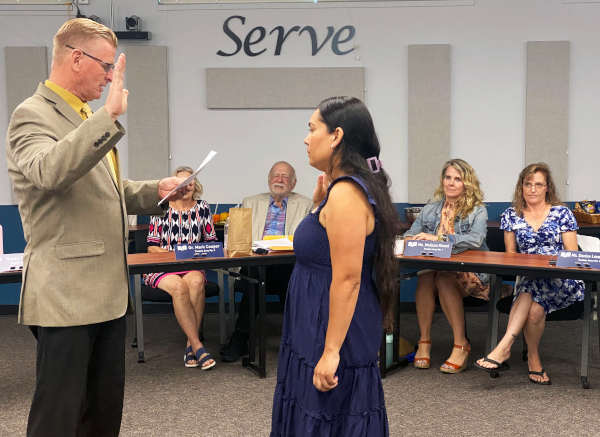
LAKE COUNTY, Calif. — After losing one of its members in the spring, the Lake County Board of Education has appointed a well-known businesswoman to fill the vacancy.
At its meeting on Wednesday, June 14, the board voted to appoint Itzia Rico to be the trustee representing Area 5, which includes Kelseyville.
The vacancy occurred on April 27, due to the death of Board Member Anna Rose Ravenwoode.
The Lake County Office of Education held a public recruitment for board candidates and received three applications. Applicants were Rico, Shauna Petker and Gary Olson.
During a regular board meeting, board members Denise Loustalot, Melissa Kinsel, Mark Cooper and Nancy Hudson interviewed the three applicants in open session.
Following the board’s deliberation, the trustees voted to appoint Rico, who was then sworn in. The term of her appointment will be until December 2024.
Rico is a longtime Lake County resident and the owner of Studebakers coffee shop located in downtown Kelseyville. She is part of the Kelseyville Business Association and has served as their secretary.
“I realize how important it is for our youth to succeed. They are the future of our communities,” Rico said. “Through my own children, I see how much teachers influence our kids. I hope to learn how I can help too, as a board member.”
Rico is a mother of five children, four of whom are enrolled in schools in the Kelseyville Unified School District.
She has volunteered in classrooms, coached youth basketball and held a free volleyball camp for middle school players that did not make the school team.
She is always looking for ways to support schools and Lake County students.
“Her ties to the community, perspective as a parent and her focus on putting students first is a welcome addition to the dynamic of the Board of Education,” said Lake County Superintendent of Schools Brock Falkenberg.
The Board of Education thanks all applicants for putting themselves up for consideration.
Pursuant to California Ed Code section 5091, the Lake County Board of Education trustees provisionally appointed Itzia Rico to fill the vacancy on June 14, 2023.
Unless a petition calling for a special election containing a sufficient number of signatures is filed with the Lake County Superintendent of Schools within 30 days of the provisional appointment, the appointment shall become an effective appointment.