How to resolve AdBlock issue?
News
If you’ve been thinking of taking college classes, learning English or completing your high school diploma or equivalency, this is your opportunity.
They will provide application assistance, financial aid support and academic counseling during this event. All participants will receive Lake County Campus of Woodland Community College, or LCC, swag.
Culinary students can earn a Certificate of Achievement in Culinary Arts and Baking in addition to a Culinary Arts Associates of Arts Degree.
Hospitality and food services is the fourth largest industry sector in the county. Employers are constantly in need of staffing. Great opportunities are consistently available in the industry, granting anyone with a certificate or degree a variety of careers to pursue from hospitality to kitchen management.
In addition to the culinary program, LCC offers more than 50 degrees and certificate programs.
Woodland Community College is ranked among the top 40 community colleges in the U.S., according to WalletHub.
The college offers a variety of instructional and student support services that help students to succeed.
Graduates can find employment in a variety of regional industries or transfer to bachelor’s programs.
LCC also provides adult basic education classes to improve your skills and confidence necessary to be successful in college.
In addition, they can help you learn English, if it isn’t your first language.
The adult education program can assist you in becoming proficient in English, completing your high school diploma or getting ready to take the HiSET or GED high school equivalency tests.
Anyone interested in this event is encouraged to attend. For more information call the campus at 707-995-7900.
The library’s newest book club, The Happy Trails Hiking Book Club, will facilitate book discussions about outdoor literature during group hikes at Anderson Marsh State Historic Park in Lower Lake at 8 a.m. on the last Saturday every month.
Hikers and readers who love the outdoors will find kindred spirits in The Happy Trails Book Club.
“Each month the theme changes,” explained Mickey Price at the Redbud Library. “This month’s theme is marsh or wetland. Members can read any fiction or nonfiction that has to do with a marsh or a wetland, and then we will chat about it while we hike. We chose Anderson Marsh as our location due to its accessibility.”
To find out each month’s theme, participants can attend meetings or call Mickey at 707-994-5115.
The public is also welcome to attend any of the Lake County Library’s other free book clubs. Each club has a unique theme, time, and location:
• Great Reads Book Club: Third Wednesday of every month at noon — meets online. At this meeting, readers share the books they’ve read independently and make recommendations of our own. Contact Amy Patton at 707-263-8817, Extension 17105 or
• Lakeport Evening Book Club: First Wednesday of every month at 5:30 p.m. at the Lakeport Library — meets in person. Led by a library volunteer. Reads and discusses the same book as a group each month. Call 707-263-8817 for more information.
• Cookbook Club: Second Thursday of every month at noon at the Lakeport Library — meets in person and online. Prepare, share and critique recipes. To sign up, call Lakeport Library at 707-263-8817 or email a
• Aging, Dying and Afterlife Discussion Group: Third Saturday of every month at noon at the Upper Lake Library — meets online and in person. Led by a library volunteer. Discuss the same book each month on the topics of aging, dying and the afterlife. To join, please call Lee at 707-772-9252 or email her at
• Garden Book Club: First Tuesday of every month at 10 a.m. — meets online. Contact Amy Patton at 707-263-8817, Extension 17105 or
The Lake County Library website also offers many other free digital resources, including free access to the New York Times, free classes on Skillshare and more.
To get started, visit the Lake County Library online at https://library.lakecountyca.gov, on Facebook @ https://www.facebook.com/LakeCountyLibrary, Twitter @LakeCoLibrary, Instagram @lakecountylibrary, YouTube @lakecountycalibrary and TikTok @ lakecountycalibrary.

You’ve just finished a cup of coffee at your favorite cafe. Now you’re facing a trash bin, a recycling bin and a compost bin. What’s the most planet-friendly thing to do with your cup?
Many of us would opt for the recycling bin – but that’s often the wrong choice. In order to hold liquids, most paper coffee cups are made with a thin plastic lining, which makes separating these materials and recycling them difficult.
In fact, the most sustainable option isn’t available at the trash bin. It happens earlier, before you’re handed a disposable cup in the first place.
In our research on waste behavior, sustainability, engineering design and decision making, we examine what U.S. residents understand about the efficacy of different waste management strategies and which of those strategies they prefer. In two nationwide surveys in the U.S. that we conducted in October 2019 and March 2022, we found that people overlook waste reduction and reuse in favor of recycling. We call this tendency recycling bias and reduction neglect.
Our results show that a decadeslong effort to educate the U.S. public about recycling has succeeded in some ways but failed in others. These efforts have made recycling an option that consumers see as important – but to the detriment of more sustainable options. And it has not made people more effective recyclers.
A global waste crisis
Experts and advocates widely agree that humans are generating waste worldwide at levels that are unmanageable and unsustainable. Microplastics are polluting the Earth’s most remote regions and amassing in the bodies of humans and animals.
Producing and disposing of goods is a major source of greenhouse gas emissions and a public health threat, especially for vulnerable communities that receive large quantities of waste. New research suggests that even when plastic does get recycled, it produces staggering amounts of microplastic pollution.
Given the scope and urgency of this problem, in June 2023 the United Nations convened talks with government representatives from around the globe to begin drafting a legally binding pact aimed at stemming harmful plastic waste. Meanwhile, many U.S. cities and states are banning single-use plastic products or restricting their use.
Upstream and downstream solutions
Experts have long recommended tackling the waste problem by prioritizing source reduction strategies that prevent the creation of waste in the first place, rather than seeking to manage and mitigate its impact later. The U.S. Environmental Protection Agency and other prominent environmental organizations like the U.N. Environment Programme use a framework called the waste management hierarchy that ranks strategies from most to least environmentally preferred.
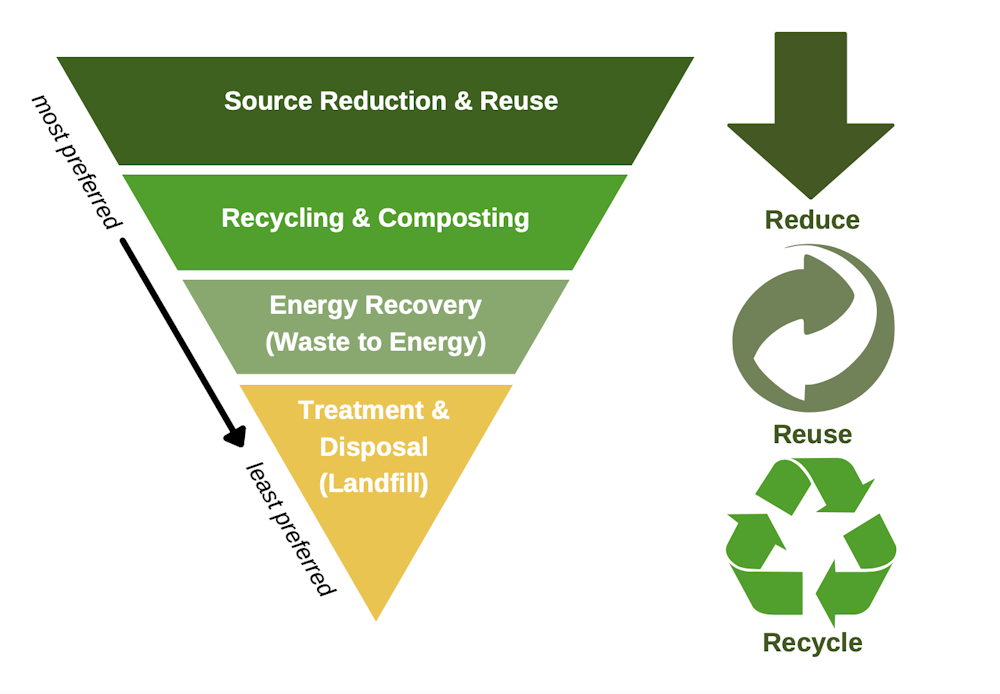
The familiar waste management hierarchy urges people to “Reduce, Reuse, Recycle,” in that order. Creating items that can be recycled is better from a sustainability perspective than burning them in an incinerator or burying them in a landfill, but it still consumes energy and resources. In contrast, reducing waste generation conserves natural resources and avoids other negative environmental impacts throughout a product’s life.
R’s out of place
In our surveys, participants completed a series of questions and tasks that elicited their views of different waste strategies. In response to open-ended questions about the most effective way to reduce landfill waste or solve environmental issues associated with waste, participants overwhelmingly cited recycling and other downstream strategies.
We also asked people to rank the four strategies of the Environmental Protection Agency’s waste management hierarchy from most to least environmentally preferred. In that order, they include source reduction and reuse; recycling and composting; energy recovery, such as burning trash to generate energy; and treatment and disposal, typically in a landfill. More than three out of four participants (78%) ordered the strategies incorrectly.
When they were asked to rank the reduce/reuse/recycle options in the same way, participants fared somewhat better, but nearly half (46%) still misordered the popular phrase.
Finally, we asked participants to choose between just two options – waste prevention and recycling. This time, over 80% of participants understood that preventing waste was much better than recycling.
Recycling badly
While our participants defaulted to recycling as a waste management strategy, they did not execute it very well.
This isn’t surprising, since the current U.S. recycling system puts the onus on consumers to separate recyclable materials and keep contaminants out of the bin. There is a lot of variation in what can be recycled from community to community, and this standard can change frequently as new products are introduced and markets for recycled materials shift.
Our second study asked participants to sort common consumer goods into virtual recycling, compost and trash bins and then say how confident they were in their choices. Many people placed common recycling contaminants, including plastic bags (58%), disposable coffee cups (46%) and light bulbs (26%), erroneously – and often confidently – in the virtual recycling bins.
This is known as wishcycling – placing nonrecyclable items in the recycling stream in the hope or belief that they will be recycled. Wishcycling creates additional costs and problems for recyclers, who have to sort the materials, and sometimes results in otherwise recyclable materials being landfilled or incinerated instead.
Although our participants were strongly biased toward recycling, they weren’t confident that it would work. Participants in our first survey were asked to estimate what fraction of plastic has been recycled since plastic production began. According to a widely cited estimate, the answer is just 9%. Our respondents thought that 25% of plastic had been recycled – more than expert estimates but still a low amount. And they correctly reasoned that a majority of it has ended up in landfills and the environment.
Empowering consumers to cut waste
Post-consumer waste is the result of a long supply chain with environmental impacts at every stage. However, U.S. policy and corporate discourse focuses on consumers as the main source of waste, as implied by the term “post-consumer waste.”
Other approaches put more responsibility on producers by requiring them to take back their products for disposal, cover recycling costs and design and produce goods that are easy to recycle effectively. These approaches are used in some sectors in the U.S., including lead-acid car batteries and consumer electronics, but they are largely voluntary or mandated at the state and local level.
When we asked participants in our second study where change could have the most impact and where they felt they could have the most impact as individuals, they correctly focused on upstream interventions. But they felt they could only affect the system through what they chose to purchase and how they subsequently disposed of it – in other words, acting as consumers, not as citizens.
As waste-related pollution accumulates worldwide, corporations continue to shame and blame consumers rather than reducing the amount of disposable products they create. In our view, recycling is not a get-out-of-jail-free card for overproducing and consuming goods, and it is time that the U.S. stopped treating it as such.
Michaela Barnett, Founder, KnoxFill, University of Virginia; Leidy Klotz, Associate Professor of Engineering and Co-Director, Convergent Behavioral Science Initiative, University of Virginia; Patrick I. Hancock, Postdoctoral fellow, University of Virginia, and Shahzeen Attari, Associate Professor of Public and Environmental Affairs, Indiana University
This article is republished from The Conversation under a Creative Commons license. Read the original article.
The board will meet beginning at 9 a.m. Tuesday, July 25, in the board chambers on the first floor of the Lake County Courthouse, 255 N. Forbes St., Lakeport.
The meeting can be watched live on Channel 8, online at https://countyoflake.legistar.com/Calendar.aspx and on the county’s Facebook page. Accompanying board documents, the agenda and archived board meeting videos also are available at that link.
To participate in real-time, join the Zoom meeting by clicking this link.
The meeting ID is 950 1537 0146, pass code 956689. The meeting also can be accessed via one tap mobile at +16694449171,,95015370146#,,,,*956689#.
All interested members of the public that do not have internet access or a Mediacom cable subscription are encouraged to call 669-900-6833, and enter the Zoom meeting ID and pass code information above.
At 10 a.m., the board will consider the second amendment to the county’s agreement with Sunrise Special Services Foundation for the homeless shelter at the former juvenile facility on Whalen Way in Lakeport.
The amendment would increase the total compensation under the agreement to $460,800 for fiscal years 2022-23 and 2023-24.
Interim Behavioral Health Services Director Stephen Carter, also the county’s assistant administrative officer, said in his memo to the board that the amendment represents a three-month extension of services through Oct. 24.
“Lake County Behavioral Health Services Department, as the lead Administrative Entity of the Lake County Continuum of Care, issued a Request for Proposals for Temporary Emergency Shelter Services,” Carter wrote. “The RFP was not successful, in that no applicant was selected. The Lake County Continuum of Care Executive Committee voted to extend sheltering services provided by Sunrise Special Services Foundation for three months to allow for another RFP to be conducted. These services are funded by the Homeless Housing, Assistance and Prevention program.”
In an untimed item, the board will consider scheduling a special meeting to interview public defender candidates in closed session.
The full agenda follows.
CONSENT AGENDA
5.1: Approve agreement between county of Lake and Ford Street Project for ASAM Level 3.2 services for fiscal year 2023-24 in the amount of $100,000 and authorize the board chair to sign.
5.2: Approve agreement between county of Lake and New Life Health Authority dba New Life LLC for substance use disorder outpatient drug free services, intensive outpatient treatment services, and narcotic treatment program services for fiscal year 2022-23 for 2021-22 services in the amount of $95,662.58 and authorize the board chair to sign.
5.3: Approve annual renewal of veterans subvention certificate of compliance and Medi-Cal Cost Avoidance Program certificate of compliance and authorize the board chair to sign certificates.
5.4: Approve the supplemental services Agreement No. 3 between the county of Lake and Armstrong Consultants for consulting services related to Lampson Airfield and authorize the chair to sign the agreement.
5.5: Approve Amendment No. 1 to Supplemental Services Agreement No. 1 between the county of Lake and Armstrong Consultants for consulting services related to Lampson Airfield and authorize the chair to sign the agreement.
5.6: (a) Approve the purchase of eight commercial grade fitness items; and (b) authorize the sheriff/coroner or his designee to issue and sign a purchase order not to exceed $50,000 to 360 Fitness Store, 727 Francisco Blvd., San Rafael, California.
5.7: Adopt proclamation commending Lynn Prescott for his 23 years of service to the county of Lake.
5.8: Approve Amendment No. 1 to agreement for professional services between county of Lake and RTLawrence Corp.
TIMED ITEMS
6.2, 9:07 a.m.: Pet of the Week.
6.3, 9:08 a.m.: Presentation of proclamation commending Lynn Prescott for his 23 years of service to the county of Lake.
6.4, 9:20 a.m.: Consideration of a request for assistance under the California Disaster Assistance Act to mitigate pervasive tree mortality, including a cover memo, hazard tree removal plan, and letter requesting waiver of 25% local match requirement.
6.5, 10 a.m.: Consideration of Amendment No. 2 to the agreement between county of Lake and Sunrise Special Services Foundation increasing the total compensation under the agreement to $460,800 for fiscal years 2022-23 and 2023-24 and authorize the board chair to sign.
6.6, 11:15 a.m.: Public hearing, continued from July 11, sitting concurrently as Clearlake Keys CSA#1, #2, #6, #13, #20, #21-Board of Supervisors, Kelseyville County Waterworks District #3 and Lake County Sanitation District - Board of Directors) - consideration of (a) resolution confirming collections of annual lighting fees; (b) resolution confirming collections of delinquent water fees; (c) resolution confirming collections of delinquent water and sewer fees; (d) resolution of delinquent sewer fees for Lake County Sanitation District.
6.7, 11:30 a.m.: Public hearing, consideration of ordinance amending Chapter 5 of the Lake County Code and adopting by reference Appendices C and J of the 2022 California Building Code, Part 2 of the California Code of Regulations, Title 24.
UNTIMED ITEMS
7.2: Consideration to schedule a special meeting to interview public defender candidates in closed session.
7.3: Consideration of the following advisory board appointments: Mental Health Board, Heritage Commission.
CLOSED SESSION
8.1: Conference with legal counsel: Existing litigation pursuant to Gov. Code sec. 54956.9 (d)(1) – FERC Project No. 77, Potter Valley Hydroelectric Project.
8.2: Conference with real property negotiators pursuant to Government Code Section 54956.8 Property: APN 013-056-04; 16540 State Hwy 175, Cobb, CA negotiating parties: (a) County Negotiators L. Ewing, Susan Parker, Stephen Carter and (b) Robert Vardenega. Under negotiation: Price and terms of payment.
Email Elizabeth Larson at
The group will meet at 5 p.m. at the Scotts Valley Women’s Clubhouse, 2298 Hendricks Road in Lakeport.
Council business includes Fourth District updates and news, the council’s boundary of influence, roadwork and utilities for Scotts Valley community roads, the land use permit report, Clear Lake hitch in the Scotts Valley area, and groundwater updates and observation.
There also will be discussion regarding maintenance of Scotts Creek, including input on efforts to clean out the creek, tree and gravel removal, and replacement, repair and maintenance of water flow gauges at the Green River and Eickhoff bridges.
Under new business, the council will discuss the procedure to submit meeting minutes and plan for the Fall Neighborfest.
The council includes Chair Greg Scott, Vice Chair Jared Hendricks, Secretary Jason Weston, and members Jody Altic and Cornelia Sieber-Davis.
Almost 1 in 4 people in the United States are socially vulnerable and have low resilience to extreme heat exposure, according to new U.S. Census Bureau data.
The Community Resilience Estimates, or CRE, for Heat, an experimental data product released in April, measures the capacity of individuals and households in a community to withstand the stress of exposure to extreme heat based on their social characteristics.
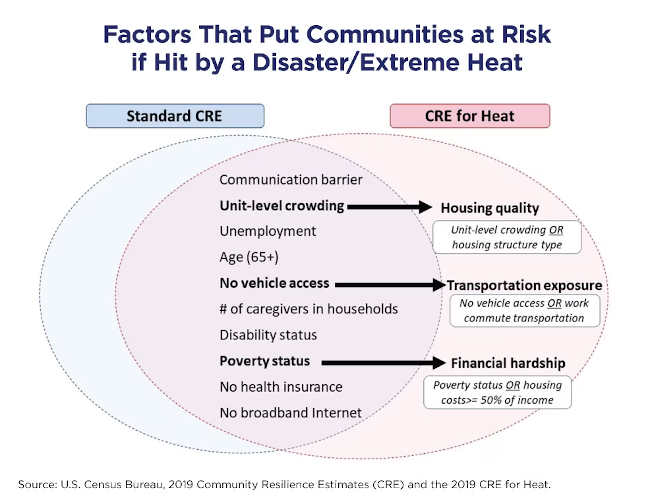
The standard CRE measures social vulnerability that inhibits community resilience while the CRE for Heat adjusts certain risk factors like quality of housing, transportation modes and financial hardship to gauge social vulnerability specifically to extreme heat exposure.
The tool produces national, state, county and census tract (neighborhood equivalent) estimates using individual and household data from the 2019 American Community Survey, or ACS, restricted microdata and the Census Bureau’s Population Estimates Program, or PEP.
The experimental climate-focused data product was developed with Arizona State University’s Knowledge Exchange for Resilience, known as KER. The product was released at a joint Census Bureau-KER climate resilience symposium in Washington, D.C.
“This collaboration is an example of how we can leverage data and innovation to identify and address social inequalities and improve the resilience of communities in the face of climate change,” said Patricia Solís, KER’s executive director.
CRE for Heat findings
CRE for Heat suggests greater social vulnerability and geographic variation compared to the standard CRE.
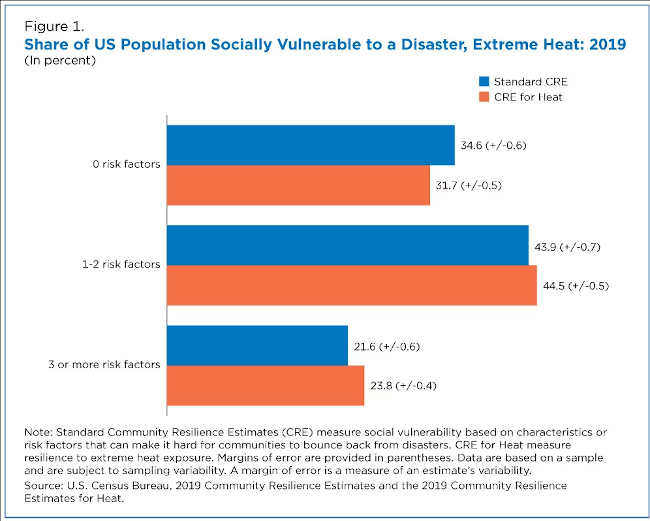
When measuring social vulnerability to heat exposure, the proportion of individuals with three or more risk factors increases from 21.6% in the standard CRE to 23.8% in CRE for Heat.
Similarly, the share with 0 risk factors decreases from 34.6% in the standard CRE to 31.7% in CRE for Heat.
In other words, when accounting for additional housing and transportation characteristics, more people in the United States are socially vulnerable or less resilient to rising heat temperatures.
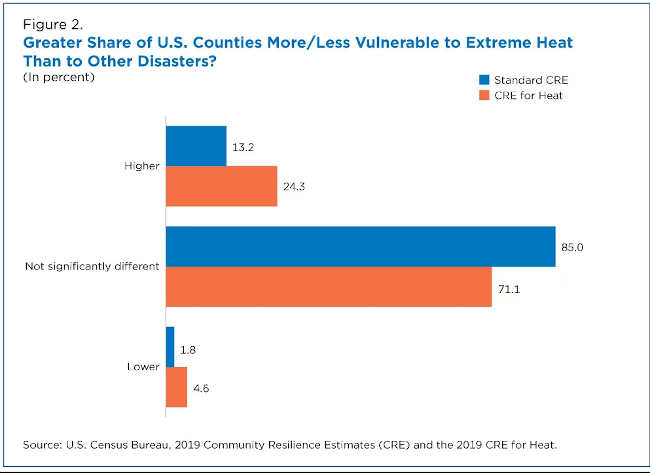
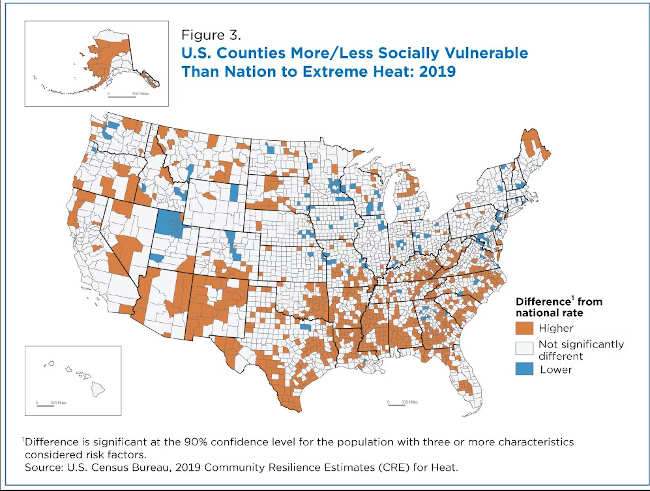
There were also differences in the number of areas flagged as statistically higher or lower than the national rate.
The CRE for Heat shows that 24.3% of counties have a greater proportion of individuals with three or more risk factors than the national rate — much higher than the 13.2% in the standard CRE.
At the same time, 4.6% of counties had a lower proportion of individuals with high risk (3+ risk factors) compared to the national rate, higher than the 1.8% in the standard CRE. This suggests the additional heat exposure risk factors produce greater distinctions across U.S. counties.
How CRE for heat came about
The first CRE was published as an experimental data product in June 2020 to provide information about the COVID-19 pandemic. It was also published to garner feedback from data users and stakeholders on the quality and usefulness of such a product.
KER reached out to the CRE team to further discuss the product and was particularly interested in how the CRE could be leveraged for measuring social vulnerability to heat exposure.
In consultation with KER, the CRE modified three of the 10 risk factors to adjust for social vulnerability to heat exposure.
While the standard CRE simply had a unit level crowding measure (0.75 people or more per room), CRE for heat has a housing-quality exposure indicator that also accounts for structure type or where people live (mobile home, boat, RV, or other).
Also, the original CRE has an indicator for no household vehicle but the CRE for Heat’s transportation exposure indicator also contains commute type (public transportation, walking, biking or other nonpersonal vehicle method).
Finally, while the CRE simply had a poverty indicator, the CRE for Heat’s financial hardship indicator also includes whether the household’s housing costs are greater than 50%.
Even though the number of risk factors didn’t change in the CRE for Heat, some characteristics or conditions like transportation modes were added. A person only needs to meet one of the conditions to receive a risk factor flag. For example, if a household does not have unit-level crowding but lives in a mobile home, it will be flagged for having a housing quality risk. If the household meets both conditions, it’s only flagged once.
Factors that put communities at risk if hit by a disaster/extreme heat
It is important to note that CRE for Heat does not measure which areas are warmer than others or which areas are more likely to experience future heat waves. Instead, it identifies which areas exhibit low resilience if faced with extreme heat.
This new product comes with the same goals as the original CRE. Its publication should provide a new useful data source about a pressing topic and allow data users and stakeholders to provide feedback on potential enhancements.
Benjamin Gurrentz is a survey statistician in the Census Bureau’s Small Area Modeling and Development Branch – Social, Economic, and Housing Statistics Division. R. Chase Sawyer is the technical lead for Modeled Data Product Development in Small Area and Longitudinal Estimates – Social, Economic, and Housing Statistics Division.