 How to resolve AdBlock issue?
News
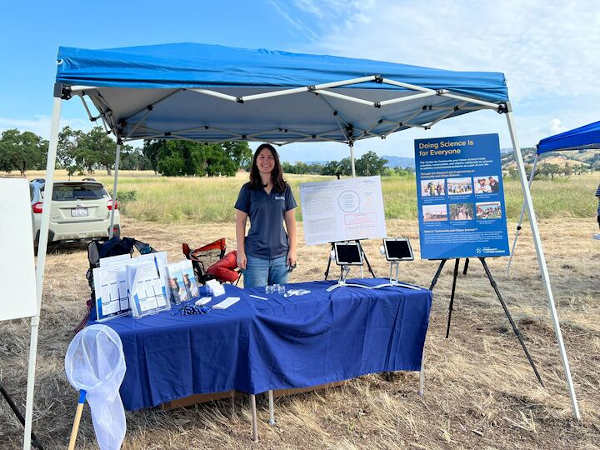
LAKE COUNTY, Calif. — The UC Davis Center for Community and Citizen Science and Center for Regional Change invite educators working with youth to contribute their skills and experience in developing environmental education materials for the Clear Lake region.
These materials will support ongoing local efforts dedicated to enhancing the health of Clear Lake, its watershed, and its communities.
This project was recommended by the Blue Ribbon Committee for the Rehabilitation of Clear Lake and funded by the California Natural Resources Agency.
Over the past year and a half, the project team spoke to over 50 community members, presented at organizational meetings, attended outreach events, and organized a Tribal Environmental Education Advisory Committee.
These efforts were undertaken to gather Tribal and community priorities and needs for environmental education in the region.
Community perspectives helped inform the environmental education materials, and a draft is now ready for further feedback and pilot testing.
They are drafted for use by non-formal educators working with third through fifth grade youth in non-formal expanded learning settings.
Opportunities for community involvement:
• Review and provide feedback: Community members are encouraged to review the drafted materials and share their feedback. The drafted materials are available for public review, and feedback can be submitted through February, 2024.
• Training, piloting and feedback (compensation available): Formal and non-formal educators interested in a more hands-on experience can receive training on the materials, pilot the materials with youth, and then provide feedback on the pilot experience to the project team. Compensation is available for this time commitment and participation.
How to get involved:
• Interested community members can fill out the involvement form available on our project page. Alternatively, you can contact Sarah Angulo (
Important 2024 dates:
• Public review of drafted materials: January through February.
• Training for educators: March.
• Piloting of materials with youth in Lake County: April and May.
• Feedback on the pilot experience: May and June.
Join in this collaborative effort to empower the youth of Lake County with environmental education and participatory science. Your involvement can make an impact on the future health of Clear Lake and its surrounding watershed.
For further information, please contact Sarah Angulo at
The Center for Community and Citizen Science, or CCSS, helps scientists, communities, and individuals collaborate on science to address environmental issues as a part of civic life. We research ways to improve scientific learning using citizen science, and broaden and improve participation in science by diverse communities.
Through our programming, we develop resources and tools to build successful citizen science programs. The CCSS is housed within the School of Education at UC Davis.
The Center for Regional Change, or CRC, is a catalyst for collaborative and action-oriented research that centers social and environmental justice.
The CRC brings together multi-disciplinary campus partners and multi-sector community partners to explore topics that transcend jurisdictional boundaries.
The CRC collaborates with partners, including youth, toward healthy, equitable, prosperous, and sustainable regions in California and beyond. The CRC is housed within the College of Agricultural and Environmental Sciences at UC Davis.

CLEARLAKE, Calif. — Clearlake Animal Control has an additional set of dogs waiting to be adopted this week.
The Clearlake Animal Control website lists 49 adoptable dogs.
The adoptable dogs include “Flounder,” a male chihuahua-dachshund mix with a black coat.
There also is “Daisy,” a four-month-old female pit bull terrier mix with a short tan coat.

The shelter is located at 6820 Old Highway 53. It’s open from 9 a.m. to 6 p.m. Tuesday through Saturday.
For more information, call the shelter at 707-762-6227, email
This week’s adoptable dogs are featured below.
Email Elizabeth Larson at
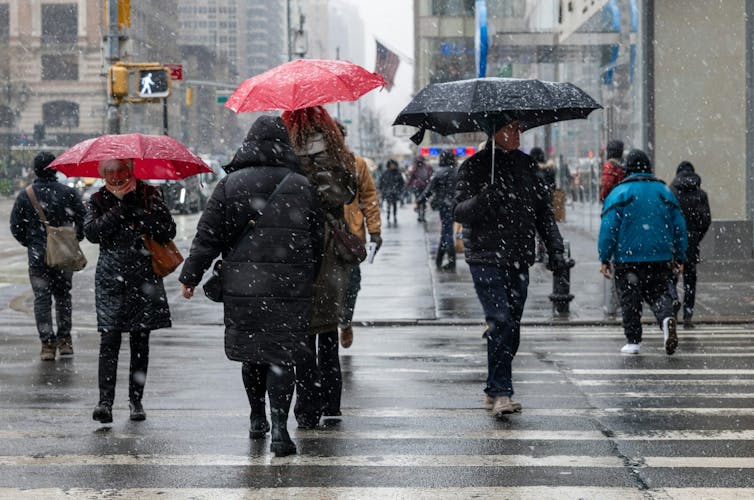
One of the most robust measures of Earth’s changing climate is that winter is warming more quickly than other seasons. The cascade of changes it brings, including ice storms and rain in regions that were once reliably below freezing, are symptoms of what I call “warming winter syndrome.”
Wintertime warming represents the global accumulation of heat. During winter, direct heat from the Sun is weak, but storms and shifts in the jet stream bring warm air up from more southern latitudes into the northern U.S. and Canada. As global temperatures and the oceans warm, that stored heat has an influence on both temperature and precipitation.
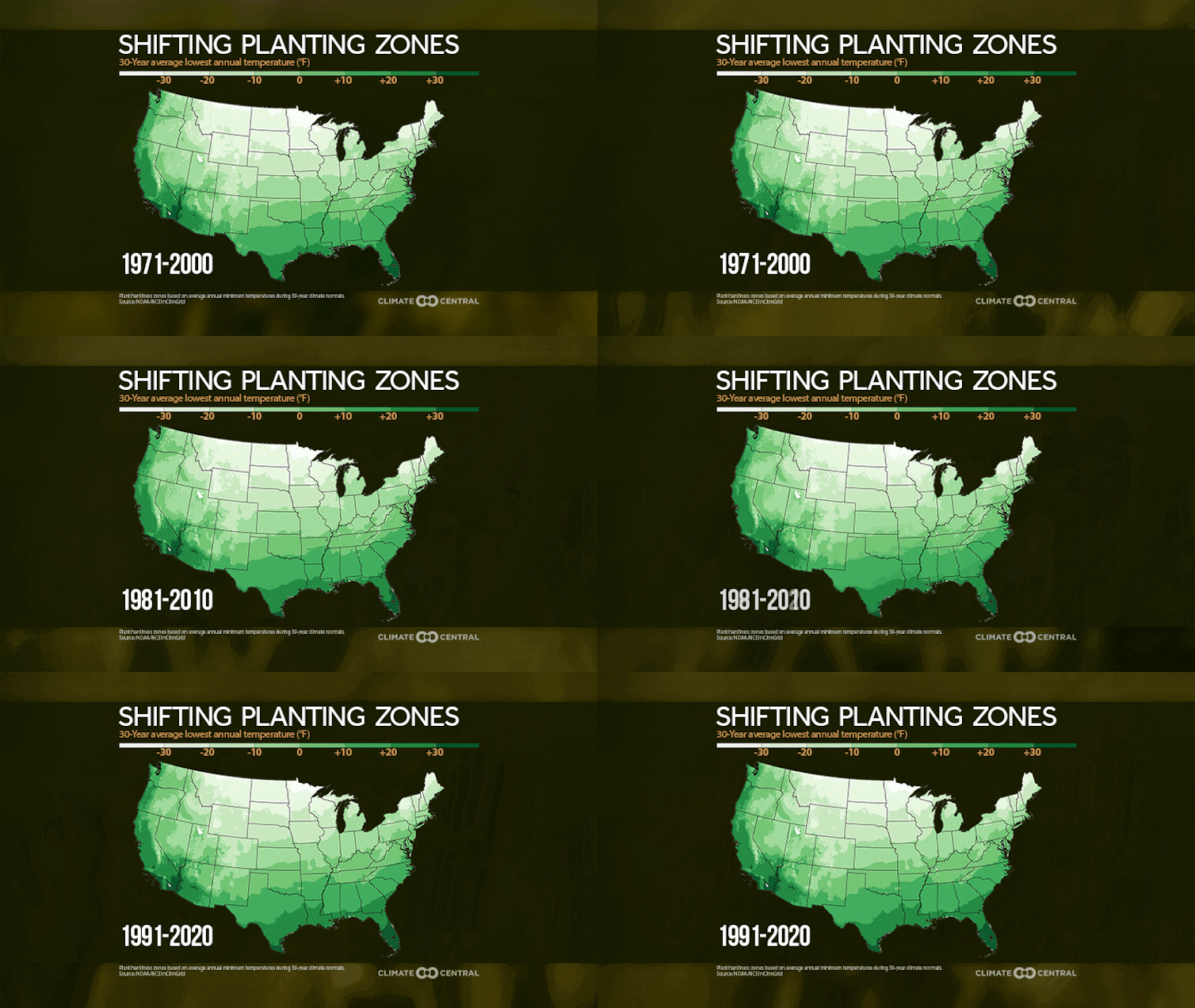
The warming is evident in changes to growing seasons, reflected in recent updates to plant hardiness zones printed on the back of seed packages. These maps show the northward and, sometimes, westward movement of freezing temperatures in eastern North America.
The shift of this freezing line between snow and rain can mean ice storms in places and at times when communities aren’t prepared to handle them, as several parts of the U.S. saw in early 2024.
Ice storms and wet snow
I study the impact of global warming and have documented changes to the climate and weather over the decades.
On average, freezing temperatures are moving northward and, along the Atlantic coast, toward the interior of the continent. For individual storms, the transition to freezing temperatures even in the dead of winter can now be as far north as Lake Superior and southern Canada in places where, 50 years ago, it was reliably below freezing from early December through February.
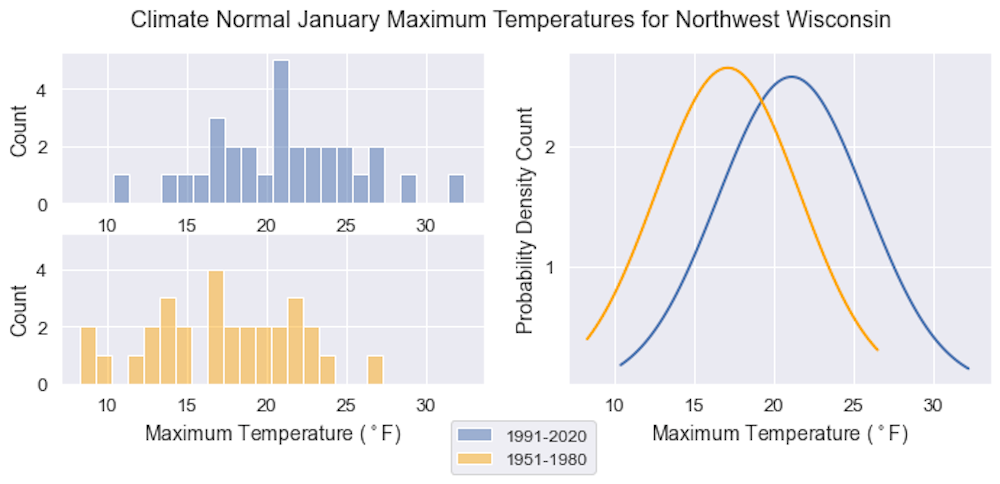
When temperatures are close to the freezing point, water can be rain, snow or ice. Regions on the colder side, which historically would have been below freezing and snowy, are seeing an increase in ice storms.
The character of snow also changes near the freezing line. When the temperature is well below freezing, the snow is dry and fluffy. Near freezing, snow has big, wet, heavy flakes that turn roads into slush and stick on tree branches and bring down power lines.
Because the climate in which snowstorms are forming is warmer due to global accumulation of heat, and wetter because of more evaporation and warmer air that can hold more moisture, individual snowstorms can also result in more intense snowfalls. However, as temperatures get warmer in the future, the scales will tilt toward rain, and the total amount of snow will decrease.
Indeed, on the warmer side of the freezing line, winter rain is already becoming the dominate type of precipitation, a trend that is expected to continue. With the warmer oceans as a major source of moisture, the already wet Eastern U.S. can expect more winter precipitation over the next 30 years. Looking to the future, soggy wet winters are more likely.
Disaster and water planning gets harder
For communities, planning for water supplies and extreme weather gets more complicated in a rapidly changing climate. Planners can’t count on the weather 30 years in the future being the same as weather today. It’s changing too quickly.
In many places, snow will not persist as late into spring. In regions like California and the Rockies that rely on the snowpack for water through the year, those supplies will become less reliable.
Rain falling on snowpack can also speed up melting, trigger flooding and change the flows of creeks and rivers. This shows up in changing runoff patterns in the Great Lakes, and it led to flooding on the East Coast in January 2024.
For road planners, the rate of freeze-thaw cycles that can damage roads will increase during winters in many regions unaccustomed to such quick shifts.
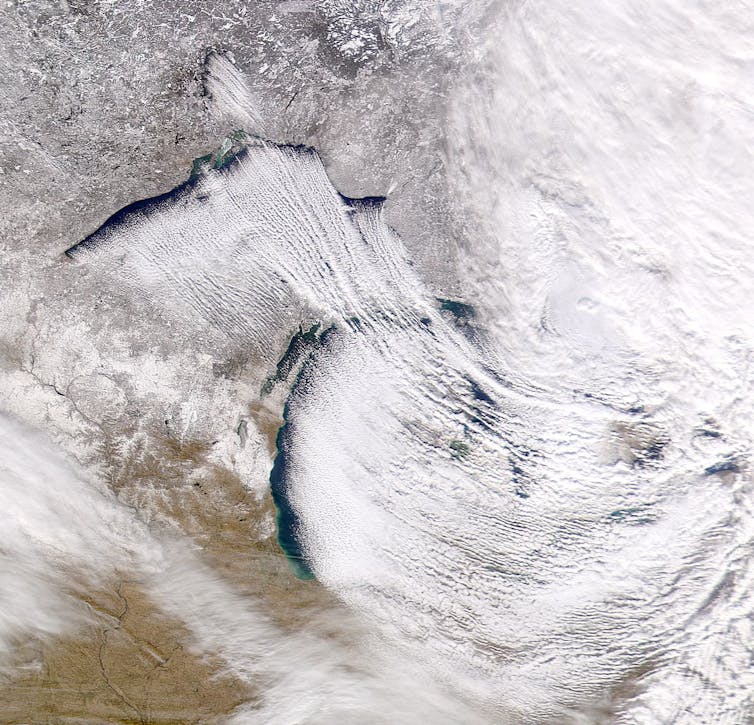

An especially interesting effect happens in the Great Lakes. Already, the Great Lakes do not freeze as early or as completely as in the past. This has large effects on the famous lake-effect precipitation zones.
With the lakes not frozen, more water evaporates into the atmosphere. In places where the wintertime air temperature is still below freezing, lake-effect snow is increasing. The Buffalo, New York, region saw 6 feet of snow from one lake-effect storm in 2022. As the air temperature flirts with the freezing line, these events are more likely to be rain and ice than snow.
These changes don’t mean cold is gone for good. There will be occasions when Arctic air dips down into the U.S. This can cause flash freezing and fog when warm wet air surges back over the frozen surface.
Enormous consequences for economies
What we are experiencing in warming winter syndrome is a consistent and robust set of symptoms on a fevered planet.
Novembers and Decembers will be milder; Februarys and Marches will be more like spring. Wintry weather will become more concentrated around January. There will be unfamiliar variability with snow, ice and rain. Some people may say these changes are great; there is less snow to shovel and heating bills are down.
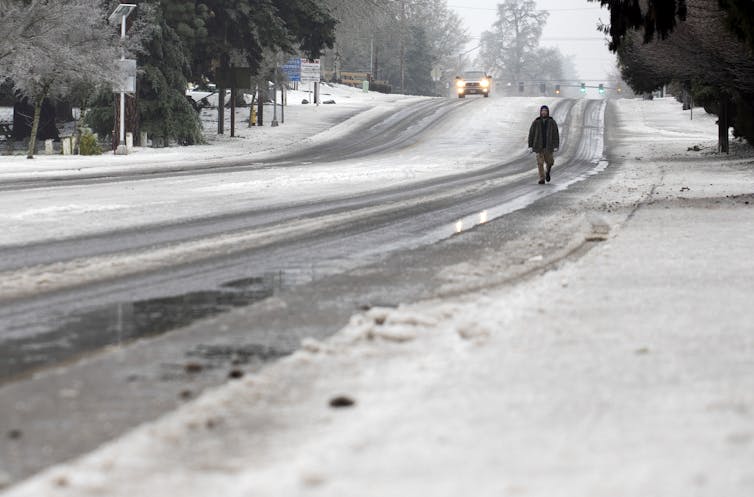
But on the other side, whole economies are set up for wintertime, many crops rely on cool winter temperatures, and many farmers rely on freezing weather to control pests. Anytime there are changes to temperature and water, the conditions in which plants and animals thrive are altered.
These changes, which affect outdoor sports and recreation, commercial fisheries and agriculture, have enormous consequences not only to the ecosystems but also to our relationship to them. In some instances, traditions will be lost, such as ice fishing. Overall, people just about everywhere will have to adapt.
Richard B. (Ricky) Rood, Professor of Climate and Space Sciences and Engineering and School of Environment and Sustainability, University of Michigan
This article is republished from The Conversation under a Creative Commons license. Read the original article.
The storm is expected to hit from Jan. 30 to Feb. 5, according to the National Weather Service.
Lake County is forecast to receive heavy rain, along with the potential for heavy snow in the higher elevations. The forecast calls for the county to have an 80% chance of above-average precipitation.
More precipitation is expected through the middle of February, based on the extended forecast.
At the same time, temperatures are generally forecast to be above average.
In the run up to next week, rain is expected through Saturday night, with a break until early next week, as the new storms head in.
The U.S. Seasonal Drought Outlook shows that none of California currently is in drought or forecast to experience it.
Email Elizabeth Larson at
The assessment came at a Wednesday hearing of the Assembly Select Committee on Native American Affairs.
“This alert is a great tool for Native Americans trying to bring attention to loved ones who are missing and possibly at great risk of physical or even fatal harm. New programs should be assessed to ensure that they are working effectively,” said Assemblymember James C. Ramos, who authored legislation creating the notification system.
He added, “One thing we do know about the Feather Alert is that when there is no alert, there is a much greater chance that we’ll be grieving and not celebrating.”
Ramos said the issue of Missing and Murdered Indigenous People, or MMIP, has been an issue since his election in 2018 when he became the first California Native American elected to the state legislature.
“California has the greatest number of Native Americans within its borders than any other state, but we’re also in the top five in the nation with the highest number of unsolved missing and murdered cases for Native people, especially for women and girls. They are victims of domestic violence, human trafficking and murder. One study by the Sovereign Bodies Institute reports 18 new cases of missing and murdered Indigenous people each year in California,” Ramos said.
Ramos noted that one challenge is making tribes and the general public aware of the Feather Alert and another is bridging communication gaps among various law enforcement agencies and the tribes.
Over the past year Ramos said he has conducted summits with tribes, the California Highway Patrol and local law enforcement to foster awareness and understanding of the program, but also to foster better communication among Indian Country and city police departments, sheriffs and the CHP.
Ramos said he has held summits in the counties of Fresno, San Bernardino, Mendocino and Los Angeles and added that he hopes to hold more summits.
The roundtable is the first in a series of meetings led by Attorney General Bonta across the state to bring together leaders of nonprofits, churches and community groups to discuss best practices in preventing gun violence.
The primary objective of the roundtables is to formulate effective approaches for addressing gun violence in communities, fostering knowledge about accessible resources for the public, and enhancing partnerships statewide to avert gun violence occurrences more effectively.
Attorney General Bonta stressed the importance of preventing gun violence at the roundtable, which falls a year after the shooting in Half Moon Bay killing seven victims and injuring one on January 23, 2023; and just after another shooting in Monterey Park, California, where 10 people were gunned down and nine injured on January 21, 2023.
“California continues to collectively mourn those lost to gun violence, including those we lost due to the horrific shootings in Half Moon Bay and Monterey Park. We continue to heal together, and we look for ongoing solutions to prevent America’s disease and its effect on our communities. Preventing gun violence must begin in our communities by strengthening relationships and fostering an environment of support and collaboration,” Bonta said.
“I’m proud to stand with our local partners to identify best practices, foster community involvement, and work toward community-driven solutions to eliminate gun violence. As California Attorney General, I am doubling down on California’s gun safety efforts by defending our common sense gun safety laws in court, cracking down on enforcing those laws, and working in collaboration with local community violence intervention and prevention experts to disrupt cycles of gun violence,” Bonta said.
“For too long gun violence has caused tremendous trauma for so many families,” said Kim Williams, Hub Manager at Sacramento Building Healthy Communities. “Preventing gun violence requires a collective effort so we must come together as community organizations, system leaders and residents, allocate more resources, and work tirelessly towards a common goal. By joining forces, we can build safer communities where our loved ones can thrive without the fear of gun violence.”
“Mutual Assistance Network is an essential part of an intentional continuum of violence prevention that seeks community led and racial equity centered solutions to gun violence,” said Danielle Lawrence, Executive Director of Mutual Assistance Network. “As we collectively and collaboratively strive for a safer future, we call on all individuals, organizations, institutions, and policymakers to join hands in addressing the multifaceted challenges and impacts of gun violence to our communities in Sacramento County.”
“We’ve all seen and experienced the impact of gun violence across our state,” said Senior Pastor Les Simmons of South Sacramento Christian Center. “Can you imagine a world without Violence? It is my hope that the Office of Gun Violence Prevention has that very imagination and action towards a collaborative solution, creating space for a deeper understanding between community lead organizations and other public safety entities for a shared vision of ending gun violence.”
In September of 2022, California Attorney General Rob Bonta announced the launch of the California Department of Justice’s first-in-the-nation Office of Gun Violence Prevention, or OGVP, dedicated to developing strategies and working with stakeholders statewide to address the gun violence epidemic.
This innovative new office — the first Office of Gun Violence Prevention under the leadership of a state attorney general — provides centralized support from DOJ for partners to implement strategic and innovative programs to reduce gun violence.
The Office of Gun Violence Prevention’s mission is to reduce and prevent gun violence, firearm injury, and related trauma. OGVP supports DOJ’s ongoing gun violence reduction efforts led by the Bureau of Firearms and DOJ's litigation sections — including the DOJ’s seizure of firearms from dangerous individuals using the Armed and Prohibited Persons System, prosecution of firearms trafficking cases, and defense of California’s commonsense gun laws. OGVP examines a broad range of factors — from firearm availability to effective resources for crisis prevention — to reduce the harm caused by firearms and make Californians healthier and safer.
OGVP aims to reduce gun violence by promoting research and data collection, increasing awareness about effective legal and policy strategies, and collaborating with federal, state, and local partners.
In 2023, the office released its first data report to provide a robust review of gun violence data in California and throughout the U.S. to help guide policy and strategy discussions related to reducing gun violence. The report highlighted California’s successes in preventing gun violence, and it shined a light on successful strategies and further areas for improvements.
For example, over the last 30 years, California has reduced its gun violence rate compared to the rest of the United States; once 50% above average, California’s firearm homicide rate is now 33% below the rest of the United States.
Additionally, if the firearm mortality rate in the rest of the United States had matched California’s between 2013-2022, there would have been nearly 140,000 fewer firearm-related deaths nationwide in that decade alone.
Also In 2023, the office released the second data report that provided an in-depth look at the ties between domestic violence and firearms. The report examined data illustrating the impact of firearms-related domestic violence, including both family and intimate partner-related violence with firearms.
The report documented California’s long-term progress in reducing domestic violence involving firearms, and highlighted California’s efforts to empower and protect survivors by providing a range of support services, offering crisis intervention and safety planning options, providing for domestic violence restraining orders and enforcing laws to protect against gun violence.