 How to resolve AdBlock issue?
News
Despite their concerns about the “Zoom bombers” — three of whom disrupted the Jan. 18 council meeting to make racist and antisemitic comments — the council stopped short of taking staff’s recommendation to end Zoom comments by anyone outside of contractors or other city-approved users.
Instead, council members asked staff to research implementing tighter controls on Zoom, the virtual meeting platform that has become ubiquitous out of necessity since the start of the COVID-19 pandemic in March of 2020.
Gov. Gavin Newsom implemented emergency orders that rolled back Brown Act rules in 2020 in order to allow for elected officials to use Zoom to meet safely in response to concerns over health as the pandemic was taking shape.
City Manager Alan Flora outlined the temporary changes to the Brown Act and explained that the city didn’t use Zoom before then but staffers have continued to use it since because of its convenience for some community members.
Flora said the state’s emergency orders have been rolled back. One key example — governing board members are no longer allowed to attend via Zoom unless under specific circumstances.
City Clerk Melissa Swanson said the city began live streaming via Zoom in August 2020.
Swanson said a poll of Calfiornia’s city clerks found that 50 of 70 agencies reported experiencing Zoom bombing.
Of those, 42 agencies said they either no longer allow comments via Zoom or use it in very limited fashion for presenters and staff. Four others are considering discontinuing it.
City Attorney Ryan Jones said his firm, Jones and Mayer, works with a number of government jurisdictions, a lot of which he said are scaling back use of the platform due to Zoom bombers. He said nothing precludes people from commenting through email.
Flora said the city uses Zoom to record meetings and stream them to Youtube, which is a convenient way to get a recording. He suggested reserving commenting for consultants.
Councilmember Joyce Overton asked if they could still do a chat room with Zoom and use that function to filter out inappropriate comments. Flora said he doesn’t know if it’s common practice, and he didn’t want to put staff in the position of having to read comments and be seen as censoring people.
Councilmemember Dirk Slooten said it was important to be as open as possible while doing the people’s business, and he wasn’t in favor of shutting down Zoom comments over one incident.
Councilmember Russell Cremer said he liked Overton’s suggestion about a chat room, but that he never wanted to hear again what he heard on Jan. 18.
“It was obscene and beyond totally inappropriate as far as I'm concerned,” he said, explaining that his first thought was to eliminate Zoom commenting except for presenters and that he had no problem doing away with using Zoom for general public input.
Calling it “a really touchy subject,” Councilmember Russell Perdock said he was concerned about the anonymity Zoom affords. After the Jan. 18 meeting, he received calls from community members offended by the comments from the Zoom bombers.
He suggested implementing more control along the lines Overton suggested in order to take away the anonymity.
“We live in a world where trolls exist,” said Mayor David Claffey, who added that for him the bar has to be higher before they take away a very valuable tool for the community to access public comment.
He asked staff about limitations, and Swanson said the city can set up Zoom with registration and a pass code, which they don’t currently use, and work on getting tighter security.
Claffey asked about the ability to ban Internet addresses, which Jones said he wasn’t sure could be done unless the commenter had threatened the city and the city had a restraining order. Zoom bombing wouldn’t rise to that level.
Jones also noted that it’s a “voluntary ask” to request that people give their names and where they live, and no way to verify they are real, and attempts to verify them could be inappropriate for the city to pursue.
Perdock asked if it was all or nothing — allow Zoom commenting or not.
“Not necessarily,” said Jones.
Supervisor Bruno Sabatier said Senate Bill 1100 could be part of the discussion. That legislation, which the governor signed into in the summer of 2022 and became law in January 2023, amended the Brown Act to give guidance on how government bodies can handle members of the public who are disruptive at open meetings. They must be warned and then they can be removed from the meeting.
Sabatier said the county has a script to use when an individual is causing issues in a meeting.
He emphasized the platform’s value and urged them to set up mechanisms to continue to use it rather than taking it away from even one person who could be bed-bound and otherwise unable to participate in a public meeting.
Flora said that, based on some quick research during the meeting, it appeared that Zoom can be configured for more controls, and that a chat etiquette tool can ban certain words and phrases. He added that they will need to make sure that chat feature is compliant with the Americans with Disabilities Act.
The council directed staff to do additional research in order to find ways to continue to allow Zoom comments.
Before reaching that consensus, they asked for public comment. There was none in the chambers and none on Zoom.
In other business, the council presented a proclamation in honor of February being Black History Month to Rick Mayor, president of the Lake County Chapter of the NAACP, and Chief Tim Hobbs gave the annual Clearlake Police Department report.
The council also held a special meeting two hours ahead of the regular meeting in which it considered, and ultimately denied, the Koi Nation’s appeal of a new subdivision approved by the Clearlake Planning Commission.
Email Elizabeth Larson at
The meeting will begin at 4 p.m. at the Moose Lodge, located at 15900 Moose Lodge Lane in Clearlake Oaks.
The meeting will be available via Zoom. The meeting ID is 986 3245 2684, pass code is 666827.
Guest speakers include Lake County Public Works Director Scott De Leon, who will discuss the road rehabilitation plan and a response to the ERTH letter dated Dec. 4.
Also speaking to the group will be Community Development Department Director Mireya Turner and Code Enforcement Manager Marcus Beltramo, who will give an update on the Clearlake Oaks Roadmap Task Force, scheduled to end in April.
Other discussion topics include crosswalk Safety at East Lake School and Highway 20; updates on Spring Valley, commercial cannabis and the Shoreline Area Plan update.
Other scheduled speakers are Northshore Fire Protection District Chief Mike Ciancio, who will give an update on the district, and Supervisor EJ Crandell who will give the group a general report.
ERTH’s next meeting will take place on March 6.
ERTH’s members are Denise Loustalot, Jim Burton, Tony Morris and Pamela Kicenski.
For more information visit the group’s Facebook page.
“As utilities make upgrades to their systems to keep us safe from wildfire, we must ensure they identify projects that have the biggest impact and can be completed in the shortest amount of time for the least amount of money,” Sen. Dodd said. “In other words, utilities need to get the biggest bang for the buck when they do projects. That way, we protect our communities from wildfires sooner and avoid unwarranted rate increases as we’re forced to absorb the cost of these improvements.”
Recently, the California Public Utilities Commission approved a $13.5 billion rate increase requested by PG&E to pay for the undergrounding of 1,230 miles of electric utility lines over the next three years.
This is a fraction of the more than 10,000 miles of undergrounding PG&E proposes for the next decade in hopes of reducing the risk of its utility infrastructure sparking wildfires. The cost per mile is estimated at $3 million.
However, there are alternatives such as insulating existing utility cable, an option favored by The Utility Reform Network, or TURN.
Insulating wires costs an estimated $800,000 per mile, and in certain circumstances may be as effective in preventing wildfire ignitions as undergrounding, and achievable in far less time.
“Undergrounding lines in high risk areas is important and needs to continue in a targeted manner, but we also need to advance faster, cheaper methods to maximize safety today,” said Sen. Dodd. “It’s all about maximizing benefit, while minimizing ratepayer costs.”
Sen. Dodd’s Senate Bill 1003 would direct the Office of Electrical Infrastructure Safety to consider the timeliness of investor-owned utility electrical infrastructure upgrades when reviewing the utilities’ wildfire mitigation plans to ensure that the maximum amount of risk from utility sparked wildfires is reduced in the shortest amount of time.
“Safety today is not the same as safety in three or 10 years,” said Michael Wara, director of climate and energy policy at Stanford University. “This bill will force the utilities to account for the long implementation delays of some strategies as an additional cost to their customers. Delivery of adequate service today — including the ‘service’ of safety — is an important value that all Californians deserve from their electric utilities. This bill will compel utilities to evaluate not just how safe a system they can create in the long run, but will push them to do it as quickly as possible.”
Dodd represents the Third Senate District, which includes all or portions of Napa, Yolo, Sonoma, Solano, Sacramento and Contra Costa counties.
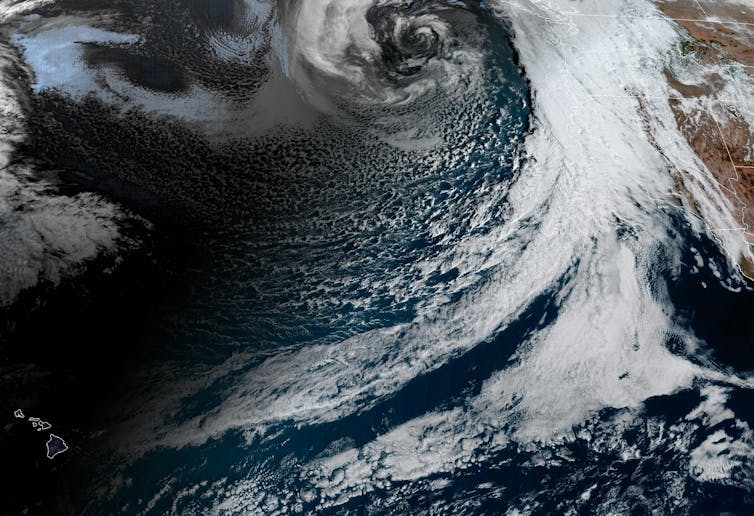

Millions of people were under flood alerts and winter storm warnings on Jan. 31 and Feb. 1, 2024, as a series of atmospheric rivers brought heavy downpours and the threat of flooding, mudslides and avalanches to the Pacific Northwest and California. Another powerful storm was expected a few days later.
While these storms are dreaded for the damage they can cause, they are also essential to the region’s water supply, particularly in California, as Qian Cao, a hydrologist at the University of California, San Diego, explains.
What are atmospheric rivers?
An atmospheric river is a narrow corridor or filament of concentrated water vapor transported in the atmosphere. It’s like a river in the sky that can be 1,000 miles long. On average, atmospheric rivers have about twice the regular flow of the Amazon River.
When atmospheric rivers run up against mountains or run into local atmospheric dynamics and are forced to ascend, the moisture they carry cools and condenses, so they can produce intense rainfall or snowfall.
Atmospheric rivers occur all over the world, most commonly in the mid-latitudes. They form when large-scale weather patterns align to create narrow channels, or filaments, of intense moisture transport. These start over warm water, typically tropical oceans, and are guided toward the coast by low-level jet streams ahead of cold fronts of extratropical cyclones.
Along the U.S. West Coast, the Pacific Ocean serves as the reservoir of moisture for the storm, and the mountain ranges act as barriers, which is why the western sides of the coastal ranges and Sierra Nevada see so much rain and snow.
Why are back-to-back atmospheric rivers a high flood risk?
Consecutive atmospheric rivers, known as AR families, can cause significant flooding.
The first heavy downpours saturate the ground. As consecutive storms arrive, their precipitation falls on soil that can’t absorb more water. That contributes to more runoff. Rivers and streams fill up. In the meantime, there may be snowmelt due to warm temperatures, further adding to the runoff and flood risk.
California experienced a historic run of nine consecutive atmospheric rivers in the span of three weeks in December 2022 and January 2023. The storms helped bring most reservoirs back to historical averages in 2023 after several drought years, but they also produced damaging floods and debris flows.
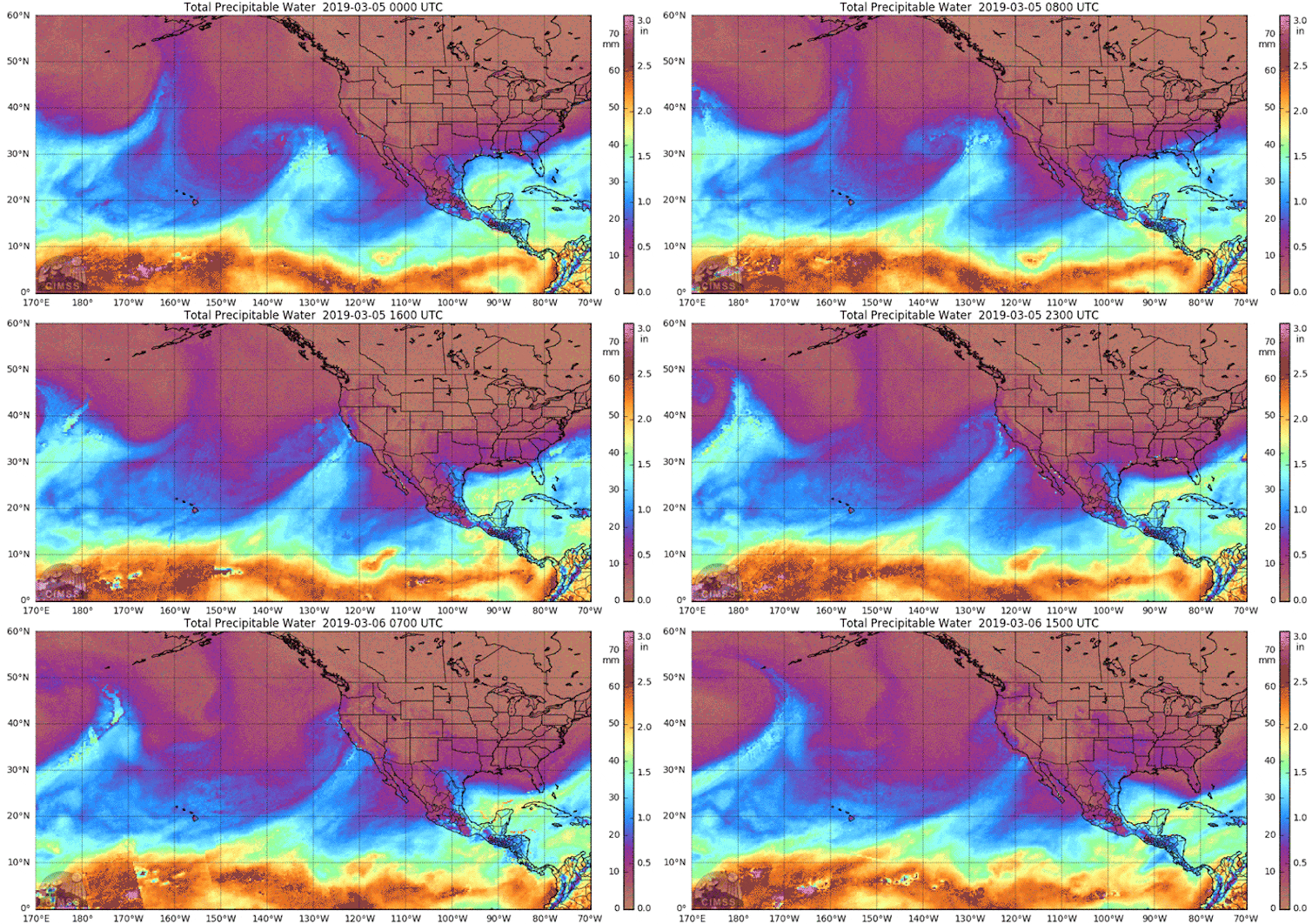
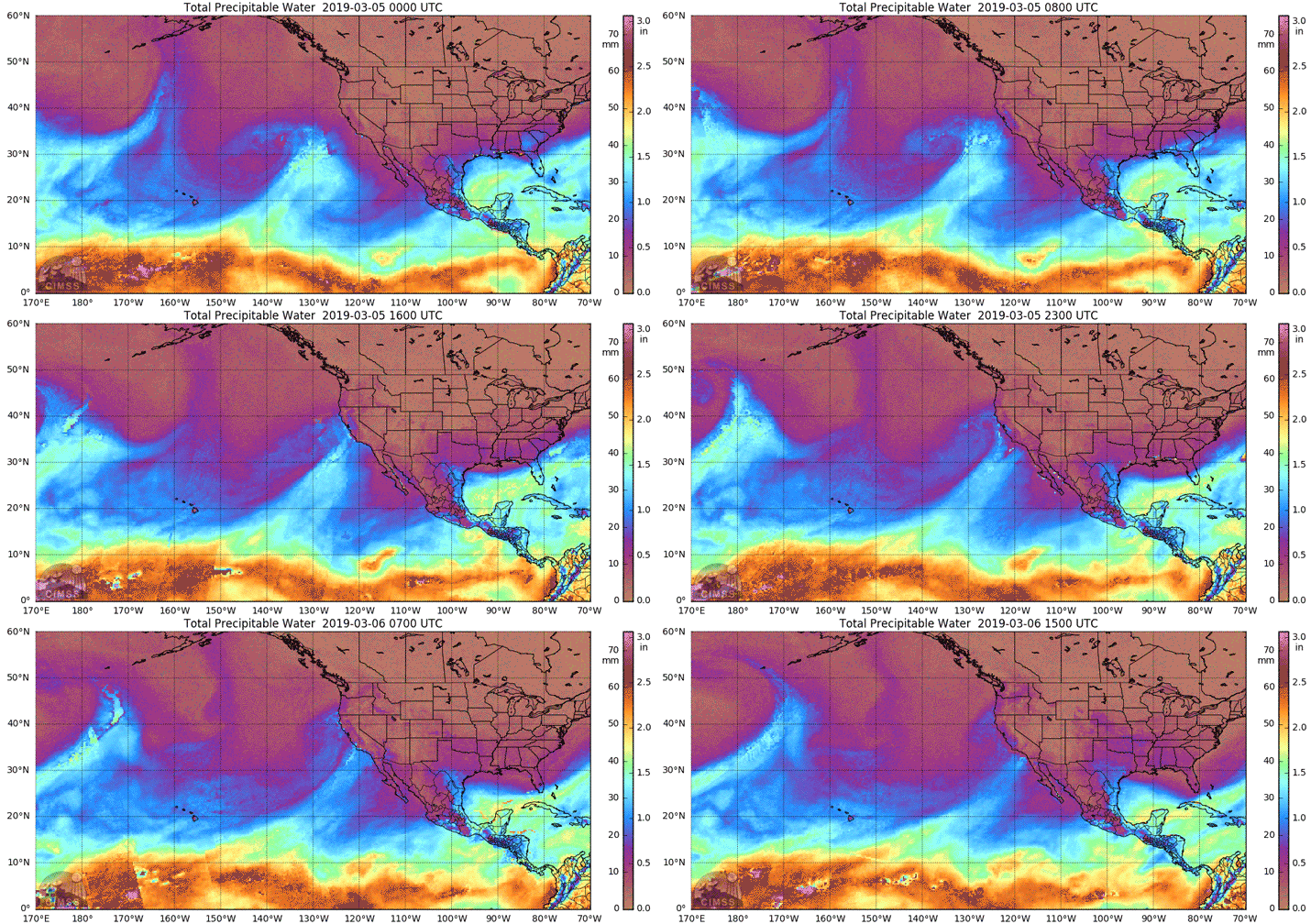
The cause of AR families is an active area of research. Compared with single atmospheric river events, AR families tend to be associated with lower atmospheric pressure heights across the North Pacific, higher pressure heights over the subtropics, a stronger and more zonally elongated jet stream and warmer tropical air temperatures.
Large-scale weather patterns and climate phenomena such as the Madden-Julian Oscillation, or MJO, also play an important role in the generation of AR families. An active MJO shift occurred during the early 2023 events, tilting the odds toward increased atmospheric river activity over California.
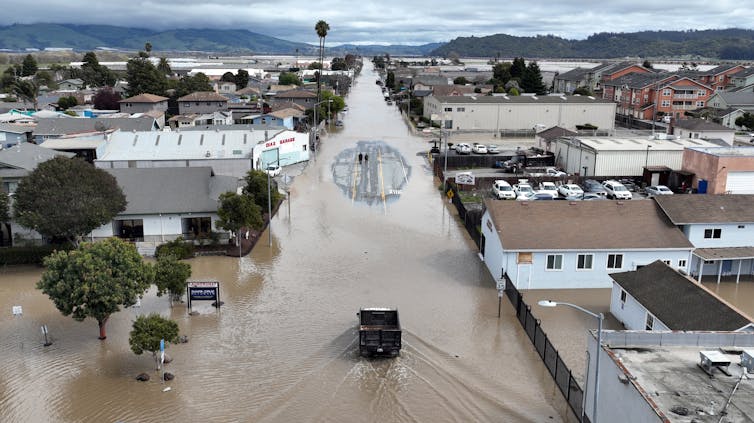
A recent study by scientists at Stanford and the University of Florida found that storms within AR families cause three to four times more economic damage when the storms arrive back to back than they would have caused by themselves.
How important are atmospheric rivers to the West Coast’s water supply?
I’m a research hydrologist, so I focus on hydrological impacts of atmospheric rivers. Although they can lead to flood hazards, atmospheric rivers are also essential to the Western water supply. Atmospheric rivers have been responsible for ending more than a third of the region’s major droughts, including the severe California drought of 2012-16.
Atmospheric rivers provide an average of 30% to 50% of the West Coast’s annual precipitation.
They also contribute to the snowpack, which provides a significant portion of California’s year-round water supply.
In an average year, one to two extreme atmospheric rivers with snow will be the dominant contributors to the snowpack in the Sierra Nevada. Together, atmospheric rivers will contribute about 30% to 40% of an average season’s total snow accumulation there.
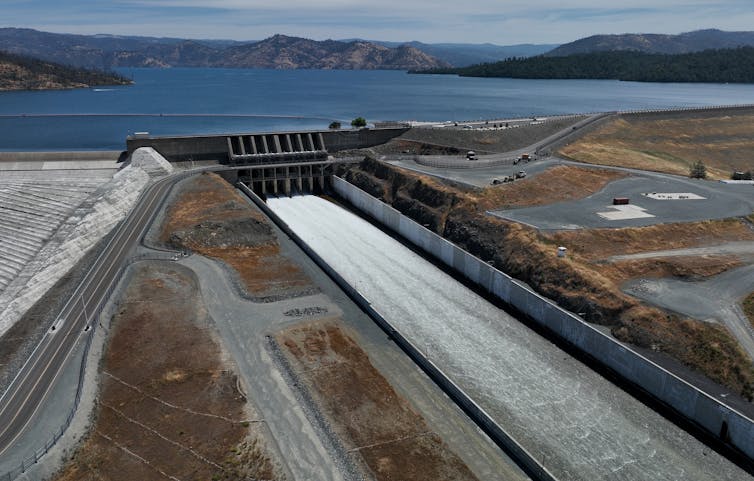
That’s why my colleagues at the Center for Western Weather and Water Extremes at the Scripps Institution of Oceanography, part of the University of California, San Diego, work on improving atmospheric river forecasts and predictions. Water managers need to be able to regulate reservoirs and figure out how much water they can save for the dry season while still leaving room in the reservoirs to manage flood risk from future storms.
How is global warming affecting atmospheric rivers?
Warmer air can hold more moisture. As global temperatures rise in the future, we can expect more intense atmospheric rivers, leading to an increase in heavy and extreme precipitation events.
My research also shows that more atmospheric rivers are likely to occur concurrently during already wet conditions. So, the chance of extreme flooding also increases. Another study, by scientists from the University of Washington, suggests that there will be a seasonal shift to more atmospheric rivers earlier in the rainy season.
There will likely also be more year-to-year variability in the total annual precipitation, particularly in California, as a study by my colleagues at the Center for Western Weather and Water Extremes projects.
This article was update Jan. 31, 2024, with flood alerts and winter storm warnings posted.
Qian Cao, Hydrologist, Center for Western Weather and Water Extremes, University of California, San Diego
This article is republished from The Conversation under a Creative Commons license. Read the original article.
CLEARLAKE, Calif. — The second annual Lake County Restaurant Expo brought together members of the local restaurant industry for a day of training and networking.
The expo took place on Monday at the Lake County Campus of Woodland Community College, known for its acclaimed Culinary Arts Program headed up by Chef Robert Cabreros.
The event was organized by the Lake County Economic Development Corp., or Lake EDC, with the assistance of the Lake County Chamber of Commerce.
The Restaurant Expo is a one-day training and networking event focused on providing expert support to new and existing owners of restaurants, food trucks, catering companies, and other food industry businesses.
They heard from industry experts, participated in sessions on aspects of the business, and ended the day with a mixer.
In the video above, hear from organizer Nicole Flora of Lake EDC about the motivation for the event, and from Cabreros and student participants in the expo.
The expo took place ahead of the second annual Lake County Restaurant Week, which will span the week of Feb. 4 to 10.
The majority of the rainfall, coupled with wind, hit later in the day and earlier in the evening.
Although the rainfall was less than predicted, it was still substantial, amounting to several inches in parts of the county.
National Weather Service observations points recorded the following data:
— Indian Valley Reservoir: 1.51.
— Kelseyville: 2.35.
— Lake Pillsbury: 1.88.
— Lower Lake: 3.03.
— Lyons Valley: 1.90.
— Whispering Pines: 2.68.
A flood watch and a flood warning issued for Lake County have ended.
More rain is expected on Thursday and Friday, and into the middle of next week, according to the National Weather Service.
The next round of storms appear to be far lighter for Lake County.
Thunderstorms are possible on Thursday during the day and at night, the National Weather Service said.
Temperatures are set to rise into the low 50s during the day and drop into the high 30s at night over the next week.
Email Elizabeth Larson at