 How to resolve AdBlock issue?
News
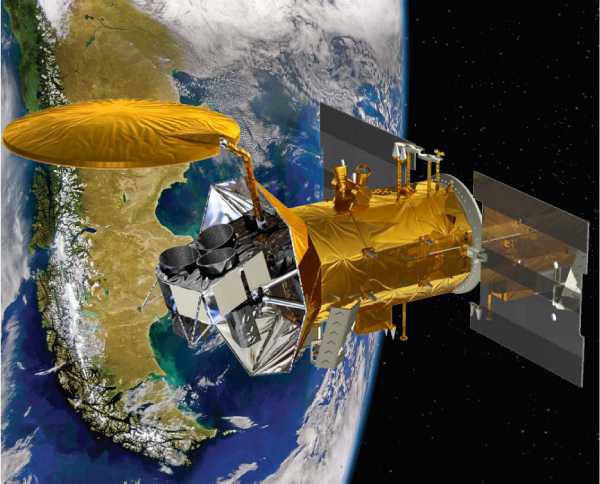
A new observatory is about to leave Earth to map a powerful compound of global importance: Common everyday sea salt.
Researchers suspect that the salinity of Earth's oceans has far-reaching effects on climate, much as the salt levels within our bodies influence our own delicate internal balance.
An international team of scientists from NASA and the Space Agency of Argentina, or CONAE, will investigate this possibility with the aid of a satellite named “Aquarius/SAC-D,” which launched June 9.
“Based on decades of historical data gathered from ocean areas by ships and buoys, we know the salinity has changed over the last 40 years,” said Aquarius principal investigator Gary Lagerloef. “This tells us there's something fundamental going on in the water cycle.”
Salinity is increasing in some ocean regions, like the subtropical Atlantic, which means more fresh water is being lost through evaporation at the sea surface.
But no one knows why this is happening; nor can anyone pinpoint why other areas are experiencing more rainfall and lower salinity. To solve these mysteries, scientists need a comprehensive look at global salinity.

Within a few months, Aquarius will collect as many sea surface salinity measurements as the entire 125-year historical record from ships and buoys.
“Salinity, along with temperature, governs the density of seawater,” said Lagerloef. “The saltier the water, the denser it is, and density drives the currents that determine how the ocean moves heat around the planet. For example, the Gulf Stream carries heat to higher latitudes and moderates the climate. When these currents are diverted by density variations, weather patterns such as rainfall and temperature change.”
Scientists have gathered an ensemble of measurements over the ocean – e.g., wind speed and direction, sea surface heights and temperatures, and rainfall. But these data do not provide a complete picture.
“We've been missing a key element – salinity,” said Lagerloef. “A better understanding of ocean salinity will give us a clearer picture of how the sea is tied to the water cycle and help us improve the accuracy of models predicting future climate.”
Aquarius is one of the most sensitive microwave radiometers ever built, and the first NASA sensor to track ocean salinity from space.
“It can detect as little as 0.2 parts salt to 1,000 parts water – about the same as a dash of salt in a gallon of water. A human couldn't taste such a low concentration of salt, yet Aquarius manages to detect it while orbiting 408 miles above the Earth,” said Lagerloef.
The Aquarius radiometer gets some help from other instruments onboard the satellite. One of them helps sort out the distortions of the choppy sea.
CONAE's Sandra Torrusio, principal investigator for the Argentine and other international instruments onboard, explained, “One of our Argentine instruments is another microwave radiometer in a different frequency band that will measure sea surface winds, rainfall, sea ice, and any other 'noise' that could distort the Aquarius salinity measurement. We'll subtract all of that out and retrieve the target signal.”
Torrusio is excited about the mission. “I've met so many new people, not only from Argentina, but from the US and NASA! It's been a great experience to work with them and exchange ideas. We may come from different places, but we all talk the same language. And it isn't English – it's science.”
Working together, these international “people of science” will tell us more about the ocean's role in our planet's balance – and in our own – no matter where we live.
For whatever we lose (like a you or a me),
It's always our self we find in the sea.
– e.e. cummings
Dauna Coulter works for the National Aeronautics and Space Administration.
Follow Lake County News on Twitter at http://twitter.com/LakeCoNews , on Tumblr at www.lakeconews.tumblr.com, on Facebook at http://www.facebook.com/pages/Lake-County-News/143156775604?ref=mf and on YouTube at http://www.youtube.com/user/LakeCoNews .
The first, a 3.3-magnitude quake that occurred at 2:08 p.m., was reported two miles west southwest of Glen Ellen and 10 miles southeast of Santa at a depth of 6.5 miles, according to the US Geological Survey.
By 2 a.m. Sunday the US Geological Survey had received 147 shake reports from 24 zip codes regarding the quake.
At 7:54 p.m., the US Geological Survey issued a preliminary report on a 3.0-magnitude quake that occurred in Lake County.
The survey reported that the quake was recorded just under the earth's surface three miles west of Anderson Springs, four miles east southeast of The Geysers and four miles south southwest of Cobb.
The survey received two shake reports by 2 a.m. Sunday, one from Mill Valley, one from Santa Rosa.
A 3.7-magnitude quake was reported near The Geysers on May 28, as Lake County News has reported.
E-mail Elizabeth Larson at
NASA's Voyager probes are truly going where no one has gone before.
Gliding silently toward the stars, 9 billion miles from Earth, they are beaming back news from the most distant, unexplored reaches of the solar system.
Mission scientists say the probes have just sent back some very big news indeed.
It's bubbly out there.
“The Voyager probes appear to have entered a strange realm of frothy magnetic bubbles,” said astronomer Merav Opher of Boston University. “This is very surprising.”
According to computer models, the bubbles are large, about 100 million miles wide, so it would take the speedy probes weeks to cross just one of them.
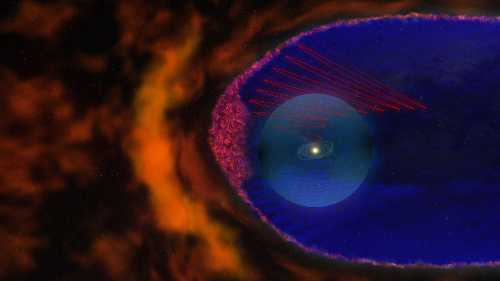
Voyager 1 entered the “foam-zone” around 2007, and Voyager 2 followed about a year later. At first researchers didn't understand what the Voyagers were sensing – but now they have a good idea.
“The sun's magnetic field extends all the way to the edge of the solar system,” explained Opher. “Because the sun spins, its magnetic field becomes twisted and wrinkled, a bit like a ballerina's skirt. Far, far away from the sun, where the Voyagers are now, the folds of the skirt bunch up.”
When a magnetic field gets severely folded like this, interesting things can happen. Lines of magnetic force criss-cross and “reconnect.” (Magnetic reconnection is the same energetic process underlying solar flares.) The crowded folds of the skirt reorganize themselves, sometimes explosively, into foamy magnetic bubbles.
“We never expected to find such a foam at the edge of the solar system, but there it is!” said Opher's colleague, University of Maryland physicist Jim Drake.
Theories dating back to the 1950s had predicted a very different scenario: The distant magnetic field of the sun was supposed to curve around in relatively graceful arcs, eventually folding back to rejoin the sun. The actual bubbles appear to be self-contained and substantially disconnected from the broader solar magnetic field.
Energetic particle sensor readings suggest that the Voyagers are occasionally dipping in and out of the foam – so there might be regions where the old ideas still hold. But there is no question that old models alone cannot explain what the Voyagers have found.
Said Drake: “We are still trying to wrap our minds around the implications of these findings.”
The structure of the sun's distant magnetic field – foam vs. no-foam – is of acute scientific importance because it defines how we interact with the rest of the galaxy.
Researchers call the region where the Voyagers are now “the heliosheath.” It is essentially the border crossing between the Solar System and the rest of the Milky Way. Lots of things try to get across – interstellar clouds, knots of galactic magnetism, cosmic rays and so on.
Will these intruders encounter a riot of bubbly magnetism (the new view) or graceful lines of magnetic force leading back to the sun (the old view)?
The case of cosmic rays is illustrative. Galactic cosmic rays are subatomic particles accelerated to near-light speed by distant black holes and supernova explosions. When these microscopic cannonballs try to enter the solar system, they have to fight through the sun's magnetic field to reach the inner planets.
“The magnetic bubbles could be our first line of defense against cosmic rays,” pointed out Opher. “We haven't figured out yet if this is a good thing or not.”
On one hand, the bubbles would seem to be a very porous shield, allowing many cosmic rays through the gaps. On the other hand, cosmic rays could get trapped inside the bubbles, which would make the froth a very good shield indeed.
“We'll probably discover which is correct as the Voyagers proceed deeper into the froth and learn more about its organization,” said Opher. “This is just the beginning, and I predict more surprises ahead.”
Dr. Tony Phillips works for the National Aeronautics and Space Administration.
Follow Lake County News on Twitter at http://twitter.com/LakeCoNews , on Tumblr at www.lakeconews.tumblr.com, on Facebook at http://www.facebook.com/pages/Lake-County-News/143156775604?ref=mf and on YouTube at http://www.youtube.com/user/LakeCoNews .
Dr. Howard Backer, the interim director of the California Department of Public Health (CDPH), warned that the number of pertussis cases in 2011 continues to be above both the 2009 baseline levels and the numbers seen by this time last year.
Backer also encouraged parents to ensure that their adolescent’s immunizations are up-to-date in compliance with a new California law that is slated to go into effect July 1, 2011.
“In 2010, California experienced a record high number of pertussis illnesses, including 10 infant deaths,” said Backer. “While it is too early to know if this year will reach the same high levels of this debilitating disease, California is currently experiencing more cases than would be typically expected, but fortunately no fatalities.”
Backer also called on parents of children in grades seven through 12, to ensure that they comply with AB 354, which requires documentation of an adolescent pertussis booster shot prior to school entry. More than one million students statewide still remain to be vaccinated before the fall semester.
“Vaccination, including critical booster shots, is the best defense against pertussis,” added Backer. “Parents of 7th to 12th graders must ensure that their children receive the necessary booster shot to avoid a delay in having their children start classes in the fall semester.”
The vaccination series for pertussis can begin at the age of 6 weeks. Infants, however, are not adequately protected by vaccination until the initial series of three shots is complete.
For new mothers and anyone in close contact with infants, CDPH encourages a “cocooning strategy,” where individuals in close contact are vaccinated to protect the not-fully-immunized infant.
Anyone who might be coming into contact with newborns and young infants should ensure that their immunizations are up-to-date.
Pertussis is a highly contagious disease. Unimmunized or incompletely immunized young infants are particularly vulnerable to severe disease.
Numbers of reported pertussis cases typically increase during the summer months.
More information on pertussis and the numbers of reported cases is available at www.cdph.ca.gov/HealthInfo/discond/Pages/Pertussis.aspx.
Follow Lake County News on Twitter at http://twitter.com/LakeCoNews , on Tumblr at www.lakeconews.tumblr.com, on Facebook at http://www.facebook.com/pages/Lake-County-News/143156775604?ref=mf and on YouTube at http://www.youtube.com/user/LakeCoNews .
Deeper cuts will be made in the next 30 days in order to reach the target number of 33,559 cell phones and achieve the 50 percent reduction outlined in an executive order issued on Jan. 11.
The 50 percent reduction is expected to save taxpayers at least $13 million, Brown's office said.
“We’ve eliminated tens of thousands of cell phones and saved taxpayers millions, but we’re not done,” said Brown, who turned in his own government-issued cell phone the day the order was issued and cut the number of phones issued to Governor’s Office employees by 75 percent.
The governor’s executive order called for the state’s agencies and departments to review and cut the number of taxpayer-funded cell phones and smart phones in half.
Of the 67,117 phones identified, agencies and departments have eliminated 29,398 devices to date. The state must eliminate a total of 33,559 phones to achieve the 50 percent cut.
The administration has compiled data which suggests that up to 51 percent of state-issued cell phones can be cut.
However, various agencies and departments have submitted requests for a total of 4,916 exemptions from the executive order.
These exemption requests will be reviewed in order to ensure they are necessary and, if necessary, the administration will seek deeper cuts in other departments.
“In my executive order I made it clear that exemptions will only be granted if phones are mission critical or tied to public safety,” Brown said. “We will deny exemption requests – or force deeper cuts to other agencies and departments – to ensure the 50 percent reduction is realized within 30 days.”
Agencies and departments are now working closely with vendors to return the phones for refunds and credits toward future service charges.
The executive order originally identified approximately 96,000 devices.
As agencies and departments reviewed their cell phone use, they discovered that this figure included:
11,300 devices at other state government entities that are not under the governor’s executive authority;
8,700 devices that had already been eliminated or were previously deactivated;
7,000 devices, originally classified as cell phones and smart phones, were other telecommunications devices not covered by the order (such as data modems in California Highway Patrol vehicles and traffic telemetry devices used by Caltrans);
2,000 were furnished by local and federal authorities and so are not subject to the order.
These were excluded, resulting in the 67,117 figure.
In addition to reducing the state’s cell phones, Brown has already cut spending in his own office by more than 25 percent and ordered state agencies and departments to halt all nonessential state employee travel; recover millions of dollars in uncollected salary and travel advances; stop spending taxpayer dollars on free giveaway and gift items; reduce the passenger vehicle fleet; and freeze hiring across state government.
Follow Lake County News on Twitter at http://twitter.com/LakeCoNews , on Tumblr at www.lakeconews.tumblr.com, on Facebook at http://www.facebook.com/pages/Lake-County-News/143156775604?ref=mf and on YouTube at http://www.youtube.com/user/LakeCoNews .
“Summer isn't here yet, but it's not too early for Californians to prepare for the possibility of several days of extremely high temperatures, particularly in areas where temperatures don't reach into the 90s and 100s very often,” said California Emergency Management Agency (Cal EMA) Acting Secretary Mike Dayton.
The Acting Cal EMA Secretary urged Californians who haven't already done so to review their emergency plans, replenish their emergency supplies, learn first aid and CPR and create a cooler, more comfortable environment in their homes.
“As we saw in 2006, prolonged periods of extremely high temperatures can cause a significant number of deaths and heat-related illnesses, including heat exhaustion and heat stroke,” said California Department of Public Health (CDPH) Interim Director Dr. Howard Backer.
According to information provided by California's county coroners and medical examiners, 136 Californians died due to heat-related illnesses caused by a 13-day heat wave that struck the state in 2006.
“Infants, young children and seniors, as well as persons who have chronic health conditions, are particularly vulnerable when temperatures rise,” noted Backer.
“Caretakers must be sure to provide adequate fluids to persons who cannot ask for them or get fluids for themselves,” Backer continued. “Never leave a child or pet in a closed vehicle for any length of time. Plan outdoor work and exercise during the early morning hours or evening hours. During periods of severe heat, communities will set up cooling centers for daytime use.”
Workers in all outdoor worksites such as agriculture, construction, landscaping and other industries, are at risk of serious heat illness and even death when temperatures rise across California.
According to the California Division of Occupational Safety and Health (Cal/OSHA), employers are required to take four basic steps to prevent heat illness at all outdoor worksites.
These include training all employees on heat illness, providing adequate water, rest and shade and having an emergency response plan in place.
“I am pleased to see a greater level of compliance and a reduction in occupational heat-related illnesses and fatalities in recent years, but we must remain vigilant during times of high summer heat,” said Cal/OSHA Chief Ellen Widess.
“Heat-related illness and death are preventable with simple steps that employers take to ensure workers have adequate water and shade and training on the symptoms of heat stress,” Widess said. “Having a good program in place not only protects workers' health, but ensures greater productivity.”
State officials urged Californians to incorporate energy conservation measures as part of their heat emergency plans.
“Californians can save money and reduce the risk of power outages by setting their thermostats to 78 to 80 degrees when they're home and to 85 degrees or the 'off' position when they're away from home,” said Dayton. “They also can reduce strain on the power grid by using their primary refrigerators and freezers for perishable foods and beverages and disconnecting secondary refrigerators and freezers.”
Other conservation measures Californians can employ include turning off lights, fans and appliances that aren't in use and using dish washers, driers, washing machines and other appliances after the peak hours of 4 p.m. to 6 p.m.
Summer heat resources are available at www.calema.ca.gov and www.cdph.ca.gov.
Other useful links include:
Flex Your Power: www.fypower.org/.
Energy Saving Tips: www.fypower.org/res/tools/energy_tips_results.html?tips=cooling.
CDC Heat Illness Prevention Tips: www.bt.cdc.gov/disasters/extremeheat/heattips.asp.
Cal OSHA Heat Prevention e-tool: www.dir.ca.gov/dosh/etools/08-006/index.htm.
Cal OSHA Heat Prevention: www.dir.ca.gov/dosh/HeatIllnessinfo.html.
Tips for Outdoor Workers: www.99calor.org/english.html.
Follow Lake County News on Twitter at http://twitter.com/LakeCoNews , on Tumblr at www.lakeconews.tumblr.com, on Facebook at http://www.facebook.com/pages/Lake-County-News/143156775604?ref=mf and on YouTube at http://www.youtube.com/user/LakeCoNews .