 How to resolve AdBlock issue?
News
On Monday, the unit will staff a fire engine at each of its 20 fire stations, as well as three bulldozers, 11 fire crews and one helicopter.
The Sonoma Air Attack Base will be opened for reloading air tankers. On July 1, one air tactical plane and two air tankers will arrive at the air attack base to begin the 2011 fire season.
The Sonoma-Lake-Napa Unit will enter into the peak staffing period on Monday, July 4, with all firefighting equipment staffed and ready for emergency response.
At peak staffing the unit has a total of 31 wildland fire engines, six bulldozers, 11 fire crews, one helicopter, two air tankers and one air tactical plane.
To meet the staffing needs for fire season, the Cal Fire Sonoma-Lake-Napa Unit augments its permanent workforce with approximately 200 seasonal firefighters.
Sonoma-Lake-Napa Unit Chief Tim Streblow reminds residents while maintaining their defensible space to use caution when mowing.
Each year mowing and equipment caused fires rank in the top five fire causes for the Sonoma-Lake-Napa Unit.
Chief Streblow urges residents to mow early in the day to avoid high temperatures and windy conditions. Ensure your mower is set at a height high enough to avoid hitting rocks with the blade. Most mowing caused fires result from a spark cast into dry grass when the blade strikes a rock.
For more information on defensible space and safe practices for mowing residents can go to Cal Fire's Web site at www.fire.ca.gov or contact their nearest Cal Fire facility.
Follow Lake County News on Twitter at http://twitter.com/LakeCoNews , on Facebook at http://www.facebook.com/pages/Lake-County-News/143156775604?ref=mf and on YouTube at http://www.youtube.com/user/LakeCoNews .

In commemoration of the 150th anniversary of the founding of Lake County this year, Lake County News is publishing a series of historical stories about the county, its people and places. In this week's story, excerpted from the files of historian Henry Mauldin, the arrival of the Reeves family is recounted.
LAKE COUNTY, Calif. – Elijah Reeves was born in Kentucky in 1821, and crossed the plains in 1848.
He was one of the first white men to see Lake County when he traveled through with a group of Spaniards. He thought it was so beautiful he returned to Illinois to bring his wife and family back to California.
They left Mt. Sterling, Illinois in May of 1853, and joined a wagon train of 150 wagons. He served as a scout, spending most of his time ahead of the train, searching for water and pasture.
Martha Caroline Lamphier Reeves was born in Holland on March 5, 1825.
Her father worked as a shipbuilder. While Martha was still a young girl, he packed up his family and moved to New York. They eventually settled in Illinois, where she met and married Elijah.
As they crossed the plains, Martha told incredible tales, including how she attempted to lighten the load of their wagon by walking almost the whole way to California while pregnant.
When they arrived in Shasta, Calif., they didn’t even have time to find a house, as her son William was born under an oak tree, with quilts hung from limbs to provide privacy.
The family spent the winter in Shasta working the lead mines. Elijah would not move his family again until the spring of 1854, when they traveled 12 days by way of Howell Mountain and Pope Valley to Lake County (which was then part of Napa County).
They arrived to find a lovely lake, surrounded by meadows of clover and tall grass.
A large settlement of Pomo Indians were living very near where Kelseyville is today. They followed Kelsey Creek down into Big Valley and took up 160 acres about one mile from the lake and two and a a half miles from Kelseyville. They were the first white family to settle in Big Valley.
The only other settlers in this region were the Hammacks in Lower Lake, and a group of cattlemen, Robert Gaddy, Press Rickabaugh, Steve Tuck and Ad Benson – all bachelors.
On Aug. 30, 1855, in a cabin Elijah had built of oak logs, the first white settler was born in Lake County. His name was George Washington Reeves. He was followed by nine more children, with a total of 14 brothers and sisters, of which 11 survived.
Elijah Reeves died on March 7, 1872, and is buried in the Pioneer Cemetery in Kelseyville. His wife Martha died Oct. 9, 1898, and is buried in the Kelseyville Cemetery. George Washington Reeves passed away March 18, 1915, at the age of 60.
Follow Lake County News on Twitter at http://twitter.com/LakeCoNews, on Tumblr at www.lakeconews.tumblr.com, on Facebook at http://www.facebook.com/pages/Lake-County-News/143156775604?ref=mf and on YouTube at http://www.youtube.com/user/LakeCoNews .

Using the deepest X-ray image ever taken, astronomers found the first direct evidence that massive black holes were common in the early universe.
This discovery from NASA's Chandra X-ray Observatory shows that very young black holes grew more aggressively than previously thought, in tandem with the growth of their host galaxies.
By pointing Chandra at a patch of sky for more than six weeks, astronomers obtained what is known as the Chandra Deep Field South (CDFS).
When combined with very deep optical and infrared images from NASA's Hubble Space Telescope, the new Chandra data allowed astronomers to search for black holes in 200 distant galaxies, from when the universe was between about 800 million to 950 million years old.
“Until now, we had no idea what the black holes in these early galaxies were doing, or if they even existed,” said Ezequiel Treister of the University of Hawaii, lead author of the study appearing in the June 16 issue of the journal Nature. “Now we know they are there, and they are growing like gangbusters.”
The super-sized growth means that the black holes in the CDFS are less extreme versions of quasars – very luminous, rare objects powered by material falling onto supermassive black holes.
However, the sources in the CDFS are about a hundred times fainter and the black holes are about a thousand times less massive than the ones in quasars.
The observations found that between 30 and 100 percent of the distant galaxies contain growing supermassive black holes.
Extrapolating these results from the small observed field to the full sky, there are at least 30 million supermassive black holes in the early universe. This is a factor of 10,000 larger than the estimated number of quasars in the early universe.
“It appears we've found a whole new population of baby black holes,” said co-author Kevin Schawinski of Yale University. “We think these babies will grow by a factor of about a hundred or a thousand, eventually becoming like the giant black holes we see today almost 13 billion years later.”

A population of young black holes in the early universe had been predicted, but not yet observed. Detailed calculations show that the total amount of black hole growth observed by this team is about a hundred times higher than recent estimates.
Because these black holes are nearly all enshrouded in thick clouds of gas and dust, optical telescopes frequently cannot detect them. However, the high energies of X-ray light can penetrate these veils, allowing the black holes inside to be studied.
Physicists studying black holes want to know more how the first supermassive black holes were formed and how they grow. Although evidence for parallel growth of black holes and galaxies has been established at closer distances, the new Chandra results show that this connection starts earlier than previously thought, perhaps right from the origin of both.
“Most astronomers think in the present-day universe, black holes and galaxies are somehow symbiotic in how they grow,” said Priya Natarajan, a co-author from Yale University. “We have shown that this codependent relationship has existed from very early times.”
It has been suggested that early black holes would play an important role in clearing away the cosmic “fog” of neutral, or uncharged, hydrogen that pervaded the early universe when temperatures cooled down after the Big Bang.
However, the Chandra study shows that blankets of dust and gas stop ultraviolet radiation generated by the black holes from traveling outwards to perform this “reionization.” Therefore, stars and not growing black holes are likely to have cleared this fog at cosmic dawn.
Chandra is capable of detecting extremely faint objects at vast distances, but these black holes are so obscured that relatively few photons can escape and hence they could not be individually detected. Instead, the team used a technique that relied on Chandra’s ability to accurately determine the direction from which the X-rays came to add up all the X-ray counts near the positions of distant galaxies and find a statistically significant signal.
NASA's Marshall Space Flight Center in Huntsville, Ala., manages the Chandra program for the agency's Science Mission Directorate in Washington. The Smithsonian Astrophysical Observatory controls Chandra's science and flight operations from Cambridge, Mass.
Follow Lake County News on Twitter at http://twitter.com/LakeCoNews , on Facebook at http://www.facebook.com/pages/Lake-County-News/143156775604?ref=mf and on YouTube at http://www.youtube.com/user/LakeCoNews .
Caltrans reported on Friday that the project is under way along Highway 53, stretching from 40th Avenue to Highway 20.
Crews will repave roughly four miles of highway, widen the highway shoulders, add and extend turn pockets at intersections, and install lighting at intersections, according to Caltrans spokesman Phil Frisbie.
One of the project's main components will be in the installation of a traffic signal at the intersection of Highway 53 and Olympic Drive, Frisbie said. The signal will replace temporary stop signs placed there last spring.
The stoplight project – which had, at one point, looked as if it would be delayed – has been moved up, according to Frisbie.
“We have also modified the contractor's schedule to focus on widening and paving the south section near Olympic Drive first so we can install the signal this fall, instead of next fall,” he said.
Frisbie said the project's purpose is to bring that section of Highway 53 up to current design standards and enhance safety for all highway users – motorists, bicyclists and pedestrians.
He said work is anticipated to be completed by fall 2012.
Work hours are 7 a.m. to 6 p.m., weekdays. Frisbie said one-way traffic control will be in effect, and motorists should anticipate 10-minute delays.
For the most current road information on all state highways, call 1-800-427-7623 (1-800-GAS-ROAD) or visit www.dot.ca.gov.
E-mail Elizabeth Larson at

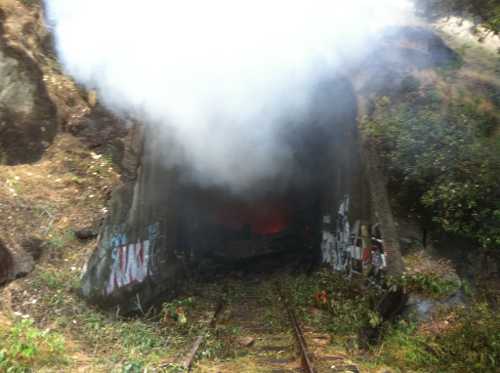
CLOVERDALE, Calif. – Firefighters are continuing to monitor a fire that broke out in a Sonoma County railroad tunnel earlier this week.
The Cloverdale Fire Protection District and the California Department of Forestry and Fire Protection (Cal Fire) responded to a fire involving an abandoned railroad tunnel shortly after 6 p.m. on Wednesday.
The tunnel is located along the Russian River, north of Cloverdale, near the Sonoma-Mendocino county line.
Firefighters found a fire involving the wood structure supporting the tunnel and were able to extinguish the fire on the southern end of the tunnel structure. However, officials reported that firefighters were unable to enter the tunnel to fully extinguish the fire due to the damaged wood structure and potential of collapse.
The firefighters reportedly observed wood and other material falling from the tunnel’s roof and walls. Cal Fire said the wood structure appears to be mainly untreated redwood timbers.
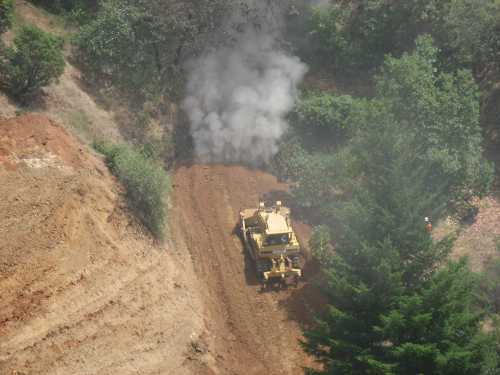
The owner of the tunnel, the Northwestern Pacific Railroad Co., was notified of the fire. Northwestern personnel have remained at the tunnel since Wednesday night, summoning water tenders and bulldozers to combat the fire, and sealing the ends of the tunnel, using bulldozers to pile dire, according to Cal Fire's report.
Cal Fire said smoke may remain visible to passing motorists on Highway 101 and residents of the area. The tunnel structure is expected to continue to burn for at least a week until it is smothered by the lack of fresh air.
The tunnel has not been used since railroad services stopped more than 10 years ago, Cal Fire said. The tunnel is 1,800 feet long and was originally built in 1898. It was refurbished in 1969.
Cal Fire said firefighters are ready to respond if the fire spreads to the surrounding vegetation.
Follow Lake County News on Twitter at http://twitter.com/LakeCoNews , on Facebook at http://www.facebook.com/pages/Lake-County-News/143156775604?ref=mf and on YouTube at http://www.youtube.com/user/LakeCoNews .
Education
Health
Business
Obituaries
Veterans
Recreation
Religion
Arts & Life
Government & Politics