 How to resolve AdBlock issue?
News
This week State Controller John Chiang updated his Web site with the salary, pension benefits and other employee compensation for several hundred special districts including library, mosquito abatement, conservation, air quality and airport agencies covering the 2009 fiscal year.
The information can be found at www.sco.ca.gov/compensation_search.html.
In the wake of concerns about public employee salaries resulting from abuses discovered in the Southern California city of Bell, Chiang started the compensation reporting Web site last October.
Since then, Chiang's office has collected and posted wage information for more than 600,000 city and county employees.
He followed that by ordering special districts across the state to report the same information, and the first 1,925 districts were loaded between February and April of this year.
Compensation information for employees of special districts has been collected and posted on the Web site in four phases.
The fourth and final phase posted this week includes almost $457 million in payroll reported by 454 local agencies, according to Chiang's office.
Chiang's last update to his site took place on April 26, as Lake County News has reported.
The compensation reporting Web site covers elected officials as well as public employees, and includes minimum and maximum salary ranges; actual wages paid; the applicable retirement formula; any contributions by the employer to the employee’s share of pension costs; any contributions by the employer to the employee’s deferred compensation plan; and any employer payments for the employee’s health, vision and dental premium benefits.
There are 33 special districts in Lake County, 26 of which had submitted information by the last deadline.
Four districts – Flood Control Maintenance Area No. 17, Reclamation District No. 2070, Scotts Valley Water Conservation District and Villa Blue Resource Conservation District – have no data available, according to the report.
The newest information includes calendar year 2009 compensation reports for Lake County Vector Control, West Lake Resource Conservation District and East Lake Resource Conservation District.
Vector Control has a five-member board of directors whose members received between $300 and $600 in compensation for 2009, the data showed.
The 2009 data showed that there were 10 paid positions, nine of which were full-time. The lowest paid full-time position, a temporary vector control technician, received a salary totaling $23,267 .
The highest paid-position, the district manager job held by Dr. Jamesina Scott, received $118,081 in compensation that year, and $18,606 in health, dental and vision.
The West Lake Resource Conservation District has five unpaid board directors and 12 paid positions, ranging from a project coordinator paid $1,849 up to Watershed Coordinator and District Manager Greg Dills, who received $58,879 in salary and no benefits.
The East Lake Resource Conservation District also has five unpaid board members, as well as three paid staffers.
Dills – who also is watershed coordinator and district manager in his shared capacity with West Lake – was paid $1,619 for the year by East Lake, a secretary clerk received $5,100 in compensation and $1,790 in health, dental and vision, and a project coordinator was paid $32,286 with no benefits.
The Controller's Office reported that 80 percent of all special districts in the final phase followed the new reporting requirements.
Each noncomplying agency could face a penalty of $5,000. Postings are updated weekly with any new information received.
Still to come – Chiang anticipates loading similar compensation information for state employees later this month.
E-mail Elizabeth Larson at

CLEARLAKE, Calif. – The Clear Lake Chamber of Commerce will soon have a new home.
This summer the chamber is moving into a new location at 14773 Lakeshore Drive, on the corner of Lakeshore Drive and Golf Avenue, the city's old senior center building, according to Chamber President Michael Horner.
Horner said the chamber welcomes members and the public to join in a work day on Saturday, June 18, beginning at 10 a.m.
The chamber previously had been located in a city-owned building on Golf Avenue in Clearlake, but due to the building's deterioration the organization moved into a space in the Highlands Senior Center on Bowers Avenue.
Horner said the chamber is supporting the Highlands Senior Center and the senior community of Clearlake through volunteer service to upgrade and improve their buildings and grounds.
In a time of serious funding cuts to the senior center and senior programs, Horner said the chamber feels it is important to support the senior center by improving and preserving their assets. This effort will allow the senior center to generate income by leasing their original buildings.
Horner expressed the chamber's deep gratitude to the city of Clearlake for providing the temporary space over the last two years.
With the current fiscal challenges all local governments are facing, Horner said the chamber feels it is in the best interests of the community to move forward with a sustainable, self-supporting business model that is not reliant on taxpayer money.
He said committee Chairman Mike Boyle of Artisan Handiworks is already hard at work renovating the building for the chamber to occupy this summer.
“This is an exciting opportunity to build community, camaraderie and create a sense of ownership within our membership through a community driven project to revitalize Lakeshore Drive that is independent of taxpayer money,” Horner said.
Partnering with the Highlands Senior Center in this project, the chamber and the senior center will be beautifying a very high profile location on Lakeshore, he said.
When the chamber moves to its new location on the community's main street, Horner said the chamber can better serve members and patrons, and be more convenient to tourists, boaters and the business community.
Follow Lake County News on Twitter at http://twitter.com/LakeCoNews , on Facebook at http://www.facebook.com/pages/Lake-County-News/143156775604?ref=mf , on Tumblr at http://lakeconews.tumblr.com/ and on YouTube at http://www.youtube.com/user/LakeCoNews .
The quakes, all measuring 3.0-magnitude or above, happened throughout the day, according to the US Geological Survey.
The first, a 3.6-magnitude recorded at 1:25 a.m., occurred at a depth of 11.1 miles, with its center located four miles south southwest of Idyllwild and 15 miles southwest of Palm Springs, the US Geological Survey reported.
The survey received 53 responses from 59 zip codes by 1:30 a.m. Wednesday.
The second, a 3.0-magnitude temblor, occurred at 4:51 a.m. nine miles east northeast of San Jose City Hall at a depth of 6.4 miles, the survey reported.
By 1:30 a.m. Wednesday the survey had received 104 responses in 28 zip codes.
At 5:20 a.m., a 3.7-magnitude quake occurred five miles southwest of Petrolia and 37 miles south southwest of Eureka, according to US Geological Survey data.
That quake, recorded 10.9 miles deep, resulted in 36 shake reports from 22 zip codes by 1:30 a.m. Wednesday.
A 3.1-magnitude quake occurred at 12:05 p.m. at a depth of 3.7 miles eight miles south of Tres Pinos and 14 miles south southeast of Hollister, the US Geological Survey reported.
The survey received 10 shake reports from eight zip codes by 1:30 a.m. Wednesday.
E-mail Elizabeth Larson at
Veterans’ service organizations have lobbied for these benefits, but with the expectation that newly authorized programs would be fully funded.
Last year, even as the once-steady stream of extra dollars for the Department of Veterans Affairs slowed to a trickle, lawmakers continued to add new programs.
Veteran groups are getting nervous.
They worry that VA, burdened with new “unfunded mandates,” has no other choice but to launch these new programs and pay for them by dipping into dollars needed for other services veterans already rely on.
Recent bills enacted that weren’t fully paid for included the important caregiver law for families of the most seriously disabled veterans and expansion of female veterans’ health benefits, including single parent childcare services, at VA medical facilities.
Joseph Violante, legislative director for Disabled American Veterans, raised the touchy issue June 8 at a hearing of the Senate Veterans Affairs Committee where lawmakers and lobbyists considered the merits of 35 new bills aimed at helping veterans.
Violante acknowledged that delegates to DAV’s own convention last August passed numerous resolutions in support of a lot of the bills now before the committee or even enacted into law late last year.
“However, as Congress considers authorizing new programs or enhancing or expanding current programs,” he warned, “it is essential that they do so in manner that does not have negative effects on existing programs and services. In today’s economic environment, VA cannot be all things to all veterans, and their families and survivors, without obtaining substantially more resources, which are dependable and stable.”
New committee chairman Sen. Patty Murray (D-Wash.) opened the hearing by touting her bills to lower veterans’ unemployment (S 951), and expand assistance to homeless veterans through improved grants, per diem, health care and case management services (S 1148).
Ranking Republican, Sen. Richard Burr (N.C.), advocated for his bill (S. 277) to extend eligibility for VA hospital care, medical services and nursing home care to as many as 600,000 veterans and family members stationed at Camp Lejeune during years well water there was contaminated.
Another Burr bill (S 423) would incentivize veterans to help deal with the backlog of claims by allow VA to pay disability benefits retroactively, for up to one year before a claim is filed, if the submitted claim is deemed “fully developed” to allow a swift decision.
VA opposes the bill. VSOs had mixed reactions. Raymond Kelley with Veterans of Foreign War said VFW likes the concept but sees a few problems including possible legal liability for VSO service officers who help to develop veterans’ claims.
Burr was the only senator at the hearing to acknowledge the looming national debt crisis, noting that the bills under consideration “would collectively spend billions of dollars” even as the country faces “staggering deficits and debt and is on a fiscal path that is simply unsustainable.”
So the committee must weigh affordability in deciding what bills to approve during mark-up at the end of June. Burr added, however, that government auditors believe by ending “overlap” in federal programs current services could improve and still save taxpayers billions of dollars a year.
“I will not shy away from providing those who have served and sacrificed for our nation with the benefits and services they need and deserve,” Burr said. “But I also want to make sure we pay for these benefits and services by cutting other spending.”
Violante noted that Congress generously raised VA budgets in recent years and so far has spared VA of the deep deficit-driven cuts being planned for many other federal departments.
But he warned senators if they want to increase veterans services, they must give VA the “time and resources” to deliver them properly.
The committee should not “forget its responsibility to ensure that when it mandates a new service in law, or admits a new eligible population to VA rolls, that sufficient resources accompany that mandate.”
If money to pay for new services isn’t part of the deal, Violante said, it “will only force VA to slice their budget pie into smaller pieces.”
VA officials testified at the hearing that Murray’s Hiring Heroes Act would cost the department only $65 million over 10 years. And a popular bill from Sen. Olympia Snowe (R-Me.), to protect the solemnity of veteran funerals anti-gay protestors, would cost taxpayers nothing at all.
But Burr’s bill to allow retroactive effective dates of disability awards for veterans whose claims are deemed fully developed when submitted would cost $762 million over ten years.
His bill to extend VA hospital care and health services to Marine Corps and Navy veterans and their families assigned to Lejeune from 1957 until 1987, and therefore possibly exposed to contaminated water, would cost $4 billion over the first decade.
Veterans groups sympathize with the goal that bill but largely oppose it, saying the Department of Defense’s TRICARE program, not the VA, should be responsible for follow up care and services.
Retired Marine Master Sergeant Jerry Ensminger testified that his daughter, Janey, born while the family was assigned to Camp Lejeune, died of acute lymphoblastic leukemia in 1985 when nine years old.
He blames chemicals found later in the tap water there, including two known carcinogens, benzene and vinyl chloride. He said the Marine Corps and Navy Department knew about the contamination for several years but failed to act.
He referred other potential victims to a Web site, www.tftptf.com, for more details. Ensminger said more than 170,000 members of the Camp Lejeune community have registered with the Marine Corps as having been exposed to the water at Lejeune sometime during the 30 year period.
In opposing the bill, VA cited numerous concerns including the “underlying scientific evidence” behind claims of contamination exposure.
To comment, e-mail
Follow Lake County News on Twitter at http://twitter.com/LakeCoNews , on Facebook at http://www.facebook.com/pages/Lake-County-News/143156775604?ref=mf , on Tumblr at http://lakeconews.tumblr.com/ and on YouTube at http://www.youtube.com/user/LakeCoNews .
Gov. Jerry Brown's office reported Monday that he signed North Coast Assemblyman Wes Chesbro's bill, AB 1020, which ratifies the tribe's gaming compact.
Chesbro's office said that the legislation, an urgency bill, immediately makes the compact law.
“With the governor’s signature, the only remaining hurdle is to get final approval from the U.S. Department of the Interior, with which the Tribe has already worked out an agreement,” Chesbro said. “The jackpot will be two to three hundred construction jobs for Lake County residents while the casino is being built. When the casino opens, the tribe will create an estimated 145 permanent, full-time jobs with benefits.”
According to Chesbro's office, AB 1020 enjoyed wide bipartisan support in the Legislature with no opposition, passing off the Assembly Floor 69-0 on May 23 and off the Senate Floor 40-0 last week.
State Sen. Noreen Evans coauthored AB 1020 and presented the bill on the Senate floor.
The tribe's efforts to work cooperatively with Lake County has earned it high marks from local officials and from state officials such as Chesbro.
“I can’t say enough how pleased I am with the Habematolel Pomo of Upper Lake Tribal Council for the groundwork it laid to make this project happen,” Chesbro said.
He pointed to the tribe's entry into a memorandum of understanding with Lake County that ensures the county’s interests are protected throughout the tribe’s project.
The tribe also has a memorandum of understanding with Northshore Fire Protection District, providing much-needed funding for this rural fire district that is suffering from budget cuts.
Additionally, the tribe has set aside more than 55 acres of land to assist with the Middle Creek Flood Damage Reduction Project, paid for wastewater expansion and funded a half million dollars in road improvements to Highway 20.
Follow Lake County News on Twitter at http://twitter.com/LakeCoNews , on Facebook at http://www.facebook.com/pages/Lake-County-News/143156775604?ref=mf , on Tumblr at http://lakeconews.tumblr.com/ and on YouTube at http://www.youtube.com/user/LakeCoNews .
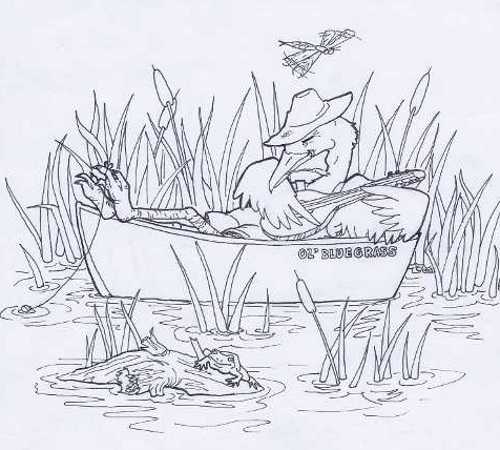
LOWER LAKE, Calif. – The Anderson Marsh Interpretive Association (AMIA) is pleased to announce the winner of the 2011 Old Time Bluegrass Festival Logo Contest.
Victoria Stahlman of Lower Lake High School won the $100 prize with her entry.
Her submission will be used as the logo for the 2011 Old Time Bluegrass Festival.
AMIA wants to make sure everyone knows the festival is happening this year, on Saturday, September 10th.
“The Bluegrass Festival is our major fundraiser and a wonderful community event,” said AMIA Secretary Gae Henry.
While Anderson Marsh State Historic Park was included on a list of state parks proposed for closure earlier this spring, the AMIA said the show is going on.
“We are committed to exploring options for keeping Anderson Marsh State Historic Park open,” Henry said. “Now, more than ever, we need support to help us do whatever we can to keep Anderson Marsh accessible to our community and the public.”
The logo contest was open to all students attending any high school in Lake County, as well as Lake County ninth through 12 graders being home schooled, the group said.
“We like to involve and support as many Lake County students as possible,” said Bluegrass Festival Coordinator Henry Bornstein, “and with the help this year of the Children’s Museum of Art & Science, we were pleased to receive 18 submissions.”
Submissions were judged by the quality of the art work and the suitability for appearing on T-shirts, posters and other promotional materials.
All the original art work will be on display with other art at the “Art in the Barn” display during this year’s sixth annual Old Time Bluegrass Festival, to be held rain or shine from 9:30 a.m. to 6:30 p.m. on Saturday, Sept. 10.
“Each student who submitted an entry has been sent a “recognition of artistic merit” and will also receive a gift certificate,” said Henry. “Also, to continue a tradition started in 2009, the 2011 submissions will be added to our postcard collection, listing the name and school of each artist. The collection will then contain all the submissions for the past three years and will be for sale at the Bluegrass Festival.”
Find more information about the Bluegrass Festival at www.andersonmarsh.org.
Follow Lake County News on Twitter at http://twitter.com/LakeCoNews , on Tumblr at www.lakeconews.tumblr.com, on Facebook at http://www.facebook.com/pages/Lake-County-News/143156775604?ref=mf and on YouTube at http://www.youtube.com/user/LakeCoNews .