 How to resolve AdBlock issue?
News
With a pair of bug-eyes swiveling on a stalk nearly 8 feet off the ground, the six-wheeled, 1800-pound Mars rover Curiosity doesn’t look much like a human being.
Yet, right now, the mini-Cooper-sized rover is playing the role of stunt double for NASA astronauts.
“Curiosity is riding to Mars in the belly of a spacecraft, where an astronaut would be,” explained Don Hassler of the Southwest Research Institute in Boulder, Colorado. “This means the rover experiences deep-space radiation storms in the same way that a real astronaut would.”
Indeed, on Jan. 27, Curiosity’s spacecraft was hit by the most intense solar radiation storm since 2005.
The event began when sunspot AR1402 produced an X2-class solar flare. On the “Richter Scale of Solar Flares,” X-flares are the most powerful kind.
The explosion accelerated a fusillade of protons and electrons to nearly light speed; these subatomic bullets were guided by the sun’s magnetic field almost directly toward Curiosity.
When the particles hit the outer walls of the spacecraft, they shattered other atoms and molecules in their path, producing a secondary spray of radiation that Curiosity both absorbed and measured.
“Curiosity was in no danger,” said Hassler. “In fact, we intended all along for the rover to experience these storms en route to Mars.”
Unlike previous Mars rovers, Curiosity is equipped with a Radiation Assessment Detector.
The instrument, nicknamed “RAD,” counts cosmic rays, neutrons, protons and other particles over a wide range of biologically-interesting energies.
RAD’s prime mission is to investigate the radiation environment on the surface of Mars, but researchers have turned it on early so that it can also probe the radiation environment on the way to Mars as well.
Curiosity’s location inside the spacecraft is key to the experiment.
“We have a pretty good idea what the radiation environment is like outside,” said Hassler, who is the principal investigator for RAD. “Inside the spacecraft, however, is still a mystery.”
Even supercomputers have trouble calculating exactly what happens when high-energy cosmic rays and solar energetic particles hit the walls of a spacecraft. One particle hits another; fragments fly; the fragments themselves crash into other molecules.
“It’s very complicated,” said Hassler. “Curiosity is giving us a chance to actually measure what happens.”
Even when the sun is quiet, Curiosity is bombarded by a slow drizzle of cosmic rays – high-energy particles accelerated by distant black holes and supernova explosions.
In the aftermath of the Jan. 27 X-flare, RAD detected a surge of particles several times more numerous than the usual cosmic ray counts.
Hassler’s team is still analyzing the data to understand what it is telling them about the response of the spacecraft to the storm.
More X-flares will help by adding to the data set. Hassler expects the sun to cooperate, because the solar cycle is trending upward toward a maximum expected in early 2013.
As of February 2012, “we still have six months to go before we reach Mars. That’s plenty of time for more solar storms,” Hassler said.
A stunt double’s work is never done.
Dr. Tony Phillips works for the National Aeronautics and Space Administration.
Follow Lake County News on Twitter at http://twitter.com/LakeCoNews, on Tumblr at www.lakeconews.tumblr.com, on Google+, on Facebook at www.facebook.com/pages/Lake-County-News/143156775604?ref=mf and on YouTube at www.youtube.com/user/LakeCoNews .
LAKEPORT, Calif. – On Friday, opening arguments took place in the trial of two young local men accused of killing a 4-year-old child and shooting five others in the worst single shooting incident in the city of Clearlake’s history.
Paul William Braden, 21, and Orlando Joseph Lopez, 24, each are facing 15 counts for the June 18, 2011, shooting that killed Skyler Rapp; injured and permanently disabled his mother, Desiree Kirby; and wounded Kirby's boyfriend, Ross Sparks and his brother, Andrew Sparks, and friends Ian Griffith and Joseph Armijo.
After weeks of jury selection, two separate jury panels have been seated, one to decide on each man’s case.
A third man, Kevin Ray Stone, 29, originally was charged with murder in the case as well, but last November he reached an agreement in which he pleaded no contest to conspiracy to commit robbery, accessory to murder and possession of a .22-caliber rifle by a prohibited person, as Lake County News has reported.
District Attorney Don Anderson told Lake County News on Friday that Stone has not yet been sentenced. Based on previous statements in court, Stone is facing up to 10 years in prison and $64,000 in fines.
Anderson said during opening statements Friday that Stone will appear as a prosecution witness.
Judge Doris Shockley from Yolo County has been brought in to preside over the trial, which is anticipated to be lengthy, in Department 1 in Lake County Superior Court.
Shockley told jurors Friday that the proceedings are right on time, with presentation of evidence and testimony expected to be finished the first week of May.
During the morning session, the “orange” jury, which will decide on Braden’s case, heard opening arguments from Braden’s attorney Doug Rhoades and Anderson.
In the afternoon, Anderson and Lopez’s attorney, Stephen Carter, presented brief opening arguments to the “green” jury.
Before arguments, the court clerk read to each jury the charging documents against each man. Each reading of the lengthy documents took about 45 minutes.
The charges against them include murder, mayhem, numerous counts of attempted murder and assault with a deadly weapon, and many special allegations for, among other things, use of a firearm.
Setting the scene
Anderson told the juries the evidence will show that the events leading to the shooting begin about a week beforehand, with a fight involving a cousin of Kirby’s. The situation escalated when Kirby and Lopez’s brother, Leonardo, allegedly had a confrontation at Walmart a few days before the shooting.
On the night of the shooting, Braden allegedly got Stone to go with him to the neighborhood where Kirby and Sparks lived on the pretense of committing a drug robbery at the home of Curtis Eeds, their neighbor, according to Anderson.
It was from Eeds’ yard that Braden allegedly began shooting over the fence – with Lopez allegedly shooting through a hole in the fence – into a crowd of between 10 to 15 people gathered at Sparks’ and Kirby’s home, Anderson said.
Standing by the barbecue was the 4-year-old Skyler Rapp, who was getting ready to make s’mores.
“He takes a shotgun blast to the back,” said Anderson.
Almost every one of the child’s vital organs – his heart, kidney, liver and his spinal cord – were pieced by 11 shots of double ought buckshot, the district attorney said.
The child collapsed and died at the scene, Anderson said.
Kirby would be hit by two shotgun blasts and would suffer as many as 34 entry wounds covering her right leg and arm. Anderson said she has suffered permanent injuries, and for the rest of her life will have limited use of her arm and leg.
Stone, Braden and Lopez fled the scene, crashed the van that Stone had borrowed from his girlfriend’s cousin, and stashed the shotgun and a rifle. Anderson said Stone will identify a .22 rifle taken to the scene as his.
In addressing Braden’s jury panel, Rhoades told jurors, “Let’s acknowledge one thing up front” – that what occurred the night of June 18, 2011, was a tragedy.
“The question that’s going to be before you is, is Paul Braden responsible for that?” he asked.
Rhoades pointed out that Daniel Loyd, alleged to have shot a Lucerne woman in September 2011, is going to be called as a a prosecution witness against Braden. Anderson told Lake County News that Loyd has information to present against Braden based on statements Braden allegedly made to Loyd in the Lake County Jail.
Rhoades said Loyd has every reason to say what the prosecution wants him to, as do witnesses against Braden who have family connections to Lopez.
Then there is Stone, who fled to Sonoma County after the shooting, Rhoades explained. While Stone was on the run, he arranged to turn himself in to police and then didn’t show up.
“He is no longer before the court on these cases or these crimes,” said Rhoades, adding that Stone’s involvement will be heard by the jury.
While Stone, and Lopez as well, allegedly disappeared after the shooting, Braden stayed in the county, Rhoades said.
“He went home. He didn’t have anything to do with it,” Rhoades said of the shooting.
Rhoades told the jury that nobody can put Braden at the scene except the others involved in the shooting, adding that none of the victims saw Braden there.
In the afternoon session, Carter offered a seven-minute opening in which he told the panel that opening arguments are “all about telling the jury ahead of time what they need to look for.”
Like Rhoades, he raised issues with Stone’s part in the incident, noting, “He doesn’t go immediately to the police and say, ‘You won’t believe what these guys did.’” Carter said Stone has now manipulated himself into a plea bargain.
Carter said it is not a simple case. “There are lots of different sorts of people with lots of different sorts of problems,” with some of the people at the scene high or drunk.
He asked them to remember all of their obligations, pay close attention to Judge Shockley’s rulings and render a fair decision.
The jury panels were ordered to return to court at 10 a.m. Wednesday, Feb. 29.
E-mail Elizabeth Larson at
LAKE COUNTY, Calif. – After several days of near record-high temperatures, snow is in the forecast for this weekend.
A high-pressure system that brought unseasonably high daytime temperatures to most of Northern California for the past few days moves out and weather forecasts predict returning to more normal temperatures for February with an expected high today in the mid-50s.
As the high-pressure system that brought warm daytime temperatures moves out of the area, a low-pressure system moves through, bringing a slight chance of rain showers early Sunday morning, with a slight chance of rain and snow showers and snow levels forecast to be at 3,400 feet, lowering to 2,500 feet throughout the day according to the National Weather Service in Sacramento.
The possibilities for rain and snow showers continue through Monday with snow levels down to 2,200 feet as daytime high temperatures top-off in the 40s and overnight lows continue dip below freezing.
Chances for rain and snow remain in the forecast throughout the week according to the National Weather Service, with daytime highs in the 50s and lows in the 30s.
For up-to-the-minute weather visit http://www.lakeconews.com/index.php?option=com_events&;Itemid=309 .
Follow Lake County News on Twitter at http://twitter.com/LakeCoNews, on Tumblr at www.lakeconews.tumblr.com, on Google+, on Facebook at www.facebook.com/pages/Lake-County-News/143156775604?ref=mf and on YouTube at www.youtube.com/user/LakeCoNews .
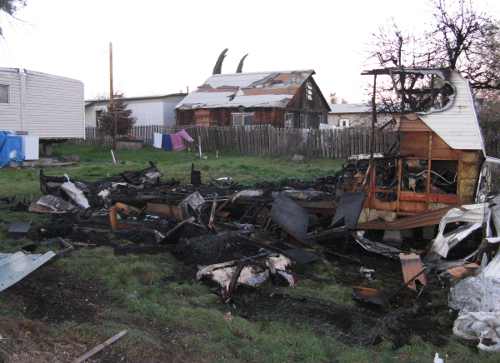
LAKEPORT, Calif. – A travel trailer was destroyed in a Friday evening fire.
The trailer, located on Mission Rancheria Road at Big Valley Rancheria, was being used as a residence, according to Lakeport Fire Chief Ken Wells.
Lakeport Fire sent two engines, one truck and seven firefighters, and Kelseyville Fire sent one engine and two firefighters, according to Wells.
Wells said the trailer was a total loss, and burned all the way to the ground.
The person who had been living there was gone by the time firefighters arrived, Wells said.
He added that there were no injuries.
Wells said firefighters didn’t know the fire’s cause, but noted that the Lake County Sheriff’s Office was looking into possible leads as to who may have been responsible for the fire.
E-mail Elizabeth Larson at
Firefighters in Napa County are continuing to work on a fire that began early Wednesday afternoon with an agricultural burn pile that got out of control.
The Soda Fire is located in the 3200 block of Soda Canyon Road, north of Silverado Trail and northeast of the city of Napa, according to a Friday report from Cal Fire.
The fire’s location in steep and rugged terrain was making it difficult to access, and Cal Fire said gusty winds made the going tougher on Thursday.
However, on Friday the winds tapered off, allowing firefighters to expand containment to 75 percent on the 200-acre fire, the agency reported Friday evening.
Approximately 143 firefighters were on scene late Friday, with three engines, eight fire crews and one bulldozer, Cal Fire said.
Cal Fire said full containment is expected Saturday at 8 a.m.
No evacuations were in place and no structures have been damaged, according to Cal Fire.
Two minor injuries were suffered by fire captains on scene, Cal Fire reported.
Agencies involved in the firefighting effort include Cal Fire, Napa County Fire Department, Calistoga Fire Department, Napa City Fire Department, St. Helena Fire Department, American Canyon Fire Protection District, Napa County Sheriff’s Office and the California Department of Corrections and Rehabilitation.
E-mail Elizabeth Larson at
In the middle of the night on Feb. 13, something disturbed the animal population of rural Portal, Georgia.
Cows started mooing anxiously and local dogs howled at the sky. The cause of the commotion was a rock from space.
"At 1:43 a.m. Eastern, I witnessed an amazing fireball," reported Portal resident Henry Strickland. "It was very large and lit up half the sky as it fragmented. The event set dogs barking and upset cattle, which began to make excited sounds. I regret I didn't have a camera; it lasted nearly 6 seconds."
Strickland witnessed one of the unusual "Fireballs of February."
"This month, some big space rocks have been hitting Earth's atmosphere," said Bill Cooke of NASA's Meteoroid Environment Office. "There have been five or six notable fireballs that might have dropped meteorites around the United States."
It’s not the number of fireballs that has researchers puzzled. So far, fireball counts in February 2012 are about normal. Instead, it's the appearance and trajectory of the fireballs that sets them apart.
"These fireballs are particularly slow and penetrating," explained meteor expert Peter Brown, a physics professor at the University of Western Ontario. "They hit the top of the atmosphere moving slower than 15 km/s, decelerate rapidly, and make it to within 50 km of Earth’s surface."
The action began on the evening of Feb. 1 when a fireball over central Texas wowed thousands of onlookers in the Dallas-Fort Worth area.
"It was brighter and long-lasting than anything I've seen before," reported eyewitness Daryn Morran. "The fireball took about eight seconds to cross the sky. I could see the fireball start to slow down; then it exploded like a firecracker artillery shell into several pieces, flickered a few more times and then slowly burned out." Another observer in Coppell, Texas, reported a loud double boom as "the object broke into two major chunks with many smaller pieces."
The fireball was bright enough to be seen on NASA cameras located in New Mexico more than 500 miles away.
"It was about as bright as the full Moon," said Cooke.
Based on the NASA imagery and other observations, Cooke estimates that the object was 1 to 2 meters in diameter.
So far in February, NASA's All-Sky Fireball Network has photographed about a half a dozen bright meteors that belong to this oddball category.
They range in size from basketballs to buses, and all share the same slow entry speed and deep atmospheric penetration.
Cooke has analyzed their orbits and come to a surprising conclusion: "They all hail from the asteroid belt—but not from a single location in the asteroid belt," he said. "There is no common source for these fireballs, which is puzzling."
This isn't the first time sky watchers have noticed odd fireballs in February. In fact, the "Fireballs of February" are a bit of a legend in meteor circles.
Brown explained: "Back in the 1960s and 70s, amateur astronomers noticed an increase in the number of bright, sound-producing deep-penetrating fireballs during the month of February. The numbers seemed significant, especially when you consider that there are few people outside at night in winter. Follow-up studies in the late 1980s suggested no big increase in the rate of February fireballs. Nevertheless, we've always wondered if something was going on."
Indeed, a 1990 study by astronomer Ian Holliday suggests that the “February Fireballs” are real.
He analyzed photographic records of about a thousand fireballs from the 1970s and 80s and found evidence for a fireball stream intersecting Earth's orbit in February. He also found signs of fireball streams in late summer and fall.
The results are controversial, however. Even Halliday recognized some big statistical uncertainties in his results.
NASA's growing All-Sky Fireball Network could end up solving the mystery. Cooke and colleagues are adding cameras all the time, spreading the network's coverage across North America for a dense, uninterrupted sampling of the night sky.
"The beauty of our smart multi-camera system," noted Cooke, "is that it measures orbits almost instantly. We know right away when a fireball flurry is underway – and we can tell where the meteoroids came from." This kind of instant data is almost unprecedented in meteor science, and promises new insights into the origin of February’s fireballs.
Meanwhile, the month isn't over yet. "If the cows and dogs start raising a ruckus tonight," advises Cooke, "go out and take a look."
Dr. Tony Phillips works for the National Aeronautics and Space Administration.
Follow Lake County News on Twitter at http://twitter.com/LakeCoNews, on Tumblr at www.lakeconews.tumblr.com, on Google+, on Facebook at www.facebook.com/pages/Lake-County-News/143156775604?ref=mf and on YouTube at www.youtube.com/user/LakeCoNews .