 How to resolve AdBlock issue?
News
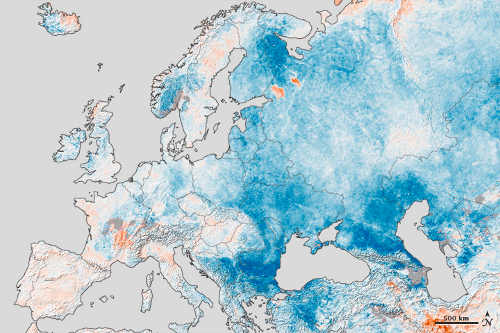
For the first half of this year's winter, the big news was warm temperatures and lack of snow. Ski resorts were covered in bare dirt, while January temperatures in southern California topped July highs.
Then, out of the blue, Europe got clobbered: Over the past two weeks, temperatures in Eastern Europe have nose-dived to -30 degrees Celsius (-22 degrees Fahrenheit).
Blizzards and the bone-chilling cold have resulted in the deaths of more than 550 people so far, with rooftop-high snow drifts trapping tens of thousands of villagers in their homes and cutting off access to entire towns. It has even snowed as far south as North Africa.
NASA climatologist Bill Patzert of the Jet Propulsion Laboratory explains what happened. “A couple of weeks ago, Mother Nature did an about face,” he said. “The tight polar vortex that had bottled up the cold arctic air in the beginning of winter suddenly weakened. Cold air swept out of Siberia and invaded Europe and the Far East.”
The “tight polar vortex” is caused by the arctic oscillation, a see-sawing pressure difference between the Arctic and lower latitudes. When the pressure difference is high, a whirlpool of air forms around the North Pole.
That’s what happened earlier this winter: the whirlpool was more forceful, corralling the cold air and keeping it nearer the pole.
Now the vortex is weakening. With “the Arctic Oscillation Index going negative,” as an expert or weather-nerd might put it, cold air escapes from that whirlpool and heads southward, resulting in the killing extremes now plaguing the other half of the planet.
However, even the breakdown of the vortex cannot completely account for the severity of the winter Europe is suddenly experiencing.
As strange as it sounds, some climatologists, among them Judah Cohen of Atmospheric and Environmental Research in Massachusetts, attribute the unusual cold to global warming.
Cohen contends that since sea ice is being melted by warmer temperatures in the Arctic, more moisture is available for the atmosphere to pick up – and drop as snow.
As a result, Siberian snow cover has increased, and this snow cover has a cooling effect which reaches East Asia and Europe.
“Cohen's research is cutting edge and could bring important improvements to forecasting climate and weather over North America and Europe,” said Patzert. “Cohen and others are on the threshold of understanding of how climate change affects the behavior of the Arctic Oscillation.”
Patzert added, however, that this winter is just one of many severe winters that have changed European history. “Looking back, Mother Nature has taken us on some very wild rides.”
He cited the winter of 1683/84, when the Thames River in England stayed frozen with a thick layer of ice for nearly two months, as an example.
“And let’s not forget the frigid winter of 1812, when Napoleon's Grande Armee was decimated by the extreme cold in Western Russia,” he said.
Patzert noted that European history would have been much different if Napoleon had had a good meteorologist on his staff and some NASA satellites to warn him about what he was marching into.
“And the turning point of World War II occurred in 1941, when Germany’s forces were nearly frozen in place,” he added.
There are many other examples, and climate change can't be blamed for all of them.
“There's always going to be some natural variability,” he said. “Every episode of high temperatures or extreme cold isn't climate change. Sometimes it's just weather!”
The weakening arctic oscillation could soon bring a return of winter to North America as well, although Patzert doesn't expect it to be as severe as what's happening on the other side of the Atlantic.
Is there any relief in sight for Europe?
“The good news is that this crippling cold snap arrived mid-winter,” he said. “With the vernal equinox less than six weeks away, this arctic oscillation episode will become muted – hopefully.”
Hang on till spring.
Dauna Coulter writes for the National Aeronautics and Space Administration.
Follow Lake County News on Twitter at http://twitter.com/LakeCoNews, on Tumblr at www.lakeconews.tumblr.com, on Google+, on Facebook at www.facebook.com/pages/Lake-County-News/143156775604?ref=mf and on YouTube at www.youtube.com/user/LakeCoNews .

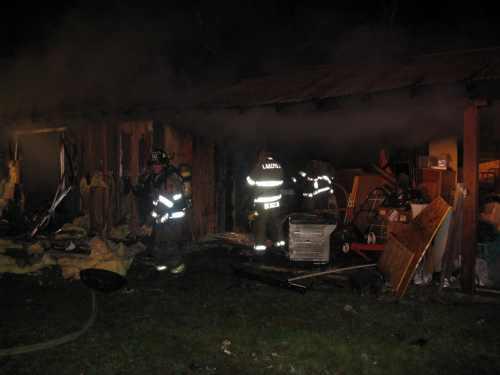
KELSEYVILLE, Calif. – An early Saturday morning fire destroyed a Kelseyville home.
Kelseyville Fire and Lakeport Fire personnel responded to the fire on Bell Hill Road shortly after 2:30 a.m. Saturday, as Lake County News has reported.
Lakeport Fire Chief Ken Wells, who was among those responding to the incident, said two engines and a water tender from Kelseyville and an engine from Lakeport – with a total of 14 firefighting personnel – arrived to fight the fire.
Wells said the residence’s occupants were not home when the fire broke out.
The fire was difficult to put out, and Wells said the single-story, single-family residence was a complete loss. He did not have an estimate of total damages.
No firefighters were injured, and Wells said five Chihuahuas that were in the home at the time were saved.
“We recovered them all, they were all safe and sound,” Wells said.
He said the cause of the fire remains under investigation.
E-mail Elizabeth Larson at
KELSEYVILLE, Calif. – An early morning fire on Saturday damaged a structure near Kelseyville.
The fire was reported at about 2:30 a.m. Saturday on Bell Hill Road a quarter-mile south of Hummel Lane.
A person delivering newspapers reported the fire, according to radio reports.
Kelseyville Fire Protection District and Lakeport Fire Protection District responded, finding a structure fully engulfed in flames on their arrival, reports from the scene indicated.
Pacific Gas and Electric Co. also was called to the scene.
Additional information about the type of structure and the fire’s cause was not immediately available.
E-mail Elizabeth Larson at
California representatives say water bill kills local jobs, neglects 50 years of established science
This week 10 Northern California representatives called on the House Committee on Natural Resources to oppose H.R. 1837, the so-called San Joaquin Valley Water Reliability Act.
As written, the legislation would divert additional water from the Sacramento-San Joaquin Bay Delta to South-of-Delta water users, running counter to established economic and environmental policies.
In a letter to the Committee on Natural Resources, U.S. Representatives Mike Thompson (CA-1), George Miller (CA-7), Doris Matsui (CA-5), Jerry McNerney (CA-11), John Garamendi (CA-10), Jackie Speier (CA-12), Mike Honda (CA-15), Lynn Woolsey (CA-6), Zoe Lofgren (CA-16) and Anna Eshoo (CA-14) wrote that the bill grossly dismisses the best available science, would cause job losses, repeals environmental protections, damages local tourism, hurts fishers and farmers, and should be rejected.
The lawmakers responded on Thursday as the legislation was being considered by the House Committee on Natural Resources.
“This legislation is nothing more than an attempt by well-funded south-of-Delta water contractors to steal water from the North with no regard for the fishers, farmers, families and businesses who depend on the Delta for their livelihoods” said Thompson. “This bill puts politics ahead of a half-century of established science, guts environmental protections and kills local jobs. It should be rejected, and solutions to California’s water challenges should be based on sound science so that our Delta communities, wildlife and environment are not harmed.”
"Last summer, we said that this bill would do serious damage to California’s water future. Republicans took their extreme bill behind closed doors for the rest of the year, tinkered with it, and emerged with an equally radical and damaging bill. Their bill undermines water policy throughout the west, including state policy, federal policy, and court approved settlements. Their bill takes years of collaboration and compromise and just blows it all up. Their bill is nothing more than a deliberate special interest attack by a small group of well funded water agencies, their lobbyists, and Republican members of Congress to undermine a sound, workable and equitable solution to our state’s serious water problems. Californians should recognize this bill for what it is and Congress should reject it,” said Miller.
“This bill is a brazen move by the water contractors and their allies who want to steal water from the Delta. The farmers, families, and business owners in our region rely upon a healthy Delta for their livelihoods. The bill before the committee today has been crafted without the input of stakeholders from the Delta and should not move forward. It would have a disastrous effect on the Delta communities and cause countless jobs to be lost. To steal from one community to benefit another is completely unacceptable,” said McNerney.
“H.R. 1837 is a shameless attempt to draw water from the farmers and urban areas of Northern California for the use of junior water right holders in the Central Valley,” said Matsui. “Further, the bill would preempt the state from passing any stricter laws needed to protect endangered and native species, and restrict California’s ability to pass tougher legislation to restore the San Joaquin River. This would dramatically undermine our state’s authority to monitor, allot, and safeguard its own natural resources, as well as set a dangerous precedent for government interference in the ability of states to protect local agricultural and environmental interests. At a time when we should be working together to solve California’s water problems through a balanced approach, H.R. 1837 is anything but balanced and will only create further discord.”
“H.R. 1837 would alter the entirety of California’s water laws,” said Garamendi, former Deputy Secretary of the Interior. “We have had only one day to understand its implications. This could be disastrous for California’s water interests. I strongly urge we step on the brakes before running roughshod over state law, threatening jobs, the environment, and our public health.”
The full text of the letter is below.
February 16, 2012
The Honorable Doc Hastings
Chairman
Committee on Natural Resources
The Honorable Tom McClintock
Chairman, Subcommittee on Water and Power
Committee on Natural Resources
The Honorable Edward J. Markey
Ranking Member
Committee on Natural Resources
The Honorable Grace Napolitano
Ranking Member, Subcommittee on Water and Power
Committee on Natural Resources
Dear Chairman Hastings, Ranking Member Markey, Chairman McClintock, and Ranking Member Napolitano:
We are writing today to express our strong opposition to Representative Nunes’s so-called San Joaquin Valley Water Reliability Act (H.R. 1837). As Northern Californians, we believe this legislation fundamentally runs counter to our established economic and environmental policies. These broadly supported policies were established to protect natural resources, promote conservation efforts, and foster economic development within the San Joaquin Valley region. This bill would repeal environmental protections and lead to catastrophic impacts to our valuable coastal resources, damage local businesses and tourism that rely on these resources, and could harm local farmers.
This bill grossly dismisses the best available science and further jeopardizes iconic salmon and steelhead that are the focal point of many California State regulations. We have seen what happens when science is ignored for the sake of politics – this became devastatingly clear during a Northern California salmon fish kill in 2002 and fishery disaster in 2006 that were a result of too little water being delivered to critical habitat. These disasters diminished a valued natural resource and harmed associated economies. H.R. 1837 sets the stage for a similar disaster in the Bay-Delta by reverting environmental protections back to 1994 levels, undermining the Endangered Species Act, and – equally important – countering the desires of community members, elected officials, and current State policies.
Aside from gutting environmental protections, H.R. 1837 does the exact opposite of what it claims: it kills local jobs. The diversion of water south of the Delta takes it from northern farmers who rely on this supply for successful harvests and livelihoods. Economic losses to the farming industry are added to those due to a decline in tourism and local business following the decline in the natural resources that support them.
The San Joaquin Valley Water Reliability Act is nothing more than an attempt by powerful water districts south of the Sacramento River Delta to abscond with water from the north. This was highlighted in the two hearings on the bill, during which the majority of the witnesses’ testimony indicated that it was seriously flawed. And yet, the Committee is voting on it with no further hearings, discussion, or collaboration.
For all of these reasons, we strongly urge your reconsideration of H.R. 1837.
Sincerely,
MIKE THOMPSON GEORGE MILLER
Member of Congress Member of Congress
DORIS MATSUI JERRY McNERNEY
Member of Congress Member of Congress
JOHN GARAMENDI JACKIE SPEIER
Member of Congress Member of Congress
MIKE HONDA
Member of Congress
LYNN WOOLSEY
Member of Congress
ZOE LOFGREN
Member of Congress
ANNA ESHOO
Member of Congress
Follow Lake County News on Twitter at http://twitter.com/LakeCoNews, on Tumblr at www.lakeconews.tumblr.com, on Google+, on Facebook at www.facebook.com/pages/Lake-County-News/143156775604?ref=mf and on YouTube at www.youtube.com/user/LakeCoNews .
MENDOCINO COUNTY, Calif. – On Friday afternoon, after a careful review by Caltrans staff, District 1 Director Charlie Fielder signed the final environmental permit for the Willits bypass.
The U.S. Army Corps of Engineers provided the permit to Caltrans for review late Thursday, and it will now be returned to USACE for their final signature.
This $200 million project will relieve congestion, reduce delays and improve safety for traffic passing through Willits, eliminating the only stoplights on US 101 between San Francisco and Eureka, Caltrans reported.
Caltrans will be going before the California Transportation Commission on March 28-29 to ask
for the funding needed for construction.
“We are very pleased to be moving forward with this important project,” said Fielder. “Not only will we be constructing a bypass to help alleviate traffic congestion and delay on Route 101 through Willits, this project is also providing the opportunity for significant environmental restoration in the Little Lake Valley.”
Fielder thanked Caltrans' permitting and resource agencies, local agencies and the legislative representatives who supported this project.
“But most of all, I want to thank all the citizens and groups who provided their comments and support,” he said. “This project is better because of them.”
Besides the U.S. Army Corps of Engineers, the permitting and resource agencies included the National Marine Fisheries Service, U.S. Environmental Protection Agency, U.S. Fish and Wildlife Service, California Department of Fish and Game and the North Coast Regional Water Quality Control Board.
Local agencies included the city of Willits and Mayor Bruce Burton, Mendocino County Council of Governments and Executive Director Phil Dow, and Mendocino County Supervisor John Pinches.
Legislative representatives included U.S. Congressman Mike Thompson and U.S. Senator Barbara Boxer.
Local groups included the Mendocino County Farm Bureau, Mendocino County Resource Conservation District and the Willits Environmental Center, which provided valuable feedback and were strong advocates for local sustainable agriculture.
Follow Lake County News on Twitter at http://twitter.com/LakeCoNews, on Tumblr at www.lakeconews.tumblr.com, on Google+, on Facebook at www.facebook.com/pages/Lake-County-News/143156775604?ref=mf and on YouTube at www.youtube.com/user/LakeCoNews .
Note to sky watchers: Put on your winter coats. What you’re about to read might make you feel an uncontrollable urge to dash outside.
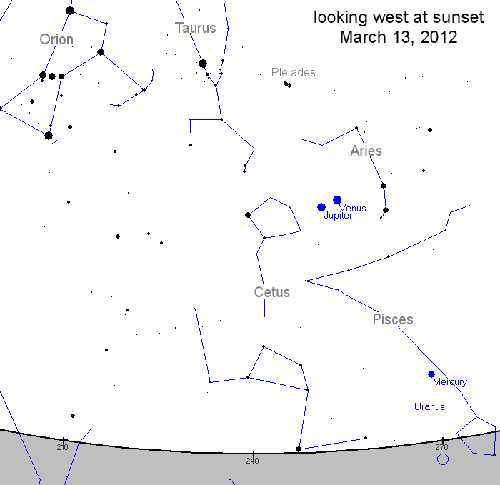
The brightest planets in the solar system are lining up in the evening sky, and you can see the formation Saturday night.
Go out at sunset and look west. Venus and Jupiter pop out of the twilight even before the sky fades completely black. The two brilliant planets surrounded by evening blue is a beautiful sight.
Venus and Jupiter are converging Saturday night. In mid-February they are about 20 degrees apart. By the end of the month, the angle narrows to only 10 degrees – so close that you can hide them together behind your outstretched palm. Their combined beauty grows each night as the distance between them shrinks.
A special night to look is Saturday, Feb. 25, when the crescent Moon moves in to form a slender heavenly triangle with Venus, Jupiter and the Moon as vertices.
One night later, on Sunday, Feb. 26, it happens again. This arrangement will be visible all around the world, from city and countryside alike.
The Moon, Venus and Jupiter are the brightest objects in the night sky; together they can shine through urban lights, fog, and even some clouds.
After hopping from Venus to Jupiter in late February, the Moon exits stage left, but the show is far from over.
In March, Venus and Jupiter continue their relentless convergence until, on March 12 and 13, the duo lie only three degrees apart – a spectacular double beacon in the sunset sky. Now you’ll be able to hide them together behind a pair of outstretched fingertips.
There’s something mesmerizing about stars and planets bunched together in this way – and, no, you’re not imagining things when it happens to you. The phenomenon is based on the anatomy of the human eye.
“Your eye is a bit like a digital camera,” explained optometrist Dr. Stuart Hiroyasu of Bishop, Calif. “There's a lens in front to focus the light, and a photo-array behind the lens to capture the image. The photo-array in your eye is called the retina. It's made of rods and cones, the organic equivalent of electronic pixels.”
There’s a tiny patch of tissue near the center of the retina where cones are extra-densely packed. This is called “the fovea.”
“Whatever you see with the fovea, you see in high-definition,” Hiroyasu said.
The fovea is critical to reading, driving, watching television. The fovea has the brain's attention.
The field of view of the fovea is only about five degrees wide. Most nights in March, Venus and Jupiter will fit within that narrow cone. And when they do – presto! It’s spellbinding astronomy.
Standing outdoors, mesmerized by planets aligned in a late winter sunset, you might just forget how cold you feel. Bring a coat anyway …
Dr. Tony Phillips works for the National Aeronautics and Space Administration.
Follow Lake County News on Twitter at http://twitter.com/LakeCoNews, on Tumblr at www.lakeconews.tumblr.com, on Google+, on Facebook at www.facebook.com/pages/Lake-County-News/143156775604?ref=mf and on YouTube at www.youtube.com/user/LakeCoNews .