 How to resolve AdBlock issue?
News
After years of increases in the rates of childhood obesity, a new UC Davis study shows that the increase slowed from 2003 to 2008 among California school children.
While encouraged by the results, the authors expressed concern about a group of youngsters currently driving the increase in obesity: children under age 10.
“Children who were obese entering the fifth grade remained obese in subsequent years as well, despite improvements in school nutrition and fitness standards,” said William Bommer, professor of cardiovascular medicine at UC Davis and senior author of the study. “And we suspect that this trend begins before kindergarten.”
Published in the February 2012 issue of the American Heart Journal, the results indicate a major turning point in efforts to reduce the impact of a chronic condition linked with a host of serious adult health issues that can begin in childhood, including heart disease, diabetes, breathing issues and some cancers.
Bommer served on a state task force that recommended standards to help protect K-12 children and teens from diseases related to sedentary living and unhealthy eating.
As a result, new laws in 2005 expanded fitness programs, nutrition education and alternatives to high-fat, high-sugar foods and beverages in California schools.
Since 1996, California schools have reported to the state Department of Education the results of a variety of fitness and body composition evaluations for fifth, seventh and ninth graders.
Body composition evaluations included body mass index – or BMI – measures, which determine if a child has a healthy weight or is overweight or obese.
Data on all students from 2003 to 2008 were provided to Bommer to evaluate and gauge the success of the new standards. For the current study, he and his colleagues included data on a total of 6.3 million students for whom complete fitness test results and body composition evaluations were available.
There were some encouraging results.
While childhood obesity is still on the rise – 2 percent more children were overweight and obese in 2008 than in 2003 – the rate of increase is slowing.
National studies in prior decades showed annual increases in obesity among children and teens between 0.8 percent and 1.7 percent each year.
For the current study, the rate of increase in California was an average of 0.33 percent per year.
In addition, while the results of fitness tests varied – abdominal strength and trunk extensor strength worsened overall, while upper body strength and flexibility improved overall – there was a significant increase in the percent of children with healthy aerobic capacity.
“This was particularly heartening, because cardiovascular and respiratory endurance directly correlate with reduced risks of heart disease and diabetes later in life, especially if it is maintained over time,” said Bommer.
One concern, however, was that students with lower aerobic capacity and upper body strength fitness scores and higher BMIs tended to live in counties with lower median household incomes (less than $40,000 per year) or with higher unemployment.
“We clearly need to do more to ensure that children, regardless of where they go to school, are benefiting from the recommended health standards,” said study lead author Melanie Aryana, a UC Davis researcher in cardiovascular medicine. “Expanding efforts to ensure that all California schools have the resources they need to make healthy changes will help.”
The team's strongest recommendation related to reducing the trend toward early onset, persistent obesity among younger school children.
This generation could eventually reverse recent advances in reducing heart disease risks and mortality, according to Bommer. He advises earlier fitness testing, including during preschool, to better monitor this increase together with interventions that specifically address unhealthy weight prior to age 10.
“Our study proves that nutrition and physical activity standards can help fewer children become obese during a critical time in their lives for establishing long-term healthy habits,” said Bommer. “But just imagine how much more we can do to reduce the impact of obesity if we are just as successful much earlier in children's lives.”
In addition to Bommer and Aryana, Zhongmin Li, UC Davis associate professor of internal medicine, was a study coauthor.
Follow Lake County News on Twitter at http://twitter.com/LakeCoNews, on Tumblr at www.lakeconews.tumblr.com , on Google+, on Facebook at www.facebook.com/pages/Lake-County-News/143156775604?ref=mf and on YouTube at www.youtube.com/user/LakeCoNews .
After drawing much public attention for his historic trek into California, the gray wolf designated as OR7 has turned north and crossed back into Oregon.
Originally part of a wolfpack in northeastern Oregon, OR7 wandered more than 1,062 miles in Oregon in September through December of last year before crossing into California last Dec. 28.
Gray wolves were extirpated in California the 1920s, leading to speculation that OR7 might be the first wolf to reestablish roots in the Golden State.
While in California, the wolf trekked south through eastern Siskiyou County, traveled through northeastern Shasta County and then resided in Lassen County for a few weeks, wildlife officials reported Friday.
On Feb. 11 he reentered Shasta County and then, about a week later, he crossed north into Siskiyou County, the Friday report explained.
The Department of Fish and Game (DFG) has continued to monitor his whereabouts through the use of a satellite tracking collar, and has been updating his status at www.dfg.ca.gov/wolf/ .
DFG biologists who have been closely monitoring the wolf’s position and progress say they have been impressed with his ability to travel considerable distances into new territory and then return, following a different route, to locations he has previously visited (possibly through his use of scent-marking), sometimes after a few weeks have passed.
Over the past two months, DFG has received many telephone calls and e-mails reporting sightings of OR7, but nearly all of these reports were inconsistent with the satellite location data.
Photographs and physical descriptions provided to DFG by the public were consistently determined to be an animal other than a wolf (usually a coyote in winter pelt).
In some cases, the available information was insufficient to make any confident determination of the species observed. However, in the past few days OR7 may have been observed in northern Siskiyou County.
In at least one instance, private citizens photographed tracks likely to have been made by OR7. Some of those photographs are available for viewing on DFG’s website.
After traveling 900 miles in California (calculated as air miles, not the actual distance traveled, which was greater), OR7 crossed the state line from Siskiyou County and back into Oregon on March 1.
DFG biologists have described his behavior as dispersal, where a young wolf seeks to find a mate or another wolf pack. That search has not been resolved for OR7 in California and his next movements cannot be predicted with any certainty.
It remains possible he will return to California in the future, officials said.
Follow Lake County News on Twitter at http://twitter.com/LakeCoNews, on Tumblr at www.lakeconews.tumblr.com , on Google+, on Facebook at www.facebook.com/pages/Lake-County-News/143156775604?ref=mf and on YouTube at www.youtube.com/user/LakeCoNews .
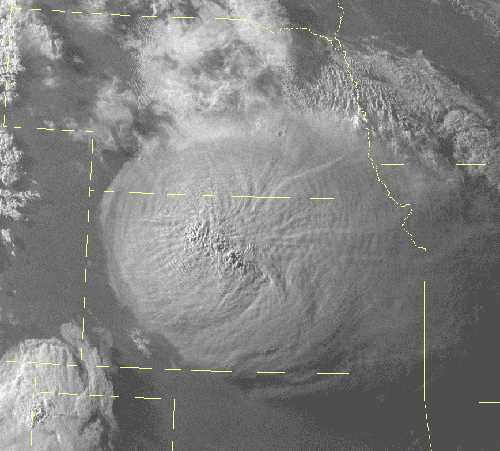
When you read the following paragraph, consider the following: Tornado season hasn't even started yet.
On Jan. 22 and 23, 2012, more than 37 tornadoes struck the southern USA. Ten of them tore across the Lower Mississippi Valley into Alabama.
Worst hit were St. Clair and Jefferson County, Ala., where 2 people were killed, about 100 others injured, and at least $30 million in damage was done. It was a chilling reminder of the April 2011 onslaught of deadly tornadoes that took a staggering toll across southern and Midwestern states.1
In southern parts of the USA, tornado season tends to peak in springtime. Yet January 2012 produced 73 winter tornadoes – third most of any January in recorded history.
Most of them struck southern states. And since over a quarter of the incredible 1,688 twisters confirmed across the US in 2011 occurred in the four-state region of Alabama, Georgia, Mississippi and Tennessee, residents there are becoming ever more wary of darkening skies.
“Even with our advances in science and communications, we can still be surprised by the deadliest storms,” said NOAA scientist Steve Goodman. “But NOAA is working with NASA and university researchers to give more lead time in tornado warnings.”
Southern tornadoes are especially insidious and challenging to track. The hilly, forested terrain in southern states makes an approaching twister harder to spot than in the flat Midwest. In the south you might not see the first evidence of an approaching tornado until it's almost in your back yard.
An Alabama resident describes the scene just before one of the April 2011 twisters struck near his home: “Suddenly, all the trees in my back yard corkscrewed violently, in unison, toward the northwest.” Moments later, the storm was there.
Rain wrapped tornadoes are especially hard to see, as are night-time tornadoes. And records indicate that southern tornadoes often strike at night.
To reduce the surprise, NOAA and NASA2 are developing the Geostationary Operational Environmental Satellite-R, or “GOES-R series,” with the first expected to launch in late 2015.
These next-generation weather satellites bristle with state-of-the-art instruments for improved scouting of these killer storms, even at night.
Tornadoes are, by their very nature, difficult to pin down. The Advanced Baseline Imager (ABI) on GOES-R will improve meteorologists' ability to assess conditions that spawn twisters.
Compared to current GOES imagers, the ABI provides twice the spatial resolution, three times as many channels of information, and more than five times the update rate.
“ABI will give us a much clearer picture of the clouds – where and how tall they are, how much and what kind of moisture they hold, and how they are moving and intensifying,” said NOAA research meteorologist Tim Schmit.
Most importantly, ABI can better detect the super-cold “overshooting tops” that mean severe weather is imminent. “Overshooting tops portend huge energy inside the cloud – it takes tremendous energy and upward velocity to poke through the lid of the tropopause,” explained Schmit.
“During episodes of severe weather, ABI can show conditions every 30 to 60 seconds. The system in use now only shows them every 7.5 minutes. And in normal mode, ABI will send readings over the continental U.S. every 5 minutes as opposed to every 15-30 minutes,” Schmit said.
Lightning is another key to tornadoes.
“Studies show that sudden changes in the total lightning correlate with [the onset of] tornadoes,” said Goodman.
Detecting lightning is a new specialty of GOES-R.
“GOES-R's Geostationary Lightning Mapper, or GLM, will see all the lightning: cloud-to-ground, cloud-to-cloud, and inside each cloud. And since this is the first time we'll have lightning detection from geostationary orbit, it means GOES-R will constantly monitor and map the lightning across the western hemisphere,” Goodman said.
The GLM is expected to give seven more minutes of lead time in tornado warnings. Average lead time now is 13 minutes.
“With GOES-R you'll have upwards of 20 minutes to get to a safe haven,” said Goodman.
That sure beats standing in your back yard, in the dark, waiting for the trees to twist.
Dauna Coulter writes for the National Aeronautics and Space Administration.
Follow Lake County News on Twitter at http://twitter.com/LakeCoNews, on Tumblr at www.lakeconews.tumblr.com , on Google+, on Facebook at www.facebook.com/pages/Lake-County-News/143156775604?ref=mf and on YouTube at www.youtube.com/user/LakeCoNews .

UPPER LAKE, Calif. – Upper Lake High School is asking for the community’s help in raising funds to send its Academic Decathlon team to the state competition this month.
The team, which won the Lake County competition Feb. 4, needs about $3,000 to attend the California Academic Decathlon, according to Upper Lake High Superintendent/Principal Pat Iaccino.
The California Academic Decathlon takes place March 15-18 in Sacramento. This year’s topic is “The Age of Empire.”
Upper Lake has been a longtime powerhouse in the Academic Decathlon competition.
Upper Lake Coach Anna Sabalone and Assistant Coach Angel Hayenga are now preparing their team for the big competition.
Winning team members are Jaqueline Estrada, Jordan Austin, Shayla Wyman, Byron Garcia, Christine Randall, Carlos Valencia, Oscar Nieves, Farhad Hussain, Justine Moran, Jamie Maddock and Krista Coleman.
Iaccino said community members wanting to contribute can contact the high school at 707-275-2338.
E-mail Elizabeth Larson at
LAKE COUNTY, Calif. – Lake County's senior centers are once again working together to raise money for important nutrition programs for seniors.
Last year Lake County senior centers participated in “March for Meals” to raise funds for their Meals on Wheels programs.
The 2011 March for Meals effort raised more than $30,000, according to a report from the centers.
This year the local senior centers are hoping to exceed that amount so that the vital services they provide that bring independence and hope to homebound seniors can continue.
With many challenges like the rising cost of gasoline and food prices, as well as a growing senior population in need of their services, senior centers are working hard to make up the difference.
Hundreds of volunteers come to the senior centers every day to prepare and serve meals, deliver meals to the homebound, run thrift stores and provide outreach services to the thousands of seniors in the community.
The month of March has been designated to bring awareness to the community of the many services that the centers provide, and give an opportunity for everyone to help.
Each senior center is running its own March for Meals campaign and need the community to help in this effort.
Bringing a sponsorship packet to places of employment, family, church or any other group to help raise money can make a world of difference to the efforts of local senior centers.
Senior centers with meals programs can be contacted at the following phone numbers, or by stopping by Middletown, 707-987-3113; Highlands Senior Center in Clearlake, 707-994-3051; Live Oak Senior Center in Clearlake Oaks, 707-998-1950; Lucerne, 707-274-8779; and Lakeport, 707-263-4218.
More information can be found online at www.lcseniors.com .
Follow Lake County News on Twitter at http://twitter.com/LakeCoNews, on Tumblr at www.lakeconews.tumblr.com , on Google+, on Facebook at www.facebook.com/pages/Lake-County-News/143156775604?ref=mf and on YouTube at www.youtube.com/user/LakeCoNews .
SACRAMENTO – Scientists at the U.S. Geological Survey have, for the first time, demonstrated how aquifer composition can affect how excessive levels of phosphorous – an essential nutrient contained in fertilizers – can be carried from fertilized agricultural fields via groundwater to streams and waterways.
This finding will allow for more informed management of agriculture, ecosystem and human water needs, according to the agency.
Nutrient transport from agricultural fields, including nitrogen and phosphorus compounds, is one of the most serious environmental problems throughout the world because it can cause adverse effects on aquatic ecosystems and/or drinking water supplies, USGS reported.
Excess phosphorus can stimulate algal growth in streams and lakes, which can lead to decreased levels of dissolved oxygen resulting in the death of sensitive organisms including fish, or can cause changes in the types of algae that are present. Some forms of algae can also release toxins that can negatively impact human health.
“While the widespread use of fertilizer has increased crop yields, excessive application is not only wasteful, but it can also be harmful to water quality, fish, and human health,” said USGS director Marcia McNutt. “New USGS science demonstrates how and when excess phosphorous is moving underground from fields to streams, and what underground conditions can mitigate nutrient transport.”
Researchers examined phosphorus quantities and movement in soils, and groundwater in five agricultural settings across the United States, including California, Washington, Nebraska, Indiana and Maryland.
Sites were chosen to represent common variations in soil geochemistry, climate, irrigation usage and cropping systems found across the nation, allowing for the first time, a comparison of factors that contribute to phosphorus movement in shallow aquifers.
The study included assessment of a variety of agricultural practices, so that factors contributing to phosphorus movement via groundwater could be compared.
“Until now, studies of phosphorus transport to streams have been focused on surface-water pathways because it was previously assumed that phosphorus does not dissolve into soil water and is not mobilized to groundwater,” explained USGS researcher Joseph Domagalski. “Farmers and resource managers can use the study information to better manage the application of fertilizer on agricultural fields and minimize phosphorus contamination in downstream water bodies.”
The study examines how iron and other elements present in particles in an aquifer can immobilize phosphorus and remove it from groundwater.
Under the right conditions, such as in the Maryland site, these processes completely limit phosphorus movement in groundwater. However, if aquifer particles are continually exposed to excess phosphorus and become saturated, the excess phosphorus will eventually be transported to a discharge zone, such as a stream.
Using this information, resource managers can evaluate what types of aquifer systems are more likely to transport phosphorus into surface water bodies.
The study also shows that inexpensive soil tests, routinely employed to estimate fertilizer requirements, can be used on deeper soil samples to evaluate the potential for downward movement of phosphorus below the plant rooting depth in agricultural areas.
The potential for groundwater transport of phosphorus can be evaluated with basic geochemical information, such as measurements of pH, dissolved oxygen, and dissolved phosphorus in samples of shallow ground water.
The study of agricultural chemicals is one of several priority topics currently being addressed by the U.S. Geological Survey National Water-Quality Assessment Program.
More information about the study is available online at http://pubs.usgs.gov/fs/2012/3004/ and in the Journal of Hydrology, “Subsurface transport of orthophosphate in five agricultural watersheds,” http://www.sciencedirect.com/science/article/pii/S0022169411005403.
Follow Lake County News on Twitter at http://twitter.com/LakeCoNews, on Tumblr at www.lakeconews.tumblr.com , on Google+, on Facebook at www.facebook.com/pages/Lake-County-News/143156775604?ref=mf and on YouTube at www.youtube.com/user/LakeCoNews .