 How to resolve AdBlock issue?
News
LAKE COUNTY, Calif. – As part of AmeriCorps Week, the Lake County Office of Education’s AmeriCorps program and community partners will hold the third annual All AmeriCorps Food Drive on Saturday, March 10.
The drive will take place from 9 a.m. to 3 p.m. at Safeway on 11th Street in Lakeport and Grocery Outlet, located on Main Street in Lakeport and Olympic Drive in Clearlake.
The group reported that all donations stay in Lake County and will be donated to North Coast Opportunities for distribution to Lake County’s food cupboards.
Over the past 11 years, the Lake County Office of Education’s AmeriCorps program has collected and donated more than 46,000 pounds of food to our local food cupboards.
Though it sounds like a large amount, the local AmeriCorps reported that it's a small part of what is needed to keep the county's children, families and community fed throughout the year.
Requested food items include canned fruits and vegetables; canned or dry soup mixes; boxed dinners like Hamburger Helper; canned meats and stews; spaghetti and other pastas; canned cooking sauces, including spaghetti and pasta sauces; pork and beans; packaged dry goods, such as rice, stuffing, boxed potatoes and baking mixes; breakfast foods, including cereal, oatmeal, pancake mix and syrup; and juice or fruit drinks on cans or plastic containers.
The group asks that no foods in glass jars or bottles be donated.
For more information about the food drive or the work of the local AmeriCorps, visit www.lakecountyamericorps.org or call 707-263-8796.
Follow Lake County News on Twitter at http://twitter.com/LakeCoNews, on Tumblr at www.lakeconews.tumblr.com , on Google+, on Facebook at www.facebook.com/pages/Lake-County-News/143156775604?ref=mf and on YouTube at www.youtube.com/user/LakeCoNews .
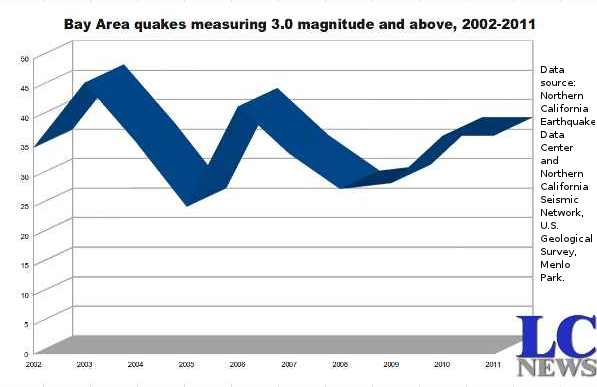
Two moderate-sized earthquakes hit within seconds of each other in the Bay Area early Monday morning, with thousands of people around the state reporting that they felt the second, larger temblor.
The United States Geological Survey said the quakes, measuring 3.5 and 4.0, took place just after 5:30 a.m. Monday.
The first, at approximately 5:33:12 a.m., was centered one mile north of El Cerrito, one mile south southeast of East Richmond Heights and four miles north northwest of Berkeley, at a depth of 5.2 miles, the U.S. Geological Survey reported.
The survey reported receiving only two shake reports on that quake.
Eight seconds later, the 4.0-magnitude quake hit. U.S. Geological Survey records showed that second temblor was centered in a slightly different spot, one mile north northwest of El Cerrito, one miles south southeast of East Richmond Heights and four miles north northwest of Berkeley, at a depth of 5.3 miles.
By Monday evening more than 14,500 people in nearly 300 California zip codes reported feeling that quake, according to survey shake report records.
Two smaller aftershocks centered one miles southeast of East Richmond Heights, followed, one measuring magnitude 1.9 at 6:03 p.m. and the second measuring 1.1 at 6.29 p.m., the survey reported.
E-mail Elizabeth Larson at
The California Office of Traffic Safety (OTS) on Monday announced deaths due to handheld cell phone use by drivers have dropped since California enacted a ban on handheld cell phone use while driving in July 2008.
The analysis, conducted by the Safe Transportation Research and Education Center (SafeTREC) at the University of California, Berkeley, showed that, when looking at state crash records two years before and two years after the handheld ban went into effect, overall traffic deaths declined 22 percent while handheld cell phone driver deaths went down 47 percent.
Similar results were shown for hands-free cell phone use as well as injuries in both categories.
“These results suggest that the law banning handheld cell phone use while driving had a positive impact on reducing traffic fatalities and injuries,” said Dr. David Ragland, director of SafeTREC.
Contributing to the decline in cell phone deaths and injuries is an overall drop in cell phone usage while driving.
A Statewide Intercept Opinion Survey commissioned with federal funds by OTS last summer showed 40 percent of California drivers reported they talk less (handheld and hands free) since enactment of the handheld cell phone ban.
In February 2010, the Insurance Institute for Highway Safety (IIHS) reported similar results from their telephone survey which found that 44 percent of drivers in states with bans reported they don't use phones (handheld or hands-free) when driving, compared with 30 percent in states without such laws.
Further, IIHS observational research found that bans on handheld phoning while driving can have big and long-term effects in curbing handheld cell phone use.
“While we are thrilled to see that the handheld ban in California has worked to reduce distracted driving crashes and overall cell phone use, there are still far too many drivers talking and texting while driving,” said Christopher J. Murphy, director for the California Office of Traffic Safety. “A good step for parents is to never call or text your kids if you think they might be driving.”
Cell phone usage while driving is top of the mind with California drivers, which they see as carrying a significant traffic safety threat.
The same OTS statewide opinion survey reported that 62 percent of respondents stated that texting and talking are the biggest safety concerns on California roadways and 84 percent claimed cell phone conversations or texting while driving constitute the most serious distractions while driving.
Another clue to the reduction in crashes might be found in new information from the Department of Motor Vehicles that shows, statewide in 2011, there were 460,487 handheld cell phone convictions – up 22 percent from 361,260 convictions in 2010 and 52 percent from 301,833 in 2009.
The cost of a ticket for a first offense is at least $159, and $279 for subsequent offenses.
“Highly visible and publicized enforcement, along with the cooperation of the motoring public to reduce distractions behind the wheel, has played a significant role in the reduction in collisions,” said California Highway Patrol (CHP) Commissioner Joe Farrow. “In addition, there are many educational programs developed by the CHP, our allied agencies, as well as nonprofit organizations such as Impact Teen Drivers that have made sustained efforts in reducing distracted driving.’’
In April 2011, the Office of Traffic Safety using federal funds conducted the nation’s first statewide cell phone observational survey that showed nine percent of drivers were talking or texting while driving, representing hundreds of thousands of drivers at any given time.
Research has shown that drivers who use handheld devices are four times as likely to get into crashes serious enough to injure themselves.
The distracted driving section of the California Strategic Highway Safety Plan (SHSP) has developed the state’s “It’s Not Worth It!” public awareness campaign that employs TV, radio commercials, billboards, Internet, social media and other outreach.
In addition, millions of Californians see the “Hand-held Cell Ticket – $159 – It’s Not Worth It” message on more than 625 permanent changeable message signs for several days throughout the year.
The SHSP’s distracted driving section is currently formulating plans to increase the data and research available to more accurately understand and combat the problem.
Follow Lake County News on Twitter at http://twitter.com/LakeCoNews, on Tumblr at www.lakeconews.tumblr.com , on Google+, on Facebook at www.facebook.com/pages/Lake-County-News/143156775604?ref=mf and on YouTube at www.youtube.com/user/LakeCoNews .
LAKE COUNTY, Calif. – Three male cats are up for adoption this week at Lake County Animal Care and Control.
A gray cat and two tabbies – an orange and a brown – are waiting to meet you.
Cats that are adopted from Lake County Animal Care and Control are either neutered or spayed and microchipped before being released to their new owner. License fees do not apply to residents of the cities of Lakeport or Clearlake .
If you're looking for a new companion, visit the shelter. There are many great pets there, hoping you'll choose them.
The following cats at the Lake County Animal Care and Control shelter have been cleared for adoption (other cats pictured on the animal control Web site that are not listed here are still “on hold”).

'Kevin'
This is Kevin, and he’s a great big cuddly cat. Kevin is featured in the video above.
He’s very friendly and affectionate. He would prefer to be an only cat.
Because Kevin is already neutered, his adoption fee is only $45, or $35 for seniors.
He’s in cat room kennel No. 5, ID No. 31753.

Brown male tabby
This brown and white male tabby is 7 months old.
He has gold eyes and a short coat.
He is already neutered, and his $90 adoption fee covers his vaccination and a microchip.
Find him in cat room kennel No. 89b, ID No. 31937.

Orange male tabby
This orange male tabby is 7 months old, like his kennel mate, the brown tabby.
He is a domestic short hair mix, with gold eyes.
He is neutered, and also has a $90 adoption fee that will including vaccinations and a microchip so he can easily be found if lost.
Find him in cat room kennel No. 89a, ID No. 31936.
Adoptable cats also can be seen at http://www.co.lake.ca.us/Government/Directory/Animal_Care_And_Control/Adopt/Cats_and_Kittens.htm or at www.petfinder.com .
Please note: Cats listed at the shelter's Web page that are said to be “on hold” are not yet cleared for adoption.
To fill out an adoption application online visit http://www.co.lake.ca.us/Government/Directory/Animal_Care_And_Control/Adopt/Dog___Cat_Adoption_Application.htm .
Lake County Animal Care and Control is located at 4949 Helbush in Lakeport, next to the Hill Road Correctional Facility.
Office hours are Monday through Friday, 8 a.m. to 5 p.m., and 1 p.m. to 3 p.m., Saturday. The shelter is open from 10:30 a.m. to 4:30 p.m. Monday through Friday and on Saturday from 1 p.m. to 3 p.m.
Visit the shelter online at http://www.co.lake.ca.us/Government/Directory/Animal_Care_And_Control.htm .
For more information call Lake County Animal Care and Control at 707-263-0278.
Follow Lake County News on Twitter at http://twitter.com/LakeCoNews, on Tumblr at www.lakeconews.tumblr.com , on Google+, on Facebook at www.facebook.com/pages/Lake-County-News/143156775604?ref=mf and on YouTube at www.youtube.com/user/LakeCoNews .
Scientists have come up with an entirely new way to monitor the health of Earth’s plants from space.
In work published in Geophysical Research Letters, researchers working at NASA’s Jet Propulsion Laboratory (JPL) and in Germany and Japan report on how measurements taken from space can open a whole new window onto the planet’s carbon cycle.
Carbon is a building block of life. It is also a key component of our climate.
Carbon dioxide – a gas that exists naturally in the air, but is also produced by humans when we burn fossil fuels, drive cars and chop down trees – acts as a thermostat that controls the temperature of the planet.
As a “greenhouse gas,” it acts like a blanket that traps heat close to the surface of the Earth. The more carbon dioxide we emit, the more the warming.
Since the beginning of the industrial age, carbon dioxide levels have gone up by nearly 40 percent, and the world’s average temperature has risen by about 0.5 degrees Celsius (nearly 1 degree Fahrenheit) as a result.
Knowing how much carbon is going into and out of the Earth’s land, air and oceans – the carbon cycle – is critical for understanding how much global warming is likely to happen to our planet in the future. And plants and vegetation are a key part of this cycle.
When plants photosynthesize, they use energy from sunlight to turn carbon dioxide from the air into sugars used to live and grow.
In doing so, they give off a fluorescent light – a glow that can’t be seen with the naked eye, but that can be seen with the right instruments.
More photosynthesis translates into more fluorescence, meaning that the plants are very productive in taking up carbon dioxide.
The amount of carbon dioxide taken up by plants is called “gross primary productivity,” and is the largest part of the global carbon cycle.
Launched in 2009, the Japanese satellite Greenhouse Gases Observing Satellite (GOSAT) has the ability to pick up this glow.
Using GOSAT data, JPL scientist Christian Frankenberg and colleagues have shown that it is possible to pick up this fluorescent glow from space over the entire planet, and thereby infer details about the health and activity of vegetation on the ground.
Typically, our best guess of global plant productivity comes from looking at the general greenness of plants from space, taking into account a plant’s ability to both block out harmful infrared radiation as well as absorb useful visible light.
Normally, we would expect that the greener the plant, the more productive it is. However, there are exceptions to this rule.
Evergreen trees in the winter, for example, are not very productive; water-stressed tropical forests may ramp down photosynthesis until the rains come back, but in the meantime they still maintain their greenness. So greenness is not always the best measure of plant productivity.
“The greenness-based approaches offer good approximate estimates, but they make assumptions. They are indirect estimates relying on additional information about the plants that is not always readily available, and are often contaminated by atmospheric interference,” explained Joshua Fisher, a climate scientist at JPL and co-author of the paper.
“Our observations of plant fluorescence are instead direct indicators of plant productivity,” said Fisher. “They don’t make any assumptions based on apparent greenness, and take advantage of a narrow window in the atmosphere where fluorescence can escape to space unimpeded by atmospheric interference.”
In addition, fluorescence responds immediately to environmental stress, while it can take days or even weeks before changes in greenness are seen by space satellites. The fluorescent glow given off by plant activity can therefore offer an early warning sign.
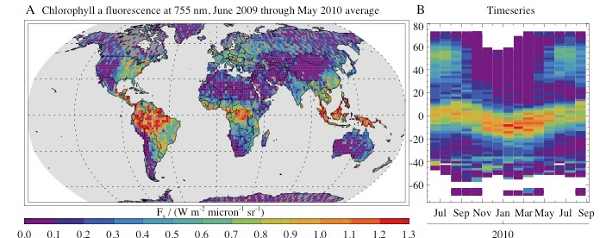
The JPL-led team – which also includes scientists from the Institute for Meteorology and Climate Research in Germany, the Max Planck Institute for Biogeochemistry in Germany, the Japan Aerospace Exploration Agency and the National Institute for Environmental Studies in Japan – has produced a global map of plant activity from space.
The map pinpoints areas of very active vegetation and areas of lower activity such as barren or snow-covered surfaces.
Plants fluoresce only when they are actively photosynthesizing. If plants are in a drought situation and short of water, for example, they don’t photosynthesize as much as when growing conditions are good, and their fluorescence drops.
The map shows increased plant activity over tropical evergreen forests, the eastern United States, Asia and central Europe. It also captures smaller-scale variations, such as enhanced fluorescence in southeastern Australia and comparatively low fluorescence in the Iberian Peninsula.
In addition, a pronounced seasonal variation in plant activity is observed, reflecting the growing season in the northern hemisphere and seasonal vegetation shifts in the tropics.
While this is the not the first map of plant fluorescence produced from space, these new findings provide the first accurate fluorescence data because they take into account important instrument effects that can severely impact the accuracy.
It is also the first time that fluorescence has been compared to model-derived gross primary productivity on a global scale. The authors will continue to scrutinize finer details, for example, the higher-than-expected fluorescence signals over croplands and savannas (thought to be linked to underestimates of plant productivity).
As Frankenberg explains, the work is a proof-of-principle. “We’ve shown that chlorophyll fluorescence exhibits a strong linear correlation with gross primary production, and can therefore be used as an entirely new way to monitor plant productivity from space.”
The findings bode well for NASA’s upcoming mission, the Orbiting Carbon Observatory-2 (OCO-2), which will measure Earth’s carbon dioxide levels and plant fluorescence from space much like GOSAT. OCO-2 (launch date to-be-determined), will collect about 50 times more data than GOSAT and offer full coverage of the planet.
Together, GOSAT and OCO-2 will provide an unprecedented amount of information on the health of plants and carbon dioxide levels of our planet.
The hope is that this will give us a much better grip on the Earth’s carbon cycle — and therefore climate change.
Amber Jenkins works for the NASA Jet Propulsion Laboratory.
Follow Lake County News on Twitter at http://twitter.com/LakeCoNews, on Tumblr at www.lakeconews.tumblr.com , on Google+, on Facebook at www.facebook.com/pages/Lake-County-News/143156775604?ref=mf and on YouTube at www.youtube.com/user/LakeCoNews .
What’s crunchy, sweet, low in calories, high in fiber, with virtually no fat? Jicama!
Pronounced HEE-kah-muh, this vegetable is a popular dietary staple in points south of our border, but may be a bit underappreciated in our culinary culture. Even so, many have embraced it enthusiastically, using it creatively in ways that go far beyond a place on a raw veggie platter.
Jicama, a legume, is also known as the yam bean, and is a low-growing vine native to Mexico. A member of the morning glory family and a relative of the sweet potato, jicama is best known for its large, edible tuberous root.
The other parts of the jicama plant – the vine, leaves, and seeds – contain poisonous compounds and should not be eaten.
Its country of origin, as well as the turnip-like shape and potato-like coloring of its root, serve as inspiration for a couple of its other monikers: Mexican turnip and Mexican yam.
If left to grow indefinitely, jicama roots – those lumpy, humble-looking orbs found in most supermarket produce aisles – can become amazingly big. The largest recorded jicama root was a 23 kilogram specimen from the Philippines. That’s just over 50 pounds!
I doubt any of us will see such gargantuan roots, however, as most jicamas slated for market remain under six pounds.
Jicama has been cultivated by all Mesoamerican civilizations.
The Spanish introduced it to the Philippines in the 17th century, and from there it spread throughout Asia, where it remains popular in the cuisines of China, Vietnam, Indonesia, Thailand, Malaysia, India and its Asian landing place, the Philippines.
The root was a popular staple on ocean-traversing ships prior to refrigeration because it stored well, could be eaten raw and was thirst-quenching.
Jicama is available year-round, with its peak season from December to June.
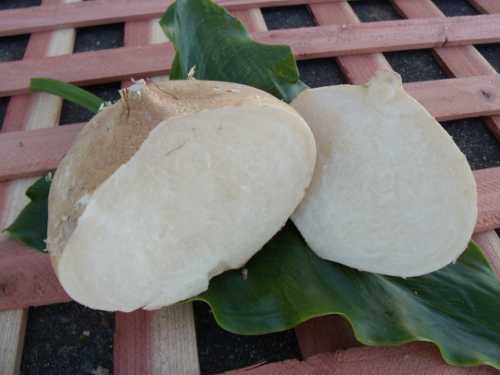
Its light brown, papery skin is tough and should be cut off with a sharp knife to expose jicama’s firm white flesh, which may be used raw or in some cooked applications.
Jicama is moist, crunchy and pleasantly sweet, with a texture similar to a raw potato. Some describe its flavor as somewhat nutty, or as a cross between a water chestnut and an apple.
It’s a popular street food in Mexico, where it’s served raw (sometimes on a stick) with a squeeze of lime and a sprinkle of spicy chili powder.
It’s often combined in salads with citrus fruits such as oranges, tangerines or grapefruits, or in salsas with tropical fruits such as mango and pineapple.
It becomes an unusual component in slaws with ingredients like Napa cabbage, carrots, snow peas, red peppers, mango or cilantro.
Combined with watermelon, mint, lime juice and honey, a refreshing salad is formed.
In addition to these wonderful flavor combinations, chefs have been known to successfully combine jicama with chile peppers, ginger, pumpkin seeds (known as pepitos in Mexico) and queso fresco, a style of Mexican cheese.
Jicama provides crunch and texture in spring rolls or in sushi in place of cucumber.
Similar to water chestnuts, jicama can be added to stir fries. Quick cooking methods – or addition at the last minute - are best to retain its characteristic fresh crunch.
Some cooks boil and mash it like potatoes, others add it to stews.
Jicama may also be marinated and grilled. A few minutes on each side until grill marks form is enough.
Jicama, which is composed of nearly 90 percent water, is high in carbohydrates in the form of dietary fiber.
It contains stores of vitamins C, B and A, along with calcium and phosphorous.
When shopping for jicama, look for medium-sized firm tubers with dry roots.
If allowed to become too large, jicama’s sugars will convert to starch, making the flesh woody. Hence the recommendation that roots larger than the size of two fists be avoided.
Be sure not to purchase jicama that has soft or wet spots, as this can indicate rot.
As to appropriate storage of your jicama, who would have thought of this as a controversial subject? Apparently there are two opposing schools of thought.
Some recommend storing it in the fridge in a plastic bag, where they claim it will keep well for about two weeks.
In contrast to this, others eschew refrigeration, saying its moisture can cause mold and early spoilage. They insist that storing jicama in a cool, dry, dark place outside the fridge is the way to go.
If using this storage method, the recommended temperature is between 53 and 60 degrees Fahrenheit. Proponents claim that if jicama roots are fresh when purchased, they’ll keep for between one and four months when stored this way.
In case you’re wondering, I’ve had bad luck storing jicama in the fridge and prefer to store it in my pantry. I’ve never kept it for more than a couple of weeks, though, so can’t attest to longevity.
Both sides do agree that jicama should be stored in the fridge once cut.
The creamy texture of avocado is a pleasant contrast to jicama’s fresh, snappy crunch, and the recipe offered today combines these two ingredients, as well as the supporting flavors of lime, scallions and mint.
If available, experiment with different types of limes (such as golden limes like the Rangpur or calamansi). Since the acidity of each variety will be different, adjust the ratio of lime to oil as needed.
Before I go, did you know that our friend, jicama, has a stepbrother of sorts, the milk jicama (jicama de leche in Spanish)?
This jicama is oblong in shape and produces a milky juice.
In contrast, the more popular turnip-like jicama sold in stores is called jicama de agua (or water jicama) because it produces a translucent juice.
What’s amazing is that both these jicamas grow from the same seed.
Have a wonderful Sunday! Enjoy this unseasonably balmy weather, which is perfect for a refreshing salad and the pleasant crunch of jicama.
Avocado and jicama salad with lime vinaigrette
1 head butter lettuce, the leaves separated
1 head Romaine lettuce, the heart leaves only, or several handfuls small spinach leaves and arugula leaves
1 small jicama, about ½ pound
2 large avocados, ripe but firm
Zest of one lime, plus one tablespoon juice
5 tablespoons extra virgin olive oil
Sea salt and freshly ground pepper
2 scallions, including an inch of the green stems
15 mint leaves, torn into small pieces
Wash and dry the greens. Slice them into narrow ribbons and set aside.
Peel the jicama and sliver it into very thin matchsticks.
Peel and slice the avocados into wedges.
Whisk the lime zest, juice and olive oil together with a few pinches of salt.
Slice the scallions into long, thin slivers.
Toss the greens with the jicama, avocado, scallions, mint and a few pinches of salt. Then dress the salad with enough vinaigrette to coat lightly but thoroughly.
Season with pepper and serve.
This recipe by Deborah Madison is from the cookbook “Local Flavors: Cooking and Eating from America’s Farmers’ Markets.”
Esther Oertel, a freelance writer, cooking teacher, and speaker, is passionate about local produce and all foods in the vegetable kingdom. She welcomes your questions and comments and may be reached at
Follow Lake County News on Twitter at http://twitter.com/LakeCoNews, on Tumblr at www.lakeconews.tumblr.com , on Google+, on Facebook at www.facebook.com/pages/Lake-County-News/143156775604?ref=mf and on YouTube at www.youtube.com/user/LakeCoNews .