 How to resolve AdBlock issue?
News
LAKE COUNTY, Calif. – World AIDS Day – marked this year on Saturday, Dec. 1 – is focusing on a future when the disease will be just a tragic memory.
The 2012 event’s motto is “Getting to Zero,” with the goal that by 2015 there will be zero AIDS-related deaths and infections, as well as an end to discrimination.
Over the past three decades, as the disease has spread across the globe, it has hit some nations particularly hard. On the African continent, AIDS and HIV remain crippling epidemics.
However, the United Nations’ World AIDS Day Report shows significant progress in preventing and treating HIV/AIDS in the past two years.
The report, published by the Joint UN Programme on HIV/AIDS (UNAIDS), also found that the number of people accessing life-saving treatment rose by 60 percent and new infections have fallen by half in 25 countries – 13 of them in sub-Saharan Africa – while AIDS-related deaths have dropped by a quarter since 2005.
“We have moved from despair to hope. Far fewer people are dying from AIDS,” said UNAIDS Executive Director Michel Sidibé in a World AIDS Day statement.
“The pace of progress is quickening. It is unprecedented – what used to take a decade is now being achieved in just 24 months. Now that we know rapid and massive scale up of HIV programs is possible, we need to do more,” Sidibé added.
The UNAIDS report estimates 1.3 million people in the United States are living with AIDS.
The California Department of Public Health’s County Health Status Profiles 2012 said the crude case rate of reported AIDS cases for Californians aged 13 years and older was 9.4 cases per 100,000 population. That is approximately one reported AIDS case for every 10,628 persons, a rate based on an average of rates from 2008 through 2010.
The statewide AIDS crude case rate did not meet the Healthy People 2010 National Objective 13-1 of no more than 1.0 AIDS case per 100,000 population aged 13 years and older, the report said.
Lake County ranked No. 28 statewide for prevalence of cases, with a rate of 1.7 cases per 100,000 from 2008 to 2010 and a crude case rate of 2.9.
Researchers are reporting that scaling up treatment and education are helping reduce not just AIDS-related deaths but also dropping new infections to the lowest levels since 1997.
The Global Fund to Fight AIDS, Tuberculosis and Malaria this week reported that there has been an increase of 900,000 in the number of people receiving antiretroviral therapy since the end of 2011, taking the total now getting treatment under programs supported by the Global Fund to 4.2 million.
Contributing to those increases is the dropping costs of first-line antiretroviral drugs costs, which today cost less than $100 for a year’s supply of the least expensive regimen recommended by the World Health Organization, down from more than $10,000 in 2000.
Health officials also have increased the distribution of condoms, care and support for patients, and services to at-risk populations.
Young people aged 15-24 are the group most affected by HIV, accounting for 40 percent of all new adult HIV infections, according to UNAIDS.
UNAIDS reported that in 2011 about five million young people were living with HIV worldwide, with more than 2,400 being newly infected every day.
The Centers for Disease Control and Prevention in Atlanta reported that 50,000 people in the United States get HIV each year. One in four new HIV infections occur in youth, between the ages of 13-24.
As advocates are focusing their efforts on zeroing out AIDS and HIV, the global financial crisis has presented another challenge for them.
World AIDS Campaign Chair Allyson Leacock said efforts should be increasing to achieve universal access to treatment.
However, there are concerns that won’t be the case, with the International Treatment Preparedness Coalition reporting that funding for HIV had already begun to flat line at the end of the last decade.
In 2011, the Global Fund failed to raise the minimum $13 billion that was needed to maintain its current programs, the coalition said.
Email Elizabeth Larson at
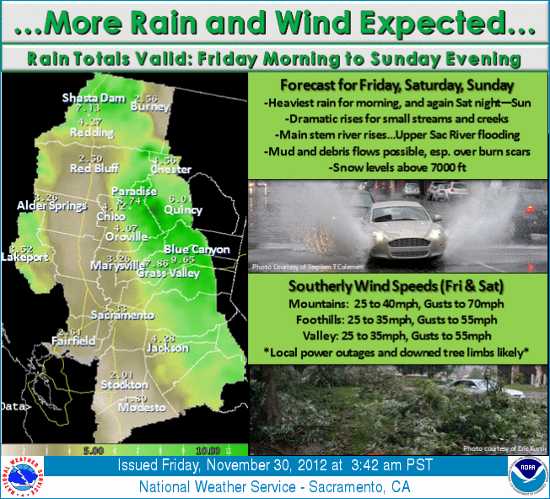
LAKE COUNTY, Calif. – The last large storm of the recent three-storm series is forecast to impact Lake County and much of Northern California on Saturday, bringing with it the most rain and highest winds of the storm trio.
The second storm that moved through on Thursday dumped more 1 inch of rain throughout Lake County, with some areas recording nearly four inches according to Western Weather Group stations while the National Weather Service in Sacramento reports that some high-elevation areas around the county received up to 10 inches of rain.
The National Weather Service in Sacramento reported on Friday afternoon that the strongest storm – with the most rains and highest winds – will reach Lake County Saturday evening.
Weather will remain unstable during the day Saturday with showers, some heavy at times, as the storm front approaches.
As the storm arrives in the evening bringing heavy rains, creeks and streams will quickly rise and urban localized flooding is predicted.
Mud and debris flows, particularly in burn areas, are anticipated, and caution is urged while driving.
With this storm, Lake County is forecast to receive an additional 4 to 8 inches of rain and 25 to 35 mile-per-hour southerly winds, with gusts up to 50 miles per hour.
Due to the saturated grounds combined with the high winds expected with this storm, power outages are expected in local areas.
Temperatures are forecast to remain mild and in the 50s until the storm moves through on Sunday evening.
Residents are urged to use caution when driving and to stay safe this weekend.
Email Terre Logsdon at
CLEARLAKE OAKS, Calif. – A fire that occurred in the Spring Valley subdivision Friday afternoon destroyed a home.
The home, located at 3865 Quail Trail, was reported on fire by a neighbor, with firefighters dispatched at 3:45 p.m., according to radio reports.
Northshore Fire Protection District Deputy Chief Pat Brown said the residence was a singlewide mobile home with numerous additions.
When he and his firefighters arrived on scene, the residence was fully involved. “It was really ripping when we got there,” Brown said.
An older woman was in the home at the time the fire broke out, he said. “One of the neighbors pulled her out when the fire got going.”
Brown said firefighters dumped 1,000 gallons of water on the fire as quickly as they could and then kept up the attack to put the fire out.
The fire caused two propane tanks to explode, Brown said.
He said firefighters had the fire knocked down within 10 minutes and fully contained in 40 minutes. Containment was reported shortly before 4:30 p.m., with mop up taking another few hours.
No other structures were threatened, said Brown.
As to the cause, “We think it was accidental,” Brown said. “It started near the stove.”
Northshore Fire sent three engines, a water tender and a total of three chiefs, including Brown. He said Lake County Fire Protection District did a cover assignment for the district while they were engaged with the Spring Valley fire.
Email Elizabeth Larson at
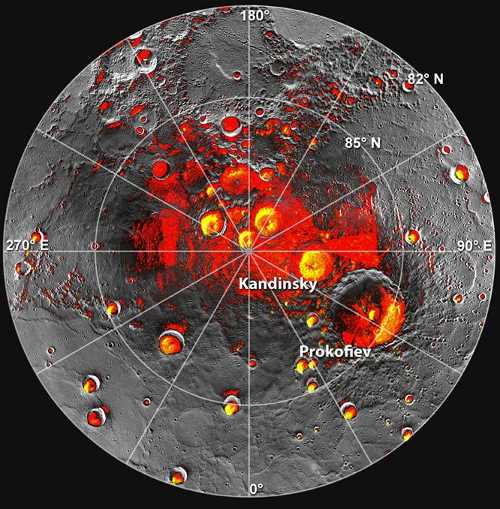
New data from NASA’s Messenger spacecraft suggest that there’s enough ice on Mercury to encase the entire US capitol.
“The new data indicate the water ice in Mercury’s polar regions, if spread over an area the size of Washington, D.C., would be more than 2 miles thick,” said David Lawrence, a Messenger participating scientist at the Johns Hopkins University Applied Physics Laboratory (APL) in Laurel, Md., and lead author of one of three papers describing the findings in the online edition of Science Express.
Given its proximity to the Sun, Mercury would seem to be an unlikely place to find ice. But the tilt of Mercury’s rotational axis is almost zero – less than one degree – so there are pockets at the planet’s poles that never see sunlight.
Scientists suggested decades ago that water ice might be trapped in those shadowed areas at Mercury’s poles.
The idea received a boost in 1991, when the Arecibo radio telescope in Puerto Rico detected unusually radar-bright patches at Mercury’s poles, spots that reflected radio waves in the way one would expect if there were water ice.
Many of these patches corresponded to the location of large impact craters mapped by the Mariner 10 spacecraft in the 1970s. But researchers weren’t sure if the radar-bright patches detected by Arecibo corresponded to shadowy places in the craters.
Messenger’s arrival at Mercury last year changed that. Images from the spacecraft’s Mercury Dual Imaging System taken in 2011 and earlier this year show that radar-bright features at Mercury’s north and south poles are within shadowed regions on Mercury’s surface.
Now, the newest data from Messenger confirm that water ice is the major constituent of Mercury’s north polar deposits. In the coldest places, the ice is exposed on the surface. In slightly warmer spots, some kind of dark insulating material appears to cover the ice.
Messenger uses neutron spectroscopy to measure average hydrogen concentrations within Mercury’s radar-bright regions. Ice concentrations are derived, in turn, from the hydrogen measurements. This is possible because water, or H2O, is two parts hydrogen.
“The neutron data indicate that Mercury’s radar-bright polar deposits contain, on average, a hydrogen-rich layer more than tens of centimeters thick beneath a surficial layer 10 to 20 centimeters thick that is less rich in hydrogen,” said Lawrence. “The buried layer has a hydrogen content consistent with nearly pure water ice.”
Data from Messenger’s Mercury Laser Altimeter (MLA) – which has fired more than 10 million laser pulses at Mercury to make detailed maps of the planet’s topography – corroborate the ice hypothesis, writes Gregory Neumann of the NASA Goddard Flight Center.
In a second paper, Neumann and his colleagues report that the first laser measurements of the shadowed north polar regions reveal irregular dark and bright deposits near Mercury’s north pole.
“Nobody had seen these dark regions on Mercury before, so they were mysterious at first,” Neumann said.
Neumann suggests that both the dark and bright materials were brought to Mercury by comets or asteroids, a finding corroborated in a third paper led by David Paige of the University of California, Los Angeles.
“The dark material is likely a mix of complex organic compounds delivered to Mercury by the impacts of comets and volatile-rich asteroids, the same objects that likely delivered water to the innermost planet,” Paige said.
This dark insulating material is a new wrinkle to the story, added Sean Solomon of the Columbia University’s Lamont-Doherty Earth Observatory, principal investigator of the Messenger mission.
“For more than 20 years the jury has been deliberating on whether the planet closest to the Sun hosts abundant water ice in its permanently shadowed polar regions,” said Solomon. “Messenger has now supplied a unanimous affirmative verdict.”
“But the new observations have also raised new questions,” added Solomon. “Do the dark materials in the polar deposits consist mostly of organic compounds? What kind of chemical reactions has that material experienced? Are there any regions on or within Mercury that might have both liquid water and organic compounds? Only with the continued exploration of Mercury can we hope to make progress on these new questions.”
Stay tuned to Science@NASA for answers.
Dr. Tony Phillips works for the National Aeronautics and Space Administration.
A gift of a particular piece of real or personal property is a specific gift. If made in the context of a will or a living trust, such gifts typically take effect at the donor’s death.
Meanwhile the donor – i.e., maker of the gift – still owns the property. Events may upset or compromise the intended gift, either in full or part. Specifically, the property may be sold, mortgaged, destroyed or subject to eminent domain (i.e., the exercise of a government’s right to condemn property), all of which can result in the donee (i.e., the recipient of the gift) receiving less than what was originally intended.
When the donor subsequently dies, what then happens in respect of any specific gift that was compromised by being sold, mortgaged, destroyed or condemned under eminent domain? It all depends. In certain defined circumstances, California law may protect the donee. Let us examine the scenarios.
If the property is sold, mortgaged, destroyed or condemned due to eminent domain while the donor (owner) was incapacitated and either the donor’s conservator or agent under a durable power of attorney, as relevant, was involved, then the intended donee may be in luck.
The law tries to compensate the donee so that the intervening events do not totally disrupt the incapacitated donor’s estate plan.
Presumably, but for the donor’s incapacity, he or she would have made an offsetting gift of money to compensate the donee of the specific gift for the sale, mortgage, destruction, or condemnation of the property.
For example, consider a parent who makes a will that leaves a home to his son and leaves the rest of his estate to his daughter. Later on, the parent becomes mentally incapacitated, is conserved and the home mortgaged by the conservator in order to pay bills.
When the parent dies, the son is entitled to receive a sum of money equal to the unpaid mortgage owed at the owner’s death. The son also receives the residence subject to the mortgage.
Now with the money, the son can pay off the mortgage. This presumes, of course, that the parent’s estate is able to generate the funds after paying off any debts, taxes and expenses of administration.
Moreover, in the case of conservatorships, the foregoing rule only applies if the conserved donor dies either while still conserved or within one year of the conservatorship’s termination. Otherwise, the rule does not apply.
However, if the property that is the subject of the specific gift is sold, mortgaged, destroyed or condemned while the owner/donor is alive and has capacity then the intended donee of the property is entitled to receive any remaining unpaid consideration on the sale of the property, any unpaid insurance proceeds, and eminent domain monies owed on the property, as relevant. This is in addition to any remaining ownership rights the decedent had in the subject property at death.
Next, there is another rule regarding the specific gift of a debt instrument (e.g., a promissory note or “IOU”). Any property owned by the donor that was acquired due to foreclosure, also belongs to the donee.
So, for example, consider the situation where a creditor’s will gifts an IOU to his daughter. The IOU is secured by a deed of trust recorded against the debtor’s residence. The debtor defaults, and loses his residence to his creditor. When the creditor dies, the daughter receives the residence instead of the IOU.
Finally, as of Jan. 1, 2013, the foregoing protections will also apply to specific gifts made in a person’s living trust.
Anyone seeking to apply the rules to a specific situation should consult an attorney.
Dennis A. Fordham, attorney (LL.M. tax studies), is a State Bar Certified Specialist in Estate Planning, Probate and Trust Law. His office is at 55 First St., Lakeport, California. Dennis can be reached by e-mail at
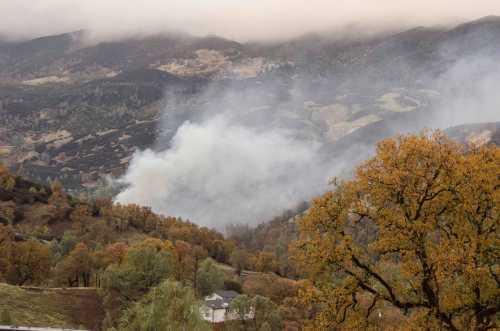
CLEARLAKE OAKS, Calif. – A Friday afternoon fire burned a mobile home in the Spring Valley community.
The fire, reported at 3865 Quail Trail, was dispatched at 3:45 p.m.
Northshore Fire Protection District firefighters arriving on the scene found the singlewide mobile home to be fully involved, according to radio reports.
Incident command reported the fire to be contained at approximately 4:23 p.m., with two hours of mop up anticipated.
A district support team was being sent to the scene, reports from the scene indicated.
Additional details will be posted as they become available.
Email Elizabeth Larson at