 How to resolve AdBlock issue?
News
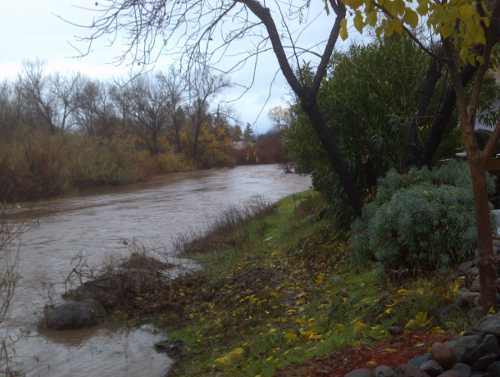
LAKE COUNTY, Calif. – If it felt like a lot of rain fell over the past few days – particularly for residents on Cobb Mountain – you are right; Lake County received the brunt of the rainfall in the storm series.
According to the National Weather Service in Sacramento, Cobb received 18.34 inches of rain since Wednesday, the most of any reported weather station in the state since the latest storm series began.
Reported rainfall totals around the state included 12.92 inches in Blue Canyon, 9.31 inches in Chico, 8.42 inches at Clear Lake/Mt. Konocti, 5.27 inches in Vacaville and 2.45 inches in Modesto.
Other areas of Lake County received much less than Cobb during the same period according to Western Weather Group. Middletown received 9.34 inches; Upper Lake, 5.66 inches; Scotts Valley, 5.65 inches; and Kelseyville, 4.81 inches.
Local creeks and streams went from summer-dry to near flood-stage during this storm series. Clear Lake itself went from 1.66 feet Rumsey on Friday to 2.74 feet Rumsey early Monday morning, according to a U.S. Geological Survey gauge.
Localized flooding was reportedly minimal, although a portion of Scotts Valley Road was open to residential traffic only on Sunday due to flooding, according to the California Highway Patrol.
Power outages were reported in several areas throughout the storm series including Cobb, Kelseyville and north Lakeport.
Skies cleared Sunday afternoon and overnight temperatures last night dropped below 50 for the first time in days.
Forecasters predict mostly sunny skies throughout the day before showers return tonight; with rain expected all day Tuesday and overnight into the day on Wednesday.
By Wednesday evening, the National Weather Service is forecasting a return to mostly sunny days with daytime temperatures in the 60s and partly cloudy nights with lows in the 40s for the remainder of the week.
Email Terre Logsdon at
LAKE COUNTY, Calif. – A new group of jewel-eyed tabbies and torbies are awaiting adoption at Lake County Animal Care and Control this week.
The cats range in age from 8 weeks to 2 years. Almost all of them have been altered in preparation for going to new homes.
Cats that are adopted from Lake County Animal Care and Control are either neutered or spayed and microchipped before being released to their new owner. License fees do not apply to residents of the cities of Lakeport or Clearlake.
If you're looking for a new companion, visit the shelter. There are many great pets there, hoping you'll choose them.
The following cats at the Lake County Animal Care and Control shelter have been cleared for adoption (other cats pictured on the animal control Web site that are not listed here are still “on hold”).
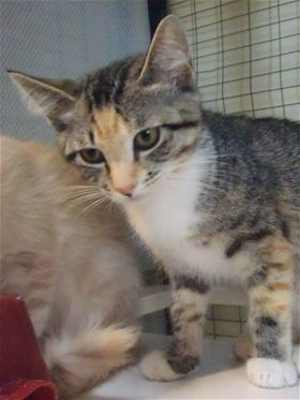
Female torbie kitten
This female kitten is 5 months old.
She has a short torbie-colored coat and gold eyes, weighs 3.6 pounds and has been spayed.
Find her in cat room kennel No. 20a, ID No. 34743.
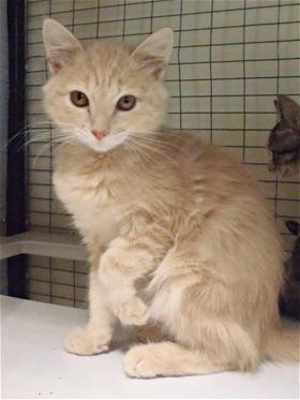
Buff-colored female kitten
This female buff-colored kitten is 5 months old.
She has a long coat, weighs 2.6 pounds and has been spayed.
Find her in cat room kennel No. 20c, ID No. 34792.
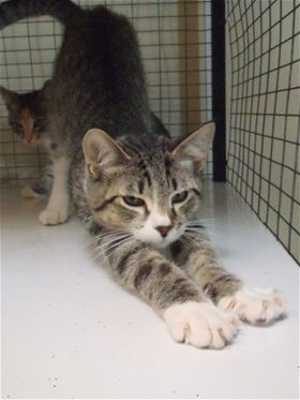
Gray tabby kitten
This gray tabby kitten is 5 months old.
He has green eyes, a short coat, weighs 3.6 pounds and has been neutered.
He’s in cat room kennel No. 20d, ID No. 34746.
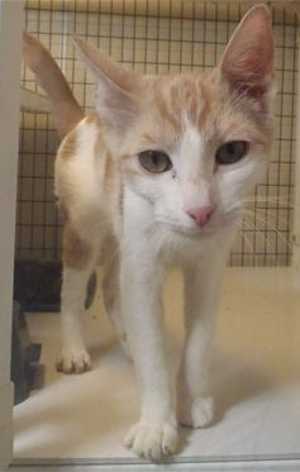
Male orange tabby
This male orange tabby is 1 year old.
He has a short orange and white coat, green eyes, weighs 5 pounds and has been neutered.
Find him in cat room kennel No. 62, ID No. 34500.
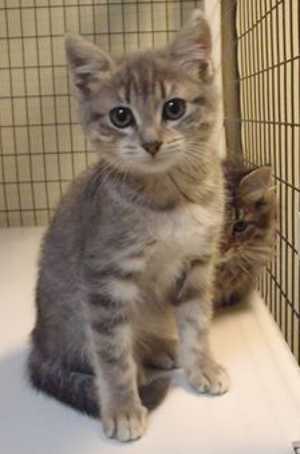
Female gray tabby
This female gray tabby is 8 weeks old.
She has a short coat, green eyes, weighs 2.2 pounds and has been spayed.
She’s in cat room kennel No. 67a, ID No. 34941.
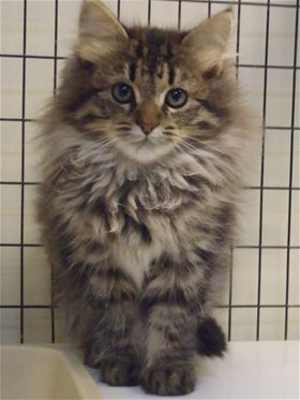
Female brown tabby
This female brown tabby is 8 weeks old.
She has a long fluffy coat, weighs 2 pounds and has been spayed.
See her in cat room kennel No. 67b, ID No. 34965.
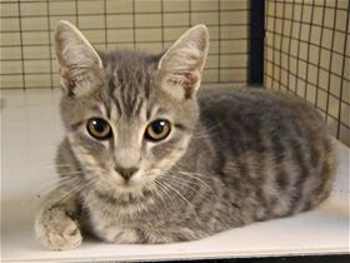
Male gray tabby kitten
This male gray tabby kitten is 6 months old.
He has green eyes, a short coat, weighs 3.4 pounds and has been neutered.
Find him in cat room kennel No. 81b, ID No. 34854.
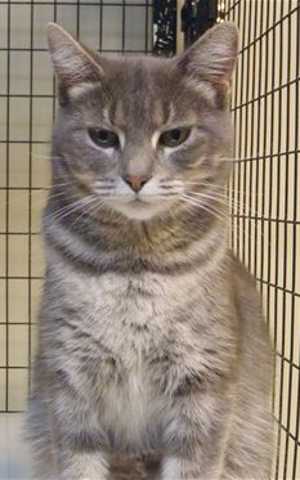
Female domestic short hair mix
This female domestic short hair mix is 2 years old.
She has green eyes and a short gray tabby coat. She has not yet been spayed.
She’s in cat room kennel No. 88, ID No. 34940.
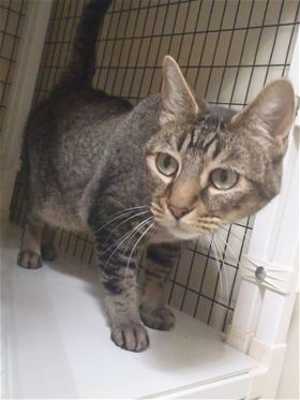
Male gray tabby
This male gray tabby is 1 year old.
He has a short coat and green eyes, and has been neutered.
He’s in cat room kennel No. 100, ID No. 34479.
Adoptable cats also can be seen at http://www.co.lake.ca.us/Government/Directory/Animal_Care_And_Control/Adopt/Cats_and_Kittens.htm or at www.petfinder.com .
Please note: Cats listed at the shelter's Web page that are said to be “on hold” are not yet cleared for adoption.
To fill out an adoption application online visit http://www.co.lake.ca.us/Government/Directory/Animal_Care_And_Control/Adopt/Dog___Cat_Adoption_Application.htm .
Lake County Animal Care and Control is located at 4949 Helbush in Lakeport, next to the Hill Road Correctional Facility.
Office hours are Monday through Friday, 8 a.m. to 5 p.m., and 1 p.m. to 3 p.m., Saturday. The shelter is open from 10:30 a.m. to 4:30 p.m. Monday through Friday and on Saturday from 1 p.m. to 3 p.m.
Visit the shelter online at http://www.co.lake.ca.us/Government/Directory/Animal_Care_And_Control.htm .
For more information call Lake County Animal Care and Control at 707-263-0278.
Email Elizabeth Larson at
CLEARLAKE, Calif. – A collision on Highway 53 Saturday evening resulted in one woman being injured.
The two-vehicle crash occurred at 5:30 p.m. at the Highway 53 and Dam Road intersection at the entrance to Walmart, according to Sgt. Martin Snyder of the Clearlake Police Department.
Snyder said Jackie Broman, 54, of Clearlake, driving a 1994 GMC pickup, collided with a 1999 Jeep Wrangler driven by Sarah Dunn, 24, who he said is believed to be from Roseville.
Due to weather conditions, Snyder said air ambulances were unavailable to fly Dunn out of county.
Instead, Dunn was transported by Lake County Fire Protection District ambulance to St. Helena Hospital Clear Lake, while Broman was released at the scene, according to Snyder.
Both vehicles were towed, he said.
Snyder said the southbound lane was closed for 45 minutes to an hour.
Email Elizabeth Larson at
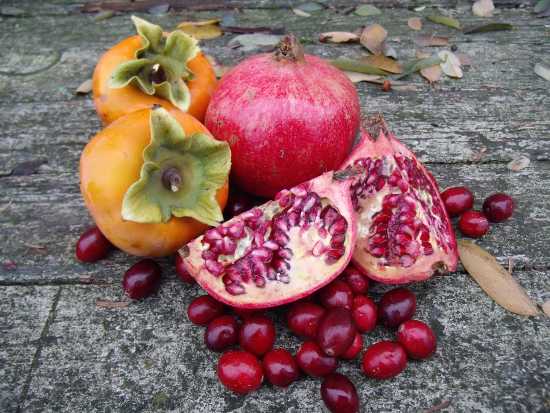
Deeply colorful pomegranates and persimmons arrive just as we begin to feel winter’s gray weight.
Overcast skies and dripping rain are no match for these bright fruits. They decorate branches and produce stalls with their jewel-like red and orange tones, daring us to defy dreariness.
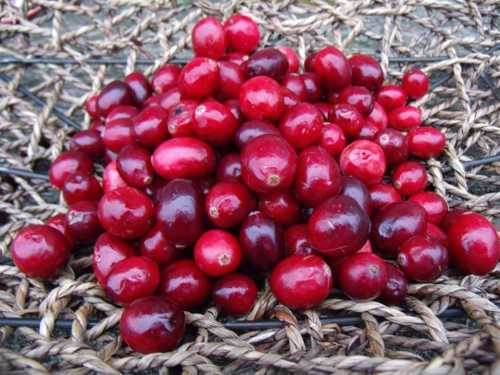
They join less hefty gem-like cranberries, which have been around a while (since mid-fall at least), in a festive campaign to infuse brilliant color and plenty of flavor into the holidays.
When autumn marches into winter, I can’t help but think of these wonderful fruits.
Some persimmons are harvested as early as September and occasionally into January, but the fruit is most widely available now, in the months of November and December.
In the northern hemisphere, pomegranates are in season from October through February, making December their zenith, and while cranberries are harvested in September and October, they’re available in their fresh form in plenitude through December.
Warm, moist persimmon bread (or cookies or pudding) is an iconic treat during the holiday season, and I look forward to imbibing in the sweet, jelly-like flesh of persimmons from our decades-old tree.
Ours bears Hachiya persimmons, one of the two varieties most commonly available in the U.S. This acorn-shaped persimmon must be eaten when soft and fully ripe; otherwise tannins present in the fruit make it sour and mouth-puckering.
I enjoy eating these persimmons whole, dipping into their soft ripeness with a spoon. The flavor might be described as an overly ripe and super sweet apricot; the texture as smooth and slippery.
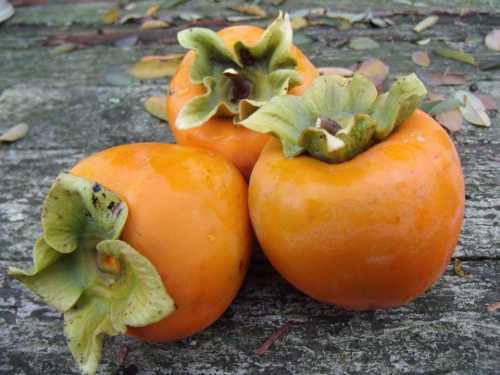
Even though the tannins in the fruit are mellow in this state, they leave a slight “fuzzy” (but not unpleasant) taste in my mouth.
Squat tomato-shaped Fuyu persimmons, the other popular variety, are crisp like an apple and may be eaten while firm, as well as when softer. I love their sweet crunch and enjoy the firm texture, skin and all.
Try adding Fuyu persimmons raw to fruit or green salads, and Hachiya persimmons to smoothies or batter for pancakes or muffins.
Both varieties, as well as the hundreds of others, are native to Asia, though there is a variety indigenous to North America.
This grape-sized fruit that grew wild on trees proved to be inedible to European settlers until American Indians taught them to wait till after the first frost to consume it.
Bread (by American Indians) and distilled spirits (by the settlers in Jamestown) were among the things made with this tiny persimmon.
If the persimmons you find at the market are hard and unripe, never fear! Persimmons will ripen at room temperature at home.
Cranberries, also known as the “bounceberry” because of their tendency to do that when ripe, are another fruit native to our continent, though they also grow wild in northern Europe.
These relatives of heather grow as low, creeping evergreen shrubs or trailing vines that prefer growing in acidic bogs. The bright berries are extremely acidic, making for a tart taste.
Cranberries have gained fame as a “super fruit” in recent years because of their high nutrient and antioxidant content.
While cranberries are associated as an accompaniment to Thanksgiving turkey, I encourage you to welcome homemade cranberry sauce or chutney as a guest to your December holiday table.
Dried cranberries are delicious in baked goods, chicken or pork dishes, and tossed on green or fruit salads.
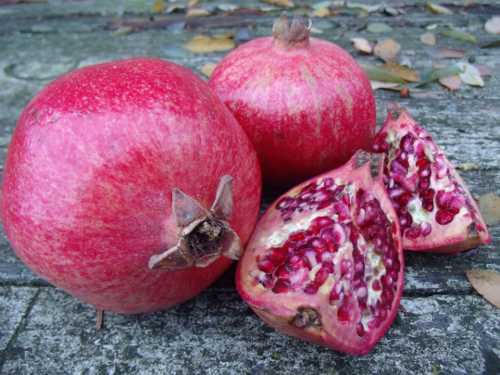
I have magical memories of pomegranates from my childhood. After school, I and a friend or two would pool our change to buy a pomegranate from our local small town market and spend the afternoon plucking out the juicy jewel-like seeds, a painstaking process.
It’s certainly true when they say that only a child has the time to eat a pomegranate, at least using this method.
Thankfully, there is another way, an underwater method of removing the seeds from the skin, causing the seeds (arils, actually) to sink and the membrane to float to the surface. Once done, a good supply is available for making juice, using in recipes, or eating out of hand.
To do this, cut the crown off the pomegranate and score the skin from top to bottom in several places so it will open up. Then plunge the entire thing underwater as you separate the seeds from the rind by hand.
Pomegranates, an ancient fruit, are native to the historical region of Persia (modern day Iran) and the Himalayan ranges of India. They’ve been cultivated in various places in Asia, the Middle East and Mediterranean Europe for several millennia.
As might be expected, pomegranates are featured in traditional Persian cuisine, as well as in the cuisine of such places as India, Pakistan, Turkey and Greece. In these cuisines, pomegranate is paired with a wide variety of savory foods. A thickened version of pomegranate juice, also known as pomegranate molasses, is often used in cooking.
Try tossing fresh pomegranate seeds into yogurt or onto fruit or green salads.
For an easy but well-presented hors d’oeuvre, drizzle honey over plain cream cheese and sprinkle it heavily with fresh pomegranate seeds. It’s very tasty spread over pita crackers.
Some stores sell tubs of fresh pomegranate seeds for those cooks who don’t wish to remove them themselves.
Like cranberries, pomegranates are known as a “super fruit” in terms of our health. They’re high in antioxidants – higher even than antioxidant power houses red wine and green tea – which bode well for cancer prevention and heart protection.
They’re also high in vitamins A, B, and C, iron, calcium, and other essential minerals.
Cranberries have anti-inflammatory, antioxidant, and anti-cancer benefits. They’re extremely high in vitamin C and dietary fiber, they aid in digestion, have properties that protect our heart and liver, they support our immune systems, and are extremely effective in fighting and preventing urinary tract infections.
And persimmons are none too shabby in the nutritional arena. High in dietary fiber and low in fat and calories, they contain antioxidant compounds like Vitamin A, beta carotene, and lycopene, as well as being high in vitamin C, another antioxidant.
If seasonal storms and gray skies have caused the spring in your step to lag a bit, take heart. We know now there’s an antidote, these beautiful jewels of winter.
Here are a few ways to enjoy them.
The first recipe, a persimmon soup flavored with curry, was given to me by friend and avid persimmon picker, Lisa Cole. The beauty of this soup is that it can be made with either Hachiya or Fuyu persimmons. It’s simple, yet delicious.
Curried persimmon soup
3 - ¼ pound ripe (either firm or soft) Fuyu persimmons (about 6-8 medium fruits) or 2 - 2/3 pound soft ripened Hachiya persimmons (about 4-5 medium fruits)
½ cup minced onion
1 - ½ tablespoons minced fresh ginger
1 quart chicken or vegetable broth
1 - ½ teaspoon curry powder (more to taste)
Salt and pepper to taste
Fresh cilantro and lemon wedges for garnish (optional)
Cut off and discard leaves and stems from persimmons. If using Fuyus, peel and slice fruit; if using Hachiyas, scoop out fruit from within peel.
Combine onion, ginger, and ¼ cup broth in a three or four quart pan. Boil over high heat, stirring occasionally, until liquid evaporates and vegetables brown and start to stick, usually about five minutes.
Add another ¼ cup broth and repeat process until vegetables are brown again. Repeat step a third time.
Add curry and stir for about 30 seconds.
Stir remaining broth into pan and bring to a boil over high heat.
If using Fuyus, add persimmons, cover and simmer until slices are tender when pierced, usually about five to eight minutes. Whirl smooth with an immersion blender. (Or puree in batches in a blender, holding the lid tight with a kitchen towel.)
If using Hachiyas, whirl pulp in a blender until smooth and stir into hot broth. (This will thicken soup; stir to thin.)
Add salt and pepper to taste, if desired.
Ladle soup into bowls and garnish with cilantro and a squeeze of lemon, if desired.
Recipe by Lisa Cole.
The following recipe is my mother’s orange-cranberry relish that has been served on our holiday table for as long as I can remember. She serves it in hollowed out orange-skin halves, which make for a pleasant and colorful presentation. The cooking of the oranges three times is to ensure they’re not bitter, since the skins are left on.
Danni’s Orange-Cranberry Relish
2-3 oranges, finely chopped with skins on
1 - ¼ cup sugar, divided
12 ounce package of fresh cranberries
Cover oranges with water in saucepan. Bring to a boil and allow oranges to simmer for a few minutes.
Drain oranges in colander and repeat process with fresh water.
Drain oranges again and put in saucepan with fresh water to generously cover them, along with ½ cup sugar.
Bring to a boil and simmer until liquid reduces somewhat and oranges get candied a bit in the sweet water.
Drain them, reserving cooking liquid, and set aside.
Using the cooking liquid and fresh water, measure 1 cup of liquid into a saucepan.
Add ¾ cup sugar and bring water and sugar to a boil.
Add cranberries, return to a boil, and cook until their skins pop.
Remove from heat and stir in oranges.
Allow mixture to cool and refrigerate until served.
If serving in orange skins, they may be refrigerated after filling.
Recipe by Danielle Loomis Post.
Finally, below is my take on a recipe for pomegranate molasses, wonderful for many things, such as glazing meats and fowl or drizzling over yogurt, desserts, or pancakes. It’s great as a dip when mixed with Dijon mustard.
There’s an option for less dense pomegranate syrup that can be used for mixing into drinks of both the alcoholic and non-alcoholic variety (think pomegranate martinis or sparking pomegranate water), as an addition to homemade salad dressings, tossed into fruit salads, or used anywhere you’d like pomegranate flavor.
Don’t be discouraged if your first batch of pomegranate molasses turns into overly thick “pomegranate candy” due to overcooking. Remember that the mixture will thicken as it cools.
Pomegranate molasses
4 cups pomegranate juice
½ cup sugar
1 tablespoon fresh lemon juice
Place ingredients in a 4-quart saucepan set over medium heat.
Cook, stirring occasionally, until the sugar has completely dissolved.
Reduce the heat to medium-low and cook until the mixture has reduced to 1 cup, approximately 70 minutes. It should be the consistency of a thick syrup.
Remove from heat and allow to cool in the pan for 30 minutes.
Transfer to a glass jar and allow to cool completely before covering and storing in the refrigerator, where it will last for 6 months.
Note: For pomegranate syrup, cook until reduced to 1½ cups, approximately 50 minutes.
Esther Oertel, a freelance writer, cooking teacher, and speaker, is passionate about local produce and all foods in the vegetable kingdom. She welcomes your questions and comments and may be reached at
LAKEPORT, Calif. – Several new puppies and older dogs are available for adoption at the county’s animal shelter this week.
A bulldog and a boxer, terriers, shepherds, labs and pointers are among the breed mixes available.
Thanks to Lake County Animal Care and Control’s new veterinary clinic, many of the animals offered for adoption already are spayed or neutered and ready to go home with their new families.
Dogs that are adopted from Lake County Animal Care and Control are either neutered or spayed, microchipped and, if old enough, given a rabies shot and county license before being released to their new owner. License fees do not apply to residents of the cities of Lakeport or Clearlake.
If you're looking for a new companion, visit the shelter. There are many great pets hoping you'll choose them.
The following dogs at the Lake County Animal Care and Control shelter have been cleared for adoption (additional dogs on the animal control Web site not listed are still “on hold”).

Female Labrador Retriever-pointer mix
This female Labrador Retriever-pointer mix pup is 12 weeks old.
She has a short chocolate-covered coat, weighs 13 pounds and has been spayed.
Find her in kennel No. 3a, ID No. 34925.

Female Labrador Retriever-pointer mix
This female Labrador Retriever-pointer mix pup is 12 weeks old.
She has a short chocolate-covered coat, weighs 13 pounds and has been spayed.
Find her in kennel No. 3b, ID No. 34926.

Male Labrador Retriever-pointer mix
This male Labrador Retriever-pointer mix pup is 12 weeks old.
He has a short chocolate-covered coat, weighs 13 pounds and has been neutered.
He’s in kennel No. 4b, ID No. 34922.
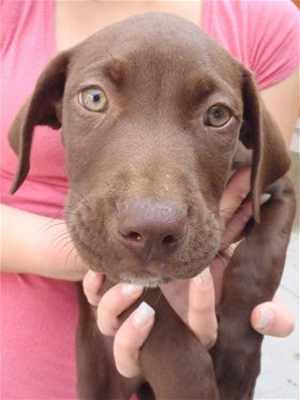
Male Labrador Retriever-pointer mix
This male Labrador Retriever-pointer mix pup is 12 weeks old.
He has a short chocolate-covered coat, weighs 13 pounds and has been neutered.
He’s in kennel No. 5a, ID No. 34924.

Male Labrador Retriever-pointer mix
This male Labrador Retriever-pointer mix pup is 12 weeks old.
He weighs 13 pounds, has a short black and white coat, and has been neutered.
Find him in kennel No. 5b, ID No. 34930.
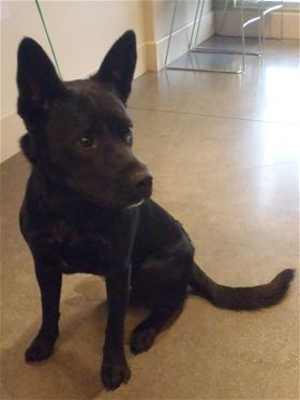
Male German Shepherd mix
This male German Shepherd mix is 1 year old.
He has a short black coat, weighs 49 pounds and has been neutered.
He’s in kennel No. 6, ID No. 34894.

‘Hito’
“Hito” is a 2-year-old male terrier mix.
He has a long brown coat and has been neutered.
Find him in kennel No. 7, ID No. 34910.
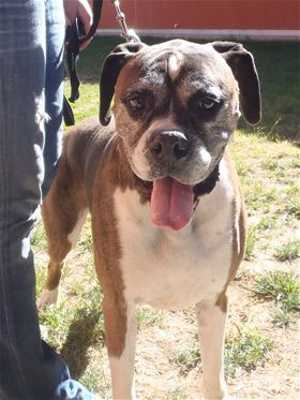
‘Brody’
“Brody” is a 7-year-old male boxer mix.
He has a docked tail, weighs 89 pounds, has a short brown brindle coat and has been neutered.
Brody is in kennel No. 10, ID No. 34726.

English Bulldog mix
This female English Bulldog mix is 5 years old.
She has a short tan and white coat and weighs 57 pounds. Shelter staff did not report if she was altered.
Find her in kennel No. 13, ID No. 34954.

Male dachshund mix
This male dachshund mix is 5 years old.
He has a short red coat, weighs 8 pounds and has been altered.
He’s in kennel No. 14, ID No. 34908.
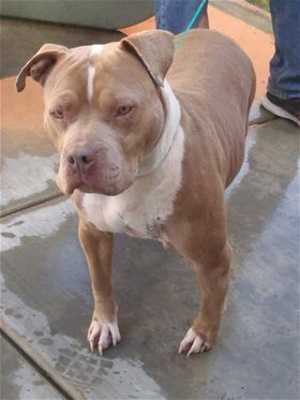
‘Nala’
“Nala” is a female pit bull terrier mix.
She is 7 years old, weighs 67 pounds, and has a short red and white coat. It was not reported if she was spayed.
Nala is in kennel No. 15, ID No. 34968.

Male Labrador Retriever mix
This male Labrador Retriever mix is 2 years old.
He has a short black coat, weighs 58 pounds and has not been altered.
Find him in kennel No. 27, ID No. 34885.

Female Labrador Retriever mix
This female Labrador Retriever mix 8 months old.
She has a short black coat and is not yet spayed.
She’s in kennel No. 29, ID No. 34829.
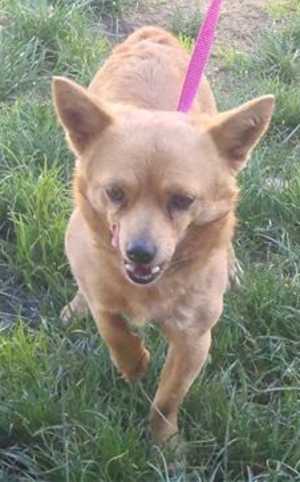
Poncho
“Poncho” is a 2-year-old male Chihuahua-terrier mix.
He weighs 10.6 pounds, has a medium-length red coat and has not been neutered.
He’s in kennel No. 30, ID No. 34860.

Male pit bull terrier mix
This male pit bull terrier mix is 7 months old.
Shelter staff reported that he is great with other dogs and loves to play.
He has a short white and gray coat, is medium-sized and has not yet been altered.
He’s in kennel No. 31, ID No. 34815.
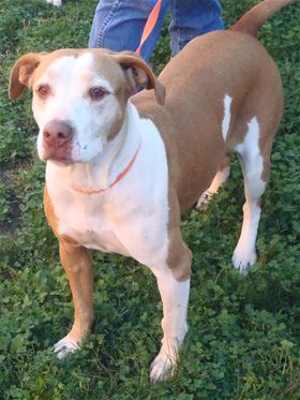
‘Mary Jane’
“Mary Jane” is a 6-year-old pit bull terrier mix.
She has a short brown and white coat, is medium-sized and has been spayed.
Find her in kennel No. 34, ID No. 34818.
Please note: Dogs listed at the shelter's Web page that are said to be “on hold” are not yet cleared for adoption.
To fill out an adoption application online visit http://www.co.lake.ca.us/Government/Directory/Animal_Care_And_Control/Adopt/Dog___Cat_Adoption_Application.htm .
Lake County Animal Care and Control is located at 4949 Helbush in Lakeport, next to the Hill Road Correctional Facility.
Office hours are Monday through Friday, 8 a.m. to 5 p.m., and 1 p.m. to 3 p.m., Saturday. The shelter is open from 10:30 a.m. to 4:30 p.m. Monday through Friday and on Saturday from 1 p.m. to 3 p.m.
Visit the shelter online at http://www.co.lake.ca.us/Government/Directory/Animal_Care_And_Control.htm .
For more information call Lake County Animal Care and Control at 707-263-0278.
Email Elizabeth Larson at
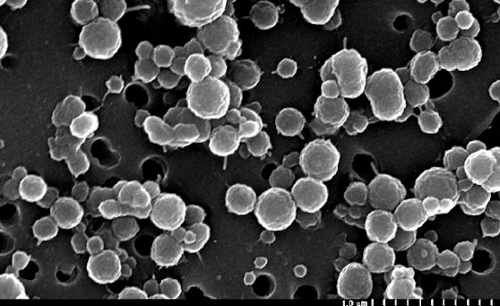
Nearly 65 feet beneath the icy surface of a remote Antarctic lake, scientists from NASA, the Desert Research Institute (DRI) in Reno, Nev., the University of Illinois at Chicago, and nine other institutions, have uncovered a community of bacteria existing in one of Earth’s darkest, saltiest and coldest habitats.
Lake Vida, the largest of several unique lakes found in the McMurdo Dry Valleys, contains no oxygen, is mostly frozen and possesses the highest nitrous oxide levels of any natural water body on Earth.
A briny liquid, which is approximately six times saltier than seawater, percolates throughout the icy environment where the average temperature is minus 8 degrees Fahrenheit.
The international team of scientists published their findings online Nov. 26, in the Proceedings of the National Academy of Sciences Early Edition.
“This study provides a window into one of the most unique ecosystems on Earth,” said Alison Murray, a molecular microbial ecologist and polar researcher at the DRI and the report’s lead author.
“Our knowledge of geochemical and microbial processes in lightless icy environments, especially at subzero temperatures, has been mostly unknown up until now,” Murray said. “This work expands our understanding of the types of life that can survive in these isolated, cryoecosystems and how different strategies may be used to exist in such challenging environments.”
Despite the very cold, dark and isolated nature of the habitat, the report finds the brine harbors a surprisingly diverse and abundant variety of bacteria that survive without a current source of energy from the sun.
Previous studies of Lake Vida dating back to 1996 indicate the brine and its inhabitants have been isolated from outside influences for more than 3,000 years.
“This system is probably the best analog we have for possible ecosystems in the subsurface waters of Saturn’s moon Enceladus and Jupiter’s moon Europa,” said Chris McKay, a senior scientist and co-author of the paper at NASA’s Ames Research Center, Moffett Field, Calif.
Murray and her co-authors and collaborators, including Peter Doran, the project’s principal investigator at the University of Illinois at Chicago, developed stringent protocols and specialized equipment for their 2005 and 2010 field campaigns to sample from the lake brine while avoiding contaminating the pristine ecosystem.
“The microbial ecosystem discovered at Lake Vida expands our knowledge of environmental limits for life and helps define new niches of habitability,” said Adrian Ponce, co-author from NASA’s Jet Propulsion Laboratory, Pasadena, Calif., who enumerated viable bacterial spore populations extracted from Lake Vida.
To sample unique environments such as this, researchers must work under secure, sterile tents on the lake’s surface.
The tents kept the site and equipment clean as researchers drilled ice cores, collected samples of the salty brine residing in the lake ice and assessed the chemical qualities of the water and its potential for harboring and sustaining life.
Geochemical analyses suggest chemical reactions between the brine and the underlying iron-rich sediments generate nitrous oxide and molecular hydrogen. The latter, in part, may provide the energy needed to support the brine’s diverse microbial life.
Additional research is under way to analyze the abiotic, chemical interactions between the Lake Vida brine and its sediment, in addition to investigating the microbial community by using different genome sequencing approaches.
The results could help explain the potential for life in other salty, cryogenic environments beyond Earth, such as purported subsurface aquifers on Mars.
Dr. Tony Phillips works for the National Aeronautics and Space Administration.