 How to resolve AdBlock issue?
News
THIS ARTICLE HAS BEEN UPDATED AND CLARIFIED REGARDING INFORMATION ABOUT THE PERMIT AND MEETING ATTENDANCE.
MIDDLETOWN, Calif. – South county residents gathered last week to hear an update on Calpine Corp.’s plans to seek an extension of a permit covering several geothermal wells and to voice their concerns about geothermal operations in the area.
Calpine Corp. hosted the meeting last Tuesday, Nov. 27, at its visitor center in Middletown to discuss continued geothermal well operation at the Davies Estate geothermal well site on Foard Road.
About 15 community members, including residents of Anderson Springs, the community closest to the drilling, came to voice their concerns. The meeting was led by Bruce Carlsen, Calpine’s director of environmental health and safety.
Up for consideration was Calpine’s application to renew a 29 year old permit issued by the Lake County Community Development Department.
The permit, which expires Aug. 11, 2013, covers four existing wells on a pad at Davies Estate, privately owned land located less than a mile south of Anderson Springs.
Among those who attended the meeting was Meriel Medrano, who has lived in Anderson Springs since 1971.
Over the years, residents have been increasingly affected by small earthquakes caused by geothermal production. The shaking occurs almost every day, she said in a phone interview.
“We were here first,” Medrano said. And now, “we are three-quarters surrounded by power plants.”
The Geysers, which began operation in the 1960s, has developed into the largest complex of geothermal power plants in the world, with companies besides Calpine at work in the steam field.
Calpine operates 15 power plants at The Geysers and generates enough electricity to power 725,000 homes, according to the company’s Web site.
However, that clean energy production also has taken its toll on about 200 homes in Anderson Springs, according to residents.
Some Anderson Springs residents have had “considerable damages,” said Medrano, citing broken windows, a fallen chimney and cracked foundations.
The site in question is only one of many that impact residents, Medrano said. “We can only address the permits as they come up.”
Medrano is part of the Anderson Springs Community Alliance, a group that advocates for residents, and the health of the local environment.
She said she attended the meeting to find out, for one thing, for how long Calpine wants to extend the permit.
The residents want a deadline, she said. “We would feel more confident if there was a 10-year plan.”
In addition, the group wants some consideration of seismicity included in the permit.
If, for example, a large earthquake occurred, they would like to see “some condition” to address that possibility, such as shutting down the wells.
They also are asking for a new environmental review. The last one was done decades ago, prior to the original permit for the wells.
Ahead of the meeting, the group sent their comments to the Lake County Community Development Department, as well as to Calpine. Their goal, Medrano said, is to see that their concerns are added to the permit.
Calpine spokesperson Danielle Matthews Seperas said the company objects to each condition of the group’s proposal.
Seperas explained that the conditions would increase the costs of an already extremely costly business – yet the company won’t be making any changes at the site. There will be no new development.
She said geothermal permits in other areas generally do not expire.
She isn’t sure why the original 30-year life was imposed by the county; Sonoma County, for example, has no such deadline on geothermal permits, she added.
“We are asking for it to be unlimited,” Seperas said of the permit.
Such geothermal permits do not expire in terms of the construction of the well, according to Joe Austin, the district geothermal engineer with California Department of Conservation in Santa Rosa.
However, this is a land use permit which is filed with the county rather than the state, Austin explained. Therefore, it does expire.
Austin said Lake County is the lead agency in regard to any new environmental review. “It’s up to the county” if that should be done.
Seperas said a new environmental review isn’t necessary, citing the Class 1 Categorical Exemption, which is applicable to projects that involve negligible or no expansion of existing use at the time of lead agency’s determination. There will be no expansion of existing use at the Davies Estate site, only an extension of time.
Under the California Environmental Quality Act – known more commonly as CEQA – “We are exempt from another review,” Seperas said.
Medrano and her fellow Anderson Springs residents disagreed.
In the letter from the Anderson Springs Community Alliance, Jeffrey Gospe, the alliance’s president, argued that the permit should receive no such exemption. He said operation of the wells does and will change over time.
Gospe referred to CEQA guidelines that identify “cumulative impact” and “significant effect” – such as seismicity associated with the project – claiming that exemptions “are not applicable.”
The original use permit is so out of date that the alliance’s members said it doesn’t even mention induced seismicity.
According to Seperas, Calpine is already working under seismicity constraints. “Seismicity needs to be studied Geyser-wide” – and it is.
The four wells that comprise the Davies Estate project simply take steam through the plant, Seperas said, so they don’t intend to make any changes to the permit in regard to earthquakes.
Medrano admitted that even if drilling stopped at this one site, the earthquakes would not. But she said the community would still like to revisit the permit in the event of an unusually large earthquake.
Have they experienced increased seismicity over time?
“Oh my God, yes,” she said.
Starting in 2005, residents have been paid exact damages for their homes. To date, the repair costs amount to $190,000, Medrano estimated.
The funds are provided through another steam field operator, the nonprofit Northern California Power Agency.
Seperas said Calpine has tried to be a good neighbor. The company helps reimburse the community by funding local projects, which now total $545,582 to Anderson Springs, she estimated.
The company funds two committees, which also cover Cobb. Since 2005, when the committees were launched, Cobb has received $293,000, according to Seperas.
Medrano noted that Calpine also “tried to move some of the wells,” noting, “That helped a great deal.”
Medrano added, “We’re trying to work with them.”
And while she thinks the meeting “went really well,” the group plans to press on with their concerns about the permit, Medrano said.
They will have a second chance to do that on Dec. 13, when the Lake County Planning Commission will hold a public hearing to consider Calpine’s application.
Sheila Pell is a Lake County News correspondent.
LAKEPORT, Calif. – Elections offices around the state have until the end of business on Tuesday to complete the final count for the Nov. 6 election, with the Lake County Registrar of Voters Office still busy finishing up its work as well.
Secretary of State Debra Bowen reported that after each statewide election, California county elections officials have 31 days to ensure all eligible ballots are accurately counted and then certify final election results to her office.
For the presidential and general election, held Nov. 6, the deadline for processing is Tuesday, with elections officials having until this Friday to report their certified vote counts to California Secretary of State.
Lake County Registrar of Voters Diane Fridley said the work has to be completed by 5 p.m. Tuesday, by which time she guaranteed she and her staff would be finished.
In addition to counting the thousands of absentee – or vote-by-mail – ballots and those cast at precincts, Fridley and her staff have had a large number of provisional ballots to process this year.
Provisional ballots are used in a number of scenarios. Examples include when registered voters have moved to a new address within the county, absentee voters who have lost their ballots and new voters in federal elections who have not previously presented a photo identification, the latter being a case which isn’t common, Fridley said.
There also are court-ordered provisional ballots, such as when a person registers to vote at the Department of Motor Vehicles but Fridley’s office didn’t receive the registration in time for the election. In that case, she said the elections office can petition the court on the voter’s behalf to have their ballot counted.
For Nov. 6 there were 1,111 provisional ballots, according to unofficial count numbers, Fridley said.
Just how many of this year’s provisional ballots will be counted will depend on several factors.
For example, in the case of an absentee voter who has misplaced their ballot, if the elections office has confirmed that vote-by-mail ballot hasn’t been returned, the provisional ballot is counted, Fridley said.
If a voter goes to the polls and is allowed to vote with a provisional ballot but is found to not be registered, the ballot isn’t counted, she said.
Fridley said that in November 2010 there were 764 provisional ballots issued and 699 counted, compared to 649 issued and 521 counted in November 2008 and 323 issued and 287 counted in November 2006.
Email Elizabeth Larson at
LAKE COUNTY, Calif. – It’s that festive time of year when we like to share the joys of family life and friendship over the holidays.
But for some older adults, this time of year can be confusing, depressing or even stressful if their mental, physical and emotional needs are not taken into consideration.
If you have family and older friends experiencing health issues, you can help them enjoy the holiday season more by following some or all of these simple tips.
Some older adults can experience profound sadness that can be exacerbated by all the activities of the holidays.
Seasonal blues can have a particularly harsh impact in the lives of older people. Depression is a dangerous and life-threatening illness in older people.
Tragically, suicide rates increase with age, specifically for older men. Depression is not a normal part of aging and should never be ignored or written off.
The noise and confusion of a large family gathering can sometimes lead to exhaustion and irritability. Try to schedule time for a nap, if necessary, and maintain a room away from the activities where an older person can take a break.
If older family members are vulnerable to overstimulation or tire easily, limit the number of activities they are involved in or the length of time they are included.
Refrain from making comments that could potentially embarrass an older family member or friend who may be experiencing short-term memory problems.
For example, if an older person does not remember a recent conversation, don’t make it worse by saying something like, “Don’t you remember what we were just talking about?”
Involve everyone in the holiday meal preparation, breaking down tasks to include all family members. Older adults with physical limitations can still participate in certain activities such as folding napkins, peeling vegetables or arranging flowers.
Holidays tend to invoke memories, which can be especially powerful in the later years of life.
Experts in the field of aging have noted that memory and talking about one’s own life experiences are important parts of the aging process.
Older people whose memories are impaired may have difficulty remembering recent events, but they are often able to share stories and observations from the past.
These shared memories are important for younger folks as well – children like to hear about how it was “back in the good old days.”
Using family videos, music, photo albums and even theme songs from old radio or TV programs to help stimulate thoughts and memories help encourage older seniors share their experiences and stories.
If you have senior family members, be sure to assist them with their schedule of medications. Also, pay close attention to their alcohol consumption during family gatherings and holiday parties. Alcohol mixed with certain medications can provoke inappropriate behavior and interfere with medications.
Winter depression – also known as Seasonal Affective Disorder – is an illness that can be brought on by the reduced hours of sunlight during the shorter days of winter.
It is important for people confined indoors, especially those at risk of depression, to ensure time is made for activities that will increase exposure to daylight.
If a holiday gathering is hosted in the home of an older person with behavioral or memory impairment problems, do not attempt to rearrange the furniture. This could lead to anxiety and confusion.
If the event is in a place that might be unfamiliar to an older person, remove throw rugs and other items that could present barriers to someone with mobility issues.
Social connectedness is especially important at holiday time. Physical touch has a tremendous impact on the emotional and physical need to feel connected to others. Hug, hold hands or put your arm around the person.
Loneliness is a difficult emotion for anyone. Recent research on older people has shown that loneliness is associated with major depression and with suicidal thoughts and impulses.
So keep these tips in mind when enjoying the holidays with older friends and family members.
Todd Metcalf is the adult services program manager at Lake County Department of Social Services.
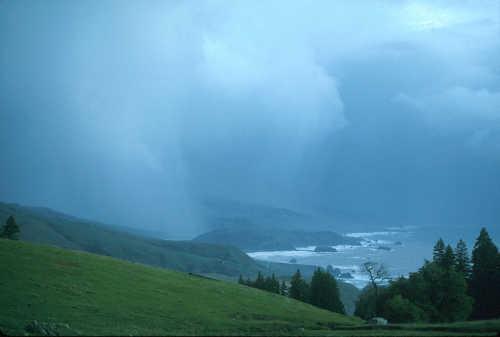
NOAA scientists and colleagues are installing the first of four long-term “atmospheric river observatories” in coastal California this month to better monitor and predict the impacts of landfalling atmospheric rivers.
These powerful winter systems, sometimes called “pineapple express” storms, can be beneficial, in that they help to fill the state’s reservoirs, but they can also cause destructive floods and debris flows.
The coastal observatories, which are arrays of custom instruments, are being installed in collaboration with the California Department of Water Resources and Scripps Institution of Oceanography, University of California San Diego.
The observatories will give weather forecasters, emergency managers and water resource experts detailed information about incoming storms such as winds and water content.
“California needs to know how and where it might rain or snow, when and where to expect flooding,” said Michael Anderson, Ph.D., state climatologist with the California Department of Water Resources. “The observatories will also help state officials and scientists monitor changes in atmospheric rivers associated with climate change.”
This month’s installation of an atmospheric river observatory in Bodega Bay will be followed by installations at Eureka, Point Sur and Goleta.
The move to set up the four observatories and other weather instruments throughout the state came after NOAA researchers and academic scientists spent several winters testing and selecting the most effective arrays of instruments for collecting useful information for decision makers. Installation of all four observatories is expected to be completed by early 2014.
“With satellites, we can see the tell-tale water vapor signature of an incoming atmospheric river over the ocean. However, NOAA’s offshore observing systems do not measure another key factor — strong low-altitude winds,” said Martin Ralph, Ph.D., a research meteorologist and branch chief in NOAA’s Earth System Research Laboratory in Boulder, Colo.
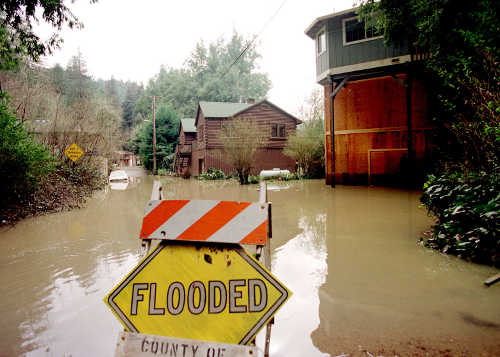
“With our new sensors, we’ll be able to measure those winds and more, to understand just how much moisture is moving in, which largely controls how extreme the precipitation inland will become,” Ralph said. “This information will ensure that meteorologists and emergency managers have additional information to keep the public informed about these potentially destructive storms.”
The four coastal observatories will include:
- A Doppler wind profiling radar, which reveals the speed and direction of winds at several altitudes aloft;
- A technique for extracting critical information from wind profiler data – the level in the atmosphere where falling snow turns to rain;
- Global positioning system (GPS) water vapor instruments, which measure the total amount of water vapor above the site; and
- Standard meteorological instruments (relative humidity, temperature, pressure and rain gauge).
Combined, these data allow forecasters to monitor the transport of moisture into the state, which is critical in determining precipitation amounts and locations as well as the altitudes in the mountains that will receive rain as opposed to snow.
These observatories will become part of the statewide observing network designed by NOAA scientists and colleagues to give forecasters and water managers the information they need to help to mitigate the impacts of strong atmospheric rivers, such as extreme precipitation and flooding.
For example, snow-level radars designed, built and tested by NOAA scientists, are now deployed in 10 major watersheds across the state.
Also, a network of soil moisture sensors is being installed at 43 sites across the state, including several in the flood-prone Russian River watershed.
“These soil moisture sensors are key to anticipating whether an incoming storm will produce heavy runoff or if much of the rain will be absorbed in the soil,” said Michael Dettinger, a research hydrologist with the U.S. Geological Survey and a research associate with Scripps.
“This new and innovative network, transitioning research into operations, is helping California move into the future, better observing and planning for floods and water resource issues of today and tomorrow,” Anderson said.

At a ceremony in the State Capitol in Sacramento on Monday, Mariko Yamada (D-Davis) was sworn into office as the Assembly member for California’s newly-drawn Fourth Assembly District.
Although this is Yamada’s third term, she will be representing a constituency that is 68-percent new following the statewide redistricting approved in 2011.
The Fourth District includes portions of her previous district in Solano and Yolo counties, but now includes all of Lake and Napa and parts of Colusa and Sonoma counties.
Lake County previously was represented in the Assembly by Wes Chesbro (D-Arcata), who now represents the Second Assembly District.
“I am honored to continue serving in the state legislature, and am ready to get-to-work on behalf of all our constituents in the big, beautiful new Fourth District,” Yamada said.
Assemblymember Yamada takes her place as part of an historic Democratic supermajority in both houses of the Legislature, the first in California for nearly 130 years.
“This unexpected Assembly supermajority presents a great opportunity to recover, rebuild, and reform our State,” she said. “As our legislative leaders and the governor have already indicated, we will move California forward, but wisely and with restraint.”
Among Yamada’s priorities are sustaining agriculture, protecting the water supply, veterans affairs, and jobs and the economy.
She also chairs the Assembly Aging and Long Term Care Committee, an issue area that is increasing in importance with the “aging-out” of the baby boomer generation.
In addition, she will continue to focus on providing high-quality constituent services.
Over the past four years, Yamada’s district office staff has mitigated more than 1,000 constituent cases, ranging from helping the jobless navigate the unemployment benefits system to taking on the Medi-Cal program on behalf of residents in need.
Constituents seeking information or assistance with state agencies may contact Yamada’s current district office by calling 707-455-8025 or by emailing
Yamada is a professional social worker by training, and has served nearly four decades in public service at the local, state and federal levels, and in nonprofit community settings.
She and her husband of 29 years, Janlee Wong, reside in Davis, and are the parents of two adult daughters.
For more information about Assemblymember Yamada, visit her Web site at www.assembly.ca.gov/yamada .

LAKEPORT, Calif. – A Lakeport man was arrested late last week for what police said was a large quantity of marijuana that he had for sale.
Burt Lee Hundley, 31, was arrested in the case, according to Lt. Jason Ferguson.
Ferguson said that at 6:30 p.m. last Friday, Nov. 30, Lakeport Police officers responded to the
Regency Inn Motel on a report of two men involved in an altercation.
Officer Joe Eastham located and detained Hundley and found him to be highly intoxicated, Ferguson said.
Located in a bag Hundley was carrying was approximately four pounds of marijuana in various plastic bags believed to be possessed for sale, according to Ferguson.
He said Hundley was arrested for possession of marijuana for sale, possession of more than one ounce of marijuana, and for being intoxicated in a public place and disorderly conduct.
Hundley was transported to the Hill Road Jail where he was booked. His bail was set $15,000.
Jail records indicated that Hundley remained in custody on Monday, when he was set to make an appearance in Lake County Superior Court.