How to resolve AdBlock issue?
Refresh this page
How to resolve AdBlock issue?
Refresh this page
Lake County News,California
  • Home
    • Registration Form
  • News
    • Education
    • Veterans
    • Community
      • Obituaries
      • Letters
      • Commentary
    • Police Logs
    • Business
    • Recreation
    • Health
    • Religion
    • Legals
    • Arts & Life
    • Regional
  • Calendar
  • Contact us
    • FAQs
    • Phones, E-Mail
    • Subscribe
  • Advertise Here
  • Login

News

Space News: Astronomers see fireworks from violent collisions around nearby star

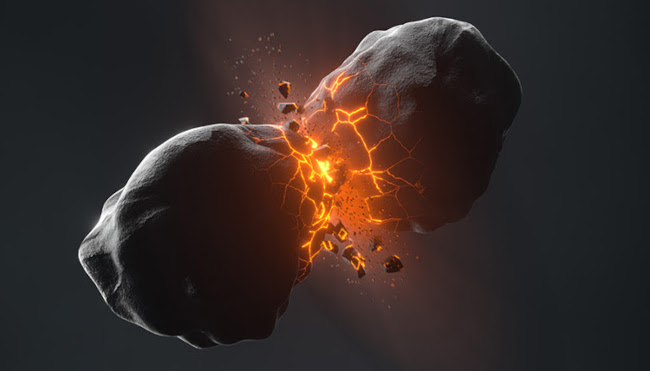
An artist's rendition of a collision between two planetesimals in the debris disk around a young star. Collisions like these occur over hundreds of millions of years as gas and dust slowly coalesces into planets and moons. (Image credit: Thomas Müller, MPIA/HdA)


BERKELEY, Calif. — Young star systems are a place of violent collisions. Rocks, comets, asteroids and larger objects carom off one another and coalesce, gradually turning the primordial dust and ice of a stellar nebula into planets and moons. 

The largest of these collisions, however, are expected to be rare over the hundreds of millions of years it takes to form a planetary system — perhaps one every 100,000 years.

Now, astronomers have seen the aftermath of two powerful collisions within a 20-year period around a nearby star called Fomalhaut. These are either lucky observations or a sign that collisions are more frequent than predicted during planet formation.

The events — the first was detected in 2004 and the second in 2023 — are the first collisions between large objects directly imaged in any solar system outside our own.

"We just witnessed the collision of two planetesimals and the dust cloud that gets spewed out of that violent event, which begins reflecting light from the host star," said Paul Kalas, adjunct professor of astronomy at the University of California, Berkeley, and first author of the report. "We do not directly see the two objects that crashed into each other, but we can spot the aftermath of this enormous impact."

Over tens of thousands of years, he said, the dust around Fomalhaut would be "sparkling with these collisions" — like twinkling holiday lights.

Kalas first started searching for a dusty disk around Fomalhaut in 1993, hoping to see for the first time the debris left over after planet formation. Only 25 light-years from Earth, the star is young — about 440 million years old — and a proxy for what our solar system looked like in its formative years. 

Thanks to NASA's Hubble Space Telescope, or HST, he eventually found such a disk around the star and, in 2008, reported finding a bright spot near the disk that was likely a planet, the first to be imaged directly at visible wavelengths. He called it Fomalhaut b, per the naming convention for exoplanets.

That planet discovery has now turned to dust. What he thought was a planet was likely the dust cloud kicked up by the collision of planetesimals.

"This is a new phenomenon, a point source that appears in a planetary system and then over 10 years or more slowly disappears," he said. "It's masquerading as a planet because planets also look like tiny dots orbiting nearby stars."

Based on the brightness of both the 2004 and 2023 events, the colliding objects are at least 60 kilometers (37 miles) across — at least four times larger than the object that collided with Earth 66 million years ago and killed off the dinosaurs. Objects of this size are referred to as planetesimals — objects similar in size to many of the asteroids and comets in our solar system but much smaller than a dwarf planet like Pluto.

"Fomalhaut is much younger than the solar system, but when our solar system was 440 million years old, it was littered with planetesimals crashing into each other," Kalas said. "That's the time period that we are seeing, when small worlds are being cratered with these violent collisions or even being destroyed and reassembled into different objects. It's like looking back in time in a sense, to that violent period of our solar system when it was less than a billion years old."

The 2023 Fomalhaut observations are discussed in a paper posted online Dec. 18 in the journal Science.

"The Fomalhaut system is a natural laboratory to probe how planetesimals behave when undergoing collisions, which in turn tells us about what they are made of and how they formed," said Kalas's colleague, Mark Wyatt, a theorist and professor of astronomy at the University of Cambridge in the United Kingdom. "The exciting aspect of this observation is that it allows us to estimate both the size of the colliding bodies and how many of them there are in the disk, information which it is almost impossible to get by any other means."

He estimates that there are about 300 million objects around Fomalhaut the size of the ones that collided to generate these bright clouds of dust. Previous observations of the star detected the presence of carbon monoxide gas, which indicates that these planetesimals are volatile-rich and therefore very similar in composition to the icy comets in our solar system, he said.

Dust clouds masquerading as exoplanets

Fomalhaut, located within the southern constellation Piscis Austrinus, is 16 times more luminous than our sun and one of the brightest stars in the sky. After Kalas began observing it with HST in 2004, he discovered a large belt of dusty debris at a distance of 133 astronomical units, or AU, from the star, more than three times the distance from the star as the Kuiper Belt is from the sun in our solar system. 

An AU is the average distance between the Earth and the sun, or 93 million miles.

To Kalas, the belt's sharp inner edge suggested that it had been sculpted by planets. After a second observation in 2006, he concluded that a bright spot in the outer belt visible in both the 2004 and 2006 images was, in fact, a planet. He acknowledged at the time that it could be a very bright dust cloud caused by a collision in the disk, but the likelihood of that seemed very low.

Kalas was able to schedule four follow-up HST observations of Fomalhaut, in 2010, 2012, 2013 and 2014. In the last, however, Fomalhaut b was nowhere to be seen. Nine years later, after three failed attempts to image Fomalhaut with HST, he obtained a new image that revealed another bright spot not far from the first, which is now referred to as Fomalhaut cs1, for circumstellar source 1. 

Based on its location, however, the new spot, dubbed Fomalhaut cs2, could not be a reappearance of Fomalhaut cs1. Because of the nine-year hiatus between the observations in 2014 and 2023, it's unclear when Fomalhaut cs2 appeared.

In the new paper, Kalas and an international team of astronomers analyzed the 2023 image of Fomalhaut and a subsequent, though poor image obtained in 2024, and concluded that it could only be light reflected from a dust cloud produced by the collision of two planetesimals.

Kalas noted that at first, Fomalhaut cs1 moved like an exoplanet, but by 2013 its path had curved away from the star. This type of motion would be possible for very small particles being pushed outward by the radiation pressure of starlight. The appearance of cs2 supports the idea that cs1 was in fact a dust cloud.

Kalas compares these events to the dust cloud generated in 2022 when NASA's DART (Double Asteroid Redirection Test) mission slammed into the moonlet Dimorphos, which was orbiting the asteroid Didemos. The cloud around Fomalhaut is about a billion times larger, the team estimated.

Kalas has been awarded time over the next three years to use the James Webb Space Telescope's Near-Infrared Camera, or NIRCam, and the HST to observe Fomalhaut and track the evolution of the cloud to see if it expands in size and determine its orbit. It is already 30% brighter than Fomalhaut cs1. Additional observations in August 2025 confirmed that cs2 is still visible.

In anticipation of future space missions to directly image exoplanets, Kalas cautioned astronomers to be on the lookout for dust clouds masquerading as planets.

"These collisions that produce dust clouds happen in every planetary system," he said. "Once we start probing stars with sensitive future telescopes such as the Habitable Worlds Observatory, which aims to directly image an Earth-like exoplanet, we have to be cautious because these faint points of light orbiting a star may not be planets."

Other co-authors of the paper are UC Berkeley research astronomer Thomas Esposito; former UC Berkeley graduate students Jason Wang, now at Northwestern University in Illinois, and Michael Fitzgerald, now at UCLA; former UC Berkeley postdoctoral fellow Robert De Rosa, now at the European Southern Observatory in Chile; Maxwell Millar-Blanchaer of UC Santa Barbara; Bin Ren of Xiamen University in China; Maximilian Sommer of the University of Cambridge; and Grant Kennedy of the University of Warwick in the UK. The work was supported by NASA (NAS5-26555, GO-HST-17139).

Robert Sanders writes for the UC Berkeley News Center. 

New Year, new laws: CHP highlights public safety laws taking effect in 2026

As part of its commitment to keeping the public informed so they can make the safest choices for themselves and their families, the California Highway Patrol is highlighting new public safety laws passed during this year’s legislative session and signed by Gov. Gavin Newsom.

Unless otherwise noted, these laws take effect Jan. 1, 2026. 

CRIMES

Crimes: Burglary Tools (AB 486, Lackey)

Assembly Bill 486 makes it a misdemeanor to possess a key programming device, a key duplicating device, or a signal extender with the intent to commit burglary. The offense can result in up to six months in county jail, a fine of up to $1,000, or both.

This bill expands existing law by adding those three tools to the list of tools illegal to possess with the intent to commit burglary. 

ELECTRIC BICYCLE SAFETY

Electric Bicycles: Required Equipment (AB 544, Davies)

Assembly Bill 544 mandates that electric bicycles must have a red reflector or a solid or flashing red light with a built-in reflector on the rear during all hours of operation, not just during darkness as the law previously required.

The bill also allows the CHP-developed online electric bicycle safety and training program to fulfill the safety course requirement for minors who receive a helmet violation involving electric bicycles.

Off-highway Electric Motorcycles (SB 586, Jones)

Senate Bill 586 defines an “off-highway electric motorcycle” or “eMoto” as a vehicle that:

• Is designed primarily for off-highway use;
• Is powered by an electric motor that does not require a motor number;
• Has handlebars for steering, a manufacturer-provided straddle seat, and two wheels;
• Is not equipped with manufacturer-provided pedals.

This bill also classifies an off-highway electric motorcycle as an off-highway motor vehicle, or OHV, subject to the same rules and regulations. This includes a requirement that a person operating an OHV wear a safety helmet and that every OHV not registered under the Vehicle Code display an identification plate or device issued by the Department of Motor Vehicles.

PEDESTRIAN SAFETY

Pedestrian Safety: School Zones: Speed Limits (AB 382, Berman)

Assembly Bill 382 allows local authorities to lower the school zone speed limit from 25 to 20 miles per hour by ordinance or resolution through Jan. 1, 2031. After this date, the speed limit will automatically decrease from 25 to 20 miles per hour in school zones when proper signage is posted.

SPEED ENFORCEMENT

State Highway Work Zone Speed Safety Program (AB 289, Haney)

Assembly Bill 289 authorizes the Department of Transportation to establish a work zone speed safety system pilot program. The program will utilize a fixed or mobile radar or laser systems to detect speeding violations and capture a clear photograph of a vehicle's license plate. Citations will be issued to the vehicle's registered owner with specified requirements and procedures for program implementation, citation issuance, review, and appeal.

Vehicles: Highway Safety (AB 390, Wilson)

Assembly Bill 390 expands the “slow down and move over” law to include any highway maintenance vehicle or stationary vehicle using flashing hazard lights or warning devices such as cones and road flares. Drivers approaching such a vehicle must move into a lane that is not next to the stopped vehicle or slow down to a safe speed if changing lanes is not possible.

Traffic Safety: Speed Limits (AB 1014, Rogers)

Assembly Bill 1014 authorizes the Department of Transportation to reduce a speed limit by five miles per hour on a highway, and mandates warning citations during the initial 30 days after a speed limit is lowered.

VEHICLE STORAGE

Vehicle Removal (AB 875, Muratsuchi)

Assembly Bill 875 authorizes a peace officer to impound a vehicle for at least 48 hours if the vehicle has fewer than four wheels but does not meet the definition of an electric bicycle,  is powered by an electric motor capable of exclusively propelling the vehicle over 20 MPH on a highway and the operator is not licensed to operate the vehicle or is a class three electric bicycle being operated by a person under 16. A safety course may be required as a condition of release if the impoundment involves a child under 16 years old operating a class three electric bike as described in Section 312.5 of the Vehicle Code.

2024 LEGISLATIVE SESSION

The following public safety laws were passed during the 2024 legislative session and will go into effect in 2026.

Electric Bicycles, Powered Mobility Devices and Storage Batteries (SB 1271, Min)

Beginning Jan. 1, 2026, Senate Bill 1271 focuses on improving the safety standards for electric bicycles, powered mobility devices, and related lithium-ion batteries. It requires these devices and their components, such as batteries and charging systems, to be tested by accredited laboratories to meet specific safety standards. 

The bill also mandates labeling these products to show compliance with safety regulations, ensuring consumers are informed.

Furthermore, it prohibits distributing, selling, or leasing e-bikes and related equipment unless they meet these standards, aiming to reduce risks like fire hazards and electrical malfunctions. 

Beginning Jan. 1, 2028, the bill would prohibit a person from renting or offering for rental an electric bicycle, powered mobility device, charging system, or storage battery unless it has been tested to the specified safety standard.

Autonomous Vehicles (AB 1777, Ting)

Upon the Department of Motor Vehicles (DMV) adoption of necessary regulations, AB 1777 creates new authority for a law enforcement officer to issue a “notice of autonomous vehicle, or AV, noncompliance” to an AV manufacturer for an alleged traffic violation committed by one of their vehicles. 

Beginning July 1, 2026, AB 1777 establishes additional requirements for how AVs that operate without a human operator in the vehicle interact with first responders, including a requirement for manufacturers to provide a two-way device in the vehicles to communicate with first responders.

Medieval peasants probably enjoyed their holiday festivities more than you do

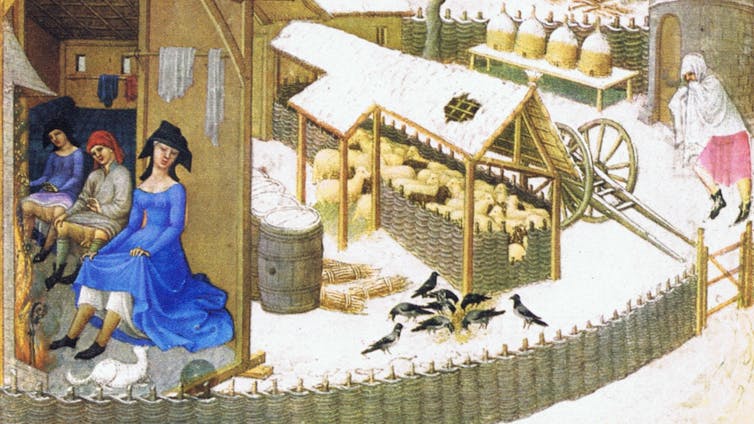
Winter in a peasant village, painted by the Limbourg brothers and published in the medieval illuminated manuscript ‘Très Riches Heures du Duc de Berry.’ Pierce Archive LLC/Buyenlarge via Getty Images

When people think of the European Middle Ages, it often brings to mind grinding poverty, superstition and darkness. But the reality of the 1,000-year period from 500 to 1500 was much more complex. This is especially true when considering the peasants, who made up about 90% of the population.

For all their hard work, peasants had a fair amount of downtime. Add up Sundays and the many holidays, and about one-third of the year was free of intensive work. Celebrations were frequent and centered around religious holidays like Easter, Pentecost and saints’ days.

But the longest and most festive of these holidays was Christmas.

As a professor of medieval history, I can assure you the popular belief that the lives of peasants were little more than misery is a misconception. They enjoyed rich social lives – maybe richer than ours – ate well, celebrated frequently and had families not unlike our own. For them, holiday festivities didn’t begin with Christmas Eve and end with New Year’s.

The party was just getting started.

Daily life in a peasant village

A peasant was not simply a low-class or poor person. Rather, a peasant was a subsistence farmer who owed their lords a portion of the food they grew. They also provided labor, which might include bridge-building or farming the lord’s land.

In return, a lord provided his peasants with protection from bandits or invaders. They also provided justice via a court system and punished people for theft, murder and other crimes. Typically, the lord lived in the village or nearby.

Peasants lived in the countryside, in villages that ranged from a few houses to several hundred. The villages had communal ovens, wells, flour mills, brewers or pubs, and blacksmiths. The houses were clustered in the center of the village along a dirt street and surrounded by farmland.

A photo of a primitive stone house with a thatched roof.
A 14th-century thatched cottage in what is now West Sussex, England. David C. Tomlinson/The Image Bank via Getty Images

By today’s standards, a peasant’s house was small – in England, the average was around 700 square feet (65 square meters). Houses might be made of turf, wood, stone or “waddle-and-daub,” a construction very similar to lathe and plaster, with beamed roofs covered in straw. Houses had front doors, and some had back doors. Windows were covered with shutters and, rarely, glass. Aside from the fireplace, only the Sun, Moon or an oil lamp or candle provided light.

Strange sleep habits and sex without privacy

The day was dictated by seasons and sunlight. Most people rose at dawn or a bit before; men went out to their fields soon after to grow grains like wheat and barley. Women worked in the home and yard, taking care of children, animals and vegetable gardens, along with the spinning, sewing and cooking. Peasants didn’t have clocks, so a recipe might recommend cooking something for the time it took to say the Lord’s Prayer three times.

Around midday, people usually took a break and ate their largest meal – often a soup or stew. The foods they ate could include lamb and beef, along with cheese, cabbage, onions, leeks, turnips and fava beans. Fish, in particular freshwater fish, were also popular. Every meal included bread.

A historical photo shows peasants dancing around a tree.
15th-century peasants in France celebrate May Day. Hulton Archives via Getty Images

Beer and wine were major components of the meal. By our standards, peasants drank a lot, although the alcohol content of the beer and wine was lower than today’s versions. They often napped before returning to work. In the evening, they ate a light meal, perhaps only bread, and socialized for a while.

They went to bed within a few hours of darkness, so how long they slept depended on the season. On average, they slept about eight hours, but not consecutively. They awoke after a “first sleep” and prayed, had sex or chatted with neighbors for somewhere between half an hour and two hours, then returned to sleep for another four hours or so.

Peasants did not have privacy as we think of it; everyone often slept in one big room. Parents made love with one another as their children slept nearby. Married couples shared a bed, and one of their younger children might sleep with them, though infants had cradles. Older children likely slept two to a bed.

A colorful illustration of a musician playing an instrument before a small audience.
A musician entertains a group of peasant farmers. duncan1890/DigitalVision Vectors via Getty Images

Dreaming of a medieval Christmas

Life certainly wasn’t easy. But the stretches of time for rest and leisure were enviable.

Today, many people start thinking about Christmas after Thanksgiving, and any sort of holiday spirit fizzles by early January.

In the Middle Ages, this would have been unheard of.

Advent – the period of anticipation and fasting that precedes Christmas – began with the Feast of St. Martin.

Back then, it took place 40 days before Christmas; today, it’s the fourth Sunday before it. During this period, Western Christians observed a fast; while less strict than the one for Lent, it restricted meat and dairy products to certain days of the week. These protocols not only symbolized absence and longing, but they also helped stretch out the food supply after the end of the harvest and before meats were fully cured.

Christmas itself was known for feasting and drunkenness – and it lasted nearly six weeks.

Dec. 25 was followed by the 12 Days of Christmas, ending with the Epiphany on Jan. 6, which commemorates the visit of the Magi to Jesus, Mary and Joseph. Gifts, often in the form of food or money, were exchanged, though this was more commonly done on New Year’s Day. Game birds, ham, mince pies and spiced wines were popular fare, with spices thought to help warm the body.

Though Christmas officially celebrates the birth of Jesus, it was clearly associated with pre-Christian celebrations that emphasized the winter solstice and the return of light and life. This meant that bonfires, yule logs and evergreen decorations were part of the festivities. According to tradition, St. Francis of Assisi created the first nativity scene in 1223.

Christmas ended slowly, with the first Monday after Epiphany being called “Plough Monday” because it marked the return to agricultural work. The full end of the season came on Feb. 2 – called Candlemas – which coincides with the older pagan holiday of Imbolc. On this day, candles were blessed for use in the coming year, and any decorations left up were thought to be at risk of becoming infested with goblins.

Many people today gripe about the stresses of the holidays: buying presents, traveling, cooking, cleaning and bouncing from one obligation to the next. There’s a short window to get it all done: Christmas Day is the only day many workplaces are required to give off.

Meanwhile, I’ll be dreaming of a medieval Christmas.The Conversation

Bobbi Sutherland, Associate Professor, Department of HIstory, University of Dayton

This article is republished from The Conversation under a Creative Commons license. Read the original article.
Estate Planning: The return of Medi-Cal gifting provisions

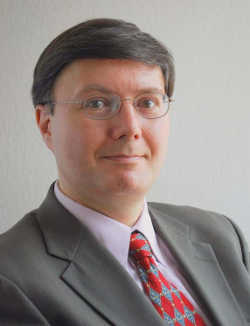
Dennis Fordham. Courtesy photo.
With the restoration of the Medi-Cal eligibility asset test on Jan. 1, 2026 (back to where it existed in July 2022), some people may want to consider whether to include specific gifting provisions in their power of attorney and in their living trust for Medi-Cal eligibility purposes.

Such provisions authorize the person’s trustee or agent under the power of attorney to gift assets subject to their control in order to allow the person’s remaining assets to be within the asset limits for Medi-Cal eligibility, as relevant to either the community based or the long term care Medi-Cal programs (excluding Medi-Cal under the Affordable Care Act).

On Jan. 1, 2026, a single person can have up to $130,000 in available, countable non exempt assets. This threshold does not include exempt assets, such as, the home, the car, the retirement account. A married couple can have an additional $65,000 in non exempt assets and be eligible for Community Based Medi-Cal. With long term care Medi-Cal, the stay at home spouse can have almost $160,000 in his or her own countable assets in addition to the institutionalized spouse’s $130,000.

Achieving the foregoing results often requires gifting by the Medi-Cal applicant to his or her spouse or children. Such gifting may not be possible if the applicant does not have capacity to make gifts due, such as to dementia. People, therefore, may want to include gifting provisions inside of their estate planning documents (trust and power of attorney) so that such gifts can be made on their behalf when the time comes.

Gifting is more complicated when the person is seeking eligibility for long term Medi-Cal for residential care at a skilled nursing home. California still has a thirty (30) month look back period prior to applying for Medi-Cal.

Any gifts of non-exempt assets in such a look back period carry a Medi-Cal ineligibility transfer penalty that is computed based on the size of the gift. Such ineligibility period commences as of the transfer date and may cause the applicant to not be eligible for long term care Medi-Cal.

Fortunately, such ineligibility transfer penalties can often be avoided with appropriate gifting techniques. Again, if the applicant does not have the capacity to make gifts then it is very important that the applicant’s estate planning include such gifting authorization.

Typically, the gifting is to the applicant’s spouse or else to their children. Also, the person with the authorization is typically also a beneficiary of such gifting. For such gifting to be valid it is important that the authorization waives the legal conflict of interest created by a person with representative authority making a gift of assets to themselves. Otherwise, such gifting could be determined to be criminally abusive as it violates the duty of self dealing that prohibits an agent or a trustee from gifting the person’s assets to themselves, at least during the person’s lifetime.

Otherwise, the person’s family may have to petition the court for a gift of assets to the well spouse. Gifting to children, without such legal authority, is more complicated as it involves a conservatorship and a substituted judgment petition to authorize the gift.

The foregoing is not legal advice. Anyone confronting the Medi-Cal issues discussed above should consult an attorney for guidance.

Dennis A. Fordham, attorney, is a State Bar-Certified Specialist in estate planning, probate and trust law. His office is at 870 S. Main St., Lakeport, Calif. He can be reached at This email address is being protected from spambots. You need JavaScript enabled to view it. and 707-263-3235.

Space News: How are dark matter and antimatter different?

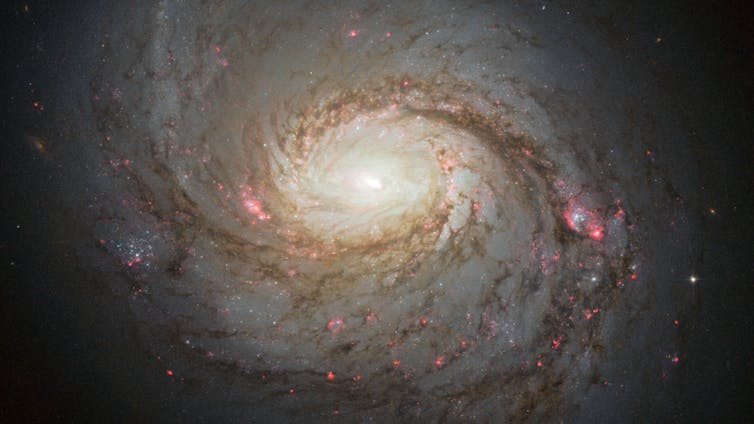
Spiral galaxies, like Messier 77 shown here, helped astronomers learn about the existence of dark matter. NASA, ESA & A. van der Hoeven, CC BY

Curious Kids is a series for children of all ages. If you have a question you’d like an expert to answer, send it to This email address is being protected from spambots. You need JavaScript enabled to view it..


What is dark matter and what is antimatter? Are they the same or different? – Namrata, age 13, Ghaziabad, India


Imagine an epic video game with your favorite hero as a character. Another character is a mirror-image twin who shows up occasionally, exploding everything they touch. And, to add an extra level of difficulty, the game includes a mysterious hive of minions hiding at every corner, changing the rules of the game, but never showing themselves.

If you think of these characters as types of matter, this video game is basically how our universe works.

The hero is regular matter, which is everything we can see around us. Antimatter is the mirror-image explosive twin that scientists understand well but can barely find. And dark matter is the invisible minions. It is everywhere, but we cannot see it, and scientists have no idea what it is.

Despite having similar-sounding names, dark matter and antimatter aare completely different. Interestingly, physicists like me know exactly what antimatter is, but there is almost none of it around. On the other hand, we have no idea what dark matter is, but there is a lot of it everywhere.

Antimatter: The mirror-image twin

All the regular matter around you is made of basic building blocks called atoms. Atoms have positively charged particles called protons surrounded by tiny negatively charged electrons.

Think of antimatter as regular matter’s oppositely charged twin.

All particles, like protons and the electrons, have antimatter siblings. Electrons have positrons, which are anti-electrons, while protons have antiprotons. Antiprotons and positrons make up antimatter atoms, or anti-atoms. They’re like mirror images, but with their electric charges flipped. When matter and antimatter meet, they destroy each other in a flash of light and energy and vanish.

Luckily, antimatter is very rare in our universe. But some special regular matter atoms, such as potassium, can decay to produce antimatter. For example, when you eat a banana, or any food rich in potassium, you are eating tiny amounts of these antimatter-producing atoms. The amount is too small to affect your health.

Antimatter was discovered almost 100 years ago. Today, scientists can create, store and study antimatter in the laboratory. They understand its properties very well. Doctors even use it for PET scans. They inject tiny amounts of antimatter-producing atoms into your body, and as these atoms travel through your body, the scan takes pictures of the flashes of light from the annihilation of the antimatter and regular matter in your body. This process lets doctors see what is happening inside your body.

Scientists have also figured out that when the universe was born, there were almost equal amounts of matter and antimatter. They met and annihilated each other. Fortunately, just a tiny bit more regular matter survived to make stars, planets and all of us.

If matter and antimatter annihilate each other when they touch, and there were once equal amounts of each, how is it possible that there is now so much more matter than antimatter in the universe?

Dark matter: The invisible minions

Dark matter is far more mysterious. Have you ever spun very fast on a merry-go-round? If so, you know how hard it is to stay on it without getting thrown off, especially if you’re the only one on the merry-go-round.

Now imagine there are a bunch of invisible minions on that merry-go-round with you. You can’t see them and you can’t touch them, but they hold you and keep you from flying off as it spins super-fast. You know they’re there because the merry-go-round is heavier than it looks, and it is harder to push and get it spinning. The invisible minions don’t play or talk to anybody; they just hang around, adding their weight to everything.

About 50 years ago, astronomer Vera Rubin discovered a similar mystery in spiral galaxies. She looked at spinning galaxies, which are like cosmic merry-go-rounds, and noticed something strange: The outer stars in these galaxies were spinning much faster than they should. They should have gone flying off into space like sparks from a firework display. But they did not.

It was like watching kids on a merry-go-round move at incredible speed but somehow stay perfectly in place.

A woman adjusting a large piece of equipment.
The astronomer Vera Rubin discovered a strong mismatch in spiral galaxies that scientists now understand as dark matter. Carnegie Institution for Science, CC BY

The only explanation? There must be a sea of invisible “stuff” holding everything together with their extra gravity. Scientists called this mystery material “dark matter.”

Since then, astronomers have observed similar strange behavior happening throughout the universe. Galaxies within large clusters move in unexpected ways. Light gets bent around galaxies more than it should be. Galaxies stick together far more than the visible matter alone can explain.

It is as if our cosmic playground has swings moving by themselves, and seesaws tipping with nobody visible sitting on them.

Dark matter is just a placeholder name until scientists figure out what it is. For the past 50 years, many scientists have been running experiments that are trying to detect dark matter or produce it in the lab. But so far, they have come up empty-handed.

We don’t know what dark matter is, but it’s everywhere. It could be unusual particles scientists have not discovered yet. It could be something completely unexpected. But astronomers can tell by observing how fast galaxies rotate that there is about five times more dark matter than all the regular matter in the entire universe.


Hello, curious kids! Do you have a question you’d like an expert to answer? Ask an adult to send your question to This email address is being protected from spambots. You need JavaScript enabled to view it.. Please tell us your name, age and the city where you live.

And since curiosity has no age limit – adults, let us know what you’re wondering, too. We won’t be able to answer every question, but we will do our best.The Conversation

Dipangkar Dutta, Professor of Nuclear Physics, Mississippi State University

This article is republished from The Conversation under a Creative Commons license. Read the original article.

Rain gives boost to lake level; conditions set to clear into next week

LAKE COUNTY, Calif. — After the first week of winter saw a steady amount of rainfall in Lake County, the forecast for the last days of 2025 calls for clearer conditions.

On Friday, the National Weather Service’s flood watch and wind advisory for Lake County will end.

After several days and more than half a dozen inches of rain, Clear Lake’s level has risen by about 1 foot Rumsey, the special measure for the lake, according to the United States Geological Survey.

The lake’s early Friday level, at just under 4 feet Rumsey, puts Clear Lake’s depth at well above the historical average, according to Lake County Water Resources data.

While concerns about further flooding appear to be reduced for now, the potential for showers will continue through Saturday, at which point sunny and clear conditions are expected to return.

Chances for showers are again forecast on New Year’s Eve and New Year’s Day.

Temperatures are expected to be in the high 40s during the day and high 30s at night through the weekend, rising to daytime temperatures into the low 50s and low 40s at night into the middle of next week.

Email Elizabeth Larson at This email address is being protected from spambots. You need JavaScript enabled to view it.. Follow her on Twitter, @ERLarson, and on Bluesky, @erlarson.bsky.social. Find Lake County News on the following platforms: Facebook, @LakeCoNews; X, @LakeCoNews; Threads, @lakeconews, and on Bluesky, @lakeconews.bsky.social. 

  • 33
  • 34
  • 35
  • 36
  • 37
  • 38
  • 39
  • 40
  • 41
  • 42

Community

  • Lake County Wine Alliance offers sponsor update; beneficiary applications open 

  • Mendocino National Forest announces seasonal hiring for upcoming field season

Public Safety

  • Lakeport Police logs: Thursday, Jan. 15

  • Lakeport Police logs: Wednesday, Jan. 14

Education

  • Woodland Community College receives maximum eight-year reaffirmation of accreditation from ACCJC

  • SNHU announces Fall 2025 President's List

Health

  • California ranks 24th in America’s Health Rankings Annual Report from United Health Foundation

  • Healthy blood donors especially vital during active flu season

Business

  • Two Lake County Mediacom employees earn company’s top service awards

  • Redwood Credit Union launches holiday gift and porch-to-pantry food drives

Obituaries

  • Rufino ‘Ray’ Pato

  • Patty Lee Smith

Opinion & Letters

  • The benefits of music for students

  • How to ease the burden of high electric bills

Veterans

  • CalVet and CSU Long Beach team up to improve data collection related to veteran suicides

  • A ‘Big Step Forward’ for Gulf War Veterans

Recreation

  • Wet weather trail closure in effect on Upper Lake Ranger District

  • Mendocino National Forest seeking public input on OHV grant applications

  • State Parks announces 2026 Anderson Marsh nature walk schedule 

  • BLM lifts seasonal fire restrictions in central California

Religion

  • Kelseyville Presbyterian to host Ash Wednesday service and Lenten dinner Feb. 18

  • Kelseyville Presbyterian Church to hold ‘Longest Night’ service Dec. 21

Arts & Life

  • Auditions announced for original musical ‘Even In Shadow’ set for March 21 and 28

  • ‘The Rip’ action heist; ‘Steal’ grounded in a crime thriller

Government & Politics

  • Lake County Democrats issue endorsements in local races for the June California Primary

  • County negotiates money-saving power purchase agreement

Legals

  • March 3 hearing on ordinance amending code for commercial cannabis uses

  • Feb. 12 public hearing on resolution to establish standards for agricultural roads

How to resolve AdBlock issue?
Refresh this page