How to resolve AdBlock issue?
Refresh this page
How to resolve AdBlock issue?
Refresh this page
Lake County News,California
  • Home
    • Registration Form
  • News
    • Education
    • Veterans
    • Community
      • Obituaries
      • Letters
      • Commentary
    • Police Logs
    • Business
    • Recreation
    • Health
    • Religion
    • Legals
    • Arts & Life
    • Regional
  • Calendar
  • Contact us
    • FAQs
    • Phones, E-Mail
    • Subscribe
  • Advertise Here
  • Login

News

West Coast levee failures show growing risks from America’s aging flood defenses

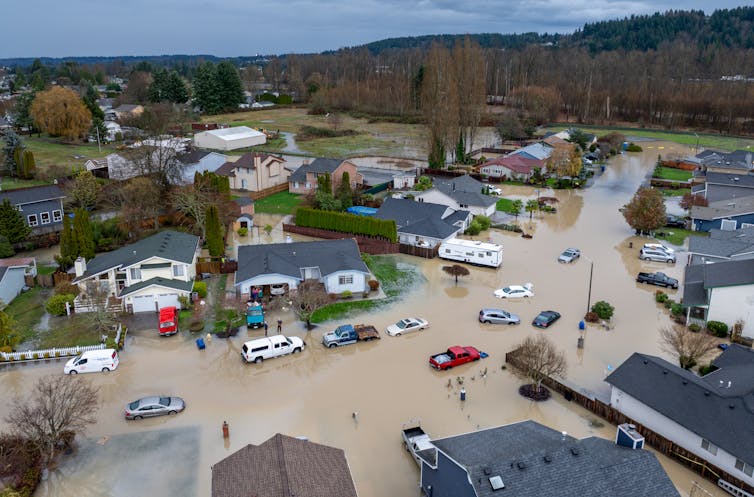
Days of heavy rain caused a levee on the White River to breach, sending water into Pacific, Wash., on Dec. 16, 2025. Brandon Bell/Getty Images

In recent weeks, powerful atmospheric river storms have swept across Washington, Oregon and California, unloading enormous amounts of rain. As rivers surged, they overtopped or breached multiple levees – those long, often unnoticed barriers holding floodwaters back from homes and towns.

Most of the time, levees don’t demand attention. They quietly do their job, year after year. But when storms intensify, levees suddenly matter in a very personal way. They can determine whether a neighborhood stays dry or ends up underwater.

The damage in the West reflects a nationwide problem that has been building for decades. Across the U.S., levees are getting older while weather is getting more extreme. Many of these structures were never designed for the enormous responsibility they now carry.

A paved bicycling path atop a levee is broken and slabs of asphalt pavement are tilted into a breach where water poured through.
Crews inspect damage to a Green River levee in the Seattle suburbs on Dec. 15, 2025. Thousands of people were urged to evacuate during a series of atmospheric river storms, and the National Guard was sent to monitor and reinforce several levees considered at risk. AP Photo/Manuel Valdes

As a civil engineer at Tufts University, I study water infrastructure, including the vulnerability of levees and strategies for making them more resilient. My research also shows that when levees fail, the consequences don’t fall evenly on the population.

Levees became critical infrastructure almost by accident

Many people assume levees were built as part of modern, carefully engineered flood-control systems. In reality, many of the levees still in use today began much more humbly.

Decades ago, farmers built simple earthen embankments to protect their fields and livestock from seasonal flooding. These early levees were practical solutions, shaped by experience rather than formal engineering. They were not constructed using rigorous design standards, and they did not follow consistent construction or maintenance guidelines.

Over time, the landscape around these levees changed. Farmland gave way to neighborhoods. Roads, railways, factories and ports expanded into floodplains. Populations grew. What were once modest, local structures protecting farms gradually became the first line of defense for millions of people in homes and workplaces.

During the Great Mississippi Flood of 1927, the river poured over and broke through levees, flooding thousands of square miles of land. Both overtopping and a breach are visible in this photo. National Weather Service Archival Photography by Steve Nicklas, NOS, NGS

Without much public debate or planning, these semi-engineered levees took on a critical and unintended role. The question that still lingers is whether they were ever prepared for it.

Vast, aging levee system now protecting millions

Today, the National Levee Database counts more than 24,000 miles (38,600 kilometers) of levees in the U.S., with an average age of about 61 years and many of them much older. Together, they protect over 23 million people, around 7 million buildings and nearly US$2 trillion in property value.

That’s an extraordinary level of responsibility for a system that is unevenly maintained with varying oversight. Some levees are inspected regularly. Others are owned by small local agencies or private entities with limited funding. In some cases, responsibility is unclear or fragmented.

One levee that was breached along the Green River in Washington state during storms in mid-December 2025 had been due for repairs for several years, but disagreements among governments had recently held up needed work, The Seattle Times reported. The breach forced thousands of people to evacuate

A map shows many breaches in the Midwest, as well as in Washington state and the Northeast.
Many states have at-risk levees. The map shows all levees in the U.S. National Levee Database (in red) and 478 levee segments where overtopping is known to have occurred in the previous 15 years (in blue). S. Flynn, et al., 2025

The American Society of Civil Engineers’ 2025 Report Card for American Infrastructure, which I contributed to, gave the nation’s levees a D-plus grade, citing aging infrastructure, inconsistent monitoring and long-term underinvestment. A new dataset that colleagues and I created of levee damage includes 487 cases where rivers poured over levees, known as overtopping, in the past 15 years. That doesn’t mean levees are failing everywhere; it means that many are operating with little margin for error.

How levees fail

Levee failures are rarely sudden collapses. More often, they start quietly.

The most common reason levees fail is overtopping, when water from a river, stream or lake behind the levee flows over the top. Once that happens, erosion can begin on the landward side, weakening the structure from behind. What starts as a slow trickle can quickly grow into a breach, creating a large gap in the levee where water can pour in.

Two illustrations. One of overtopping points out that age, height and the materials used can weaken the levee, leading to a breach, which cuts into the levee allowing a faster, deeper steam of water to pour through.
An illustration shows the difference between overtopping and a breach, and some of the reasons a levee can fail. S. Flynn et al., 2025

Atmospheric river storms make the risk of overtopping and breaches much higher. These storms deliver enormous amounts of rainfall across wide areas in a matter of hours, often combined with snowmelt. Rivers rise faster and stay high longer. Many levees were never designed for that kind of sustained pressure.

When a levee breaches, flooding can be rapid and deep, leaving little time for evacuation and causing damage that spreads far beyond the floodplain.

Who relies on levees today?

Millions of Americans live and work in area protected by levees, often without realizing it. Homes, schools, highways, rail corridors, ports and power facilities depend on the integrity of these structures.

A recent national study found that across the contiguous U.S., urban expansion into floodplains occurred more than twice as fast after levee construction as it did in surrounding counties, highlighting how levees can affect communities’ perception of danger.

In fact, when levees fail, flooding can be worse than in areas without levees, because water rushes in quickly and drains slowly.

The risks are also uneven, shaped by history, economics and policy decisions.

That reality became painfully clear during an atmospheric river storm in March 2023 when a levee along California’s Pajaro River failed, flooding the town of Pajaro. Pajaro is home to many low-income farmworkers. Floodwaters forced hundreds of residents to evacuate, and some people were trapped as water levels rose.

How the Pajaro Valley flooded after intense rainfall from an atmospheric river in March 2023, breaching a levee protecting a small California town.

What made the disaster especially troubling was what emerged afterward. Officials and engineers had known for decades that the Pajaro River levee was vulnerable. Reports documented its weaknesses, but repairs were repeatedly delayed.

Interviews by The Los Angeles Times and public records showed that part of the reason was financial. Decision-makers did not prioritize investing in a levee system protecting the low-income community. The risk was known, but the protection was deferred.

Pajaro is not an isolated case. Across the country, disadvantaged communities and communities of color are more likely to rely on older levees or levees that are not part of major federal programs. Rural towns often depend on agricultural levees. Urban neighborhoods may rely on structures built for a much smaller population.

When levees fail, the impacts cascade, closing roads, knocking out power, contaminating water supplies and disrupting lives for years.

A map shows highest disparities in Idaho, Utah, Colorado, Iowa, Ohio, Tennessee, Georgia, North Carolina, Virginia, Maine, Massachusetts and Vermont.
Disparity refers to the percentage of each state’s residents protected by levees who are considered disadvantaged, based on the U.S. Council on Environmental Quality’s Climate and Economic Justice Screening Tool. All levees in the National Levee Database are counted. F. Vahedifard et al., 2023

Why this moment matters

Advances in engineering, monitoring and risk assessment have improved how levees are evaluated and designed.

Hurricane Katrina marked a turning point in 2005 when its storm surge broke through levees protecting New Orleans. Hundreds of people died in the flooding. The disaster exposed the consequences of neglect and fragmented responsibility for levee upkeep.

At the same time, there has been real progress. Over the past two decades, significant federal investments have strengthened the condition and management of many of the nation’s levees, particularly through the work of federal agencies such as the U.S. Army Corps of Engineers.

Still, the legacy of decisions made decades ago remains, and climate change is raising the risks. Heavier rainfall, fast snowmelt and rising seas are pushing water control systems beyond what many levees were designed to handle. Events once considered rare are becoming more frequent.

As atmospheric rivers test levees in the West and flood risks grow nationwide, the challenge is no longer just technical. It’s about how society values protection, communicates risk and decides whose safety is prioritized.

Levees will continue to play a vital role in protecting communities. Understanding their history, and their limits, is essential as the storms of the future arrive.The Conversation

Farshid Vahedifard, Professor of Civil and Environmental Engineering, Tufts University

This article is republished from The Conversation under a Creative Commons license. Read the original article.

More atmospheric river storms to arrive midweek

LAKE COUNTY, Calif. — The National Weather Service said a new round of atmospheric river storms will arrive this week, bringing the chances for heavy rain and flooding.

The series of storms, which follows atmospheric rivers that hit last week, is expected to start on Wednesday night and Thursday morning.

The forecast calls for light to moderate rainfall amounts during the first days of the storm series.

By Friday, the forecast anticipates possible heavy rain and road flooding in southern Lake County. The local forecast calls for a potential thunderstorm that day before 1 p.m.

Conditions into next week will be breezy and cold, although slightly warmer than in recent days, according to the forecast. 

The National Weather Service said temperatures at night will be in the low 40s, ranging up into the low 50s during the day into early next week.

Email Elizabeth Larson at This email address is being protected from spambots. You need JavaScript enabled to view it.. Follow her on Twitter, @ERLarson, and on Bluesky, @erlarson.bsky.social. Find Lake County News on the following platforms: Facebook, @LakeCoNews; X, @LakeCoNews; Threads, @lakeconews, and on Bluesky, @lakeconews.bsky.social. 

CHP rings in the New Year with holiday enforcement period

LAKE COUNTY, Calif. — The California Highway Patrol is ringing in 2026 by launching a New Year’s Holiday Enforcement Period, or HEP.

The CHP will boost patrols statewide from 6 p.m. Wednesday, Dec. 31, to 11:59 p.m. Thursday, Jan. 1.

While New Year's is a time for celebration, the CHP encourages drivers to follow traffic laws, slow down and always drive sober. 

Officers are prepared to stop reckless and impaired driving, which is one of the top preventable causes of crashes. 

During last year’s New Year's HEP, the CHP reported 10 fatal crashes and 481 arrests statewide for driving under the influence.

“We’re entering a new year, but our message stays the same. Driving under the influence increases the risks on our roads, raises the chance of a crash, and puts lives in danger. We encourage everyone to do their part in keeping our roads safe by making responsible choices behind the wheel,” said CHP Commissioner Sean Duryee.

Driving while under the influence, whether from alcohol, drugs, or both, impairs judgment, decreases visibility and slows reaction times — key skills needed to drive safely. 

During the recent Christmas HEP, which ran from 6 p.m. Wednesday, Dec. 24, through 11:59 p.m. on Thursday, Dec. 25, CHP officers made 297 DUI arrests.

Before counting down to the new year, the CHP reminds everyone to plan ahead: designate a sober driver, use a ride-share service or public transportation and report drunk drivers by calling 9-1-1. Let’s start the new year safely.

City of Lakeport welcomes applicants for Lakeport FIre District Board of Directors

LAKEPORT, Calif. — The Lakeport City Council invites interested residents to submit an application for appointment to serve on the Lakeport Fire Protection District Board of Directors.

This recruitment is open to any resident of the fire district.  

Applications will be accepted until Jan. 26, 2026 at 5 p.m.  

The Lakeport Fire District is governed by the Lakeport Fire District Board of Directors, which is composed of five citizens that live within the district. This includes two board members appointed by the Lakeport City Council on the basis of interest and qualifications. 

This recruitment is to fill a mid-term vacancy due to the resignation of the incumbent. The term of office for this appointment expires Dec. 31, 2026.

The Fire District Board of Directors meet at 5:30 p.m. on the second Tuesday of each month at the Main Street Station.

Membership on this board is voluntary. If you are interested in serving on the board, applications are available on the city’s website here.

For additional information, contact Deputy City Clerk Hilary Britton at 707-263-5615, Extension 102, or by e-mail at This email address is being protected from spambots. You need JavaScript enabled to view it.. 

How your electric bill may be paying for big data centers’ energy use

Your power bill may be hiding something. photoschmidt/iStock/Getty Images Plus

In the race to develop artificial intelligence, large technology companies such as Google and Meta are trying to secure massive amounts of electricity to power new data centers. Electric utilities see the prospect of earning large profits by providing electricity to these power-hungry facilities and are competing for their business by offering discounts not available to average consumers.

In our paper Extracting Profits from the Public, we explain how utilities are forcing regular ratepayers to pay for the discounts enjoyed by some of the nation’s largest companies and identify ways policymakers can limit the costs to the public.

Shifting costs

In much of the U.S., utilities are monopolists. Within their service territories, they are the only companies allowed to deliver electricity to consumers. To fund their operations, utilities split the costs of maintaining and expanding their systems among all ratepayers – homeowners, businesses, warehouses, factories and anyone else who uses electricity.

Historically, a utility expanded its system to meet growing demand for electricity from new factories, businesses and homes. To pay for its expansion − new power plants, new transmission lines and other equipment − the utility would propose to raise electricity rates by different amounts for various types of consumers.

Public utility commissions are state agencies charged with ensuring that the public gets a fair deal. These commissions monitor how much money the utility spends to provide electric service and how its costs are shared among various types of ratepayers, including residential, commercial and industrial consumers. Ultimately, the public utility commission is supposed to approve any rate increases based on its assessment of what’s fair to consumers.

Splitting the utility’s costs among all consumers made perfect sense when population growth and economic development across the economy stimulated the need for new infrastructure. But today, in many utility service territories, most of the projected growth in electricity demand is due to new data centers.

Here’s the problem for consumers: To meet data center demand, utilities are building new power plants and power lines that are needed only because of data center growth. If state regulators allow utilities to follow the standard approach of splitting the costs of new infrastructure among all consumers, the public will end up paying to supply data centers with all that power.

A drawing of various large buildings.
An artist’s rendering of a proposed Meta data center in Richland Parish, La. Meta via Facebook

A big price tag

One particularly acute example is in Louisiana. A Meta data center under development in the northeastern corner of the state is projected to use, by our calculations, twice as much energy as the city of New Orleans.

Entergy, the regional monopoly utility, is proposing to build more than US$3 billion worth of new gas-fired power plants and delivery infrastructure to meet the data center’s energy demand. Rather than billing Meta directly for these costs, Entergy is proposing to include the costs in rates paid by all customers.

Entergy claims its contract with Meta will cover some portion of the $3 billion price tag and that will mitigate any increases in consumers’ bills. But Entergy has asked state regulators to keep key terms of the contract secret, and only a redacted version of its application is available online.

The public has no idea how much it might pay if the commission approves the contract. And if the Meta data center ends up using much less power than the company anticipates, the public does not know whether it would be on the hook to pay higher electricity rates for longer periods to guarantee Entergy a profit.

A close-up of a rack of electronics.
The electronics in data centers consume large amounts of electricity. RJ Sangosti/MediaNews Group/The Denver Post via Getty Images

Secret agreements

Our research, reviewing nearly 50 public utility commission proceedings about data centers’ power needs across 10 states, uncovered dozens of secretive contracts between utilities and data centers. Unlike Louisiana, most states require utilities to submit to the public utility commission their one-off deals with data centers, but they allow utilities to conceal the pricing terms from the public.

In normal rate-review cases, numerous parties advocate for their interests in a public proceeding, including members of the public, industry groups and the utility itself. But as our paper finds, utility commission reviews of data center contracts are based on confidential utility filings that are inaccessible to the general public. Few, if any, outsiders participate, and as a result the commission often hears only the utility’s version of the deal.

Because the pricing terms are secret, it is impossible to know whether the deal that a utility is offering to a data center is too low to cover the utility’s costs of providing power to the data center, which would mean that the public is subsidizing the deal. History shows, however, that utilities have a long history of exploiting their monopolies to shift costs to the public, including through secret contracts.

A group of large metal structures holding electric wires.
Electric utilities also charge customers for the costs of building and maintaining transmission networks. Jay L. Clendenin/Getty Images

Other public costs

Our paper also explores other ways that the public pays for data center energy costs. For instance, many high-voltage interstate transmission projects, which connect large power plants to local delivery systems, are developed through regional planning processes run by numerous utilities. These alliances have complex rules for splitting the costs of new transmission lines and equipment among their utility members.

Once a utility is charged its share, it spreads the costs of new transmission projects among its local ratepayers. Because some regions are building new transmission capacity to accommodate data centers, our analysis finds that the public has been forced to pay billions of dollars for data center growth.

Data center energy costs can also be shifted when data centers connect directly to existing power plants. Under what are called “co-location” deals, the power plant stops selling energy to the wider public and just sells to the data center. With less supply in the overall market, prices go up and the public faces higher bills as a result.

Many state legislatures are noticing these problems and working to figure out how to address them. Several recent bills would set new terms and conditions for future data center deals that could help protect the public from data center energy costs.The Conversation

Ari Peskoe, Lecturer on Law, Harvard University and Eliza Martin, Legal Fellow, Environmental and Energy Law Program, Harvard University

This article is republished from The Conversation under a Creative Commons license. Read the original article.

Census: Tribally owned casinos may improve economic conditions on reservations and lower unemployment for nearby people of all races

American Indians on tribal lands in the United States have historically faced some of the nation’s worst economic conditions.

The proportion of American Indian people living below the poverty line in 1989 was 31%, considerably higher than the 13% national poverty rate at the time.

The expansion of tribal casinos that began in the 1990s helped improve economic conditions faster for American Indians relative to the U.S. population as a whole, according to joint U.S. Census Bureau and university research, though there is still progress to be made: the American Indian poverty rate was 19.6% in 2024, greater than that year’s national average of 12.1%, according to Census Bureau data.

A working paper, written by Maggie R. Jones (Census Bureau),  Randall Akee (Census Bureau and University of California Los Angeles) and Emilia Simeonova (Johns Hopkins University) used census data to evaluate the ZIP-code-level economic impact of tribal casinos on nearby people and places.

Casino economy

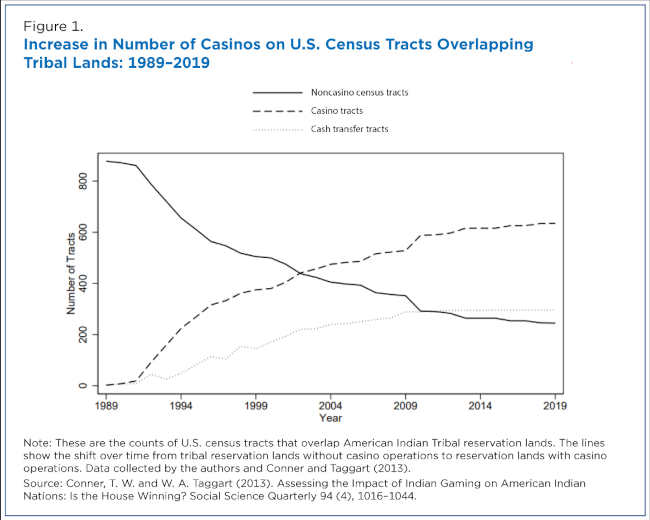
After Congress passed the Indian Gaming Regulatory Act (IGRA) in 1988, the number of U.S. census tracts with an American Indian tribal casino operation surged from near zero in 1989 to nearly 600 by 2019 (Figure 1).

The research shows that tribal casino operations boost wages for American Indians and reduce unemployment for nearby people of all races employed in casino-related industries (Accommodation, Food Service and Arts and Entertainment) when compared with non-casino reservation ZIP codes in the same state.

It also indicates that direct cash transfer programs (i.e., per capita payments of casino profits) may have contributed to improved living standards, on average, for tribal citizens living on reservations.

Sovereignty and solvency

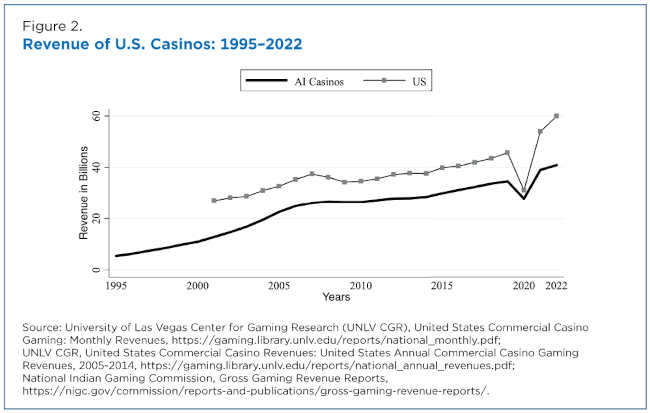
In recent years, the American Indian gaming industry generated more than $40 billion annually (Figure 2).

How do American Indian tribes “split the pot”?

Under the IGRA, tribe-owned casino revenue must support tribal economic development and welfare, including local charities and, in some cases, sharing it with state and local governments. 

This means the IGRA, by permitting casino operations, can be viewed as a “place-based” policy that targets specific geographies for economic development.

The law not only re-affirmed tribal nation’s sovereign right to form government-owned enterprises — it enabled the large-scale tribal gaming industry as it exists today.

Prior to 1988, tribal gaming was limited to small-scale bingo and card games on reservations in California and Florida. High-stakes casinos only existed in Nevada and New Jersey.

Tribal casino operations, post-IGRA, created a revenue stream almost exclusive to reservation lands in much of the United States.

The benefits of casino ownership

Economic conditions for American Indians living on reservations improved significantly as the tribal casino industry took off in the first two decades of the IGRA, according to the research.

During this time, American Indians living on reservation lands (regardless of the presence of a casino or cash transfer program) saw a 46.5% rise in real per capita income compared to 7.8% for the United States as a whole.

Casino revenues helped tribes develop their economic base through investments in infrastructure and expanded employment. Additionally, some tribal nations provided their citizens with unconditional cash transfers (from casino profits) designed to improve tribal development and welfare.

Citizens of casino-owning tribal nations received a significant cash infusion when their government adopted cash-transfer policies. Provided that the tribal nation has opted for unconditional cash transfers, all tribal citizens are eligible to receive the transfers, regardless of whether they live on a reservation.

These programs are among the earliest and longest running examples of universal basic income in the United States.

But added income wasn’t the only benefit, according to the study.  

In the first two decades after IGRA’s passage American Indians living on reservations experienced:

• About an 11% decrease in childhood poverty compared to no significant change for the country as a whole.
• A roughly 7% increase in labor force participation by American Indian women, compared to 3% for the country as a whole.
• A 4% reduction in overall unemployment compared to no significant change for the country as a whole.

To access this and other working papers, visit the Census Working Papers website. Working papers are intended to make Census Bureau research accessible and have not undergone the standard review and editorial process of other Census Bureau publications.

Travis Shoemaker is a writer/editor at the U.S. Census Bureau.

  • 31
  • 32
  • 33
  • 34
  • 35
  • 36
  • 37
  • 38
  • 39
  • 40

Community

  • Lake County Wine Alliance offers sponsor update; beneficiary applications open 

  • Mendocino National Forest announces seasonal hiring for upcoming field season

Public Safety

  • Lakeport Police logs: Thursday, Jan. 15

  • Lakeport Police logs: Wednesday, Jan. 14

Education

  • Woodland Community College receives maximum eight-year reaffirmation of accreditation from ACCJC

  • SNHU announces Fall 2025 President's List

Health

  • California ranks 24th in America’s Health Rankings Annual Report from United Health Foundation

  • Healthy blood donors especially vital during active flu season

Business

  • Two Lake County Mediacom employees earn company’s top service awards

  • Redwood Credit Union launches holiday gift and porch-to-pantry food drives

Obituaries

  • Rufino ‘Ray’ Pato

  • Patty Lee Smith

Opinion & Letters

  • The benefits of music for students

  • How to ease the burden of high electric bills

Veterans

  • CalVet and CSU Long Beach team up to improve data collection related to veteran suicides

  • A ‘Big Step Forward’ for Gulf War Veterans

Recreation

  • Wet weather trail closure in effect on Upper Lake Ranger District

  • Mendocino National Forest seeking public input on OHV grant applications

  • State Parks announces 2026 Anderson Marsh nature walk schedule 

  • BLM lifts seasonal fire restrictions in central California

Religion

  • Kelseyville Presbyterian to host Ash Wednesday service and Lenten dinner Feb. 18

  • Kelseyville Presbyterian Church to hold ‘Longest Night’ service Dec. 21

Arts & Life

  • Auditions announced for original musical ‘Even In Shadow’ set for March 21 and 28

  • ‘The Rip’ action heist; ‘Steal’ grounded in a crime thriller

Government & Politics

  • Lake County Democrats issue endorsements in local races for the June California Primary

  • County negotiates money-saving power purchase agreement

Legals

  • March 3 hearing on ordinance amending code for commercial cannabis uses

  • Feb. 12 public hearing on resolution to establish standards for agricultural roads

How to resolve AdBlock issue?
Refresh this page