How to resolve AdBlock issue?
Refresh this page
How to resolve AdBlock issue?
Refresh this page
Lake County News,California
  • Home
    • Registration Form
  • News
    • Education
    • Veterans
    • Community
      • Obituaries
      • Letters
      • Commentary
    • Police Logs
    • Business
    • Recreation
    • Health
    • Religion
    • Legals
    • Arts & Life
    • Regional
  • Calendar
  • Contact us
    • FAQs
    • Phones, E-Mail
    • Subscribe
  • Advertise Here
  • Login

News

Police attempt to locate missing 16-year-old

Abby Herrin. Courtesy photo.


CLEARLAKE, Calif. — The Clearlake Police Department is working to locate a missing 16-year-old girl.

Abby Herrin was last seen in the Middletown area, wearing a white tank top or black sweater.

She is described as a white female, standing 5 feet 3 inches tall and weighing 135 pounds, with blonde hair and blue eyes. 

If you have any information regarding her whereabouts please contact the Clearlake Police Department at 707-994-8251, Extension 1 for dispatch.

Lake County Animal Care and Control: Three horses and a pig

LAKE COUNTY, Calif. — Lake County Animal Care and Control has livestock this week available for adoption.

The agency is offering three horses and a pig to new homes.

The horses are:

• Ice, a 14-year-old male pinto. It was not reported if he was gelded.
• Belle, a 6-year-old bay mare.
• Sugar, a 10-year-old sorrel mare. 

The pig is a 1-year-old male with a gray and white coat.

Call Lake County Animal Care and Control at 707-263-0278 or visit the shelter online for information on visiting or adopting.

The shelter is located at 4949 Helbush in Lakeport.

Email Elizabeth Larson at This email address is being protected from spambots. You need JavaScript enabled to view it.. Follow her on Twitter, @ERLarson, and on Bluesky, @erlarson.bsky.social. Find Lake County News on the following platforms: Facebook, @LakeCoNews; X, @LakeCoNews; Threads, @lakeconews, and on Bluesky, @lakeconews.bsky.social. 


Ice 's preview photo
Ice

Bella 's preview photo
Bella


Sugar 's preview photo
Sugar


Upper Pen#1's preview photo

Upper Pen#1

Understanding climate change in America: Skepticism, dogmatism and personal experience

Warmer temperatures can supercharge storms. Joe Raedle/Getty Images

Scientists are trained to be professional skeptics: to always judge the validity of a claim or finding on the basis of objective, empirical evidence. They are not cynics; they just ask themselves and each other a lot of questions.

If they see a claim that a finding is true, they will ask: “Why?” They may hypothesize that if that finding is true, then some related findings must also be true. If it’s unclear whether one or more of those other findings is true, they will do more work to find out.

It is no wonder that science moves so slowly, especially on really important topics such as climate change.

Dogmatism is the opposite of skepticism. It is the proclivity to assert opinions as unequivocally true without taking account of contrary evidence or the contradictory findings. It is why public debate over scientific findings never seems to go away.

An example of the difference is the reaction to the Intergovernmental Panel on Climate Change’s finding in 1995 that “evidence suggests a discernible human influence on global climate.” The IPCC’s assessment reports involve hundreds of researchers from around the world who reviewed the global scientific understanding of the planet’s changing climate.

It’s an instructive case in the differences between skepticism and dogmatism, and it’s something to think about as you hear people talk about climate change.

Origins of a dogmatic response

Shortly after the IPCC released that finding in 1995, persistent and well-organized attacks on the science began. Many came from groups supported by the owners of Koch Industries, a conglomerate involved in oil refining and chemicals.

Their strategies mimicked earlier assaults on science and scientists who had warned the public that smoking posed a serious threat to their health. This time it was a warning about fossil fuels’ impact on the climate.

The similarity should not be a surprise. Science historians Naomi Oreskes and Erik Conway, in their 2011 book “Merchants of Doubt,” and American historian Nancy MacLean, in her 2010 book “Democracy in Chains,” have explained how the strategy was written by some of the same people who had tried to stop efforts to tighten tobacco regulations a decade or so earlier.

The dogma presented to the public for fighting regulation held that personal freedoms are paramount and that they are not to be diminished by any efforts designed explicitly to improve the general welfare.

What a skeptical response looks like

Climate scientists understood in 1995 that they must provide more than laboratory results, which go back to Svante Arrhenius’ work in 1895 demonstrating a causal correlation between increasing carbon dioxide concentrations and rising temperatures.

They also accepted the challenge of exploring collections of associated effects that should also be true if human activity was changing the climate.

Scientists have since examined dozens of different independently monitored aspects of climate change and confirmed the expected fingerprints of climate change all around the world.

Since the upper layers of the oceans absorb 90% of the atmosphere’s excess heat, they should be persistently warming as global temperatures rise. Has that happened? Yes, it has.

Since land-based ice melts when temperatures get too warm, global sea level should rise. And it should rise by more than would happen with thermal expansion of warming ocean water alone. Is it? Data shows that it is.

A line chart showing meltwater as the top contributor, followed by thermal expansion
The major contributors to sea level rise. NOAA Climate.gov

Syukuro Manabe and Richard Wetherald argued in 1967 that the upper atmosphere should cool while surface temperatures rise in response to higher carbon dioxide concentrations. Has it cooled over the past 50 years? Yes, it has, just as Manabe predicted.

A temperature map of the atmosphere shows cooling in the upper atmosphere, above the tropopause, and warming below it, over the past two decades.
The upper atmosphere has been cooling while the lower atosphere, close to Earth’s surface, has warmed over the past two decades. The gray line marks the tropopause, between the lower troposphere and higher stratosphere. IPCC 6th Assessment Report

By 2021, as the evidence piled up, the IPCC’s Sixth Assessment stated: “It is unequivocal that human influence has warmed the global climate system since pre-industrial times. Combining the evidence from across the climate system increases the level of confidence in the attribution of observed climate change to human influence and reduces the uncertainties associated with assessments based on single variables. Large-scale indicators of climate change in the atmosphere, ocean, cryosphere and at the land surface show clear responses to human influence consistent with those expected based on model simulations and physical understanding.”

Convincing the public

But has the public been convinced? The data on this is mixed.

Annual surveys conducted by the Yale Program on Climate Change Communication have found that the percentage of Americans “alarmed” about climate change rose over the past 11 years – from 15% in 2014 to 26% in 2024. And they show that much of that increase came from an increase in concern among Americans who earlier considered themselves “concerned” or “cautious.”

Over the same time period, though, the proportion of citizens in the survey who considered themselves “disengaged,” “doubtful” or “dismissive” shrank only modestly, from 29% to 27%.

Other surveys suggest that personal experience likely plays a significant role in how people understand climate change.

Many local and national news stations have mentioned climate change as a contributing factor in their extensive coverage of destructive wildfires in Los Angeles and Hawaii, flash floods in North Carolina and Texas, persistent drought across the Southwest, extreme heat waves and destructive hurricanes.

Some of their viewers could certainly be coming around to believing what evidence shows: that climate-related disasters have become more frequent and more intense.

Americans are also directly experiencing other effects of climate change on their homes, health and wallets. For example:

  • Doctors in the North are seeing increasing cases of Lyme disease. Those in the South have been witnessing a rising number of cases of dengue fever. Both are spread by insects whose ranges are expanding as temperatures rise.

  • Lobster populations have collapsed in Long Island Sound and flourished farther north in Canada’s Bay of Fundy.

  • Residents in southern New England now enjoy feeding bluebirds in winter.

  • Homeowners across the U.S. are seeing their property insurance premiums quickly rise as disaster risks increase. Many others can’t get coverage from insurance companies at all because of their area’s disaster risks.

Stories like these do not make the national news very often, but they do show up in conversations around the kitchen table.

Reaching those with dismissive views

So, how can those Americans who are dismissive of climate change be reached? Some dogmatically believe claims that “climate change is a hoax” despite ever-growing evidence to the contrary.

Talking about personal experiences with extreme weather events, wildfires or droughts and their connections to rising global temperatures can help.

It might also help to remind them of failed dogma from the past that was disproved by science, yet people continued for years to believe them. For example, we know today that the Earth is not flat, the Sun does not circle the Earth, and living organisms cannot materialize spontaneously from nonliving matter.

The shift in public perceptions of climate risks leaves me hopeful that more people are acknowledging the scientific understanding of climate change and catching up with the climate scientists who have produced, questioned, reexamined and reaffirmed their findings through rigorous application of the scientific method.The Conversation

Gary W. Yohe, Professor of Economics and Environmental Studies, Wesleyan University

This article is republished from The Conversation under a Creative Commons license. Read the original article.


Jameson Humane awards grant to SPCA of Lake County for feral cat program

LAKE COUNTY, Calif. — A newly announced grant award has given the SPCA of Lake County and its supporters an extra reason to be merry this Christmas.

Napa County-based Jameson Humane has awarded the SPCA of Lake County a $10,000 grant for its “Feed Them Fix Them” program for feral cats. 

The program, the only high-quality, high-volume spay neuter effort in Lake County, offers free trap-neuter-return clinics.

The SPCA of Lake County is one of 11 organizations that will receive a total of $100,500 from Jameson Humane’s inaugural Grants for Global Stewardship.

Jameson Humane said the grants are meant to advance “animal welfare, community wellness, humane education, and global spay/neuter initiatives. 

"These grants represent our commitment to supporting organizations that are creating meaningful, measurable impact for animals and communities," said Monica Stevens, founder and president of Jameson Humane. "Because of our donors, we are able to support transformative programs that protect animals, uplift communities, and create long-term, systemic impact."

The funding was made possible by contributions to the 2025 WineaPAWlooza Fund A Need, Jameson Humane reported. 

“We want to extend a massive thank you to Jameson Humane for their incredible $10,000 grant to our Feed Them Fix Them feral clinic,” the SPCA said on its Facebook page. “Jameson Animal Rescue Ranch has been a steadfast supporter of spay/neuter initiatives in Lake County for years. This funding will allow us to continue reducing the community cat population and providing essential care for local dogs and cats. Partnerships like this save lives! Thank you for helping us make a difference.”

In November, SPCA wrapped up a busy year of spay/neuter clinics, setting a new record with completing surgeries for more than 2,000 dogs and cats — including ferals cared for through the Feed Them Fix Them program. That more than doubled the animals they served in 2024.

The SPCA announced Friday that it is expanding its Feed Them Fix Them program in 2026 with more vets, more staff and surgeries. Their goal is to do 900 spay/neuter surgeries for feral cats alone.

They are in a December funding drive in which every dollar up to $4,000 will be matched. 

Online donations can be made here.

Donations also can be mailed to the SPCA of Lake County at PO Box 784, Clearlake, CA 95422.

A decade of work in Lake County

Over the past decade, Jameson Humane — which was founded in 2014 — has supported efforts in Lake County to reduce the pet population and keep pets healthy and safe.

Its efforts began in 2015 when it assisted Valley Fire evacuees and their pets, and the following year was part of a “Pet Pantry” to help those impacted by the Clayton Fire.

In the years since, Jameson Humane has helped low-income community members with spaying and neutering, microchipping and vaccinations, and has supported SPCA of Lake County’s spay/neuter efforts. 

Jameson Humane said the grant awards represent a major achievement for the Grants for its Global Stewardship initiative, which opened its inaugural application cycle on Sept. 1.

The program's first grant cycle drew more than 32 applicants. After eligibility screening and a comprehensive review by Jameson Humane’s nine-member Grant Advisory Committee, it selected SPCA of Lake County and 10 other organizations “for their impactful and community-centered work,” the organization said.

Jameson Humane said the funding will support programs including spay/neuter services, humane education, sanctuary and rescue operations, legal action on behalf of animals, international welfare initiatives and community veterinary support.

In addition to SPCA of Lake County, the 2025 grant awardees are as follows:

• Ruthless Kindness, $15,000: Support for temporary care, fostering and boarding of pets belonging to domestic violence survivors.
• Sunrise Horse Rescue, $10,000: Funding for sanctuary services, horse rehabilitation and community education programs in Napa County.
• Kim's Nurturing Nest Animal Sanctuary, $10,000: Medical care and support for homeless, injured, or sick unowned animals across Northern California.
• We Care Animal Rescue, $10,000: Construction of a dedicated dog yard for adoptable dogs.
• LEAP, Leaders for Ethics, Animals, and the Planet, $10,000: Expansion of humane education programming in the United States and Canada.
• Contra Costa Humane Society, $5,000: Pet food distribution and spay/neuter assistance for underserved communities.
• Legal Impact for Chickens, $8,500: Support for a California humane officer engaged in legal action addressing animal cruelty.
• Stray Animal Project, $7,000: Spay/neuter and deworming initiative to address stray overpopulation in the Andes region of Peru.
• Compassion Without Borders, $10,000: Training apartments for animal care interns supporting spay/neuter work in Latin America.
• Napa Bunnies, $5,000: Community wellness and vaccination clinics, and financial assistance for low-income families needing rabbit veterinary care.

The grants were distributed by Dec. 15. Grantees will submit required impact reports by Dec. 30, 2026.

Email Elizabeth Larson at This email address is being protected from spambots. You need JavaScript enabled to view it.. Follow her on Twitter, @ERLarson, and on Bluesky, @erlarson.bsky.social. Find Lake County News on the following platforms: Facebook, @LakeCoNews; X, @LakeCoNews; Threads, @lakeconews, and on Bluesky, @lakeconews.bsky.social. 

Helping Paws: Many new dogs and puppies

LAKE COUNTY, Calif. — There are many dogs waiting for new homes at Lake County Animal Care and Control.

The dogs available for adoption this week include mixes of border collie, bulldog, cattle dog, Chihuahua, Doberman Pinscher, German shepherd, Great Pyrenees, husky, Labrador Retriever, pit bull terrier, shepherd and Yorkshire terrier.

Dogs that are adopted from Lake County Animal Care and Control are either neutered or spayed, microchipped and, if old enough, given a rabies shot and county license before being released to their new owner. License fees do not apply to residents of the cities of Lakeport or Clearlake.

Those animals shown on this page at the Lake County Animal Care and Control shelter have been cleared for adoption.

Call Lake County Animal Care and Control at 707-263-0278 or visit the shelter online for information on visiting or adopting.

The shelter is located at 4949 Helbush in Lakeport.

Email Elizabeth Larson at This email address is being protected from spambots. You need JavaScript enabled to view it.. Follow her on Twitter, @ERLarson, and on Bluesky, @erlarson.bsky.social. Find Lake County News on the following platforms: Facebook, @LakeCoNews; X, @LakeCoNews; Threads, @lakeconews, and on Bluesky, @lakeconews.bsky.social. 


Kennel#17 Sugar's preview photo

Kennel#17 Sugar

Kennel#14 Chief's preview photo
Kennel#14 Chief

Kennel#32 Feather's preview photo
Kennel#32 Feather

Kennel#12 Shylah's preview photo
Kennel#12 Shylah

Kennel#28 Mitzy's preview photo
Kennel#28 Mitzy

 Kennel#20 Gracie's preview photo
Kennel#20 Gracie

Kennel #29 Star's preview photo
Kennel #29 Star

Kennel#27 Lola's preview photo
Kennel#27 Lola

Kennel#9 Amore's preview photo
Kennel#9 Amore

Kennel#25a Charlie's preview photo
Kennel#25a Charlie

Kennel#25b Bear's preview photo
Kennel#25b Bear

Kennel#31a(Cleo)'s preview photo
Kennel#31a(Cleo)

Kennel#31b Baxter's preview photo
Kennel#31b Baxter

Kennel#24 Nelly's preview photo
Kennel#24 Nelly

Kennel#30 Rosa's preview photo
Kennel#30 Rosa

Kennel#8(Brut)'s preview photo
Kennel#8(Brut)

 
Kennel#15a Mufasa's preview photo
Kennel#15a Mufasa

Kennel#15b Terrance's preview photo
Kennel#15b Terrance

Kennel#3(Buddy)'s preview photo
Kennel#3(Buddy)

Kennel#4(Chance)'s preview photo
Kennel#4(Chance)

Kennel#26 Theo's preview photo
Kennel#26 Theo

Kennel#26 Ivy's preview photo
Kennel#26 Ivy
Kennel#13 Roland's preview photo
Kennel#13 Roland

Kennel#10 Tyler's preview photo
Kennel#10 Tyler

Kennel#11a Sprinkles's preview photo
Kennel#11a Sprinkles

Kennel#11b Sparkles's preview photo
Kennel#11b Sparkles
Kennel#7 Tara's preview photo
Kennel#7 Tara

Kennel#6 Tommy's preview photo
Kennel#6 Tommy

 Kennel#22a's preview photo
Kennel#22a

 Kennel#22b's preview photo
Kennel#22b

 Kennel#22c 's preview photo
Kennel#22c

Kennel#34a Hunter's preview photo
Kennel#34a Hunter

Kennel#34b Bebe's preview photo
Kennel#34b Bebe

B#54 Little Lady's preview photo
B#54 Little Lady

Kennel#5(Willow)'s preview photo
Kennel#5(Willow)

A#11(Brutus)'s preview photo
A#11(Brutus)

Kennel#19a Stella's preview photo
Kennel#19a Stella

Kennel#19b Aurora's preview photo
Kennel#19b Aurora

Kennel#19c Celeste's preview photo
Kennel#19c Celeste

Kennel#16 Polar's preview photo
Kennel#16 Polar

Kennel#33 Princess's preview photo
Kennel#33 Princess


From record warming to rusting rivers, 2025 Arctic Report Card shows a region transforming faster than expected

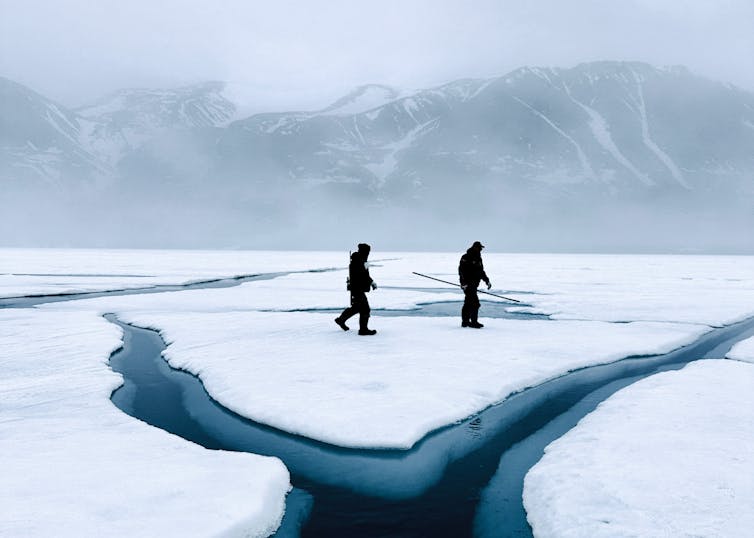
As temperatures rise, the timing of the ice thaw changes. Vincent Denarie via Arctic Report Card

The Arctic is transforming faster and with more far-reaching consequences than scientists expected just 20 years ago, when the first Arctic Report Card assessed the state of Earth’s far northern environment.

The snow season is dramatically shorter today, sea ice is thinning and melting earlier, and wildfire seasons are getting worse. Increasing ocean heat is reshaping ecosystems as non-Arctic marine species move northward. Thawing permafrost is releasing iron and other minerals into rivers, which degrades drinking water. And extreme storms fueled by warming seas are putting communities at risk.

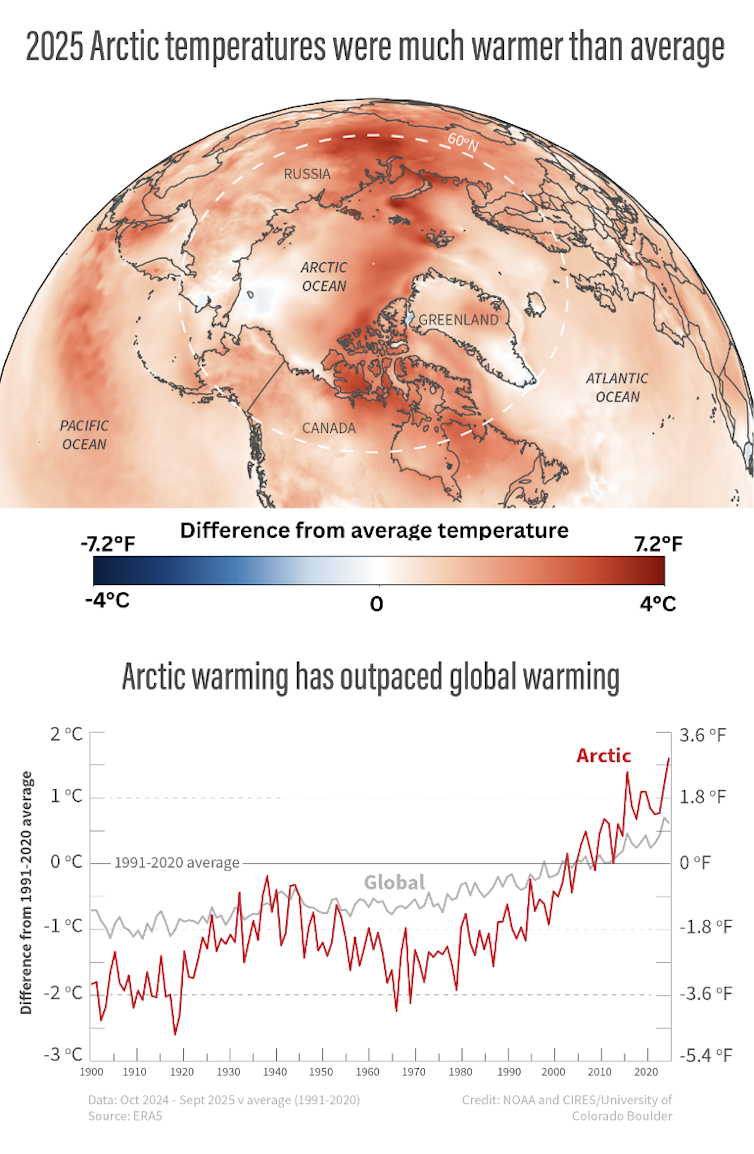
The past water year, October 2024 through September 2025, brought the highest Arctic air temperatures since records began 125 years ago, including the warmest autumn ever measured and a winter and a summer that were among the warmest on record. Overall, the Arctic is warming more than twice as fast as the Earth as a whole.

Highlights from the National Oceanic and Atmospheric Administration’s 2025 Arctic Report Card.

For the 20th Arctic Report Card, we worked with the National Oceanic and Atmospheric Administration, an international team of scientists and Indigenous partners from across the Arctic to track environmental changes in the North – from air and ocean temperatures to sea ice, snow, glaciers and ecosystems – and the impacts on communities.

Together, these vital signs reveal a striking and interconnected transformation underway that’s amplifying risks for people who live there.

A wetter Arctic with more extreme precipitation

Arctic warming is intensifying the region’s water cycle.

A warmer atmosphere increases evaporation, precipitation and meltwater from snow and ice, adding and moving more water through the climate system. That leads to more extreme rainstorms and snowstorms, changing river flows and altering ecosystems.

Charts show how the Arctic has warmed faster than the global average.
Arctic surface air temperatures are warming much faster than the global average. NOAA and CIRES/University of Colorado Boulder.

The Arctic region saw record-high precipitation for the entire 2025 water year and for spring, with the other seasons each among the top-five wettest since at least 1950. Extreme weather – particularly atmospheric rivers, which are long narrow “rivers in the sky” that transport large amounts of water vapor – played an outsized role.

These wetter conditions are reshaping snow cover across the region.

Snow and ice losses accelerate warming, hazards

Snow blankets the Arctic throughout much of the year, but that snow cover isn’t lasting as long. In 2025, snowpack was above average in the cold winter months, yet rapid spring melting left the area covered by snow far smaller than normal by June, continuing a six-decade decline. June snow cover in recent years has been half of what it was in the 1960s.

Losing late spring snow cover means losing a bright, reflective surface that helps keep the Arctic cool, allowing the land instead to be directly warmed by the sun, which raises the temperature.

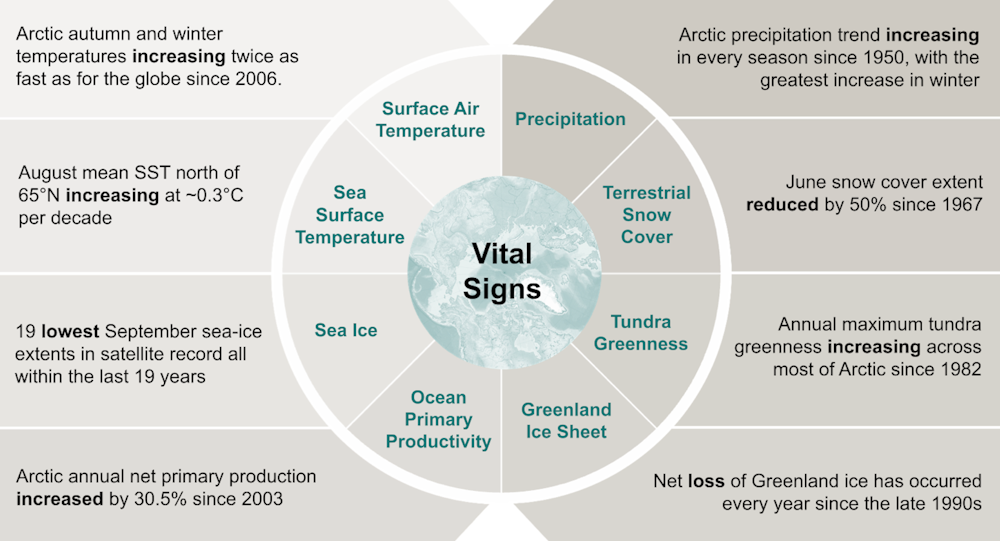
An illustration shows changes in sea level rise, temperature, precipitation, sea ice and other vital areas.
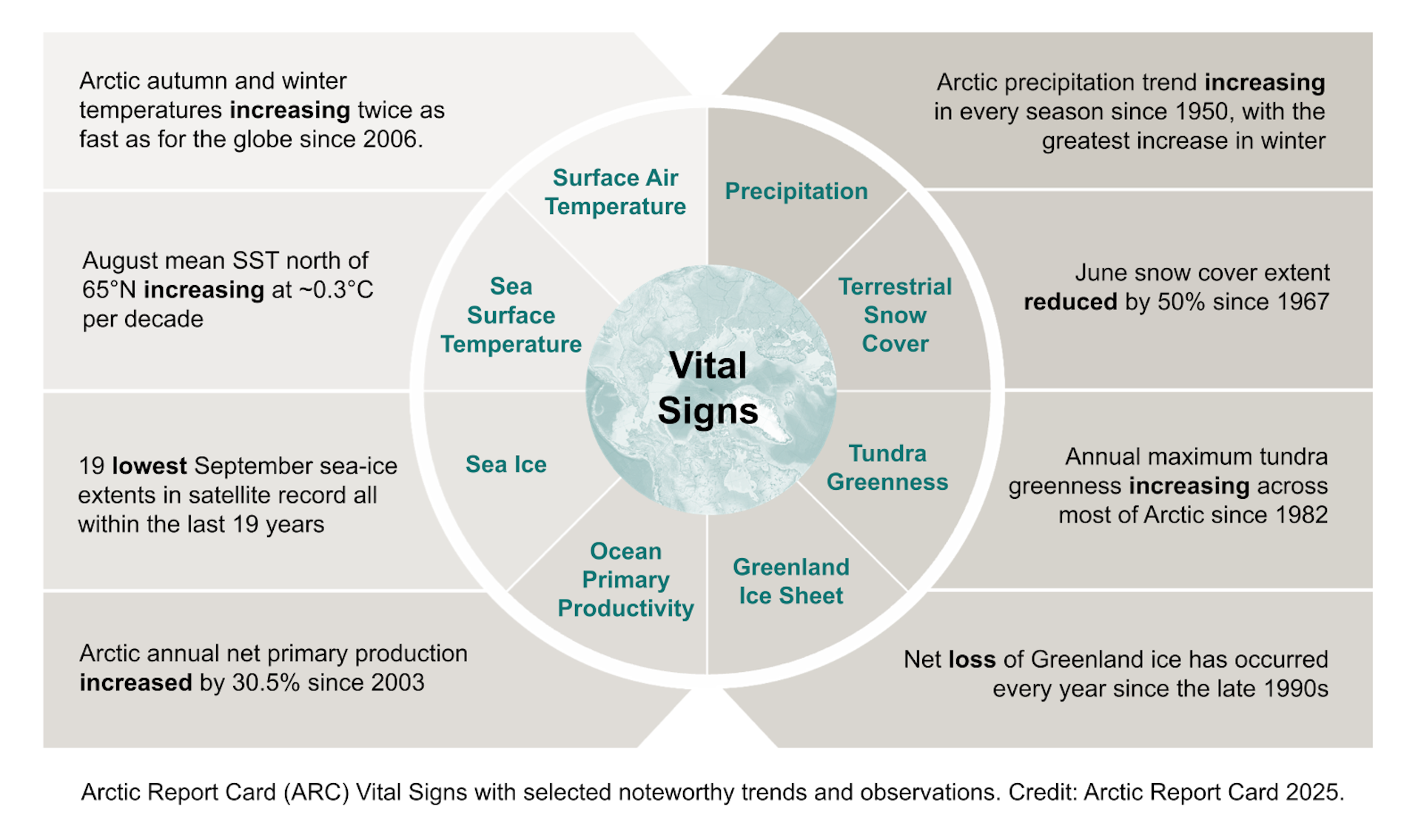
Eight vital signs and observations in 2025 from the 20th edition of the Arctic Report Card. Arctic Report Card 2025

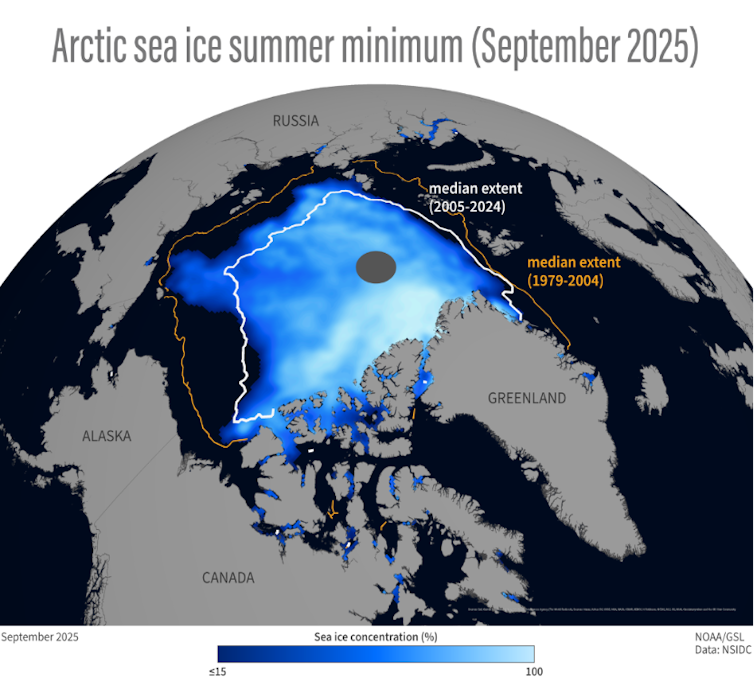
Sea ice tells a similar story. The year’s maximum sea ice coverage, reached in March, was the lowest in the 47-year satellite record. The minimum sea ice coverage, in September, was the 10th lowest.

Since the 1980s, the summer sea ice extent has shrunk by about 50%, while the area covered by the oldest, thickest sea ice – ice that has existed for longer than four years – has declined by more than 95%.

The thinner sea ice cover is more influenced by winds and currents, and less resilient against warming waters. This means greater variability in sea ice conditions, causing new risks for people living and working in the Arctic.

Map shows sea ice extent in 2025 and the 2005-2024 median is much smaller than the 1979-2004 median extent.
Arctic sea ice concentration in September 2025, during its annual minimum extent at the end of summer, was much smaller than the 1979-2004 median extent. The shades of blue reflect the concentration of sea ice. NOAA and CIRES/University of Colorado Boulder.

The Greenland Ice Sheet continued to lose mass in 2025, as it has every year since the late 1990s. As the ice sheet melts and calves more icebergs into the surrounding seas, it adds to global sea-level rise.

Mountain glaciers are also losing ice at an extraordinary rate – the annual rate of glacier ice loss across the Arctic has tripled since the 1990s.

This poses immediate local hazards. Glacial lake outburst floods – when water that is dammed up by a glacier is suddenly released – are becoming more frequent. In Juneau, Alaska, recent outburst floods from Mendenhall Glacier have inundated homes and displaced residents with record-setting levels of floodwater.

A mountain view shows where the retreating glacier and possible permafrost thaw influenced valley walls exposed above open water.
An aerial photo shows the result of an Aug. 10, 2025, landslide at South Sawyer Glacier in Alaska. The light-colored area of the mountainside is where the slide occurred. USGS

Glacier retreat can also contribute to catastrophic landslide impacts. Following the retreat of South Sawyer Glacier, a landslide in southeast Alaska’s Tracy Arm in August 2025 generated a tsunami that swept across the narrow fjord and ran nearly 1,600 feet (nearly 490 meters) up the other side. Fortunately, the fjord was empty of the cruise ships that regularly visit.

Record-warm oceans drive storms, ecosystem shifts

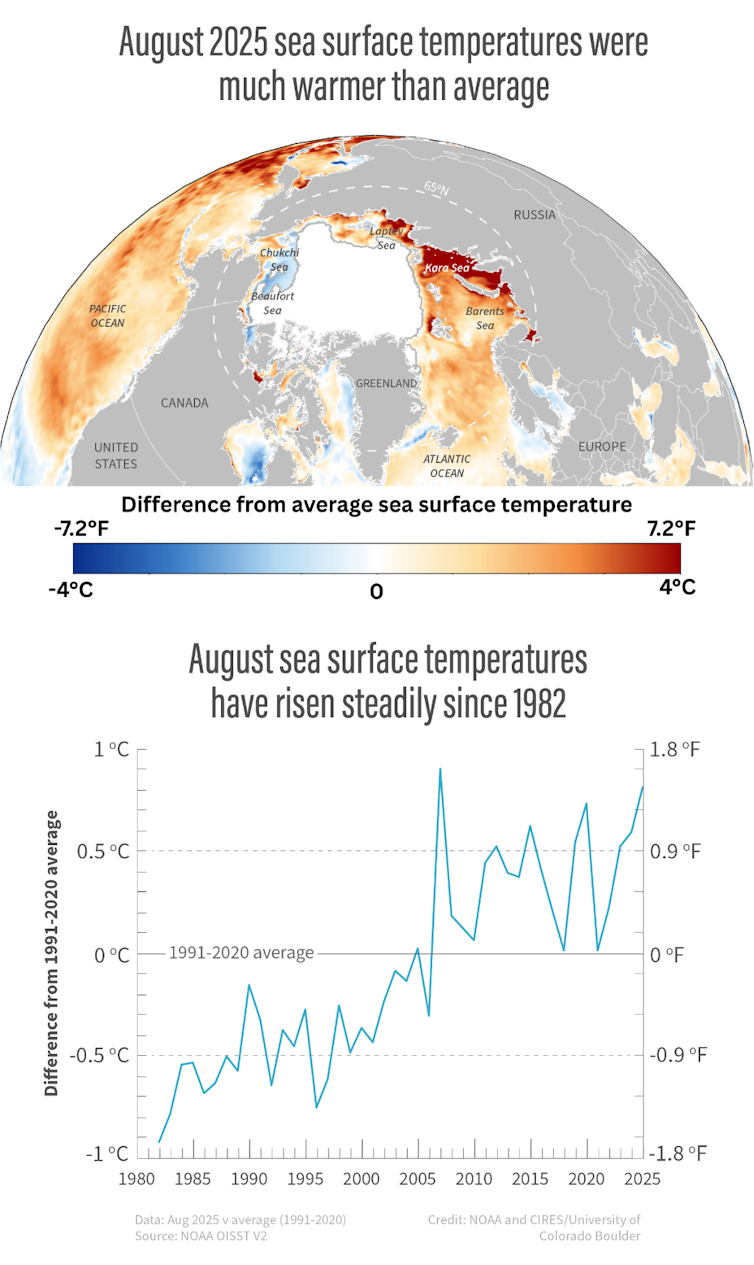
Arctic Ocean surface waters are steadily warming, with August 2025 temperatures among the highest ever measured. In some Atlantic-sector regions, sea surface temperatures were as much as 13 degrees Fahrenheit (7.2 Celsius) above the 1991-2020 average. Some parts of the Chukchi and Beaufort seas were cooler than normal.

A map and chart show temperatures rising.
Arctic sea surface temperatures are much warmer today than in past decades, as this map and chart of August 2025 sea surface temperatures shows. NOAA and CIRES/University of Colorado Boulder.

Warm water in the Bering Sea set the stage for one of the year’s most devastating events: Ex-Typhoon Halong, which fed on unusually warm ocean temperatures before slamming into western Alaska with hurricane-force winds and catastrophic flooding. Some villages, including Kipnuk and Kwigillingok, were heavily damaged.

As seas warm, powerful Pacific cyclones, which draw energy from warm water, are reaching higher latitudes and maintaining strength longer. Alaska’s Arctic has seen four ex-typhoons since 1970, and three of them arrived in the past four years.

A town with homes surrounded by water.
The village of Kipnuk, shown on Oct. 12, 2025, was devastated by ex-Typhoon Halong. The storm displaced at least 1,500 people from across western Alaska. Alaska National Guard

The Arctic is also seeing warmer, saltier Atlantic Ocean water intrude northward into the Arctic Ocean. This process, known as Atlantification, weakens the natural layering of water that once shielded sea ice from deeper ocean heat. It is already increasing sea ice loss and reshaping habitat for marine life, such as by changing the timing of phytoplankton production, which provides the base of the ocean food web, and increasing the likelihood of harmful algal blooms.

From ocean ‘borealization’ to tundra greening

Warming seas and declining sea ice are enabling southern, or boreal, marine species to move northward. In the northern Bering and Chukchi seas, Arctic species have declined sharply – by two-thirds and one-half, respectively – while the populations of boreal species expand.

On land, a similar “borealization” is underway. Satellite data shows that tundra vegetation productivity – known as tundra greenness – hit its third-highest level in the 26-year record in 2025, part of a trend driven by longer growing seasons and warmer temperatures. Yet greening is not universal – browning events caused by wildfires and extreme weather are also increasing.

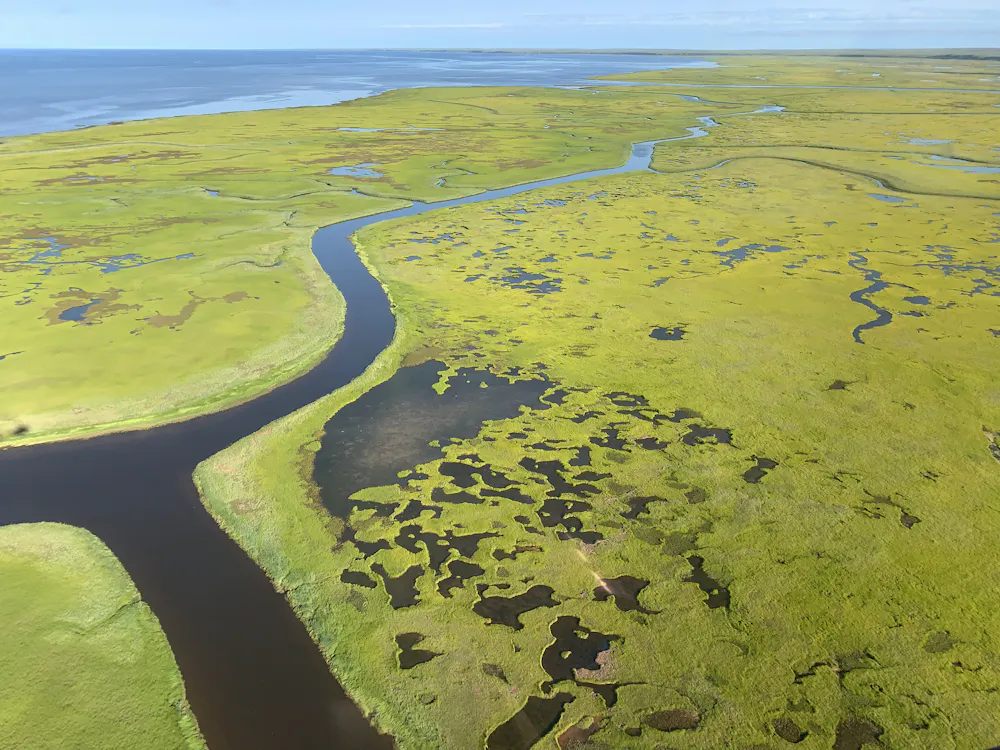
An aerial view of green land dotted with lakes and a river.
Coastal tundra vegetation on the Baldwin Peninsula of Alaska. The tundra is seeing longer growing seasons with warmer temperatures, leading to the overall ‘greening’ of the region. G. V. Frost

Summer 2025 marked the fourth consecutive year with above-median wildfire area across northern North America. Nearly 1,600 square miles (over 4,000 square kilometers) burned in Alaska and over 5,000 square miles (over 13,600 square kilometers) burned in Canada’s Northwest Territories.

Permafrost thaw is turning rivers orange

As permafrost – the frozen ground that underlies much of the Arctic – continues its long-term warming and thaw, one emerging consequence is the spread of rusting rivers.

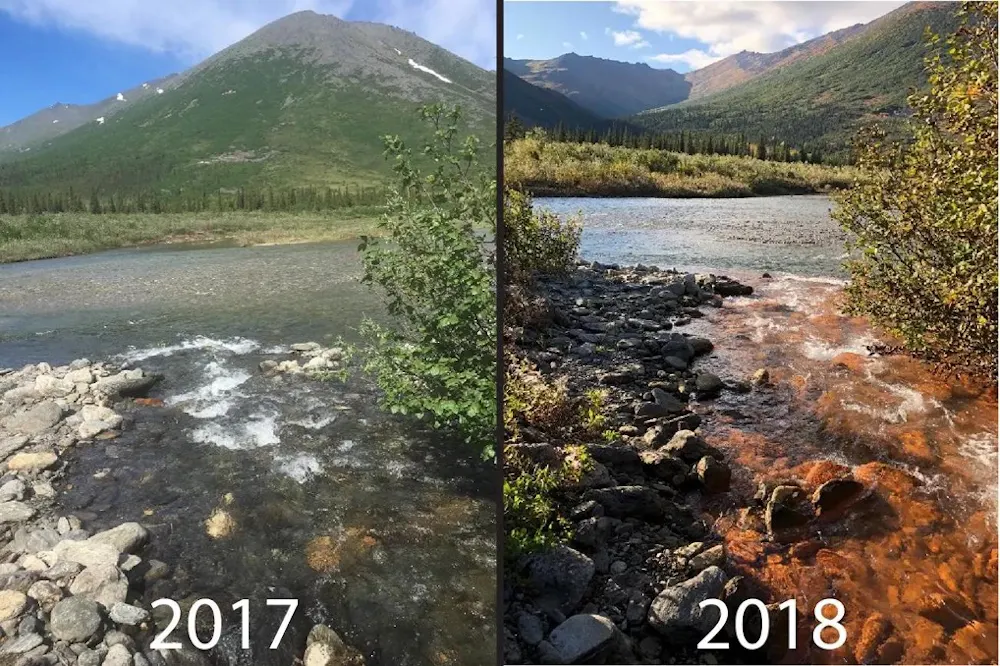
As thawing soils release iron and other minerals, more than 200 watersheds across Arctic Alaska now show orange discoloration. These waters exhibit higher acidity and elevated levels of toxic metals, which can contaminate fish habitat and drinking water and impact subsistence livelihoods.

In Kobuk Valley National Park in Alaska, a tributary to the Akillik River lost all its juvenile Dolly Varden and slimy sculpin fish after an abrupt increase in stream acidity when the stream turned orange.

Side-by-side images show the same stream a year apart, one with rust-colored water.
Rust-colored water in a tributary of the Akillik River in Kobuk Valley National Park reflects permafrost thaw releasing metals into the water. National Park Service/Jon O’Donnell

Arctic communities lead new monitoring efforts

The rapid pace of change underscores the need for strong Arctic monitoring systems. Yet many government-funded observing networks face funding shortfalls and other vulnerabilities.

At the same time, Indigenous communities are leading new efforts.

The Arctic Report Card details how the people of St. Paul Island, in the Bering Sea, have spent over 20 years building and operating their own observation system, drawing on research partnerships with outside scientists while retaining control over monitoring, data and sharing of results. The Indigenous Sentinels Network tracks environmental conditions ranging from mercury in traditional foods to coastal erosion and fish habitat and is building local climate resilience in one of the most rapidly changing environments on the planet.

A group of people with binoculars watch the water.
Observers with the Indigenous Sentinel Network, together with National Oceanic and Atmospheric Administration scientists, monitor the population and health of northern fur seals on St. Paul Island. Hannah-Marie Ladd, CC BY

The Arctic is facing threats from more than the changing climate; it’s also a region where concerns of ecosystem health and pollutants come sharply into view. In this sense, the Arctic provides a vantage point for addressing the triple planetary crisis of climate change, biodiversity loss and pollution.

The next 20 years will continue to reshape the Arctic, with changes felt by communities and economies across the planet.The Conversation

Matthew L. Druckenmiller, Senior Scientist, National Snow and Ice Data Center (NSIDC), Cooperative Institute for Research in Environmental Sciences (CIRES), University of Colorado Boulder; Rick Thoman, Alaska Climate Specialist, University of Alaska Fairbanks, and Twila A. Moon, Deputy Lead Scientist, National Snow and Ice Data Center (NSIDC), Cooperative Institute for Research in Environmental Sciences (CIRES), University of Colorado Boulder

This article is republished from The Conversation under a Creative Commons license. Read the original article.

  • 32
  • 33
  • 34
  • 35
  • 36
  • 37
  • 38
  • 39
  • 40
  • 41

Community

  • Lake County Wine Alliance offers sponsor update; beneficiary applications open 

  • Mendocino National Forest announces seasonal hiring for upcoming field season

Public Safety

  • Lakeport Police logs: Thursday, Jan. 15

  • Lakeport Police logs: Wednesday, Jan. 14

Education

  • Woodland Community College receives maximum eight-year reaffirmation of accreditation from ACCJC

  • SNHU announces Fall 2025 President's List

Health

  • California ranks 24th in America’s Health Rankings Annual Report from United Health Foundation

  • Healthy blood donors especially vital during active flu season

Business

  • Two Lake County Mediacom employees earn company’s top service awards

  • Redwood Credit Union launches holiday gift and porch-to-pantry food drives

Obituaries

  • Rufino ‘Ray’ Pato

  • Patty Lee Smith

Opinion & Letters

  • The benefits of music for students

  • How to ease the burden of high electric bills

Veterans

  • CalVet and CSU Long Beach team up to improve data collection related to veteran suicides

  • A ‘Big Step Forward’ for Gulf War Veterans

Recreation

  • Wet weather trail closure in effect on Upper Lake Ranger District

  • Mendocino National Forest seeking public input on OHV grant applications

  • State Parks announces 2026 Anderson Marsh nature walk schedule 

  • BLM lifts seasonal fire restrictions in central California

Religion

  • Kelseyville Presbyterian to host Ash Wednesday service and Lenten dinner Feb. 18

  • Kelseyville Presbyterian Church to hold ‘Longest Night’ service Dec. 21

Arts & Life

  • Auditions announced for original musical ‘Even In Shadow’ set for March 21 and 28

  • ‘The Rip’ action heist; ‘Steal’ grounded in a crime thriller

Government & Politics

  • Lake County Democrats issue endorsements in local races for the June California Primary

  • County negotiates money-saving power purchase agreement

Legals

  • March 3 hearing on ordinance amending code for commercial cannabis uses

  • Feb. 12 public hearing on resolution to establish standards for agricultural roads

How to resolve AdBlock issue?
Refresh this page